Proceedings of the 2019 Conference on Empirical Methods in Natural Language Processing and the 9th International Joint Conference on Natural Language Processing, pages 3957–3967,
3957
Text Emotion Distribution Learning from Small Sample:
A Meta-Learning Approach
Zhenjie Zhao Xiaojuan Ma
Department of Computer Science and Engineering Hong Kong University of Science and Technology
Clear Water Bay, Hong Kong {zzhaoao, mxj}@cse.ust.hk
Abstract
Text emotion distribution learning (EDL) aims to develop models that can predict the inten-sity values of a sentence across a set of emo-tion categories. Existing methods based on supervised learning require a large amount of well-labelled training data, which is difficult to obtain due to inconsistent perception of fine-grained emotion intensity. In this paper, we propose a meta-learning approach to learn text emotion distributions from a small sam-ple. Specifically, we propose to learn low-rank sentence embeddings by tensor decomposition to capture their contextual semantic similarity, and use K-nearest neighbors (KNNs) of each sentence in the embedding space to generate sample clusters. We then train a meta-learner that can adapt to new data with only a few training samples on the clusters, and further fit the meta-learner on KNNs of a testing sample for EDL. In this way, we effectively augment the learning ability of a model on the small sample. To demonstrate the performance, we compare the proposed approach with state-of-the-art EDL methods on a widely used EDL dataset: SemEval 2007 Task 14 (Strapparava and Mihalcea,2007). Results show the superi-ority of our method on small-sample emotion distribution learning.
1 Introduction
Analyzing emotions in text automatically is an im-portant topic (Yadollahi et al.,2017) with widely used applications such as classifying e-commerce products reviews (Rao et al., 2016) and devel-oping emotionally intelligent chatbots for health-care (Fadhil and Gabrielli, 2017), to name a few. Text emotion analysis aims to recognize writers’ emotional states towards particular top-ics or subjects (Yadollahi et al., 2017), and has attracted considerable research efforts in the last few decades (Canales and Mart´ınez-Barco,2014;
Abdul-Mageed and Ungar, 2017;Yu et al.,2018;
Zhang et al.,2018).
Existing works cast text emotion analysis into three types of tasks: single label learning (SLL), multi-label learning (MLL), and label distribution learning (LDL). In SLL, one particular name in an emotion category (referred as label in the fol-lowing) is predicted (Abdul-Mageed and Ungar,
2017), e.g., joyful, angry, or sad. However, due to the correlation among different emotions, one sentence can potentially contain multiple differ-ent emotions (Yu et al.,2018). Therefore, a more practical way is to assign multiple labels to a sen-tence (Yu et al.,2018), namely, MLL. Label dis-tribution learning, which is called emotion distri-bution learning (EDL) in emotion mining (Zhou et al.,2016), goes a step further and assigns one in-tensity value to each emotion, which is necessary to encode fine-grained information for comparing strength of different emotions, etc.
In general, there are three approaches to text emotion analysis tasks: lexicon-based (Staiano and Guerini,2014), learning-based (Zhang et al.,
However, learning-based methods usually de-mand a large amount of annotated data to train models, which has become one of the performance bottlenecks. EDL in particular aims to decode fine-grained composition and magnitude of emo-tions in text, the human perception of which can be highly subtle and personal (Volkova et al.,2010). It is difficult, if not impossible, to collect a large-scale emotion distribution dataset with consistent, clean human labels. Therefore, developing tech-niques to learn from a small sample is critical for the practicality of emotion distribution analysis.
In this paper, based on meta-learning (Vilalta and Drissi, 2002;Finn et al., 2017), we propose an efficient approach to learn text emotion distri-bution from a small sample. To make the most of a small labeled dataset, we propose to use the K-nearest semantically similar neighbors (KNNs) of each training sample to cluster the training data, and train a meta-learner that can adapt to new test-ing data with only a few samples on the clusters. We can then fit the meta-learner on KNNs of each testing sample. Learning semantic similarity of sentences usually requires a large amount of data (Le and Mikolov,2014). We propose to learn low-rank embeddings of sentences by tensor decompo-sition to capture their contextual semantic similar-ity, which works well regardless of the size of doc-uments (Hosseinimotlagh and Papalexakis,2018). We evaluate the proposed approach on a widely used text emotion distribution dataset: SemEval 2007 Task 14 (Strapparava and Mihalcea, 2007), and show that it outperforms the existing SOTA methods for small sample EDLs.
The contributions of this paper are: 1) we pro-pose a novel meta-learning framework to learn text emotion distribution from a small sample; 2) we propose to learn low-rank embeddings of sen-tences by tensor decomposition to find semanti-cally similar neighbors for training and adapting a meta-learner.
2 Related Works
We briefly review three related areas that motivate this work, including emotion distribution learning, text representation learning, and learning from a small sample.
2.1 Emotion Distribution Learning
Emotion distribution learning of text (Zhou et al.,
2016;Zhang et al., 2018) is a recently proposed
task that tries to predict the intensity values of a sentence across a set of emotion categories. Such information is important for understanding the fine-grained emotion information (Zhou et al.,
2016;Zhang et al.,2018). For example, one sen-tence can usually invoke multiple emotional states with different levels, and existing approaches of SLL and MLL are inadequate for capturing multi-label, multi-intensity information. LDL is more suitable for such scenarios. In general, LDL meth-ods can be classified into three categories: prob-lem transformation, algorithm adaption, and spe-cialized algorithms (Geng and Ji, 2013). PT-Bayes and PT-SVM are typical problem trans-formation methods that transform the LDL prob-lem into an SLL probprob-lem, and use Bayes clas-sifier and SVM to predict label distribution, re-spectively. AA-KNN and AA-BP are algorithm adaption methods that extend K-nearest neigh-bors (KNNs) and back-propagation (BP) neural networks. LDSVR, IIS, BFGS, SA-CPNN are specialized LDL algorithms that di-rectly parametrize and optimize LDL objectives (Geng and Ji,2013). In terms of EDL, two differ-ent models have been proposed recdiffer-ently, includ-ing a maximum entropy model (Zhou et al.,2016) and a convolutional neural network model (Zhang et al.,2018), and the latter one is the SOTA.
2.2 Text Representation Learning
Learning numerical representation of text is usu-ally the first step for learning-based emotion analysis, which can be categorized at two lev-els: word/phrase and sentence/document. At the word/phrase level, for example, Mikolov et al.
(2013) propose word2vec which uses a three-layer neural network, i.e., the input layer, the projec-tion layer, and the output layer, to learn word vectors from a large corpora in an unsupervised manner. The projection layer maps one-hot en-coded input to a low-dimension vector, which is used to predict a word in the output layer. The learned word vectors of the projection layer are shown to be an effective word representation. At the sentence/document level, similar to word2vec, doc2vec (Le and Mikolov,2014) treats sentences and context words in the same way in the input layer, and uses a three-layer neural network to learn the vector representation of sentences. Simi-larly, the skip-thought vector method (Kiros et al.,
and ignores context words used in doc2vec. Re-cent works show that using attention mechanism, transformer in particular (Vaswani et al.,2017), is an effective way to learn universal sentence repre-sentation with unlabeled text, such as BERT ( De-vlin et al., 2019) and XLNet (Yang et al.,2019). There are other ways to improve the discrimina-tive ability of the learned features through super-vised learning, such as task transfer methods like InferSent (Conneau et al.,2017).
2.3 Learning from A Small Sample
The success of machine learning models, espe-cially deep learning models, heavily depends on a large amount of labeled data. But acquiring train-ing data is usually difficult and expensive ( John-son et al.,2018). Therefore, considerable research efforts on small sample learning are emerging re-cently (Lake et al.,2015;Shu et al.,2018). There are generally two approaches for learning from a small sample (Shu et al., 2018): concept learn-ing and experience learnlearn-ing. Concept learning means analyzing the structure of example sam-ples by imitating human abilities like imagina-tion, synthesis, and analysis (Lake et al., 2015;
Shu et al.,2018). Experience learning means aug-menting or transferring learning experience from other data or models, including data augmentation, model fine-tuning, model compression, and meta-learning (Shu et al.,2018). Meta-learning in par-ticular is an effective way of augmenting the ex-perience learning ability (Thrun and Pratt, 1998;
Vilalta and Drissi,2002;Finn et al.,2017).
2.3.1 Meta-Learning
Meta-learning aims to increase the learning per-formance through experience sharing among tasks (Thrun and Pratt, 1998;Vilalta and Drissi,2002;
Finn et al., 2017). One kind of meta-learning is to train a meta-learner to update the parameters or rules of the learning models (Bengio et al.,1991). However, the complexity of this approach is usu-ally high (Bengio et al., 1991;Finn et al.,2017). Another approach is to train a memory neural net-work, such as recurrent neural networks (Santoro et al.,2016), to keep a record of the different expe-riences among different tasks. In particular,Finn et al. (2017) find that it is possible to optimize a learner to adapt new tasks quickly only by gradi-ent descgradi-ent. In this approach, no additional pa-rameters are needed. Recently, researchers have also extended this method to unsupervised
learn-ing (Hsu et al.,2019) and online learning scenarios (Finn et al., 2019). Meta-learning has been used for few-shot image recognition (Lee et al.,2019), agent navigation (Finn et al.,2017), low-resource machine translation (Gu et al.,2018), query gen-eration (Huang et al.,2018), and so on.
Existing EDL methods are designed with tra-ditional machine learning paradigms (Geng and Ji, 2013; Zhou et al., 2016; Zhang et al., 2018), which may not work well on a small sample. Due to the difficulty of annotating emotion distribution data, developing techniques of small sample EDLs is thus critical for text emotion analysis. Trans-ferring experience with pre-trained models (Shu et al.,2018) can be an effective way to boost natu-ral language tasks. But such methods may need an additional large training corpora, and fine-tuning models on specific domains is non-trivial (Le and Mikolov,2014). In this paper, we are interested in how to only use the labeled data for small sample EDLs (Shu et al.,2018).
3 Problem Formulation
3.1 Emotion Distribution Learning (EDL)
We denote one sample as(s,y), wheresis a sen-tence or document, y = (y1, y2, . . . , yC) is its emotion distribution label, yj denotes the inten-sity value of thej-th emotion,C is the number of discrete emotions, and∑Cj yj = 1. For EDL, we expect to train a model f ∶ S ↦ Y that can ac-curately map any sentencesin semantic spaceS to its entailed emotion distribution y in emotion distribution spaceY.
3.2 EDL from A Small Sample
Given a set of training samples Dtrain = {(si,yi)}Mi
=1, we are interested in how to train
a model f that can predict emotion distribution effectively on a set of testing samples Dtest = {(si,yi)}Ni
=1, whereM is the number of training
samples and is a small number (e.g.,50),N is the number of testing samples.
meta-learning
meta learner
adapting
training sample (small) testing sample ...
training task 1
training task 2
training task 𝑀
K-nearest neighbors
... ...
[image:4.595.79.282.63.151.2]...
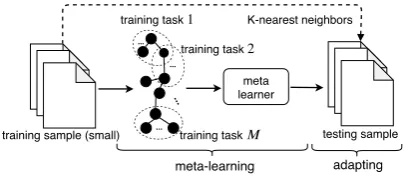
Figure 1: Illustration diagram of the proposed EDL method.
4 Method
As shown in Figure 1, to augment the learn-ing ability on a small sample, we first partition the training data by finding K-nearest neighbors (KNNs) of each sample based on semantic simi-larity, and treat eachK samples as a cluster. We then train a meta-learner that is optimized to adapt to new data with only a few training samples on the clusters. During testing, we fit the meta-learner with KNNs of a testing sample, where KNNs are found in the training data.
4.1 Meta-Learning Preliminary
A meta-learning algorithm consists of a set of training tasksTtrain= {Ti}Mi=1, a set of testing tasks Ttest= {Ti}Ni
=1, and a modelfθ
1, whereM andN
are the numbers of the training and testing tasks separately, andθis the parameters off. Each task
T consists of a set of training samples called sup-porting set S and a set of testing samples called querying setQ, namely,T = {S, Q}. The goal of meta-learning is to train a learnerfθusingTtrainso that given a new testing taskT inTtest, it can per-form well on the query setQofT by fine-tuning it with only a few samples in the support setS.
4.2 EDL via Meta-Learning
We propose a meta-learning framework for EDL, including task generation from a small sample, meta-learner training, and meta-learner adaption for predicting testing samples.
4.2.1 Task Generation
For each sample inDtrain, we first find its KNNs by semantic similarity, and treat theK samples as a training task. Therefore, samples in each task can be overlapped, and we use this way to increase the number of tasks. For each task, we randomly se-lectK/2 samples as the support set, and use the
1
To be consistent with the existing literature, we refer to themodelas thelearnerin the rest of the paper.
tensor decomposition
sentence tensor low-rank embedding
s
K-nearest neighbors neighbor
search
Figure 2: Tensor decomposition to find KNNs of each sentence.
remaining ones as the query set, i.e., the sizes of
SandQare bothK/2. Therefore, forM samples inDtrain, we can generateM training tasksTtrain. The intuition is that semantically similar sentences are more likely to have similar emotion distribu-tion patterns.
Algorithm 1:Text EDL via Meta-Learning Data:training sampleDtrainand testing
sampleDtest
Result:learnerfθs for each sentencesin
Dtest
1 initialize hyper-parameters
α, β, γ, H, R, K, niter, L;
// Task Generation
2 calculate sentence embeddingsCwith
formula (1), and for each sample inDtrain, find its KNNs to getTtrain;
// Meta-Learner Training
3 initialize the meta-learnerfwith parameterθ; 4 foriterin1,2, . . . , niterdo
5 sampleLtasks fromTtrainrandomly;
6 forlin1,2, . . . , Ldo
7 θl′←θ−α▽θLT
l(S)(fθ)
8 end
9 θ←θ−β▽θ∑lLT
l(Q)(fθ′l);
10 end
// Adapting Meta-Learner
11 foreach sentencesinDtestdo
12 find KNNsKsofsinDtrain;
13 θs←θ− ▽θLKs(fθ)
14 end
[image:4.595.313.514.64.133.2]Mikolov,2014). We propose to use low-rank em-beddings of sentences mined by tensor decompo-sition, which can obtain text embeddings regard-less of the corpus size (Hosseinimotlagh and Pa-palexakis, 2018). As shown in Figure 2, con-sidering D = Dtrain ∪ Dtest, we first build a vo-cabulary for it, namely, w1, w2, . . . , wV, where V is the number of words. For each sentence
s in D, we count the word-word co-occurrence in a small window H, and build a binary matrix
Vs ∈ [0,1]V×V. In particular, Vs(i, j) = 1 in-dicates word wi and wj co-occurs in s within a
small window H at least once. In this way, we can capture the semantic patterns of a sentence in Vs. In addition, this approach can also deal
with negation issue to some extent, which is im-portant for sentiment analysis (Reitan et al.,2015). Because negation sentences usually have negation words, they will have a different word-word co-occurrence pattern with that of normal sentences, which will result in different embeddings. There-fore, the tensor decomposition method may put sentences with and without negation words into different clusters. Afterwards, we stack all Vs
as a three-dimensional tensor V ∈ [0,1]V×V×D, where D = M + N. We adopt the CANDE-COMP/PARAFAC tensor decomposition method (Sidiropoulos et al., 2017) to find an approxima-tionVˆ ofV:
ˆ
V=
R
∑
r=1
wr⊗wr⊗sr, (1)
such that the Frobenius norm∣∣Vˆ −V∣∣F is min-imal, where wr ∈ RV, sr ∈ RD, R is the rank, and⊗is the outer product, namely,wr⊗wr⊗sr being a three-dimensional tensor, andwr⊗wr⊗
sr(i, j, k) = wr(i) ⋅wr(j) ⋅sr(k). We use both training and testing datasets for embedding, which follows the general practice of previous literature (Zhou et al.,2016;Zhang et al.,2018). In such a case, it is possible to infer a complete vocabulary of the corpus by making use of both the training and testing dataset. If some testing data are not available when the tensor is built, there exist tensor decomposition methods for dealing with stream-ing data scenarios (Gujral et al., 2018), namely, the testing data can be updated continuously over time. Our framework can easily utilize such ad-vanced methods to generalize to sentences with out-of-vocabulary words.
With the tensor decomposition, we can find
low-rank embeddings of sentences that capture the similarity of contextual patterns ( Hosseini-motlagh and Papalexakis, 2018). In particular,
C = [s1,s2, . . . ,sR] ∈ RD×R, where the s-row ofC = [cT1,cT2, . . . ,cTD]T, cTs, is the embedding vector of the sentence s. We measure the simi-larity of two sentencesi,jby Euclidean distance:
d(i, j) = √
∑Rr=1(ci(r) −cj(r))2, wherec(r) de-notes ther-th element ofc.
4.2.2 Meta-Learner Training
We can train a meta-learner on the generatedTtrain.
Learner. We use a Convolutional Neural Net-work (CNN) model as the basic learner, which has shown good performance on text classification (Kim, 2014) and text emotion distribution learn-ing (Zhang et al., 2018). The CNN learner has the same architecture with (Zhang et al.,2018). In particular, given the input sentences, we first stack a matrix X with the word vector of each word (Mikolov et al., 2013). Then three convolution layers with kernel sizes3,4,5are performed onX
separately, and we then concatenate them together. A fully connected layer is then used, following with a soft-max operation to get the final emotion probability prediction. We use Kullback-Leibler (K-L) divergenceLK-Las the objective to measure the distance of predicted distribution yˆ and the
true distributionyˆ:LK-L= ∑Ki=1
1
K∑
C j=1y
j i log
yij
ˆ
yij,
whereK is the number of training samples. Sim-ilarly to (Zhang et al., 2018), we also optimize the classification accuracy of the dominant emo-tion by a cross-entropy (CE) objective, which is shown to improve EDL performance. In partic-ular, LCE = − ∑Ki=1
1
K∑
C j=11(y
j i)log ˆy
j
i, where
1(yj) =1ifyj is the maximal value ofy, other-wise1(yj) =0. The final objective is a weighted sum of LKL andLCE: L = γLK-L+ (1−γ)LCE, whereγis the weight factor,0≤γ≤1.
Training meta-learner. To train the learnerfθ,
we optimize the parametersθof the learnerfsuch that a small number of gradient steps on a new task will produce maximally effective behavior on that task, namely,
min
θ T ∑
i∼Ttrain LT
i(Q)(fθ′i), (2)
Q. Equation (3) is optimized via stochastic gradi-ent descgradi-ent (SGD),
θ←θ−β(▽θ ∑
Ti∼Ttrain LT
i(Q)(fθ′i)), (3)
whereβis the meta-learning rate. Similarly, SGD is used to computeθ′
i,θ
′
i ←θ−α▽θLT
i(S)(fθ),
whereTi(S)denotes that the loss is computed on
S, andαis the learning rate.
4.2.3 Adapting Meta-Learner
The meta-learnerfθis trained to adapt to new data
with only a few semantically similar training sam-ples. Therefore, given a testing samples, we first find its K-nearest neighborsKsin the training data Dtrain, and then adaptfθonKsby SGD:
θ←θ−α▽θLKs(fθ). (4)
Here we use the learning rate α to be consistent with the meta-training procedure.
The overall algorithm is shown in Algorithm 1, where α is the learning rate, β is the meta-learning rate, γ is the weight value of the distri-bution and classification losses,H is the window size for word-word co-occurrence counting,R is the rank of tensor decomposition, K is the num-ber of nearest neighbors, niter is the number of meta-training iterations, and L is the number of tasks for each round of meta-training.
5 Experiment
To evaluate the proposed approach for learning emotion distribution from a small sample, we con-duct intensive experiments on SemEval 2007 Task 14 (Strapparava and Mihalcea,2007). To the best of our knowledge, this is the only publicly avail-able English dataset with emotion distributions la-beled by humans.
5.1 Experiment Setup
5.1.1 Dataset
SemEval 2007 Task 14 contains 1250 sentences of news headlines with 6 emotion intensities (anger, disgust, fear, joy, sadness, and surprise) labeled by humans. Each intensity value is a non-negative value. We normalize the annotated scores to get emotion distribution labels using the same pro-cedure with Zhang et al. (2018). In particular, given an original intensity tuple(l1, l2, . . . , l6), we first calculate the sum of all values, l = ∑6k=1lk,
and then normalize it to get a distribution as (l1/l, l2/l, . . . , l6/l). If l = 0, then the distribu-tion will be(1/6,1/6, . . . ,1/6). It is possible to add another intensity valuel7denoting the overall
level of emotion to the original label; for example, ifl7is 1, there is no emotion in the text, and ifl7
is 0, there is strong emotions. Similar tol1∼l6,l7 can be annotated manually. We can then normal-ize(l1, l2, . . . , l7)to get a new distribution. In this way, we can better model the cases of a sentence expressing very little emotion overall. For sim-plicity and fair comparison, we only usel1 ∼l6 in this paper.
5.1.2 Experiment Protocal
Because there is no publicly available small dataset for text emotion distribution evaluation, we follow existing practices (Hosseinimotlagh and Papalexakis,2018) to simulate a small training set by randomly selecting10%of the samples and us-ing the remainus-ing ones for testus-ing. We run 10-fold cross validation, and report the averaged results.
Baselines. We compare the proposed method (denoted as EDL-Meta) with several baseline methods, including the SOTA method EDL-CNN (Zhang et al.,2018), LDL methods, and document vectorization methods. EDL-CNN uses the ba-sic learner of EDL-Meta, and can be seen as a special case of EDL-Meta when K = 0. Sim-ilar to Zhang et al. (2018), we also extract the penultimate layer of EDL-CNN as features, and fit several typical LDL methods: Bayes, PT-SVM, AA-KNN, AA-BP, SA-LDSVR, SA-IIS, SA-BFGS, SA-CPNN for comparison. The ba-sic principles of each method are briefly summa-rized in subsection 2.1. In addition, we apply three SOTA document vectorization methods – doc2vec (Le and Mikolov,2014), InferSent (Conneau et al.,
2017), and BERT (Devlin et al., 2019) – and use the extracted vectors to train a linear regressor to predict emotion distributions.
5.1.3 Evaluation Metrics
Method Euclidean↓ Sørensen↓ Squaredχ2↓ K-L↓ Fidelity↑ Intersection↑
[image:7.595.125.474.63.214.2]PT-Bayes 0.4870 0.4889 0.6707 0.7574 0.7330 0.5111 PT-SVM 0.5748 0.5706 0.8578 1.1327 0.6639 0.4294 AA-KNN 0.4248 0.4054 0.5181 0.8325 0.7986 0.5946 AA-BP 0.4620 0.4468 0.5945 0.7410 0.7662 0.5532 SA-LDSVR 0.4336 0.4238 0.5301 0.5828 0.7927 0.5762 SA-IIS 0.4402 0.4305 0.5456 0.5983 0.7842 0.5695 SA-BFGS 0.8403 0.6909 1.1563 7.7697 0.5056 0.3091 SA-CPCNN 0.4779 0.4600 0.6108 0.7365 0.7660 0.5400 BERT 0.4498 0.4378 0.5620 0.6207 0.7770 0.5622 InferSent 0.4630 0.4518 0.5882 0.6488 0.7662 0.5482 doc2vec 0.4458 0.4334 0.5552 0.6133 0.7799 0.5666 EDL-CNN 0.4450 0.4345 0.5553 0.6105 0.7794 0.5655 EDL-Meta 0.3949 0.3747 0.4478 0.5148 0.8319 0.6253
Table 1: Evaluation results on SemEval 2007 Task 14.
Distance
Euclidean↓
√
∑Ci=1(pi−qi)2
Sørensen↓ ∑
C i=1∣pi−qi∣
∑C i=1(pi+qi)
Squaredχ2↓ ∑Ci=1 (pi−qi)2
pi+qi
K-L↓ ∑Ci=1pilogpqi i
Similarly
Fidelity↑ ∑Ci=1 √
piqi
Intersection↑ ∑Ci=1min(pi, qi)
Table 2: Metrics for evaluating the performance of emotion distribution learning.
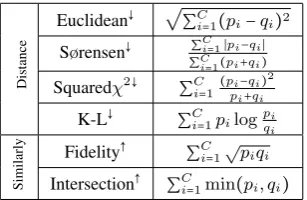
K-L↓, Fidelity↑, Intersection↑, and can be
classi-fied into two categories: distance metrics and sim-ilarity metrics (Geng and Ji,2013). Distance met-rics measure the distance between the predicted distribution and the true one, the smaller the better. Similarity metrics measure the similarity between the predicted distribution and the true one, the big-ger the better. Here, ↑ means the bigger the
bet-ter,↓ means the smaller the better. The formulas
for calculating all metrics are summarized in Table
2, where(q1, q2, . . . , qC)is the predicted distribu-tion,(p1, p2, . . . , pC)is the true distribution,Cis the number of emotions.
5.1.4 Implementation
We use 300 dimension word vectors trained on Google News from (Mikolov et al.,2013) as ini-tial input. Because SemEval 2007 Task 14 is mostly News headlines, the pre-trained word vec-tors are closer to it. We implement our algo-rithm by PyTorch 2. Owing to EDL-CNN not being open-sourced, we also implement it by Py-Torch. The implementation of doc2vec is adopted from gemsim3. BERT embedding (uncased base
2
https://pytorch.org
3
https://radimrehurek.com/gensim
model, without fine-tuning) is adopted from an open-source implementation (Xiao, 2018). The implementations of other methods are downloaded from the original paper (Geng and Ji,2013; Con-neau et al.,2017). For EDL-CNN, we use the net-work architecture in the original paper, and set the learning rate0.1, epoch number25 (Kim,2014). In the same experiment setting with (Zhang et al.,
2018), namely, 90% training data and 10% test-ing data of SemEval 2007, we can obtain 0.344 Euclidean↓, 0.330 Sørensen↓, 0.344 Squaredχ2↓,
0.437 K-L↓
, 0.853 Fidelity↑
, 0.670 Intersection↑
, which are slightly better than the results reported in (Zhang et al., 2018). For fair comparison, we use the default parameters of all other methods, which are reported to get the best performance. For EDL-Meta, we empirically set α = 0.01,
β = 0.1, L = 5, H = 5. γ is set to be 0.7 ac-cording to (Zhang et al., 2018), and we do not further tune it. 1000 epoches are used to train the meta-learner for both datasets. To find opti-mal K and R, we run a 5-fold cross validation grid search, and set K = 20, R = 5. The alter-nating least squares method is used to calculate the tensor decomposition, and we use the imple-mentation in the Matlab tensor toolbox4. The k-d tree methok-d is usek-d to fink-d KNNs of a sample efficiently. We run all experiments on a desktop with Intel(R) Core(TM) i9-7900X CPU 3.30GHz, 64GB RAM, Nvidia GeForce GTX 1080 Ti (×2).
5.2 Results
The comparison results of SemEval 2007 Task 14 are shown in Table1. We can see that EDL-Meta shows better results than other methods on all met-rics. In particular, EDL-Meta can usually
outper-4
[image:7.595.104.258.257.357.2]Method Euclidean↓ Sørensen↓ Squaredχ2↓ K-L↓ Fidelity↑ Intersection↑
[image:8.595.130.468.63.125.2]doc2vec 0.3987 0.3795 0.4563 0.5231 0.8279 0.6205 InferSent 0.3993 0.3799 0.4567 0.5228 0.8277 0.6201 random 0.3966 0.3763 0.4494 0.5179 0.8317 0.6237 tensor 0.3949 0.3747 0.4478 0.5148 0.8319 0.6253
Table 3: Comparison results of different embedding methods.
Meta. Adap. Euclidean↓ Sørensen↓ Squaredχ2↓ K-L↓ Fidelity↑ Intersection↑
[image:8.595.119.478.162.222.2]No No 0.4450 0.4345 0.5553 0.6105 0.7794 0.5655 No Yes 0.4588 0.4489 0.5827 0.6403 0.7680 0.5511 Yes No 0.3954 0.3752 0.4482 0.5154 0.8318 0.6248 Yes Yes 0.3949 0.3747 0.4478 0.5148 0.8319 0.6253
Table 4: Comparison results of different combinations of training and adapting procedures.
form other methods by about5%on most metrics. Although EDL-CNN can perform well with more training samples (Zhang et al.,2018), on the small sample, its performance is not as stable as EDL-Meta. Even simple KNN can get slightly better results than EDL-CNN on most metrics. Likewise, other methods cannot get stable results on all met-rics. This indicates that EDL-Meta is more suit-able for small sample EDLs.
5.3 Discussion
5.3.1 Low-rank Embedding
To investigate the effectiveness of the tensor de-composition method, we use doc2vec (Le and Mikolov, 2014) and InferSent (Conneau et al.,
2017) to train sentence vectors on D, and find KNNs of a sample by cosine similarity, denoted as doc2vec and InferSent, respectively. In addition, we also use randomly selected K-neighbors to train and test EDL-Meta, denoted as random. We denote our tensor decomposition method as ten-sor. The results are shown in Table3. Compared to doc2vec, InferSent, and random, our method can get better results on all metrics. The doc2vec and InferSent embedding methods show a slightly lower performance, even worse than the random version. doc2vec usually assumes a large pool of training data (Le and Mikolov, 2014), while In-ferSent also does not work well for transferring to a task with a small training sample. The tensor decomposition method is more suitable for small sample learning.
5.3.2 Meta-Training and Adapting
To investigate the effect of the proposed meta-training and adapting procedures, we conduct an-other experiment. In particular, with the same
ex-EDL-CNN EDL-Meta
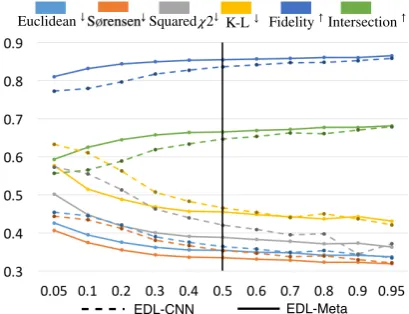
Figure 3: The performance of CNN and EDL-Meta on different training percentages. The horizontal axis denotes different training percentages, and the ver-tical axis denotes the performance on different metrics.
[image:8.595.314.519.266.423.2]adapting is meaningless, as the performance of the second version decreases a lot.
5.3.3 Label Percentage
In the same experiment setting, we further investi-gate the influence of different training/testing par-tition. We compare the performance of EDL-CNN and EDL-Meta under different training/testing partition. The results are shown in Figure3. We can find that on small training sample, there is a clear gap between EDL-CNN and EDL-Meta. But with more training sample (>50%), EDL-CNN and EDL-Meta converge to similar results. There-fore, it is likely that the learning ability of EDL-Meta is limited by its basic learner. Further exper-iments on different learners deserve to investigate.
6 Conclusion
In this paper, we propose an efficient meta-learning approach to learn text emotion distribu-tion from a small sample. In addidistribu-tion, to find the K-nearest semantically similar neighbors, we pro-pose to learn sentence embedding by tensor de-composition. Experiments on SemEval 2007 Task 14 shows that the proposed approach outperforms existing EDL methods on small sample emotion distribution learning. We further investigate the low-rank embedding method, the meta-training procedure, and the adaption procedure. We find that leveraging nearest semantically similar neigh-bors is an effective way for small sample EDLs. We also find that the meta-training procedure can be a good alternative to the normal batch training procedure, especially for small sample EDLs.
Acknowledgments
The authors would like to thank Lanqing Xue, Zhenhui Peng, and Prof. Evangelos E. Papalexakis for insightful discussions, as well as all anony-mous reviewers for constructive comments. This work is supported by the Research Grants Council of the Hong Kong Special Administrative Region, China under Grant No.: C6030-18G.
References
Muhammad Abdul-Mageed and Lyle Ungar. 2017. EmoNet: Fine-grained emotion detection with gated recurrent neural networks. In Proceedings of the 55th Annual Meeting of the Association for Com-putational Linguistics, pages 718–728, Vancouver, Canada. Association for Computational Linguistics.
Yoshua Bengio, Samy Bengio, and Jocelyn Cloutier. 1991. Learning a synaptic learning rule. In In-ternational Joint Conference on Neural Networks (IJCNN), page 969.
Lea Canales and Patricio Mart´ınez-Barco. 2014. Emo-tion detecEmo-tion from text: A survey. InProceedings of the Workshop on Natural Language Processing in the 5th Information Systems Research Working Days (JISIC), pages 37–43, Quito, Ecuador. Association for Computational Linguistics.
Alexis Conneau, Douwe Kiela, Holger Schwenk, Lo¨ıc Barrault, and Antoine Bordes. 2017. Supervised learning of universal sentence representations from natural language inference data. InProceedings of the 2017 Conference on Empirical Methods in Nat-ural Language Processing, pages 670–680, Copen-hagen, Denmark. Association for Computational Linguistics.
Jacob Devlin, Ming-Wei Chang, Kenton Lee, and Kristina Toutanova. 2019. BERT: Pre-training of deep bidirectional transformers for language under-standing. InProceedings of the 2019 Conference of the North American Chapter of the Association for Computational Linguistics: Human Language Technologies, pages 4171–4186, Minneapolis, Min-nesota. Association for Computational Linguistics.
Andrea Esuli and Fabrizio Sebastiani. 2006. SENTI-WORDNET: A publicly available lexical resource for opinion mining. InProceedings of the Fifth In-ternational Conference on Language Resources and Evaluation (LREC’06), Genoa, Italy. European Lan-guage Resources Association (ELRA).
Ahmed Fadhil and Silvia Gabrielli. 2017. Addressing challenges in promoting healthy lifestyles: The AI-chatbot approach. InProceedings of the 11th EAI International Conference on Pervasive Computing Technologies for Healthcare, pages 261–265. ACM.
Chelsea Finn, Pieter Abbeel, and Sergey Levine. 2017. Model-agnostic meta-learning for fast adaptation of deep networks. In Proceedings of the 34th In-ternational Conference on Machine Learning, vol-ume 70 of Proceedings of Machine Learning Re-search, pages 1126–1135, International Convention Centre, Sydney, Australia. PMLR.
Chelsea Finn, Aravind Rajeswaran, Sham Kakade, and Sergey Levine. 2019. Online meta-learning. In Proceedings of the 36th International Conference on Machine Learning, volume 97 of Proceedings of Machine Learning Research, pages 1920–1930, Long Beach, California, USA. PMLR.
Xin Geng and Rongzi Ji. 2013. Label distribution learning. Proceedings of the 13th IEEE Inter-national Conference on Data Mining Workshops, pages 377–383.
in Natural Language Processing, pages 3622–3631, Brussels, Belgium. Association for Computational Linguistics.
Ekta Gujral, Ravdeep Pasricha, and Evangelos E. Pa-palexakis. 2018. Sambaten: Sampling-based batch incremental tensor decomposition. InProceedings of the 2018 SIAM International Conference on Data Mining, pages 387–395.
Seyedmehdi Hosseinimotlagh and Evangelos E Pa-palexakis. 2018. Unsupervised content-based iden-tification of fake news articles with tensor decom-position ensembles. In WSDM 2018 Workshop on Misinformation and Misbehavior Mining on the Web (MIS2).
Kyle Hsu, Sergey Levine, and Chelsea Finn. 2019. Un-supervised learning via meta-learning. In Interna-tional Conference on Learning Representations.
Po-Sen Huang, Chenglong Wang, Rishabh Singh, Wen-tau Yih, and Xiaodong He. 2018. Natural language to structured query generation via meta-learning. InProceedings of the 2018 Conference of the North American Chapter of the Association for Computational Linguistics: Human Language Tech-nologies, pages 732–738, New Orleans, Louisiana. Association for Computational Linguistics.
Mark Johnson, Peter Anderson, Mark Dras, and Mark Steedman. 2018. Predicting accuracy on large datasets from smaller pilot data. InProceedings of the 56th Annual Meeting of the Association for Com-putational Linguistics, pages 450–455, Melbourne, Australia. Association for Computational Linguis-tics.
Yoon Kim. 2014. Convolutional neural networks for sentence classification. In Proceedings of the 2014 Conference on Empirical Methods in Natural Lan-guage Processing, pages 1746–1751, Doha, Qatar. Association for Computational Linguistics.
Ryan Kiros, Yukun Zhu, Ruslan R Salakhutdinov, Richard Zemel, Raquel Urtasun, Antonio Torralba, and Sanja Fidler. 2015. Skip-thought vectors. In C. Cortes, N. D. Lawrence, D. D. Lee, M. Sugiyama, and R. Garnett, editors, Advances in Neural Infor-mation Processing Systems 28, pages 3294–3302. Curran Associates, Inc.
Brenden M Lake, Ruslan Salakhutdinov, and Joshua B Tenenbaum. 2015. Human-level concept learning through probabilistic program induction. Science, 350(6266):1332–1338.
Quoc Le and Tomas Mikolov. 2014.Distributed repre-sentations of sentences and documents. In Proceed-ings of the 31st International Conference on Ma-chine Learning, volume 32 ofProceedings of Ma-chine Learning Research, pages 1188–1196, Bejing, China. PMLR.
Kwonjoon Lee, Subhransu Maji, Avinash Ravichan-dran, and Stefano Soatto. 2019. Meta-learning with differentiable convex optimization. In The IEEE Conference on Computer Vision and Pattern Recog-nition (CVPR).
Tomas Mikolov, Ilya Sutskever, Kai Chen, Greg S Cor-rado, and Jeff Dean. 2013. Distributed representa-tions of words and phrases and their composition-ality. In C. J. C. Burges, L. Bottou, M. Welling, Z. Ghahramani, and K. Q. Weinberger, editors, Ad-vances in Neural Information Processing Systems 26, pages 3111–3119. Curran Associates, Inc.
Andrius Mudinas, Dell Zhang, and Mark Levene. 2012. Combining lexicon and learning based approaches for concept-level sentiment analysis. InProceedings of the First International Workshop on Issues of Sen-timent Discovery and Opinion Mining, WISDOM ’12, pages 5:1–5:8, New York, NY, USA. ACM.
Yanghui Rao, Haoran Xie, Jun Li, Fengmei Jin, Fu Lee Wang, and Qing Li. 2016. Social emotion classifi-cation of short text via topic-level maximum entropy model. InInformation & Management, volume 53, pages 978 – 986.
Johan Reitan, Jørgen Faret, Bj¨orn Gamb¨ack, and Lars Bungum. 2015. Negation scope detection for twit-ter sentiment analysis. In Proceedings of the 6th Workshop on Computational Approaches to Subjec-tivity, Sentiment and Social Media Analysis, pages 99–108, Lisboa, Portugal. Association for Compu-tational Linguistics.
Adam Santoro, Sergey Bartunov, Matthew Botvinick, Daan Wierstra, and Timothy Lillicrap. 2016. Meta-learning with memory-augmented neural networks. InProceedings of the 33rd International Conference on International Conference on Machine Learning -Volume 48, ICML’16, pages 1842–1850. JMLR.org.
Jun Shu, Zongben Xu, and Deyu Meng. 2018. Small sample learning in big data era.arXiv:1808.04572.
Nicholas D. Sidiropoulos, Lieven De Lathauwer, Xiao Fu, Kejun Huang, Evangelos E. Papalexakis, and Christos Faloutsos. 2017. Tensor decomposition for signal processing and machine learning. IEEE Trans. Signal Process., 65(13):3551–3582.
Jacopo Staiano and Marco Guerini. 2014. Depeche mood: a lexicon for emotion analysis from crowd annotated news. InProceedings of the 52nd Annual Meeting of the Association for Computational Lin-guistics, pages 427–433, Baltimore, Maryland. As-sociation for Computational Linguistics.
Carlo Strapparava and Rada Mihalcea. 2007. Semeval-2007 task 14: Affective text. In Proceedings of the 4th International Workshop on Semantic Eval-uations, SemEval ’07, pages 70–74.
Conference on Language Resources and Evaluation (LREC’04), Lisbon, Portugal. European Language Resources Association (ELRA).
Sebastian Thrun and Lorien Pratt, editors. 1998. Learning to Learn. Kluwer Academic Publishers, Norwell, MA, USA.
Ashish Vaswani, Noam Shazeer, Niki Parmar, Jakob Uszkoreit, Llion Jones, Aidan N Gomez, Ł ukasz Kaiser, and Illia Polosukhin. 2017. Attention is all you need. In I. Guyon, U. V. Luxburg, S. Bengio, H. Wallach, R. Fergus, S. Vishwanathan, and R. Gar-nett, editors, Advances in Neural Information Pro-cessing Systems 30, pages 5998–6008. Curran As-sociates, Inc.
Ricardo Vilalta and Youssef Drissi. 2002. A perspec-tive view and survey of meta-learning. Artificial In-telligence Review, 18(2):77–95.
Ekaterina P. Volkova, Betty J. Mohler, Detmar Meur-ers, Dale Gerdemann, and Heinrich H. B¨ulthoff. 2010. Emotional perception of fairy tales: Achiev-ing agreement in emotion annotation of text. In Proceedings of the NAACL HLT 2010 Workshop on Computational Approaches to Analysis and Gener-ation of Emotion in Text, CAAGET ’10, pages 98– 106, Stroudsburg, PA, USA. Association for Com-putational Linguistics.
Han Xiao. 2018. bert-as-service. https://github.com/ hanxiao/bert-as-service.
Ali Yadollahi, Ameneh Gholipour Shahraki, and Os-mar R. Zaiane. 2017.Current state of text sentiment analysis from opinion to emotion mining. ACM Comput. Surv., 50(2):25:1–25:33.
Zhilin Yang, Zihang Dai, Yiming Yang, Jaime Car-bonell, Ruslan Salakhutdinov, and Quoc V Le. 2019. XLNet: Generalized autoregressive pretrain-ing for language understandpretrain-ing. arXiv preprint arXiv:1906.08237.
Jianfei Yu, Luis Marujo, Jing Jiang, Pradeep Karu-turi, and William Brendel. 2018. Improving multi-label emotion classification via sentiment classifica-tion with dual attenclassifica-tion transfer network. In Pro-ceedings of the 2018 Conference on Empirical Meth-ods in Natural Language Processing, pages 1097– 1102, Brussels, Belgium. Association for Computa-tional Linguistics.
Yuxiang Zhang, Jiamei Fu, Dongyu She, Ying Zhang, Senzhang Wang, and Jufeng Yang. 2018. Text emo-tion distribuemo-tion learning via multi-task convolu-tional neural network. InProceedings of the Twenty-Seventh International Joint Conference on Artificial Intelligence, pages 4595–4601. International Joint Conferences on Artificial Intelligence Organization.
Deyu Zhou, Xuan Zhang, Yin Zhou, Quan Zhao, and Xin Geng. 2016. Emotion distribution learning from texts. In Proceedings of the 2016 Conference on