Proceedings of the 2019 Conference on Empirical Methods in Natural Language Processing and the 9th International Joint Conference on Natural Language Processing, pages 4227–4237,
4227
Distributionally Robust Language Modeling
Yonatan Oren*1 Shiori Sagawa*1 Tatsunori B. Hashimoto*1,2 Percy Liang1
(* equal contribution)
1Stanford Computer Science 2Stanford Statistics
{yonatano,thashim}@stanford.edu {ssagawa,pliang}@cs.stanford.edu
Abstract
Language models are generally trained on data spanning a wide range of topics (e.g., news, reviews, fiction), but they might be applied to an a priori unknown target distribution (e.g., restaurant reviews). In this paper, we first show that training on text outside the test dis-tribution can degrade test performance when using standard maximum likelihood (MLE) training. To remedy this without the knowl-edge of the test distribution, we propose an ap-proach which trains a model that performs well over a wide range of potential test tions. In particular, we derive a new distribu-tionally robust optimization (DRO) procedure which minimizes the loss of the model over theworst-casemixture of topics with sufficient overlap with the training distribution. Our ap-proach, calledtopic conditional value at risk (topic CVaR), obtains a 5.5 point perplexity re-duction over MLE when the language models are trained on a mixture of Yelp reviews and news and tested only on reviews.
1 Introduction
Large-scale language modeling plays a central role in both text generation (Sordoni et al.,2015; Nal-lapati et al., 2016) and unsupervised pre-training (Vaswani et al.,2013;Dai and Le,2015;McCann et al.,2017;Peters et al.,2018;Devlin et al.,2018; Radford et al., 2018). In both settings, a sin-gle language model is trained on a large corpus containing a range of topics (e.g. news, fiction, and reviews). This language model is then ap-plied in many different tasks, each with a specific test distribution (e.g., analyzing the sentiment of restaurant reviews). Can we train a single general-purpose language model that works across a wide range of potential test distributions?
In this work, we first demonstrate that stan-dard maximum likelihood training on a large, het-erogeneous dataset can fail to achieve this goal.
x
p
tra
in
x
(x
) reviews
news training
p
x
p
(x
[image:1.595.329.503.223.364.2]) MLErobust
Figure 1. Illustration of a training corpus as a density (black) with mostly news stories (red) and a small number of restaurant reviews (blue). The standard MLE model (gray) reflects the underlying data and assigns little weight to reviews, and thus performs poorly on reviews. A more robust model should try to equalize the weight across all topics so that it can perform well regardless of which topics appear at test time.
While more data is generally better, the presence of text outside the target distribution actually de-grades performance on a target test distribution. For example, a language model trained on Yelp reviews achieves a perplexity of 32, and this per-plexity increases to 43 when trained on a mix-ture of 10% Yelp and 90% newswire sentences from the One Billion Word Benchmark (Chelba et al., 2013). Performance degrades because ex-isting maximum likelihood estimation (MLE) ob-jectives tend to emphasize model performance on more common sentences and topics at the expense of infrequent ones (Figure1).
singlemodel that performs well across many un-known test distributions.
In order to do this, we will train a model that performs uniformly well over an entire family of potential test distributions. Since we cannot ex-pect to do well on all possible test distributions, we consider the subpopulation shift setting, in which the test distribution is a subpopulation of the training distribution, and seek good performance across all such test distributions (e.g. Yelp re-views in a Yelp-newswire mixture). 1 In other words, adding data from topics outside the test topics should not hurt. It seems reasonable to pro-tect against subpopulation shifts, intuitively be-cause large-scale data collection schemes are de-signed to cover a diverse array of topics as a way to generalize to potential test distributions.
We train a model that performs well over all subpopulations by minimizing the risk for the worst-case subpopulation, following the dis-tributionally robust optimization (DRO) litera-ture (Ben-Tal et al., 2013). While an existing DRO framework called the conditional value at risk (CVaR) ensures uniformly good performance across subpopulations (Rockafellar and Uryasev, 2000; Duchi and Namkoong, 2018), we demon-strate that na¨ıvely applying this approach to lan-guage modeling fails due to three challenges. First, the existing CVaR approach is too conser-vative because it considers robustness toarbitrary subpopulations. Such worst-case subpopulations are attained by adversarially choosing the hard-est, most unusual sentences. Instead, we propose to considermeaningfulsubpopulations, defined by topics in a corpus (Hu et al.,2018). Second, ap-plying CVaR directly to log loss results in a loss which is biased towards topics with high entropy, instead of those for which the model performs poorly relative to what is possible. We correct this by introducing a newbaselinedloss function which measures losses relative to the entropy of each topic. Finally, existing optimization algo-rithms for CVaR are either inapplicable to topic-based robustness sets or unscalable because they require batch optimization. We develop a scal-able online algorithm which identifies the worst-performing topics at each iteration and upweights examples from those topics.
With these methodological improvements, we
1The subpopulation assumption refers to overlaps in dis-tributions, rather than individual examples. Our assumptions do not require overlap in the training and test data.
demonstrate that our approach, topic CVaR, im-proves robustness against subpopulation shifts. Topic CVaR reduces perplexity on the Yelp re-view corpus by 5.5 points compared to MLE when trained on the Yelp-One Billion Word Benchmark mixture from before. We also show improved ro-bustness even when the shift is not strictly a sub-population shift. Topic CVaR also achieves a 4 point perplexity reduction on a test distribution (TripAdvisor hotel reviews) that is similar to, but not strictly a subpopulation of the training distri-bution (Yelp and newswire text).
2 Problem Statement
Our goal is to learn a language modelpθ based on
sentences sampled from the training distribution x∼ptrain
x , such thatpθperforms well on unknown
test distributionsptestx .
Language modelspθare generally trained to
ap-proximateptrain
x by minimizing the KL divergence
KL ptrainx pθ
via maximum likelihood estima-tion (MLE),
inf
θ E[−logpθ(x)]. (1)
When ptestx = ptrainx , classical statistical theory guarantees that a model trained via MLE performs well on the test distribution given sufficient data. However, whenptestx is not identical toptrainx , MLE can perform poorly no matter how much data is observed. This is because the test set might consist solely of sentences from topics that are infrequent during training, to which MLE would assign low probabilities.
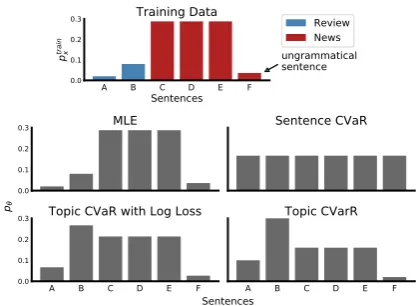
To illustrate this point, consider the toy exam-ple drawn in Figure2. In this example, the train-ing distributionptrain
x is a multinomial distribution
over six possible sentences A–F, with two from re-views and four from news. Sentence F is ungram-matical and thus has an extremely low probabil-ity. The training distribution includes10%reviews and90%news, whereas the test distribution could be all reviews, all news, or a mixture. MLE as-signs low probabilities to any review and thus per-forms poorly when evaluated solely on reviews. To be robust, we intuitively need a more conser-vative objective that encourages models to assign higher probabilities to rare but valid sentences.
In order to achieve this, we want to learn a modelpθwhich performs well in situations where
A B C D E F
Sentences 0.0
0.1 0.2 0.3
p
tra
in
x ungrammatical
sentence
Training Data Review
News
0.0 0.1 0.2 0.3
p
MLE Sentence CVaR
A B C D E F
0.0 0.1 0.2
0.3 Topic CVaR with Log Loss
A B C D E F
Sentences
[image:3.595.75.285.65.218.2]Topic CVarR
Figure 2. Toy example of a multinomial distribu-tion over six sentences (top). Different panels il-lustrate models learned by different training proce-dures. MLE fits common topics (news) at the ex-pense of rare ones (reviews). Sentence CVaR is too conservative, overemphasizing the ungrammati-cal sentence. Topic CVaR with log loss overempha-sizes difficult topics (news) over easy ones (review). Topic CVaR (with baselining) balances the weight assigned to each topics, as desired.
a model that performs well on all distributions in the uncertainty setP, we can ensure good test per-formance as long asptest
x ∈ P.
More formally, this approach falls under the framework of distributionally robust optimization (DRO) (Ben-Tal et al.,2013). With DRO, we op-timize a model for loss`and a set of potential test distributionsP by minimizing the risk under the worst-casedistribution inP,
sup
px∈P
Epx[`(x;θ)]. (2)
Observe that the above worst-case objective does not depend on the unknown quantity ptestx . The objective also upper bounds the test risk for all ptest
x ∈ Pas
Eptest
x [`(x;θ)]≤ sup px∈P
Epx[`(x;θ)], (3)
so optimizing the above objective gives guarantees on test performance wheneverptestx ∈ P.
DRO provides a conceptually appealing frame-work for learning under train-test mismatch. How-ever, it crucially depends on both the choice of uncertainty setP and loss `, and we will discuss these choices in the next section.
3 Robust Language Modeling
We will begin by applying standard distribution-ally robust optimization approaches to the log loss (Section 3.1), and showing that this na¨ıve ap-proach suffers from two drawbacks:
1. Existing DRO uncertainty setsPare too con-servative.
2. The log loss overemphasizes topics with in-herently high entropy.
These drawbacks will motivate our development of a new approach we call topic CVaR, which ad-dresses these two problems (Sections3.2and3.3).
3.1 Robustness to arbitrary subpopulations
Observing that MLE is not robust because it as-signs low probabilities (i.e. incurs high losses) on rare sentences, we might initially try to define P
as individual training examples to ensure low loss on all data points. However, this is far too con-servative, since the worst-case distribution would consist of exactly one data point. Therefore, we may want to optimize a slightly more realistic un-certainty set consisting of all sufficiently large sub-populations of the training distribution.
Minimizing losses over all subpopulations of the training distribution can be formulated as a type of distributionally robust optimization (DRO) problem (Duchi and Namkoong, 2018), which has been used to regularize models (Duchi and Namkoong, 2016), defend against adversarial ex-amples (Sinha et al.,2018), and improve the fair-ness of models (Hashimoto et al.,2018).
One type of distributionally robust loss is known as conditional value at risk (CVaR) which guarantees low losses on allα-fraction subpopula-tions of the training distribution (Rockafellar and Uryasev,2000). This corresponds to defining the uncertainty setP as all sentence distributions that areα-coveredbyptrainx ,
Pxα :={px:αpx(x)≤ptrainx (x) ∀x}. (4)
This is equivalent to definingPα
x as the set ofpx
which fulfillsptrainx =αpx+ (1−α)potherx for some
distributionpother x .
To achieve low loss on all possible test distribu-tions inPα
x, we minimize the expected loss under
the worst-case distribution,
sup
px∈Pxα
Ex∼px[`(x;θ)]. (5)
by downweighting sentences with low loss, and upweighting sentences with high loss.
Because sentence CVaR considers arbitrary groups of examples, it can be too conservative in our problem setting. While sentence CVaR can prevent modeling common sentences at the cost of rare ones, it can also encourage modeling in-valid sentences at the expense of in-valid ones. Re-turning to our example in Figure2with`(x;θ) =
−logpθ(x) , sentence CVaR with for sufficiently
lowαachieves perfectly uniform performance. It equalizes likelihoods across all sentences, which unfortunately also results in high probabilities as-signed to the ungrammatical sentence F.
3.2 Robustness over Topics
Sentence CVaR is too conservative since it allows for arbitrary groups — including ones consisting of purely invalid sentences. To remedy this, we will optimize models for allmeaningful subpopu-lations instead ofarbitraryones.
One way to achieve this is through robustness over topics, rather than individual examples. For example, a news corpus often contains a variety of topics (politics, business, opinion, food) and a test corpus may contain these topics with differ-ent proportions. A robust language model should perform well on a wide range of topic mixtures without taking the topic identity as an input.
Formally, we posit that each sentencexbelongs to some latent topic z, which has a sentence dis-tribution px|z. We want our models to be robust
to shifts in the topic distribution, where we have z∼ptrainz andz∼ptestz . In this case, we can define a natural uncertainty set for CVaR, defined over latent topics rather than individual examples. Ex-tending the definition ofα-covered distributions to topics, we have the set
Pzα:={pz :αpz(z)≤ptrainz (z) ∀z} (6)
and the objective is the expected loss under the worst-case topic distribution,
sup
pz∈Pzα Ez∼pz
h
Ex∼px|z[`(x;θ)]
i
. (7)
This objective intuitively encourages uniform loss across topics by upweighting topics incurring high losses and downweighting topics with low losses, while keeping the conditional distribution of sen-tences given a topic constant.
3.3 Baselined Loss Function
Recall that DRO depends critically on the choice of uncertainty set and loss function. Having spec-ified the uncertainty set, we now turn to the choice of loss `(x;θ). While the log loss `(x;θ) =
−logpθ(x) is the standard choice in language
modeling, we show that this approach has a flaw in the robust setting and propose a corrected loss.
Log Loss. Using log loss on CVaR
encour-ages uniformabsolute log-likelihoods across top-ics even if some toptop-ics are much harder than others. For example, consider a model which performs nearly optimally on difficult topics and highly suboptimally on easy topics. Since log loss measures absolute performance, it would force the model to focus on the difficult topic even if the model can’t improve further on this topic. In the example in Figure2, news is emphasized over re-views because news has higher entropy and thus higher difficulty. Empirically, we observe that log loss with CVaR forces the models to focus almost entirely on the difficult topics such as long news stories.
Baselined Loss. We now propose a new
base-lined loss, which encourages uniformrelative per-formance across topics. We refer to our approach with the baselined loss astopic CVaR.
The baselined loss function `(x, z;θ) = logpx|z(x|z) − logpθ(x) evaluates the
perfor-mance of the model relative to the best possible model for the topic,logpx|z(x|z). Although we
do not observelogpx|z(x|z), we will show later
in section4.2that we can estimate sufficient statis-tics oflogpx|z(x|z)that allow us to compute the
baselined loss. By using baselined loss, we intu-itively encourage models to perform as well as it can on each topic while making optimal trade-offs among topics.
Plugging the baselined loss into the robust ob-jective (7), the optimization problem is
sup
pz∈Pzα Ez∼pz
h
Ex∼px|z
logpx|z(x|z)−logpθ(x)
i
,
(8)
which can be simplified to
sup
pz∈Pzα Ez∼pz
KL px|z
pθ
. (9)
a general goal of trainingpθ that matches the test
distribution. Unlike in the MLE case, minimiz-ing the KL is not equivalent to minimizminimiz-ing the log loss. In MLE, minimizing KL(ptrain
x kpθ) = Elogptrainx (x)−logpθ(x)
is equivalent to min-imizing the log loss because logptrainx (x) can be treated as a constant. However, in topic CVaR, the analogous baseline entropy term logpx|z(x|z)
depends onz and thus is not a constant with re-spect to the outer supremum.
In the running toy example (Figure 2), topic CVaR results in robust models that perform rela-tively well on both news and reviews. The result-ing model is a mixture of news and review distri-bution with equal weights on the two topics.
In summary, topic CVaR contains two improve-ments over existing DRO approaches: using the latent topic distributionptrainz to specify the uncer-tainty set and defining the baselined loss. In the following section, we will describe an algorithm which optimizes this topic CVaR objective.
4 Algorithm
We now operationalize the principles in the pre-vious section, specifying (i) how we choose top-ics (Section4.1), (ii) how we estimate the baseline (Section4.2), and (iii) how to efficiently optimize the robust objective (7) (Section4.3).
4.1 Identifying Topics
The topic CVaR objective requires topic assign-ments z for each sentence in order to define the uncertainty setP. Since the topics determine the set of ptestx distribution for which the model per-forms well, we seek topics whose subpopulation shifts capture realistic potential test settings.
We use latent Dirichlet allocation (LDA) (Blei et al., 2003) to cluster the sentences into latent topics. LDA assigns each word in a sentence to a topic, and we assign each sentence to the topic with highest total posterior probability.
4.2 Estimating Baselined Losses
Recall that topic CVaR uses KL-divergence as the loss term (Eq. (9)),
KL px|z
pθ
:=Epx|z[logpx|z(x|z)]
−Epx|z[logpθ(x)].
While we can estimate the log loss term E[logpθ(x)] from samples, the entropy term
H(X |Z =z) :=Epx|z[−logpx|z(x|z)]is not something we can easily estimate.
We thus propose to estimate the entropies H(X | Z = z) by fitting a baseline model pβ
for each topic, and computingHβ(X |Z =z) := Epx|z[−logpβ(x | z)].
2 In practice, we use a
bi-gram model, which was fast enough to scale and worked sufficiently well in experiments.
4.3 Online Optimization of topic CVaR
No scalable, online algorithm exists for opti-mizing the topic CVaR objective. Many DRO problems admit efficient batch optimization pro-cedures based on Lagrangian duality (Duchi et al., 2016). However, this approach fails for topic CVaR, since the dual form requires exact computations rather than stochastic estimates of Epx|z[−logpθ(x)]. Online algorithms for DRO exist (Namkoong and Duchi, 2016), but do not handle the nested maximization-expectation struc-ture arising in topic CVaR (Eq. (7)).
Because of this, we develop an online optimiza-tion procedure for topic CVaR compatible with stochastic gradient descent methods. The topic CVaR problem is a two-player minimax game be-tween the model parameterθand the potential test distribution pz. Intuitively, pz attempts to be the
worst-case distribution and maximize the robust objective, whileθattempts to minimize the robust objective. The precise two-player minimax game is
inf
θ psupz∈Pα z
Ez∼pz[L(z;θ)], (10)
where the expected loss for eachz(inner expecta-tion) isL(z;θ) :=Ex∼px|z[`(x;θ)].
In the above two-player game, the game pro-ceeds in multiple rounds t = 1,2, . . .. At each round, the players selectpz(t) andθ(t). It is
stan-dard to interleave parameter updates between the two players in minimax optimization, and we de-scribe the precise update rules in subsequent para-graphs. To carry out these updates, we keep track of an empirical estimate of the probabilityptrainz (z)
at each iterationt, which we refer to aspˆtrainz (t)(z). We also keep track of the historical average of losses incurred for each topic so far, up to the cur-rent roundt, which we call Lˆ(t)(z;θ(1:t)).
Con-2Hβ yields accurate solutions to the topic CVaR
prob-lem as long as they capture the entropy up to a constant (i.e.
cretely, Lˆ(t)(z;θ(1:t)) is computed as an average of{`(x(t0);θ(t0)) :t0 ∈[t], z(t0)=z}.
At each iteration t, pz is updated by selecting
an optimal value with respect to historical losses up to the current iteration, loosely inspired by the “Be The Leader” algorithm. This results in the following update rule topz,
pz(t)= argmax pz∈Pzα
Ez∼pz
h
ˆ
L(t)(z;θ(1:t))i. (11)
The above argmax can computed efficiently by ordering topics in the order of decreasing aver-age loss, and assigning each topic either pˆtrainz (z)
α
or the probability left to be assigned, whichever is lower.3
We updateθwith online gradient descent,
θ(t)=θ(t−1)− pz
(t)(z(t)) ˆ
ptrain
z (t)(z(t))
∇`(x(t);θ(t−1)),
whereis the learning rate.
To give intuition for the two updates, first note that pz(t)(z)
ptrain
z (t)(z) = 1
α on approximatelyαfraction of
the data and this ratio acts as an indicator func-tion which determines if an example is part of the worst-case set or not. If it is, we update the model and otherwise we ignore it.
5 Experiments
We demonstrate that topic CVaR improves max-imum likelihood language models when ptrain
x 6=
ptestx . Section5.1 outlines the experimental setup while Section5.2 shows the robustness improve-ments and analysis of topic CVaR.
5.1 Evaluation Details
Datasets. We use the following three corpora:
the Yelp review corpus (YELP, (2017)), One Bil-lion Word benchmark corpus (ONEBWORD), and
the TripAdvisor Annotated Dataset (TRIPADV, Marcheggiani et al.(2014)).
We preprocess the corpora using SPACY(
Hon-nibal and Johnson(2015)) by removing sentences with fewer than 10 characters, segmenting sen-tences, tagging named-entities, and replacing each entity with its corresponding OntoNotes tag.
3
For example with α = 0.2, Lˆ(t) = [40,30,60], and ˆ
ptrain
z = [0.2,0.8,0.1], thenpz(t)= [0.5,0,0.5].
Vocabulary. Our experiments will evaluate
models using perplexity, which depends on the choice of vocabulary. To make perplexity compa-rable for models trained on different datasets, we use a single, fixed vocabulary formed by combin-ing the most frequently occurrcombin-ing10,000words in each corpus. All words in the mixtures which are not in the vocabulary (1−3% in our experiments) are replaced with a specialunktoken.
Clustering. To cluster sentences in the training
set, we ran LightLDA (Yuan et al.(2015)) for 100 iterations with prior hyperparameters α = 0.1, β = 1.0and2Metropolis-Hastings steps. We set the model to find10topics, as this resulted in sta-ble clusters consisting of semantically similar sen-tences.
Models. Our models are Transformer (Vaswani
et al., 2017) based language models trained us-ing the FAIRSEQ sequence-to-sequence toolkit (2017). We use the same model architecture, op-timizers, and hyperparameters for both MLE and CVaR. For both models, we use Nesterov’s accel-erated gradient descent, a fixed learning rate of 0.01, minibatch size of 500 sentences, and 30k minibatches (corresponding to 100 epochs on the YELPcorpus). These values were derived by tun-ing a MLE model trained on the YELP data and tested on the YELPdev set.
Hyperparameters Topic CVaR can be unstable
at smallα values due to the fact that we are op-timizing for worst-case errors. Because of this, we make three small but important modifications to the algorithm. (i) We use α = 0.2 to es-timate models for α∗ < 0.2, as small αs can cause gradients to become unstable; (ii) we set a minimum pz(z)/ptrainz (z) value of 0.1; and (iii)
we compute historical losses using exponentially weighted moving averages. With these modifica-tions, the model reliably converges to similar vali-dation losses.
5.2 Language Model Robustness
We seek to assess the performance of MLE and CVaR models under subpopulation shift. In order to do this, we train language models on various mixtures of YELP and ONEBWORDcorpora and evaluate the models on a held-out set of YELP sen-tences.
fraction of the training distribution corresponds to the Yelp distribution). In this case, we expect that topic CVaR with α = α∗ to perform well since the test set exactly fulfills the subpopulation shift assumption.
To form a training corpus, whose distribution α∗-covers the YELP distribution, we mix a fixed set of 500,000 sentences from YELPtraining sub-set with 500,000(1 − α∗)/α∗ sentences from ONEBWORD. This results in a dataset where α∗ of the training data comes from YELP. The test corpus is composed of sentences from the YELP test subset, with no sentence overlap with the training corpora. Since the absolute number of YELPsamples in the training corpora remains
con-stant across different values ofα∗, we expect that a model which is robust to added nuisance data will perform equally well on a YELP-only test set, even
as the mixture proportion of ONEBWORD sam-ples in the training corpus increases.
Oracle model. We estimate the oracle
perfor-mance of a robust language model as running topic CVaR where the topicz={YELP,ONEBWORD}
and the topic assignments use the ground truth cor-pus identities rather than a clustering algorithm. In this case, when α∗ = α we are directly mini-mizing the worst-case baselined test loss over both YELPand ONEBWORD.
0.2 0.4 0.6 0.8 1.0
Mixture weight (alpha*) 32
34 36 38 40 42 44
Perplexity
MLE
[image:7.595.326.503.305.428.2]MLE+Early stopping Topic CVaR, alpha=alpha* Topic CVaR+Oracle+Early stopping
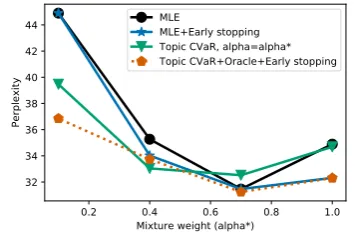
Figure 3. Topic CVaR (green) provides substan-tial improvements in perplexity compared to MLE (black and blue) as the amount of train-test
mis-match increases (α∗ → 0). This performance is
close to the oracle performance which uses ground truth corpus labels and early stopping (orange).
Topic CVaR improves robustness over MLE. Using the YELP-ONEBWORDmixtures, we eval-uate the robustness of topic CVaR and MLE to added nuisance data. We find that with no nui-sance data, the MLE model matches the topic CVaR model (Figure 3 α∗ = 1.0). As we add data from ONEBWORD andα∗ decreases to 0.7,
we find some positive transfer effects where the increased data from the ONEBWORD corpus im-proves the performance on Yelp. However, as the fraction of nuisance data grows further and α∗ drops below 0.4 the MLE models suffer large in-creases in perplexity, incurring up to 10 additional points of perplexity. Early stopping according to validation perplexity on YELP does not improve this substantially beyond the basic MLE model (blue star). On the other hand, applying topic CVaR with α∗ = α provides substantial boosts to language model performance for smallα∗, with nearly no loss of performance for largeα∗ (green triangle). Finally, we find that the topic CVaR method we propose is close to the best possible oracleperformance.
0.2 0.4 0.6 0.8 1.0
Mixture weight (alpha*) 38
40 42 44 46 48
Perplexity
MLE
[image:7.595.91.269.465.581.2]MLE+Early stopping Topic CVaR, alpha=alpha* Topic CVaR+Oracle+Early stopping
Figure 4.The robustness improvements from topic CVaR (black vs green and orange) apply even when the test set (TRIPADVreviews) is not a
subpopula-tion shift from the training set (YELP and
ONEB-WORD).
Topic CVaR robustness beyond subpopulation
shift. The prior YELP-ONEBWORDexperiment
showed that topic CVaR is more robust than MLE under subpopulation shift.
We now explore the more realistic setting in which the test distribution is not a subpopulation shift, but merely “similar” to the training distri-bution. We do this by testing the same model on the TRIPADV hotel review corpus. The hotel and restaurant review distributions are similar (i.e. they both frequently mention service) but differ in that hotels reviews often mention the location and room, while restaurant reviews often mention food items.
bene-fits in real-world settings where the topic overlaps are not exact, and the subpopulation shift assump-tion no longer holds.
Ablations. Topic CVaR extends the standard
CVaR objective in two ways: the use of topics and the use of a baseline. We investigate the ef-fect of these choices via an ablation experiment. Removing the topic structure results in dramatic loss of performance for our models: the perplexity exceeds 80 with α = 0.2 for allα∗. This is be-cause the worst case group can consist of solely of disfluent sentences that do not match any real test distribution. If we remove the baseline, the result-ing model is not completely degenerate, but it is not as robust asα∗decreases (Figure5, teal). This is because ONEBWORD is a higher entropy
cor-pus than YELP, and forcing the model to achieve equal absolute losses causes the model to focus nearly entirely on ONEBWORD, resulting in low
YELPperformance.
0.2 0.4 0.6 0.8 1.0
Mixture weight (alpha*) 32
34 36 38 40 42 44
Perplexity
[image:8.595.325.502.63.191.2]Topic CVaR, alpha=alpha* Topic CVaR, no baseline Topic CVaR, alpha=0.2
Figure 5.The robustness of topic CVaR degrades when the baseline is removed (teal), but is resistant to being over-conservative in choosingα(yellow).
Choice ofα. Since the true train-test overlapα∗
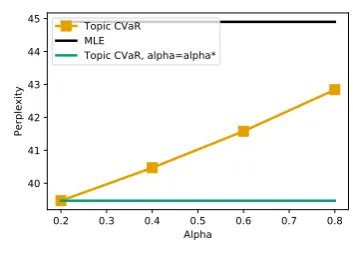
is not always known, we cannot always set our hyperparameter α equal to α∗. We find that se-lecting suboptimal values of α degrades perplex-ity between 2–3 points depending on α∗. Fig-ure 5shows that setting α to the most conserva-tive choice of 0.2 outperforms MLE on small α∗ while incurring only 2 points of perplexity loss over MLE atα∗ = 1.0. Figure6 further demon-strates that whenα∗ = 0.1, any choice ofα out-performs MLE, and incorrectly selectingαseems to incur a linear penalty in perplexity.
Error analysis and examples. Evaluating both
models trained with α∗ = 0.1 on both the YELP
and ONEBWORD test sets, we find that topic CVaR assigns higher probabilities (and therefore
0.2 0.3 0.4 0.5 0.6 0.7 0.8
Alpha 40
41 42 43 44 45
Perplexity
Topic CVaR MLE
Topic CVaR, alpha=alpha*
Figure 6. Topic CVaR outperforms MLE in the
ptrainx 6= p test
x setting (α
∗
= 0.1) for any small α
(x-axis). The performance degradation is linear, im-plying topic CVaR is robust to small errors in the choice ofα.
incurs lower losses) on sentences from Yelp (Fig-ure7, top right). We also see that MLE does par-ticularly well on low loss examples (bottom left) while topic CVaR does well on high-loss ones (top right) as we might expect from optimizing the worst-case losses.
Examining examples from the YELP test set
(Table 1), we identify examples which have sub-stantially higher probabilities under MLE than topic CVaR (left column) and vice versa (right column). These examples show that topic CVaR performs well by assigning high probabilities to stereotypical YELP sentences that discuss food
and service, while MLE performs better on sen-tences about accidents and locations. These ex-amples are consistent with the observation that topic CVaR assigns higher probabilities to typi-cal YELPsentences and thus has lower perplexity, while the MLE model has high perplexity since it assigns probabilities to YELPsentences primarily based on their similarity to examples from ONE B-WORD.
0 1 2 3 4 5 6 7 8
Negative log loss (MLE) 0
1 2 3 4 5 6 7 8
Negative log loss (Topic CVaR)
Yelp One billion word
Figure 7. Log losses for sentences (points) from
YELP (blue) and ONEBWORD (red) under topic
CVaR (y-axis) and MLE (x-axis). Topic CVaR
per-forms well on YELP and infrequent sentences (top
right). MLE performs better on frequent sentences
[image:8.595.94.266.361.478.2]pMLE> pCVaR pCVaR> pMLE
my girlfriend had an awful accident that hurt her leg & ankle which resulted in a fire and rescue ride
huge servings, so plenty for leftovers.
the address [PERSON] has listed is their old address it tastes the way food should taste!
wonderful location in a up and coming part of [GPE]. every single person we spoke to on staff was absolutely incredible.
Table 1. Examples from the YELPcorpus for which MLE outperforms topic CVaR (left column) and vice versa.
Brackets indicate ONTONOTES named-entity tags. The examples preferred by topic CVaR are stereotypical Yelp
sentences, while those preferred by MLE refer to locations and accidents.
6 Related Work
Domain Adaptation: In the case of known
source (train) and target (test) domains, there exist a variety of techniques to learn robust models ( Shi-modaira, 2000; Qui˜nonero-Candela et al., 2009; Daume III,2007;Ben-David et al.,2010;Blitzer et al., 2011; Pryzant et al., 2017) or domain-invariant features (Ganin and Lempitsky, 2015; Tzeng et al., 2014). However, such methods re-quire accurate domain membership annotations.
In the absence of domain membership annota-tions, prior multi-source domain adaptation ( Man-sour et al., 2009) approaches propose the use of clustering to identify candidate domains. For in-stance, Hoffman et al. (2012) and Xiong et al. (2014) discover latent domains in classification by clustering data using class labels. Gong et al. (2013) extend this work by identifying subsets which are distinct and learnable. More recent work consider errors in estimating the target do-main (Hoffman et al., 2018) and derive learning bounds with respect to such errors. While these approaches make use of cluster and topic struc-tures as prior, they still require some knowledge of the target distribution and train a model tailored to the target distribution. Instead, we assume no knowledge on the target distribution and train a single model by considering the worst case.
In conditional settings such as machine trans-lation, prior works connect topic modeling and domain adaptation (Hu et al., 2014; Eidelman et al.,2012). However, unlike our work, these ap-proaches use topics attest timeby inferring the do-main from the input variablex. In language mod-eling, we have no inputs and thus must find models robust to unknown domain shifts at test time. In addition, it can be difficult to infer the test distribu-tion as the distribudistribu-tion can rapidly change across users and time.
Distributional Robustness: Our approach is
based upon existing work in the distributionally robust optimization (DRO) literature. Optimiz-ing on a ball of distributions around the
em-pirical distribution has been considered in prior work (Ben-Tal et al.,2013;Namkoong and Duchi, 2017;Duchi and Namkoong, 2016; Sinha et al., 2018). Using DRO to minimize losses over sub-populations was proposed earlier in Hashimoto et al. (2018) and Duchi and Namkoong (2018), andHu et al.(2018) proposed incorporating prob-lem structure via class labels. Our work derives an efficient optimization procedure for DRO with topic-based uncertainty sets, and demonstrates that naively applying DRO to log losses fails to provide robustness due to the lack of baselining.
7 Discussion
In this work, we show that the performance of lan-guage models degrade as the amount of text from outside the test distribution grows. We hypothe-size that this problem arises from the tendency of MLE to optimize for common sentences in the cor-pus, and we propose a solution based on distribu-tionally robust optimization.
Empirically, we demonstrate that the DRO-based topic CVaR is more robust than MLE to subpopulation shifts and similar shifts. While this work focuses on DRO for language modeling, train-test mismatches under subpopulation shifts are more broadly applicable to any task where there are trade-offs between potential test distri-butions, and potential test distributions can be de-scribed with topics. Our work shows that topics are an effective way to encode prior information about test distributions, and baselines can properly normalize for the difficulty across these topics.
Acknowledgments. This work was supported
by a PECASE Award and DARPA CwC program under ARO prime contract no. W911NF-15-1-0462. SS was supported by a Herbert Kunzel Stan-ford Graduate Fellowship.
Reproducibility. Code and data is available
on CodaLab: https://worksheets.
codalab.org/worksheets/
References
S. Ben-David, J. Blitzer, K. Crammer, A. Kulesza, F. Pereira, and J. W. Vaughan. 2010. A theory of learning from different domains. Machine Learn-ing, 79(1):151–175.
A. Ben-Tal, D. den Hertog, A. D. Waegenaere, B. Me-lenberg, and G. Rennen. 2013. Robust solutions of optimization problems affected by uncertain proba-bilities. Management Science, 59:341–357.
D. Blei, A. Ng, and M. I. Jordan. 2003. Latent Dirichlet allocation. Journal of Machine Learning Research (JMLR), 3:993–1022.
J. Blitzer, S. Kakade, and D. P. Foster. 2011. Domain adaptation with coupled subspaces. InArtificial In-telligence and Statistics (AISTATS), pages 173–181.
C. Chelba, T. Mikolov, M. Schuster, Q. Ge, T. Brants, P. Koehn, and T. Robinson. 2013. One billion word benchmark for measuring progress in statistical lan-guage modeling.arXiv preprint arXiv:1312.3005.
A. M. Dai and Q. V. Le. 2015. Semi-supervised se-quence learning. InAdvances in Neural Information Processing Systems (NeurIPS).
H. Daume III. 2007. Frustratingly easy domain adap-tation. InAssociation for Computational Linguistics (ACL).
J. Devlin, M. Chang, K. Lee, and K. Toutanova. 2018. Bert: Pre-training of deep bidirectional transform-ers for language undtransform-erstanding. arXiv preprint arXiv:1810.04805.
J. Duchi, P. Glynn, and H. Namkoong. 2016. Statis-tics of robust optimization: A generalized empirical likelihood approach.arXiv.
J. Duchi and H. Namkoong. 2016. Variance-based reg-ularization with convex objectives. arXiv preprint arXiv:1610.02581.
J. Duchi and H. Namkoong. 2018. Learning models with uniform performance via distributionally robust optimization. arXiv preprint arXiv:1810.08750.
V. Eidelman, J. Boyd-Graber, and P. Resnik. 2012. Topic models for dynamic translation model adapta-tion. InAssociation for Computational Linguistics (ACL), pages 115–119.
Y. Ganin and V. Lempitsky. 2015. Unsupervised do-main adaptation by backpropagation. In Interna-tional Conference on Machine Learning (ICML), pages 1180–1189.
J. Gehring, M. Auli, D. Grangier, D. Yarats, and Y. N. Dauphin. 2017. Convolutional sequence to se-quence learning. arXiv preprint arXiv:1705.03122.
B. Gong, K. Grauman, and F. Sha. 2013. Reshaping vi-sual datasets for domain adaptation. InAdvances in Neural Information Processing Systems (NeurIPS).
T. B. Hashimoto, M. Srivastava, H. Namkoong, and P. Liang. 2018. Fairness without demographics in repeated loss minimization. In International Con-ference on Machine Learning (ICML).
J. Hoffman, B. Kulis, T. Darrell, and K. Saenko. 2012. Discovering latent domains for multisource domain adaptation. InEuropean Conference on Computer Vision (ECCV), pages 702–715.
J. Hoffman, M. Mohri, and N. Zhang. 2018. Algo-rithms and theory for multiple-source adaptation. In
Advances in Neural Information Processing Systems (NeurIPS), pages 8256–8266.
M. Honnibal and M. Johnson. 2015. An improved non-monotonic transition system for dependency pars-ing. In Empirical Methods in Natural Language Processing (EMNLP), pages 1373–1378.
W. Hu, G. Niu, I. Sato, and M. Sugiyama. 2018. Does distributionally robust supervised learning give ro-bust classifiers? InInternational Conference on Ma-chine Learning (ICML).
Y. Hu, K. Zhai, V. Eidelman, and J. Boyd-Graber. 2014. Polylingual tree-based topic models for translation domain adaptation. In Association for Computa-tional Linguistics (ACL), pages 1166–1176.
Y. Mansour, M. Mohri, and A. Rostamizadeh. 2009. Domain adaptation with multiple sources. In Ad-vances in Neural Information Processing Systems (NeurIPS), pages 1041–1048.
D. Marcheggiani, O. T¨ackstr¨om, A. Esuli, and F. Se-bastiani. 2014. Hierarchical multi-label conditional random fields for aspect-oriented opinion mining. In
ECIR.
B. McCann, J. Bradbury, C. Xiong, and R. Socher. 2017. Learned in translation: Contextualized word vectors. In Advances in Neural Information Pro-cessing Systems (NeurIPS), pages 6297–6308.
R. Nallapati, B. Zhou, C. Gulcehre, B. Xiang, et al. 2016. Abstractive text summarization us-ing sequence-to-sequence rnns and beyond. arXiv preprint arXiv:1602.06023.
H. Namkoong and J. Duchi. 2016. Stochastic gradi-ent methods for distributionally robust optimization with f-divergences. InAdvances in Neural Informa-tion Processing Systems (NeurIPS).
H. Namkoong and J. Duchi. 2017. Variance regulariza-tion with convex objectives. InAdvances in Neural Information Processing Systems (NeurIPS).
R. Pryzant, D. Britz, and Q. V. Le. 2017. Effective domain mixing for neural machine translation. In
Proceedings of the Second Conference on Machine Translation, pages 118–126.
J. Qui˜nonero-Candela, M. Sugiyama, A. Schwaighofer, and N. D. Lawrence. 2009. Dataset shift in machine learning. The MIT Press.
A. Radford, K. Narasimhan, T. Salimans, and I. Sutskever. 2018. Improving language understand-ing by generative pre-trainunderstand-ing. Technical report, OpenAI.
R. T. Rockafellar and S. Uryasev. 2000. Optimization of conditional value-at-risk. Journal of Risk, 2:21– 41.
H. Shimodaira. 2000. Improving predictive inference under covariate shift by weighting the log-likelihood function. Journal of Statistical Planning and Infer-ence, 90:227–244.
A. Sinha, H. Namkoong, and J. Duchi. 2018. Certi-fiable distributional robustness with principled ad-versarial training. In International Conference on Learning Representations (ICLR).
A. Sordoni, M. Galley, M. Auli, C. Brockett, Y. Ji, M. Mitchell, J. Nie, J. Gao, and B. Dolan. 2015. A neural network approach to context-sensitive generation of conversational responses. In North American Association for Computational Linguis-tics (NAACL).
E. Tzeng, J. Hoffman, N. Zhang, K. Saenko, and T. Darrell. 2014. Deep domain confusion: Max-imizing for domain invariance. arXiv preprint arXiv:1412.3474.
A. Vaswani, N. Shazeer, N. Parmar, J. Uszkoreit, L. Jones, A. N. Gomez, L. Kaiser, and I. Polosukhin. 2017. Attention is all you need. arXiv preprint arXiv:1706.03762.
A. Vaswani, Y. Zhao, V. Fossum, and D. Chiang. 2013. Decoding with large-scale neural language models improves translation. InEmpirical Methods in Nat-ural Language Processing (EMNLP), pages 1387– 1392.
C. Xiong, S. McCloskey, S. Hsieh, and J. J. Corso. 2014. Latent domains modeling for visual domain adaptation. In Association for the Advancement of Artificial Intelligence (AAAI).
Yelp. 2017. Yelp Dataset Challenge, Round
8. https://www.yelp.com/dataset_
challenge.