Proceedings of the 2019 Conference on Empirical Methods in Natural Language Processing
3350
Synchronously Generating Two Languages with Interactive Decoding
Yining Wang1,2, Jiajun Zhang1,2∗, Long Zhou1,2 Yuchen Liu1,2 and Chengqing Zong1,2,3
1National Laboratory of Pattern Recognition, CASIA, Beijing, China
2University of Chinese Academy of Sciences, Beijing, China
3CAS Center for Excellence in Brain Science and Intelligence Technology, Beijing, China
{yining.wang, jjzhang, long.zhou}@nlpr.ia.ac.cn {yuchen.liu, cqzong}@nlpr.ia.ac.cn
Abstract
In this paper, we introduce a novel interactive approach to translate a source language into two different languages simultaneously and in-teractively. Specifically, the generation of one language relies on not only previously gener-ated outputs by itself, but also the outputs pdicted in the other language. Experimental re-sults on IWSLT and WMT datasets demon-strate that our method can obtain significant improvements over both conventional Neural Machine Translation (NMT) model and multi-lingual NMT model.
1 Introduction
Neural Machine Translation (NMT) based on the encoder-decoder framework has significantly im-proved translation quality due to its powerful end-to-end modeling (Sutskever et al.,2014;Bahdanau et al., 2015;Vaswani et al., 2017;Gehring et al.,
2017;Hassan et al.,2018;Zhang and Zong,2015). This paradigm facilitates the development of mul-tilingual NMT (Dong et al., 2015; Luong et al.,
2016;Johnson et al.,2017;Ha et al., 2016;Firat et al.,2016;Lakew et al.,2017;Tan et al.,2019;
Wang et al., 2019), which handles multiple lan-guage pairs in one model, with the benefit of sim-plifying offline model training and easing online maintenance cost.
Although multilingual NMT attempts to utilize the complementary information of different lan-guages (Lu et al.,2018;Neubig and Hu,2018; Pla-tanios et al., 2018;Wang et al., 2018), all of the models handle one language pair at each moment for both training and testing. However, we find that the generation process of different target lan-guages can help each other. For example in Figure
1, when decoding the Chinese word “书” meaning “book” at stept = 5, the predicted Japanese word
∗Jiajun Zhang is the corresponding author.
我 I
买了
bought 一本 pad
一冊
a の book本
買い bought
t=1 t=2 t=4 t=5
今天 today
今日 today
t=3
书 book
を I bought a book today.
English
Chinese
Japanese pad 一本
a
[image:1.595.313.521.223.365.2]ました
Figure 1: An example of an English sentence trans-lated into Chinese and Japaneses sentences, in which two targets can interact with each other.
“本” with same meaning can provide the context at stept =4. The reason is that the sentence struc-ture between the two languages is different. It is
subject-verb-objectin Chinese while it is
subject-object-verbin Japanese. Moreover, we find that
two languages are complementary, and if decoders belonging to two different languages can interact with each other, the quality of translation will be improved.
In this work, we present a novel interactive de-coding algorithm to generate two target languages simultaneously and interactively. To this end, we propose a synchronous attention model, in which the generation of one language can attend to al-ready generated outputs of another language. As shown in Figure1, the two decoders predict their outputs at the same time. At each moment, word prediction of each language does not only rely on previously generated targets itself but also de-pends on outputs of the other language.
Our contributions in this work are two-fold: (1) We propose a novel synchronous transla-tion model that can predict outputs of two different languages simultaneously and interactively, which can enhance the translation quality of both lan-guages.
(2) Extensive experiments show the superiority of our proposed method. Specifically, this syn-chronous approach can significantly outperform both the conventional NMT model and the mul-tilingual NMT model.
2 Background
Owing to powerful modeling ability, our syn-chronous method relies on Transformer architec-ture (Vaswani et al.,2017), which is entirely based on the attention mechanism detailed below.
Scaled Dot-Product Attention: The inputs of attention mechanism contain queries Q, keys K, and valuesV. This function can be described as mapping a query and a set of key-value pairs to an output, and the output is calculated as a weighted sum of the values.
Attention(Q,K,V)=softmax(QK
T
p
dk
)V (1)
where dk is dimension of keys, Q, K,V are
ob-tained by linearly transforming input hidden states with projection matrices.
3 Synchronous Translation Method
As discussed in Sec. 1, outputs in different lan-guages can be complementary and can help with each other. Thus, it is reasonable to improve trans-lation quality with interactions of two decoders. In this section, we propose an interactive decod-ing algorithm and then describe how to implement it by a new attention mechanism, named as syn-chronous attention model.
3.1 Interactive Decoding Algorithm
[image:2.595.325.506.59.248.2]Interactive decoding algorithm can generate trans-lations of different languages in the same beam. At each step, each half of the beam produces translations in one target language conditioning on source sentence and the predicted tokens in both target languages. Here, we use two decoders with separated embeddings and softmax layers to oper-ate two languages. The two decoders predict each token in parallel and keep interaction with each
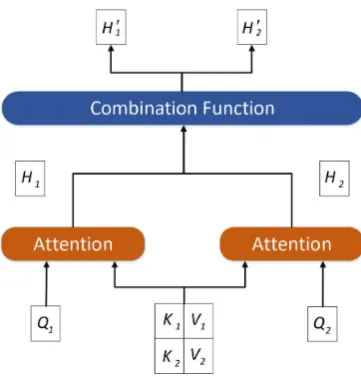
Figure 2: The synchronous self-attention framework, which simultaneously operates on the keys, queries and values of two different decoders.
other, which can be formalized as follows:
logP(y1|x)=log
n−1
Ö
i=0
p(y1i|x,y10, . . . ,yi1−1,y20, . . . ,yi2−1)
logP(y2|x)=log
n−1
Ö
i=0
p(y2i|x,y20, . . . ,yi2−1,y10, . . . ,yi1−1)
(2)
wherexis source sentence,y1,y2 are target sen-tences corresponding to two different languages. At time-stepi, we have generated the firsti−1 to-kens of language-1y1and the firsti−1tokens of language-2y2. Then both languages predictions
can be utilized together with source sentence to generate tokens yi1 and yi2. This interaction be-tween two languages is realized by synchronous attention model, which will be detailed in the fol-lowing subsection.
It should be noted that the two language sen-tences can be generated in different directions (Liu et al.,2016;Zhang et al.,2018;Zhou et al.,2019), which means language-1 can be produced in left-to-right (L2R) manner while language-2 in right-to-left (R2L) manner. We will analyze the effect of different decoding manners in Sec.5.2.
3.2 Synchronous Attention Model
Synchronous attention model (SyncAtt) is shown in Figure2, in which inputs of two decoders con-tain queries (Q1,Q2), keys (K1,K2), and values
(V1,V2) separately. The new hidden states (H 0
i) can
atten-tion as follows:
H10 =SyncAtt(Q1,[K1;K2],[V1;V2])
H20 =SyncAtt(Q2,[K1;K2],[V1;V2])
(3)
where synchronous attention model (SyncAtt) can be described in detail:
H1=Attention(Q1,K1,V1)
e
H1=Attention(Q1,K2,V2) H2=Attention(Q2,K2,V2)
e
H2=Attention(Q2,K1,V1)
H10 =f(H1;He1)=H1+λ×tanh(He1)
H20 =f(H2;He2)=H2+λ×tanh(He2)
(4)
where λis a balance weight of hidden states be-tween two decoders decided by development set.
We apply our synchronous attention model to replace self-attention sub-layer in Transformer de-coder, and it also utilizes the residual connections (He et al.,2016) around each sub-layer, followed by layer normalization (Ba et al.,2016).
3.3 Training
Since our synchronous method decodes two lan-guages at the same time, the different decoders can be optimized simultaneously.
Supposing we have the trilingual datasetsD =
(x,y1,y2) , the objective function is to maxi-mize the log-likelihood over the two target sen-tences:
L(θ)= Õ (x,y1,y2)∈D
( |y1
i|
Õ
i=1
logP(y1i|x)+ |y2
i|
Õ
i=1
logP(yi2|x)) (5)
When calculating P(y1i|x), except for the con-text from source sidex, our synchronous method employs not only previous referencey1<ias condi-tion, but the previous context of the other decoder referencey2<i. The calculation process ofP(yi2|x)
is similar.
However, the practical situation is that the triple data is limited and hard to be collected. In this work, we construct the trilingual training cor-pus by data augmenting method (Sennrich et al.,
2016a;Zhang and Zong, 2016). To achieve this, we first learn two independent translation mod-els Model-1 andModel-2 on the bilingual train-ing data (x1,y1) and (x2,y2) separately. Then, Model-1 and Model-2 are employed to decode the input sentencesx2andx1, resulting in pseudo training data (x2,y1?) and (x1,y2?), respectively.
Thus, we can obtain the triple parallel training data
D = (x1,y1,y2?) ∪
(x2,y1?,y2) , which can be used to train our synchronous translation model mentioned above.
4 Experimental Settings
4.1 Data
We evaluate our proposed synchronous method on two translation tasks, which in-clude English→Chinese/Japanese (briefly, En→Zh/Ja) and English→German/French (briefly, En→De/Fr) on IWSLT1 datasets. The
IWSLT.TED.tst2013 and IWSLT.TED.tst2014
are employed as devlopment set and test set respectively. Besides, we also perform En→De/Fr translation in large scale WMT142 datasets. We
usenewstest2014as test set.
En→Zh/Ja: For this translation task, the train-ing sets of En→Zh and En→Ja consist of 231K, 223K sentence pairs. We tokenize the English sen-tences using a script from Moses (Koehn et al.,
2007), and we segment Chinese and Japanese data
byjieba3 andmecab4. We use BPE method (
Sen-nrich et al.,2016b) to encode the source side tences and the combination of target side sen-tences respectively and limit the vocabularies of both sides to the most frequent 10k tokens.
En→De/Fr: We conduct this translation task on two different settings. One setting is using training set of IWSLT datasets which contains 206K sentence pairs for En→De and 233K sen-tence pairs for En→Fr. We follow the common practice to tokenize and lowercase all words. Sen-tences are encoded using BPE, which has a shared vocabulary of 10K tokens. At last, we construct pseudo triple data by the method described in Sec. 3.3. For the other setting, we extract the trilingual subset in WMT14 inspired byZoph and Knight (2016), which includes about 2.43M sen-tence triples. We use 37K shared BPE tokens as vocabulary.
4.2 Training Details
We implement our synchronous translation based on the tensor2tensor5library. We train our models using the configurationtransformer baseadopted
1https://wit3.fbk.eu
2http://www.statmt.org/wmt14/translation-task.html
3https://github.com/fxsjy/jieba 4http://taku910.github.io/mecab
Hyper-paramter (λ)
En-De/Fr En-Zh/Ja En-De En-Fr En-Zh En-Ja
0.1 30.95 43.01 16.33 18.88
[image:4.595.84.280.61.136.2]0.2 30.77 42.99 16.06 18.82 0.3 30.55 42.99 15.96 18.38 0.4 29.60 42.52 15.66 18.03 0.5 29.19 41.87 15.17 17.42
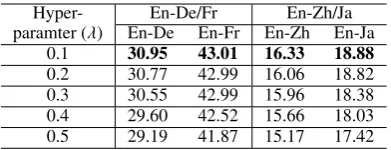
Table 1: Experiment results on the development set with differentλs.
by Vaswani et al. (2017), which contains a 6-layer encoder and a 6-6-layer decoder with 512-dimensional hidden representations. During train-ing, each mini-batch contains roughly 4,096 to-kens for both source and target sides. We use Adam optimizer (Kingma and Ba, 2014) with
β1=0.9, β2=0.98, and=10−9. For decoding, we
set beam size to be k = 4 and length penalty
α = 0.6. All our methods are trained and tested on single Nvidia P40 GPU.
We investigate the impact of differentλs in our synchronous attention model. As shown in Ta-ble1, whenλ=0.1, the translation results perform best on development set for both En→Zh/Ja and En→De/Fr tasks, and we will use this setting in the subsequent experiments.
5 Results and Analysis
The translation performance of IWSLT datasets is evaluated by case-insensitive BLEU4 (Papineni et al., 2002) for En→De/Fr task and character-level BLEU5 for En→Zh/Ja task. For WMT14 datasets, we calculate the case-sensitive BLEU4 the same as previous work. In our experiments, the NMT models trained on individual language pair are denoted byIndiv.
5.1 Results on IWSLT
Table 2 shows the main translation results of En→Zh/Ja and En→De/Fr on IWSLT datasets. We also conduct a typical one-to-many translation adopting Johnson et al.(2017) method on Trans-former as our another baseline model, referred to
Multi. Compared withIndiv, we can see thatMulti
achieves better results on all cases, which can be attributed to that the encoder can be enhanced by extra training data from the other language pair.
As for our proposed method, the synchronous translation method performs significantly better than both Indivand Multi baseline methods, and it can achieve the improvements up to 2.75 BLEU points (19.31 vs. 16.56) on En→Ja.
Method En-Zh/Ja En-De/Fr
En-Zh En-Ja En-De En-Fr
Indiv 15.68 16.56 27.11 40.62
Indiv + pseudo 16.72 18.02 28.47 40.39
Multi 17.06 18.31 27.79 40.97
Multi + pseudo 17.10 18.40 28.56 40.62
[image:4.595.311.520.61.135.2]SyncTrans 17.97 19.31 29.16 41.53
Table 2: Translation performance on IWSLT datasets.
SyncTransrepresents our proposed synchronous trans-lation method. All results of ourSyncTransare signifi-cantly better than bothIndivandMulti(p<0.01).
To perform synchronous translation, the triple parallel corpus contains pseudo training data we construct. For a fair comparison, we also conduct our baseline methods on the training sentences augmented by the pseudo corpus. From row 2 and row 4 in Table2, our method achieves better per-formance than both Multi + pseudo method and
Indiv + pseudomethod with gains of 0.82 BLEU
and 1.09 points on average, which demonstrates the effectiveness of our method.
5.2 L2R or R2L Manner
As described in Sec.3.1, two target languages can be generated in L2R or R2L manner, which can provide the future contexts for each other. We fur-ther conduct an experiment to investigate different decoding manners in this work.
Figure 3 reports the results. We observe that when performing En→De/Fr translation, one lan-guage generated from R2L manner is helpful for the other language but do harm to itself. However, for En→Zh/Ja translation, Japanese can achieve improvements on both L2R and R2L decoding set-tings. The reason is that Japanese is suited for translating from right-to-left manner, and it can take advantage of future outputs from Chinese.
5.3 Results on WMT
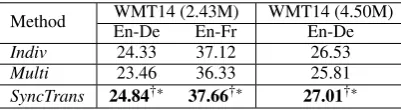
We also employ our method on the real triple train-ing datasets, which can be collected from WMT14 En→De/Fr datasets as described in Sec.4.1. From Table3, we observe that our method consistently outperforms baseline models. Note that in con-trast to results on IWSLT datasets,Multi can not perform on par with Indiv, because the source side data for two language pairs are the same, and encoder network can not be enhanced as Multi
method in Sec.5.1.
29.16
41.53
28.43
41.87
29.51
41.18
25 30 35 40 45
En-De En-Fr
BLEU
Scores
En-De/Fr Translation L2R
R2L-De R2L-Fr
17.97
19.31
18.01
19.58
17.81
20.13
15 16 17 18 19 20 21 22
En-Zh En-Ja
BLEU
Scores
En-Zh/Ja Translation
[image:5.595.103.503.69.197.2]L2R R2L-Zh R2L-Ja
Figure 3: The comparison of L2R and R2L decoding manners, in which one of target languages generated from R2L manner.
Method WMT14 (2.43M) WMT14 (4.50M)
En-De En-Fr En-De
Indiv 24.33 37.12 26.53
Multi 23.46 36.33 25.81
SyncTrans 24.84†∗ 37.66†∗ 27.01†∗
Table 3: Translation quality of En-De/Fr on WMT14 datasets. The significance values with respect to the baseline methodIndivandMultimethod are denoted by “∗” and “†” respectively, indicating our proposed Sync-Transsignificantly better than both Indiv(p < 0.05) andMulti(p<0.01) methods.
triple data about 4.5M6. The result is demonstrated in the last column of Table 3, in which our syn-chronous method performs better than the baseline methods as well.
6 Conclusion
In this paper, we propose an interactive decod-ing algorithm to generate two target languages si-multaneously and interactively. The empirical ex-periments on four language pairs demonstrate that our approach can obtain significant improvements over both the NMT model trained on individual language pair and multilingual NMT model. For the future work, we plan to extend our method on more than two target languages and explore other effective interactive approaches to improve the translation quality further.
Acknowledgments
The research work described in this paper has been supported by the National Key Research and Development Program of China under Grant No.
6The Fr part is entirely created by translating
En-glish of WMT14 En-De datasets into French using the model trained on WMT14 En-Fr corpus about 37M.
2016QY02D0303, the Natural Science Founda-tion of China under Grant No. U1836221 and the Beijing Municipal Science and Technology Project under Grant No. Z181100008918017. The research work in this paper has also been supported by Beijing Advanced Innovation Cen-ter for Language Resources. We thank the three anonymous reviewers for their efforts on this manuscript. We would like to thank Yanfen Zhang and Junnan Zhu for their invaluable discussions on this paper.
References
Jimmy Lei Ba, Jamie Ryan Kiros, and Geoffrey E Hin-ton. 2016. Layer normalization. arXiv preprint arXiv:1607.06450.
Dzmitry Bahdanau, Kyunghyun Cho, and Yoshua Ben-gio. 2015. Neural machine translation by jointly learning to align and translate. In Proceedings of ICLR 2015.
Daxiang Dong, Hua Wu, Wei He, Dianhai Yu, and Haifeng Wang. 2015. Multi-task learning for mul-tiple language translation. In Proceedings of ACL 2015, pages 1723–1732.
Orhan Firat, Kyunghyun Cho, and Yoshua Bengio. 2016. Multi-way, multilingual neural machine translation with a shared attention mechanism. In Proceedings of NAACL 2016, pages 866–875.
Jonas Gehring, Michael Auli, David Grangier, De-nis Yarats, and Yann N. Dauphin. 2017. Convolu-tional sequence to sequence learning.arXiv preprint arXiv:1601.03317.
[image:5.595.80.281.253.308.2]Hany Hassan, Anthony Aue, Chang Chen, Vishal Chowdhary, Jonathan Clark, Christian Feder-mann, Xuedong Huang, Marcin Junczys-Dowmunt, William Lewis, Mu Li, et al. 2018. Achieving hu-man parity on automatic Chinese to English news translation. arXiv preprint arXiv:1803.05567.
Kaiming He, Xiangyu Zhang, Shaoqing Ren, and Jian Sun. 2016. Deep residual learning for image recog-nition.In proceddings of CVPR 2016.
Melvin Johnson, Mike Schuster, Quoc V. Le, Maxim Krikun, Yonghui Wu, Zhifeng Chen, Nikhil Thorat, Fernanda Vi´egas, Martin Wattenberg, Greg Corrado, Macduff Hughes, and Jeffrey Dean. 2017. Google’s multilingual neural machine translation system: En-abling zero-shot translation. Transactions of the As-sociation for Computational Linguistics, 5:339–351.
Diederik P Kingma and Jimmy Ba. 2014. Adam: A method for stochastic optimization. arXiv preprint arXiv:1412.6980.
Philipp Koehn, Hieu Hoang, Alexandra Birch, Chris Callison-Burch, Marcello Federico, Nicola Bertoldi, Brooke Cowan, Wade Shen, Christine Moran, Richard Zens, et al. 2007. Moses: Open source toolkit for statistical machine translation. In Pro-ceedings of ACL 2007.
Surafel M Lakew, ADG Mattia, and F Marcello. 2017. Multilingual neural machine translation for low re-source languages. CLiC-it.
Lemao Liu, Masao Utiyama, Andrew Finch, and Eiichiro Sumita. 2016. Agreement on target-bidirectional neural machine translation. In Pro-ceedings of NAACL 2016, pages 411–416.
Yichao Lu, Phillip Keung, Faisal Ladhak, Vikas Bhard-waj, Shaonan Zhang, and Jason Sun. 2018. A neu-ral interlingua for multilingual machine translation.
arXiv preprint arXiv:1804.08198.
Minh-Thang Luong, Quoc V Le, Ilya Sutskever, Oriol Vinyals, and Lukasz Kaiser. 2016. Multi-task se-quence to sese-quence learning. In Proceedings of ICLR 2016.
Graham Neubig and Junjie Hu. 2018. Rapid adaptation of neural machine translation to new languages. In Proceedings of EMNLP 2018, pages 875–880.
Kishore Papineni, Salim Roukos, Todd Ward, and Wei-Jing Zhu. 2002. Bleu: a method for automatic eval-uation of machine translation. In Proceedings of ACL, pages 311–318.
Emmanouil Antonios Platanios, Mrinmaya Sachan, Graham Neubig, and Tom Mitchell. 2018. Contex-tual parameter generation for universal neural ma-chine translation. In Proceedings of EMNLP 2018, pages 425–435.
Rico Sennrich, Barry Haddow, and Alexandra Birch. 2016a. Improving neural machine translation mod-els with monolingual data. In Proceedings of ACL 2016, pages 86–96.
Rico Sennrich, Barry Haddow, and Alexandra Birch. 2016b. Neural machine translation of rare words with subword units. In Proceedings of ACL 2016, pages 1715–1725.
Ilya Sutskever, Oriol Vinyals, and Quoc V Le. 2014. Sequence to sequence learning with neural net-works. In Proceedings of NIPS, pages 3104–3112.
Xu Tan, Yi Ren, Di He, Tao Qin, Zhou Zhao, and Tie-Yan Liu. 2019. Multilingual neural machine transla-tion with knowledge distillatransla-tion. In Proceedings of ICLR 2019.
Ashish Vaswani, Noam Shazeer, Niki Parmar, Jakob Uszkoreit, Llion Jones, Aidan N. Gomez, and Łukasz Kaiser. 2017. Attention is all you need. In Proceedings of NIPS, pages 30–34.
Yining Wang, Jiajun Zhang, Feifei Zhai, Jingfang Xu, and Chengqing Zong. 2018. Three strategies to im-prove one-to-many multilingual translation. In Pro-ceedings of EMNLP 2018, pages 2955–2960.
Yining Wang, Long Zhou, Jiajun Zhang, Feifei Zhai, Jingfang Xu, and Chengqing Zong. 2019. A com-pact and language-sensitive multilingual translation method. In Proceedings of ACL 2019, pages 1213– 1223.
Jiajun Zhang and Chengqing Zong. 2015. Deep neu-ral networks in machine translation: An overview.
IEEE Intelligent Systems, 30(5):16–25.
Jiajun Zhang and Chengqing Zong. 2016. Exploit-ing source-side monolExploit-ingual data in neural machine translation. In Proceedings of EMNLP, pages 1535– 1545.
Xiangwen Zhang, Jinsong Su, Yue Qin, Yang Liu, Ron-grong Ji, and Hongji Wang. 2018. Asynchronous bidirectional decoding for neural machine transla-tion. In proceddings of AAAI 2018.
Long Zhou, Jiajun Zhang, and Chengqing Zong. 2019. Synchronous bidirectional neural machine transla-tion. Transactions of the Association for Compu-tational Linguistics, 7:91–105.