Proceedings of the 2011 Conference on Empirical Methods in Natural Language Processing, pages 759–770,
Learning Local Content Shift Detectors from Document-level Information
Rich´ard Farkas
Institute for Natural Language Processing University of Stuttgart
Abstract
Information-oriented document labeling is a
special document multi-labeling task where the target labels refer to a specific information instead of the topic of the whole document. These kind of tasks are usually solved by look-ing up indicator phrases and analyzlook-ing their local context to filter false positive matches. Here, we introduce an approach for machine learning local content shifters which detects irrelevant local contexts using just the origi-nal document-level training labels. We handle content shifters in general, instead of learn-ing a particular language phenomenon detec-tor (e.g. negation or hedging) and form a sin-gle system for document labeling and content shift detection. Our empirical results achieved 24% error reduction – compared to supervised baseline methods – on three document label-ing tasks.
1 Introduction
There are special document multi-labeling tasks where the target labels refer to a specific piece of information extractable from the document instead of the overall topic of the document. In these kinds of tasks the target information is usually an attribute or relation related to the target entity (usually a per-son or an organisation) of the document in question, but the task is to assign class labels at the document (entity) level. For example, the smoking habits of the patients are frequently discussed in the textual parts of clinical notes (Uzuner et al., 2008). In this case the task is to find specific information in the text – i.e. the patient in question is a smoker, past
smoker, non-smoker – but at the end an applica-tion has to assign labels to the documents(patients). Similarly, the soccer club names where a sportsman played for are document(sportman)-level labels in Wikipedia articles expressed by the Wikipedia cat-egories. The target information in these tasks is usually just mentioned in the document and much of the document is irrelevant for this information request in contrast to standard document classifi-cation tasks where the goal is to identify the top-ics of the whole document. On the other hand, they are not a standard information extraction task as the task is to assign class labels to documents, and the training dataset contains labels just at this level. These special tasks lie somewhere between information extraction and document classification and require special approaches to solve them. We will call them Information-oriented document
label-ing throughout this paper. There are several
appli-cation areas where information-oriented document labels are naturally present in an enormous amount like clinical records, Wikipedia categories and user-generated tags of news.
Previous evaluation campaigns (Uzuner et al., 2008; Pestian et al., 2007; Uzuner, 2009) demon-strated that information-oriented document labeling can be effectively performed by looking up indicator
phrases which can be gathered by hand, by corpus
statistics or in a hybrid way. However these cam-paigns also highlighted that the analysis of the local
context of the indicator phrases is crucial. For
in-stance, in the smoking habit detection task there are a few indicator words (e.g. smokes, cigarette) and the local context of their occurrences in texts should
be analysed to see whether their semantic was rad-ically changed (e.g. they are negated or in a past tense), for instance:
The patient has a 20 pack-year smoking history.
The patient denies any smoking history.
He has a greater than 100 pack year smoking history and quit 9 to 10 years ago.
We propose a simple but efficient approach for information-oriented document labeling tasks by ad-dressing the automatic detection of language phe-nomena for a particular task which alters the sense or information content of the indicator phrase’s oc-currences. For example, they may be logical modi-fiers (e.g. negation) or modal modimodi-fiers (e.g. auxil-iaries like might and can); they may refer to a subject which differs from the target entity of the task (e.g. clinical notes usually contain information about the family history of the patient); or the semantic con-tent of the shifter may change the role of the tar-get span of a text (e.g. a sportsman can play for or
against a particular team). We call these
phenom-ena content shifters and the task of identifying them
content shift detection (CSD).
Existing CSD approaches focus on a particular class of language phenomena (especially negation or hedging) and use hand-crafted rules (Chapman et al., 2007) or a supervised learning approach that ex-ploits corpora manually annotated at the token-level for a particular type of content shifter (Morante et al., 2009). Moreover higher level applications (like document labeling and information extraction) use a separate CSD module which is developed indepen-dently from the target task. We argue that the nature of content shifters is domain and task dependent, so training corpora (at the token-level) are required for content shifters which are important for a particular task but the construction of such training corpora is expensive. Here, we propose an alternative approach which uses only document-level labels.
The input of our system is a training corpus la-beled on the document level (e.g. a clinical dataset consisting clinical notes and meta-data about pa-tients). Our approach extracts indicator phrases and trains a CSD jointly. We focus on local content
shifters and we analyse just the sentences of indi-cator phrase occurrences. Our chief assumption is that CSD can be learnt by exploiting the false pos-itive occurrences of indicator phrases in the train-ing dataset. We show that our method performs sig-nificantly better than standard document classifiers (which were designed for a slightly different task).
The chief contributions of our work are that (i) we handle the CSD problem in general, so we de-tect all content shifters instead of focusing on one particular language phenomenon, (ii) we form a sin-gle framework for joint CSD and document labeling, (iii) moreover our approach does not require a dedi-cated annotated training dataset for content shifters.
2 Related Work
Information-oriented document classification tasks were first highlighted in the clinical domain where medical reports contain useful information about the patient in question, but labels are only available at the document (patient) level. The field of clinical NLP has been studied extensively since the 1990s (Larkey and Croft, 1995), but the most recent results are related to the shared task challenges organized relatively recently (Pestian et al., 2007; Uzuner et al., 2008; Uzuner, 2009). For example the first I2B2 challenge in 2006 (Uzuner et al., 2008) fo-cused on the smoking habits of the patient, the CMC challenge in 2007 (Pestian et al., 2007) dealt with the problem of automatically constructing ICD cod-ing systems and the second I2B2 challenge (Uzuner, 2009) addressed the classification of discharge sum-maries according to the question ”Who’s obese and what co-morbidities do they have?”. These chal-lenges were dominated by entirely or partly rule-based systems that solved the tasks using indicator phrase lookup and incorporated explicit mechanisms for detecting speculation and negation.
to a certain type of information.
Existing content shift detection approaches focus on a particular class of language phenomena, espe-cially on negation and hedge recognitions. Avail-able tools work mainly on clinical and biological domains. The first systems were fully hand-crafted (Light et al., 2004; Friedman et al., 1994; Chapman et al., 2007) without any empirical evaluation on a dedicated corpus. Recently, there have been several corpora published with manual sentence-, event- or token-level annotation for negation, certainty and factuality in the biological (Medlock and Briscoe, 2007; Vincze et al., 2008), newswire (Strassel et al., 2008; Sauri and Pustejovsky, 2009) and encyclope-dical (Farkas et al., 2010) domains.
Exploiting these corpora, machine learning mod-els were also developed. Solving the sentence-level task, Medlock and Briscoe (2007) used sin-gle words as input features in order to classify sen-tences from biological articles as speculative or non-speculative. Szarvas (2008) extended their method-ology to use n-gram features and a semi-supervised selection of the keyword features. Ganter and Strube (2009) proposed an approach for the automatic de-tection of sentences containing uncertainty based on Wikipedia weasel tags and syntactic patterns. For in-sentence negation and speculation detection, Morante et al. (2009) developed scope – i.e. con-tent shifted text spans – detectors for negation and speculation following a supervised sequence label-ing approach, while ¨Ozg¨ur and Radev (2009) devel-oped a rule-based system that exploits syntactic pat-terns. The goal of the CoNLL 2010 Shared Task (Farkas et al., 2010) was to develop linguistic scope detectors as well. The participants usually followed a supervised sequence labeling approach or used a rule-based system that exploits syntactic patterns. The approach of classifying identified events into whether they fall under negation or speculation was followed by Sauri and Pustejovsky (2009) and the participants of the BioNLP’09 Shared Task (Kim et al., 2009). Here the systems investigated the syn-tax path between the event trigger and a cue word (which came from a small lexicon) (Kilicoglu and Bergler, 2009; Aramaki et al., 2009).
Our approach differs from the previous works fundamentally. We deal with the two tasks (information-oriented document classification and
content shift detection) together and introduce a co-learning approach for them. Our approach han-dles content shifters in a data-driven and general-ized way i.e. it is not specialgeneral-ized for a certain class of language phenomena. Instead it tries to recog-nize task-specific syntactic and semantic patterns which are responsible for semantic changes or irrel-evance. In addition, we have no access to a gold-standard sentence-level or in-sentence-level annota-tion but exploit document-level ones.
3 Tasks and Datasets
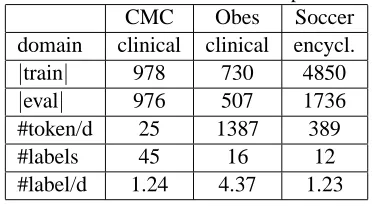
[image:3.612.332.518.390.493.2]Before introducing our approach in detail we de-scribe three tasks and datasets which were used in our experiments in order to give an insight into the challenges of the information-oriented document la-beling tasks. Table 1 summarizes the key statistical figures (the number of documents in the corpora, the size of the label sets along with the average number of tokens and label assignments per document) of the datasets used for the experimental evaluations.
Table 1: The datasets used in our experiments.
CMC Obes Soccer
domain clinical clinical encycl.
|train| 978 730 4850
|eval| 976 507 1736
#token/d 25 1387 389
#labels 45 16 12
#label/d 1.24 4.37 1.23
The CMC ICD Coding Dataset was originally prepared for a shared task challenge organized by the Computational Medicine Center (CMC) in Cin-cinatti, Ohio in 2007 (Pestian et al., 2007). It con-tains radiology reports along with document-level International Classification of Diseases (ICD) codes given by three human experts. ICD is a coding of diseases, signs, symptoms and abnormal findings. In our experiments we used the train/evaluation split of the shared task. The ICD coding guide states that negative or uncertain diagnosis should not be coded in any case.
The corpus contains very short documents. For instance, the document
pneumonia. IMPRESSION: Normal chest.
has one label 786.50 (cough) as 486 (pneumonia) is ruled out.
The main conclusion of the shared task in 2007 was that simple rule-based systems generally out-perform bag-of-words-based machine learning mod-els. The rules were extracted from ICD guidelines and/or from the training corpus using simple sta-tistical measures, then they were checked or ex-tended manually. Several systems of the challenge employed a negation and speculation detection sub-module. The (manually highly fine-tuned) top sys-tems of the CMC shared task achieved an F-measure of 88-89 (Pestian et al., 2007; Farkas and Szarvas, 2008).
The I2B2 Obesity Dataset was also the subject of a clinical natural language processing shared task. The challenge in 2008 focused on analyzing clinical discharge summary texts and addressed the following question: ”Who is obese and what co-morbidities do they have?” (Uzuner, 2009). Tar-get diseases (document labels) included obesity and its 15 most frequent co-morbidities exhibited by patients. In our experiments, we used the same train/evaluation split as that of the shared task. Here a special aspect of the corpus is that the docu-ments are semi-structured, i.e. they contain head-ings like discharge medications and admit
diagno-sis. By pasting the given heading to the beginning
of each sentence, we incorporated it into the local context. The top performing systems of the shared task employed mostly hand-crafted rules for indica-tor selection and for negation and uncertainty detec-tion as well. They achieved an F-measure1of 96-97 (Uzuner, 2009; Solt et al., 2009).
Wikipedia Soccer Dataset. We constructed a cor-pus based on Wikipedia articles and categories2. The categories assigned to Wikipedia articles can be regarded as labels (for example, the labels of David
Beckham in the Wikipedia are English people, ex-patriate soccer player, male model and A.C. Milan player, Manchester United player). Based on the
1
Using the definitions of the challenge, the evaluation metric applied here is the micro F-measure of the textual task on the YESversus every other class.
2
The dataset is available as the supplementary material.
categories of Wikipedia, classifiers can be trained to tag unlabeled texts or even add missing category as-signments to Wikipedia (Sch¨onhofen, 2006).
For a case study we focused on learning En-glish soccer clubs that a given sportsman played for. Note that this task is an information-oriented document labeling task as the clubs for which a sportsman played are usually just mentioned (espe-cially for smaller clubs) in the article of a player. The Wikipedia category Footballers in England by
club contains 408 subcategories (for the present and
past). We selected the best known clubs (where the category label for the club is assigned to more than 500 player pages). Each article referring to a player having a category assignment to these clubs was downloaded and the textual parts were extracted. Then a random 3:1 train:evaluation split of the doc-ument set was used.
4 Document-labeling with CSD
We introduce here an iterative solution which selects indicator phrases and trains a content shift detec-tor at the same time. Our focus will be on
multi-label document classification tasks where multiple
class labels can be assigned to a single document. In this study we will not deal with the modeling of inter-label dependencies, so binary (positive versus negative) and multi-class document classifications (where exactly one label has to be assigned to a sin-gle document) can be regarded as special cases of this multi-label classification problem. Our result-ing multi-label model is then a set of binary classi-fiers – ”assign a label” classiclassi-fiers for each class label – and the final prediction on a document is simply the union of the labels forecasted by the individual classifiers.
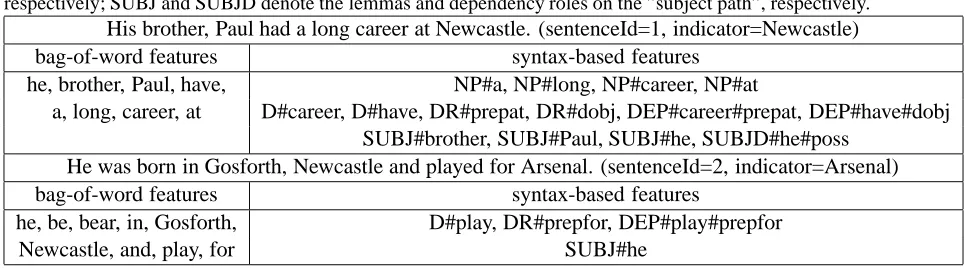
Table 2: Example feature representation of local contexts of Arsenal. The prefix NP stands for the lemma features from the deepest noun phrase; D,DR and DEP marks the lemmas, roles and their combination in the dependency path, respectively; SUBJ and SUBJD denote the lemmas and dependency roles on the ”subject path”, respectively.
His brother, Paul had a long career at Newcastle. (sentenceId=1, indicator=Newcastle)
bag-of-word features syntax-based features
he, brother, Paul, have, NP#a, NP#long, NP#career, NP#at
a, long, career, at D#career, D#have, DR#prepat, DR#dobj, DEP#career#prepat, DEP#have#dobj SUBJ#brother, SUBJ#Paul, SUBJ#he, SUBJD#he#poss
He was born in Gosforth, Newcastle and played for Arsenal. (sentenceId=2, indicator=Arsenal)
bag-of-word features syntax-based features
he, be, bear, in, Gosforth, D#play, DR#prepfor, DEP#play#prepfor
Newcastle, and, play, for SUBJ#he
4.1 Learning Content Shift Detectors
The key idea behind our approach is that a training corpus for task-specific content shifter learning can be automatically generated by exploiting the occur-rences of indicators in various contexts. The local context of an indicator is assumed to have altered if it yields a false positive document-level prediction. More precisely, a training dataset can be constructed for learning a content shift detector in a way that the instances are the local contexts of each occurrence of indicator phrases in the training document set. The instances of this content shifter training dataset are then labeled asnon-alteredwhen the indicated label is among the gold-standard labels of the doc-ument in question or is labeled asaltered other-wise. On this dataset, arbitrary binary classification models (S) can be trained.
As a feature representation of a local context of an indicator phrase, the bag-of-words of the sentence instance (excluding the indicator phrase itself) was used at the beginning. Our preliminary experiments showed that the tokens of the sentence after the indi-cator played a negligible role, hence we represented contexts just by tokens before the indicator.
Features concerning the syntactic context of the given indicator were also investigated. For this, we extended the feature set with features derived from the constituent and dependency parses of the sen-tence3. First, the deepest noun phrase which in-cludes the indicator phrase was identified, then all
3
We parse only the sentences which contain indicator phrase which makes these features computable in reasonable time even on bigger document sets.
lemmas from its subtree were gathered. From the dependency parse, the lemmas and dependency la-bels on the directed path from the indicator to the root node (main path) were extracted. The directed paths branching from this main path starting with
subject dependency were also used for feature
extraction (note that these walk in opposite direction to that of the main path). The intuition of the latter was that the subject of the given information – as it can differ from the target entity of extraction – is of great importance. We note that we recognize the in-sentence subject and employing a co-reference mod-ule would probably increase the value of these fea-tures.
Table 2 exemplifies the feature representation of local contexts of the Newcastle and Arsenal indi-cators for the Wikipedia soccer task. In both sen-tences, a naive system would extract Newcastle as false positives. We want to learn content shifters from them along with the true positive match of
Arsenal in sentence 2. From the first example the
CSD could learn even that the bag-of-word con-tains brother or the SUBJ=brother. However, in
the second example, the bag-of-word representa-tion is not sufficient to learn that the local context of Newcastle is altered because it is the sub-set of the bag-of-word representation of Arsenal’s
non-alteredlocal context. In this case the
syn-tactic context representation can help and in our CSD DEP=play#prepfor gets high weight for the
4.2 Co-learning of Indicator Selection and CSD
If document labels are available at training time, an iterative approach can be used to learn the local content shift detector and the indicator phrases as well. The training phase of this procedure (see Al-gorithm 1) has two outputs, namely the set of indica-tor phrases for each labelI and the content shift de-tectorS which is a binary function for determining whether the sense of an indicator in a particular local context is being altered. Good indicator phrases are those that identify the class label in question when they are present. In each step of the iteration we se-lect indicator phrases I[l]for each label lbased on the actual state of the document setD′. Using these I[l]s we train a CSDS. Then we apply it to the orig-inal datasetDand we delete each local context from the documents which was predicted to be altered by S.
Algorithm 1 Co-learning of labels and CSD Input: Lclass labels,Dlabeled training documents
D′ ←D
repeat
for alll∈Ldo
I[l]←indicatorSelection(D′, l)
end for
S←learnCSD(D′, I)
D′←removeAlteredParts(D, S)
until convergence return I, S
The indicator selection and content shifter learn-ing phases can form an iterative process. The bet-ter the selected indicators are, the betbet-ter the content shift detectors can be learnt. By applying the content shift detector to each token of the documents, each part of the texts lying within the scope of a content shifter can be removed4. By using such a cleaned training document set (D′), better indicators can be selected. These steps can be repeated until some convergence criterion is reached. In our experiments we simply used a fixed iteration number to gain an insight into the behavior of the approach.
4In our first experiments introduced here, we removed the parts of the documents classified as altered. Instead of removing these parts they may be marked and then different features may be extracted from them.
Algorithm 2 Document labeling with CSD Input: ddocument,Iindicator sets,SCSD
pred← ∅
for alll∈Ldo
for allo∈occurrences(d, I[l]) do
if not altered(o, S) then pred←pred∪l
end if end for end for return pred
The prediction procedure of the approach (see Al-gorithm 2) then looks for occurrences of the indica-tor phrases in the text and checks whether they are altered in a certain local context. A non-altered indi-cator directly assigns a class label without any global consistency check on assigned labels.
We note here, that the local relationship among tokens (i.e. the local context) may be taken into account by incorporating this information directly into the feature space of a document classifier (as an alternative of our co-learning procedure), but the number of features would exponentially increase and submodels for each indicator phrases should be learnt which would made such a classification task intractable.
4.3 Indicator Phrase Selection
Indicator phrases are sequences of tokens whose presence implies the positive class. We aimed to extract phrases with the length of 1,2 or 3 (and we used exact matching after lemmatisation). There are several possible ways of developing indicator selec-tion algorithms. One way is to treat it as a special feature selection procedure where the goal is to se-lect a set of features (uni-, bi-, trigrams of a bag-of-word model) which achieves high recall along with moderate precision as false positives are ex-pected to be eliminated by the local CSD in our two-step approach. Indicator selectors can be even de-rived from most classifiers which are based on fea-ture weighting (like MaxEnt and AvgPerceptron) or feature ranking (like rule-based classifiers)5as well. However indicator selection is not the focus of this
Table 3: Results obtained for local content shift detection in a precision/recall/F-measure format.
CMC Obesity Soccer
Trained BoW 90.7 / 60.7 / 72.7 82.1 / 35.4 / 49.4 75.0 / 70.6 / 72.7 BoW+syntactic 88.3 / 60.2 / 71.6 84.4 / 33.3 / 47.8 81.0 / 78.9 / 79.9
Hand-crafted
CSSDB 94.7 / 53.3 / 68.2 42.0 / 57.9 / 48.7 36.8 / 9.8 / 15.5 in-sentence 80.7 / 65.2 / 72.2 70.5 / 40.5 / 51.5 N/A
work.
For our experiments, a feature evaluation-based greedy algorithm was employed to select the set of indicators from the pool of token uni- and bigrams. The aim of the the indicator selection here is to cover each positive documents while introducing a rela-tively small amount of false positives. The greedy algorithm iteratively selects the 1-best phrase ac-cording to a feature evaluation metric based on the actual state of covered documents and adds it to the indicator phrase set. The process is iterated while the score – in terms of the applied feature evaluation metric – of the 1-best phrase is above a threshold t. The quality of the selected indicator set is highly dependent on the stopping threshold t, but as indi-vidual feature evaluation functions are very fast and the number of good indicators is usually low (4-5), the whole greedy indicator selection is fast, hencet can be fine-tuned without overfitting on the training sets employing a cross-validation procedure. As a feature evaluation metric we employed p(+|f) the probability of the positive class ”+” conditioned on the presence of a featuref because preliminary ex-periments did not show any significant advances for more complex metrics.
5 Experiments
Experiments were carried out on the three datasets introduced in Section 3 with local content shift de-tection as an individual task and also to investigate its added value to information-oriented document la-beling.
In our experiments, we applied the sentence split-ter and lemmatizer implementation of the Mor-phAdorner package6 and the Stanford tokenizer and lexicalized PCFG parser (Klein and Manning, 2003)7.
6morphadorner.northwestern.edu/ 7
The JAVA implementation of the entire framework and
5.1 Content Shifter Learning Results
In order to evaluate content shift detection as an indi-vidual task, a set of indicator phrases have to be fixed as an input to the CSD. We used manually collected indicator phrases for each label for each dataset. We utilized the terms of Farkas and Szarvas (2008) and Farkas et al. (2009) collected for the CMC and Obe-sity datasets, respectively and club names for the Soccer dataset in our first branch of experiments. Note that the clinical term sets here have been man-ually fine-tuned as they were developed for partici-pating systems of the shared tasks of the corpora.
Based on the occurrences of these fixed indicator phrases, CSD training datasets were built from the local contexts of the three datasets and binary clas-sification was carried out by using MaxEnt. Table 3 shows the results achieved by the learnt CSDs us-ing the bag-of-word feature representation (row 1) along with the ones obtained by the feature set that was extended with syntactic patterns (raw 2). Here, the precision/recall/F-measure values measure how many false positive matches of the indicator phrases can be recognized (the F-measure of thealtered
class), i.e. here, the true positives are local contexts of an indicator phrase which do not indicate a docu-ment label in the evaluation set and the local content shift detector predicted it to bealtered.
For comparison purposes, we employed
manu-ally developed CSDs which were fine-tuned for the
medical shared task datasets. Row 3 of Table 3 (we refer to it as content shifted sentence detection
base-line (CSSDB) later on) shows the results archived
by the method which predicts every sentence to be
alteredwhich contain any cue phrases for
nega-tion, modality and different experiencer. Note that off-the-shelf tools are available just for these types of content shifters. We collected cue phrases for such a content shifted sentence detection from the
works of Chapman et al. (2007), Light et al. (2004) and Vincze et al. (2008) and from the experiments of Farkas and Szarvas (2008) and Farkas et al. (2009).
For the CMC and Obesity tasks, hand-crafted in-sentence CSDs were also available (Farkas and Szarvas, 2008; Farkas et al., 2009), i.e. they apply heuristics – which usually tries to recognise clause boundaries – for determining the scope of a nega-ton/modality cue. This CSD is more fine-grained than the sentence-level one as here a part of a sen-tence can be detected asalteredwhile other parts
asnon-altered. The results of these detectors –
two different CSDs, both highly fine-tuned for the corresponding shared task – are listed in the last row of Table 3.
On the CMC dataset, our machine learning ap-proach identified mostly negation and speculation expressions as content shifters; the top weighted features for the positive class of the MaxEnt model were no, without, may and vs. They can filter out false positive matches like
Hyperinflated without focal pneumonia..
On the Obesity dataset, similar content shifters were learnt along with references to family mem-bers (like the terms mother and uncle, and the
fam-ily history header). The significance of these types
of content shifters may be illustrated by the follow-ing sentence:
History of hypertension in mother and sis-ter.
The soccer task highlighted totally different con-tent shifters which is also the reason for the poor per-formance of CSSDB. The mention of a club name which the person in question did not play for (false positives) is usually a rival club, club of an unsuc-cessful negotiation or club which was managed by the footballer after his retirement. For example:
His last game was against Chelsea at Stamford Bridge.
He was a coach at United during his son’s playing career.
Summing up, the machine learnt CSDs proved to be competitive with the manually fine-tuned CSD on the three datasets. Table 3 shows that learnt
CSDs were able to eliminate a significant amount of false positive indicator phrase matches on each of the three datasets. The hand-crafted CSDs de-veloped for the medical texts certainly work poorly (an F-score of 15.5) on the Soccer dataset as content shifters different from negation, hedge and experi-encer are useful there. On the other hand, the content shifters could be learnt on this dataset by our CSD approach (achieving F-score of 79.9). In the clinical corpora, the features from the syntactic parses just confused the system, but they proved to be useful on the Soccer corpus. Here, the dependency parse achieved improvements in terms of both precision and recall (the number of true positives increased by 137) which can be mainly attributed to the preposi-tions against and over. The reason why it did not advance on the clinical corpora is probably the do-main difference between the training corpus of the parsers and the target texts, i.e. the parsers trained on the Wall Street Journal could not build adequate dependency parses on clinical notes.
As a final comparison we investigated the manu-ally annotated BioScope corpus (Vincze et al., 2008) as a CSD. The CMC corpus is included in the Bio-Scope corpus where text spans in the in-sentence scope of speculation and negation were annotated. We used this manual annotation as an oracle CSD and got an F-measure of 75.2 (which is significantly higher than the scores 72.2 and 72.7 archived by the hand-crafted and trained CSD respectively). This score can be regarded as an upper bound for the amount of false positive indicator matches that can be fixed by local speculation and negation detec-tors. The remaining false positives are not covered by the linguistically motivated annotations of Bio-Scope, i.e. false positives recognizable by domain knowledge (e.g. coding symptoms should be omit-ted when a certain diagnosis that is connecomit-ted with the symptom in question is present in the document) are not marked.
Our error analysis revealed that most of the er-rors of the learnt CSDs is due to the lack of seman-tic link between lexical units. For instance, on the Soccer dataset it could learn that the token coach occuring in the sentence in question indicates an
alteredcontent, but it was not able to recognise
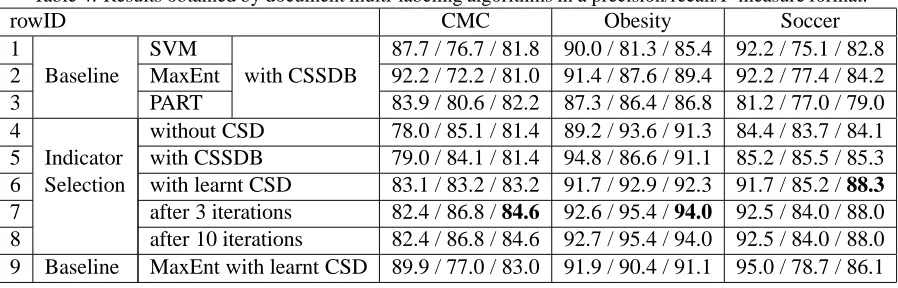
Table 4: Results obtained by document multi-labeling algorithms in a precision/recall/F-measure format.
rowID CMC Obesity Soccer
1 SVM 87.7 / 76.7 / 81.8 90.0 / 81.3 / 85.4 92.2 / 75.1 / 82.8
2 Baseline MaxEnt with CSSDB 92.2 / 72.2 / 81.0 91.4 / 87.6 / 89.4 92.2 / 77.4 / 84.2
3 PART 83.9 / 80.6 / 82.2 87.3 / 86.4 / 86.8 81.2 / 77.0 / 79.0
4 without CSD 78.0 / 85.1 / 81.4 89.2 / 93.6 / 91.3 84.4 / 83.7 / 84.1
5 Indicator with CSSDB 79.0 / 84.1 / 81.4 94.8 / 86.6 / 91.1 85.2 / 85.5 / 85.3 6 Selection with learnt CSD 83.1 / 83.2 / 83.2 91.7 / 92.9 / 92.3 91.7 / 85.2 / 88.3 7 after 3 iterations 82.4 / 86.8 / 84.6 92.6 / 95.4 / 94.0 92.5 / 84.0 / 88.0 8 after 10 iterations 82.4 / 86.8 / 84.6 92.7 / 95.4 / 94.0 92.5 / 84.0 / 88.0 9 Baseline MaxEnt with learnt CSD 89.9 / 77.0 / 83.0 91.9 / 90.4 / 91.1 95.0 / 78.7 / 86.1
training corpus. Increasing the training size may be a simple way to overcome this shortcoming. Note that increasing the number of labels (e.g. introduc-ing more soccer clubs in the Soccer task) would also directly increase the size of training dataset as we use the occurrences of the indicator phrases belong-ing to each of the labels for trainbelong-ing a CSD. The so-lution for the rare cases would require the explicit handling of semantic relatedness (by utilising ex-isting semantic resources or trying to automatically identify task-specific relations).
5.2 Document Labeling Results
The second branch of experiments investigated the added value of CSDs in information-oriented doc-ument labeling tasks. Table 4 summarizes the re-sults we got on the three datasets using the micro-averaged Fβ=1of assigned labels (positive class).
As baseline systems we trained binary SVMs with a linear kernel, MaxEnts and PARTs – a rule-learner classification algorithm (Frank and Witten, 1998) – for each label using the bag-of-word rep-resentation of the documents (implementations of SVMligth (Joachims, 1999), MALLET (McCallum, 2002) and WEKA (Witten and Frank, 1999) were used). The first two learners are popular choices for document classification, while the third is similar to our simple indicator selection procedure. We did not tuned the parameters of the classifiers, we used the default ones everywhere.
To have a fair comparison, we applied to pre-processing steps on dataset of these document clas-sifiers. First, we removed from the training and evaluation raw documents which were predicted to
be alteredby CSSDB. Second, as our indicator
selection phrase can be regarded as a special fea-ture selection method, we carried out an Information Gain-based feature selection (keeping the 500 best-rated features proved to be the best solution) on the bag-of-word representation of the documents. The effect of these two preprocessing steps varied among datasets. It improved the F-score of the MaxEnt baseline document classifier by 20%, 2% and 3% on the Obesity, CMC and Soccer datasets, respectively (the F-measures of Table 4 are the values we got by employing pre-processing).
The indicator selection results presented in the rows 4-8 of Table 4 made use of thep(+|f)-based indicator selector with a five-fold-cross-validated stopping threshold t (introduced in Section 4.3). Row 4 contains the results of using the selected in-dicators without any CSD. Indicator selection with the CSSDB was applied for the 5th row. Rows 6-8 of Table 4 show the results obtained after one, three and ten iterations of the full learning algo-rithm (see Algoalgo-rithm 1). For training the CSD, we employed MaxEnt as a binary classifier for de-tecting altered local contexts and we used the basic BoW feature representation for the clinical tasks while the extended (BoW+syntactic) one for the Soccer dataset.
In the final experiment (the last row of Table 4)) we investigated whether the learnt content shift detector can be applied as a general ”document
cleaner” tool. For this, we trained the baseline
Max-Ent document classifier with feature selection on documents from which the text spans predicted to
be altered by the learnt CSD in the tenth
used in row 2 and row 9 differ only in the applied document cleaner pre-processing steps (the first one applied the CSSDB while the latter one employed the the learnt CSD).
The difference between the best baseline and the indicator selector with learnt CSD and between the best baseline and the document classifier with learnt CSD were statistically significant8 on each dataset. The difference between the predictions after the 1st and 3rd iterations were statistically significant on the CMC and the Obesity corpora but not signifi-cant on the Soccer dataset. The difference between the 3th and 10th iterations were not significant in ei-ther case. Our co-learning method which integrated the document-labeling and CSD tasks significantly outperformed the baseline approaches – which use separate document cleaning and document labeling steps – on the three datasets.
On the clinical domains the automatically se-lected indicators were disease names, symptom names (e.g. high blood pressure), their spelling vari-ants, synonyms (like hypertension) and their abbre-viations (e.g htn). On the soccer domain club names, synonyms (like The Saints) and stadium names (e.g.
Old Trafford) were selected. A label was indicated
by 3-4 indicator phrases.
Note that in these information-oriented docu-ment multi-labeling tasks simple indicator selection-based document labelers alone achieved results comparable to the bag-of-words-based classifiers. The learnt content shift detectors led to an average improvement of 3.6% in the F-measure (i.e. a 24% error reduction). The effect of further iterations is various. As Table 4 shows, three iterations brought an increase on the CMC and Obesity datasets but not on the Soccer corpus. After a few iterations the set of indicator phrases and the content shift detector did not change substantially. The results achieved by the MaxEnt document classifier employing the ”cleaned” training documents (last row of Table 4) are significantly better (an average improvement of 1.9% in the F-measure and 12% error reduction) than those by the CSSDB (row 2) but the indicator selector approach performed even better.
8
According to McNemar’s test with P-value of 0.001
6 Conclusions
In this paper, we dealt with information-oriented document labeling tasks and investigated machine learning approaches for local content shift detectors from document-level labels. We demonstrated ex-perimentally that a significant amount of false posi-tive matches of indicator phrases can be recognized by trained content shift detectors. Our trained CSD does not use any task or domain specific knowledge and exploits the false and true positive matches of in-dicator phrases, i.e. it uses only document-level an-notation. This task-independent approach achieved competitive results with CSDs which were manually fine-tuned for particular datasets. The empirical re-sults also support the idea of generalized local CSD (false positive removal) opposite to developing in-dependent CSD for particular language phenomena (like negation and speculation).
A co-learning framework for training local con-tent shift detectors and indicator selection was in-troduced as well. Our method integrates document classification and CSD learning, which are tradi-tionally used as independent submodules of appli-cations. Experiments on three information-oriented document-labeling datasets – from two application areas – with simple indicator selection and syntactic parse-based content shifter learning were performed and the results show a clear improvement over the bag-of-word-based document classification baseline approaches.
However, the proposed content shift detec-tor learning approach is tailored for information-oriented document labeling tasks, i.e. it performs well when not too many and reliable indicator phrases are present. In the future, we plan to in-vestigate and extend the framework for the general document classification task where many indicators with complex relationships among them determine the labels of a document but local content shifters can play an important role.
Acknowledgements
References
Eiji Aramaki, Yasuhide Miura, Masatsugu Tonoike, Tomoko Ohkuma, Hiroshi Mashuichi, and Kazuhiko Ohe. 2009. TEXT2TABLE: Medical Text Summa-rization System Based on Named Entity Recognition and Modality Identification. In Proceedings of the
BioNLP 2009 Workshop, pages 185–192.
Wendy W. Chapman, David Chu, and John N. Dowling. 2007. Context: an algorithm for identifying contextual features from clinical text. In Proceedings of the ACL
Workshop on BioNLP 2007, pages 81–88.
Rich´ard Farkas and Gy ¨orgy Szarvas. 2008. Automatic construction of rule-based icd-9-cm coding systems.
BMC Bioinformatics, 9(Suppl 3):S10.
Rich´ard Farkas, Gy ¨orgy Szarvas, Istv´an Heged ¨us, At-tila Alm´asi, Veronika Vincze, R´obert Orm´andi, and R´obert Busa-Fekete. 2009. Semi-automated construc-tion of decision rules to predict morbidities from clini-cal texts. Journal of the American Mediclini-cal Informatics
Association, 16:601–605.
Rich´ard Farkas, Veronika Vincze, Gy ¨orgy M´ora, J´anos Csirik, and Gy ¨orgy Szarvas. 2010. The CoNLL-2010 Shared Task: Learning to Detect Hedges and their Scope in Natural Language Text. In Proceedings
of the Fourteenth Conference on Computational Natu-ral Language Learning (CoNLL-2010): Shared Task,
pages 1–12.
Eibe Frank and Ian H. Witten. 1998. Generating accu-rate rule sets without global optimization. In Proc. of
Fifteenth International Conference on Machine Learn-ing, pages 144–151.
Carol Friedman, Philip O. Alderson, John H. M. Austin, James J. Cimino, and Stephen B. Johnson. 1994. A General Natural-language Text Processor for Clinical Radiology. Journal of the American Medical
Infor-matics Association, 1(2):161–174.
Viola Ganter and Michael Strube. 2009. Finding Hedges by Chasing Weasels: Hedge Detection Us-ing Wikipedia Tags and Shallow LUs-inguistic Features. In Proceedings of the ACL-IJCNLP 2009 Conference
Short Papers, pages 173–176.
Thorsten Joachims, 1999. Making large-scale support
vector machine learning practical, pages 169–184.
MIT Press, Cambridge, MA, USA.
Halil Kilicoglu and Sabine Bergler. 2009. Syntactic De-pendency Based Heuristics for Biological Event Ex-traction. In Proceedings of the BioNLP Workshop
Companion Volume for Shared Task, pages 119–127.
Jin-Dong Kim, Tomoko Ohta, Sampo Pyysalo, Yoshi-nobu Kano, and Jun’ichi Tsujii. 2009. Overview of BioNLP’09 Shared Task on Event Extraction. In
Pro-ceedings of the BioNLP 2009 Workshop Companion Volume for Shared Task, pages 1–9.
Dan Klein and Christopher D. Manning. 2003. Accurate unlexicalized parsing. In Proceedings of the 41st ACL, pages 423–430.
Leah S. Larkey and W. Bruce Croft. 1995. Automatic as-signment of icd9 codes to discharge summaries. Tech-nical report.
Marc Light, Xin Ying Qiu, and Padmini Srinivasan. 2004. The language of bioscience: Facts, specula-tions, and statements in between. In Proc. of Biolink
2004, Linking Biological Literature, Ontologies and Databases (HLT-NAACL Workshop:), pages 17–24.
Andrew Kachites McCallum. 2002.
Mal-let: A machine learning for language toolkit. http://mallet.cs.umass.edu.
Ben Medlock and Ted Briscoe. 2007. Weakly supervised learning for hedge classification in scientific literature. In Proceedings of the ACL, pages 992–999, June. Roser Morante, V. Van Asch, and A. van den Bosch.
2009. Joint memory-based learning of syntactic and semantic dependencies in multiple languages. In
Pro-ceedings of CoNLL, pages 25–30.
Arzucan ¨Ozg ¨ur and Dragomir R. Radev. 2009. Detect-ing Speculations and their Scopes in Scientific Text. In Proceedings of the 2009 Conference on
Empiri-cal Methods in Natural Language Processing, pages
1398–1407.
John P. Pestian, Chris Brew, Pawel Matykiewicz, DJ Hovermale, Neil Johnson, K. Bretonnel Cohen, and Wlodzislaw Duch. 2007. A shared task involving multi-label classification of clinical free text. In
Pro-ceedings of the ACL Workshop on BioNLP 2007, pages
97–104.
Roser Sauri and James Pustejovsky. 2009. Factbank: a corpus annotated with event factuality. Language
Resources and Evaluation, 43(3):227–268.
Peter Sch ¨onhofen. 2006. Identifying document topics using the wikipedia category network. In Proceedings
of the 2006 IEEE/WIC/ACM International Conference on Web Intelligence, pages 456–462.
Ill´es Solt, Domonkos Tikk, Viktor G´al, and Zsolt Tivadar Kardkov´acs. 2009. Semantic classification of diseases in discharge summaries using a context-aware rule-based classifier. J. Am. Med. Inform. Assoc., 16:580– 584, jul.
Stephanie Strassel, Mark A. Przybocki, Kay Peterson, Zhiyi Song, and Kazuaki Maeda. 2008. Linguis-tic resources and evaluation techniques for evaluation of cross-document automatic content extraction. In
LREC.
O. Uzuner, Ira Goldstein, Yuan Luo, and Isaac Kohane. 2008. Identifying Patient Smoking Status from Medi-cal Discharge Records. Journal of American MediMedi-cal
Informatics Association, 15(1):14–24.
Ozlem Uzuner. 2009. Recognizing obesity and comor-bidities in sparse data. Journal of American Medical
Informatics Association, 16(4):561–70.
Veronika Vincze, Gy ¨orgy Szarvas, Rich´ard Farkas, Gy ¨orgy M´ora, and J´anos Csirik. 2008. The Bio-Scope Corpus: Biomedical Texts Annotated for Un-certainty, Negation and their Scopes. BMC
Bioinfor-matics, 9(Suppl 11):S9.
Ian H. Witten and Eibe Frank. 1999. Data Mining: