Assembling the Kazakh Language Corpus
Olzhas Makhambetov, Aibek Makazhanov, Zhandos Yessenbayev,
Bakhyt Matkarimov, Islam Sabyrgaliyev, and Anuar Sharafudinov
Nazarbayev University
Research and Innovation System
53 Kabanbay batyr ave., Astana, Kazakhstan
{
omakhambetov, aibek.makazhanov, zhyessenbayev, bmatkarimov,
islam.sabyrgaliyev, anuar.sharaphudinov
}
@nu.edu.kz
Abstract
This paper presents the Kazakh Language Corpus (KLC), which is one of the first attempts made within a local research community to assemble a Kazakh corpus. KLC is designed to be a large scale corpus containing over 135 million words and con-veying five stylistic genres: literary, publicistic, of-ficial, scientific and informal. Along with its pri-mary part KLC comprises such parts as: (i) anno-tated sub-corpus, containing segmented documents encoded in the eXtensible Markup Language (XML) that marks complete morphological, syntactic, and structural characteristics of texts; (ii) as well as a sub-corpus with the annotated speech data. KLC has a web-based corpus management system that helps to navigate the data and retrieve necessary informa-tion. KLC is also open for contributors, who are willing to make suggestions, donate texts and help with annotation of existing materials.
1
Introduction
This article describes theoretical and practical issues ex-perienced during the construction of the Kazakh Lan-guage Corpus. Kazakh is an agglutinative and highly in-flected language which belongs to the Turkic group. It is official state language of Kazakhstan and a mother tongue for more than 10 million people all around the world. However, up until the early 90’s of 20th century, due to historical reasons of the Soviet era, Russian language was the predominant language in spoken and written commu-nication in Kazakhstan. This fact in turn caused the prob-lem of underrepresentation of Kazakh language in var-ious fields such as science, entertainment, official doc-umentation, etc. For this reason, while assembling the corpus, we had to group categories that are generally pre-sented as separate in other corpora into five stylistic gen-res. Also, in contrast to other corpora (Aksan et al., 2012; Chen, 1996), we included texts as they were available, i.e we did not try to fill a predefined set of categories.
Substantial part of materials was collected using source-customized web crawlers and donated texts.
KLC also contains a manually annotated sub-corpus with morpho-syntactic and structural markups encoded in XML following general notions outlined in CES (Ide, 1998). Our syntactic tagset comprises a set of syntactic categories well-defined in a classical Kazakh grammar, and the part of speech (POS) tagset is based on a posi-tional system in which the tags are formed by concatena-tion of POS of a word form and a chain of encoded lin-guistic properties, such as number, case, voice etc. The annotations have been carried out manually by philology students specializing in morphology and syntax. Trying to make the annotation process as comfortable as possi-ble, we have designed a web-based annotation tool with a user-friendly interface. We took a great care for the an-notation quality, and to do that we (i) arranged the valida-tion process, and (ii) equipped the tool with a recommen-dation system that, as we will show, improves the inter-annotator agreement.
As a part of KLC we have also compiled the annotated read-speech corpus (RSC), which includes audio record-ings of words, phrases, sentences (from all genres), news articles and excerpts from books, that were carefully cho-sen from the primary part of the corpus. All text materials were read by volunteers who represented different age, gender, region and education backgrounds in a balanced way. Each audio file is accompanied with a label file and a corresponding text transcript. Moreover, some of the transcripts have been grammatically annotated, i.e. in ad-dition to a word-level segmentation of audio information a portion of our data has lexical, and morpho-syntactic annotations. In total RSC contains 10GB or more than 40 hours of speech.
This paper is organized as follows. Section 2 reviews the existing work. Section 3 provides detailed informa-tion about the primary corpus. Secinforma-tions 4 and 5 thor-oughly describe annotated text and speech sub-corpora respectively. Finally, we draw conclusions and discuss future work in Section 6.
2
Related Work
Since the pioneering corpus of Brown University was completed in 1964 by Francis and Kuˇcera (1979), cor-pus linguistics has become a thriving research field. Over the past two decades researchers all around the world released many corpora, including well known British National Corpus (BNC) (Burnard, 2007) developed be-tween 1991 and 1994, and containing more than 100 million words of written and spoken language from a wide range of sources (Ide and Macleod, 2001; Al-Sulaiti and Atwell, 2006). All materials were selected on a ba-sis of three independent criteria (medium, domain and time), where each criterion had predefined target proptions. The spoken part (remaining 10%) consists of or-thographic transcriptions of unscripted informal conver-sations and spoken language collected in different con-texts. BNC is tagged for part of speech (POS) using the CLAWS4 (Constituent Likelihood Automatic Word-tagging System) (Leech et al., 1994) Word-tagging system de-veloped at Lancaster University. BNC is generally ac-cepted as a balanced corpus, and many researchers, such as the creators of Turkish National Corpus (Aksan et al., 2012), Korean National Corpus (Kim, 2006) etc., adopted it as a model for compiling their own corpora.
The Russian National Corpus (RNC) has been re-leased by the group of specialists from different organi-zations led by the Institute of Russian language, Russian Academy of Sciences (Ruscorpora, 2003). The corpus covers primarily a period from the middle of the XVIII to the early XXI centuries. It includes both written texts (fiction, memoirs, science, religious literature and others) and recorded spoken data (public speeches and private conversations). Currently RNC contains over 350 mil-lion word forms that are automatically POS-tagged and lemmatized. The corpus also includes semantic tags for words and texts (Apresjan et al., 2006). Along with its main part, RNC contains such subcorpora as: Deeply Annotated Corpus, that contains sentences with a com-plete morphological and syntax structure markup, where the syntax structure is largely based on the Meaning-Text Theory introduced by Aleksandr ˇZolkovskij and Igor Mel’ˇcuk; English – Russian, German – Russian, Ukrainian – Russian, Belorussian – Russian parallel cor-pora; Dialect corpus; Poetry corpus and others.
Unfortunately, up until now, not too much work has been accomplished in developing a corpus that will rep-resent Kazakh language. To the best of our knowledge there has been a limited number of attempts to compile one, but resulting corpora are too small in size and scope, or not available to the public. A Kazakh corpus has been initiated by the Committee on Languages of the Ministry of Culture of the Republic of Kazakhstan (CLMCRK, 2009). This corpus is small in size and not annotated, as it
remains in its very early stage of development. The new sub-corpus for Kazakh has been recently built by Baisa et al. as a part of larger corpus of Turkic languages (Baisa and Suchomel, 2012). This corpus was compiled using a web crawler that selected texts based on a language model trained on Wikipedia texts. Although the obtained corpus is relatively large in size, the data was not cate-gorized by genres. Also, since a crawler was not source-customized, the corpus may contain some noise coming in the form of text in Russian or other languages. We also could not find enough information about a Kazakh corpus that has been developed at Xinjiang University and used in their research (Altenbek and Xiao-long, 2010). The ab-sence of an available corpus that will be large enough to represent Kazakh language decelerates many research ac-tivities (Mukan, 2012). We believe that building an open Kazakh corpus will have a significant impact and it will be very useful tool in the analysis of Kazakh.
3
KLC Primary Corpus
KLC is one of the first attempts to build a large scale, general purpose corpus that represents the present state of Kazakh language. Currently, the size of the primary corpus is more than 135 million words and it contains approximately more than 400 000 documents classified by genres into the following five sections: (1)literary
section contains Kazakh literary texts that were pub-lished in the range from the beginning of the XX cen-tury till present; (2)officialsection includes mainly of-ficial statutes, orders, acts and other materials produced by the governmental organizations within the period of 2009-2012; (3)scientificsection includes books, research monographs, dissertations, articles and essays from vari-ous fields (informatics, biology, chemistry, etc.); (4) pub-licisticsection contains periodicals and articles from on-line sources, i.e. newspapers and magazines published over the last ten years; (5)informal languagesection in-cludes documents with colloquial Kazakh texts extracted from the popular blog platforms starting from 2009. We have to note that while compiling this corpus we inten-tionally relaxed the document selection criteria by not re-stricting the collected data to particular domains, media, and time. This was mainly dictated by the lack of ma-terials, and partially due to the reasons mentioned in the introduction.
Genre # docs # all words # unique words Literary 8 255 7 733 456 423 445 Publicistic 404 884 79 302 154 951 659 Official 25 302 44 670 856 335 264 Scientific 527 2 227 878 153 877 Informal 6 110 1 337 953 162 074 TOTAL 445 078 135 272 297 1 365 202
Table 1: A quantitative description of the corpus.
less than 1kB. It took about 7 months to grow the corpus to its current size. Table 1 provides a general quantitative description of the corpus.
We release the data under a license that in accordance with Kazakhstan‘s law allows distribution of some ma-terials in whole (official documents, news articles) and some only in part (literature, scientific texts, analytics) provided that sources are properly cited. This license does not allow printed or electronic publications or simi-lar use of substantial portions of text drawn from the cor-pus without the permission of its original publisher(s) or copyright holder(s).
3.1 Text Documents Description
Each document is stored in a plain text format in the UTF-8 encoding. Documents contain both the content and the meta-data in a single file, and have the following simple structure:
• TITLE – the title of a document;
• SOURCE – the source of a document
• AUTHOR – the author(s) of a document;
• DATE – the date when a document was published;
• META – additional information;
• TEXT – the content of a document.
Provided that the corresponding information is present in a source, the<META>tag contains both the name of the section of the corpus to which a document belongs and a further categorical sub-division, such as the type of a literary work, e.g. a poem. That is, whenever possi-ble such categories are assigned automatically, e.g. some websites provide this information. For sources that lack meta data, such as the digitized books, dissertations and scientific papers, the corresponding categories (informat-ics, biology, chemistry, etc.) are assigned manually.
3.2 Writing System of Kazakh language
Kazakh adopts different writing systems depending on the regions where it is spoken (Cyrillic alphabet in Kaza-khstan, Arabic and Latin graphics in other countries). Recently the government of Kazakhstan has decided to adopt Kazakh alphabet to a Latin graphic. In this regard we believe that KLC could become a valuable tool.
In-documents, total 1213
documents, % 0.3
all words, total 613 511
all words, % 0.4
unique words, total 80 368 unique words, % 5.9 lemmata, total 42 901
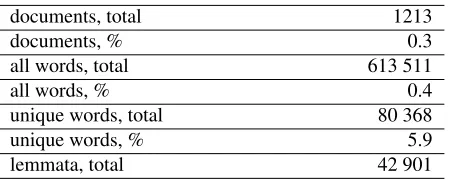
Table 2: A quantitative description of the annotated data
deed, we have already provided a group working on this problem with statistical information about letter distribu-tions in Kazakh texts. This information could also aid in designing various speech corpora as well as a proper Kazakh keyboard layout. It can be stated that the latter was done rather carelessly just as a simple adjustment to a Russian keyboard (Wikipedia, 2012). Current Kazakh Cyrillic alphabet consists of 42 letters, whereas 9 of them are pure Kazakh letters and the others adopt the Russian symbolic. Figure 1 shows the distribution of Kazakh let-ters in the corpus. It can be seen that there is a small non-zero distribution of pure Russian letters (underlined). This can be explained by the ineluctable use of Russian words due to the lack of a proper translation or inheri-tance of Russian vocabulary.
4
The Annotated Sub-corpus
In order to enhance the effectiveness of the corpus as a research tool, we have annotated a portion of the data for syntactic and POS tags, lemmata, and for morpheme types and boundaries. Table 2 provides net amount and the percentages (with respect to the current size of the corpus) of the annotated data in terms of documents, words, unique words, and lemmata.
Figure 1: The distribution of letters across the corpus, in %.
Tag Description PTB equivalents S Simple declarative clause S
BSS Independent clause S
BGS Dependent clause SBAR(Q)
BAS Subject NP
BND Predicate VP TOL Object (WH)NP ANT Modifier ADJP PYS Adverbial (WH)ADVP
(WH)PP X Void, unknown, uncertain X
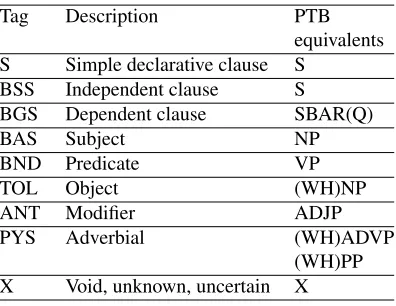
Table 3: The syntactic tagset description
quality was fairly high, as roughly only 6% of annotated tokens were fixed.
To the best of our knowledge this is the first attempt to annotate Kazakh texts with various linguistic markups. Given this, in the following subsections we would like to describe the tagsets (syntactic and POS), the annotation scheme (the format in which the annotated data is stored and distributed), and the annotation tool itself.
4.1 Designing the Tagsets
The syntactic tagset. At the initial stage of the corpus development we did not plan to build a detailed treebank, leaving this task for the future work. Therefore, our syn-tactic tagset comprises a compact set of synsyn-tactic cate-gories well-defined in a classical grammar. Table 3 con-tains the tagset description along with the equivalent tags defined in a widely used Penn Treebank (Marcus et al., 1993) tagset1. In addition to that, we also label
prover-bials which are rather common elements of Kazakh lan-guage. We do not treat them as a separate syntactic
cat-1For ease of presentation we used bracketing instead of listing, i.e. SBAR(Q) should be read as SBARQ, SBAR; (WH)NP as WHNP, NP; etc.
# Linguistic property Code Cardinality
1 Animacy A 2
2 Number N 2
3 Possessiveness S 10
4 Person P 8
5 Case C 7
6 Negation G 2
7 Tense T 3
8 Mood M 4
[image:4.612.87.285.247.400.2]9 Voice V 5
Table 4: Linguistic properties considered in the POS tagset de-sign
egory, for they typically serve as a single syntactic unit (e.g. predicate, adverbial, clause, etc.) Instead each syn-tactic tag has a corresponding binary property that marks the proverbial case.
The POS tagset. Kazakh is an agglutinative Turkic language, in which word forms are generated by means of the affix inflection. Different affix types mark different linguistic properties. For instance, consider a translation of a simple Kazakh sentence:
Mektepke bardym. - school.Dat go.Past.1sg - I went to school.
In this example pronoun“I”and preposition“to”are “hidden” in the affixes of case and person, i.e.:
Mektep(NN =a school) +ke(dative case =to school)
bar(VB, imperative = go) + dy (past tense = he/she went) +m(1st person =I went)
[image:4.612.316.539.248.375.2]en-# Tag Description LPs Cap. # Tag Description LPs Cap.
Noun: Pronoun:
1 ZEP non-personal ANSPC 314 20 SIMZ personal3 NSPC 229
2 ZEQ personal ANSPC 314 21 SIMU demonstrative NSPC 157
Verb: 22 SIMS interrogative NSPC 157
3 ET regular GTMVP 840 23 SIMD reflexive NSPC 157
4 ETU infinitive GSC 196 24 SIMB indefinite NSPC 157
5 ETK auxiliary P 8 25 SIMY indefinite, negative NSPC 157
6 ETB auxiliary, negative P 8 26 SIMP indefinite, universal NSPC 157
7 KEL auxiliary, desiderative GT 6 Adposition:
8 ESM present participle GNSPC 314 27 KOM auxiliary nominal C 7
9 KSE past participle G 2 28 SHS preposition - 1
Adjective: 29 SHZ conjunction - 1
10 SE regular P 8 30 SHD particle - 1
11 SES comparative P 8 Interjection:
12 SEA superlative P 8 31 OSP vocative - 1
Numeral: 32 OSQ thought - 1
13 SN cardinal NSPC 157 33 OSO emotion - 1
14 SNR ordinal NSPC 157
15 SNZ collective NSPC 157 34 ELK Onomatopoeia - 1
16 SNB fraction NSPC 157 35 MOD Modal word - 1
Adverb:
17 US regular - 1 36 BOS foreign word - 1
18 USS comparative - 1
[image:5.612.77.541.64.366.2]19 USA superlative - 1 Total capacity: - 3844
Table 5: The POS tagset description
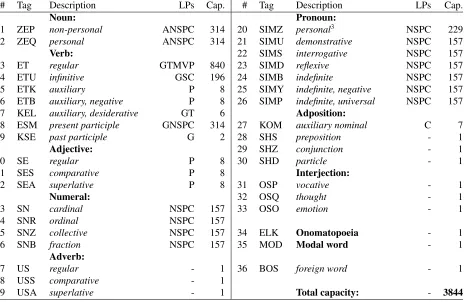
coded chains of linguistic properties (LPs). Table 4 con-tains main LPs defined in Kazakh grammar along with their codes andcardinalities, i.e. a number of values they accept. Although integrating a rich set of LPs may siderably enlarge the size of a tagset, we tried to con-sider as many LPs as possible for the following two rea-sons: (i) previous research shows that increasing the size of a tagset does not necessarily decrease the tagging ac-curacy (Elworthy, 1995) and that for agglutinative lan-guages omitting grammatical aspects may hurt the accu-racy ofn-gram tagging (Feldman, 2008); (ii) it is easier to reduce a detailed tagset than to re-annotate data for the missed information. Table 5 provides a detailed descrip-tion of the designed tagset (not including punctuadescrip-tion) both qualitatively and quantitatively. The table contains a list of tags grouped by the ten major POS (in bold). For each tag we provide a set of LPs it accepts andgenerative capacities, i.e. the upper bound on a number of possible tags that can be generated from a given basic tag and the different combinations of the corresponding LPs2. The
2The multiplication of cardinalities of LPs does not always give the exact number of possible tags, for there are rules that restrict certain combinations of LPs. Moreover, some LP combinations may be techni-cally valid but semantitechni-cally incorrect as they would make no sense, e.g.
bala + m + myn-I am a son of my son. Where possible we tried to account for such exceptions, checking the combinations and providing
list of 36 basic tags was compiled following the best prac-tices of Penn tagset design (Marcus et al., 1993), and bearing in mind the specifics of Kazakh grammar. Par-ticularly, we broke down the major POS categories in sub-categories, in order to capture semantic distinctions and various usage patterns. For instance, negative (tag #6) and desiderative (tag #7) auxiliary verbs in conjunc-tion with main verbs are used to mark uninflected nega-tion (vianoandnot) and desiderative mood construction (via usage ofto comein the meaning ofto want) respec-tively. Similarly, auxiliary nominals (tag #27) are used as prepositional phrases such as,in front of,at the top of, etc. Also, apart from the ordinal and cardinal numerals we distinguishcollectives(tag #15), that are used to em-phasize completeness of quantities as inboth,all three, etc.; andfractions(tag #16) as inhalf,quarter, etc. Fi-nally, following classical Kazakh grammar, we treat ono-matopoeias (tag #34), i.e. sound imitations as intic-tac
orknock-knock, as a distinct part of speech.
Themaximumsize of the tagset equals to the total gen-erative capacity, or 3844 tags. However, depending on the
exact numbers.
morpheme→token direct speech→sentence
token→syntactic unit sentence→direct speech
syntactic unit→sentence list item→sentence
sentence→paragraph sentence→list item
paragraph→chapter dialog→sentence
chapter→document sentence→dialog
Figure 2: Structural markup hierarchy
level of granularity required for an application, some or even all LPs may be dropped or added back in, providing additional flexibility. Even the minimal tagset of 36 basic tags can be further reduced to a universal tagset (Petrov et al., 2011) that consists of 11 tags, with the first seven major POS groups being mapped to their direct equiv-alents, and the latter four (Interjection through Foreign word) being mapped to thecatch allcategory.
Lastly, given the designed tagset the aforementioned Kazakh sentence can be tagged as follows:
Mektepke/ZEP A0N0S0P3C3 (ZEP - non-personal noun; A0 - inanimate; N0 - singular; S0 - no possessor; P3 - 3rd person; C3 - dative case)
bardym/ET G0T3M1V0P1 (ET - regular verb; G0 - not negated; T3 - past tense; M1 - indicative mood; V0 - ac-tive voice; P1 - 1st person)./.
4.2 The Annotation Scheme
We have developed an XML-based annotation scheme that follows paradigms of the CES (Ide, 1998) and is convertible into the XCES standard (Ide et al., 2000). The main difference with the latter is that in our scheme the raw text and all markup types (i.e. lexical, syntac-tic and structural annotation; cf. Section 4) are stored in a single document. For the morpho-lexical and syntac-tic markups we have corresponding tags, i.e. <TOK>
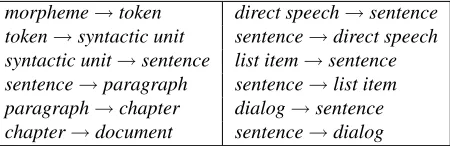
-tokenand<SU>-syntactic unit, respectively. Main lin-guistic characteristics, such as POS, lemmata, morpheme segmentation and syntactic labels are marked through the corresponding sub-tags and properties. All the afore-mentioned tags have their place in the global hierarchy of the structural markup. In turn, this hierarchy is in-tegrated into the structure of an XML document itself. Figure 2 shows the schematic representation of the devel-oped structural markup. A statementA →B represents
“A is contained by B”relation.
4.3 The Annotation Tool
To ease the process of annotation we have developed a special tool that was designed as a web application with a logging and a document management system. The tool allows for (auto)saving current work and reviewing and revising the already annotated documents.
Functionality-wise the tool consists of the following three modules: (1) the syntactic module is designed
[image:6.612.76.301.63.136.2]Before After inter-annotator agreement 0.81 0.84 average MAE 0.08 0.07 average speed, words/hour 212.1 322.6
Table 6: Various characteristics of the annotation process before and after introducing the recommendation system
to parse sentences using the syntactic tagset described in subsection 4.1, and to simultaneously mark sentence boundaries; (2) the morpho-lexical module is designed to perform a morphological analysis, and to comprise such functionalities as morpheme segmentation, POS tagging and lemma identification; (3) finally, the structural mod-ule is designed to mark up the logical structure of a docu-ment, i.e. paragraphs, dialogues, direct speech, lists, etc. Annotation of a given document is performed in the order in which we described the modules. The decision on such an order, as many other major design decisions, was made accounting for the annotators’ feedback, suggestions and requests, thus making the annotation experience as con-venient as possible. The validators have almost identical interface with additional functionality, such as a quick look up and correction of word-level (morphology) and sentence-level (syntax) markups. Also, both the valida-tors and the annotavalida-tors have means to correct orthography and punctuation. However, the originals of each and ev-ery annotated document are kept. In fact we have already collected data on misspellings to use in our ongoing re-search in spelling correction.
We have also developed a recommendation system for morphological analysis based on the already annotated data. For a given word or a given morpheme, the system generates a list of recommended markups ordered by the decreasing frequency of the previous usage. While this approach arguably has a potential to propagate errors, our experiments suggest the opposite. We have measured the inter-annotator agreement, average mean absolute error (MAE), and the annotation speed with and without the recommendation system. All measurements were taken for five annotators, who had been working with the tool for two weeks. For the experiments the annotators were given a randomly chosen news article containing about 300 words. The agreement was calculated using Fleiss’ kappa (Fleiss and others, 1971). The average MAE was calculated as
∆M AE= 1
|A|
X
a∈A
W −Ca
W
Age group I II III IV
Region F1 M1 F2 M2 F3 M3 F4 M4 Sum
1 3 3 2 1 2 1 2 1 15
2 2 3 2 1 2 1 11
3 1 1 2 3 2 1 1 11
4 3 2 1 1 7
5 2 2 2 1 2 2 2 1 14
6 2 2 2 2 2 1 2 13
7 2 2 1 2 2 2 1 12
8 2 1 1 2 1 1 2 1 11
9 3 2 2 1 3 1 1 1 14
10 1 1 2 2 1 1 2 1 11
11 2 1 2 1 1 2 9
12 2 2 2 2 1 2 1 12
13 2 2 2 1 1 1 1 1 11
14 2 1 1 1 1 2 1 2 11
15 1 3 1 2 7
Total 30 28 23 20 22 12 21 13 169
[image:7.612.156.457.62.311.2]Age group, % 35% 25% 20% 20%
Table 7: The distribution of the speakers.
the inter-annotator agreement improves with the incorpo-ration of the recommendations, while, in contrast to the error propagation assumption, the error rate slightly de-creases. Moreover, we get more than 100 words/hour in-crease in the labeling speed. Thus, we conclude that as long as the quality of the already annotated data is high, the recommendation system will help to produce quality annotations at a higher speed. One can argue that we used a rather small sample of data to evaluate our recommen-dation system. However, we drew conclusions not only from the experimental results but also from opinions of validators, who confirmed that they noticed that after in-tegrating the recommendation system annotations grew more coherent and synchronized.
Finally, let us provide a brief technical descrip-tion of the tool. The design and structure of the front end is based on HTML5 and CSS3. We also use JQuery for HTML elements manipu-lation and various event handling. The tool can be tried out at http://kazcorpus.kz/klcweb/ annotated/#annotsample, and the detailed infor-mation about it can be found athttp://kazcorpus. kz/klcweb/annotated/#annotdemo.
5
Read Speech Corpus
Most of the modern speech processing systems require a large amount of audio and text data for training acoustic and language models. Depending on the type of an appli-cation required data varies from high quality microphone read speech (Garofalo et al., 2007) to conversational
tele-phone speech (Godfrey and Holliman, 1997; Canavan and Zipperlen, 1996), from continuous speech (Garo-folo et al., 1993) to connected (Leonard and Doddington, 1993) and isolated words (Pitrelli et al., 1995). In our cur-rent work, we collected a corpus of more than 40 hours of high quality microphone read Kazakh speech of 169 na-tive speakers for the large vocabulary continuous speech recognition tasks.
5.1 Text Materials
The text materials to be uttered were carefully selected from the primary section of the corpus and divided into two parts: sentences andstories. The “sentences” part has more than 12 000 different sentences randomly and equally extracted from all of the five genre specific sec-tions of the corpus. The sentences are chosen so that in total they contain more than 120 000 words which be-long to the set of the most frequent words that cover the 95% of all the texts in the corpus. Additionally, the sen-tences were grouped according to their length in words. Thus, we have ten groups of sentences, so that the first group contains the sentences of length six, the second – of length seven, and so on up until the length of 15.
“short-sentenced” groups (10 sentences per each group), and the remaining 25 belonged to the last five “long-sentenced” groups (5 sentences per each group).
5.2 Speakers
The main criteria of a speaker selection were the follow-ing: a region where (s)he learned Kazakh or spent most of his/her life; age; gender; and the ability to read Kazakh.
The first criterion helped us to capture various accents attributed to speakers’ settlement both local and exter-nal. From the regional perspective we divide the speakers into 15 groups: 14 domestic (one per each administra-tive region, i.e. “oblast”, of Kazakhstan) and one abroad (all foreign countries). Furthermore, the speakers are di-vided into the following four age groups (not including children and school students): (i) 18-27 years, (ii) 28-37 years, (iii) 38-47 years, (iv) 48 years and above. We did not strictly balance the speakers by their gender due to the difficulties in finding the volunteers, but still tried to choose no more than three speakers of the same gender per one age-regional group. A female-to-male distribu-tion of speakers is 57% to 43%, respectively.
The other important criterion is the ability to read Kazakh, since not all of the interviewees could read in Kazakh sufficiently fluent, which is a common issue in a bilingual country such as Kazakhstan. Additionally, we kept a record of the speakers’ education, i.e. whether they attended and graduated from a university, or graduated from a school or a college without attending any univer-sities.
The speakers were encoded using the fol-lowing scheme: <Region><Gender><Year of birth><Initials><Education>, where “Region” holds the values in the range of [1-15], “Gender” – F or M, “Year of birth” – the last two digits of a year of birth, ”Initials” – initials of a name followed by a surname, “Education” – 1 for school, 2 for college, and 3 for university, e.g. 06F70ZK3.
In total, we have recorded 169 speakers. Table 7 presents a distribution of the speakers across the age, gender and regional groups. The blank spots show the speaker profiles that we could not recruit. Mostly, these cases correspond to the distant regions and elder male groups.
5.3 Recording Setup
[image:8.612.325.530.61.355.2]The actual recording sessions took place in a sound-proof studio of the university with the assistance of a sound operator. Before the recordings, the speakers were in-structed, documented and given some time to prepare, as well as asked to fill in the copyright transfer form for the audio data with their voice. They were not constrained on the manner, speed or time except for the correctness of reading. The average time for a recording session
Figure 3: ASCII version of the Kazakh letters.
per speaker was about 40-45 minutes, though there were cases that lasted for two hours. Audio data was captured using a professional vocal microphone Neumann TLM 49 and digitized by LEXICON I-ONIX U82S sound card. The format of the recorded audio files is 44.1 kHz 16-bit PCM-encoded mono WAVE file format. All the recorded audio files were manually post-processed to have each ut-terance (sentences and stories) in a separate file and in the corresponding directories. The size of the speech corpus is about 8.5 GB on disk. A collective duration of the au-dio files is more than 40 hours long.
5.4 Transcription and Annotation
visualization and manipulation, which supports TIMIT word-level transcription format. Although, it supports Unicode, it does provide a proper support for Kazakh symbols. Therefore, we used an ASCII version of the Kazakh letters depicted on Figure 3. Also, we used the#
symbol for the pauses and silence, and ˆ symbol for other non-speech events.
6
Conclusion and Future Work
In this work we have described the design and compila-tion process of the Kazakh Language Corpus. KLC is oriented for a wide range of users and we believe that it will be a valuable tool for research communities, espe-cially given that a portion of the data has been labeled with multiple levels of annotation, including word-level segmentation of audio information. We are already using the annotated data in our initial experiments in morpheme segmentation and error correction.
One can explore the corpus through the website (http://kazcorpus.kz) that was designed to pro-vide the best experience in the analysis of data.
For the future work we plan to use the corpus as a re-search tool to tackle the following problems: (i) auto-matic part of speech tagging, (ii) morphological disam-biguation, (iii) statistical machine translation. For the latter we have already started collecting parallel text in Russian and English.
Acknowledgments
We would like to thank the Ministry of Education and Science of the Republic of Kazakhstan for supporting this work through a grant under the 055 research program.
We express our gratitude to Dr. A. Sharipbayev for his valuable advice on methodology of constructing the read-speech corpus.
We also would like to sincerely thank our validators and annotators: Bobek A., Asemgul R., Aidana Zh., Naz-erke G., Nazym K., Ainur N., Sandughash A., Zhuldyzai S., Dinara O., Aigerim Zh. The annotation and valida-tion work they have done helped a great deal in designing tagsets. This work would not be possible without their contribution.
References
Yesim Aksan, Mustafa Aksan, Ahmet Koltuksuz, Taner Sezer, Umit Mersinli, Umut Ufuk Demirhan, Hakan Yilmazer, Gul-sum Atasoy, Seda Oz, Ipek Yildiz, and Ozlem Kurtoglu. 2012. Construction of the turkish national corpus (tnc). In Nicoletta Calzolari, Khalid Choukri, Thierry Declerck, Mehmet Ugur Dogan, Bente Maegaard, Joseph Mariani, Jan Odijk, and Stelios Piperidis, editors,Proceedings of the Eight
International Conference on Language Resources and Eval-uation (LREC’12), Istanbul, Turkey, may. European Lan-guage Resources Association (ELRA).
L. Al-Sulaiti and E.S. Atwell. 2006. The design of a corpus of contemporary arabic. International Journal of Corpus Lin-guistics, 11:135–171.
Gulila Altenbek and WANG Xiao-long. 2010. Kazakh seg-mentation system of inflectional affixes. InJoint Conference on Chinese Language Processing, pages 183–190. CIPS-SIGHAN.
Juri Apresjan, Igor Boguslavsky, Boris Iomdin, Leonid Iomdin, Andrei Sannikov, and Victor Sizov. 2006. A syntactically and semantically tagged corpus of russian: State of the art and prospects. InThe fifth international conference on Lan-guage Resources and Evaluation (LREC 2006), Genoa, Italy. Vt. Baisa and Vt. Suchomel. 2012. Large corpora for tur-kic languages and unsupervised morphological analysis. In Proceedings of the Eight International Conference on Lan-guage Resources and Evaluation (LREC’12), pages 28–32, Istanbul, Turkey. European Language Resources Association (ELRA).
Lou Burnard, editor. 2007. Reference Guide for the British National Corpus. Research Technologies Service at Oxford University Computing Services, February.
Alexandra Canavan and George Zipperlen. 1996. Callhome japanese speech.
K.-j. Chen. 1996. Sinica corpus: Design methodology for bal-anced corpora. In B.S. Park and J.B. Kim, editors, Proceed-ing of the 11th Pacific Asia Conference on Language, Infor-mation and Computation, pages 167–176, Seoul. Kyung Hee University.
CLMCRK. 2009. The corpus of kazakh language. [visited 29/08/2012].
David Elworthy. 1995. Tagset design and inflected languages. InIn EACL SIGDAT workshop iFrom Texts to Tags: Issues in Multilingual Language Analysis, pages 1–10.
Anna Feldman. 2008. Tagset design, inflected languages, and n-gram tagging. Editors: Paul Robertson and John Adam-son, 3(1):151.
J.L. Fleiss et al. 1971. Measuring nominal scale agreement among many raters.Psychological Bulletin, 76(5):378–382. Winthrop Nelson Francis and Henry Kuˇcera. 1979. Manual of information to accompany a standard corpus of present-day edited American English, for use with digital computers. Brown University, Department of Lingustics.
John Garofalo, David Graff, Doug Paul, and David Pallett. 2007. Csr-i (wsj0) complete linguistic data consortium, philadelphia.
John S. Garofolo, Lori F. Lamel, William M. Fisher, Jonathan G. Fiscus, David S. Pallett, Nancy L. Dahlgren, and Victor Zue. 1993. Timit acoustic-phonetic continuous speech corpus.
JJ Godfrey and E Holliman. 1997. Switchboard-1 release 2. Linguistic Data Consortium, Philadelphia.
- Volume 1, ACL ’98, pages 483–490, Stroudsburg, PA, USA. Association for Computational Linguistics.
Jirka Hana and Anna Feldman. 2010. A positional tagset for russian.Proceedings of LREC-10. Malta.
Nancy Ide and Catherine Macleod. 2001. The american na-tional corpus: A standardized resource of american english. In Paul Rayson, Andrew Wilson, Tony McEnery, Andrew Hardie, , and Shereen Khoja, editors,Proceedings of the Cor-pus Linguistics 2001 Conference, pages 274–280. Lancaster University (UK).
N. Ide, P. Bonhomme, and L. Romary. 2000. Xces: An xml-based standard for linguistic corpora. In Proceedings of the Second Annual Conference on Language Resources and Evaluation, pages 825–830, Athens.
Nancy Ide. 1998. Corpus encoding standard: Sgml guidelines for encoding linguistic corpora. InProceedings of the First International Language Resources and Evaluation Confer-ence, pages 463–70. Citeseer.
H. Kim. 2006. Korean national corpus in the 21st century se-jong project. language corpora:their compilation and appli-cation. InProceedings of the 13th NIJL International Sym-posium, pages 49–54, Tokyo, March.
Geoffrey Leech, Roger Garside, and Michael Bryant. 1994. Claws4: the tagging of the british national corpus. In Proceedings of the 15th conference on Computational linguistics-Volume 1, pages 622–628. Association for Com-putational Linguistics.
R. Gary Leonard and George Doddington. 1993. Tidigits. Mitchell P. Marcus, Mary Ann Marcinkiewicz, and Beatrice
Santorini. 1993. Building a large annotated corpus of en-glish: the penn treebank.Comput. Linguist., 19(2):313–330, June.
Akmaral Mukan. 2012. A Learner’s Dictionary of Kazakh Id-ioms. Georgetown University Press.
Kemal Oflazer, Bilge Say, Dilek Zeynep Hakkani-T¨ur, and G¨okhan T¨ur. 2003. Building a turkish treebank. In Tree-banks, pages 261–277. Springer.
Slav Petrov, Dipanjan Das, and Ryan McDonald. 2011. A universal part-of-speech tagset. Arxiv preprint ArXiv:1104.2086.
John F. Pitrelli, Cynthia Fong, Suk H. Wong, Judith R. Spitz, and Hong C. Leung. 1995. Phonebook: A phonetically-rich isolated-word telephone-speech database. InICASSP, volume 1, pages 101–104.
Ruscorpora. 2003. Russian national corpus. [visited 29/08/2012].
WaveSurfer. 2013. http://www.speech.kth.se/ wavesurfer/. Accessed: 2013-03-30.