Minimally Supervised Event Causality Identification
Quang Xuan Do Yee Seng Chan Dan Roth
Department of Computer Science University of Illinois at Urbana-Champaign
Urbana, IL 61801, USA
{quangdo2,chanys,danr}@illinois.edu
Abstract
This paper develops a minimally supervised approach, based on focused distributional sim-ilarity methods and discourse connectives, for identifying of causality relations between events in context. While it has been shown that distributional similarity can help identify-ing causality, we observe that discourse con-nectives and the particular discourse relation they evoke in context provide additional in-formation towards determining causality be-tween events. We show that combining dis-course relation predictions and distributional similarity methods in a global inference pro-cedure provides additional improvements to-wards determining event causality.
1 Introduction
An important part of text understanding arises from understanding the semantics of events described in the narrative, such as identifying the events that are mentioned and how they are related semantically. For instance, when given a sentence “The police arrested him because he killed someone.”, humans understand that there are two events, triggered by the words “arrested” and “killed”, and that there is a causality relationship between these two events. Besides being an important component of discourse understanding, automatically identifying causal re-lations between events is important for various nat-ural language processing (NLP) applications such as question answering, etc. In this work, we auto-matically detect and extract causal relations between events in text.
Despite its importance, prior work on event causality extraction in context in the NLP litera-ture is relatively sparse. In (Girju, 2003), the au-thor used noun-verb-noun lexico-syntactic patterns to learn that “mosquitoes cause malaria”, where the
causeandeffectmentions are nominals and not
nec-essarily event evoking words. In (Sun et al., 2007), the authors focused on detecting causality between search query pairs in temporal query logs. (Beamer and Girju, 2009) tried to detect causal relations be-tween verbs in a corpus of screen plays, but limited themselves to consecutive, or adjacent verb pairs. In (Riaz and Girju, 2010), the authors first cluster sentences into topic-specific scenarios, and then fo-cus on building a dataset of causal text spans, where each span is headed by a verb. Thus, their focus was not on identifying causal relations between events in a given text document.
In this paper, given a text document, we first iden-tify events and their associated arguments. We then identify causality or relatedness relations between event pairs. To do this, we develop a minimally su-pervised approach using focused distributional sim-ilarity methods, such as co-occurrence counts of events collected automatically from an unannotated corpus, to measure and predict existence of causal-ity relations between event pairs. Then, we build on the observation that discourse connectives and the particular discourse relation they evoke in context provide additional information towards determining causality between events. For instance, in the ex-ample sentence provided at the beginning of this section, the words “arrested” and “killed” probably have a relatively high apriori likelihood of being
sually related. However, knowing that the connec-tive “because” evokes a contingency discourse re-lation between the text spans “The police arrested him” and “he killed someone” provides further ev-idence towards predicting causality. The contribu-tions of this paper are summarized below:
• Our focus is on identifying causality between event pairs in context. Since events are of-ten triggered by either verbs (e.g. “attack”) or nouns (e.g. “explosion”), we allow for detec-tion of causality between verb-verb, verb-noun, and noun-noun triggered event pairs. To the best of our knowledge, this formulation of the task is novel.
• We developed a minimally supervised ap-proach for the task using focused distributional similarity methods that are automatically col-lected from an unannotated corpus. We show that our approach achieves better performance than two approaches: one based on a frequently used metric that measures association, and an-other based on the effect-control-dependency (ECD) metric described in a prior work (Riaz and Girju, 2010).
• We leverage on the interactions between event causality prediction and discourse relations prediction. We combine these knowledge sources through a global inference procedure, which we formalize via an Integer Linear Pro-gramming (ILP) framework as a constraint op-timization problem (Roth and Yih, 2004). This allows us to easily define appropriate con-straints to ensure that the causality and dis-course predictions are coherent with each other, thereby improving the performance of causality identification.
2 Event Causality
In this work, we define an event as an action or oc-currence that happens with associated participants or arguments. Formally, we define an event e as: p(a1, a2, . . . , an), where the predicate p is the
word that triggers the presence of e in text, and a1, a2, . . . , an are the arguments associated with
e. Examples of predicates could be verbs such as “attacked”, “employs”, nounssuch as “explosion”,
“protest”, etc., and examples of the arguments of “attacked” could be itssubjectandobjectnouns.
To measure the causality association between a pair of events ei and ej (in general, ei and ej
could be extracted from the same or different doc-uments), we should use information gathered about their predicates and arguments. A simple approach would be to directly calculate the pointwise mu-tual information (PMI)1betweenpi(ai
1, ai2, . . . , ain)
andpj(aj
1, aj2, . . . , ajm). However, this leads to very
sparse counts as the predicatepi with its list of ar-guments ai1, . . . , ain would rarely co-occur (within some reasonable context distance) with predicatepj
and its entire list of argumentsaj1, . . . , ajm. Hence,
in this work, we measure causality association us-ing three separate components and focused distribu-tional similarity methods collected about event pairs as described in the rest of this section.
2.1 Cause-Effect Association
We measure the causality or cause-effect association (CEA) between two eventsei andej using the
fol-lowing equation:
CEA(ei, ej) =
spp(ei, ej) +spa(ei, ej) +saa(ei, ej) (1)
where spp measures the association between event
predicates,spameasures the association between the
predicate of an event and the arguments of the other event, and saa measures the association between
event arguments. In our work, we regard each event eas being triggered and rooted at a predicatep.
2.1.1 Predicate-Predicate Association
We definesppas follows:
spp(ei, ej) =P M I(pi, pj)×max(ui, uj)
×IDF(pi, pj)×Dist(pi, pj) (2)
which takes into account the PMI between pred-icates pi and pj of events ei and ej respectively,
as well as various other pieces of information. In Suppes’Probabilistic theory of Casuality (Suppes, 1970), he highlighted that eventeis a possible cause of evente0, ife0happens more frequently withethan
1PMI is frequently used to measure association between
by itself, i.e. P(e0|e) > P(e0). This can be easily rewritten as P(e,e0)
P(e)P(e0) > 1, similar to the definition of PMI:
P M I(e, e0) =log P(e, e0) P(e)P(e0)
which is only positive when P(e,e0)
P(e)P(e0) >1.
Next, we build on the intuition that event predi-cates appearing in a large number of documents are probably not important or discriminative. Thus, we penalize these predicates when calculating spp by
adopting the inverse document frequency (idf):
IDF(pi, pj) =idf(pi)×idf(pj)×idf(pi, pj),
whereidf(p) = log1+DN, Dis the total number of documents in the collection andN is the number of documents thatpoccurs in.
We also award event pairs that are closer together, while penalizing event pairs that are further apart in texts, by incorporating the distance measure of Lea-cock and Chodorow (1998), which was originally used to measure similarity between concepts:
Dist(pi, pj) =−log|sent(p
i)−sent(pj)|+ 1
2×ws ,
wheresent(p)gives the sentence number (index) in which p occurs and ws indicates the window-size (of sentences) used. Ifpiandpj are drawn from the
same sentence, the numerator of the above fraction will return 1. In our work, we setwsto 3 and thus, ifpioccurs in sentencek, the furthest sentence that
pj will be drawn from, is sentencek+ 2.
The final component of Equation 2, max(ui, uj), takes into account whether predicates (events)piand
pjappear most frequently with each other.uianduj are defined as follows:
ui = P(p
i, pj)
maxk[P(pi, pk)]−P(pi, pj) +
uj = P(p
i, pj)
maxk[P(pk, pj)]−P(pi, pj) +
,
where we set= 0.01to avoid zeros in the denom-inators. ui will be maximized if there is no other predicate pk having a higher co-occurrence
proba-bility withpi, i.e.pk=pj.uj is treated similarly.
2.1.2 Predicate-Argument and
Argument-Argument Association
We definespaas follows:
spa(ei, ej) = 1 |Aej|
X
a∈Aej
P M I(pi, a)
+ 1 |Aei|
X
a∈Aei
P M I(pj, a), (3)
whereAei andAej are the sets of arguments ofei andej respectively.
Finally, we definesaaas follows:
saa(ei, ej) = 1 |Aei||Aej|
X
a∈Aei
X
a0∈Aej
P M I(a, a0) (4)
Together,spa andsaa provide additional contexts
and robustness (in addition tospp) for measuring the
cause-effect association between eventseiandej.
Our formulation of CEA is inspired by the ECD metric defined in (Riaz and Girju, 2010):
ECD(a, b) =max(v, w)× −log dis(a, b)
2×maxDistance,(5) where
v= P(a, b)
P(b)−P(a, b) +×
P(a, b)
maxt[P(a, bt)]−P(a, b) +
w= P(a, b)
P(a)−P(a, b) + ×
P(a, b)
maxt[P(at, b)]−P(a, b) +
,
where ECD(a,b) measures the causality between two events a and b (headed by verbs), and the sec-ond component in the ECD equation is similar to Dist(pi, pj). In our experiments, we will evaluate the performance of ECD against our proposed ap-proach.
So far, our definitions in this section are generic and allow for any list of event argument types. In this work, we focus on two argument types: agent (subject) and patient (object), which are typical core arguments of any event. We describe how we extract event predicates and their associated arguments in the section below.
3 Verbal and Nominal Predicates
events are also frequently triggered by nominal pred-icates, it is important to identify an appropriate list of event triggering nouns. In our work, we gathered such a list using the following approach:
• We first gather a list of deverbal nouns from the set of most frequently occurring (in the Giga-word corpus) 3,000 verbal predicate types. For each verb typev, we go through all its Word-Net2senses and gather all its derivationally
re-lated nounsNv 3.
• From Nv, we heuristically remove nouns that
are less than three characters in length. We also remove nouns whose first three characters are different from the first three characters ofv. For each of the remaining nouns in Nv, we
mea-sured its Levenstein (edit) distance fromv and keep the noun(s) with the minimum distance. When multiple nouns have the same minimum distance fromv, we keep all of them.
• To further prune the list of nouns, we next re-moved all nouns ending in “er”, “or”, or “ee”, as these nouns typically refer to a person, e.g. “writer”, “doctor”, “employee”. We also re-move nouns that are not hyponyms (children) of the first WordNet sense of the noun “event”4.
• Since we are concerned with nouns denoting events, FrameNet (Ruppenhofer et al., 2010) (FN) is a good resource for mining such nouns. FN consists of frames denoting situations and events. As part of the FN resource, each FN frame consists of a list of lexical units (mainly verbs and nouns) representing the semantics of the frame. Various frame-to-frame relations are also defined (in particular the inheritance re-lation). Hence, we gathered all the children frames of the FN frame “Event”. From these children frames, we then gathered all their noun lexical units (words) and add them to our list of
2http://wordnet.princeton.edu/
3The WordNet resource provides derivational information
on words that are in different syntactic (i.e. part-of-speech) cat-egories, but having the same root (lemma) form and that are semantically related.
4The first WordNet sense of the noun “event” has the
mean-ing: “something that happens at a given place and time”
nouns. Finally, we also add a few nouns denot-ing natural disaster from Wikipedia5.
Using the above approach, we gathered a list of about 2,000 noun types. This current approach is heuristics based which we intend to improve in the future, and any such improvements should subse-quently improve the performance of our causality identification approach.
Event triggering deverbal nouns could have as-sociated arguments (for instance, acting as subject, object of the deverbal noun). To extract these ar-guments, we followed the approach of (Gurevich et al., 2008). Briefly, the approach uses linguistic patterns to extract subjects and objects for deverbal nouns, using information from dependency parses. For more details, we refer the reader to (Gurevich et al., 2008).
4 Discourse and Causality
Discourse connectives are important for relating dif-ferent text spans, helping us to understand a piece of text in relation to its context:
[The police arrested him] because [he killed someone]. In the example sentence above, the discourse con-nective (“because”) and the discourse relation it evokes (in this case, theCauserelation) allows read-ers to relate its two associated text spans, “The po-lice arrested him” and “he killed someone”. Also, notice that the verbs “arrested” and “killed”, which
cross the two text spans, are causally related. To
aid in extracting causal relations, we leverage on the identification of discourse relations to provide addi-tional contextual information.
To identify discourse relations, we use the Penn Discourse Treebank (PDTB) (Prasad et al., 2007), which contains annotations of discourse relations in context. The annotations are done over the Wall Street Journal corpus and the PDTB adopts a predicate-argument view of discourse relations. A discourse connective (e.g. because) takes two text spans as its arguments. In the rest of this section, we briefly describe the discourse relations in PDTB and highlight how we might leverage them to aid in determining event causality.
Coarse-grained relations Fine-grained relations
Comparison Concession, Contrast, Pragmatic-concession, Pragmatic-contrast Contingency Cause, Condition, Pragmatic-cause, Pragmatic-condition
Expansion Alternative, Conjunction, Exception, Instantiation, List, Restatement Temporal Asynchronous, Synchronous
Table 1: Coarse-grained and fine-grained discourse relations.
4.1 Discourse Relations
PDTB contains annotations for four coarse-grained discourse relation types, as shown in the left column of Table 1. Each of these are further refined into several fine-grained discourse relations, as shown in the right column of the table.6 Next, we briefly
de-scribe these relations, highlighting those that could potentially help to determine event causality.
Comparison A Comparison discourse relation between two text spans highlights prominent differ-ences between the situations described in the text spans. An example sentence is:
Contrast: [According to the survey,x%of Chinese Inter-net users prefer Google] whereas [y%prefer Baidu].
According to the PDTB annotation manual (Prasad et al., 2007), the truth of both spans is in-dependent of the established discourse relation. This means that the text spans are not causally related and thus, the existence of aComparisonrelation should imply that there is no causality relation across the two text spans.
Contingency A Contingency relation between two text spans indicates that the situation described in one text span causally influences the situation in the other. An example sentence is:
Cause: [The first priority is search and rescue] because [many people are trapped under the rubble].
Existence of a Contingency relation potentially implies that there exists at least one causal event pair crossing the two text spans. The PDTB an-notation manual states that while the Cause and
Condition discourse relations indicate casual influ-ence in their text spans, there is no causal in-fluence in the text spans of the Pragmatic-cause
and Pragmatic-condition relations. For instance,
Pragmatic-condition indicates that one span
pro-6PDTB further refines these fine-grained relations into a
fi-nal third level of relations, but we do not use them in this work.
vides the context in which the description of the sit-uation in the other span is relevant; for example: Pragmatic-condition: If [you are thirsty], [there’s beer in the fridge].
Hence, there is a need to also identify fine-grained discourse relations.
Expansion Connectives evoking Expansion dis-course relations expand the disdis-course, such as by providing additional information, illustrating alter-native situations, etc. An example sentence is: Conjunction: [Over the past decade, x women were killed] and [ywent missing].
Most of theExpansionfine-grained relations (ex-cept forConjunction, which could connect arbitrary pieces of text spans) should not contain causality re-lations across its text spans.
Temporal These indicate that the situations de-scribed in the text spans are related temporally. An example sentence is:
Synchrony: [He was sitting at his home] when [the whole world started to shake].
Temporal precedence of the (cause) event over the (effect) event is a necessary, but not sufficient req-uisite for causality. Hence by itself, Temporal re-lations are probably not discriminative enough for determining event causality.
4.2 Discourse Relation Extraction System
lan-guage (LBJ) (Rizzolo and Roth, 2010) and will be made available soon. Due to space constraints, we refer interested readers to (Lin et al., 2010) for de-tails on the features, etc.
In the example sentences given thus far in this sec-tion, all the connectives were explicit, as they appear in the texts. PDTB also provides annotations for im-plicit connectives, which we do not use in this work. Identifying implicit connectives is a harder task and incorporating these is a possible future work.
5 Joint Inference for Causality Extraction
To exploit the interactions between event pair causality extraction and discourse relation identifi-cation, we define appropriate constraints between them, which can be enforced through the Con-strained Conditional Models framework (aka ILP for NLP) (Roth and Yih, 2007; Chang et al., 2008). In doing this, the predictions of CEA (Section 2.1) and the discourse system are forced to cohere with each other. More importantly, this should improve the performance of using only CEA to extract causal event pairs. To the best of our knowledge, this ap-proach for causality extraction is novel.
5.1 CEA & Discourse: Implementation Details
Let E denote the set of event mentions in a docu-ment. LetEP = {(ei, ej) ∈ E × E | ei ∈ E, ej ∈
E, i < j,|sent(ei) −sent(ej)| ≤ 2} denote the
set of event mention pairs in the document, where sent(e)gives the sentence number in which evente occurs. Note that in this work, we only extract event pairs that are at most two sentences apart. Next, we defineLER={“causal”, “¬causal”}to be the set of
event relation labels that an event pairep∈ EP can be associated with.
Note that the CEA metric as defined in Section 2.1 simply gives a score without it being bounded to be between 0 and 1.0. However, to use the CEA score as part of the inference process, we require that it be bounded and thus can be used as a binary prediction, that is, predicting an event pair ascausalor¬causal. To enable this, we use a few development documents to automatically find a threshold CEA score that sep-arates scores indicating causal vs ¬causal. Based on this threshold, the original CEA scores are then rescaled to fall within 0 to 1.0. More details on this
are in Section 6.2.
LetC denote the set of connective mentions in a document. We slightly modify our discourse sys-tem as follows. We define LDR to be the set of
discourse relations. We initially add all the fine-grained discourse relations listed in Table 1 toLDR.
In the PDTB corpus, some connective examples are labeled with just a coarse-grained relation, with-out further specifying a fine-grained relation. To accommodate these examples, we add the coarse-grained relationsComparison,Expansion, and
Tem-poral to LDR. We omit the coarse-grained
Con-tingency relation from LDR, as we want to
sepa-rateCauseandConditionfromPragmatic-causeand
Pragmatic-condition. This discards very few
exam-ples as only a very small number of connective ex-amples are simply labeled with aContingencylabel without further specifying a fine-grained label. We then retrained our discourse system to predict labels inLDR.
5.2 Constraints
We now describe the constraints used to support joint inference, based on the predictions of the CEA metric and the discourse classifier. Let sc(dr) be
the probability that connectivecis predicated to be of discourse relationdr, based on the output of our discourse classifier. Let sep(er) be the CEA
pre-diction score (rescaled to range in [0,1]) that event paireptakes on thecausalor¬causallabeler. Let xhc,dribe a binary indicator variable which takes on the value 1 iffcis labeled with the discourse relation dr. Similarly, letyhep,eribe a binary variable which takes on the value 1 iffepis labeled aser. We then define our objective function as follows:
maxh|LDR|
X
c∈C
X
dr∈LDR
sc(dr)·xhc,dri
+|LER|
X
ep∈EP
X
er∈LER
sep(er)·yhep,eri
i
(6)
subject to the following constraints:
X
dr∈LDR
xhc,dri = 1 ∀c∈ C (7)
X
er∈LER
yhep,eri = 1 ∀ep∈ EP (8)
xhc,dri ∈ {0,1} ∀c∈ C, dr∈ LDR (9)
Equation (7) requires that each connective ccan only be assigned one discourse relation. Equation (8) requires that each event pair ep can only be
causalor¬causal. Equations (9) and (10) indicate thatxhc,driandyhep,eriare binary variables.
To capture the relationship between event pair causality and discourse relations, we use the follow-ing constraints:
xhc,“Cause”i ≤
X
ep∈EPc
yhep,“causal”i (11)
xhc,“Condition”i ≤ X
ep∈EPc
yhep,“causal”i, (12)
where both equations are defined ∀c ∈ C. EPc is
defined to be the set of event pairs that cross the two text spans associated withc. For instance, if the first text span of c contains two event mentions ei, ej,
and there is one event mentionekin the second text
span ofc, thenEPc = {(ei, ek),(ej, ek)}. Finally,
the logical form of Equation (11) can be written as: xhc,“Cause”i⇒yhepi,“causal”i∨. . .∨yhepj,“causal”i, whereepi, . . . , epj are elements inEPc. This states
that if we assign the Cause discourse label to c, then at least one ofepi, . . . , epj must be assigned as
causal. The interpretation of Equation (12) is simi-lar.
We use two more constraints to capture the inter-actions between event causality and discourse rela-tions. First, we definedCepas the set of connectives
cenclosing each event ofepin each of its text spans, i.e.: one of the text spans of c contain one of the event inep, while the other text span ofccontain the other event inep. Next, based on the discourse rela-tions in Section 4.1, we propose that when an event pair epis judged to be causal, then the connective cthat encloses it should be evoking one of the dis-course relations inLDRa ={“Cause”, “Condition”, “Temporal”, “Asynchronous”, “Synchrony”, “Con-junction”}. We capture this using the following con-straint:
yhep,“causal”i ≤ X
dra∈LDRa
xhc,drai ∀c∈ Cep(13)
The logical form of Equation (13) can be written as: yhep,“causal”i⇒xhc,“Cause”i∨xhc,“Condition”i. . .∨
xhc,“Conjunction”i. This states that if we assignepas
causal, then we must assign tocone of the labels in LDRa.
Finally, we propose that for any connectives evok-ing discourse relations LDRb = {“Comparison”, “Concession”, “Contrast”, “Pragmatic-concession”, “Pragmatic-contrast”, “Expansion”, “Alternative”, “Exception”, “Instantiation”, “List”, “Restate-ment”}, any event pair(s) that it encloses should be
¬causal. We capture this using the following
con-straint:
xhc,drbi≤yhep,“¬causal”i
∀ drb ∈ LDRb, ep∈ EPc, (14)
where the logical form of Equation (14) can be writ-ten as:xhc,drbi ⇒yhep,“¬causal”i.
6 Experiments
6.1 Experimental Settings
To collect the distributional statistics for measuring CEA as defined in Equation (1), we applied part-of-speech tagging, lemmatization, and dependency parsing (Marneffe et al., 2006) on about 760K docu-ments in the English Gigaword corpus (LDC catalog number LDC2003T05).
We are not aware of any benchmark corpus for evaluating event causality extraction in contexts. Hence, we created an evaluation corpus using the following process: Using news articles collected from CNN7during the first three months of 2010, we
randomly selected 20 articles (documents) as evalu-ation data, and 5 documents as development data.
Two annotators annotated the documents for causal event pairs, using two simple notions for causality: the Cause event should temporally pre-cede the Effect event, and the Effect event occurs be-cause the Cause event occurs. However, sometimes it is debatable whether two events are involved in a causal relation, or whether they are simply involved in an uninteresting temporal relation. Hence, we al-lowed annotations ofC to indicate causality, andR to indicate relatedness (for situations when the exis-tence of causality is debatable). The annotators will simply identify and annotate theCorRrelations be-tween predicates of event pairs. Event arguments are not explicitly annotated, although the annotators are free to look at the entire document text while mak-ing their annotation decisions. Finally, they are free
System Rec% Pre% F1%
P M Ipp 26.6 20.8 23.3
ECDpp&P M Ipa,aa 40.9 23.5 29.9
CEA 62.2 28.0 38.6
[image:8.612.81.293.60.129.2]CEA+Discourse 65.1 30.7 41.7
Table 2: Performance of baseline systems and our ap-proaches on extractingCausalevent relations.
System Rec% Pre% F1%
P M Ipp 27.8 24.9 26.2
ECDpp&P M Ipa,aa 42.4 28.5 34.1
CEA 63.1 33.7 43.9
CEA+Discourse 65.3 36.5 46.9
Table 3: Performance of the systems on extractingCausal
andRelatedevent relations.
to annotate relations between predicates that have any number of sentences in between and are not re-stricted to a fixed sentence window-size.
After adjudication, we obtained a total of 492 C+Rrelation annotations, and 414Crelation anno-tations on the evaluation documents. On the devel-opment documents, we obtained 92C+Rand 71C relation annotations. The annotators overlapped on 10 evaluation documents. On these documents, the first (second) annotator annotated 215 (199)C+R relations, agreeing on 166 of these relations. To-gether, they annotated 248 distinct relations. Us-ing this number, their agreement ratio would be 0.67 (166/248). The corresponding agreement ratio for C relations is 0.58. These numbers highlight that causality identification is a difficult task, as there could be as many asN2 event pairs in a document
(N is the number of events in the document). We plan to make this annotated dataset available soon.8
6.2 Evaluation
As mentioned in Section 5.1, to enable translat-ing (the unbounded) CEA scores into binarycausal, ¬causalpredictions, we need to rescale or calibrate these scores to range in [0,1]. To do this, we first rank all the CEA scores of all event pairs in the de-velopment documents. Most of these event pairs will
be ¬causal. Based on the relation annotations in
these development documents, we scanned through
8http://cogcomp.cs.illinois.edu/page/publication view/663
0 5 10 15 20 25 30 35 40 45 50 55 60
5 10 15 20 25 30 35 40
Precision(%)
K (number of causality predictions) Precision(%) on top K event causality predictions
[image:8.612.318.534.66.220.2]CEA ECDpp & PMIpa,aa PMIpp
Figure 1: Precision of the topKcausalityCpredictions.
this ranked list of scores to locate the CEA score
t that gives the highest F1-score (on the develop-ment docudevelop-ments) when used as a threshold between
causal vs ¬causal decisions. We then ranked all
the CEA scores of all event pairs gathered from the 760K Gigaword documents, discretized all scores higher thantinto B bins, and all scores lower than tintoBbins. Together, these2B bins represent the range [0,1]. We used B = 500. Thus, consecu-tive bins represent a difference of 0.001 in calibrated scores.
To measure the causality between a pair of events ei and ej, a simple baseline is to calculate
P M I(pi, pj). Using a similar thresholding and
cali-bration process to translateP M I(pi, pj)scores into binary causality decisions, we obtained a F1 score of 23.1 when measured over the causalityC relations, as shown in the rowP M Ippof Table 2.
As mentioned in Section 2.1.2, Riaz and Girju (2010) proposed the ECD metric to measure causality between two events. Thus, as a point of comparison, we replaced spp of Equation (1) with
ECD(a, b)of Equation (5), substitutinga=piand
b=pj. After thresholding and calibrating the scores of this approach, we obtained a F1-score of 29.7, as shown in the rowECDpp&P M Ipa,aaof Table 2.
[image:8.612.77.294.173.245.2]an improved F1-score of 41.7. We note that we ob-tained improvements in both recall and precision. This means that with the aid of discourse relations, we are able to recover more causal relations, as well as reduce false-positive predictions.
Constraint Equations (11) and (12) help to re-cover causal relations. For improvements in pre-cision, as stated in the last paragraph of Section 5.2, identifying other discourse relations such as “Comparison”, “Contrast”, etc., provides counter-evidence to causality. Together with constraint Equation (14), this helps to eliminate false-positive event pairs as classified by CEA and contributes towards CEA+Discourse having a higher precision than CEA.
The corresponding results for extracting both causality and relatednessC+Rrelations are given in Table 3. For these experiments, the aim was for a more relaxed evaluation and we simply collapsedC andRinto a single label.
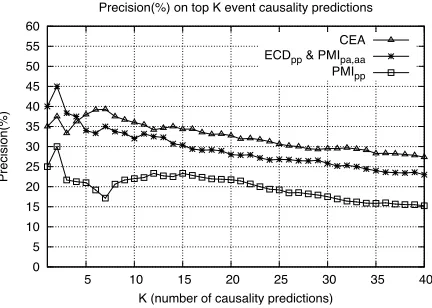
Finally, we also measured the precision of the top K causality C predictions, showing the preci-sion trends in Figure 1. As shown,CEAin general achieves higher precision when compared toP M Ipp
andECDpp&P M Ipa,aa. The trends forC+R
pre-dictions are similar.
Thus far, we had included both verbal and nom-inal predicates in our evaluation. When we repeat the experiments forECDpp&P M Ipa,aa andCEA
on just verbal predicates, we obtained the respective F1-scores of 31.8 and 38.3 on causality relations. The corresponding F1-scores for casuality and relat-edness relations are 35.7 and 43.3. These absolute F1-scores are similar to those in Tables 2 and 3, dif-fering by 1-2%.
7 Analysis
We randomly selected 50 false-positive predictions and 50 false-negativecausality relations to analyze the mistakes made by CEA.
Among the false-positives (precision errors), the most frequent error type (56% of the errors) is that CEA simply assigns a high score to event pairs that are not causal; more knowledge sources are required to support better predictions in these cases. The next largest group of error (22%) involves events contain-ing pronouns (e.g. “he”, “it”) as arguments.
Ap-plying coreference to replace these pronouns with their canonical entity strings or labeling them with semantic class information might be useful.
Among the false-negatives (recall errors), 23% of the errors are due to CEA simply assigning a low score to causal event pairs and more contex-tual knowledge seems necessary for better predic-tions. 19% of the recall errors arises from causal event pairs involving nominal predicates that are not in our list of event evoking noun types (described in Section 3). A related 17% of recall errors involves nominal predicates without any argument. For these, less information is available for CEA to make pre-dictions. The remaining group (15% of errors) in-volves events containing pronouns as arguments.
8 Related Work
9 Conclusion
In this paper, using general tools such as the depen-dency and discourse parsers which are not trained specifically towards our target task, and a minimal set of development documents for threshold tuning, we developed a minimally supervised approach to identify causality relations between events in con-text. We also showed how to incorporate discourse relation predictions to aid event causality predictions through a global inference procedure. There are sev-eral interesting directions for future work, including the incorporation of other knowledge sources such as coreference and semantic class predictions, which were shown to be potentially important in our er-ror analysis. We could also use discourse relations to aid in extracting other semantic relations between events.
Acknowledgments
The authors thank the anonymous reviewers for their insightful comments and suggestions. University of Illinois at Urbana-Champaign gratefully acknowl-edges the support of Defense Advanced Research Projects Agency (DARPA) Machine Reading Pro-gram under Air Force Research Laboratory (AFRL) prime contract No. FA8750-09-C-0181. The first author thanks the Vietnam Education Foundation (VEF) for its sponsorship. Any opinions, findings, and conclusion or recommendations expressed in this material are those of the authors and do not nec-essarily reflect the view of the VEF, DARPA, AFRL, or the US government.
References
Brandon Beamer and Roxana Girju. 2009. Using a bi-gram event model to predict causal potential. In
CI-CLING.
Cosmin Adrian Bejan and Sanda Harabagiu. 2010. Un-supervised event coreference resolution with rich lin-guistic features. InACL.
Nathanael Chambers and Dan Jurafsky. 2008. Unsuper-vised learning of narrative event chains. InACL-HLT. Nathanael Chambers and Dan Jurafsky. 2009. Unsuper-vised learning of narrative schemas and their partici-pants. InACL.
Ming-Wei Chang, Lev Ratinov, Nicholas Rizzolo, and Dan Roth. 2008. Learning and inference with con-straints. InAAAI.
Zheng Chen, Heng Ji, and Robert Haralick. 2009. A pairwise event coreference model, feature impact and evaluation for event coreference resolution. InRANLP
workshop on Events in Emerging Text Types.
Roxana Girju. 2003. Automatic detection of causal re-lations for question answering. InACL workshop on
Multilingual Summarization and Question Answering.
Olga Gurevich, Richard Crouch, Tracy Holloway King, and Valeria de Paiva. 2008. Deverbal nouns in knowl-edge representation. Journal of Logic and Computa-tion, 18, June.
Heng Ji and Ralph Grishman. 2008. Refining event ex-traction through unsupervised cross-document infer-ence. InACL.
Claudia Leacock and Martin Chodorow, 1998. Combin-ing Local Context and WordNet Similarity for Word
Sense Identification. MIT Press.
Ziheng Lin, Hwee Tou Ng, and Min-Yen Kan. 2010. A pdtb-styled end-to-end discourse parser. Tech-nical report. http://www.comp.nus.edu.sg/ linzi-hen/publications/tech2010.pdf.
Marie-catherine De Marneffe, Bill Maccartney, and Christopher D. Manning. 2006. Generating typed dependency parses from phrase structure parses. In
LREC.
Rashmi Prasad, Eleni Miltsakaki, Nikhil Dinesh, Alan Lee, Aravind Joshi, Livio Robaldo, and Bonnie Webber. 2007. The penn discourse tree-bank 2.0 annotation manual. Technical report. http://www.seas.upenn.edu/ pdtb/PDTBAPI/pdtb-annotation-manual.pdf.
Mehwish Riaz and Roxana Girju. 2010. Another look at causality: Discovering scenario-specific contingency relationships with no supervision. InICSC.
N. Rizzolo and D. Roth. 2010. Learning based java for rapid development of nlp systems. InLREC.
Dan Roth and Wen Tau Yih. 2004. A linear program-ming formulation for global inference in natural lan-guage tasks. InCoNLL.
Dan Roth and Wen Tau Yih. 2007. Global inference for entity and relation identification via a linear program-ming formulation. In Lise Getoor and Ben Taskar, ed-itors, Introduction to Statistical Relational Learning. MIT Press.
Josef Ruppenhofer, Michael Ellsworth, Miriam R. L. Petruck, Christopher R. Johnson, and Jan Scheffczyk. 2010. FrameNet II: Extended Theory and Practice. http://framenet.icsi.berkeley.edu.
Yizhou Sun, Ning Liu, Kunqing Xie, Shuicheng Yan, Benyu Zhang, and Zheng Chen. 2007. Causal rela-tion of queries from temporal logs. InWWW.