295
A Study of Incorrect Paraphrases in Crowdsourced User Utterances
Mohammad-Ali Yaghoub-Zadeh-Fard, Boualem Benatallah, Moshe Chai BarukhandShayan Zamanirad
University of New South Wales, Sydney
{m.yaghoubzadehfard,b.benatallah,mosheb,shayanz}@unsw.edu.au
Abstract
Developing bots demands high quality train-ing samples, typically in the form of user ut-terances and their associated intents. Given the fuzzy nature of human language, such datasets ideally must cover all possible utterances of each single intent. Crowdsourcing has widely been used to collect such inclusive datasets by paraphrasing an initial utterance. However, the quality of this approach often suffers from var-ious issues, particularly language errors pro-duced by unqualified crowd workers. More so, since workers are tasked to write open-ended text, it is very challenging to automatically asses the quality of paraphrased utterances. In this paper, we investigate common crowd-sourced paraphrasing issues, and propose an annotated dataset calledPara-Quality, for de-tecting the quality issues. We also investigate existing tools and services to provide baselines for detecting each category of issues. In all, this work presents a data-driven view of incor-rect paraphrases during the bot development process, and we pave the way towards auto-matic detection of unqualified paraphrases.
1 Introduction
With the increasing advances in deep learning as well as natural language processing, a new gen-eration of conversational agents is attracting sig-nificant attention (Dale, 2016). Also known as dialogue systems, virtual assistants, chatbots or simply bots (Campagna et al., 2017; Su et al.,
2017), some advanced bots are now designed to perform complex tasks (e.g.,flight booking), many of which are built using machine learning tech-niques.
At the heart of building such task-oriented botslies the challenge of accurately capturing the user’s intent (e.g.,find cafes in Chicago), and then extracting its entities to service the request (e.g term= “cafes”, location=“Chicago”). However,
its success relies heavily on obtaining both, large and high quality corpora of training samples show-ing mappshow-ings between sample utterances and in-tents. This is necessary given the ambiguous na-ture of the human language (Wasow et al., 2005) and large variations of expressions (Wang et al.,
2012;Zamanirad et al.,2017).
A lack of variations in training samples can re-sult in incorrect intent detection and consequently execution of undesirable tasks (e.g., booking an expensive hotel instead of a cheap room) ( Hen-derson et al., 2018). Likewise, quality issues in the training samples can lead to unmitigated dis-asters (Neff and Nagy, 2016) as it happened to Microsoft’sTay by making a huge number of of-fensive commentaries due to biases in the train-ing data (Henderson et al., 2018). It is there-fore not surprising that research and development into training data acquisition for bots has received significant consideration (Campagna et al., 2017;
Kang et al.,2018).
inexperi-enced crowd-workers may provide misleading, er-roneous, and semantically invalid paraphrases (Li et al., 2016;Campagna et al.,2017). Quality is-sues may also stem from misunderstanding the in-tent or not covering important information such as values of the intent parameters (Su et al.,2017).
The common practice for quality assessment of crowdsourced paraphrases is to design another crowdsourcing task in which workers validate the output from others. However, this approach is costly having to pay for the task twice, making domain-independent automated techniques a very appealing alternative. Moreover, quality control is especially desirable if done before workers submit their paraphrases, since low quality workers can be removed early on without any payment. This can also allow crowdsourcing tasks to provide feed-back to users in order to assist them in generating high quality paraphrases (Nilforoshan et al.,2017;
Nilforoshan and Wu, 2018). To achieve this, it is therefore necessary to automatically recognize quality issues in crowdsourced paraphrases during the process of bot development.
In this paper, we investigate common para-phrasing errors when using crowdsourcing, and we propose an annotated dataset called Para-Qualityin which each paraphrase is labelled with the error categories. Accordingly, this work presents a quantitative data-driven study of incor-rect paraphrases in bot development process and paves the way towardsenhancedautomated detec-tion of unqualified paraphrased utterances. More specifically, our contributions are two-folded:
• We obtained a sample set of 6000 para-phrases using crowdsourcing. To aim for a broad diversity of samples, the initial expres-sions were sourced from 40 expresexpres-sions of highly popular APIs from various domains. Next, we examined and analyzed these sam-ples in order to identify a taxonomy of com-mon paraphrase errors errors (e.g., cheat-ing, misspellcheat-ing, linguistic errors). Accord-ingly, we constructed an annotated dataset calledPara-Quality(using both crowdsourc-ing and manual verification), in which the paraphrases were labeled with a range of dif-ferent categorized errors.
• We investigated existing tools and services (e.g., spell and grammar checkers, language identifiers) to detect potential errors. We for-mulated baselines for each category of errors
to determine if they were capable to automat-ically detect such issues. Our experiments in-dicate that existing tools often have low pre-cision and recall, and hence our results advo-cates the need for new approaches in effective detection of paraphrasing issues.
2 Paraphrase Dataset Collection
Various types of paraphrasing issues have been re-ported in the literature, namely: spelling errors (Braunger et al.,2018), grammatical errors (Jiang et al.,2017;Negri et al.,2012), and missing slot-value (happens when a worker forget to include an entity in paraphrases) (Su et al., 2017). We collected paraphrases for two main reasons: (i) to have a hands-on experience on how incorrect paraphrases are generated, and (ii) to annotate the dataset for building and evaluating paraphrasing quality control systems.
Methodology. We obtained 40 expressions from various domains (i.e. Yelp, Skyscanner, Spotify, Scopus, Expedia, Open Weather, Amazon AWS, Gamil, Facebook, Bing Image Search) indexed in ThingPedia (Campagna et al.,2017) and API-KG1. We then launched a paraphrasing task on Figure-Eight2. Workers were asked to provide three paraphrases for a given expression (Jiang et al.,2017), which is common practice in crowd-sourced paraphrasing to reduce repetitive results (Campagna et al., 2017; Jiang et al., 2017). In the provided expression, parameter values were highlighted and crowd-workers were asked to pre-serve them. Each worker’s paraphrases for an ini-tial utterance are normalized by lowercasing and removing punctuation. Next, the initial utterance and the paraphrases are compared to forbid sub-mitting empty strings or repeated paraphrases, and checked if they contain highlighted parameter val-ues (which is also a common practice to avoid missing parameter values) (Mitchell et al.,2014). We collected paraphrases from workers in English speaking countries, and created a dataset contain-ing 6000 paraphrases (2000 triple-paraphrases) in total3.
3 Common Paraphrasing Issues
To characterize the types of paraphrasing issues, two authors of this paper investigated the
crowd-1
http://apikg.ngrok.io
2https://www.figure-eight.com
sourced paraphrases, and recognized 5 primary categories of paraphrasing issues. However, we only considered paraphrase-level issues related to the validity of a paraphrase without considering dataset-level quality issues such as lexical diver-sity (Negri et al.,2012) and bias (Henderson et al.,
2018).
3.1 Spelling Errors
Misspelling has been reported as one of most com-mon mistakes in paraphrasing (Inaba et al.,2015;
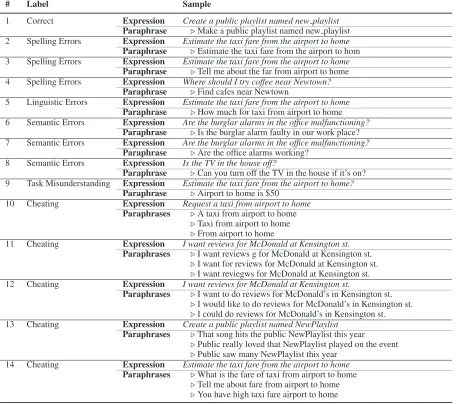
Wang et al., 2012; Chklovski, 2005; Braunger et al., 2018). In our sample set, we also noticed misspellings were generated both intentionally (as an act of cheating to quickly generate a paraphrase such as Example 2 in Table1) and unintentionally (due to a lack of knowledge or a simple mistake such as Example 3 in Table1).
3.2 Linguistic Errors
Linguistic errors are also common in crowd-sourced natural language collections (Jiang et al.,
2017;Negri et al.,2012). Verb errors, preposition errors, vocabulary errors (improper word substitu-tions), and incorrect singular/plural nouns, just to name a few. Moreover, capitalization and article errors seems abundant (e.g., Example 5 in Table
1). Given that real bot users also make such errors, it is important to have linguistically incorrect utter-ances in the training samples (Bapat et al.,2018). However, at a very least, detecting linguistic errors can contribute to quality-aware selection of crowd workers.
3.3 Semantic Errors
This occurs when a paraphrase deviates from the meaning of the initial utterance (e.g.,find cafes in Chicago). As reported in various studies, work-ers may forget to mention parameter values (also known as missing slot)(e.g., find cafes)4 ( Cross-ley et al.,2016;Su et al.,2017;Ravichander et al.,
2017;Wang et al., 2012;Braunger et al., 2018), provide wrong values (e.g.,find cafes in Paris) (Su et al.,2017;Ravichander et al.,2017;Wang et al.,
2012;Negri et al., 2012; Braunger et al., 2018), or add unmentioned parameter values(Wang et al.,
2012) (e.g.,find two cafes in Chicago). Workers may also incorrectly use a singular noun instead of its plural form, and vice versa. For instance,
4
In our task design, this type of error cannot happen since parameter values are checked using regular expressions be-fore submission
in Example 6 of Table1, the paraphrase only asks for the status of one specificburglar alarmwhile the expression asks for the status of all burglar alarms. Making mistakes in paraphrasing comple-mentary forms of words also exists in the crowd-sourced dataset. For instance, in Example 7 of Ta-ble1, assuming that the bot answers the question only by saying “YES” or “NO”, the answer for the paraphrase differs from that of the expression. However, it will make no difference if the bot’s re-sponse is more descriptive (e.g., “it’s working”, “it isn’t working”.) Finally, some paraphrases signif-icantly diverge from expressions. For instance, in Example 8 of Table1, the intent of paraphrase is to turn off the TV; however, that of initial utterance is to query about the TV status.
3.4 Task Misunderstanding
In some cases, workers misunderstood the task and provided translations in their own native lan-guages (referred to asTranslationissues) ( Cross-ley et al.,2016;Braunger et al.,2018;Bapat et al.,
2018), and some mistakenly thought they should provide answers for expressions phrased as ques-tions (referred to asAnsweringissues) such as Ex-ample 9 in Table 1. This occurred even though workers were provided with comprehensive in-structions and examples. We infer that some work-ers did not read the instructions, ignoring the pos-sibility of cheating.
3.5 Cheating
In crowdsourced tasks, collecting paraphrases is not immune to unqualified workers, cheaters, or spammers (Daniel et al., 2018; Crossley et al.,
2016;Chklovski,2005).
# Label Sample
1 Correct Expression Create a public playlist named new playlist
Paraphrase ⊲Make a public playlist named new playlist
2 Spelling Errors Expression Estimate the taxi fare from the airport to home
Paraphrase ⊲Estimate the taxi fare from the airport to hom
3 Spelling Errors Expression Estimate the taxi fare from the airport to home
Paraphrase ⊲Tell me about the far from airport to home
4 Spelling Errors Expression Where should I try coffee near Newtown?
Paraphrase ⊲Find cafes near Newtown
5 Linguistic Errors Expression Estimate the taxi fare from the airport to home
Paraphrase ⊲How much for taxi from airport to home
6 Semantic Errors Expression Are the burglar alarms in the office malfunctioning?
Paraphrase ⊲Is the burglar alarm faulty in our work place?
7 Semantic Errors Expression Are the burglar alarms in the office malfunctioning?
Paraphrase ⊲Are the office alarms working?
8 Semantic Errors Expression Is the TV in the house off?
Paraphrase ⊲Can you turn off the TV in the house if it’s on?
9 Task Misunderstanding Expression Estimate the taxi fare from the airport to home?
Paraphrase ⊲Airport to home is $50
10 Cheating Expression Request a taxi from airport to home
Paraphrases ⊲A taxi from airport to home ⊲Taxi from airport to home ⊲From airport to home
11 Cheating Expression I want reviews for McDonald at Kensington st.
Paraphrases ⊲I want reviews g for McDonald at Kensington st. ⊲I want for reviews for McDonald at Kensington st. ⊲I want reviegws for McDonald at Kensington st.
12 Cheating Expression I want reviews for McDonald at Kensington st.
Paraphrases ⊲I want to do reviews for McDonald’s in Kensington st. ⊲I would like to do reviews for McDonald’s in Kensington st. ⊲I could do reviews for McDonald’s in Kensington st.
13 Cheating Expression Create a public playlist named NewPlaylist
Paraphrases ⊲That song hits the public NewPlaylist this year ⊲Public really loved that NewPlaylist played on the event ⊲Public saw many NewPlaylist this year
14 Cheating Expression Estimate the taxi fare from the airport to home
[image:4.595.73.529.67.471.2]Paraphrases ⊲What is the fare of taxi from airport to home ⊲Tell me about fare from airport to home ⊲You have high taxi fare airport to home
Table 1: Paraphrase Samples
faulty paraphrases after generating some correct paraphrases as shown in Example 14 of Table 1. Based on our observations, the simplest mode of cheating is to add a few random characters to the source sentence as shown in Example 11. Next is adding a few words to the source sentence without much editing as shown in Example 12. Finally, there are cheaters who rewrite and change the sen-tences substantially in a very random way such as Example 13.
4 Dataset Annotation
Next, we designed another crowdsourcing task to annotate the collected paraphrases according to the category of issues devised above. Namely, using following labels: Correct, Semantic Error, Misspelling, Linguistic Error, Translation, An-swering, andCheating. We split the category of
misunderstanding issues intoTranslationand An-sweringbecause they require different methods to detect.
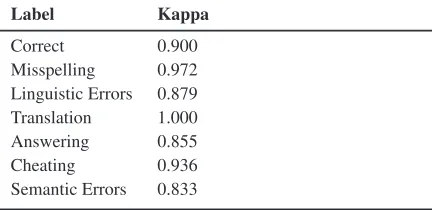
Methodology. In the annotation task, crowd workers were instructed to label each paraphrase with the paraphrasing issues. Next, to further in-crease the quality of annotations5, two authors of this paper manually re-annotated the paraphrases to resolve disagreements between crowd annota-tors. Moreover, contradictory labels (e.g., a para-phrase cannot be labeled both Correct and Mis-spelling simultaneously) were checked to ensure consistency. The overall Kappa test showed a high agreement coefficient between the annota-tors (McHugh,2012) by Kappa being0.85. Table
2 also shows the pair-wise inter-annotator
Label Kappa
Correct 0.900
Misspelling 0.972
Linguistic Errors 0.879
Translation 1.000
Answering 0.855
Cheating 0.936
[image:5.595.306.527.63.188.2]Semantic Errors 0.833
Table 2: Pairwise Inter-Annotator Agreement
ment (Cohen,1960). Next, the authors discussed and revised the re-annotated labels to further in-crease the quality of annotations by discussing and resolving disagreements.
Statistics. Figure 1 shows the frequencies of each label in the crowdsourced paraphrases as well as their co-occurrences in an UpSet plot (Lex et al., 2014) using Intervene (Khan and Mathe-lier,2017). Accordingly we infer that only 61% of paraphrases are labeledCorrect. This plot also shows how many times two labels co-occurred. For example, all paraphrases which are labeled Translation(24 times), are also labeledCheating6.
5 Automatic Error Detection
Automatically detecting paraphrasing issues, es-pecially when done during the crowd task, can minimize the cost of crowdsourcing by eliminat-ing malicious workers, reduceliminat-ing the number of er-roneous paraphrases, and eliminating the need for launching another crowdsourced validation task. Moreover, by detectingMisspellingandLinguistic Errors, users can be provided with proper feed-back to help them improve the quality of para-phrasing by showing the source of error and sug-gestions to address the error (e.g., “Spelling er-ror detected: articl → article”). Detecting Se-mantic Errors, such as missing parameter val-ues, can also help crowd workers to generate high quality correct paraphrases. Automated methods can also be used to identify low quality workers, and particularly cheaters who may generate po-tentially large amount of invalid paraphrases in-tentionally. Moreover, providing suggestions to cheaters will not help and therefore early detection is of paramount.
6
We usedGoogle Translateto check whether they were proper translations or just random sentences in other lan-guages
Spell Checker Precision Recall F1
Aspell8 0.249 0.618 0.354
Hunspell9 0.249 0.619 0.355
MySpell10 0.249 0.619 0.355
Norvig11 0.488 0.655 0.559
Ginger12 0.540 0.719 0.616
Yandex13 0.571 0.752 0.650
Bing Spell Check14 0.612 0.737 0.669
LanguageTool15
0.630 0.727 0.674
Table 3: Comparison of Spell Checkers
In a pre-hoc quality control approach for crowd-sourced paraphrases, the most important metric seems to be theprecisionof detecting invalid para-phrases (Nilforoshan et al.,2017). That is because the main aim of using such a quality control ap-proach is rejecting invalid paraphrases without re-jecting correct ones (Burrows et al., 2013). This is essential because rejecting correct paraphrases would be unfair and unproductive. For instance, sincere and trustful crowd workers might not get paid as a result of false-positives (incorrectly de-tected errors). On the other hand, having a high recallin detecting invalid paraphrases is important to eliminate faulty paraphrases and consequently obtain robust training samples.
Moreover, such a quality control technique should ideally be domain-independent, accessible, and easily-operated to minimize the cost of cus-tomization for a special domain and requiring paid experts (e.g., an open source pre-built machine learning model). In the rest of this section, we examine current tools and approaches and discuss their effectiveness in assessing the paraphrasing issues.
5.1 Spelling Errors
We employed several spell checkers as listed in Table3to examine if they are effective in recog-nizing spelling errors. We looked up Wikipedia, Github, and ProgrammableWeb7to find available tools and APIs for this purpose.
7https://www.programmableweb.com 8http://aspell.net/
9
http://hunspell.github.io/
10http://www.openoffice.org/lingucomponent/dictionary.html 11https://github.com/barrust/pyspellchecker
12
https://www.gingersoftware.com/ grammarcheck
13
https://tech.yandex.ru/speller/
14
https://azure.microsoft.com/en-us/services/cognitive-services/spell-check/
[image:5.595.73.289.64.169.2]0 1000
000
,Q
WH
UVH
FW
LR
Q
)UH
TX
HQ
F\
● ●
● ●
● ●
●
● ●
● ●
● ●
● ●
●
● ●
● ●
● ●
● ●
● ● ʇʥʔʡʦʟʔʧʜʢʡ
ɴʡʦʪʘʥʜʡʚ ʀʜʦʦʣʘʟʟʜʡʚ ʆʘʠʔʡʧʜʖɸʥʥʢʥ
ɿʜʡʚʨʜʦʜʧʖɸʥʥʢʥ ɶʛʘʔʧʜʡʚ ɶʢʥʥʘʖʧ
)UHTXHQF\
●
●
[image:6.595.143.457.64.263.2]● ●
Figure 1: Dataset Label Statistics
Even though detecting misspelled words seems easy with existing automatic spellcheckers, they fall short in a few cases. This can be also con-cluded from Table 3 by considering the preci-sion and recall of each spell checker in detect-ing only paraphrases with misspelldetect-ings. For in-stance, spell checkers are often unable to identify homonyms (Perelman, 2016), incorrectly mark proper nouns and unusual words (Bernstein et al.,
2015), and sometimes do not identify wrong words that are properly spelled (Chisholm and Henry,2005). For instance, in Example 1 of Ta-ble1, the “new playlist” is incorrectly detected as a misspelled word by LanguageTool (the best per-former as listed in Table 3). In Example 3, the word “far” is not detected even though the worker has misspelled the word “fare”. In Example 4, the word “Newtown” (a suburb in Sydney) is mistak-enly detected as a misspelling error. Some of these deficiencies can be addressed. For instance, in the case of spelling errors, assuming that the initial ex-pressions given to the crowd are free of typos, we can ignore false-positives like the “Newtown” and “new playlist”.
5.2 Linguistic Errors
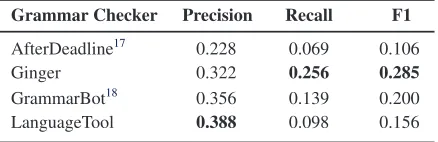
We investigated how well grammar checkers per-form in detecting linguistic errors. We employed several grammar checkers as listed in Table4.
Our experiments shows that spell checkers have both low precision and recall. Perel-man (Perelman, 2016) also conducted several experiments with major commercial and non-commercial grammar checkers, and identified that
Grammar Checker Precision Recall F1
AfterDeadline17 0.228 0.069 0.106
Ginger 0.322 0.256 0.285
GrammarBot18 0.356 0.139 0.200
LanguageTool 0.388 0.098 0.156
Table 4: Comparison of Grammar Checkers
grammar checkers are unreliable. Based on our observations, grammar checkers often fail in de-tecting linguistic errors as shown in Table4. Ex-amples include improper use of words (e.g.,“Who is the latest scientific article of machine learn-ing?”), random sequence of words generated by cheaters (e.g.,“Come the next sing”), and missing articles16 (e.g.,“I’m looking for flight for Tehran to Sydney”). Given these examples, we believe that language models can be used to measure the likelihood of a sequence of words to detect if it is linguistically acceptable.
5.3 Translation
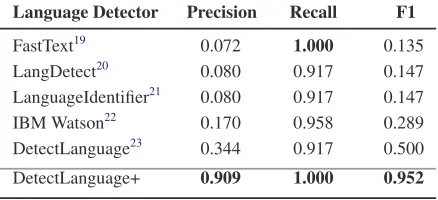
We also investigated several language detectors to evaluate how well they perform when crowd workers use another language instead of English. The results of experiment in Table5indicate that these tools detect almost all sentences in other lan-guages. But they produce lots of false-positives in-cluding for correct English sentences (e.g.,“play next song”). As a result, the tools in our
experi-16
Missing articles in expressions similar to newspaper headlines are not considered error in the dataset (e.g.,“Hotel near Disneyland”)
[image:6.595.308.527.301.372.2]Language Detector Precision Recall F1
FastText19 0.072
1.000 0.135
LangDetect20 0.080 0.917 0.147
LanguageIdentifier21 0.080 0.917 0.147
IBM Watson22 0.170 0.958 0.289
DetectLanguage23 0.344 0.917 0.500
[image:7.595.72.291.65.165.2]DetectLanguage+ 0.909 1.000 0.952
Table 5: Language Detection
ment have low precision in detecting languages as shown in Table5. Most of the false-positives are caused by sentences that contain unusual words such as misspellings and named entities in the sen-tence (e.g., EmailPhilsaying “I got you”).
One possible approach to improve the precision of such tools and APIs is to check if a given para-phrase has spelling errors prior to using language detection tools. We therefore extended the Detect-Language(the best performing tool) by adding a constraint: a sentence is not written in another language unless it has at least two spelling er-rors. This constraint is based on the assumption that spell checkers treat foreign words as spelling errors and a sentence has at least two words to be called a sentence. This approach ( Detect-Language+ in Table 5) significantly reduced the number of false-positives and thus improved pre-cision.
5.4 Answering
Dialog Acts (DAs) (Jurafsky and Martin, 2018), also known as speech acts, represent general in-tents of an utterance. DA tagging systems la-bel utterances with a predefined set of utterance types (Directive, Commissive, Informative, etc (Mezza et al., 2018).) Based on the fact that DAs must remain consistent during paraphrasing, we employed a state-of-art, domain-independent, pre-trained DA tagger proposed in (Mezza et al.,
2018). For example, if an initial utterance is a question (e.g., are there any cafes nearby?) it is acceptable to paraphrase it into a directive sen-tence (e.g., find cafes nearby.), but its speech act cannot beinformative(e.g., there is a cafe on the corner.). Overall, due to the lack of any other
19
https://fasttext.cc/blog/2017/10/02/blog-post.html(Joulin et al.,2017)
20
https://pypi.org/project/langdetect/
21
https://github.com/saffsd/langid.py
22
https://console.bluemix.net/apidocs/language-translator#identify-language
23https://ws.detectlanguage.com
domain-independent DA tagger for the English language, we only investigated this tagger. We found that it has a precision of 2% with recall of 63%. This shows that detecting speech acts is a very challenging task especially for domain-independent environments.
Advances in speech act detection and availabil-ity of public speech act datasets can assist in de-tecting this category of the paraphrasing issues. Moreover, it is feasible to automatically generate pairs of questions and answers by mining datasets in the fields of Question Answering and dialog systems. Automatically building such pairs can help building a dataset which is diverse enough to be used in practice. Such a dataset can be fed into deep learning algorithms to yield better per-formance in detectingAnsweringissues.
5.5 Semantic Errors & Cheating
To the best our knowledge, there is not yet an approach to distinguish between categories of se-mantically invalid paraphrases. Paraphrase detec-tion and textual semantic similarity (STS) meth-ods are designed to measure how two pieces of text are semantically similar. However, they do not dif-ferentiate between different types of errors (e.g., Cheating,Answering,Semantic Errors) in our set-tings. As such, these techniques are not directly applicable. In the rest of this section, we focus on building machine learning models to detect the paraphrasing errors.
learn-Category # Description
N-gram Features 12 N-gram overlap, exclusive longest common prefix n-gram overlap, and SUMO all proposed in (Joao et al.,2007), as well as Gaussian, Parabolic, and Trigonometric proposed in (Cordeiro et al.,2007), Paraphrase In N-gram Changes (PINC) (Chen and Dolan,2011), Bilingual Eval-uation Understudy (BLEU) (Papineni et al.,2002), Google’s BLEU (GLEU) (Wu et al.,2016), NIST (Doddington,2002), Character n-gram F-score (CHRF) (Popovi´c,2016), and the length of the longest common subsequence.
Semantic Similarity 15 Semantic Textual Similarity (Fakouri-Kapourchali et al.,2018), Word Mover’s Distance ( Kus-ner et al., 2015) between words embeddings of expression and paraphrase, cosine similarity and euclidean distance between vectors of expression and paraphrase generated by Sent2Vec (Pagliardini et al.,2018), InferSent (Conneau et al.,2017), Universal Sentence Encoder (Cer et al.,2018), Concatenated Power Mean Embeddings (R¨uckl´e et al.,2018), tenses of sentences, pronoun used in the paraphrase, and miss-matched named entities
Others 11 Number of spelling and grammatical errors detected by LanguageTool, task completion time, edit distance, normalized edit distance, word-level edit distance (Fakouri-Kapourchali et al.,
[image:8.595.72.290.282.339.2]2018), length difference between expression and paraphrase (in characters and words), and sim-ple functions to detect questions, imperative sentences, and answering.
Table 6: Summary of Feature Library
Classifier Precision Recall F1
Random Forest 0.947 0.129 0.226
Maximum Entropy 0.564 0.157 0.246
[image:8.595.70.290.370.427.2]Decision Tree 0.527 0.350 0.421
Table 7: AutomaticAnsweringDetection
Classifier Precision Recall F1
Random Forest 0.798 0.120 0.209
Decision Tree 0.377 0.276 0.319
[image:8.595.72.290.457.551.2]Naive Bayes 0.171 0.783 0.280
Table 8: AutomaticSemantic ErrorDetection
Classifier Precision Recall F1
SVM 0.878 0.223 0.356
K-Nearest Neighbor 0.871 0.248 0.386
Random Forest 0.843 0.546 0.663
Maximum Entropy 0.756 0.440 0.557
Decision Tree 0.632 0.566 0.597
Naive Bayes 0.473 0.426 0.449
Table 9: AutomaticCheatingDetection
ing techniques are data thirsty (Goodfellow et al.,
2016; Yang et al., 2018a), to use these kinds of models and eliminate the burden of manual feature engineering, much more expressions are needed. Instead, we benefited from the state-of-art sen-tence encoders via Transfer Learning as listed in Table6.
Table7, 8, and9demonstrate the performance of various classifiers (excluding classifiers with F1 being less than0.2) for each of paraphrasing issues
using 10-fold cross validation. To keep the clas-sifiers domain-independent, we split the dataset based on the expressions without sharing any
para-phrases of a single expression between the test and train samples. It can be seen that automat-ically detecting these quality issues is very chal-lenging; even the best performing classifier has a very low F1 score especially for detecting Answer-ingandSemantic Errorissues. Based on manual exploration, we also found that the classifiers fail to recognize complex cheating behaviours such as Example 13 in Table 1 as discussed in Sec-tion 3. Therefore, new approaches are required to accurately detect paraphrasing issues. Based on our explorations and a prior work (McCarthy et al.,2009), we postulate that accurately detecting linguistic errors such as grammatically incorrect paraphrases can play indispensable role in detect-ing cheatdetect-ing behaviours. Moreover, advances in measuring semantic similarity between sentences can help differentiate between semantically in-valid paraphrases and correct ones.
5.6 Incorrect Paraphrases Detection
We also assessed the performance of detecting in-correct paraphrases regardless of their categories. In this setting, we labeled all incorrect sentences with a single label (“Incorrect”) regardless of their categories. Table 10 demonstrates the per-formance of various classifiers. Detecting incor-rect paraphrases is useful for post-hoc quality con-trol to remove incorrect paraphrases after crowd-sourcing paraphrases and consequently eliminate the need for crowdsourced validation task.
6 Related Work
Classifier Precision Recall F1
K-Nearest Neighbor 0.799 0.341 0.478
Random Forest 0.781 0.551 0.646
Maximum Entropy 0.721 0.489 0.583
SVM 0.709 0.289 0.411
Decision Tree 0.633 0.585 0.608
Naive Bayes 0.574 0.557 0.565
Table 10: Automatic Incorrect Paraphrase Detection
an annotated dataset for assessing quality issues of paraphrased user expressions. Nevertheless, our work is related to the areas of (i) quality control in crowdsourced natural language datasets; and (ii) semantic similarity.
Quality Control. Quality can be assessed after or before data acquisition. While post-hoc meth-ods evaluate quality when all paraphrases are col-lected, pre-hoc methods can prevent submission of low quality paraphrases during crowdsourcing. The most prevalentpost-hoc approach is launch-ing a verification task to evaluate crowdsourced paraphrases (Negri et al., 2012; Tschirsich and Hintz, 2013). However, automatically remov-ing misspelled paraphrases (Wang et al., 2012) and discarding submissions from workers with low/high task completion time (Ma et al., 2017) are also applied in literature. Machine learning models have also been explored in plagiarism de-tection systems to assure quality of crowdsourced paraphrases (Crossley et al.,2016;Burrows et al.,
2013).
Pre-hocmethods, on the other hand, rely on on-line approaches to asses the quality of the data pro-vided during crowdsourcing (Nilforoshan et al.,
2017). Sophisticated techniques are required to avoid generation of erroneous paraphrases (e.g., automatic feedback generation was used to assist crowd workers in generating high quality para-phrases). Precog (Nilforoshan et al.,2017) is an example of such tools which is based on a su-pervised method for generating automatic writ-ing feedback for multi-paragraph text– designed mostly for crowdsourced product reviews ( Nil-foroshan et al.,2017;Nilforoshan and Wu,2018). This paper aims for paving the way for building automaticpre-hocapproaches, and providing ap-propriate online feedback to users to assist them in generating appropriate paraphrases. However, the provided dataset can also be used for build-ingpost-hocmethods to automatically omit faulty paraphrases.
Semantic Similarity. Measuring similarity be-tween units of text plays an important role in Natural Language Processing (NLP). Several NLP tasks have been designed to cover various aspects and usages of textual similarity. Examples in-clude textual entailment, semantic textual simi-larity (Yang et al., 2018b; Fakouri-Kapourchali et al.,2018), paraphrase detection (Agarwal et al.,
2018; Issa et al., 2018), duplicate question de-tection (Mannarswamy and Chidambaram, 2018) tasks which are studied well in NLP. Moreover, re-cent success in sentence encoders (e.g., Sent2Vec (Pagliardini et al., 2018), InferSent (Conneau et al., 2017), Universal Sentence Encoder (Cer et al.,2018), and Concatenated Power Mean Em-beddings (R¨uckl´e et al., 2018)) can be exploited to detect paraphrasing issues with more accuracy. These techniques can be borrowed with some do-main specific considerations to build automatic quality control systems for detecting low quality paraphrases.
7 Conclusion
In this paper, we employed a data-driven ap-proach to investigate and quantitatively study var-ious crowdsourced paraphrasing issues. We dis-cussed how automatic techniques for detecting various quality issues can assist the manual pro-cess of crowdsourced paraphrasing. We collected an annotated dataset of crowdsourced paraphras-ing in which each paraphrase is labeled with asso-ciated paraphrasing issues. We used this dataset to assess existing tools and techniques and to deter-mine whether they are sufficient for automatically detecting such issues. Our experiments revealed that automated detection of errors in paraphrases is a challenging task. As a future work, we will be working on devising automated-assisted meth-ods for detection of paraphrasing issues. This will be based on a two-way feedback mechanism: gen-erating feedback for workers, while at the same time the system learns from the (data of) users to improve its machine intelligence. In time, we en-vision increasingly less dependence on users.
acknowledgements
References
Basant Agarwal, Heri Ramampiaro, Helge Langseth, and Massimiliano Ruocco. 2018. A deep network model for paraphrase detection in short text mes-sages. Information Processing & Management, 54(6):922–937.
Rucha Bapat, Pavel Kucherbaev, and Alessandro Boz-zon. 2018. Effective crowdsourced generation of training data for chatbots natural language under-standing. InWeb Engineering, Cham. Springer In-ternational Publishing.
Michael S. Bernstein, Greg Little, Robert C. Miller, Bj¨orn Hartmann, Mark S. Ackerman, David R. Karger, David Crowell, and Katrina Panovich. 2015.
Soylent: A word processor with a crowd inside. vol-ume 58, pages 85–94, New York, NY, USA. ACM.
Patricia Braunger, Wolfgang Maier, Jan Wessling, and Maria Schmidt. 2018. Towards an automatic assess-ment of crowdsourced data for nlu. InLREC.
Steven Burrows, Martin Potthast, and Benno Stein. 2013.Paraphrase acquisition via crowdsourcing and machine learning. volume 4, pages 43:1–43:21, New York, NY, USA. ACM.
Giovanni Campagna, Rakesh Ramesh, Silei Xu, Michael Fischer, and Monica S. Lam. 2017. Al-mond: The architecture of an open, crowdsourced, privacy-preserving, programmable virtual assistant. InProceedings of the 26th International Conference on World Wide Web, WWW ’17, pages 341–350, Re-public and Canton of Geneva, Switzerland. Interna-tional World Wide Web Conferences Steering Com-mittee.
Daniel Cer, Yinfei Yang, Sheng-yi Kong, Nan Hua, Nicole Limtiaco, Rhomni St John, Noah Constant, Mario Guajardo-Cespedes, Steve Yuan, Chris Tar, et al. 2018. Universal sentence encoder. arXiv preprint arXiv:1803.11175.
David L. Chen and William B. Dolan. 2011. Col-lecting highly parallel data for paraphrase evalua-tion. InProceedings of the 49th Annual Meeting of the Association for Computational Linguistics: Hu-man Language Technologies - Volume 1, HLT ’11, pages 190–200, Stroudsburg, PA, USA. Association for Computational Linguistics.
Wendy A. Chisholm and Shawn Lawton Henry. 2005.
Interdependent components of web accessibility. In Proceedings of the 2005 International Cross-Disciplinary Workshop on Web Accessibility (W4A), W4A ’05, pages 31–37, New York, NY, USA. ACM.
Timothy Chklovski. 2005. Collecting paraphrase cor-pora from volunteer contributors. In Proceedings of the 3rd International Conference on Knowledge Capture, K-CAP ’05, pages 115–120, New York, NY, USA. ACM.
Jacob Cohen. 1960. A coefficient of agreement for nominal scales. Educational and psychological measurement, 20(1):37–46.
Alexis Conneau, Douwe Kiela, Holger Schwenk, Lo¨ıc Barrault, and Antoine Bordes. 2017. Supervised learning of universal sentence representations from natural language inference data. InProceedings of the 2017 Conference on Empirical Methods in Nat-ural Language Processing, pages 670–680, Copen-hagen, Denmark. Association for Computational Linguistics.
Joao Cordeiro, Gael Dias, and Pavel Brazdil. 2007. A metric for paraphrase detection. In Computing in the Global Information Technology, 2007. ICCGI 2007. International Multi-Conference on, pages 7– 7. IEEE.
Scott Crossley, Luc Paquette, Mihai Dascalu, Danielle S. McNamara, and Ryan S. Baker. 2016. Combining click-stream data with nlp tools to better understand mooc completion. In Pro-ceedings of the Sixth International Conference on Learning Analytics & Knowledge, LAK ’16, pages 6–14, New York, NY, USA. ACM.
Robert Dale. 2016. The return of the chatbots.Natural Language Engineering, 22(5):811–817.
Florian Daniel, Pavel Kucherbaev, Cinzia Cappiello, Boualem Benatallah, and Mohammad Allahbakhsh. 2018. Quality control in crowdsourcing: A survey of quality attributes, assessment techniques, and as-surance actions. volume 51, pages 7:1–7:40, New York, NY, USA. ACM.
George Doddington. 2002. Automatic evaluation of machine translation quality using n-gram co-occurrence statistics. In Proceedings of the Sec-ond International Conference on Human Language Technology Research, HLT ’02, pages 138–145, San Francisco, CA, USA. Morgan Kaufmann Publishers Inc.
Roghayeh Fakouri-Kapourchali, Mohammad-Ali Yaghoub-Zadeh-Fard, and Mehdi Khalili. 2018. Semantic textual similarity as a service. InService Research and Innovation, pages 203–215, Cham. Springer International Publishing.
Ian Goodfellow, Yoshua Bengio, Aaron Courville, and Yoshua Bengio. 2016. Deep learning, volume 1. MIT press Cambridge.
Mark Hall, Eibe Frank, Geoffrey Holmes, Bernhard Pfahringer, Peter Reutemann, and Ian H. Witten. 2009. The weka data mining software: An up-date. volume 11, pages 10–18, New York, NY, USA. ACM.
Society, AIES ’18, pages 123–129, New York, NY, USA. ACM.
Michimasa Inaba, Naoyuki Iwata, Fujio Toriumi, Takatsugu Hirayama, Yu Enokibori, Kenichi Taka-hashi, and Kenji Mase. 2015. Statistical response method and learning data acquisition using gami-fied crowdsourcing for a non-task-oriented dialogue agent. InRevised Selected Papers of the 6th Inter-national Conference on Agents and Artificial Intel-ligence - Volume 8946, ICAART 2014, pages 119– 136, Berlin, Heidelberg. Springer-Verlag.
Fuad Issa, Marco Damonte, Shay B Cohen, Xiaohui Yan, and Yi Chang. 2018. Abstract meaning rep-resentation for paraphrase detection. In Proceed-ings of the 2018 Conference of the North American Chapter of the Association for Computational Lin-guistics: Human Language Technologies, Volume 1 (Long Papers), volume 1, pages 442–452.
Youxuan Jiang, Jonathan K. Kummerfeld, and Wal-ter S. Lasecki. 2017. Understanding task design trade-offs in crowdsourced paraphrase collection. In Proceedings of the 55th Annual Meeting of the Association for Computational Linguistics (Volume 2: Short Papers), pages 103–109. Association for Computational Linguistics.
Cordeiro Joao, Dias Ga¨el, and Brazdil Pavel. 2007. New functions for unsupervised asymmetrical para-phrase detection. Journal of Software, 2(4):12–23.
Armand Joulin, Edouard Grave, Piotr Bojanowski, and Tomas Mikolov. 2017. Bag of tricks for efficient text classification. InProceedings of the 15th Con-ference of the European Chapter of the Association for Computational Linguistics: Volume 2, Short Pa-pers, pages 427–431. Association for Computational Linguistics.
D Jurafsky and JH Martin. 2018. Dialog systems and chatbots.Speech and language processing.
Yiping Kang, Yunqi Zhang, Jonathan K Kummerfeld, Lingjia Tang, and Jason Mars. 2018. Data collec-tion for dialogue system: A startup perspective. In
Proceedings of the 2018 Conference of the North American Chapter of the Association for Computa-tional Linguistics: Human Language Technologies, Volume 3 (Industry Papers), volume 3, pages 33–40.
Aziz Khan and Anthony Mathelier. 2017. Intervene: a tool for intersection and visualization of multiple gene or genomic region sets. BMC bioinformatics, 18(1):287.
Matt Kusner, Yu Sun, Nicholas Kolkin, and Kilian Weinberger. 2015. From word embeddings to docu-ment distances. InInternational Conference on Ma-chine Learning, pages 957–966.
Alexander Lex, Nils Gehlenborg, Hendrik Strobelt, Romain Vuillemot, and Hanspeter Pfister. 2014. Up-set: visualization of intersecting sets. IEEE trans-actions on visualization and computer graphics, 20(12):1983–1992.
Guoliang Li, Jiannan Wang, Yudian Zheng, and Michael J Franklin. 2016. Crowdsourced data man-agement: A survey. IEEE Transactions on Knowl-edge and Data Engineering, 28(9):2296–2319.
Xiao Ma, Trishala Neeraj, and Mor Naaman. 2017.
A computational approach to perceived trustworthi-ness of airbnb host profiles.
Sandya Mannarswamy and Saravanan Chidambaram. 2018. Geminio: Finding duplicates in a question haystack. InAdvances in Knowledge Discovery and Data Mining, pages 104–114, Cham. Springer Inter-national Publishing.
Philip M. McCarthy, Rebekah H. Guess, and Danielle S. McNamara. 2009. The components of paraphrase evaluations. Behavior Research Meth-ods, 41(3):682–690.
Mary L McHugh. 2012. Interrater reliability: the kappa statistic.Biochemia medica: Biochemia med-ica, 22(3):276–282.
Stefano Mezza, Alessandra Cervone, Evgeny Stepanov, Giuliano Tortoreto, and Giuseppe Riccardi. 2018. Iso-standard domain-independent dialogue act tagging for conversational agents. In
Proceedings of the 27th International Conference on Computational Linguistics, pages 3539–3551. Association for Computational Linguistics.
Margaret Mitchell, Dan Bohus, and Ece Kamar. 2014. Crowdsourcing language generation templates for dialogue systems. Proceedings of the INLG and SIGDIAL 2014 Joint Session, pages 172–180.
Gina Neff and Peter Nagy. 2016. Automation, algo-rithms, and politics— talking to bots: symbiotic agency and the case of tay. International Journal of Communication, 10:17.
Matteo Negri, Yashar Mehdad, Alessandro Marchetti, Danilo Giampiccolo, and Luisa Bentivogli. 2012. Chinese whispers: Cooperative paraphrase acquisi-tion. InLREC, pages 2659–2665.
Hamed Nilforoshan, Jiannan Wang, and Eugene Wu. 2017. Precog: Improving crowdsourced data quality before acquisition. CoRR, abs/1704.02384.
Hamed Nilforoshan and Eugene Wu. 2018. Leverag-ing quality prediction models for automatic writ-ing feedback. In Proceedings of the Twelfth In-ternational Conference on Web and Social Media, ICWSM 2018, Stanford, California, USA, June 25-28, 2018., pages 211–220.
Matteo Pagliardini, Prakhar Gupta, and Martin Jaggi. 2018. Unsupervised learning of sentence embed-dings using compositional n-gram features. In
Kishore Papineni, Salim Roukos, Todd Ward, and Wei-Jing Zhu. 2002. Bleu: A method for automatic eval-uation of machine translation. In Proceedings of the 40th Annual Meeting on Association for Com-putational Linguistics, ACL ’02, pages 311–318, Stroudsburg, PA, USA. Association for Computa-tional Linguistics.
Les Perelman. 2016. Grammar checkers do not work.
WLN: A Journal of Writing Center Scholarship, 40(7-8):11–20.
Maja Popovi´c. 2016. chrf deconstructed: beta param-eters and n-gram weights. In Proceedings of the First Conference on Machine Translation: Volume 2, Shared Task Papers, pages 499–504. Association for Computational Linguistics.
Abhilasha Ravichander, Thomas Manzini, Matthias Grabmair, Graham Neubig, Jonathan Francis, and Eric Nyberg. 2017. How would you say it? elic-iting lexically diverse dialogue for supervised se-mantic parsing. InProceedings of the 18th Annual SIGdial Meeting on Discourse and Dialogue, pages 374–383.
Andreas R¨uckl´e, Steffen Eger, Maxime Peyrard, and Iryna Gurevych. 2018. Concatenatedp-mean word
embeddings as universal cross-lingual sentence rep-resentations. CoRR, abs/1803.01400.
Yu Su, Ahmed Hassan Awadallah, Madian Khabsa, Patrick Pantel, Michael Gamon, and Mark Encar-nacion. 2017. Building natural language interfaces to web apis. InProceedings of the 2017 ACM on Conference on Information and Knowledge Man-agement, CIKM ’17, pages 177–186, New York, NY, USA. ACM.
Martin Tschirsich and Gerold Hintz. 2013. Leveraging crowdsourcing for paraphrase recognition. In Pro-ceedings of the 7th Linguistic Annotation Workshop and Interoperability with Discourse, pages 205–213.
William Yang Wang, Dan Bohus, Ece Kamar, and Eric Horvitz. 2012. Crowdsourcing the acquisition of natural language corpora: Methods and observa-tions. In Spoken Language Technology Workshop (SLT), 2012 IEEE, pages 73–78. IEEE.
Thomas Wasow, Amy Perfors, and David Beaver. 2005. The puzzle of ambiguity. Morphology and the web of grammar: Essays in memory of Steven G. La-pointe, pages 265–282.
Yonghui Wu, Mike Schuster, Zhifeng Chen, Quoc V. Le, Mohammad Norouzi, Wolfgang Macherey, Maxim Krikun, Yuan Cao, Qin Gao, Klaus Macherey, Jeff Klingner, Apurva Shah, Melvin Johnson, Xiaobing Liu, Lukasz Kaiser, Stephan Gouws, Yoshikiyo Kato, Taku Kudo, Hideto Kazawa, Keith Stevens, George Kurian, Nishant Patil, Wei Wang, Cliff Young, Jason Smith, Jason Riesa, Alex Rudnick, Oriol Vinyals, Gregory S. Corrado, Macduff Hughes, and Jeffrey Dean. 2016.
Google’s neural machine translation system: Bridg-ing the gap between human and machine translation.
CoRR, abs/1609.08144.
Jie Yang, Thomas Drake, Andreas Damianou, and Yoelle Maarek. 2018a. Leveraging crowdsourcing data for deep active learning an application: Learn-ing intents in alexa. In Proceedings of the 2018 World Wide Web Conference, WWW ’18, pages 23– 32, Republic and Canton of Geneva, Switzerland. International World Wide Web Conferences Steer-ing Committee.
Yinfei Yang, Steve Yuan, Daniel Cer, Sheng-Yi Kong, Noah Constant, Petr Pilar, Heming Ge, Yun-hsuan Sung, Brian Strope, and Ray Kurzweil. 2018b.
Learning semantic textual similarity from conver-sations. InProceedings of The Third Workshop on Representation Learning for NLP, pages 164–174. Association for Computational Linguistics.