Word Sense Disambiguation Based on Structured Semantic Space*
Ji D o n g h o n g H u a n g C h a n g n i n g
D e p a r t m e n t o f C o m p u t e r Science T s i n g h u a University Beijing, 100084, P. R. China Email: j d h @ s 1 0 0 0 e . c s . t s i n g h u a . e d u . c n
h c n @ m a i l . t s i n g h u a . e d u . c n
Abstract
In this paper, we propose a framework, structured semantic space, as a foundation for word sense disarnbiguation tasks, and present a strategy to identify the correct sense of a word in some context based on the space. The semantic space is a set of multidimensional real-valued vectors, which formally describe the contexts of words. Instead of locating all word senses in the space, we only make use of mono-sense words to outline it. We design a merging procedure to establish the dendrogram structure of the space and give an heuristic algorithm to find the nodes (sense clusters) corresponding with sets of similar senses in the dendrogram. Given a word in a particular context' the context would activate some clusters in the dendrogram, based on its similarity with the contexts of the words in the clusters, then the correct sense of the word could be determined by comparing its definitions with those of the words in the clusters.
1. Introduction
Word sense disambiguation has long been one of the major concerns in natural language processing area (e.g., Bruce et al., 1994; Choueka et al., 1985; Gale et al., 1993; McRoy, 1992; Yarowsky 1992, 1994, 1995), whose aim is to identify the correct sense of a word in a particular context, among all of
its senses defined in a dictionary or a thesaurus. Undoubtedly, effective disambiguation techniques are of great use in many natural language processing tasks, e.g., machine translation and information retrieving (Allen, 1995; Ng and Lee, 1996; Resnik,
1995), etc.
Previous strategies for word sense disambiguation mainly fall into two categories: statistics-based method and exemplar-based method. Statistics-based method often requires large-scale corpora (e.g., Hirst, 1987; Luk, 1995), sense-tagging or not, monolingual or aligned bilingual, as training data to specify significant clues for each word sense. The method generally suffers from the problem of data sparseness. Moreover, huge corpora, especially sense-tagged or aligned ones, are not generally available in all domains for all languages.
Exemplar-based method makes use of typical contexts (exemplars) of a word sense, e.g., verb- noun collocations or adjective-noun collocations, and identifies the correct sense of a word in a particular context by comparing the context with the exemplars (Ng and Lee, 1996). Recently, some kinds of learning techniques have been applied to cumulatively acquire exemplars form large corpora (Yarowsky, 1994, 1995). But ideal resources from which to learn exemplars are not generally available for any languages. Moreover, the effectiveness of this method on disambiguating words in large-scale corpora into fine-grained sense distinctions needs to be further investigated (Ng and Lee, 1996).
A common assumption held by both approaches is that neighboring words provide strong and consistent clues for the correct sense o f a target word in some context. In this paper, we also hold the same assumption, but start from a different point. We see the senses o f all words in a particular language as forming a space, which we call semantic space, for any word o f the language, each o f its senses is regarded as a point in the space. So the task o f disambiguating a word in a particular context is to locate an appropriate point in the space based on the context.
Now that word senses can be generally suggested by their distributional contexts, we model senses with their contexts. In this paper, we formalize the contexts as a kind o f multidimensional real-valued vectors, so the semantic space can be seen as a vector space. The similar idea about representing contexts with vectors has been proposed by Schuetze (1993), but what his work focuses on is the contexts o f words, while what we concern is the contexts o f word senses. Furthermore, his formulation o f contexts is based on word frequencies, while we formalize them with semantic codes given in a thesaurus and their salience with respect to senses.
It seems that we should first have a large-scale sense-tagged corpus in order to build semantic space, but establishing such a corpus is obviously too time- consuming. To simplify it, we only try to outline the semantic space by locating the mono-sense words in the space, rather than build it completely by spotting all word senses in the space.
N o w that we don't try to specify all word senses in the semantic space, for a word in a particular context, it may be the case that we cannot directly spot its correct sense in the space, because the space may not contain the sense at all. But we could locate some senses in the space which are similar with it according to their contexts, and based on their definitions given in a dictionary, we could make out the correct sense o f the word in the context.
In our implementation, we first build the
semantic space based on the contexts o f the mono- sense words, and structure the senses in the space as a dendrogram, which we call structured semantic space. Then we make use o f an heuristic method to determine some nodes in the dendrogram which correspond with sets o f similar senses, which we call sense clusters. Finally, given a target word in a particular context, some clusters in the dendrogram can be activated by the context, then we can make use o f the definitions o f the target word and the words ~ in the clusters to determine its correct sense in the context.
The remainder o f the paper is organized as follows: Section 2 defines the notion o f semantic space, and discuss how to outline it by establishing the context vectors for mono-sense words. Section 3 examines the structure o f the semantic space, and introduces algorithms to merge the senses into a dendrogram and specify the nodes in it which correspond with sets o f similar senses. Section 4 discusses the disambiguation procedure based on the contexts. Section 5 describes some experiments and their results. Section 6 presents some conclusions and discusses the future work
2 Semantic Space
In general, a word may have several senses and may appear in several different kinds o f contexts. From a point o f empirical view, we suppose that each sense o f a word is corresponded with a particular kind o f context it appears, and the similarity between word senses can be measured by their corresponding contexts. For a particular kind o f language, we regard its semantic space as the set o f all word senses o f the language, with similarity relation between them.
Now that word senses are in accordance with their contexts, we u s e the contexts to model word senses. Due to the unavailability o f large~-scale
i Because the senses in the semantic space are of mono-sense words, we don't distinguish "words" from "senses" strictly here.
sense-tagged corpus, we try to outline the semantic space by only taking into consideration the mona- sense words, instead of locating all word senses in the space.
In order to formally represent word senses, we formalize the notion of context as multidimensional real-valued vectors. For any word, we first annotate its neighboring words within certain distances in the corpus with all of their semantic codes in a thesaurus respectively, then make use of such codes and their salience with respect to the word to formalize its contexts. Suppose w is a mona-sense word, and there are n occurrences of the word in a corpus, i.e., wt, we . . . . , w , , (1) lists their neighbor words within d word distances respectively.
(l)
al,.d, al,-(d.l), . . . , al,-i
az-a, az-ca-O . . . . , az.t
an,~, a,,-(d-O . . . an, a
W I at, l, al,2, . . . , a l , d
we a z t , az2 . . . aza
Wn an, l, an, e, . . . , an, d
Suppose C r is the set of all the semantic codes defined in a thesaurus, for any occurrence wt, 1_< i.~_n, let NCi. be the set of all the semantic codes of its neighboring words which are given in the thesaurus, for any c ~ Cr, we define its salience with respect to w, denoted as Sal(c, w), as (2).
(2) Sal(c, w ) -
Itw, Nc,)I
n
So we can build a context vector for w as (3), denoted as CVw, whose dimension is
[Cr[.
Chinese thesaurus, iii) a Chinese corpus consisting of 80 million Chinese characters. In the Chinese dictionary, 37,824 words have only one sense, among which only 27,034 words occur in the corpus, we select 15,000 most frequent mona=sense words in the corpus to build the semantic space for Chinese. In the Chinese thesaurus, the words are divided into 12 major classes, 94 medium classes and 1428 minor classes respectively, and each class is given a semantic code, we select the semantic codes for the minor classes to formalize the contexts of the words. So k=[ CT[ =1428.
3. Structure of Semantic Space
• Due to the similarity/dissimilarity relation between word senses, those in the semantic space cannot be distributed in an uniform way. We suppose that the senses form some clusters, and the senses in each cluster are similar with each other. In order to make out the clusters, we first construct a dendrogram of the senses based on their similarity, then make use of an heuristic strategy to select some appropriate nodes in the dendrogram which most likely correspond with the clusters.
Now that word senses occur in accordance with their contexts, we measure their similarity /dissimilarity by their contexts. For any two senses st, seeS, let cvt=(xt xe ... xk), cve=( Yt Ye ... yk) be their context vectors respectively, we define the distance between st and se; denoted as dis(st, se), based on the cosine of the angle between the two vectors.
(4) dis(st, s2)=l-cos(cvt, cv2) 2
(3) cvw=<Sal(ct, w), Sal(c2, w) . . . Sal(ck, w)>
where k= I CTI.
When building the semantic space for Chinese language, we make use of the following resources, i) Xiandai Hanyu Cidian(1978), a Modem Chinese Dictionary, ii) Tongyici Cilin(Mei et al, 1983), a
Obviously, dis(st, s2) is a normalized coefficient: its value ranges from 0 to 1.
Suppose S is the set of the mona-senses in the
189
semantic space, for any sense si~S, we create a
preliminary node
dj, and let Idjl=l, which denotes the number of senses related with d~. Suppose D bethe set of all
preliminary nodes, the
following is the algorithm to construct the dendrogram.0 . 1 0 5
O. 078
O. 04.3 O. 058
ai s h a n g / /b e ishartg/ /b e it ong/ /b e iai/
O. 067
~.t~
/ shartgbei/ / a:i.t o r t ~
Fig. 1 A subtree of the dendrogram for Chinese mono-sense words
Algorithm 1.
Procedure
Den-construct(D)
begin
i) select dr and
d2
among all in D, whosedistance
is the smallest; ii) merge dl and d2 into a new node d,and let Idl=l dl I+l de l;
iii) remove dr and d2 from D, and put d into D;
iv) compute the context vector of d based on the vectors of dl and
d/;
v) go to i) until there is only one node;
end;
Obviously, the algorithm is a bottom-up merging procedure. In each step, two closest nodes are selected and merged into a new one. In
(n-1)th
step, where n is the number of word senses in S, a final node is produced. The complexity of the algorithm is O(n 3) when implementing it directly, but can bereduced t o
O(n 2)
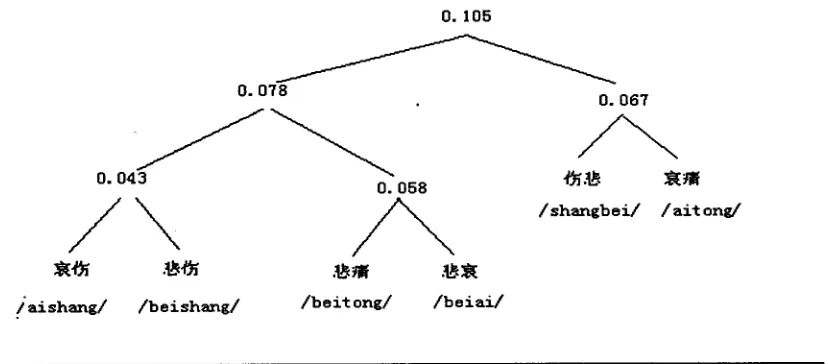
by sorting the distances between all nodes in each previous step.Fig. 1 is a sub-tree of the dendrogram we build for Chinese. It contains six mono-sense words, whose English correspondences are
sad, sorrowful,
etc. In the sub-tree, we mark each non-preliminary node with the distance between the two merged sub- nodes, which we also refer to as the
weight
of the node.It can be proved that the distances between the merged nodes in earlier merging steps are smaller than those in later merging steps 4. According to the similarity/dissimilarity relation between the senses, there should exist a
level
across the dendrogram such that the weights of the nodes above it are bigger, while the weights of the nodes below it smaller, in other words, the ratio between themean
weight
of the nodes above the level and that of the nodes below the level is the biggest. Furthermore we suppose that the nodes immediately below the level correspond with the clusters of similar senses. So, in3 W e call (zl z2 ... zk ) the context vector o f d, w h e r e for all i,
l_<i_<k, zi = ([ d, ]e x, +1
d21-
y,)/I d I.4 This can b e seen f r o m the fact that the context vector o f d is
a linear c o m p o s i t i o n o f the vectors o f dl and
d2.
[image:4.612.104.518.119.301.2]order to make out the sense clusters, we only need to determine the level.
Unfortunately, the complexity of determining such a level is exponential to the edges in the dendrogram, which demonstrates that the problem is hard. So we adopt an heuristic strategy to determine an optimal level.
Suppose T is the dendrogram,
sub_T
is the sub- tree of T, which takes the same root as T, we also use T andsub T
to denote the sets of non- preliminary nodes in T and insub_T
respectively, for any d e T, letWei(d)
be the weight of the node d, we define anobject function, as
(5):(5)
~ Wei ( d) /
d~sub T
/ s u b _ 7~
Oby(sub_T)- Wei(d)/
de(T-sub T) /
- /JZ- ub
/* v.L
is not a sense cluster */ elseTee-- Tc ~
{v.L};/* v.L
is a sense cluster */ ifObj(sub T+v.R)>Obj(sub T)
then
Clustering(v.R, s u b T)
/* v.R
is not a sense cluster */ else Tc¢-- Tc u {v.R};/* v.R
is a sense cluster */ end;The algorithm is a depth-first search procedure. Its complexity is O(n), where n is the number of the leaf nodes in the dendrogram, i.e., the number of the mono-sense words in the semantic space.
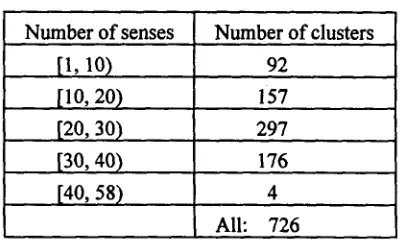
When building the dendrograrn for the Chinese semantic space, we found 726 sense clusters in the space. The distribution of the senses in the clusters is demonstrated in Table 1.
where the numerator is the
mean weight
of the nodes insub_T,
while the denominator is themean
weight
of the nodes inT-sub_T.
In order to specify the sense clusters, we only need to determine a sub-tree of T which makes (5) get its biggest value. We adopt depth-first search strategy to determine the sub-tree. Suppose
vo
is the root ofT, for anyveT,
we usev.L andv.R
to denote its two sub-nodes, let Tc be the set of all the nodes corresponding with the sense clusters, we can get Tc byClustering(vo, Nlff)
calling the following procedure.Algorithm 2
Clustering(v, sub_T)
begin
sub_T~ sub_T+ {v} ;
/* add node v to the subtree*/ if
Obj(sub_T+v.L)>Obj(sub_T)
then
Clustering(v.L, subT)
5 NIL is a preliminary value for sub_T, which demonstrates the tree includes no nodes.
Number of senses Number of clusters
[1, 10)
[10, 20)
[20, 30 )
[30, 40)
,
[40, 58),
92
157 297 176 4
All: 726
Table 1. The distribution of senses in the clusters
4. Disambiguation Procedure
Given a word in some context, we suppose that some clusters in the space can be
activated
by the context, which reflects the fact that the contexts of the clusters are similar with the given context. But the given context may contain much noise, so there may be some activated clusters in which the senses are not similar with the correct sense of the word in the given context. But due to the fact that the given context can suggest the correct sense of the word, there should be clusters, among all activated ones, in which the senses are similar with the correct sense. [image:5.612.313.515.353.478.2]To make out these clusters, we make use of the definitions of the words in the Modem Chinese Dictionary, and determine the correct sense of the word in the context by measuring the similarity between their definitions.
percent 1
0.9 0.8
0.7 0.6 0.5 0.4
0.3 0.2 0.1 0
0
90.2~3.66-/0.
8 7 " 9 0 % / . . 7 0 . 6 0
'/'21"20¢'2-30% a %, ~ ,
0.1 0.2 0.3 0.4 0.5
distance
4.1 Activation
Given a word w in some context, we consider the context as consisting of n words to the left of the word, i.e., w.,,, w.(,. 0 .... , w.l and n words to the right of the word, i.e., wl, w2, w3 ... w,,. We make use of the semantic codes given in the Chinese thesaurus to
. . . , - . . . . ,,nnnno/_ l n n o / ^ 1 0 0 %
. l l . # v / o ~ u . u v / 0 J o . I J T l l r . . . - . . . .
I I ! I I
0.6 0.7 0.8 0.9 1
Fig.2 The distribution ofdisl(clu~, w).
create a context vector to formally model the context,. Suppose NCw be the set of all semantic codes of the words in the context, then cvw=<x~, x2 ... x p , where if c~eNC,, then x~=l; otherwise x~=O.
For any cluster clu in the space, let cvau be its context vector, we also define its distance from w based on the cosine of the angle between their context vectors as (6).
(6) disl(clu, w)=l-cos(cvdu, cvw)
We say clu is activated, if disl(clu, w).~dl, where dt is a threshold. Here we don't define the activated cluster as the one which makes disl(clu, w) smallest, this is because that the context may contain much noise, and the senses in the cluster which makes disj(clu, w) smallest may not be similar with the very sense of the word in the context.
To estimate a reasonable value for dl, we can compute the distance between the context vector of
each mono-sense word occurrence in the corpus and the context vector of the cluster containing the word, then select a reasonable value ford1 based on these distances as the threshold. Suppose C L U is the set of all sense clusters in the space, O is the set of all occurrences of the mono-sense word in the corpus, for any w e O , let cluw be the sense cluster containing the sense in the space, we compute all distances dist(cluw, w), for all w e O . It should be the case that most values for disl(cluw, w) will be smaller than a threshold, but some will be bigger, even close to 1, this is because most contexts in which the mono- sense words occur would contain meaningful words for the senses, while other contexts contain much noise, and less words, even no words in the contexts are meaningful for the senses.
When estimating the parameter di for the Chinese semantic space, we let n=5, i.e., we only take 5 words to the left or the right of a word as its context. Fig. 2 demonstrates the distribution of the values of disl(cluw, w), where X axle denotes the
distance, and Y axle denotes the percent of the distances whose values are smaller than x~[0, 1] among all distances. We produce a function fix) to model the distribution based on commonly used smoothing tools and locate its inflection point by settingf"(x)=0. Finally we get x=0.378, and let it be the threshold dr.
(7) sat(c, clu) =
I{w,[c
n
We call (8) definition vector ofclu, denoted as dvd~.
(8) dvau =
< sal(cl, clu), sal(c2, clu) ... sal(ck, clu)>
4.2 Definition-Based Disambiguation
Given a word w in some context c, suppose CLU~ is the set of all the clusters in the semantic space
activated by the context, the problem is to determine the correct sense of the word in the context, among all of its senses defined in the modem Chinese dictionary.
The activation of the clusters in CLUw by the context c demonstrates that c is similar with the contexts of the clusters in CLUw, so there should be at least one cluster in CLU~, in which the senses are similar with the correct sesne of w in c. On the other hand, now that the senses in a cluster are similar in meaning, their definitions in the dictionary should contain similar words, which can be characterized as holding the same semantic codes in the thesaurus. So the definitions of all the words in the clusters contain strong and meaningful information about the very sense of the word in the context.
We first construct two definition vectors to model the definitions of all the words in a cluster and the definitions of w based on the semantic codes of the definition words 6, then determine the sense of w in the context by measuring the similarity between each definition of w and the definitions of all the words in a cluster.
For any clu~CLU~, suppose clu={wJ l_<ig_n}, let C~ be the set of all semantic codes of all the words in w;s definition, CT be defined as above, i.e., the set of all the semantic codes in the thesaurus, for
any CeCT, we define its salience with respect to clu,
denoted as sal(c, clu), as (7).
6 The words in the definitions are called definition words.
Suppose Sw is the set o f w ' s senses defined in the dictionary, for any sense s~Sw, let Cs be the set of all the semantic codes of its definition words, we call
dvs=<xl, x2 ... xk> definition vector of s, where for all i, ifci~C,, x~=l; otherwise x~=0.
We define the distance between an activated cluster in the semantic space and the sense of a word as (9) again in terms of the cosine of the angle between their definition vectors.
(9)
dis2(clu,
s)=l-cos(dvau, dv,)Intuitively the distance can be seen as a measure of the similarity between the definitions of the words in the cluster and each definition of the word. Compared with the distance defined in (6), this distance is to measure the similarity between definitions, while the distance in (6) is to measure the similarity between contexts.
Thus it is reasonable to select the sense s* among all as the correct one in the context, such that there exists clu'~CLUw, and dis2(clu*, s*) gets the smallest value as (10), for clu~CLUw, and s~Sw.
(1 O)
M I N
dis 2 ( clu, s)
c I u e C L U w ,s~.S,,5. Experiments and Results
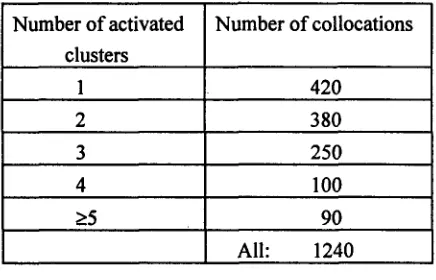
collocation dictionary, some words are listed as its collocations. We see these collocations as the contexts of the word senses, and evaluate our algorithm automatically. We randomly select 40 ambiguous words contained in the dictionary, and there are altogether 1240 words listed as their collocations. Table 2 lists the distribution of the number of the sense clusters activated by these collocation words.
Table 3 lists the distribution of the smallest distances between the word senses and the activated clusters, and the accuracy of the disambiguation. From Table 3, we can see that smaller distances between the senses and the activated clusters mean higher accuracy of disambiguation.
Number of activated Number of collocations clusters
1 420
2 380
3 250
4 100
~5 90
[image:8.612.90.308.296.436.2]All: 1240
Table 2. Collocation words and the number of activated clusters
occurrences of the word in the corpus, and implement our algorithm on them respectively. The result is 66 occurrences are tagged with the second sense (6 occurrences wrongly tagged), and the others tagged with the first sense (2 occurrences wrongly tagged). The overall accuracy is 92%. To examine the reasonableness of the result, we formalize four context vectors again based on semantic codes to represent the contexts of four groups of the occurrences:
cvl: the context o f the 60 occurrences correctly tagged with the second sense;
cv2: the context o f the 6 occurrences wrongly tagged with the second sense;
cv3: the context o f the 32 occurrences correctly tagged with the first sense;
cv4: the context o f the 2 occurrences wrongly
tagged with the first sense;
The distances between these vectors are listed in Table 4:
CVL
cv2
cv3
cv4
CV I CV 2
0.364 0.364
0.914 0.825
0.941
cv3 cv4
0.914 0.825 0.941 0.876 0.320 0.876 0.320
Distance area [0.0 0.2) [0.2 0.4) [0.4 0.6) [0.6 1.0)
Percent(%) 27.3
Accuracy(%) 94.2
58.2 90.5
9.6 40.5
4.9 10.4
Table 3. Distribution of distances and disambiguation accuracy
In another experiment, we examine the ambiguous Chinese word --0-~ (/danbo/7), it has two senses, one is less clothes taken by a man, the other is thin and weak. We randomly select 100
7 The Piyin of the word.
Table 4. The distances between the contexts of the four groups
From Table 4, we find that both the distance between cvl and cv4 and that between cv2 and cv3 are very high, which reflects the fact that they are not similar with each other. This demonstrates that one main reason for tagging errors is that the considered contexts of the words contain less meaningful information for determining the correct senses.
In third experiment, we implement our algorithm on 100 occurrences of the ambiguous word f~l~ (/bianji/), it also has two senses, one is editor, the other is to edit. We find the tagging accuracy is very low. To explore the reason for the errors, we
compute the distances between its definitions and those of the words in the activated clusters, and find that the smallest distances fall in [0.34, 0.87]. This demonstrates that another main reason for the tagging errors is the sparseness of the clusters in the space.
6. Conclusions and Future w o r k
In this paper, we propose a formal resource of language, structured semantic space, as a
foundation for word sense disambiguation tasks. For a word in some context, the context can activate some sense clusters in the semantic space, due to its similarity with the contexts of the senses in the clusters, and the correct sense o f the word can be determined by comparing its definitions and those of the words in the clusters.
Structured semantic space can be seen as a general model to deal with WSD problems, because it doesn't concern any language-specific knowledge at all. For a language, we can first make use of its mono-sense word to outline its semantic space, and produce a dendrogram according to their similarity, then word sense disambiguation can be carried out based on the dendrogram and the definitions of the words given in a dictionary.
As can be seen that ideal structured semantic space should be homogeneous, i.e., the clusters in it should be well-distributed, neither too dense nor too sparse. If it is too dense, there may be too many clusters activated by a context. On the contrary, if it is too sparse, there may be no clusters activated by a context, even if there is any, it may be the case that the senses in the clusters are not similar with the correct sense of the target word. So future work includes how to evaluate the homogeneity of the semantic space, how to locate the non-homogeneous areas in the space, and how to make them homogeneous.
Obviously, the disambiguation accuracy will be reduced if the cluster contains less words, because less words in the cluster will lead to invalidity of its definition vectors in revealing the similar words
included in their definitions. But it seems to be impossible to ensure that every cluster contains enough words, with only mono-sense words taken into consideration when building the semantic space. In order to make the cluster contain more words, we must make use of ambiguous words. So future work includes how to add ambiguous words into clusters based on their contexts.
Another problem is about the length of the contexts to be considered. With longer contexts taken into consideration, there may be too many clusters activated. But if we consider shorter contexts, the meaningful information for word sense disambiguation may be lost. So future work also includes how to make an appropriate decision on the length of the contexts to be considered, meanwhile make out the meaningful information carried by the words outside the considered contexts.
References
J. Allen. 1995. Natural Language Understanding,
The Benjamin/Cumming Publishing Company, INC.
Rebecca Bruce, Janyce Wiebe. 1994. Word sense disarnbiguation using decomposable models. In
Proceedings of the 32nd Annual Meeting of the Association for Computational Linguistics, Las
Cruces, New Mexico.
Y. Choueka and S. Lusignan. 1985. Disambiguation by short contexts. Computers and the Humanities, 19:147-157.
William Gale, Kenneth Ward Church, and David Yarowsky. 1992. Estimating upper and lower bounds on the performance of word-sense disambiguation programs. In Proceedings of the 30th Annual Meeting of the Association for Computational Linguistics, Newark, Delaware. Graeme Hirst. 1987. Semantic Interpretation and
the Resolution of Ambiguity. Cambridge University Press, Cambridge.
Alpha K.Luk. 1995. Statistical sense disambiguation with relatively small corpora using dictionary definitions. In Proceedings of the 33th Annual
Meeting of the Association for Computational
Linguistics,
Cambridge, Massachusetts.Susan W. McRoy. 199Z Using multiple knowledge
sources for w o r d sense disambiguation.
Computational Linguistics,
18(1): 1-30.J.J.Mei et al. 1983.
TongYiCi CiLin (A Chinese
Thesaurus),
Shanghai Cishu press, Shanghai. Hwee Tou Ng and Hian Beng Lee. 1996. Integratingmultiple knowledge sources to disambiguating word sense: an exemplar-based approach. In
Proceedings of the 34th Annual Meeting of the
Association for Computational Linguistics.
P. Resnik. 1995. Disambiguating noun groupings
with respect to WordNet senses, In
Proceedings
of 3rd Workshop on Very Large Corpus,
MIT,USA,
54-68.H. Schutz¢. 1993. Part-of-speech induction from
scratch. In
Proceedings of the 31st Annual
Meeting of the Association for Computational
Linguistics,
Columbus, OH.Xiandai Hanyu Cidian. (a Modern Chinese
Dictionary).
1978. Shnagwu Press, Beijing (in Chinese).D. Yarowsky. 1992. Word sense disambiguation using statistical models of Roget's categories
trained on large corpora,
Proceedings of
COLING '92,
Nantas, France, 454-460.David Yarowsky. 1994. Decision lists for lexical ambiguity resolution: Application to accent
restoration in Spanish and French. In
Proceedings of the 32nd Annual Meeting of the
Association for Computational Linguistics, Las
Cruces, New Mexico.
David Yarowsky. 1995. Unsupervised word sense disambiguation rivaling supervised methods. In
Proceedings of the 33th Annual Meeting of the
Association for Computational Linguistics,
Cambridge, Massachusetts.
Zhang et al. 1994.