Proceedings of NAACL-HLT 2019, pages 407–413 407
Learning Interpretable Negation Rules via Weak Supervision at
Document Level: A Reinforcement Learning Approach
Nicolas Pr¨ollochs Oxford-Man Institute
University of Oxford
Stefan Feuerriegel ETH Zurich
Dirk Neumann University of Freiburg
Abstract
Negation scope detection is widely performed as a supervised learning task which relies upon
negation labels at word level. This suffers
from two key drawbacks: (1) such granular an-notations are costly and (2) highly subjective, since, due to the absence of explicit linguistic resolution rules, human annotators often dis-agree in the perceived negation scopes. To the best of our knowledge, our work presents the first approach that eliminates the need for
word-level negation labels, replacing it
in-stead with document-levelsentiment
annota-tions. For this, we present a novel strategy for learning fully interpretable negation rules via weak supervision: we apply reinforcement learning to find a policy that reconstructs nega-tion rules from sentiment predicnega-tions at docu-ment level. Our experidocu-ments demonstrate that our approach for weak supervision can effec-tively learn negation rules. Furthermore, an out-of-sample evaluation via sentiment analy-sis reveals conanaly-sistent improvements (of up to 4.66 %) over both a sentiment analysis with (i) no negation handling and (ii) the use of word-level annotations from humans. More-over, the inferred negation rules are fully in-terpretable.
1 Introduction
Negations are a frequently utilized linguistic tool for expressing disapproval or framing negative content with positive words. Neglecting nega-tions can lead to false attribunega-tions (Morante et al.,
2008) and, moreover, impair accuracy when an-alyzing natural language; e. g., in information re-trieval (Cruz D´ıaz et al.,2012;Rokach et al.,2008) and especially in sentiment analysis (Cruz et al.,
2015;Wiegand et al.,2010). Hence, even simple
heuristics for identifying negation scopes can yield substantial improvements in such cases (Jia et al.,
2009).
Negation scope detection is sometimes imple-mented as unsupervised learning (e. g.,Pr¨ollochs et al., 2016), while a better performance is com-monly achieved via supervised learning (see our supplements for a detailed overview): the resulting models thus learn to identify negation scopes from word-level annotations (e. g.,Li and Lu,2018; Re-itan et al., 2015). We argue that this approach suffers from inherent drawbacks. (1) Such gran-ular annotations are costly and, especially at word level, a considerable number of them is needed. (2) Negation scope detection is highly subjec-tive (Councill et al., 2010). Due to the absence of explicit linguistic rules for resolutions, exist-ing corpora often come with annotation guidelines (Morante and Blanco,2012;Morante and Daele-mans, 2012). Yet there are considerable differ-ences: some corpora were labeled in a way that negation scopes consist of single text spans, while others allowed disjoint spans (Fancellu et al.,
2017). More importantly, given the absence of universal rules, human annotators largely disagree in their perception of what words should be la-beled as negated.
Motivational experiment. Since prevalent
cor-pora were labeled only by a single rater, we now establish the severity of between-rater discrepan-cies. For this, we carried out an initial analy-sis of 500 sentences from movie reviews.1 Each sentence contained at least one explicit negation phrase from the list of Jia et al. (2009), such as
“not”or“no.” Two human raters were then asked
to annotate negation scopes. They could choose an arbitrary selection of words and were not re-stricted to a single subspan, as recommended by
Fancellu et al. (2017). The annotations resulted in large differences: only 50.20 % of the words were simultaneously labeled as “negated” by both raters. Based on this experimental evidence, we showcase there is no universal definition of nega-tion scopes (rather, human annotanega-tions are likely to be noisy or even error-prone) and thus highlight the need for further research.
Contributions. To the best of our knowledge,
our work presents the first approach that elimi-nates the need forword-levelannotations of nega-tion labels. Instead, we perform negation scope detection merely by utilizing shallow annotations at document level in the form of sentiment la-bels (e. g., from user reviews). Our novel strat-egy learns interpretable negation rules via weak supervision: we apply reinforcement learning to find a policy that reconstructs negation rules based on sentiment prediction at document level (as op-posed to conventional word-level annotations).
In our approach, a single document d comes with a sentiment label yd. The document
con-sists of Nd words, wd,1, . . . , wd,Nd, where the number of words can easily surpass several hun-dreds. Based on the sentiment value, we then need to make a decision (especially out-of-sample) for each of theNdwords, whether or not it should be
negated. In this case, asingle sentiment value is outnumbered by potentiallyhundredsof negation decisions, thus pinpointing to the difficulty of this task. Formally, the goal is to learn individual la-bels ad,i ∈ {Negated,¬Negated} for each word
wd,i. Rewards are the errors in sentiment
predic-tion at document level.
Strengths.Our approach exhibits several
favor-able features that overcome shortcomings found in prior works. Among them, it eliminates the need for manual word-level labels. It thus avoids the detrimental influence of subjectivity and mis-interpretation. Instead, our model is solely trained on a document-level variable and can thus learn domain-specific particularities of the given prose. The inferred negation rules are fully interpretable while documents can contain multiple instances of negations with arbitrary complexity, sometimes nested or consisting out of disjoint text spans. De-spite facing several times more negation decisions than sentiment labels, our experiments
demon-strate that this problem can be effectively learned through reinforcement learning.
Evaluation. Given the considerable
inconsis-tencies in human annotations of negation scopes and the lack of universal rules, we regard the “true” negation scopes as unobservable. Hence, we later compare the identified negation scopes with those from rater 1 and 2 only as a sensitiv-ity check because of the fact that both raters have only 50.2 % overlap. Instead, we choose the fol-lowing evaluation strategy. We concentrate on the performance of negation scope detection as a sup-porting tool in natural language processing where its primary role is to facilitate more complex learn-ing tasks such as sentiment analysis. Therefore, we report the performance improvements in sen-timent analysis resulting from our approach. For a fair comparison, we use baselines that only rely upon the same information as our weak supervi-sion (and thus have no access to word-level nega-tion labels). Our performance is even on par with a supervised classifier that can exploit richer labels during training.
2 Learning Negation Scope Detection via Weak Supervision
Intuition. The choice of reinforcement learning
for weak supervision might not be obvious at first, but, in fact, it is informed by theory: it imitates the human reading process as stipulated by cognitive reading theory (Just and Carpenter, 1980), where readers iteratively process information word-by-word.
States and actions. In each learning iteration,
the reinforcement learning agent observes the cur-rent statesi = (wi, ai−1)that we engineer as the combination of thei-th wordwiin a document and
the previous actionai−1. This specification
estab-lishes arecurrentarchitecture whereby the previ-ous negation can pass on to the next word. At the same time, this allows for nested negations, as a word can first introduce a negation scope and an-other subsequent negation can potentially revert it. After observing the current state, the agent chooses an action at from of two possibilities:
(1) it can set the current word to negated or (2) it can mark it asnot negated. Hence, we ob-tain the following set of possible actions A =
{Negated,¬Negated}. Based on the selected ac-tion, the agent receives a reward, ri which
Q(si, ai). This state-action function is then used
to infer the best possible actionaiin each statesi,
i. e., the optimal policyπ∗(si, ai).
Reward function.The rewardridepends upon
the correlation between a given a document-level label (e. g., a rating in movie reviews) and the sen-timent of a document. We predict the sensen-timentSd
of documentdusing a widely-used sentiment rou-tine based on the occurrences of positively- and negatively-opinionated terms (seeTaboada et al.,
2011). If a term is negated by the policy, the po-larity of the corresponding term is inverted, i. e., positively opinionated terms are counted as nega-tive and vice versa. In the following,Sd0 denotes the document sentiment without considering nega-tions;Sdπ the sentiment when incorporating nega-tions based on policyπ.
When processing a document, we cannot actu-ally compute the reward until we have processed all words. Therefore, we set the reward before the last word toc≈0, i. e.,ri =cfori= 1, . . . , Nd− 1. For the final word, the agent compares its per-formance in predicting the document label based on sentiment without considering negationsSd0 to the sentiment when incorporating negations based on the current policy π∗. The former is defined by the absolute difference between the document labelydand the predicted sentiment without
nega-tionsSd0, whereas the latter is defined by the ab-solute difference betweenydand the adjusted
sen-timent using the current policySdπ. Then the dif-ference between these values returns the terminal rewardrNd. Thus the reward is
ri =
(0, ifa
i=Neg andi < Nd, c, ifai=¬Neg andi < Nd,
yd−S0d
− |yd−Sπd|, ifi=Nd,
with a constant c (we use c = 0.005) that adds a small reward for default (i. e., non-negating) ac-tions to avoid overfitting.
Q-learning. During the learning process2, the
agent then successively observes a sequence of words in which it can select between exploring new actions or taking the current optimal one. This choice is made byε-greedy selection accord-ing to which the agent explores the environment by selecting a random action with probabilityεor,
2
We use Watkin’sQ(λ)with eligibility traces; seeSutton and Barto(1998) for details. At the beginning, we initialize the action-value functionQ(s, a) to zero for all states and actions. This also controls our default action when encoun-tering unknown states or out-of-vocabulary (OOV) words. In such cases, the non-negated action is preferred.
alternatively, exploits the current knowledge with probability1−ε.
3 Experiments
Datasets. We use the following benchmark
datasets with document-level annotations from the literature (cf. Hogenboom et al., 2011;Pr¨ollochs et al.,2016;Wiegand et al.,2010):
IMDb: movie reviews from the Internet Movie Database archive, each annotated with an overall rating at document level (Pang and Lee,2005).
Airport: user reviews of airports from Skytrax, each annotated with an overall rating at document level (P´erezgonz´alez and Gilbey,2011).
Ad hoc: financial announcements with com-plex, domain-specific language (Pr¨ollochs et al.,
2016), labeled with the daily abnormal return of the corresponding stock.
Learning parameters.We perform 4000
learn-ing iterations with a higher exploration rate as given by the following parameters3: exploration ε= 0.001, discount factorγ = 0 and learning rate α= 0.005. In a second phase, we run 1000 itera-tions for fine-tuning with explorationε= 0.0001, discount factorγ= 0 and learning rateα= 0.001.
Policy learning. For each dataset, the
rein-forcement learning process converges to a sta-tionary policy that shows reward fluctuations be-low 0.05 %. As part of a benchmark, we study the mean squared error (MSE) between yd and
the predicted sentiment Sd0 when leaving nega-tions untreated as our benchmark. For all datasets, the in-sample MSE decreases substantially (see Figure1), demonstrating the effectiveness of our learning approach. The reductions number to 14.93 % (IMDb), 16.77 % (airport), and 0.91 % (ad hoc). The latter is a result of the considerably more complex language in financial statements.
Performance in Sentiment Analysis. We use
10-fold cross validation to compare the out-of-sample performance in sentiment analysis of rein-forcement learning to benchmarks without word-level labels from previous works. The bench-marks consists of rules (Hogenboom et al.,2011;
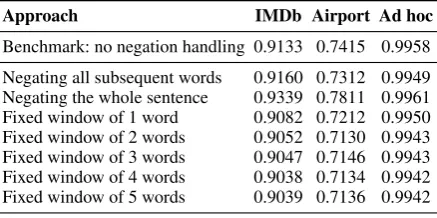
Taboada et al.,2011), which search for the occur-rence of specific cues based on pre-defined lists and then invert the meaning of a fixed number of surrounding words. Table1compares the out-of-sample MSE between predicted sentiment and the
3Further details regarding the learning parameters are
(a) IMDb
Benchmark (no negation handling)
0.80 0.85 0.90 0.95 1.00
0 1000 2000 3000 4000 5000 Iteration
M
S
E
(b) Airport
Benchmark (no negation handling)
0.6 0.7 0.8 0.9
0 1000 2000 3000 4000 5000 Iteration
M
S
E
(c) Ad hoc
Benchmark (no negation handling)
0.980 0.985 0.990 0.995 1.000
0 1000 2000 3000 4000 5000 Iteration
M
S
E
Figure 1: MSE between the document label and predicted sentiment across different learning iterations using 10-fold cross validation. Additional lines in black from smoothing.
document-level label:4
IMDb: Negating a fixed window of the next 4 words achieves the lowest error among all rules, similar toDadvar et al.(2011). This rule reduces the MSE of the benchmark with no negation han-dling by 1.05 %. Our approach works even more accurately, and dominates all of the rules, reducing the out-of-sample MSE by at least 4.60 %.
Airport: Our method decreases the MSE by 4.66 % compared to the best-performing rule (negating a fixed window of the next 4 words).
Ad hoc: Even for complex financial language, reinforcement learning exceeds this benchmark method by 0.19 % in terms of out-of-sample MSE. Altogether, our weak supervision improves sen-timent analysis consistently across all datasets.5
Approach IMDb Airport Ad hoc
Benchmark: no negation handling 0.9133 0.7415 0.9958
Negating all subsequent words 0.9160 0.7312 0.9949 Negating the whole sentence 0.9339 0.7811 0.9961 Fixed window of 1 word 0.9082 0.7212 0.9950 Fixed window of 2 words 0.9052 0.7130 0.9943 Fixed window of 3 words 0.9047 0.7146 0.9943 Fixed window of 4 words 0.9038 0.7134 0.9942 Fixed window of 5 words 0.9039 0.7136 0.9942
Proposed reinforcement learning 0.8622 0.6798 0.9923 for weak supervision
Table 1: Out-of-sample MSE between sentimentSdπ
and the document labelyd. Lowest error in bold.
Comparison to human raters. For reasons
of completeness, our supplements report the over-lap with both human raters from our motivational experiment, which is in the range of 18.8 % to
4We also experimented with performance comparisons in
a classification task, yet our approach also yields consistent improvements in this evaluation.
5We also investigated the relationship between prediction
performance and text length, finding only minor effects.
25.2 %. However, these numbers should be treated with caution, as we remind that there is no univer-sal definition of negation scopes and even the two human annotations reveal on 50.2 %. Moreover, our approach was not learned towards reconstruct-ing these human annotations, since we focused on rules that achieve the greatest benefit in sentiment analysis.
Comparison to word-level classifiers.We also
compared weak supervision against a supervised HMM classifier fromPr¨ollochs et al. (2016) that draws upon granular word-level negation labels. Here we report the sentiment analysis on IMDb in order to be able to use the domain-specific nega-tion labels from IMDb text snippets of our ini-tial experiment. In comparison to our reinforce-ment learning, the supervised classifier results in a 5.79 % higher (and thus inferior) MSE. Yet our weak supervision circumvents costly word-level annotations.
Interpretability. Our method yields negation
rules that are fully interpretable: one simply has to assess the state-action functionQ(si, ai). Table2
provides an example excerpt for the document
“this beautiful movie isn’t good but fantastic.”
[image:4.595.77.525.63.172.2] [image:4.595.73.292.467.576.2]State=(wi, ai−1) Negated ¬Negated π∗(si, ai)
(this,¬Negated) 0.0114 0.0502 ¬Negated (beautiful,¬Negated) 0.0081 0.0779 ¬Negated (movie,¬Negated) 0.0039 0.0506 ¬Negated (isn’t,¬Negated) 0.0700 0.0456 Negated (good,Negated) 0.0578 0.0322 Negated (but,Negated) 0.0120 0.0365 ¬Negated (fantastic,¬Negated) −0.0181 0.1708 ¬Negated
Table 2: Excerpt of state-action functionQ(si, ai)
ac-tionsA={Negated,¬Negated}and the learned policy
π∗for IMDb reviews.
4 Related Work
State-of-the-art methods for detecting, handling and interpreting negations can be grouped into dif-ferent categories (cf.Pr¨ollochs et al.,2015,2016;
Rokach et al.,2008).
Rule-based approaches are among the most common due to their ease of implementation and solid out-of-the-box performance. These usu-ally suppose a forward influence of negation cues based on which they invert the meaning of the whole sentence or a fixed number of subsequent words (Hogenboom et al., 2011). Furthermore, they can also incorporate syntactic information in order to imitate subject and object (Padmaja et al.,2014;Chowdhury and Lavelli,2013). Nega-tion rules have been found to work effectively across different domains and rarely need fine-tuning (Taboada et al.,2011). However, rule-based approaches entail several drawbacks, as the list of negations must be pre-defined and the selection criterion according to which rule a rule is chosen is usually random or determined via cross vali-dation. In addition, rules cannot effectively cope with implicit expressions or particular, domain-specific characteristics.
Generative probabilistic models (e. g., hidden Markov models or conditional random fields) can partially overcome these shortcomings (Li and Lu,
2018; Reitan et al., 2015; Rokach et al., 2008), such as the difficulty of recognizing implicit nega-tions. These process narrative language word-by-word and move between hidden states represent-ing negated and non-negated parts. Such mod-els can adapt to domain-specific language, but re-quire more computational resources and rely upon ex ante transition probabilities. Although vari-ants based on unsupervised learning avoid the need for any labels, practical applications reveal inferior performance compared to supervised ap-proaches (Pr¨ollochs et al., 2015). The latter
usu-ally depend on manual labels at a granular level, which are not only costly but suffer from subjec-tive interpretations (Fancellu et al.,2017).
A third category of methods links the polar-ity shift effect of negations more closely to sen-timent analysis tasks at sentence or document level. For example, text parts can be classified into a polarity-unshifted part and a polarity-shifted part according to certain rules (Li and Huang,
2009). Sentiment classification models are then trained using both parts (Li et al.,2010). Alterna-tively, rule-based algorithms can extract sentences with inconsistent sentiment and omit them from standard sentiment analysis procedures (Orimaye et al.,2012). Reversely, antonym dictionaries have been used to generate sentiment-inverted texts to classify polarity in pairs (Xia et al., 2016). Al-though such data expansion techniques usually en-hance the performance of sentiment analysis, they require either complex linguistic knowledge or ex-tra human annotations (Xia et al.,2015).
Research gap. In contrast to these methods,
we propose a novel strategy for learning negation rules via weak supervision. Our model uses re-inforcement learning to reconstruct negation rules based on an document-level variable and does not require any kind of manual word-level labeling or precoded linguistic patterns. It is able to recognize explicit as well as implicit negations, while avoid-ing the influence of subjective interpretations.
5 Conclusion
This paper proposes the first approach for nega-tion scope detecnega-tion based on weak supervision. Our proposed reinforcement learning strategy cir-cumvents the need for word-level annotations with negation scopes, as it reconstructs negation rules based on a document-level sentiment labels. Our experiments show that our weak supervision is ef-fective in negation scope detection; it yields con-sistent improvements (of up to 4.66 %) over a sen-timent analysis without negation handling.
References
Md Faisal Mahbub Chowdhury and Alberto Lavelli.
2013. Exploiting the scope of negations and
heterogeneous features for relation extraction: A case study for drug-drug interaction extraction. In
NAACL-HLT, pages 765–771.
Isaac G. Councill, Ryan McDonald, and Leonid Ve-likovich. 2010. What’s great and what’s not: Learn-ing to classify the scope of negation for improved
sentiment analysis. InWorkshop on Negation and
Speculation in Natural Language Processing, pages 51–59. ACL.
Noa P. Cruz, Maite Taboada, and Ruslan Mitkov. 2015. A machine–learning approach to negation and
spec-ulation detection for sentiment analysis. Journal of
the Association for Information Science and Tech-nology, 67(9):2118–2136.
Noa P. Cruz D´ıaz, Ma˜na L´opez, Manuel J.,
Jac-into Mata V´azquez, and Victoria Pach´on ´Alvarez.
2012. A machine-learning approach to negation and speculation detection in clinical texts. Journal of the American Society for Information Science and Tech-nology, 63(7):1398–1410.
Maral Dadvar, Claudia Hauff, and Franciska de Jong. 2011. Scope of negation detection in sentiment
anal-ysis. InDutch-Belgian Information Retrieval
Work-shop, pages 16–20.
Federico Fancellu, Adam Lopez, Bonnie Webber, and Hangfeng He. 2017. Detecting negation scope is
easy, except when it isn’t. InConference of the
Eu-ropean Chapter of the ACL, pages 58–63. ACL.
Alexander Hogenboom, Paul van Iterson, Bas Heer-schop, Flavius Frasincar, and Uzay Kaymak. 2011. Determining negation scope and strength in
senti-ment analysis. InIEEE International Conference on
Systems, Man, and Cybernetics, pages 2589–2594.
Lifeng Jia, Clement Yu, and Weiyi Meng. 2009. The effect of negation on sentiment analysis and retrieval
effectiveness. InCIKM, pages 1827–1830.
Marcel A Just and Patricia A Carpenter. 1980. A theory of reading: From eye fixations to comprehension.
Psychological review, 87(4):329.
Hao Li and Wei Lu. 2018. Learning with structured
representations for negation scope extraction. In
Proceedings of the ACL, pages 533–539.
Shoushan Li and Chu-Ren Huang. 2009. Sentiment classification considering negation and contrast
tran-sition. InPacific Asia Conference on Language,
In-formation and Computation, pages 297–306. ACL.
Shoushan Li, Sophia Yat Mei Lee, Ying Chen,
Chu-Ren Huang, and Guodong Zhou. 2010.
Senti-ment classification and polarity shifting. In
Inter-national Conference on Computational Linguistics, pages 635–643. ACL.
Roser Morante and Eduardo Blanco. 2012. Sem 2012 shared task: Resolving the scope and focus of
nega-tion. InProceedings of the First Joint Conference
on Lexical and Computational Semantics (SemEval
’12), pages 265–274.
Roser Morante and Walter Daelemans. 2012.
Conandoyle-neg: Annotation of negation in
conan doyle stories. InProceedings of the Eighth
International Conference on Language Resources and Evaluation, Istanbul.
Roser Morante, Anthony Liekens, and Walter
Daele-mans. 2008. Learning the scope of negation in
biomedical texts. InEMNLP, pages 715–724.
Sylvester Olubolu Orimaye, Saadat M Alhashmi, and Eu-Gene Siew. 2012. Buy it-don’t buy it: sentiment classification on amazon reviews using sentence
po-larity shift. InPacific Rim International Conference
on Artificial Intelligence, pages 386–399. Springer.
S. Padmaja, Sameen Fatima, and Sasidhar Bandu. 2014. Evaluating sentiment analysis methods and identifying scope of negation in newspaper articles.
International Journal of Advanced Research in Arti-ficial Intelligence, 3(11):1–6.
Bo Pang and Lillian Lee. 2005. Seeing stars: Exploit-ing class relationships for sentiment categorization
with respect to rating scales. InProceedings of the
ACL, pages 115–124.
Jose D. P´erezgonz´alez and Andrew Gilbey. 2011. Pdicting skytrax airport rankings from customer
re-views. Journal of Airport Management, 5(4):335–
339.
Nicolas Pr¨ollochs, Stefan Feuerriegel, and Dirk Neu-mann. 2015. Enhancing sentiment analysis of
finan-cial news by detecting negation scopes. InHICSS,
pages 959–968.
Nicolas Pr¨ollochs, Stefan Feuerriegel, and Dirk Neu-mann. 2016. Negation scope detection in sentiment analysis: Decision support for news-driven trading.
Decision Support Systems, 88:67–75.
Johan Reitan, Jørgen Faret, Bj¨orn Gamb¨ack, and Lars Bungum. 2015. Negation scope detection for
twit-ter sentiment analysis. In Workshop on
Computa-tional Approaches to Subjectivity, Sentiment and So-cial Media Analysis, pages 99–108.
Lior Rokach, Roni Romano, and Oded Maimon. 2008. Negation recognition in medical narrative reports.
Information Retrieval, 11(6):499–538.
Richard S. Sutton and Andrew G. Barto. 1998.
Rein-forcement Learning: An Introduction. MIT Press, Cambridge, MA.
Maite Taboada, Julian Brooke, Milan Tofiloski, Kim-berly Voll, and Manfred Stede. 2011. Lexicon-based
methods for sentiment analysis.Computational
Michael Wiegand, Alexandra Balahur, Benjamin Roth, Dietrich Klakow, and Andr´es Montoyo. 2010. A survey on the role of negation in sentiment
analy-sis. In Workshop on Negation and Speculation in
Natural Language Processing, pages 60–68. ACL.
Rui Xia, Feng Xu, Jianfei Yu, Yong Qi, and Erik Cam-bria. 2016. Polarity shift detection, elimination and ensemble: A three-stage model for document-level
sentiment analysis.Information Processing &
Man-agement, 52(1):36–45.
Rui Xia, Feng Xu, Chengqing Zong, Qianmu Li, Yong
Qi, and Tao Li. 2015. Dual sentiment analysis:
Considering two sides of one review. Transactions