Automatically Learning Cognitive Status for Multi-Document
Summarization of Newswire
Ani Nenkova and Advaith Siddharthan and Kathleen McKeown Department of Computer Science
Columbia University
ani,advaith,kathy @cs.columbia.edu
Abstract
Machine summaries can be improved by using knowledge about the cognitive sta-tus of news article referents. In this paper, we present an approach to automatically acquiring distinctions in cognitive status using machine learning over the forms of referring expressions appearing in the in-put. We focus on modeling references to people, both because news often revolve around people and because existing natu-ral language tools for named entity iden-tification are reliable. We examine two specific distinctions—whether a person in the news can be assumed to be known to a target audience (hearer-old vs hearer-new) and whether a person is a major charac-ter in the news story. We report on ma-chine learning experiments that show that these distinctions can be learned with high accuracy, and validate our approach using human subjects.
1 Introduction
Multi-document summarization has been an active area of research over the past decade (Mani and Maybury, 1999) and yet, barring a few exceptions (Daum´e III et al., 2002; Radev and McKeown, 1998), most systems still use shallow features to pro-duce an extractive summary, an age-old technique (Luhn, 1958) that has well-known problems. Ex-tractive summaries contain phrases that the reader cannot understand out of context (Paice, 1990) and irrelevant phrases that happen to occur in a relevant sentence (Knight and Marcu, 2000; Barzilay, 2003).
Referring expressions in extractive summaries illus-trate this problem, as sentences compiled from dif-ferent documents might contain too little, too much or repeated information about the referent.
Whether a referring expression is appropriate de-pends on the location of the referent in the hearer’s mental model of the discourse—the referent’s cog-nitive status(Gundel et al., 1993). If, for example, the referent is unknown to the reader at the point of mention in the discourse, the reference should in-clude a description, while if the referent was known to the reader, no descriptive details are necessary.
Determining a referent’s cognitive status, how-ever, implies the need to model the intended audi-ence of the summary. Can such a cognitive status model be inferred automatically for a general read-ership? In this paper, we address this question by performing a study with human subjects to confirm that reasonable agreement on the distinctions can be achieved between different humans (cf. 5). We
present an automatic approach for inferring what the typical reader is likely to know about people in the news. Our approach uses machine learning, exploit-ing features based on the form of references to peo-ple in the input news articles (cf. 4). Learning
cognitive status of referents is necessary if we want to ultimately generate new, more appropriate refer-ences for news summaries.
1.1 Cognitive status
In human communication, the wording used by speakers to refer to a discourse entity depends on their communicative goal and their beliefs about what listeners already know. The speaker’s goals and beliefs about the listener’s knowledge are both a part of a cognitive/mental model of the discourse.
Cognitive status distinctions depend on two pa-rameters related to the referent—a) whether it al-ready exists in the hearer’s model of the discourse, andb)its degree of salience. The influence of these distinctions on the form of referring expressions has been investigated in the past. For example, center-ing theory (Grosz et al., 1995) deals predominantly with local salience (local attentional status), and the givenness hierarchy (information status) of Prince (1992) focuses on how a referent got in the discourse model (e.g. through a direct mention in the current discourse, through previous knowledge, or through inference), leading to distinctions such as discourse-old, discourse-new, hearer-discourse-old, hearer-new, infer-able and containing inferinfer-able. Gundel et al. (1993) attempt to merge salience and givenness in a single hierarchy consisting of six distinctions in cognitive status (in focus, activated, familiar, uniquely identi-fiable, referential, type-identifiable).
Among the distinctions that have an impact on the form of references in a summary are thefamiliarity of the referent:
D. Discourse-old vs discourse-new
H. Hearer-old vs hearer-new and its global salience1:
M. Major vs minor
In general, initial (discourse-new) references to en-tities are longer and more descriptive, while sub-sequent (discourse-old) references are shorter and have a purely referential function. Nenkova and McKeown (2003) have studied this distinction for references to people in summaries and how it can be used to automatically rewrite summaries to achieve better fluency and readability.
The other two cognitive status distinctions, whether an entity is central to the summary or not (major or minor) and whether the hearer can be as-sumed to be already familiar with the entity (hearer-old vs hearer-new status), have not been previously studied in the context of summarization. There is a tradeoff, particularly important for a short sum-mary, between what the speaker wants to convey 1The notion of global salience is very important to
summa-rization, both during content selection and during generation on initial references to entities. On the other hand,in focusorlocal attentional stateare relevant to anaphoric usage during subse-quent mentions.
and how much the listener needs to know. The hearer-old/new distinction can be used to determine whether a description for a character is required from the listener’s perspective. The major/minor distinction plays a role in defining the communica-tive goal, such as what the summary should be about and which characters are important enough to refer to by name.
1.2 Hearer-Old vs Hearer-New
Hearer-new entities in a summary should be de-scribed in necessary detail, while hearer-old enti-ties do not require an introductory description. This distinction can have a significant impact on over-all length and intelligibility of the produced sum-maries. Usually, summaries are very short, 100 or 200 words, for input articles totaling 5,000 words or more. Several people might be involved in a story, which means that if all participants are fully described, little space will be devoted to actual news. In addition, introducing already familiar en-tities might distract the reader from the main story (Grice, 1975). It is thus a good strategy to refer to an entity that can be assumed hearer-old by just a title + last name, e.g. President Bush, or by full name only, with no accompanying description, e.g. Michael Jackson.
1.3 Major vs Minor
2 Why care about people in the news?
News reports (and consequently, news summaries) tend to have frequent references to people (in DUC data - see 3 for description - from 2003 and 2004,
there were on average 3.85 references to people per 100-word human summary); hence it is important for news summarization systems to have a way of modeling the cognitive status of such referents and a theory for referring to people.
It is also important to note that there are differ-ences in referdiffer-ences to people between news reports and human summaries of news. Journalistic con-ventions for many mainstream newspapers dictate that initial mentions to people include a minimum description such as their role or title and affilia-tion. However, in human summaries, where there are greater space constraints, the nature of initial ref-erences changes. Siddharthan et al. (2004) observed that in DUC’04 and DUC’03 data2, news reports contain on average one appositive phrase or relative clause every 3.9 sentences, while the human sum-maries contain only one per 8.9 sentences on aver-age. In addition to this, we observe from the same data that the average length of a first reference to a named entity is 4.5 words in the news reports and only 3.6 words in human summaries. These statis-tics imply that human summarizers do compress ref-erences, and thus can save space in the summary for presenting information about the events. Cognitive status models can inform a system when such refer-ence compression is appropriate.
3 Data preparation: the DUC corpus
The data we used to train classifiers for these two distinctions is the Document Understanding Confer-ence collection (2001–2004) of 170 pairs of doc-ument input sets and the corresponding human-written multi-document summaries (2 or 4 per set). Our aim is to identify every person mentioned in the 10 news reports and the associated human sum-maries for each set, and assign labels for their cog-nitive status (hearer old/new and major/minor). To do this, we first preprocess the data ( 3.1) and then
perform the labeling ( 3.2).
2The data provided under DUC for these years includes sets
of about 10 news reports, 4 human summaries for each set, and the summaries by participating machine summarizers.
3.1 Automatic preprocessing
All documents and summaries were tagged with BBN’s IDENTIFINDER (Bikel et al., 1999) for named entities, and with a part-of-speech tagger and simplex noun-phrase chunker (Grover et al., 2000). In addition, for each named entity, relative clauses, appositional phrases and copula constructs, as well as pronominal co-reference were also automatically annotated (Siddharthan, 2003). We thus obtained coreference information (cf. Figure 1) for each per-son in each set, across documents and summaries.
Andrei Sakharov
Doc 1:
[IR] laureate Andrei D. Sakharov [CO] Sakharov [CO] Sakharov [CO] Sakharov [CO] Sakharov [PR] his [CO] Sakharov [PR] his [CO] Sakharov [RC] who acted as an unofficial Kremlin envoy to the troubled Transcaucasian region last month [PR] he [PR] He [CO] Sakharov
Doc 1: [IR] Andrei Sakharov [AP] , 68 , a Nobel Peace Prizewinner and a human rights activist , [CO] Sakharov [IS] a physicist [PR] his [CO] Sakharov
Figure 1: Example information collected forAndrei Sakharovfrom two news report. ‘IR’ stands for ‘ini-tial reference’, ‘CO’ for noun co-reference, ‘PR’ for pronoun reference, ‘AP’ for apposition, ‘RC’ for rel-ative clause and ‘IS’ for copula constructs.
The tools that we used were originally devel-oped for processing single documents and we had to adapt them for use in a multi-document setting. The goal was to find, for each person mentioned in an input set, the list of all references to the per-son in both input documents and human summaries. For this purpose, all input documents were concate-nated and processed with IDENTIFINDER. This was then automatically post-processed to mark-up core-ferring names and to assign a unique canonical name (unique id) for each name coreference chain. For the coreference, a simple rule of matching the last name was used, and the canonical name was the “First-Name Last“First-Name” string where the two parts of the name could be identified3. Concatenating all docu-ments assures that the same canonical name will be assigned to all named references to the same person. 3Occasionally, two or more different people with the same
The tools for pronoun coreference and clause and apposition identification and attachment were run separately on each document. Then the last name of each of the canonical names derived from the IDEN-TIFINDER output was matched with the initial ref-erence in the generic corefref-erence list for the doc-ument with the last name. The tools that we used have been evaluated separately when used in nor-mal single document setting. In our cross-document matching processes, we could incur more errors, for example when the general coreference chain is not accurate. On average, out of 27 unique people per cluster identified by IDENTIFINDER, 4 people and the information about them are lost in the matching step for a variety of reasons such as errors in the clause identifier, or the coreference.
3.2 Data labeling
Entities were automatically labeled as hearer-old or new by analyzing the syntactic form that human summarizers used for initial references to them. The labeling rests on the assumption that the people who produced the summaries used their own model of the reader when choosing appropriate references for the summary. The following instructions had been given to the human summarizers, who were not profes-sional journalists: “To write this summary, assume you have been given a set of stories on a news topic and that your job is to summarize them for the gen-eral news sections of the Washington Post. Your au-dience is the educated adult American reader with varied interests and background in current and re-cent events.” Thus, the human summarizers were given the freedom to use their assumptions about what entities would be generally hearer-old and they could refer to these entities using short forms such as (1) title or role+ last name or (2) full name only with no pre- or post-modification. Entities that the major-ity of human summarizers for the set referred to us-ing form (1) or (2) were labeled as hearer-old. From the people mentioned in human summaries, we ob-tained 118 examples of hearer-old and 140 examples of hearer-new persons - 258 examples in total - for supervised machine learning.
In order to label an entity as major or minor, we again used the human summaries—entities that were mentionedby namein at least one summary were la-beledmajor, while those not mentioned by name in
any summary were labeled minor. The underlying assumption is that people who are not mentioned in any human summary, or are mentioned without be-ing named, are not important. There were 258 major characters who made it to a human summary and 3926 minor ones that only appeared in the news re-ports. Such distribution between the two classes is intuitively plausible, since many people in news ar-ticles express opinions, make statements or are in some other way indirectly related to the story, while there are only a few main characters.
4 Machine learning experiments
The distinction between hearer-old and hearer-new entities depends on the readers. In other words, we are attempting to automatically infer which charac-ters would be hearer-oldfor the intended readership of the original reports, which is also expected to be the intended readership of the summaries. For our experiments, we used the WEKA(Witten and Frank, 2005) machine learning toolkit and obtained the best results for hearer-old/new using a support vector ma-chine (SMO algorithm) and for major/minor, a tree-based classifier (J48). We used WEKA’s default set-tings for both algorithms.
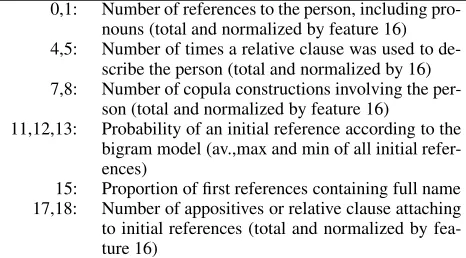
We now discuss what features we used for our two classification tasks (cf. list of features in table 1). Our hypothesis is that features capturing the fre-quency and syntactic and lexical forms of references are sufficient to infer the desired cognitive model.
Intuitively, pronominalization indicates that an entity was particularly salient at a specific point of the discourse, as has been widely discussed in at-tentional status and centering literature (Grosz and Sidner, 1986; Gordon et al., 1993). Modified noun phrases (with apposition, relative clauses or premod-ification) can also signal different status.
de-0,1: Number of references to the person, including
pro-nouns (total and normalized by feature 16) 2,3: Number of times apposition was used to describethe person(total and normalized by feature 16) 4,5: Number of times a relative clause was used to
de-scribe the person (total and normalized by 16) 6: Number of times the entity was referred to byname after the first reference 7,8: Number of copula constructions involving the
per-son (total and normalized by feature 16) 9,10: Number of apposition, relative clause or copuladescriptions (total and normalized by feature 16) 11,12,13: Probability of an initial reference according to the
bigram model (av.,max and min of all initial refer-ences)
14: Number of top 20 high frequency description words (from references to people in large news corpus) present in initial references
15: Proportion of first references containing full name 16: Total number of documents containing the person 17,18: Number of appositives or relative clause attaching
[image:5.612.73.306.55.184.2]to initial references (total and normalized by fea-ture 16)
Table 1: List of Features provided to WEKA.
scriptors may signal importance; the full list is:
president, former, spokesman, sen, dr, chief, coach, attorney, minister, director, gov, rep, leader, secre-tary, rev, judge, US, general, manager, chairman.
Another lexical feature was the overall likelihood of a person’s description using the bigram model from our web corpus. This indicates whether a per-son has a role or affiliation that is frequently men-tioned. We performed 20-fold cross validation for both classification tasks. The results are shown in Table 2 (accuracy) and Table 3 (precision/recall).
4.1 Major vs Minor results
For major/minor classification, the majority class prediction has 94% accuracy, but is not a useful baseline as it predicts thatnoperson should be men-tioned by name and all are minor characters. J48 correctly predicts 114 major characters out of 258 in the 170 document sets. As recall appeared low, we further analyzed the 148 persons from DUC’03 and DUC’04 sets, for which DUC provides four hu-man summaries. Table 4 presents the distribution of recall taking into account how many humans men-tioned the person by name in their summary (origi-nally, entities were labeled as main ifanysummary had a reference to them, cf. 3.2). It can be seen that
recall is high (0.84) when all four humans consider a character to be major, and falls to 0.2 when only one out of four humans does. These observations re-flect the well-known fact that humans differ in their choices for content selection, and indicate that in the automatic learning is more successful when there is more human agreement.
In our data there were 258 people mentioned by name in at least one human summary. In addition, there were 103 people who were mentioned in at
least one human summary using only a common noun reference (these were identified by hand, as common noun coreference cannot be performed re-liably enough by automatic means), indicating that 29% of people mentioned in human summaries are not actually named. Examples of such references include an off duty black policeman, a Nigerian born Roman catholic priest, Kuwait’s US ambas-sador. For the purpose of generating references in a summary, it is important to evaluate how many of these people are correctly classified as minor char-acters. We removed these people from the training data and kept them as a test set. WEKA achieved a testing accuracy of 74% on these 103 test exam-ples. But as discussed before, different human sum-marizers sometimes made different decisions on the form of reference to use. Out of the 103 referent for which a non-named reference was used by a summarizer, there were 40 where other summariz-ers used named reference. Only 22 of these 40 were labeled as minor characters in our automatic proce-dure. Out of the 63 people who were not named in anysummary, but mentioned in at least one by com-mon noun reference, WEKA correctly predicted 58 (92%) as minor characters. As before, we observe that when human summarizers generate references of the same form (reflecting consensus on convey-ing the perceived importance of the character), the machine predictions are accurate.
4,5) and copula (feature 8) constructs, total number of apposition, relative clauses and copula (feature 9), number of high frequency premodifiers (feature 14) and the maximum bigram probability (feature 12). It was interesting that presence of apposition did not select for either major or minor class. It is not surprising that the frequency of mention within and across documents were significant features—a frequently mentioned entity will naturally be consid-ered important for the news report. Interestingly, the syntactic form of the references was also a signifi-cant indicator, suggesting that the centrality of the character was signaled by the journalists by using specific syntactic constructs in the references.
Major/Minor Hearer New/Old WEKA 0.96 (J48) 0.76 (SMO)
Majority class prediction 0.94 0.54
Table 2: Cross validationtestingaccuracy results.
Class Precision Recall F-measure SMO hearer-new 0.84 0.68 0.75
hearer-old 0.69 0.85 0.76 J48 major-character 0.85 0.44 0.58 minor-character 0.96 0.99 0.98
Table 3: Cross validation testingP/R/F results.
Number of summaries Number of Number and % containing the person examples recalled by J48
1 out of 4 59 15 (20%) 2 out of 4 35 20 (57%) 3 out of 4 29 23 (79%) 4 out of 4 25 21 (84%)
Table 4: J48 Recall results and human agreement.
4.2 Hearer Old vs New Results
The majority class prediction for the hearer-old/new classification task is that no one is known to the reader and it leads to overall classification accu-racy of 54%. Using this prediction in a summarizer would result in excessive detail in referring expres-sions and a consequent reduction in space available to summarize the news events. The SMO prediction outperformed the baseline accuracy by 22% and is more meaningful for real tasks.
For the hearer-old/new classification, the feature selection step chose the following features: the num-ber of appositions (features 2,3) and relative clauses (feature 5), number of mentions within the docu-ment set (features 0,1), total number of apposition, relative clauses and copula (feature 10), number of high frequency premodifiers (feature 14) and the
minimum bigram probability (feature 13). As in the minor-major classification, the syntactic choices for reference realization were useful features.
We conducted an additional experiment to see how the hearer old/new status impacts the use of ap-position or relative clauses for elaboration in refer-ences produced in human summaries. It has been observed (Siddharthan et al., 2004) that on average these constructs occur 2.3 times less frequently in human summaries than in machine summaries. As we show, the use of postmodification to elaborate re-lates to the hearer-old/new distinction.
To determine when an appositive or relative clause can be used to modify a reference, we con-sidered the 151 examples out of 258 where there was at least one relative clause or apposition describing the person in the input. We labeled an example as positive if at least one human summary contained an apposition or relative clause for that person and negative otherwise. There were 66 positive and 85 negative examples. This data was interesting be-cause while for the majority of examples (56%) all the human summarizers agreed not to use postmod-ification, there were very few examples (under 5%) where all the humans agreed to postmodify. Thus it appears that for around half the cases, it should be obvious that no postmodification is required, but for the other half, human decisions go either way.
Notably, none of the hearer-old persons (using test predictions of SMO) were postmodified. Our cogni-tive status predictions cleanly partition the examples into those where postmodification is not required, and those where it might be. Since no intuitive rule handled the remaining examples, we added the test-ing predictions of hearer-old/new and major/minor as features to the list in Table 1, and tried to learn this task using the tree-based learner J48. We report a testing accuracy of 71.5% (majority class baseline is 56%). There were only three useful features— the predicted hearer-new/old status, the number of high frequency premodifiers for that person in the input (feature 14 in table 1) and the average number of postmodified initial references in the input docu-ments (feature 17).
5 Validating the results on current news
consen-sus on the hearer-new/old distinction. For these pur-poses, we downloaded 45 clusters from one day’s output from Newsblaster4. We then automatically compiled the list of people mentioned in the ma-chine summaries for these clusters. There were 107 unique people that appeared in the machine sum-maries, out of 1075 people in the input clusters.
5.1 Human agreement on hearer-old/new
A question arises when attempting to infer hearer-new/old status: Is it meaningful to generalize this across readers, seeing how dependent it is on the world knowledge of individual readers?
To address this question, we gave 4 Ameri-can graduate students a list of the names of peo-ple in the DUC human summaries (cf. 3), and
asked them to write down for each person, their country/state/organization affiliation and their role (writer/president/attorney-general etc.). We consid-ered a person hearer-old to a subject if they correctly identified both role and affiliation for that person. For the 258 people in the DUC summaries, the four subjects demonstrated 87% agreement ( 5. Similarly, they were asked to perform the same task for the Newsblaster data, which dealt with con-temporary news6, in contrast with the DUC data that contained news from the the late 80s and early 90s. On this data, the human agreement was 91% ( ). This is a high enough agreement to suggest that the classification of national and inter-national figures as hearer old/new across the edu-cated adult American reader with varied interests and background in current and recent events is a well defined task. This is not necessarily true for the full range of cognitive status distinctions; for example Poesio and Vieira (1998) report lower hu-man agreement on more fine-grained classifications of definite descriptions.
5.2 Results on the Newsblaster data
We measured how well the models trained on DUC data perform with current news labeled using human
4http://newsblaster.cs.columbia.edu 5
(kappa) is a measure of inter-annotator agreement over and above what might be expected by pure chance (See Carletta (1996) for discussion of its use in NLP).
if there is perfect agreement between annotators and
if the annotators agree only as much as you would expect by chance.
6The human judgments were made within a week of the
news stories appearing.
judgment. For each person who was mentioned in the automatic summaries for the Newsblaster data, we compiled one judgment from the 4 human sub-jects: an example was labeled as hearer-new if two or more out of the four subjects had marked it as hearer new. Then we used this data as test data, to test the model trained solely on the DUC data. The classifier for hearer-old/hearer-new distinction achieved 75% accuracy on Newsblaster data labeled by humans, while the cross-validation accuracy on the automatically labeled DUC data was 76%. These numbers are very encouraging, since they indicate that the performance of the classifier is stable and does not vary between the DUC and Newsblaster data. The precision and recall for the Newsblaster data are also very similar for those obtained from cross-validation on the DUC data:
Class Precision Recall F-Measure Hearer-old 0.88 0.73 0.80 Hearer-new 0.57 0.79 0.66
5.3 Major/Minor results on Newsblaster data
For the Newsblaster data, no human summaries were available, so no direct indication on whether a hu-man summarizer will mention a person in a sum-mary was available. In order to evaluate the perfor-mance of the classifier, we gave a human annotator the list of people’s names appearing in the machine summaries, together with the input cluster and the machine summary, and asked which of the names on the list would be a suitable keyword for the set (keyword lists are a form of a very short summary). Out of the 107 names on the list, the annotator chose 42 as suitable for descriptive keyword for the set.
The major/minor classifier was run on the 107 ex-amples; only 40 were predicted to be major char-acters. Of the 67 test cases that were predicted by the classifier to be minor characters, 12 (18%) were marked by the annotator as acceptable keywords. In comparison, of the 40 characters that were predicted to be major characters by the classifier, 30 (75%) were marked as possible keywords. If the keyword selections of the annotator are taken as ground truth, the automatic predictions have precision and recall of 0.75 and 0.71 respectively for themajorclass.
6 Conclusions
what to say and how to say it. However, to date, no one has attempted the task of inferring cognitive status from unrestricted news.
We have shown that the hearer-old/new and ma-jor/minor distinctions can be inferred using features derived from the lexical and syntactic forms and fre-quencies of references in the news reports. We have presented results that show agreement on the famil-iarity distinction between educated adult American readers with an interest in current affairs, and that the learned classifier accurately predicts this distinc-tion. We have demonstrated that the acquired cogni-tive status is useful for determining which characters to name in summaries, and which named characters to describe or elaborate. This provides the founda-tion for a principled framework in which to address the question of how much references can be short-ened without compromising readability.
References
R. Barzilay. 2003. Information Fusion for Multidocu-ment Summarization: Paraphrasing and Generation. Ph.D. thesis, Columbia University, New York. D. Bikel, R. Schwartz, and R. Weischedel. 1999. An
al-gorithm that learns what’s in a name.Machine Learn-ing, 34:211–231.
J. Carletta. 1996. Assessing agreement on classification tasks: The kappa statistic. Computational Linguistics, 22(2):249–254.
H. Daum´e III, A. Echihabi, D. Marcu, D.S. Munteanu, and R. Soricut. 2002. GLEANS: A generator of logi-cal extracts and abstracts for nice summaries. In Pro-ceedings of the Second Document Understanding Con-ference (DUC 2002), pages 9 – 14, Philadelphia, PA.
P. Gordon, B. Grosz, and L. Gilliom. 1993. Pronouns, names, and the centering of attention in discourse.
Cognitive Science, 17:311–347.
H.P. Grice. 1975. Logic and conversation. In P. Cole and J.L. Morgan, editors,Syntax and semantics, volume 3, pages 43–58. Academic Press.
B. Grosz and C. Sidner. 1986. Attention, intentions, and the structure of discourse. Computational Linguistics, 3(12):175–204.
B. Grosz, A. Joshi, and S. Weinstein. 1995. Centering: A framework for modelling the local coherence of dis-course.Computational Linguistics, 21(2):203–226. C. Grover, C. Matheson, A. Mikheev, and M. Moens.
2000. Lt ttt: A flexible tokenization toolkit. In Pro-ceedings of LREC’00.
J. Gundel, N. Hedberg, and R. Zacharski. 1993. Cog-nitive status and the form of referring expressions in discourse. Language, 69:274–307.
Y. Guo, X. Huang, and L. Wu. 2003. Approaches to event-focused summarization based on named entities and query words. InDocument Understanding Con-ference (DUC’03).
K. Knight and D. Marcu. 2000. Statistics-based summa-rization — step one: Sentence compression. In Pro-ceeding of The American Association for Artificial In-telligence Conference (AAAI-2000), pages 703–710. H. P. Luhn. 1958. The automatic creation of literature
abstracts.IBM Journal of Research and Development, 2(2):159–165.
I. Mani and M. Maybury, editors. 1999.Advances in Au-tomatic Text Summarization. MIT Press, Cambridge, Massachusetts.
A. Nenkova and K. McKeown. 2003. References to named entities: a corpus study. In Proceedings of HLT/NAACL 2003.
C. D. Paice. 1990. Constructing literature abstracts by computer: techniques and prospects. Inf. Process. Manage., 26(1):171–186.
M. Poesio and R. Vieira. 1998. A corpus-based investi-gation of definite description use.Computational Lin-guistics, 24(2):183–216.
E. Prince. 1992. The zpg letter: subject, definiteness, and information status. In S. Thompson and W. Mann, editors,Discourse description: diverse analyses of a fund raising text, pages 295–325. John Benjamins. D. Radev and K. McKeown. 1998. Generating
natu-ral language summaries from multiple on-line sources.
Computational Linguistics, 24(3):469–500.
H. Saggion and R. Gaizaukas. 2004. Multi-document summarization by cluster/profile relevance and redun-dancy removal. InDocument Understanding Confer-ence (DUC04).
A. Sanford, K. Moar, and S. Garrod. 1988. Proper names as controllers of discourse focus. Language and Speech, 31(1):43–56.
A. Siddharthan, A. Nenkova, and K. McKeown. 2004. Syntactic simplification for improving content selec-tion in multi-document summarizaselec-tion. In Proceed-ings of the 20th International Conference on Compu-tational Linguistics (COLING 2004), pages 896–902, Geneva, Switzerland.