Proceedings of the 2008 Conference on Empirical Methods in Natural Language Processing, pages 353–362,
Transliteration as Constrained Optimization
Dan Goldwasser Dan Roth
Department of Computer Science University of Illinois
Urbana, IL 61801
{goldwas1,danr}@uiuc.edu
Abstract
This paper introduces a new method for iden-tifying named-entity (NE) transliterations in bilingual corpora. Recent works have shown the advantage of discriminative approaches to transliteration: given two strings (ws, wt) in
the source and target language, a classifier is trained to determine if wt is the
translitera-tion ofws. This paper shows that the
translit-eration problem can be formulated as a con-strained optimization problem and thus take into account contextual dependencies and con-straints among character bi-grams in the two strings. We further explore several methods for learning the objective function of the opti-mization problem and show the advantage of learning it discriminately. Our experiments show that the new framework results in over 50% improvement in translating English NEs to Hebrew.
1 Introduction
Named entity (NE) transliteration is the process of transcribing a NE from a source language to some target language based on phonetic similarity be-tween the entities. Identifying transliteration pairs is an important component in many linguistic appli-cations which require identifying out-of-vocabulary words, such as machine translation and multilingual information retrieval (Klementiev and Roth, 2006b; Hermjakob et al., 2008).
[image:1.612.347.492.248.387.2]It may appear at first glance that identifying the phonetic correlation between names based on an orthographic analysis is a simple, straight-forward
Figure 1: Named entities transliteration pairs in English and Hebrew and the character level mapping between the two names. The Hebrew names can be romanized as ee-ta-l-ya anda-ya
task; however in many cases a consistent deter-ministic mapping between characters does not ex-ist; rather, the mapping depends on the context the characters appear in and on transliteration conven-tions which may change across domains. Figure 1 exhibits two examples of NE transliterations in En-glish and Hebrew, with the correct mapping across the two scripts. Although the two Hebrew names share a common prefix1, this prefix can be mapped
into a single English character or into two differ-ent characters depending on the context it appears in. Similarly, depending on the context it appears in, the English characteracan be mapped into different characters or to an “empty” character.
1In all our example the Hebrew script is shown left-to-right
to simplify the visualization of the transliteration mapping.
In recent years, as it became clear that solutions that are based on linguistics rules are not satisfac-tory, machine learning approaches have been de-veloped to address this problem. The common ap-proach adopted is therefore to view this problem as a classification problem (Klementiev and Roth, 2006a; Tao et al., 2006) and train a discriminative classifier. That is, given two strings, one in the source and the other in the target language, extract pairwise features, and train a classifier that deter-mines if one is a transliteration of the other. Sev-eral papers have followed up on this basic approach and focused on semi-supervised approaches to this problem or on extracting better features for the dis-criminative classifier (Klementiev and Roth, 2006b; Bergsma and Kondrak, 2007; Goldwasser and Roth, 2008). While it has been clear that the relevancy of pairwise features is context sensitive and that there are contextual constraints among them, the hope was that a discriminative approach will be sufficient to account for those by weighing features appropri-ately. This has been shown to be difficult for lan-guage pairs which are very different, such as English and Hebrew (Goldwasser and Roth, 2008).
In this paper, we address these difficulties by proposing to view the transliteration decision as a globally phrased constrained optimization problem. We formalize it as an optimization problem over a set of local pairwise features – character n-gram matches across the two string – and subject to legit-imacy constraints.
We use a discriminatively trained classifier as a way to learn the objective function for the global constrained optimization problem. Our technical approach follows a large body of work developed over the last few years, following (Roth and Yih, 2004) that has formalized global decisions problems in NLP as constrained optimization problems and solved these optimization problems using Integer Linear Programming (ILP) or other methods (Pun-yakanok et al., 2005; Barzilay and Lapata, 2006; Clarke and Lapata, ; Marciniak and Strube, 2005).
We investigate several ways to train our objective function, which is represented as a dot product be-tween a set of features chosen to represent a pair
(ws, wt), and a vector of initial weights. Our first baseline makes use of all features extracted from a pair, along with a simple counting method to
deter-mine initial weights. We then use a method simi-lar to (Klementiev and Roth, 2006a; Goldwasser and Roth, 2008) in order to discriminatively train a better weight vector for the objective function.
Our key contribution is that we use a constrained optimization approach also to determine a better fea-ture representation for a given pair. (Bergsma and Kondrak, 2007) attempted a related approach to re-stricting the set of features representing a transliter-ation candidate. However, rather than directly align-ing the two stralign-ings as done there, we exploit the ex-pressiveness of the ILP formulation and constraints to generate a better representation of a pair. This is the representation we then use to discriminatively learn a better weight vector for the objective func-tion used in our final model.
Our experiments focus on Hebrew-English transliteration, which were shown to be very dif-ficult in a previous work (Goldwasser and Roth, 2008). We show very significant improvements over existing work with the same data set, proving the advantage of viewing the transliteration decision as a global inference problem. Furthermore, we show the importance of using a discriminatively trained objective function.
The rest of the paper is organized as follows. The main algorithmic contribution of this paper is scribed in Sec. 2. Our experimental study is de-scribes in Sec. 3 and Sec. 4 concludes.
2 Using inference for transliteration
In this section we present our transliteration decision framework, which is based on solving a constrained optimization problem with an objective function that is discriminatively learned. Our framework consists of three key elements:
1. Decision Model When presented with a NE in the source languagews and a set of candi-dates{wt}k
1in the target language, the decision model ranks the candidate pairs (ws, wt) and selects the “best” candidate pair. This is framed as an optimization problem
wt∗=argmaxi{w·F(ws, wit)}, (1)
2. RepresentationA pairs= (ws, wt)of source and target NEs is represented as a vector of fea-tures, each of which is a pair of character n-grams, from ws andwt, resp. Starting with a baseline representation introduced in (Klemen-tiev and Roth, 2006a), denoted here AF(s), we refine this representation to take into ac-count dependencies among the individual n-gram pairs. This refinement process is framed as a constrained optimization problem:
F(s)∗ =argmaxF⊆AF{w·AF(s)}, (2)
subject to a set C of linear constraints. Here
AF is the initial representation (All−Features),
w is a vector ofweightsassigned to each fea-ture andCis a set of constraints accounting for interdependencies among features.
3. Weight VectorEach pairwise n-gram feature is associated with a weight; this weigh vector is used in both optimization formulations above. The weight vector is determined by considering the whole training corpus. The initial weight vector is obtained generatively, by counting the relative occurrence of substring pairs in posi-tive examples. The representation is refined by discriminatively training a classifier to maxi-mize transliteration performance on the train-ing data. In dotrain-ing that, each example is rep-resented using the feature vector representation described above.
The three key operations described above are be-ing used in several stages, with different parameters (weight vectors and representations) as described in Alg. 1. In each stage a different element is re-fined. The input to this process is a training corpus Tr=(DS,DT) consisting of NE transliteration pairs s = (ws, wt), where ws, wt are NEs in the source and target language, respectively. Each such sam-ple point is initially represented as a feature vector
AF(s)(for All−Features), where features are pairs of substrings from the two words (following (Kle-mentiev and Roth, 2006a)).
Given the set of feature vectors generated by ap-plying AF to Tr, we assign initial weights W to the features ((1) in Alg. 1). These weights form the initial objective function used to construct a new
feature based representation, Informative−Features,
IFW(s)((2) in Alg. 1). Specifically, for an instance s,IFW(s)is the solution of the optimization prob-lem in Eq. 2, withW as the weight vector, AF(s)
as the representation, and a set of constraints ensur-ing the “legitimacy” of the selected set of features (Sec. 2.2.1).
Input: Training Corpora Tr=(DS,DT)
Output: Transliteration modelM
1. Initial Representation and Weights
For each sample s∈Tr, use AF to generate a feature vector
{(fs, ft)1,(fs, ft)2, . . . ,(fs, ft)n} ∈ {0,1}n.
DefineW:f → Rs.t. foreach featuref=(fs, ft)
W(f) = #(fs,ft) #(fs) ×
#(fs,ft) #(ft)
2. Inferring Informative Representation (W)
Modify the initial representation by solving the following constrained optimization problem: IFW(s)∗=argmaxIF(s)⊆(AF(s))W ·AF(s),
subject to constraints C.
3. Discriminative Training
Train a discriminative model on Tr, using
{IF(s)}s∈T r.
LetWDbe the new weight vector obtained by
discriminative training.
4. Inferring Informative Representation (WD)
Modify the initial representation by solving the following constrained optimization problem. This time, the objective function is determined by the discriminatively trained weight vectorWD.
IFWD(s)∗=argmaxIF(s)⊆(AF(s))WD·AF(s),
subject to constraints C.
5. Decision Model
Given a wordwsand a list of candidates
w1
t, w2t, . . . wtk, the chosen transliteration iswt∗,
determined by: t∗=argmax
i{WD·IFWD((ws, w
i t))}
Algorithm 1: Transliteration Framework.
de-note by IFWD(s) the solution of this optimization
problem for an instances.
Given a representation and a weight vector, the optimization problem in Eq. 1 is used to find the transliteration ofws. Our best decision model makes use of Eq. 1 using WD as the feature vector and
IFWD(s)as the feature representation ofs.
The rest of this section provides details on the op-erations and how we use them in different stages.
2.1 Initial Representation and Weights
The feature space we consider consists of n po-tential features, each feature f = (fs, ft) repre-sents a pairing of character level n-grams, where
fs ∈ {Source-Language∪empty-string}andft ∈
{Target-Language∪empty-string}. A given sample
(ws, wt) consisting of a pair of NEs is represented as a features vectors∈ {0,1}n. We say that a fea-turefi is active iffi = 1and thats
1 ⊂ s2, ⇐⇒
{fi}
{fi= 1in s1} ⊂ {fi}{fi=1in s2}. We represent
the active features corresponding to a pair as a bipar-tite graphG= (V, E), in which each vertexv ∈V
either represents the empty string, a single character or a bi-gram. VS, VT denote the vertices represent-ing source and target language n-grams respectively. Each of these sets is composed of two disjoint sub-sets: VS = VUS∪VBS, VT = VUT ∪VBT consisting of vertices representing the uni-gram and bi-gram strings. Given a vertexv,degree(v, V0)denotes the degree of v in a subgraph ofG, consisting only of
V0 ⊂ V;index(v)is the index of the substring rep-resented byvin the original string.
Edges in the bipartite graph represent active fea-tures. The only deviation is that the vertex represent-ing the empty strrepresent-ing can be connected to any other (non-empty) vertex.
Our initial feature extraction method follows the one presented in (Klementiev and Roth, 2006a), in which the feature space consists of n-gram pairs from the two languages. Given a pair, each word is decomposed into a set of character substrings of up to a given length (including the empty string). Features are generated by pairing substrings from the two sets whose relative positions in the original words differ bykor less places, or formally:
E={e= (vi, vj)|(vi∈VS∧vj ∈VT)⇒
(index(vj) +k≥index(vi)≥index(vj)−k)∧
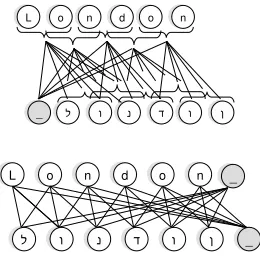
Figure 2: All possible unigram and bigram pairs gener-ated by theAF operator. The Hebrew name can be ro-manized aslo-n-do-n
(vi6=vempty−string∨vj 6=vempty−string)}.
In our experiments we usedk=1 which tested em-pirically, achieved the best performance.
Figure 2 exhibits the active features in the exam-ple using the graph representation. We refer to this feature extraction method asAll-F eatures (AF), and define it formally as an operator AF : s → {(fs, ft)i} that maps a sample points = (w
s, wt) to a set of active features.
The initial sample representation generates fea-tures by coupling substrings from the two terms without considering the dependencies between the possible consistent combinations. Ideally, given a positive sample, it is desirable that paired sub-strings would encode phonetic similarity or a dis-tinctive context in which the two substrings corre-late. However,AF simply pairs substrings from the two words, resulting in a noisy representation of the sample point. Given enough positive samples, we assume that features appearing with distinctive fre-quency will encode the desired relation. We use this observation, and construct a weight vector, associ-ating each feature with a positive number indicassoci-ating its relative occurrence frequency in the training data representation formed byAF. This weight is com-puted as follows:
Definition 1 (Initial Feature Weights Vector) Let W:f→ Rs.t. for each featuref={fs, ft},
W(f) = #(fs, ft) #(fs) ×
#(fs, ft)
#(ft) ,
where#(fs, ft)is the number of occurrences of that
feature in the positive sample set, and#(fL), L =
These weights transform every example into a weighted graph, where each edge is associated byW
with the weight assigned to the feature it represents. As we empirically tested, this initialization assigns high weights to features that preserve the phonetic correlation between the two languages. The top part of figure 5 presents several examples of weights as-signed byW to features composed of different En-glish and Hebrew substrings combinations. It can be observed that combination which are phonetically similar are associated with a higher weight. How-ever, as it turns out, transliteration mappings do not consist of “clean” and consistent mappings of pho-netically similar substrings. In the following section we explain how to use these weights to generate a more compact representation of samples.
2.2 Inferring Informative Representations In this section we suggest a new feature extraction method for determining the representation of a given word pair. We use the strength of the active features computed above, along with legitimacy constraints on mappings between source and target strings to find an optimal set of consistent active features that represents a pair. This problem can be naturally en-coded as a linear optimization problem, which seeks to maximize a linear objective function determined by W, over a set of variables representing the ac-tive features selection, subject to a set of linear con-straints representing the dependencies between se-lections. We follow the formulation given by (Roth and Yih, 2004), and define it as an Integer Linear Programming (ILP) optimization problem, in which each integer variablea(j,k), defined over{0,1}, rep-resents whether a feature pairing an n-gramj ∈ S
with an n-gramk∈T, is active. Although using ILP is in general NP-hard, it has been used efficiently in many natural language (see section 1). Our experi-ence as well has been that this process is very effi-cient due to the sparsity of the constraints used.
2.2.1 Constraining Feature Dependencies To limit the selection of active features in each sample we require that each element in the decom-position ofwsinto bi-grams should be paired with an element in wt, and the vice-versa. We restrict the possible pairs by allowing only a single n-gram to be matched to any other n-gram, with one
excep-tion - we allow every bi-gram to be mapped into an empty string. Viewed as a bipartite graph, we allow each node (with the exception of the empty string) to have only one connected edge. These constraints, given the right objective function, should enforce an alignment of bi-grams according to phonetic simi-larity; for example, the word pairs described in Fig-ure 1, depicts a character level alignment between the words, where in some cases a bi-gram is mapped into a single character and in other cases single char-acters are mapped to each other, based on phonetic similarity encoded by the two scripts. However, im-posing these constraints over the entire set of candi-date features would be too restrictive; it is unlikely that one can consistently represent a single “correct” phonetic mapping. We wish to represent both the character level and bi-gram mapping between names as both represent informative features on the corre-spondence between the names over the two scripts. To allow this, we decompose the problem into two disjoint sets of constraints imposing 1-1 mappings, one over the set of single character substrings and the other over the gram substrings. Given the bi-partite graph generated byAF, we impose the fol-lowing constraints:
Definition 2 (Transliteration Constraints) Let C be the set of constraints, consisting of the following predicates:
∀v∈VS,degree(v,VS∪VT U)≤1∧
∀v∈VS,degree(v,VS∪VT B)≤1∧
∀v ∈VT,degree(v,VT∪VUS)≤1∧ ∀v∈VT,degree(v,VT∪VS
B)≤1
For example, Figure 2 shows the graph of all pos-sible candidates produced byAF. In Figure 3, the graph is decomposed into two graphs, each depict-ing possible matches between the character level uni-gram or bi-gram substrings. the ILP constraints ensure that in each graph, every node (with the ex-ception of the empty string) has a degree of one . Figure 4 gives the results of the ILP process – a unified graph in which every node has only a single edge associated with it.
Definition 3 (Informative Feature Extraction (IF))
We define the Informative-Features(IF) feature extraction operator, IF : s → {(fs, ft)i} as the
Figure 3: Find informative features by solving an ILP problem. Dependencies between matching decisions are modeled by allowing every node to be connected to a sin-gle edge (except the node representing the empty-string).
Figure 4: The result of applying theIF operator by solv-ing an ILP problem, represented as a pruned graph.
IF(s)∗=argmaxIF(s)⊆(AF(s))w·AF(s),
subject to constraints C.
We will use this operator with w = W, defined above, and denote it IFW, and also use it with a different weight vector, trained discriminatively, as described next.
2.3 Discriminative Training
Using theIFW operator, we generate a better rep-resentation of the training data, which is now used to train a discriminative model. We use a linear classifier trained with a regularized average percep-tron update rule (Grove and Roth, 2001) as imple-mented in SNoW, (Roth, 1998). This learning al-gorithm provides a simple and general linear clas-sifier that has been demonstrated to work well in other NLP classification tasks, e.g. (Punyakanok et al., 2005), and allows us to incorporate extensions such as strength of features naturally into the ing algorithm. We augment each sample in the
train-Figure 5: Several examples of weights assigned to fea-tures generated by coupling English and Hebrew sub-strings. Top figure: initial weights. Bottom figure: Dis-criminatively learned weights. The Hebrew characters, ordered left to right, can be romanized asy,z,t,sh
ing data with feature weights; given a sample, the learner is presented with a real-valued feature vec-tor instead of a binary vecvec-tor. This can be viewed as providing a better starting point for the learner, which improves the learning rate (Golding and Roth, 1999; Ng and Jordan, 2001).
The weight vector learned by the discriminative training is denotedWD. Given the new weight vec-tor, we can define a new feature extraction opera-tor, that we get by applying the objective function in Eq. 2 withWD instead ofW. Given a samples, the feature representation generated by this new infor-mation extraction operator is denotedIFWD(s). The
key difference betweenW andWD is that the latter was trained over a corpora containing both negative and positive examples, and as a resultWD contains negative weights. To increase the impact of training we multiplied the negative weights by 2.
[image:6.612.114.244.70.199.2]presented in Figure 5 an edge matching a vowel to a Hebrew character with a high weight, the bottom graph showing the results of the discriminative train-ing process show that this edge is associated with a zero weight score.
2.4 Decision Models
This section defines several transliteration decision models given a word ws and a list of candidates w1
t, w2t, . . . wtk. The models are used to identify the correct transliteration pair from the set of candidates
{si= (ws, wti)}i=1...k.
In all cases, the decision is formulated as in Eq. 1, where different models differ by the representations and weight vectors used.
Decision Model 1 Ranking the transliteration can-didates is done by evaluating
s∗=argmaxi W ·AF(si),
which selects the transliteration pair which maxi-mizes the objective function based on the genera-tively computed weight vector.
Decision Model 2 Ranking the transliteration can-didates is done by evaluating:
s∗=argmaxi WD·AF(si)).
This decision model is essentially equivalent to the transliteration models used in (Klementiev and Roth, 2006a; Goldwasser and Roth, 2008), in which a linear transliteration model was trained using a fea-ture extraction method equivalent toAF.
Decision Model 3 Ranking the transliteration can-didates is done by evaluating:
s∗ =argmaxi W ·IFW(si),
which maximizes the objective function with the generatively computed weight vector and the infor-mative feature representation derived based on it. Decision Model 4 Ranking the transliteration can-didates is done by evaluating:
s∗=argmaxi WD·IFW(si)),
which conceptually resembles the transliteration model presented in (Bergsma and Kondrak, 2007), in that a discriminative classifier was trained and used over a pruned feature set.
Decision Model 5 Ranking the transliteration can-didates is done by evaluating:
s∗ =argmaxi WD ·IFWD(si),
which maximize the objective function with the dis-criminately derived weight vector and the informa-tive features inferred based on it. This decision model is the only model that incorporates discrim-inative weights as part of the feature extraction pro-cess; WD is used as the objective function used when inferringIFWD.
3 Evaluation
We evaluated our approach over a corpus of 300 English-Hebrew transliteration pairs, and used an-other 250 different samples for training the models. We constructed the test set by pairing each English name with all Hebrew names in the corpus. The sys-tem was evaluated on its ability to correctly iden-tify the 300 transliteration pairs out of all the pos-sible transliteration candidates. We measured per-formance using the Mean Reciprocal Rank(MRR) measure. This measure, originally introduced in the field of information retrieval, is used to evaluate systems that rank several options according to their probability of correctness. MRR is a natural mea-sure in our settings and has been used previously for evaluating transliteration systems, for example by (Tao et al., 2006).
Given a set Q of queries and their respective responses ranked according to the system’s confi-dence, we denote the rank of the correct response to a queryqi ∈ Q asrank(qi). MRR is then de-fined as the average of the multiplicative inverse of the rank of the correct answer, that is:
M RR= 1
|Q| X
i=1...|Q|
1
rank(qi) .
using the publicly available GLPK package (http:
//www.gnu.org/software/glpk/).
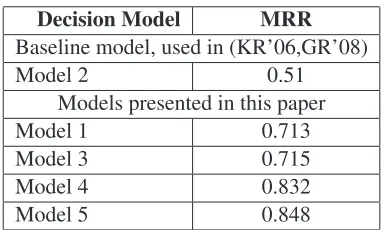
The performance of the different models is sum-marized in table 1, these results are based on a train-ing set of 250 samples used to train the discrimi-native transliteration models and also to construct the initial weight vectorW. Figure 6 shows perfor-mance over different number of training examples. Our evaluation is concerns with the core transliter-ation and decision models presented here and does not consider any data set optimizations that were in-troduced in previous works, which we view as or-thogonal additions, hence the difference with the re-sults published in (Goldwasser and Roth, 2008).
The results clearly show that our final model, model 5, outperform other models. Interestingly, model 1, a simplistic model, significantly outper-forms the discriminative model presented in (Kle-mentiev and Roth, 2006b). We believe that this is due to two reasons. It shows that discriminative training over the representation obtained using AF is not efficient; moreover, this phenomenon is ac-centuated given that we train over a very small data set, which favors generative estimation of weights. This is also clear when comparing the performance of model 1 to model 4, which shows that learning over the representation obtained using constrained optimization (IF) results in a very significant perfor-mance improvement.
The improvement of usingIFW is not automatic. Model 3, which usesIFW, and model 1, which uses AF, converge to nearly the same result. Both these models use generative weights to make the translit-eration decision, and this highlights the importance of discriminative training. Both model 4 and model 5 use discriminatively trained weights and signifi-cantly outperform model 3. These results indicate that using constraint optimization to generate the ex-amples’ representation in itself may not help; the ob-jective function used in this inference has a signifi-cant role in improved performance.
The benefit of discriminatively training the objec-tive function becomes even clearer when compar-ing the performance of model 5 to that of model 4, which uses the original weight vector when inferring the sample representation.
It can be assumed that this algorithm can bene-fit from further iterations – generating a new feature
Decision Model MRR Baseline model, used in (KR’06,GR’08)
Model 2 0.51
Models presented in this paper
Model 1 0.713
Model 3 0.715
Model 4 0.832
[image:8.612.328.520.61.176.2]Model 5 0.848
Table 1: Results of the different transliteration models, trained using 250 samples. To facilitate readability (Kle-mentiev and Roth, 2006b; Goldwasser and Roth, 2008) are referenced as KR’06 and GR’08 respectively.
Figure 6: Results of the different constraint optimization transliteration models. Performance is compared relative to the number of samples used for training.
representations, training a model on it, and using the resulting model as a new objective function. How-ever, it turns out that after a single round, improved weights due to additional training do not change the feature representation; the inference process does not yield a different outcome.
3.1 Normalized Objective Function
Formulating the transliteration decision as an op-timization problem also allows us to naturally en-code other considerations into our objective func-tion. in this case we give preference to matching short words. We encode this preference as a normal-ization factor for the objective function. When eval-uating on pair(ws, wt), we divide the weight vector length of the shorter word; our decision model now becomes:
[image:8.612.317.531.249.385.2]Decision Model MRR Model 5 0.848 Model 5 - LN 0.894
Table 2: Results of using model 5 with and without a normalized objective function. Both models were trained using 250 samples. The LN suffix in the model’s name indicate that the objective function used length normal-ization.
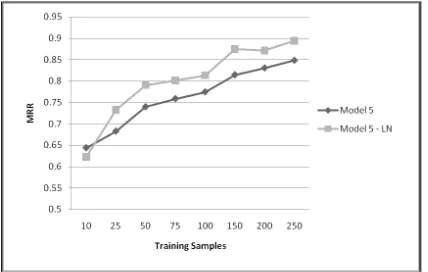
Figure 7: Results of using model 5 with and without a normalized objective function. Performance is compared relative to the number of samples used for training.
Ranking the transliteration candidates is done by evaluating:
s∗ =argmaxi WD·IFWD(si)/min(|ws|,|wt|)
As described in table 2 and figure 7, using length normalization significantly improves the re-sults. This can be attributed to the fact that typically Hebrew names are shorter and therefore every pair
(ws, wt) considered by our model will be effected differently by this normalization factor.
4 Discussion
We introduced a new approach for identifying NE transliteration, viewing the transliteration decision as a global inference problem. We explored sev-eral methods for combining discriminative learning in a global constraint optimization framework and showed that discriminatively learning the objective function improves performance significantly.
From an algorithmic perspective, our key contri-bution is the introduction of a new method, in which learning and inference are used in an integrated way.
We use learning to generate an objective function for the inference process; use the inference process to generate a better representation for the learning pro-cess, and iterate these stages.
From the transliteration perspective, our key con-tribution is in deriving and showing the significance of a good representation for a pair of NEs. Our representation captures both phonetic similarity and distinctive occurrence patterns across character level matchings of the two input strings, while enforcing the constraints induced by the interdependencies of the individual matchings. As we show, this represen-tation serves to improve the ability of a discrimina-tive learning algorithm to weigh features appropri-ately and results in significantly better transliteration models. This representation can be viewed as a com-promise between models that do not consider depen-dencies between local decisions and those that try to align the two strings. Achieving this compromise is one of the advantages of the flexibility allowed by the constrained optimization framework we use. We plan to investigate using more constraints within this framework, such as soft constraints which can pe-nalize unlikely local decisions while not completely eliminating the entire solution.
Acknowledgments
We wish to thank Alex Klementiev and the anony-mous reviewers for their insightful comments. This work is partly supported by NSF grant SoD-HCER-0613885 and DARPA funding under the Bootstrap Learning Program.
References
R. Barzilay and M. Lapata. 2006. Aggregation via Set Partitioning for Natural Language Generation. In Pro-ceedings of HLT/NAACL, pages 359–366, New York City, USA, June. Association for Computational Lin-guistics.
S. Bergsma and G. Kondrak. 2007. Alignment-based discriminative string similarity. InProceedings of the 45th Annual Meeting of the Association of Computa-tional Linguistics, pages 656–663, Prague, Czech Re-public, June. Association for Computational Linguis-tics.
[image:9.612.77.291.189.325.2]guage Processing and Computational Natural Lan-guage Learning (EMNLP-CoNLL), pages 1–11. A. R. Golding and D. Roth. 1999. A Winnow based
approach to context-sensitive spelling correction. Ma-chine Learning, 34(1-3):107–130.
D. Goldwasser and D. Roth. 2008. Active sample selec-tion for named entity transliteraselec-tion. InProceedings of ACL-08: HLT, Short Papers, Columbus, OH, USA, Jun. Association for Computational Linguistics. A. Grove and D. Roth. 2001. Linear concepts and hidden
variables. Machine Learning, 42(1/2):123–141. Ulf Hermjakob, Kevin Knight, and Hal Daum´e III. 2008.
Name translation in statistical machine translation -learning when to transliterate. InProceedings of ACL-08: HLT, pages 389–397, Columbus, Ohio, June. As-sociation for Computational Linguistics.
A. Klementiev and D. Roth. 2006a. Named entity transliteration and discovery from multilingual com-parable corpora. InProc. of the Annual Meeting of the North American Association of Computational Lin-guistics (NAACL), pages 82–88, June.
A. Klementiev and D. Roth. 2006b. Weakly supervised named entity transliteration and discovery from mul-tilingual comparable corpora. InProc. of the Annual Meeting of the ACL, July.
T. Marciniak and M. Strube. 2005. Beyond the Pipeline: Discrete Optimization in NLP. InProceedings of the Ninth CoNLL, pages 136–143, Ann Arbor, Michigan, June. Association for Computational Linguistics. A. Y. Ng and M. I. Jordan. 2001. On discriminative vs.
generative classifiers: A comparison of logistic regres-sion and na¨ıve bayes. InNeural Information Process-ing Systems, pages 841–848.
V. Punyakanok, D. Roth, and W. Yih. 2005. The neces-sity of syntactic parsing for semantic role labeling. In
Proc. of the International Joint Conference on Artifi-cial Intelligence (IJCAI), pages 1117–1123.
D. Roth and W. Yih. 2004. A linear programming formu-lation for global inference in natural language tasks. In Hwee Tou Ng and Ellen Riloff, editors, Proc. of the Annual Conference on Computational Natural Lan-guage Learning (CoNLL), pages 1–8. Association for Computational Linguistics.
D. Roth. 1998. Learning to resolve natural language am-biguities: A unified approach. InProceedings of the National Conference on Artificial Intelligence (AAAI), pages 806–813.