Simple Coreference Resolution with Rich Syntactic and Semantic Features
Aria Haghighi and Dan Klein Computer Science Division
UC Berkeley
{aria42, klein}@cs.berkeley.edu
Abstract
Coreference systems are driven by syntactic, se-mantic, and discourse constraints. We present a simple approach which completely modularizes these three aspects. In contrast to much current work, which focuses on learning and on the dis-course component, our system is deterministic and is driven entirely by syntactic and semantic com-patibility as learned from a large, unlabeled corpus. Despite its simplicity and discourse naivete, our system substantially outperforms all unsupervised systems and most supervised ones. Primary con-tributions include (1) the presentation of a simple-to-reproduce, high-performing baseline and (2) the demonstration that most remaining errors can be at-tributed to syntactic and semantic factors external to the coreference phenomenon (and perhaps best addressed by non-coreference systems).
1 Introduction
The resolution of entity reference is influenced by a variety of constraints. Syntactic constraints like the binding theory, the i-within-i filter, and appos-itive constructions restrict reference by configura-tion. Semantic constraints like selectional compat-ibility (e.g. aspokespersoncanannouncethings) and subsumption (e.g. Microsoft is a company) rule out many possible referents. Finally, dis-course phenomena such as salience and centering theory are assumed to heavily influence reference preferences. As these varied factors have given rise to a multitude of weak features, recent work has focused on how best to learn to combine them using models over reference structures (Culotta et al., 2007; Denis and Baldridge, 2007; Klenner and Ailloud, 2007).
In this work, we break from the standard view. Instead, we consider a vastly more modular system in which coreference is predicted from a determin-istic function of a few rich features. In particu-lar, we assume a three-step process. First, a self-contained syntactic module carefully represents syntactic structures using an augmented parser and extracts syntactic paths from mentions to potential antecedents. Some of these paths can be ruled in
or out by deterministic but conservative syntactic constraints. Importantly, the bulk of the work in the syntactic module is in making sure the parses are correctly constructed and used, and this mod-ule’s most important training data is a treebank. Second, a self-contained semantic module evalu-ates the semantic compatibility of headwords and individual names. These decisions are made from compatibility lists extracted from unlabeled data sources such as newswire and web data. Finally, of the antecedents which remain after rich syntac-tic and semansyntac-tic filtering, reference is chosen to minimize tree distance.
This procedure is trivial where most systems are rich, and so does not need any supervised corefer-ence data. However, it is rich in important ways which we argue are marginalized in recent coref-erence work. Interestingly, error analysis from our final system shows that its failures are far more often due to syntactic failures (e.g. parsing mis-takes) and semantic failures (e.g. missing knowl-edge) than failure to model discourse phenomena or appropriately weigh conflicting evidence.
One contribution of this paper is the exploration of strong modularity, including the result that our system beats all unsupervised systems and ap-proaches the state of the art in supervised ones. Another contribution is the error analysis result that, even with substantial syntactic and semantic richness, the path to greatest improvement appears to be to further improve the syntactic and semantic modules. Finally, we offer our approach as a very strong, yet easy to implement, baseline. We make no claim that learning to reconcile disparate fea-tures in a joint model offers no benefit, only that it must not be pursued to the exclusion of rich, non-reference analysis.
2 Coreference Resolution
In coreference resolution, we are given a docu-ment which consists of a set of docu-mentions; each
mention is a phrase in the document (typically an NP) and we are asked to cluster mentions ac-cording to the underlying referent entity. There are three basic mention types: proper (Barack Obama), nominal (president), and pronominal (he).1 For comparison to previous work, we eval-uate in the setting where mention boundaries are given at test time; however our system can easily annotate reference on all noun phrase nodes in a parse tree (see Section 3.1.1).
2.1 Data Sets
In this work we use the following data sets: Development: (see Section 3)
• ACE2004-ROTH-DEV: Dev set split of the ACE
2004 training set utilized in Bengston and Roth (2008). The ACE data also annotates pre-nominal mentions which we map onto nominals. 68 documents and 4,536 mentions.
Testing: (see Section 4)
• ACE2004-CULOTTA-TEST: Test set split of the
ACE 2004 training set utilized in Culotta et al. (2007) and Bengston and Roth (2008). Consists of 107 documents.2
• ACE2004-NWIRE: ACE 2004 Newswire set to
compare against Poon and Domingos (2008). Consists of 128 documents and 11,413 men-tions; intersects with the other ACE data sets.
• MUC-6-TEST: MUC6 formal evaluation set consisting of 30 documents and 2,068 men-tions.
Unlabeled: (see Section 3.2)
• BLIPP: 1.8 million sentences of newswire
parsed with the Charniak (2000) parser. No labeled coreference data; used for mining se-mantic information.
• WIKI: 25k articles of English Wikipedia
ab-stracts parsed by the Klein and Manning (2003) parser.3 No labeled coreference data; used for mining semantic information. 1Other mention types exist and are annotated (such as
pre-nominal), which are treated as nominals in this work.
2The evaluation set was not made available to
non-participants.
3Wikipedia abstracts consist of roughly the first paragraph
of the corresponding article
2.2 Evaluation
We will present evaluations on multiple corefer-ence resolution metrics, as no single one is clearly superior:
• Pairwise F1: precision, recall, and F1 over all pairs of mentions in the same entity clus-ter. Note that this over-penalizes the merger or separation of clusters quadratically in the size of the cluster.
• b3(Amit and Baldwin, 1998): For each
men-tion, form the intersection between the pre-dicted cluster and the true cluster for that mention. The precision is the ratio of the in-tersection and the true cluster sizes and recall the ratio of the intersection to the predicted sizes; F1 is given by the harmonic mean over precision and recall from all mentions.
• MUC (Vilain et al., 1995): For each true clus-ter, compute the number of predicted clusters which need to be merged to cover the true cluster. Divide this quantity by true cluster size minus one. Recall is given by the same procedure with predicated and true clusters reversed.4
• CEAF (Luo, 2005): For a similarity function between predicted and true clusters, CEAF scores the best match between true and pre-dicted clusters using this function. We use theφ3 similarity function from Luo (2005). 3 System Description
In this section we develop our system and re-port developmental results on ACE2004-ROTH-DEV(see Section 2.1); we report pairwise F1 fig-ures here, but report on many more evaluation metrics in Section 4. At a high level, our system resembles a pairwise coreference model (Soon et al., 1999; Ng and Cardie, 2002; Bengston and Roth, 2008); for each mention mi, we select
ei-ther a single-best antecedent amongst the previ-ous mentions m1, . . . , mi−1, or the NULL
men-tion to indicate the underlying entity has not yet been evoked. Mentions are linearly ordered ac-cording to the position of the mention head with ties being broken by the larger node coming first. 4The MUC measure is problematic when the system
While much research (Ng and Cardie, 2002; Cu-lotta et al., 2007; Haghighi and Klein, 2007; Poon and Domingos, 2008; Finkel and Manning, 2008) has explored how to reconcile pairwise decisions to form coherent clusters, we simply take the tran-sitive closure of our pairwise decision (as in Ng and Cardie (2002) and Bengston and Roth (2008)) which can and does cause system errors.
In contrast to most recent research, our pair-wise decisions are not made with a learned model which outputs a probability or confidence, but in-stead for each mentionmi, we select an antecedent
amongst m1, . . . , mi−1 or the NULL mention as
follows:
• Syntactic Constraint: Based on syntac-tic configurations, either force or disallow coreference between the mention and an an-tecedent. Propagate this constraint (see Fig-ure 4).
• Semantic/Syntactic Filter: Filter the re-maining possible antecedents based upon compatibility with the mention (see Fig-ure 2).
• Selection: Select the ‘closest’ mention from the set of remaining possible antecedents (see Figure 1) or theNULLantecedent if empty.
Initially, there is no syntactic constraint (im-proved in Section 3.1.3), the antecedent com-patibility filter allows proper and nominal men-tions to corefer only with menmen-tions that have the same head (improved in Section 3.2), and pro-nouns have no compatibility constraints (improved in Section 3.1.2). Mention heads are determined by parsing the given mention span with the Stan-ford parser (Klein and Manning, 2003) and us-ing the Collins head rules (Collins, 1999); Poon and Domingos (2008) showed that using syntactic heads strongly outperformed a simple rightmost headword rule. The mention type is determined by the head POS tag: proper if the head tag isNNP
orNNPS, pronoun if the head tag isPRP,PRP$,WP,
orWP$, and nominal otherwise.
For the selection phase, we order mentions m1, . . . , mi−1 according to the position of the
head word and select the closest mention that re-mains after constraint and filtering are applied. This choice reflects the intuition of Grosz et al. (1995) that speakers only use pronominal men-tions when there are not intervening compatible
S
!!!!!!! "
" " " " " "
NP#1
### $ $ $
NP
NNP
Nintendo PP
%% & &
IN
of NP#2
NNP
America
VP
'''' ( ( ( (
VBD
announced
NP#3
))) * * *
NP#1
PRP$
its
NP
%% & &
JJ
new NN
[image:3.595.318.519.66.165.2]console
Figure 1: Example sentence where closest tree dis-tance between mentions outperforms raw disdis-tance. For clarity, each mention NP is labeled with the underlying entity id.
mentions. This system yields a rather low 48.9 pairwise F1 (see BASE-FLAT in Table 2). There
are many, primarily recall, errors made choos-ing antecedents for all mention types which we will address by adding syntactic and semantic con-straints.
3.1 Adding Syntactic Information
In this section, we enrich the syntactic represen-tation and information in our system to improve results.
3.1.1 Syntactic Salience
We first focus on fixing the pronoun antecedent choices. A common error arose from the use of mention head distance as a poor proxy for dis-course salience. For instance consider the exam-ple in Figure 1, the mention America is closest to its in flat mention distance, but syntactically
Nintendo of Americaholds a more prominent
syn-tactic position relative to the pronoun which, as Hobbs (1977) argues, is key to discourse salience. Mapping Mentions to Parse Nodes: In order to use the syntactic position of mentions to determine anaphoricity, we must associate each mention in the document with a parse tree node. We parse all document sentences with the Stanford parser, and then for each evaluation mention, we find the largest-span NP which has the previously deter-mined mention head as its head.5 Often, this re-sults in a different, typically larger, mention span than annotated in the data.
Now that each mention is situated in a parse tree, we utilize the length of the shortest tree path between mentions as our notion of distance. In 5If there is no NP headed by a given mention head, we
S !!!!!!!!! " " " " " " " " " NP-ORG#1 ### $ $ $ The Israelis VP !!!!!!!!!!! % % % % % " " " " " " " " " " " VBP regard NP#2 ### $ $ $ NP the site PP && ' ' IN as NP#2 && ' ' a shrine SBAR (((((( )) * * * * * * IN because PP ++ , , TO to NP#1 PRP them S ### $ $ $
[image:4.595.316.515.61.132.2]it is sacred
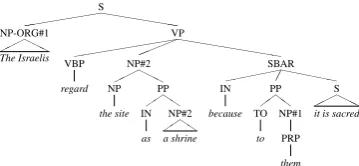
Figure 2: Example of a coreference decision fixed by agreement constraints (see Section 3.1.2). The pronounthemis closest tothe sitemention, but has an incompatible number feature with it. The clos-est (in tree distance, see Section 3.1.1) compatible mention isThe Israelis, which is correct
particular, this fixes examples such as those in Figure 1 where the true antecedent has many em-bedded mentions between itself and the pronoun. This change by itself yields 51.7 pairwise F1 (see
BASE-TREEin Table 2), which is small overall, but
reduces pairwise pronoun antecedent selection er-ror from 51.3% to 42.5%.
3.1.2 Agreement Constraints
We now refine our compatibility filtering to in-corporate simple agreement constraints between coreferent mentions. Since we currently allow proper and nominal mentions to corefer only with matching head mentions, agreement is only a con-cern for pronouns. Traditional linguistic theory stipulates that coreferent mentions must agree in number, person, gender, and entity type (e.g. an-imacy). Here, we implement person, number and entity type agreement.6
A number feature is assigned to each mention deterministically based on the head and its POS tag. For entity type, we use NER labels. Ideally, we would like to have information about the en-tity type of each referential NP, however this in-formation is not easily obtainable. Instead, we opt to utilize the Stanford NER tagger (Finkel et al., 2005) over the sentences in a document and anno-tate each NP with the NER label assigned to that mention head. For each mention, when its NP is assigned an NER label we allow it to only be com-patible with that NER label.7 For pronouns, we deterministically assign a set of compatible NER values (e.g. personal pronouns can only be a
PER-6Gender agreement, while important for general
corefer-ence resolution, did not contribute to the errors in our largely newswire data sets.
7Or allow it to be compatible with all NER labels if the
NER tagger doesn’t predict a label.
gore president florida state bush governor lebanese territory nation people arafat leader
inc. company aol company
[image:4.595.91.271.62.145.2]nation country assad president Table 1: Most common recall (missed-link) errors amongst non-pronoun mention heads on our de-velopment set. Detecting compatibility requires semantic knowledge which we obtain from a large corpus (see Section 3.2).
S``` ` NP#1 NNP Wal-Mart VPhhhh ( ( ( ( VBZ says Shhhh ( ( ( ( NP#2 XXX NP NNP Gitano , ,
NP-APPOS#2PP NP#1 PRP its JJ top NNS brand VP PP is underselling
Figure 4: Example of interaction between the ap-positive and i constraint. The i-within-i constrai-within-int di-within-isallows coreference between parent and child NPs unless the child is an appositive. Hashed numbers indicate ground truth but are not in the actual trees.
SON, butitscan be anORGANIZATION or LOCA-TION). Since the NER tagger typically does not
label non-proper NP heads, we have no NER com-patibility information for nominals.
We incorporate agreement constraints by filter-ing the set of possible antecedents to those which have compatible number and NER types with the target mention. This yields 53.4 pairwise F1, and reduces pronoun antecedent errors to 42.5% from 34.4%. An example of the type of error fixed by these agreement constraints is given by Figure 2. 3.1.3 Syntactic Configuration Constraints Our system has so far focused only on improving pronoun anaphora resolution. However, a plurality of the errors made by our system are amongst non-pronominal mentions.8 We take the approach that in order to align a non-pronominal mention to an antecedent without an identical head, we require evidence that the mentions are compatible.
Judging compatibility of mentions generally re-quires semantic knowledge, to which we return later. However, some syntactic configurations 8There are over twice as many nominal mentions in our
[image:4.595.333.501.218.315.2]NP#1
!!!!!!!! "
" " " " " " "
NP
##### $ $ $ $ $
NN#1
painter NNP
Pablo NNP
Picasso ,
,
NP#1
%%%%%% &
& & & & &
subject of the [exhibition]2
NP-PERS#1
!!!!!!!!! ""
# # # # # # # # #
NP
$$$$ % % % %
NP-APPOS#1
NN
painter
NP-PERS
& && ' ' '
NNP
Pablo
NNP
Picasso
,
,
NP-APPOS#1
(((((( )
) ) ) ) )
subject of the [exhibition]2
[image:5.595.113.484.67.164.2](a) (b)
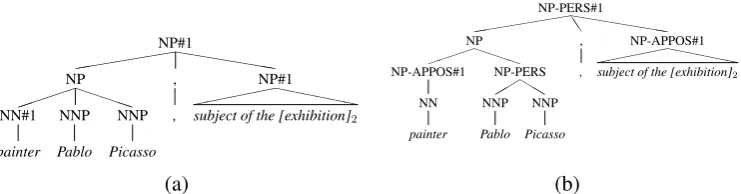
Figure 3: NP structure annotation: In (a) we have the raw parse from the Klein and Manning (2003) parser with the mentions annotated by entity. In (b), we demonstrate the annotation we have added. NER labels are added to all NP according to the NER label given to the head (see Section 3.1.1). Appositive NPs are also annotated. Hashes indicate forced coreferent nodes
guarantee coreference. The one exploited most in coreference work (Soon et al., 1999; Ng and Cardie, 2002; Luo et al., 2004; Culotta et al., 2007; Poon and Domingos, 2008; Bengston and Roth, 2008) is the appositive construction. Here, we rep-resent apposition as a syntactic feature of an NP indicating that it is coreferent with its parent NP (e.g. it is an exception to the i-within-i constraint that parent and child NPs cannot be coreferent). We deterministically mark a node as NP-APPOS
(see Figure 3) when it is the third child in of a par-ent NP whose expansion begins with (NP , NP), and there is not a conjunction in the expansion (to avoid marking elements in a list as appositive).
Role Appositives: During development, we dis-covered many errors which involved a variant of appositives which we call ‘role appositives’ (see
painter in Figure 3), where an NP modifying the
head NP describes the role of that entity (typi-cally a person entity). There are several challenges to correctly labeling these role NPs as being ap-positives. First, the NPs produced by Treebank parsers are flat and do not have the required inter-nal structure (see Figure 3(a)). While fully solving this problem is difficult, we can heuristically fix many instances of the problem by placing an NP around maximum length sequences of NNP tags or NN (and JJ) tags within an NP; note that this will fail for many constructions such asU.S. Pres-ident Barack Obama, which is analyzed as a flat sequence of proper nouns. Once this internal NP structure has been added, whether the NP immedi-ately to the left of the head NP is an appositive de-pends on the entity type. For instance,Rabbi Ashi is an apposition butIranian armyis not. Again, a full solution would require its own model, here we mark as appositions any NPs immediately to the
left of a head child NP where the head child NP is identified as a person by the NER tagger.9
We incorporate NP appositive annotation as a constraint during filtering. Any mention which corresponds to an appositive node has its set of possible antecedents limited to its parent. Along with the appositive constraint, we implement the i-within-i constraint that any non-appositive NP cannot be be coreferent with its parent; this con-straint is then propagated to any node its parent is forced to agree with. The order in which these constraints are applied is important, as illustrated by the example in Figure 4: First the list of pos-sible antecedents for the appositive NP is con-strained to only its parent. Now that all apposi-tives have been constrained, we apply the i-within-i constrai-within-int, whi-within-ich preventsitsfrom having the NP headed bybrandin the set of possible antecedents, and by propagation, also removes the NP headed
by Gitano. This leaves the NP Wal-Mart as the
closest compatible mention.
Adding these syntactic constraints to our system yields 55.4 F1, a fairly substantial improvement, but many recall errors remain between mentions with differing heads. Resolving such cases will require external semantic information, which we will automatically acquire (see Section 3.2). Predicate Nominatives: Another syntactic con-straint exploited in Poon and Domingos (2008) is the predicate nominative construction, where the object of a copular verb (forms of the verbbe) is constrained to corefer with its subject (e.g. Mi-crosoft is a company in Redmond). While much less frequent than appositive configurations (there are only 17 predicate nominatives in our devel-9Arguably, we could also consider right modifying NPs
Path Example
NP !!! " " "
NP-NNP PRN-NNP NP
##### $$
% % % % %
NP-president CC NP-NNP
America Online Inc. (AOL)
NP !!! " " "
NP-NNP PRN-NNP NP
##### $$
% % % % %
[image:6.595.143.458.61.178.2]NP-president CC NP-NNP [President and C.E.O] Bill Gates
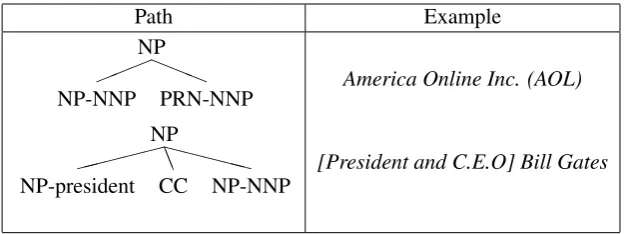
Figure 5: Example paths extracted via semantic compatibility mining (see Section 3.2) along with exam-ple instantiations. In both examexam-ples the left child NP is coreferent with the rightmost NP. Each category in the interior of the tree path is annotated with the head word as well as its subcategorization. The examples given here collapse multiple instances of extracted paths.
opment set), predicate nominatives are another highly reliable coreference pattern which we will leverage in Section 3.2 to mine semantic knowl-edge. As with appositives, we annotate object predicate-nominative NPs and constrain corefer-ence as before. This yields a minor improvement to 55.5 F1.
3.2 Semantic Knowledge
While appositives and related syntactic construc-tions can resolve some cases of non-pronominal reference, most cases require semantic knowledge about the various entities as well as the verbs used in conjunction with those entities to disambiguate references (Kehler et al., 2008).
However, given a semantically compatible men-tion head pair, say AOL and company, one might expect to observe a reliable appositive or predicative-nominative construction involving these mentions somewhere in a large corpus. In fact, the Wikipedia page for AOL10 has a predicate-nominative construction which supports the compatibility of this head pair:AOL LLC (for-merly America Online) is an American global In-ternet services and media company operated by Time Warner.
In order to harvest compatible head pairs, we utilize our BLIPP and WIKI data sets (see
Sec-tion 2), and for each noun (proper or common) and pronoun, we assign a maximal NP mention node for each nominal head as in Section 3.1.1; we then annotate appositive and predicate-nominative NPs as in Section 3.1.3. For any NP which is annotated as an appositive or predicate-nominative, we ex-tract the head pair of that node and its constrained antecedent.
10http://en.wikipedia.org/wiki/AOL
The resulting set of compatible head words, while large, covers a little more than half of the examples given in Table 1. The problem is that these highly-reliable syntactic configurations are too sparse and cannot capture all the entity infor-mation present. For instance, the first sentence of Wikipedia abstract forAl Goreis:
Albert Arnold “Al” Gore, Jr. is an American environmental activist who served as the 45th Vice President of the United States from 1993 to 2001 under President Bill Clinton.
The required lexical patternX who served as Yis a general appositive-like pattern that almost surely indicates coreference. Rather than opt to manu-ally create a set of these coreference patterns as in Hearst (1992), we instead opt to automatically ex-tract these patterns from large corpora as in Snow et al. (2004) and Phillips and Riloff (2007). We take a simple bootstrapping technique: given a set of mention pairs extracted from appositives and predicate-nominative configurations, we ex-tract counts over tree fragments between nodes which have occurred in this set of head pairs (see Figure 5); the tree fragments are formed by an-notating the internal nodes in the tree path with the head word and POS along with the subcatego-rization. We limit the paths extracted in this way in several ways: paths are only allowed to go be-tween adjacent sentences and have a length of at most 10. We then filter the set of paths to those which occur more than a hundred times and with at least 10 distinct seed head word pairs.
MUC b3 Pairwise CEAF
System P R F1 P R F1 P R F1 P R F1
ACE2004-ROTH-DEV
BASIC-FLAT 73.5 66.8 70.0 80.6 68.6 74.1 63.6 39.7 48.9 68.4 68.4 68.4
BASIC-TREE 75.8 68.9 72.2 81.9 69.9 75.4 65.6 42.7 51.7 69.8 69.8 69.8
+SYN-COMPAT 77.8 68.5 72.9 84.1 69.7 76.2 71.0 43.1 53.4 69.8 69.8 69.8
+SYN-CONSTR 78.3 70.5 74.2 84.0 71.0 76.9 71.3 45.4 55.5 70.8 70.8 70.8
+SEM-COMPAT 77.9 74.1 75.9 81.8 74.3 77.9 68.2 51.2 58.5 72.5 72.5 72.5
ACE2004-CULOTTA-TEST
BASIC-FLAT 68.6 60.9 64.5 80.3 68.0 73.6 57.1 30.5 39.8 66.5 66.5 66.5
BASIC-TREE 71.2 63.2 67.0 81.6 69.3 75.0 60.1 34.5 43.9 67.9 67.9 67.9
+SYN-COMPAT 74.6 65.2 69.6 84.2 70.3 76.6 66.7 37.2 47.8 69.2 69.2 69.2
+SYN-CONSTR 74.3 66.4 70.2 83.6 71.0 76.8 66.4 38.0 48.3 69.6 69.6 69.6
+SEM-COMPAT 74.8 77.7 79.6 79.6 78.5 79.0 57.5 57.6 57.5 73.3 73.3 73.3 Supervised Results
Culotta et al. (2007) - - - 86.7 73.2 79.3 - - -
-Bengston and Roth (2008) 82.7 69.9 75.8 88.3 74.5 80.8 55.4 63.7 59.2 - -
-MUC6-TEST
+SEM-COMPAT 87.2 77.3 81.9 84.7 67.3 75.0 80.5 57.8 67.3 72.0 72.0 72.0
Unsupervised Results
Poon and Domingos (2008) 83.0 75.8 79.2 - - - 63.0 57.0 60.0 - -
-Supervised Results
Finkel and Manning (2008) 89.7 55.1 68.3 90.9 49.7 64.3 74.1 37.1 49.5 - -
-ACE2004-NWIRE
+SEM-COMPAT 77.0 75.9 76.5 79.4 74.5 76.9 66.9 49.2 56.7 71.5 71.5 71.5 Unsupervised Results
Poon and Domingos (2008) 71.3 70.5 70.9 - - - 62.6 38.9 48.0 - -
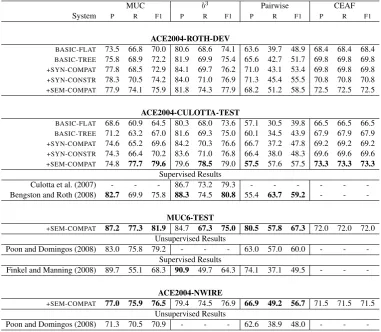
-Table 2: Experimental Results (See Section 4): When comparisons between systems are presented, the largest result is bolded. The CEAF measure has equal values for precision, recall, and F1.
specified. However there are some tree fragments which correspond to the novel coreference pat-terns (see Figure 5) of parenthetical alias as well as conjunctions of roles in NPs.
We apply our extracted tree fragments to our
BLIPPandWIKIdata sets and extract a set of
com-patible word pairs which match these fragments; these words pairs will be used to relax the seman-tic compatibility filter (see the start of the section); mentions are compatible with prior mentions with the same head or with a semantically compatible head word. This yields 58.5 pairwise F1 (see SEM-COMPAT in Table 2) as well as similar
improve-ments across other metrics.
By and large the word pairs extracted in this way are correct (in particular we now have cov-erage for over two-thirds of the head pair recall errors from Table 1.) There are however word-pairs which introduce errors. In particular city-state constructions (e.g. Los Angeles, California) appears to be an appositive and incorrectly allows our system to have angeles as an antecedent for
california. Another common error is that the %
symbol is made compatible with a wide variety of common nouns in the financial domain.
4 Experimental Results
We present formal experimental results here (see Table 2). We first evaluate our model on the ACE2004-CULOTTA-TEST dataset used in
the state-of-the-art systems from Culotta et al. (2007) and Bengston and Roth (2008). Both of these systems were supervised systems discrimi-natively trained to maximizeb3and used features
from many different structured resources includ-ing WordNet, as well as domain-specific features (Culotta et al., 2007). Our best b3 result of 79.0
is broadly in the range of these results. We should note that in our work we use neither the gold men-tion types (we do not model pre-nominals sepa-rately) nor do we use the gold NER tags which Bengston and Roth (2008) does. Across metrics, the syntactic constraints and semantic compatibil-ity components contribute most to the overall final result.
[image:7.595.109.491.62.394.2]outper-PRO
PER NOMINAL PRONOUN NULL TOTAL
PROPER 21/451 8/20 - 72/288 101/759
NOMINAL 16/150 99/432 - 158/351 323/933
[image:8.595.77.291.64.116.2]PRONOUN 29/149 60/128 15/97 1/2 105/376
Table 3: Errors for each type of antecedent deci-sion made by the system. Each row is a mention type and the column the predicted mention type antecedent. The majority of errors are made in the
NOMINALcategory.
forms both Poon and Domingos (2008) (an un-supervised Markov Logic Network system which uses explicit constraints) and Finkel and Manning (2008) (a supervised system which uses ILP in-ference to reconcile the predictions of a pairwise classifier) on all comparable measures.11 Simi-larly, on theACE2004-NWIREdataset, we also
out-perform the state-of-the-art unsupervised system of Poon and Domingos (2008).
Overall, we conclude that our system outper-forms state-of-the-art unsupervised systems12and is in the range of the state-of-the art systems of Cu-lotta et al. (2007) and Bengston and Roth (2008).
5 Error Analysis
There are several general trends to the errors made by our system. Table 3 shows the number of pairwise errors made on MUC6-TEST dataset by
mention type; note these errors are not equally weighted in the final evaluations because of the transitive closure taken at the end. The most er-rors are made on nominal mentions with pronouns coming in a distant second. In particular, we most frequently say a nominal is NULLwhen it has an
antecedent; this is typically due to not having the necessary semantic knowledge to link a nominal to a prior expression.
In order to get a more thorough view of the cause of pairwise errors, we examined 20 random errors made in aligning each mention type to an antecedent. We categorized the errors as follows:
• SEM. COMPAT: Missing information about
the compatibility of two words e.g. payand wage. For pronouns, this is used to mean that 11Klenner and Ailloud (2007) took essentially the same
ap-proach but did so on non-comparable data.
12Poon and Domingos (2008) outperformed Haghighi and
Klein (2007). Unfortunately, we cannot compare against Ng (2008) since we do not have access to the version of the ACE data used in their evaluation.
we incorrectly aligned a pronoun to a men-tion with which it is not semantically com-patible (e.g.healigned toboard).
• SYN. COMPAT: Error in assigning linguistic
features of nouns for compatibility with pro-nouns (e.g. disallowingtheyto refer toteam).
• HEAD: Errors involving the assumption that
mentions with the same head are always com-patible. Includes modifier and specificity er-rors such as allowingLebanonandSouthern Lebanonto corefer. This also includes errors of definiteness in nominals (e.g. the people in the roomandChinese people). Typically, these errors involve a combination of missing syntactic and semantic information.
• INTERNALNP: Errors involving lack of
inter-nal NP structure to mark role appositives (see Section 3.1.3).
• PRAG. / DISC.: Errors where discourse salience
or pragmatics are needed to disambiguate mention antecedents.
• PROCESSERROR: Errors which involved a
tok-enization, parse, or NER error.
The result of this error analysis is given in Ta-ble 4; note that a single error may be attributed to more than one cause. Despite our efforts in Sec-tion 3 to add syntactic and semantic informaSec-tion to our system, the largest source of error is still a combination of missing semantic information or annotated syntactic structure rather than the lack of discourse or salience modeling.
Our error analysis suggests that in order to im-prove the state-of-the-art in coreference resolu-tion, future research should consider richer syntac-tic and semansyntac-tic information than typically used in current systems.
6 Conclusion
Mention Type SEM. COMPAT SYN. COMPAT HEAD INTENALNP PRAG/ DISC. PROCESSERROR OTHER Comment
NOMINAL 7 - 5 6 2 2 1 2 general appos. patterns
PRONOUN 6 3 - 6 3 3 3 2 cataphora
[image:9.595.77.512.63.104.2]PROPER 6 - 3 4 4 4 1
Table 4: Error analysis onACE2004-CULOTTA-TEST data by mention type. The dominant errors are in
either semantic or syntactic compatibility of mentions rather than discourse phenomena. See Section 5.
route forward. Of course, a system which is rich in all axes will find some advantage over any sim-plified approach.
Nonetheless, our coreference system, despite being relatively simple and having no tunable pa-rameters or complexity beyond the non-reference complexity of its component modules, manages to outperform state-of-the-art unsupervised coref-erence resolution and be broadly comparable to state-of-the-art supervised systems.
References
B. Amit and B. Baldwin. 1998. Algorithms for scoring
coreference chains. InMUC7.
Eric Bengston and Dan Roth. 2008. Understanding the value of features for corefernce resolution. In Em-pirical Methods in Natural Language Processing. E. Charniak. 2000. Maximum entropy inspired parser.
In North American Chapter of the Association of Computational Linguistics (NAACL).
Mike Collins. 1999. Head-driven statistical models for natural language parsing.
A Culotta, M Wick, R Hall, and A McCallum. 2007. First-order probabilistic models for coreference
res-olution. InNAACL-HLT.
Pascal Denis and Jason Baldridge. 2007. Global, Joint Determination of Anaphoricity and Corefer-ence Resolution using Integer Programming. In
HLT-NAACL.
Jenny Finkel and Christopher Manning. 2008. Enforc-ing transitivity in coreference resolution. In Associ-ation of ComputAssoci-ational Linguists (ACL).
Jenny Finkel, Trond Grenager, and Christopher Man-ning. 2005. Incorporating non-local information into information extraction systems by gibbs sam-pling. InACL.
Barbara J. Grosz, Aravind K. Joshi, and Scott Wein-stein. 1995. Centering: A framework for modelling the local coherence of discourse.
Aria Haghighi and Dan Klein. 2007. Unsupervised coreference resolution in a nonparametric bayesian
model. InProceedings of the 45th Annual Meeting
of the Association of Computational Linguistics. As-sociation for Computational Linguistics.
Marti Hearst. 1992. Automatic acquisition of
hy-ponyms from large text corpora. InConference on
Natural Language Learning (COLING).
J. R. Hobbs. 1977. Resolving pronoun references.
Lingua.
Andrew Kehler, Laura Kertz, Hannah Rohde, and Jef-frey Elman. 2008. Coherence and coreference re-visited.
D. Klein and C. Manning. 2003. Accurate
unlexical-ized parsing. InAssociation of Computational
Lin-guists (ACL).
Manfred Klenner and Etienne Ailloud. 2007. Op-timization in coreference resolution is not needed: A nearly-optimal algorithm with intensional
con-straints. InRecent Advances in Natural Language
Processing.
Xiaoqiang Luo, Abe Ittycheriah, Hongyan Jing, Nanda
Kambhatla, and Salim Roukos. 2004. A
Mention-Synchronous Coreference Resolution
Al-gorithm Based on the Bell Tree. InAssociation of
Computational Linguists.
X Luo. 2005. On coreference resolution performance
metrics. In Proceedings of the conference on
Hu-man Language Technology and Empirical Methods in Natural Language Processing.
Vincent Ng and Claire Cardie. 2002. Improving Ma-chine Learning Approaches to Coreference Resolu-tion. InAssociation of Computational Linguists.
Vincent Ng. 2008. Unsupervised models of
corefer-ence resolution. InEMNLP.
W. Phillips and E. Riloff. 2007. Exploiting role-identifying nouns and expressions for information
extraction. InRecent Advances in Natural Language
Processing (RANLP).
Hoifung Poon and Pedro Domingos. 2008. Joint unsu-pervised coreference resolution with Markov Logic. InProceedings of the 2008 Conference on Empirical Methods in Natural Language Processing.
R. Snow, D. Jurafsky, and A. Ng. 2004. Learning syn-tactic patterns for automatic hypernym discovery. In
Neural Information Processing Systems (NIPS).
Marc Vilain, John Burger, John Aberdeen, Dennis Con-nolly, and Lynette Hirschman. 1995. A