E
MOB
ANK: Studying the Impact of Annotation Perspective and
Representation Format on Dimensional Emotion Analysis
Sven Buechel and Udo Hahn
Jena University Language & Information Engineering (JULIE) Lab Friedrich-Schiller-Universit¨at Jena, Jena, Germany
{sven.buechel,udo.hahn}@uni-jena.de http://www.julielab.de
Abstract
We describe EMOBANK, a corpus of 10k
English sentences balancing multiple gen-res, which we annotated with dimensional emotion metadata in the Valence-Arousal-Dominance (VAD) representation format.
EMOBANK excels with a bi-perspectival
and bi-representational design. On the one hand, we distinguish between writer’s and reader’s emotions, on the other hand, a subset of the corpus complements dimen-sional VAD annotations with categorical ones based on Basic Emotions. We find ev-idence for the supremacy of the reader’s perspective in terms of IAA and rating in-tensity, and achieve close-to-human per-formance when mapping between dimen-sional and categorical formats.
1 Introduction
In the past years, the analysis of affective lan-guage has become one of the most productive and vivid areas in computational linguistics. In the early days, the prediction of the semantic polar-ity (positiveness or negativeness) was in the center of interest, but in the meantime, research activities shifted towards a more fine-grained modeling of sentiment. This includes the extension from only two to multiple polarity classes or even real-valued scores (Strapparava and Mihalcea, 2007), the ag-gregation of multiple aspects of an opinion item into a composite opinion statement for the whole item (Schouten and Frasincar, 2016), and senti-ment compositionality (Socher et al., 2013).
Yet, two important features of fine-grained modeling still lack appropriate resources, namely shifting towards psychologically more adequate models of emotion (Strapparava, 2016) and
dis-tinguishing between writer’svs.reader’s
perspec-tive on emotion ascription (Calvo and Mac Kim,
2013). We close both gaps with EMOBANK,
the first large-scale text corpus which builds on the Valence-Arousal-Dominance model of emo-tion, an approach that has only recently gained increasing popularity within sentiment analysis.
EMOBANKnot only excels with a genre-balanced
selection of sentences, but is based on a
bi-perspectival annotation strategy (distinguishing
the emotions of writers and readers), and includes
a bi-representationally annotated subset (which
has previously been annotated with Ekman’s Ba-sic Emotions) so that mappings between both
rep-resentation formats can be performed. EMOBANK
is freely available for academic purposes.1
2 Related Work
Models of emotion are commonly subdivided into
categorical and dimensional ones, both in
psy-chology and natural language processing (NLP). Dimensional models consider affective states to be best described relative to a small number of independent emotional dimensions (often two or
three): Valence (corresponding to the concept of
polarity), Arousal (degree of calmness or
excite-ment), andDominance2(perceived degree of
con-trol over a situation); the VAD model. Formally, the VAD dimensions span a three-dimensional real-valued vector space as illustrated in Figure 1. Alternatively, categorical models, such as the six
Basic Emotionsby Ekman (1992) or theWheel of
Emotion by Plutchik (1980), conceptualize
emo-tions as discrete states.3
In contrast to categorical models which were used early on in NLP (Ovesdotter Alm et al., 2005; Strapparava and Mihalcea, 2007), dimensional
1https://github.com/JULIELab/EmoBank
2This dimension is sometimes omitted (the VA model).
3Both dimensional and categorical formats allow for
nu-merical scores regarding their dimensions/categories.
−−1.01.0 −0.5 0.0 0.5 1.0
−
0.5
0.0
0.5
1.0
−1.0
−0.5 0.0
0.5 1.0
Valence
Arousal
Dominance
● ●
● ●
●
●
Anger
Surprise Disgust
Fear Sadness
[image:2.595.92.263.62.184.2]Joy
Figure 1: The affective space spanned by the three VAD dimensions. As an example, we here include the positions of Ekman’s six Basic Emotions as determined by Russell and Mehrabian (1977).
models have only recently received increased at-tention in tasks such as word and document emo-tion predicemo-tion (see, e.g., Yu et al. (2015), K¨oper and Schulte im Walde (2016), Wang et al. (2016), Buechel and Hahn (2016)).
In spite of this shift in modeling focus, VA(D)-annotated corpora are surprisingly rare in number and small in size, and also tend to be restricted
in reliability. ANET, for instance, comprises only
120 sentences designed for psychological research (Bradley and Lang, 2007), while Preot¸iuc-Pietro et al. (2016) created a corpus of 2,895 English Face-book posts relying on only two annotators. Yu et al. (2016) recently presented a corpus of 2,009 Chinese sentences from various online texts.
As far as categorical models for emotion anal-ysis are concerned, many studies use incompati-ble subsets of category systems, which limits their comparability (Buechel and Hahn, 2016; Calvo and Mac Kim, 2013). This also reflects the sit-uation in psychology where there is still no con-sensus on a set of fundamental emotions (Sander and Scherer, 2009). Here, the VAD model has a major advantage: Since the dimensions are de-signed as being independent, results remain com-parable dimension-wise even in the absence of others (e.g., Dominance). Furthermore, dimen-sional models are the predominant format for lexi-cal affective resources in behavioral psychology as evident from the huge number of datasets available for a wide range of languages (see, e.g., Warriner et al. (2013), Stadthagen-Gonzalez et al. (2016), Moors et al. (2013) and Schmidtke et al. (2014)).
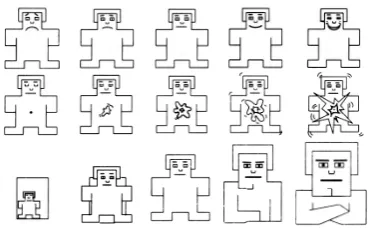
For the acquisition of VAD values from par-ticipant’s self-perception, the Self-Assessment Manikin (SAM; Lang (1980), Bradley and Lang (1994)) has turned out as the most important and
(to our knowledge) only standardized instrument (Sander and Scherer, 2009). SAM iconically dis-plays differences in Valence, Arousal and Domi-nance by a set of anthropomorphic cartoons on a multi-point scale (see Figure 2).
While it is common for more basic sentiment analysis systems in NLP to map the many differ-ent possible interpretations of a sdiffer-entence’s affec-tive meaning into a single assessment (“its senti-ment”), there is an increasing interest in a more fine-grained approach where emotion expressed by writers is modeled separately from emotion evoked in readers. An utterance like “Italy de-feats France in the World Cup Final” may be
com-pletely neutral from the writer’s viewpoint
(pre-sumably a professional journalist), but is likely to evoke rather adverse emotions in Italian and
Frenchreaders(Katz et al., 2007).
In this line of work, Tang and Chen (2012) ex-amine the relation between the sentiment of mi-croblog posts and the sentiment of their com-ments (as a proxy for reader emotion). Liu et al. (2013) model the emotion of a news reader jointly with the emotion of a comment writer using a co-training approach. This contribution was followed up by Li et al. (2016) who propose a two-view la-bel propagation approach instead. However, to our knowledge, only Mohammad and Turney (2013) investigated the effects of these perspectives on annotation quality, finding differences in inter-annotator agreement (IAA) relative to the exact phrasing of the annotation task.
In a similar vein to the writer-reader
distinc-tion, identifying the holderorsourceof an
opin-ion or sentiment also aims at describing the affec-tive information entailed in a sentence in more de-tail (Wiebe et al., 2005; Seki et al., 2009). Thus, opinion statements that can directly be attributed to the writer can be distinguished from references to other’s opinions. A related task, the
detec-tion of stance, focuses on inferring the writer’s
(dis)approval towards a given issue from a piece of text (Sobhani et al., 2016).
3 Corpus Design and Creation
The following criteria guided the data selection
process of the EMOBANK corpus: First,
Corpus Domain Raw Filtered
SE07 news headlines 1,250 1,192
MASC
blogs 1,378 1,336
essays 1,196 1,135
fiction 2,893 2,753
letters 1,479 1,413
newspapers 1,381 1,314
travel guides 971 919
Sum 10,548 10,062
Table 1: Genre distribution of the raw and filtered
EMOBANKcorpus.
Second, we conducted a pilot study on two sam-ples (one consisting of movie reviews, the other pulled from a genre-balanced corpus) to compare the IAA resulting from different annotation spectives (e.g., the writer’s and the reader’s per-spective) in different domains (see Buechel and Hahn (2017) for details). Since we found differ-ences in IAA but the results remained
inconclu-sive, we decided to annotate the whole corpus
bi-perspectivally, i.e., each sentence was rated
ac-cording to both the (perceived) writer andreader
emotion (henceforth, WRITERand READER).
Third, since many problems of comparing emo-tion analysis studies result from the diversity of emotion representation schemes (see Section 2), the ability to accurately map between such alterna-tives would greatly improve comparability across systems and boost the reusability of resources. Therefore, at least parts of our corpus should be
annotated bi-representationally as well,
comple-menting dimensional VAD ratings with annota-tions according to a categorical emotion model.
Following these criteria, we composed our
cor-pus out of several categories of the Manually
Annotated Sub-Corpus of the American National
Corpus(MASC; Ide et al. (2008), Ide et al. (2010))
and the corpus of SemEval-2007 Task 14Affective
Text (SE07; Strapparava and Mihalcea (2007)).
MASC is already annotated on various linguistic
levels. Hence, our work will allow for research at the intersection of emotion and other language
phenomena. SE07, on the other hand, bears
anno-tations according to Ekman’s six Basic Emotion
(see Section 2) on a [0,100] scale, respectively.
This collection of raw data comprises 10,548 sen-tences (see Table 1).
Given this large volume of data, we opted for a crowdsourcing approach to annotation. We
chose CROWDFLOWER(CF) over AMAZONME
-CHANICAL TURK (AMT) for its quality control
mechanisms and accessibility (customers of AMT,
Sven%Büchel%—%JULIE%LAB%(Prof.%Dr.%Udo%Hahn)%—%FSU%Jena%—%November%2,%2016%
Pleasure(
Unhappy% Annoyed% Unsatisfied%
% % % % %
Happy% Pleased% Satisfied%
%
% % % % % % %
% % % % % % %
Arousal(
Calm% Relaxed%
Sleepy% %
% % % % %
Excited% Nervous% Aroused%
%
% % % % % % %
% % % % % % %
Control(
Submissive% Influenced% Guided%
%
% % % % %
Dominant% In%control% Influential%
% % % % % % %
%
Sven%Büchel%—%JULIE%LAB%(Prof.%Dr.%Udo%Hahn)%—%FSU%Jena%—%November%2,%2016%
Pleasure(
Unhappy% Annoyed% Unsatisfied%
% % % % %
Happy% Pleased% Satisfied%
%
% % % % % % %
% % % % % % %
Arousal(
Calm% Relaxed%
Sleepy% %
% % % % %
Excited% Nervous% Aroused%
%
% % % % % % %
% % % % % % %
Control(
Submissive% Influenced% Guided%
%
% % % % %
Dominant% In%control% Influential%
% % % % % % %
%
Sven%Büchel%—%JULIE%LAB%(Prof.%Dr.%Udo%Hahn)%—%FSU%Jena%—%November%2,%2016%
Pleasure(
Unhappy% Annoyed% Unsatisfied%
% % % % %
Happy% Pleased% Satisfied%
%
% % % % % % %
% % % % % % %
Arousal(
Calm% Relaxed%
Sleepy% %
% % % % %
Excited% Nervous% Aroused%
%
% % % % % % %
% % % % % % %
Control(
Submissive% Influenced% Guided%
%
% % % % %
Dominant% In%control% Influential%
% % % % % % %
% Figure 2: The modified 5-point Self-Assessment
Manikin (SAM) scales for Valence, Arousal and Dominance (row-wise). Copyright of the original SAM by Peter J. Lang 1994.
but not CF, must be US-based). CF’s main
qual-ity control mechanism rests on gold questions,
items for which the acceptable ratings have been previously determined by the customer. These questions are inserted into a task to restrict the workers to those performing trustworthily. We chose these gold items by automatically extracting highly emotional sentences from our raw data
ac-cording to JEMAS4, a lexicon-based tool for VAD
prediction (Buechel and Hahn, 2016). The ac-ceptable ratings were determined based on manual annotations by three students trained in linguis-tics. The process was individually performed for
WRITERand READERwith different annotators.
For each of the two perspectives, we launched
an independent task on CF. The instructions were
based on those by Bradley and Lang (1999) to whom most of the VAD resources developed in psychology refer (see Section 2). We changed the 9-point SAM scales to 5-point scales (see Figure 2) in order to reduce the cognitive load during de-cision making for crowdworkers. For the writer’s perspective, we presented a number of linguis-tic clues supporting the annotators in their rating decisions, while, for the reader’s perspective, we
asked what emotion would be evoked in an
aver-age reader (rather than asking for the rater’s
per-sonal feelings). Both adjustments were made to establish more objective criteria for the exclusion of untrustworthy workers. We provide the instruc-tions along with our dataset.
For each sentence, five annotators generated VAD ratings. Thus, a total of 30 ratings were gath-ered per sentence (five ratings for each of the three VAD dimensions and two annotation perspectives,
WRITERand READER). Ten sentences were
pre-sented at a time. The task was available for
[image:3.595.324.511.60.174.2] [image:3.595.87.273.61.159.2]ers located in the UK, the US, Ireland, Canada, Australia or New Zealand. The total annotation costs amounted to $1,578.
Upon inspection of the individual judgments,
we found that the VAD rating(1,1,1)was
heav-ily overrepresented. We interpret this skewed cod-ing distribution as a bias mainly due fraudulent re-sponses since, from a psychological view, this rat-ing is highly improbable (Warriner et al., 2013). Accordingly, we decided to remove all of these ratings (about 10% for each of the tasks; the ‘Fil-tered’ condition in Table 1) because these annota-tions would have inserted a systematic bias into our data which we consider more harmful than erroneously removing a few honest outliers. For each sentence with two or more remaining judg-ments, its final emotion annotation is determined by averaging these valid ratings leading to a total
of 10,062 sentences bearing VAD values forboth
perspectives (see Table 1).
This makes EMOBANK to the best of our
knowledge by far the largest corpus for dimen-sional emotion models and, with the exception of the dataset by Quan and Ren (2009) (which is
problematic in having onlyoneannotator per
sen-tence), the largest gold standard for any emotion format (both dimensional and categorical). Even compared with polarity corpora it is still
reason-ably large (e.g., similar in size to theStanford
Sen-timent Treebank(Socher et al., 2013)).
4 Analysis and Results
For continuous, real-valued numbers, well-known
metrics for IAA, such as Cohen’s κ or F-score,
are inappropriate as these are designed for nom-inally scaled variables. Instead, Pearson’s
correla-tion coefficient (r) or Mean Absolute Error (MAE)
are often applied for this setting (Strapparava and Mihalcea, 2007; Yu et al., 2016). Accordingly, for
each annotator, we computer andMAEbetween
their own and the aggregated EMOBANK
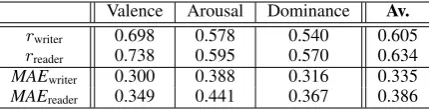
annota-tion and average these values for each VAD di-mension. This results in one IAA value per metric
(rorMAE), perspective and dimension (Table 2).
As average over the VAD dimensions, we
achieve a satisfying IAA of r > .6for both
per-spectives. The READER results in significantly
higher correlation,5 but also higher error than
5Note that using this set-up, obtaining statistical
signifi-cance is very rare, since the number of cases is based on the number of raters.
Valence Arousal Dominance Av.
rwriter 0.698 0.578 0.540 0.605
rreader 0.738 0.595 0.570 0.634
MAEwriter 0.300 0.388 0.316 0.335
[image:4.595.309.524.62.117.2]MAEreader 0.349 0.441 0.367 0.386
Table 2: IAA for the three VAD dimensions.
WRITER(p < .05for Valence inrand for all
di-mensions inMAEusing a two-tailedt-test).
Prior work found that a large portion of lan-guage may actually be neutral in terms of emo-tion (Ovesdotter Alm et al., 2005). However, a too narrow rating distribution (i.e., most of the ratings being rather neutral relative to the three VAD di-mensions) may be a disadvantageous property for
training data. Therefore, we regard the
emotional-ityof ratings as another quality criterion for
emo-tion annotaemo-tion complementary to IAA.
We capture this notion as the absolute difference of a sentence’s aggregated rating from the neutral
rating (3, in our case), averaged over all VAD
di-mensions. Comparing the average emotionality of
all sentences between WRITERand READER, we
find that the latter perspective also excels with
sig-nificantly higher emotionality than the WRITER
(p < .001; two-tailedt-test).
These beneficial characteristics of the READER
perspective (better correlation-based IAA and emotionality) contrast with its worse error-based IAA. Thus, we decided to examine the relationship between error and emotionality between the two
perspectives more closely: Let V, A, D be three
m×n-matrices wheremcorresponds to the
num-ber of sentences andnto the number of annotators
so that the three matrices yield all the individual ratings for Valence, Arousal and Dominance,
re-spectively. Then we define thesentence-wise error
for sentencei(SWEi) as
SWEi:= 13
X
X∈{V,A,D} 1
n
n
X
j=1
|Xi−Xij| (1)
whereXi := n1 Pnj=1Xij. We compute SWE
val-ues for reader and writer perspective individually. We can now examine the dependency between er-ror and emotionality by subtracting, for each sen-tence, SWE and emotionality for both perspectives
from another (resulting in onedifference in error
and onedifference in emotionalityvalue).
Our data reveal a strong correlation (r = .718)
(compar-● ● ● ●● ● ● ● ● ● ● ● ● ● ● ● ● ● ● ● ● ● ● ● ● ● ● ● ● ● ● ● ● ● ● ● ● ● ● ● ● ● ● ● ● ● ● ● ● ● ● ● ● ● ● ●● ● ● ● ● ● ● ● ● ● ● ● ● ● ● ● ● ● ● ● ● ● ● ● ● ● ● ● ● ● ● ● ● ● ● ● ● ●● ● ● ● ● ● ● ● ● ● ●● ● ● ● ● ● ● ● ● ● ● ● ● ● ● ● ● ● ● ● ● ● ● ● ● ● ● ● ● ● ● ● ● ● ● ● ● ● ● ● ● ● ● ● ● ● ● ● ● ● ● ● ● ● ● ● ● ● ● ● ● ● ● ● ● ● ● ● ● ● ● ● ● ● ●● ● ● ● ● ● ● ● ● ● ● ● ● ● ● ● ● ● ● ● ● ● ●● ● ● ● ● ● ● ● ●● ● ● ● ● ● ● ● ● ● ● ● ● ● ● ● ● ● ● ● ●● ● ● ● ● ● ● ● ● ● ● ● ● ● ● ● ● ● ● ● ● ● ● ● ● ● ● ● ● ● ● ● ● ● ● ● ● ● ● ● ● ● ● ● ● ● ● ● ● ● ● ● ● ● ● ● ● ● ●● ● ● ● ● ● ● ● ● ● ● ● ● ● ● ● ● ● ● ● ● ● ● ● ● ● ● ● ● ● ● ● ● ● ● ● ● ● ● ● ● ● ● ● ● ● ● ● ● ● ● ● ● ● ● ● ● ● ● ● ● ● ● ● ● ● ●● ● ● ● ● ● ● ● ● ● ● ● ● ● ● ● ● ●● ● ●● ● ● ● ● ● ● ● ● ●● ● ● ● ● ● ● ● ● ● ●● ● ● ● ● ● ● ● ● ● ● ● ● ● ● ● ● ● ● ● ● ● ● ● ● ● ● ● ● ● ● ● ● ● ● ● ● ● ● ● ● ● ● ● ● ● ● ● ● ● ● ● ● ● ● ● ● ● ● ● ● ● ● ● ● ● ● ● ● ● ● ● ● ● ● ● ● ● ● ● ● ● ● ● ● ● ● ● ● ● ● ● ● ● ● ● ● ● ● ● ● ●● ● ● ● ● ● ● ● ●●● ● ● ● ● ● ● ● ● ● ● ● ● ● ● ● ● ● ● ● ● ● ● ● ● ● ● ● ● ● ● ● ● ● ● ● ● ● ● ● ● ● ● ● ● ● ● ● ● ● ● ● ● ● ● ● ● ● ● ● ● ● ● ● ● ● ● ● ● ● ● ● ● ● ● ● ● ● ● ● ● ● ● ● ● ● ● ● ● ● ● ● ● ● ● ● ● ● ● ● ● ● ● ● ● ● ● ● ● ● ● ● ● ● ● ● ● ● ● ● ● ● ● ● ● ● ● ● ● ● ● ● ● ● ● ● ● ● ● ● ● ● ● ● ● ● ● ● ● ● ● ● ● ● ● ● ● ● ● ● ● ● ● ● ● ● ● ● ● ●● ● ● ● ● ● ● ● ● ● ● ● ● ● ● ● ● ● ● ● ● ● ● ● ● ● ● ● ● ● ● ● ● ● ● ● ● ● ● ● ● ● ● ● ● ● ● ● ● ● ●● ● ● ● ● ● ● ● ● ● ● ● ● ● ● ● ● ● ● ● ● ● ● ● ● ● ● ● ● ● ● ● ● ● ● ● ● ● ● ● ● ● ● ● ● ● ● ● ● ● ● ● ● ●● ● ● ● ● ● ● ● ● ● ● ● ● ● ● ● ● ● ● ● ● ● ● ● ● ● ● ● ● ● ● ● ● ● ● ● ● ● ● ● ● ● ● ● ● ● ● ● ● ● ● ● ● ● ● ● ● ● ● ● ● ● ● ● ● ● ● ● ● ● ● ● ● ● ● ● ● ● ● ● ● ● ● ● ● ● ● ● ● ● ● ● ● ● ● ● ● ● ● ● ● ● ● ● ● ● ● ● ● ● ●● ● ● ●● ● ● ● ● ● ● ● ● ● ● ● ● ● ● ● ● ● ● ● ● ● ● ● ● ● ● ● ● ● ● ● ● ● ● ● ● ● ● ● ● ● ● ● ●● ● ● ● ● ● ● ● ● ● ● ● ● ● ● ● ● ● ● ● ● ● ● ● ● ● ● ● ● ● ● ● ● ●● ● ● ● ● ● ● ● ● ● ● ● ● ● ● ● ● ● ● ● ● ● ● ● ● ● ● ● ● ● ● ● ● ● ● ● ● ● ● ● ● ● ● ● ● ● ● ● ● ● ● ● ● ● ● ● ● ● ● ● ● ● ● ● ● ● ● ● ● ● ● ● ● ● ● ● ● ● ● ● ● ● ● ● ● ● ● ● ● ● ● ● ● ● ● ● ● ● ● ● ● ● ● ● ● ● ● ● ● ● ● ● ● ● ● ● ● ● ● ● ● ● ● ● ● ● ● ● ● ● ● ● ● ● ● ● ● ● ● ● ● ● ● ● ● ● ● ● ● ● ● ● ● ● ● ● ● ● ● ● ● ● ● ● ● ● ● ● ● ● ● ● ● ● ● ● ● ● ● ● ● ● ● ● ● ● ● ● ● ● ● ● ● ● ●● ● ● ● ● ● ● ● ● ● ● ● ● ● ● ● ● ● ● ● ● ● ● ● ● ● ● ● ● ● ● ● ● ● ● ● ● ● ● ● ● ● ● ● ● ● ● ● ● ● ● ● ● ● ● ● ● ● ● ● ● ● ● ● ● ● ● ● ● ● ● ● ● ● ● ● ● ● ● ● ● ● ● ● ● ● ● ● ● ● ● ● ● ●● ● ● ● ● ● ● ● ● ● ● ● ● ● ● ● ● ● ● ● ● ● ● ● ● ● ● ● ● ● ● ● ● ● ● ● ● ● ● ● ● ● ● ● ● ● ● ● ● ● ● ● ● ● ● ●● ● ● ● ● ● ● ● ● ● ● ● ● ● ● ● ●● ● ● ● ● ● ● ● ● ● ● ● ● ● ● ● ● ● ● ● ● ● ● ● ● ● ● ● ● ● ● ● ● ● ● ● ● ● ● ● ● ● ● ● ● ● ● ● ● ● ● ● ● ● ● ● ● ● ● ● ● ● ● ● ● ● ● ● ● ● ● ● ● ● ● ● ● ● ● ● ● ● ● ● ● ● ● ● ● ● ● ● ● ● ● ● ● ● ● ● ● ● ● ● ● ● ● ● ● ● ● ● ● ● ● ● ● ● ●●●● ● ● ●● ● ● ● ● ● ● ● ● ● ● ● ● ● ● ● ● ● ● ● ● ● ● ● ● ● ● ● ● ● ● ● ● ● ● ● ● ● ● ● ● ● ● ● ● ●● ● ●● ● ● ● ● ● ● ● ● ● ● ●● ● ● ● ● ● ● ● ● ● ● ● ● ● ● ● ●● ● ● ● ● ● ● ● ● ● ● ● ● ● ● ●●● ● ● ● ● ● ● ● ● ● ● ● ●● ●● ● ● ● ● ● ● ● ● ● ● ● ● ● ● ● ● ● ● ● ● ● ● ● ● ● ● ● ● ● ● ● ● ● ● ● ● ● ● ● ● ● ● ● ● ● ● ● ● ● ● ● ● ● ● ●● ● ● ● ● ● ● ● ● ● ● ● ● ● ● ● ● ● ● ●● ● ● ● ● ● ● ● ● ● ● ● ● ● ● ● ● ● ● ● ● ● ● ● ● ● ● ● ● ● ● ● ● ● ● ● ● ● ● ● ● ● ● ● ● ● ● ● ● ● ● ● ● ● ● ● ● ● ● ● ● ● ● ● ● ● ● ● ● ● ● ● ● ● ● ● ● ● ● ● ● ● ● ●● ● ● ● ● ● ● ● ● ● ● ● ● ● ● ● ● ● ● ● ● ● ● ● ● ● ● ● ● ● ● ● ● ● ● ● ● ● ● ● ● ● ● ● ● ● ● ● ● ● ● ● ● ● ● ● ● ● ● ● ● ● ● ● ● ● ● ● ● ● ● ● ● ● ● ● ● ● ● ● ● ● ● ● ● ● ● ● ● ● ● ● ● ● ● ● ● ● ● ● ● ● ● ● ● ● ● ● ● ● ● ● ● ● ● ● ● ● ● ● ● ● ● ● ● ● ● ● ● ● ● ● ● ● ● ● ● ●● ● ● ● ● ● ● ● ● ● ● ● ● ● ● ● ● ● ● ● ● ● ● ● ● ● ● ● ● ● ● ● ● ● ● ● ● ● ● ● ● ● ● ● ● ● ● ● ● ● ● ● ● ● ● ● ● ● ● ● ● ● ● ● ● ● ● ● ● ● ● ● ● ● ● ● ● ● ● ● ● ● ● ● ● ● ● ● ● ● ● ● ● ● ● ● ● ● ● ● ●● ● ● ● ● ● ● ● ● ● ● ● ● ● ● ● ● ● ● ● ● ● ● ● ● ● ● ● ● ● ● ● ● ● ● ● ● ● ● ● ● ● ● ● ● ● ● ● ● ● ● ● ● ● ● ● ● ● ● ● ● ● ● ● ● ● ● ● ● ● ● ● ● ● ● ● ● ● ● ● ● ● ● ● ● ● ● ● ● ● ● ● ● ● ● ● ● ● ● ● ● ● ● ● ● ● ● ● ● ● ● ● ● ● ● ● ● ● ● ● ● ● ● ● ● ● ● ● ● ●● ● ● ● ● ● ● ● ● ● ● ● ● ● ● ● ● ● ● ● ● ● ● ● ● ● ● ● ● ● ● ●● ● ● ● ● ● ● ● ● ● ● ● ● ● ● ● ● ● ● ● ● ● ● ● ● ● ● ● ● ● ● ● ● ● ● ● ● ● ● ● ● ● ● ● ● ● ● ● ● ● ● ● ● ● ● ● ● ● ● ● ● ● ● ● ● ● ● ● ● ● ● ● ● ● ● ● ● ● ● ● ● ● ● ● ● ●● ● ● ● ● ● ● ● ● ● ● ● ● ● ● ● ● ● ● ● ● ● ● ● ● ● ● ● ● ● ● ● ● ● ● ● ● ● ● ● ● ● ● ● ● ● ● ● ● ● ● ● ● ● ● ● ● ● ● ● ● ● ● ● ● ● ● ● ● ● ● ● ● ● ●● ● ● ● ● ● ● ● ●● ● ● ● ● ● ● ● ● ● ● ● ● ● ● ● ● ● ● ●● ● ● ● ● ● ● ● ● ● ● ● ● ● ● ● ● ● ● ● ● ● ● ● ● ● ● ● ● ●●● ● ● ● ● ● ● ● ● ● ● ● ● ● ● ● ● ● ● ● ● ● ● ● ● ● ● ● ● ● ● ● ● ● ● ● ● ● ● ● ● ● ● ● ● ● ● ● ● ● ● ● ● ● ●● ● ● ● ● ●● ● ● ●● ● ● ● ● ● ● ● ● ● ● ● ● ● ● ● ● ● ● ● ● ● ● ● ● ● ● ● ● ● ● ● ● ● ● ● ● ● ● ● ● ● ● ● ● ● ● ● ● ● ● ● ● ● ● ● ● ● ● ● ● ● ● ● ● ● ● ● ● ● ● ● ● ● ● ● ● ● ● ● ● ● ● ● ● ●● ● ● ● ● ● ● ● ● ● ● ● ● ● ● ● ● ● ● ● ● ● ● ● ● ● ● ● ● ● ● ● ● ● ● ● ● ● ● ● ● ● ● ● ● ● ● ● ● ● ● ● ● ● ● ● ● ● ● ● ● ● ● ● ● ● ● ● ● ● ● ● ● ● ● ● ● ● ● ● ● ● ● ● ● ● ● ● ● ● ● ● ● ● ● ● ● ● ● ● ● ●● ● ● ● ● ● ● ● ● ● ● ● ● ● ● ● ● ● ● ● ● ● ● ● ● ● ● ● ● ● ● ● ● ●● ● ● ● ● ● ● ● ● ● ● ● ● ● ● ● ● ● ● ● ● ● ● ● ● ● ● ● ● ● ● ● ● ● ● ● ● ● ● ● ● ● ● ● ● ● ● ● ● ● ● ● ● ● ● ● ● ● ● ● ● ● ● ● ●● ● ● ● ● ● ● ● ● ● ● ● ● ● ● ● ● ● ● ● ● ● ● ● ● ● ● ● ● ● ● ● ● ● ● ● ● ● ● ● ● ● ● ● ● ● ● ● ● ● ● ● ● ● ● ● ● ● ● ● ● ● ● ● ● ● ● ● ● ● ● ● ● ● ● ● ● ● ● ● ● ● ● ● ● ● ● ● ● ●● ● ● ● ● ● ● ● ● ● ● ● ● ● ● ● ● ● ● ● ● ● ● ● ● ● ● ● ● ● ● ● ● ● ● ● ● ● ● ● ● ● ● ● ● ● ● ● ● ● ●● ● ● ● ● ● ● ● ● ● ● ● ● ● ● ● ● ● ● ● ● ● ● ● ● ● ● ● ● ● ● ● ● ● ● ● ● ● ●● ● ● ● ● ● ● ● ● ● ● ● ● ● ● ● ● ● ● ● ● ● ● ● ● ● ● ● ● ● ●● ● ● ●● ● ● ● ● ● ● ● ● ● ● ● ● ● ● ● ● ● ● ● ● ● ● ● ● ● ● ● ● ● ● ● ● ● ● ●● ● ● ● ● ● ● ● ● ● ● ● ● ● ● ● ● ● ● ● ● ● ● ● ● ● ● ● ● ● ● ● ● ● ● ● ● ● ● ● ● ●● ● ● ● ● ● ● ● ● ● ● ● ● ● ● ● ● ● ● ● ● ● ● ● ● ● ● ● ● ● ● ● ● ● ● ● ● ● ● ● ● ● ● ● ● ● ● ● ● ● ● ● ● ● ● ● ● ● ● ● ● ● ● ● ● ● ● ● ● ● ● ● ● ● ● ● ● ● ● ● ● ● ● ● ● ● ● ● ● ● ● ● ● ● ● ● ●● ● ● ● ● ● ● ● ● ● ● ● ● ● ● ● ● ● ● ● ● ● ● ● ● ● ● ● ● ● ● ● ● ● ● ●● ● ● ● ● ● ● ● ● ● ● ● ● ● ● ● ● ● ● ● ● ● ● ● ● ● ●● ● ● ● ● ● ● ● ● ● ● ● ● ●● ● ● ● ● ● ● ● ● ● ● ● ● ● ● ● ● ● ● ● ● ● ● ● ● ● ● ● ● ● ● ● ●● ● ● ● ● ● ● ● ● ● ● ● ● ● ● ● ● ● ● ●● ● ● ● ● ● ● ● ● ● ● ● ● ● ● ● ● ● ● ● ●● ● ● ● ● ● ● ● ● ● ● ● ●● ● ● ● ● ● ● ● ● ● ● ● ● ● ● ●● ● ● ● ● ● ● ● ● ● ● ● ● ● ● ● ● ● ● ● ●● ● ● ● ● ● ● ● ● ● ● ● ● ● ● ● ● ● ● ● ● ● ● ● ● ● ● ● ● ● ● ● ● ● ● ● ● ● ● ● ● ● ● ● ● ● ● ● ● ●● ● ● ● ● ● ● ● ● ● ● ● ● ● ● ● ● ● ● ● ● ● ● ● ● ● ● ● ● ● ● ● ● ● ● ● ● ● ●● ● ● ● ● ● ● ● ● ● ● ● ● ● ● ● ● ● ● ● ● ● ● ● ● ●● ● ● ● ● ● ● ● ● ● ● ● ● ● ● ● ● ● ● ● ● ● ● ● ●● ● ● ● ● ● ● ● ● ● ● ● ● ● ● ● ● ● ● ● ● ● ● ● ● ● ● ● ● ● ● ● ● ● ● ● ● ● ● ● ● ● ● ● ● ● ● ● ● ● ● ● ● ● ● ● ● ● ● ● ● ● ● ● ● ● ● ● ● ● ● ● ● ● ● ● ● ● ● ● ● ● ● ● ●● ● ● ● ● ● ● ● ● ● ● ● ● ● ● ● ● ● ● ● ● ● ● ● ● ● ● ● ● ● ● ● ● ● ● ● ● ● ● ● ● ●● ● ● ● ● ● ● ● ● ● ● ● ● ● ● ● ● ● ● ● ● ● ● ● ● ● ● ● ● ● ● ● ● ● ● ● ● ● ● ● ● ● ● ● ● ● ● ● ● ● ● ● ● ● ● ● ● ● ● ● ●● ● ● ● ● ● ● ● ● ● ● ● ● ● ● ● ● ● ● ● ● ● ● ● ● ● ● ● ● ● ● ● ● ● ● ● ● ● ● ● ● ● ● ● ● ● ● ● ● ● ● ● ● ● ● ● ● ● ● ● ● ● ● ● ● ● ● ● ● ● ● ● ● ● ● ● ● ● ● ● ● ● ● ● ● ● ● ● ● ● ● ● ● ● ● ● ● ● ● ● ● ● ● ● ● ● ● ● ● ● ● ● ● ● ● ● ● ● ● ● ● ● ● ● ● ● ● ● ● ● ● ● ● ● ● ● ● ● ● ● ● ● ● ● ● ● ● ● ● ● ● ●● ● ● ● ● ● ● ● ● ● ● ● ● ● ● ● ● ● ● ● ● ● ● ● ● ● ● ● ● ● ● ● ● ● ● ● ● ● ● ● ● ● ● ● ● ● ● ● ● ● ● ● ● ● ● ● ● ● ● ● ● ● ● ● ● ● ● ● ● ● ● ● ● ● ● ● ● ● ● ● ● ● ● ● ● ● ● ● ● ● ● ● ● ● ● ● ● ● ● ● ● ● ● ● ● ● ● ● ● ● ● ● ● ● ● ● ● ● ● ● ● ● ● ● ● ● ● ● ● ● ● ● ● ● ● ● ● ● ● ● ● ● ● ● ● ● ● ● ● ● ● ● ● ● ● ● ● ● ● ● ● ● ● ● ● ● ● ● ● ● ● ● ● ● ● ● ● ● ● ● ● ● ● ● ● ● ● ● ● ● ● ● ● ● ● ● ● ● ● ● ● ● ● ● ● ● ● ● ● ● ● ● ● ● ● ● ● ● ● ● ● ● ● ● ● ● ● ● ● ● ● ● ● ● ● ● ● ● ● ●● ● ● ● ● ● ● ● ● ● ● ● ● ● ● ● ● ● ● ● ● ● ● ● ● ● ● ● ● ● ●● ● ● ● ● ● ● ● ● ● ● ● ● ● ● ● ● ● ● ● ● ● ● ● ● ● ● ● ● ●● ● ● ● ● ● ● ● ● ● ● ● ● ● ● ● ● ● ● ● ● ● ● ● ● ● ●● ● ● ● ● ● ● ● ● ● ● ● ● ● ● ● ● ● ● ● ● ● ● ● ● ● ● ● ● ● ● ● ● ● ● ● ● ● ● ● ● ● ● ● ● ● ● ● ●● ● ● ● ● ● ● ● ● ● ● ● ● ● ● ● ● ● ● ● ● ● ● ● ● ● ● ● ● ● ● ● ● ● ● ● ● ● ● ● ● ● ● ● ● ● ● ● ● ● ● ● ● ● ● ● ● ● ● ● ● ● ● ● ● ● ● ● ● ● ● ● ● ● ● ● ● ● ● ● ● ● ● ● ● ● ● ● ● ● ● ● ● ● ● ● ● ● ● ● ● ● ● ● ● ● ● ● ● ● ● ● ● ● ● ● ● ● ● ● ● ● ● ● ● ● ● ● ● ● ● ● ● ●●● ● ● ● ● ● ● ● ● ● ● ● ● ● ● ● ● ● ● ● ● ● ● ● ● ● ● ● ● ● ● ● ● ● ● ● ● ● ● ● ● ● ● ● ● ● ● ● ● ● ● ● ● ● ● ● ● ● ● ● ● ● ● ● ● ● ● ● ● ● ● ● ● ● ● ● ● ● ● ● ● ● ● ● ● ● ● ● ● ● ● ● ● ● ● ●● ● ● ● ● ● ● ● ● ● ● ● ● ● ● ● ● ● ● ● ● ● ● ● ● ●● ● ● ● ● ● ● ● ● ● ● ● ● ● ● ● ● ● ● ● ● ● ● ● ●●● ● ● ● ● ● ● ● ● ● ● ● ● ● ● ● ● ● ● ● ● ● ● ● ● ● ● ● ● ● ● ● ● ● ● ● ● ● ● ● ● ● ● ● ● ● ● ●●● ● ● ● ● ● ● ● ● ● ● ● ● ● ● ● ● ● ● ● ● ● ● ● ● ●● ● ● ● ● ● ● ● ● ● ● ● ● ● ● ● ● ● ● ● ●●● ● ● ● ● ● ● ● ● ● ● ● ● ● ● ● ● ● ● ● ● ● ● ● ● ● ● ● ● ● ● ● ● ● ● ● ● ● ● ● ● ● ● ● ● ● ● ● ● ● ● ● ● ● ● ● ● ● ● ● ● ● ● ● ● ● ● ● ● ● ● ● ● ● ● ● ● ● ● ● ● ● ● ● ● ● ● ● ● ● ● ● ● ● ● ● ● ● ● ● ● ● ● ● ● ● ● ● ● ● ● ● ● ● ● ● ● ● ● ● ● ● ● ● ● ● ● ● ● ● ● ● ● ● ● ● ● ● ● ● ● ● ● ● ● ● ● ● ● ● ● ● ● ● ● ● ● ● ● ● ● ● ● ● ● ● ● ● ● ● ● ● ● ● ● ● ● ● ● ● ● ● ● ● ● ● ● ● ● ● ● ● ● ● ● ● ● ● ● ● ● ● ● ● ● ● ● ● ● ● ● ●● ● ● ● ● ● ● ● ● ● ● ● ● ● ● ● ● ● ● ● ● ● ● ● ● ● ● ● ● ● ● ● ● ● ● ● ● ● ● ● ● ● ● ● ● ● ● ● ● ● ● ● ● ● ● ● ● ● ● ● ● ● ● ● ● ● ● ● ● ● ● ● ● ● ● ● ● ● ● ● ● ● ● ● ● ● ● ● ● ● ● ● ● ● ● ● ● ● ● ● ● ● ● ● ● ● ● ● ● ● ● ● ● ●● ● ● ● ● ● ● ● ● ● ● ● ● ● ● ● ● ● ● ● ● ● ● ● ● ● ● ● ● ● ● ● ● ● ● ● ● ● ● ●● ● ● ● ● ● ● ● ● ● ● ● ● ● ● ● ● ● ● ● ● ● ● ● ● ● ● ● ● ● ● ● ● ● ● ● ● ● ● ● ● ● ● ● ● ● ● ● ● ● ● ● ● ● ● ● ● ● ● ● ● ● ● ● ● ●● ● ● ● ● ● ● ● ● ● ● ● ● ● ● ● ● ● ● ● ● ● ● ● ● ● ● ● ● ● ● ● ● ● ● ● ● ● ● ● ● ● ● ● ● ● ● ● ● ● ● ● ● ● ● ● ● ● ● ● ●● ● ● ● ● ● ●● ● ● ● ● ● ● ● ● ● ● ● ● ● ● ● ●● ● ● ● ● ● ● ● ● ● ● ● ● ● ● ● ● ● ● ● ● ● ● ● ● ● ● ● ● ● ● ● ● ● ● ● ● ● ● ● ● ● ● ● ● ● ● ● ● ● ● ● ● ● ● ● ● ● ● ● ● ● ● ● ● ● ● ● ● ● ● ● ● ● ● ● ● ● ● ● ● ● ● ● ● ● ● ● ● ● ● ● ● ● ● ● ● ● ● ● ● ● ● ● ● ● ● ● ● ●● ● ● ● ● ● ● ● ● ● ● ● ● ● ● ● ● ● ● ● ● ● ● ● ● ● ● ● ● ●● ● ● ● ● ● ● ● ● ● ● ● ● ● ● ● ● ● ● ●● ● ● ● ● ● ● ● ● ● ● ● ● ● ● ●● ● ●● ● ● ● ● ● ● ●● ● ● ● ● ● ● ● ● ● ● ● ● ● ● ● ● ● ● ● ● ● ● ● ● ● ● ● ● ● ● ● ● ● ● ● ● ● ● ● ● ● ● ● ● ● ● ● ● ● ● ● ● ● ● ● ● ● ● ● ● ● ● ● ● ● ● ● ● ● ● ● ● ● ● ● ● ● ● ● ● ● ● ● ● ● ● ● ● ● ● ● ● ● ● ● ● ● ● ● ● ● ● ● ● ● ● ● ● ● ● ● ● ● ● ● ● ● ●● ● ● ● ● ● ● ● ● ● ● ● ● ● ● ● ● ● ● ● ● ● ● ● ● ● ● ● ● ● ● ● ● ● ● ● ● ● ● ● ● ● ● ● ● ● ● ● ● ● ● ● ● ● ● ● ● ● ● ● ● ● ● ● ● ● ● ● ● ● ● ● ● ● ● ● ● ● ● ● ● ● ● ● ● ● ● ● ● ●● ● ● ● ● ● ● ● ● ● ● ● ● ● ● ● ● ● ● ● ● ● ● ● ● ● ● ● ● ● ● ● ● ● ● ● ● ● ● ● ● ● ● ● ● ● ● ● ● ● ● ● ● ● ● ● ● ● ● ● ● ● ● ● ● ● ● ● ● ● ● ● ● ● ● ● ● ● ● ● ● ● ● ● ● ● ● ● ● ● ● ● ● ● ● ● ● ● ● ● ● ● ● ● ● ● ● ● ● ● ● ● ● ● ● ● ● ● ● ● ● ● ● ● ● ● ● ● ● ● ● ● ● ● ●● ● ● ● ● ● ● ● ● ● ● ● ● ● ● ● ● ● ● ● ● ● ● ● ● ● ● ● ● ● ● ● ● ● ● ● ● ● ● ● ● ● ● ● ● ● ● ● ● ● ● ● ● ● ● ● ● ● ● ● ● ● ● ● ● ● ● ● ● ● ● ● ● ● ● ● ● ● ● ● ● ● ● ● ● ● ● ● ● ● ● ● ● ● ● ● ● ● ● ● ● ● ● ● ● ● ● ● ● ● ● ● ● ● ● ● ● ● ● ● ● ● ● ● ● ● ● ● ● ● ● ● ● ● ● ● ● ● ● ● ● ● ● ● ● ● ● ● ● ● ● ● ● ● ● ● ● ● ● ● ● ● ● ● ● ● ● ● ● ● ● ● ● ● ● ● ● ● ● ● ● ● ● ● ● ● ● ●● ● ● ● ● ● ● ● ● ● ● ● ● ● ● ● ● ● ● ● ● ● ● ● ● ● ● ● ● ● ● ● ● ● ● ● ● ● ● ● ●● ● ● ● ● ● ● ●● ● ●● ● ● ● ● ● ● ● ● ● ● ● ● ● ● ● ● ● ● ● ● ● ● ● ● ● ● ● ● ● ● ● ● ● ● ●● ● ● ● ● ● ● ● ● ● ● ● ● ● ● ● ● ● ● ● ● ● ● ● ● ● ● ● ● ● ● ● ● ● ● ● ● ● ● ● ● ● ● ● ● ● ● ● ● ● ● ● ● ● ● ● ● ● ● ● ● ● ● ● ● ● ● ● ● ● ●●● ● ● ● ● ● ● ● ● ● ● ● ● ● ● ● ● ● ● ● ● ● ● ● ● ● ● ● ● ● ● ● ● ● ● ● ● ● ● ● ●● ● ● ● ● ● ● ● ● ● ● ● ● ● ● ● ● ● ● ● ● ● ● ● ● ● ● ● ● ● ● ● ● ● ● ● ● ● ● ● ● ● ● ● ● ● ● ● ● ● ● ● ● ● ● ● ● ● ● ●● ● ● ● ● ● ● ● ● ● ● ● ● ● ● ● ● ● ● ● ● ● ● ● ● ● ● ● ● ● ● ● ● ● ● ● ● ● ● ● ● ● ● ● ● ● ● ● ● ● ● ● ● ● ● ● ● ● ●● ● ● ● ● ● ● ● ● ● ●● ● ● ● ● ● ● ● ● ● ● ● ● ● ● ● ● ● ● ● ● ● ● ● ● ● ● ● ● ● ● ● ● ● ● ● ● ● ● ● ● ● ● ● ● ● ● ● ● ● ● ● ● ● ● ● ● ● ● ● ● ● ● ● ● ● ● ● ● ● ● ● ● ● ● ● ● ● ● ● ● ● ● ● ● ●● ● ● ● ● ● ● ● ● ● ● ● ● ● ● ● ●● ● ● ● ● ● ● ● ●● ● ● ● ● ● ● ● ● ● ● ● ● ● ● ● ● ● ● ● ● ● ● ● ● ● ● ● ● ● ● ● ● ● ● ● ● ● ● ● ● ● ● ●● ● ● ● ● ● ● ● ● ● ● ● ● ● ● ● ● ● ● ● ● ● ● ● ● ● ● ● ● ● ● ● ● ● ●● ● ● ● ● ● ● ● ● ●● ● ● ● ● ● ● ● ● ● ● ● ● ● ● ● ● ● ● ● ● ● ● ●● ● ● ● ● ● ● ● ● ● ● ● ● ● ● ● ● ● ● ● ● ● ● ● ● ● ● ● ● ● ● ● ●● ● ● ● ● ● ● ● ● ● ● ● ● ● ● ● ● ● ● ● ● ● ● ● ● ● ● ● ● ● ● ● ● ● ● ● ● ● ● ● ● ● ● ● ● ● ● ● ● ● ● ● ● ● ● ● ● ● ● ● ● ● ● ● ● ● ● ● ● ● ● ● ● ● ● ● ● ● ● ● ● ● ● ●●● ● ● ● ● ● ● ● ● ● ● ● ● ● ● ● ● ● ● ● ● ● ● ● ● ● ● ● ● ● ● ● ● ● ● ● ● ● ● ● ● ● ● ● ● ● ● ● ● ● ● ● ● ● ● ● ● ● ● ● ● ● ● ● ● ● ● ● ● ● ● ● ● ● ● ● ● ● ● ● ● ● ● ● ● ● ● ● ● ● ● ● ● ● ● ● ● ● ● ● ● ● ● ● ● ● ● ● ● ● ● ● ● ● ● ● ● ● ● ● ● ● ● ● ● ● ● ● ● ● ● ● ● ● ● ● ● ● ● ● ● ● ● ● ● ● ● ● ● ● ● ● ● ● ● ● ● ● ● ● ● ● ● ● ● ● ● ● ● ● ● ● ● ● ● ● ● ● ● ● ● ● ● ● ● ● ● ● ● ● ● ●● ● ● ● ● ● ● ● ● ● ● ● ● ● ● ● ● ● ● ● ● ● ● ● ● ● ● ● ● ● ● ● ● ● ● ● ● ● ● ● ● ● ● ● ● ● ● ● ● ● ● ● ● ● ● ● ● ● ● ● ● ● ● ● ● ● ● ● ● ● ● ● ● ● ● ● ● ● ● ● ● ● ● ● ● ● ● ● ● ● ● ● ● ● ● ● ● ● ● ● ● ●● ● ●● ● ● ● ● ● ● ● ● ● ● ● ● ● ● ● ● ● ● ● ● ● ● ● ● ● ● ● ● ● ● ● ● ● ● ● ● ● ● ● ● ● ● ● ● ● ● ● ● ● ● ● ● ● ●● ● ● ● ● ● ● ● ● ● ● ● ● ● ● ● ● ● ●● ● ● ● ● ● ● ● ● ● ● ● ● ● ● ● ● ● ● ● ● ● ● ● ● ● ● ● ● ● ● ● ● ● ● ● ● ● ● ● ● ● ● ● ● ● ● ● ● ● ● ● ● ● ● ● ● ● ● ● ● ● ● ● ● ● ● ● ● ● ● ● ●● ● ● ● ● ● ● ● ● ● ● ● ● ● ● ● ● ● ● ● ● ● ● ● ● ● ● ● ● ● ● ● ● ● ● ● ● ● ● ● ● ● ● ● ● ● ● ● ● ● ● ● ● ● ● ● ● ● ● ● ● ● ● ● ● ● ● ● ● ● ● ● ● ● ● ● ● ● ● ● ● ● ● ● ● ● ● ● ● ● ● ● ● ● ● ● ● ● ● ● ● ● ● ● ● ● ● ● ● ●● ● ● ● ● ● ● ● ● ● ● ● ● ● ● ● ● ● ● ● ● ● ● ● ● ● ● ● ● ● ● ● ● ● ● ● ● ● ● ● ● ● ● ● ● ● ● ● ● ● ● ● ● ● ● ● ● ● ● ● ● ● ● ● ● ● ● ● ● ● ● ● ● ●● ● ● ● ● ● ● ● ● ● ● ● ● ● ● ● ● ● ● ● ●● ● ● ● ● ● ● ● ● ● ● ● ● ● ● ● ● ● ● ● ● ● ● ● ● ● ● ● ● ● ● ● ● ● ● ● ● ● ● ● ● ● ● ● ● ● ● ● ● ● ● ● ● ● ● ● ● ● ● ● ● ● ● ● ● ● ● ● ● ● ● ● ● ● ● ● ● ● ● ● ● ● ● ● ● ● ● ● ● ● ● ● ● ● ● ● ● ● ● ● ● ● ● ● ● ● ● ● ● ● ● ● ●● ● ● ● ● ● ● ● ● ● ● ● ● ● ● ● ● ● ● ● ● ● ● ● ● ● ● ● ● ● ● ● ● ● ● ● ● ● ● ● ● ● ● ● ● ● ● ● ● ● ● ● ● ● ● ● ● ● ● ● ● ● ● ● ● ● ● ● ● ● ● ● ● ● ● ● ●● ● ● ● ● ● ● ● ● ● ● ● ● ● ● ● ● ● ● ● ● ● ● ● ● ● ● ● ● ● ● ● ● ● ● ● ● ● ● ● ● ● ● ● ● ● ● ●● ● ● ● ● ● ● ● ● ● ● ● ● ● ● ● ● ● ● ● ● ● ● ● ● ● ● ● ● ● ● ● ● ● ● ● ● ● ● ● ● ● ● ● ● ● ● ● ● ● ● ● ● ● ● ● ● ● ● ● ● ● ● ● ● ● ● ● ● ● ● ● ● ● ● ● ● ● ● ● ● ● ● ● ● ● ● ● ● ● ● ● ● ● ● ● ● ● ● ● ● ● ● ● ● ● ● ● ● ● ● ● ● ● ● ● ● ● ● ● ● ● ● ● ● ● ● ● ● ● ● ● ● ● ● ● ● ● ● ● ● ● ● ● ● ● ● ● ● ● ● ● ● ● ● ●● ● ● ● ● ● ● ● ● ● ● ● ● ● ● ● ● ● ● ● ● ●● ● ● ● ● ●● ● ● ● ● ● ● ● ● ● ●● ● ● ● ● ● ● ● ● ● ● ● ● ● ● ● ● ● ● ● ● ● ● ● ● ● ● ● ● ● ● ● ● ● ● ● ● ● ● ● ● ● ● ●● ● ● ● ● ● ● ● ● ● ● ● ● ● ● ● ● ● ● ● ● ● ● ● ● ● ● ● ● ● ● ● ● ●● ● ● ● ● ● ● ● ● ● ● ● ● ● ● ● ● ● ● ● ● ● ● ● ● ● ● ● ● ● ● ● ● ● ● ● ● ● ● ● ● ● ● ● ● ● ● ● ● ● ● ● ● ● ● ● ● ● ● ● ● ● ● ● ● ● ●● ● ● ● ● ● ● ● ● ● ● ● ● ● ● ● ● ● ● ● ● ● ●● ● ● ● ● ● ● ● ● ● ● ● ● ● ● ● ● ● ● ● ● ● ● ● ● ● ● ● ● ● ● ● ● ● ● ● ● ● ● ●● ● ●● ● ● ● ● ● ● ● ● ● ● ● ● ● ● ● ● ● ● ● ● ● ● ● ● ● ● ● ● ● ● ● ● ● ● ● ● ● ● ● ● ● ● ● ● ● ● ● ● ● ● ● ● ● ● ● ● ● ● ● ● ● ● ● ● ● ● ● ● ● ● ● ● ● ● ● ● ● ● ● ● ● ● ● ● ● ● ● ● ● ● ● ● ● ● ● ● ● ● ● ● ● ● ● ● ● ● ● ● ● ● ● ● ● ● ● ● ● ● ● ● ● ● ● ● ● ● ● ● ● ● ● ● ● ● ● ● ● ● ● ● ● ● ● ● ● ● ● ● ● ● ● ● ● ● ● ● ● ● ● ● ● ●● ● ● ● ● ● ● ● ● ● ● ● ● ● ● ● ● ● ● ● ● ● ● ● ● ● ● ● ● ● ● ● ● ● ● ● ● ● ● ● ● ● ● ● ● ● ● ● ● ● ● ● ● ● ● ● ● ● ● ● ● ● ● ● ● ● ● ● ● ● ● ● ● ● ● ● ● ● ● ● ● ● ● ● ● ● ● ● ● ● ● ● ● ● ● ● ● ● ● ● ● ● ● ● ● ● ● ● ● ● ● ● ● ● ● ● ● ● ● ● ● ● ● ● ● ● ● ● ● ● ● ● ● ● ● ● ● ● ● ● ● ● ● ●● ● ● ● ● ● ● ● ● ● ● ● ● ● ● ● ● ● ● ● ● ● ● ● ● ● ● ● ● ● ● ● ● ● ● ● ● ● ● ● ● ● ● ● ● ● ● ● ● ● ● ● ● ● ● ● ● ● ● ● ● ● ● ● ● ● ● ● ● ● ● ● ● ● ● ● ● ● ● ● ● ● ● ● ● ● ● ● ● ● ● ● ● ● ● ● ● ● ● ● ● ● ●● ● ● ● ● ● ● ● ● ● ● ● ● ● ● ● ● ● ● ●● ● ● ● ● ● ● ● ● ● ● ● ● ● ● ● ● ● ● ● ● ● ● ● ● ● ● ● ● ● ● ● ● ● ● ● ● ● ● ● ●● ● ● ● ● ● ● ● ● ● ● ● ● ● ● ● ● ● ● ● ● ● ● ● ● ● ● ● ● ● ● ● ● ● ● ● ● ● ● ● ● ● ● ● ● ● ● ● ● ● ● ● ● ● ● ● ● ● ● ● ● ● ● ● ● ● ● ● ● ● ● ● ● ● ● ● ● ● ● ● ● ● ● ● ● ● ● ● ● ● ● ● ● ● ● ● ● ● ● ● ● ● ●● ● ● ● ● ● ● ● ● ● ● ● ● ● ● ● ● ● ● ● ● ● ● ● ● ● ● ● ● ● ● ● ● ● ● ● ● ● ● ● ● ● ● ● ● ● ● ● ● ●●● ● ● ● ● ● ● ● ● ● ● ● ● ● ● ● ● ● ● ● ● ● ● ● ● ● ● ● ● ● ● ● ● ● ● ● ● ● ● ● ● ● ● ● ● ● ● ● ● ● ● ● ● ● ● ● ● ● ● ● ● ● ● ● ● ● ● ● ● ● ● ● ● ● ● ● ● ● ● ● ● ● ● ● ● ● ● ● ● ● ● ● ● ● ● ● ● ● ● ● ● ● ● ● ● ● ● ● ●● ● ● ● ● ● ● ● ● ● ● ● ● ● ● ● ● ● ●● ● ● ● ● ● ● ● ● ● ● ● ● ● ● ● ● ● ● ● ● ● ● ● ● ● ● ● ● ● ● ● ● ● ● ● ● ● ● ● ● ● ● ● ● ● ● ● ● ● ● ● ● ● ● ● ● ● ● ● ● ● ● ● ● ● ● ● ● ● ● ● ● ● ● ● ● ● ● ● ● ● ● ● ● ● ● ● ● ● ● ● ● ● ● ● ● ● ● ● ● ● ● ● ● ● ● ● ● ● ● ● ● ● ● ● ● ● ● ● ● ● ● ● ● ● ● ● ● ● ● ● ● ● ● ● ● ● ● ● ● ● ● ● ● ● ● ● ● ● ● ● ● ● ● ● ● ● ● ● ● ● ● ● ● ● ● ● ● ● ● ● ● ● ● ● ● ●● ● ● ● ● ● ● ● ● ● ●● ● ● ● ● ● ● ● ● ● ● ● ● ● ● ●● ● ● ● ● ● ● ● ● ● ● ● ● ●●● ● ● ● ● ● ● ● ● ● ● ● ● ● ● ● ● ● ● ● ● ● ● ●● ● ● ● ● ● ● ● ● ● ● ● ● ● ● ● ● ● ● ● ● ● ● ● ● ● ● ● ● ● ● ● ● ● ● ● ● ● ● ● ● ● ● ● ● ● ● ● ● ● ● ● ● ● ● ● ● ● ● ● ● ● ● ● ● ● ● ● ● ● ● ● ● ● ● ● ● ● ● ● ● ● ● ● ● ● ● ● ● ● ● ● ● ● ● ● ● ● ● ● ● ● ● ● ● ● ● ● ● ● ● ● ● ● ● ● ● ● ● ● ●● ● ● ● ● ● ● ● ● ●● ● ● ● ● ● ● ●● ● ● ● ● ● ● ● ● ● ● ● ● ● ● ●● ● ● ● ● ● ● ● ● ● ● ● ● ● ● ● ● ● ● ● ● ● ● ● ● ● ● ● ● ● ● ● ● ● ● ● ● ● ● ● ● ● ● ● ● ● ● ● ● ● ● ● ● ● ● ● ● ● ● ● ●● ● ● ● ● ●● ● ● ● ● ● ● ● ● ● ● ● ● ● ● ● ● ● ● ● ● ● ● ● ● ● ● ● ● ● ● ● ● ● ● ● ● ● ● ●● ● ● ● ●● ● ● ● ● ● ● ● ● ● ● ● ● ● ● ● ● ● ● ● ● ● ● ● ● ● ● ● ● ● ● ● ● ● ● ● ● ● ● ● ● ● ● ● ● ● ● ● ● ● ● ●● ● ● ● ● ● ● ● ●● ● ● ● ● ● ● ● ● ● ● ● ● ● ● ● ● ● ● ● ● ● ● ● ● ● ● ● ● ● ● ● ● ● ● ● ● ●● ●● ● ● ● ● ● ● ● ● ● ● ● ● ● ● ● ● ● ● ● ● ● ● ● ● ● ● ● ● ● ● ● ● ● ● ● ● ● ● ● ● ● ● ● ● ● ● ● ● ● ● ● ● ● ● ● ● ● ● ● ● ● ● ● ● ● ● ● ● ● ● ● ● ● ● ● ● ● ● ● ● ● ● ● ● ● ● ● ● ● ● ● ● ● ● ● ● ● ● ● ● ● ● ● ● ● ● ● ●● ● ● ● ● ● ● ● ● ● ● ● ● ● ● ● ● ● ● ● ● ● ● ● ● ● ● ● ● ● ● ● ● ● ● ● ● ● ● ● ● ● ● ● ● ● ● ● ● ● ● ● ● ● ● ● ● ● ● ● ● ● ● ● ● ● ● ● ● ● ● ● ● ● ● ● ● ● ● ● ● ● ● ● ● ● ● ● ● ● ● ● ● ● ● ● ● ● ● ● ● ●● ● ● ● ● ● ● ● ● ● ●●● ● ● ● ● ● ● ● ● ● ● ● ● ● ● ● ● ● ● ● ● ● ● ● ● ● ● ● ● ● ● ● ● ● ● ●● ● ● ● ● ● ● ● ● ● ● ● ● ● ● ● ● ● ● ● ● ● ● ● ● ● ● ● ● ● ● ● ● ● ● ● ● ● ● ● ● ● ● ● ● ● ● ● ● ● ● ● ● ● ● ● ● ● ● ● ● ● ● ● ● ● ● ●● ● ● ● ● ● ● ● ● ● ● ● ● ● ● ● ● ● ● ● ● ● ● ● ● ● ● ● ● ● ● ● ● ● ● ● ● ● ● ● ● ● ● ● ● ● ● ● ● ● ● ● ● ● ● ● ● ● ● ● ● ● ● ● ● ● ● ● ● ● ● ● ● ● ● ● ● ● ● ● ● ● ● ● ● ● ●● ● ● ● ● ● ● ● ● ● ● ● ● ● ● ● ● ● ● ●● ● ● ● ● ● ● ● ● ● ● ●● ● ● ●● ● ● ● ● ● ● ● ● ● ● ● ● ● ● ● ● ● ● ● ● ● ● ● ●● ● ● ● ● ● ● ● ● ● ● ● ● ● ● ● ● ● ● ● ● ● ● ● ● ● ● ● ● ● ● ● ● ● ● ● ● ● ● ● ● ● ● ● ● ● ● ● ● ● ● ● ● ● ● ● ● ● ● ● ● ● ● ● ● ● ● ● ● ● ● ● ● ●● ● ● ● ● ● ● ● ● ● ● ● ● ● ● ● ● ● ● ● ● ● ● ● ● ● ● ● ● ● ● ● ● ● ● ● ● ● ● ● ● ● ● ● ● ● ● ● ● ● ● ● ● ● ● ● ● ● ● ● ● ● ● ● ● ● ● ● ● ● ● ● ● ● ● ● ● ● ● ● ● ● ● ● ● ● ● ● ● ● ●● ● ● ● ● ● ● ● ● ● ● ● ● ●● ● ● ● ● ● ● ● ● ● ● ● ● ● ● ● ● ● ● ● ● ● ● ● ● ● ● ● ● ● ● ● ● ● ● ● ● ● ● ● ● ● ● ● ●● ● ●● ● ● ● ● ● ● ● ● ● ● ● ● ● ● ● ● ● ● ● ● ● ● ● ● ● ● ● ● ● ● ● ● ● ● ● ●● ● ● ● ● ● ● ● ● ● ● ● ● ● ● ● ● ● ● ● ● ● ● ● ● ● ● ● ● ● ● ● ● ● ● ● ● ● ● ● ● ● ● ● ● ● ● ● ● ● ● ● ● ● ● ● ● ● ● ● ● ● ● ● ● ● ● ● ● ● ● ● ● ● ● ● ● ● ● ● ● ● ● ● ● ● ● ● ● ● ● ● ● ● ● ● ● ● ● ● ● ● ● ● ●● ● ● ● ● ● ● ● ● ● ● ● ● ● ● ● ● ● ● ● ● ● ● ● ● ● ● ● ● ● ● ● ● ● ● ● ● ● ● ● ● ● ● ● ● ● ● ● ● ● ● ● ● ● ● ● ● ● ● ● ● ● ● ● ● ● ● ●● ● ● ● ● ● ● ● ● ● ● ● ● ● ● ● ● ● ● ● ● ● ● ● ● ● ● ● ● ● ● ● ● ● ● ● ● ● ● ● ●
−0.5 0.0 0.5
−
0.5
0.0
0.5
Difference in Emotionality
Diff
erence in Error
Figure 3: Differences in emotionality and
differ-ences in error between WRITER and READER,
each sentence corresponding to one data point; re-gression line depicted in red.
ing between the perspectives), the more they dif-fer in error as well. Running linear regression on these two data rows, we find that the regression line runs straight through the origin (intercept is
not significantly different from 0; p = .992; see
Figure 3). This means that without difference in
emotionality, WRITER and READER rating for a
sentence do, on average,notdiffer in error. Hence,
our data strongly suggest that READERis the
su-perior perspective yielding better inter-annotator
correlationand emotionality without
overpropor-tionally increasing inter-annotatorerror.
5 Mapping between Emotion Formats
Making use of the bi-representational subset of
our corpus (SE07), we now examine the
feasibil-ity of automatically mapping between dimensional and categorical models. For each Basic Emotion
category, we train onekNearest Neighbor model
given all VAD values of either WRITER, READER
or both combined as features. Training and hyper-parameter selection was performed using 10-fold cross-validation.
Comparing the correlation between our models’ predictions and the actual annotations (in categor-ical format) with the IAA as reported by Strparava and Mihalcea (2007), we find that this ap-proach already comes close to human performance
(see Table 3). Once again, READERturns out to be
superior in terms of the achieved mapping
perfor-mance compared to WRITER. However, both
per-spectives combined yield even better results. In this case, our models’ correlation with the actual
SE07 rating is as good as or even better than the
average human agreement. Note that the SE07
rat-ings are in turn based on averaged human judg-ments. Also, the human IAA differs a lot between
Joy Ang Sad Fea Dsg Srp Av.
IAA .60 .50 .68 .64 .45 .36 .54
W .68 .40 .67 .47 .27 .15 .44
R .73 .47 .68 .54 .36 .15 .49
WR .78 .50 .74 .56 .36 .17 .52
DW +.08 –.10 –.01 –.17 –.17 –.21 –.09
DR +.13 –.03 +.00 –.10 –.09 –.22 –.05
DWR +.18 +.00 +.05 –.08 –.09 –.19 –.02
Table 3: IAA by Strapparava and Mihalcea (2007) compared to mapping performance of KNN mod-els using writer’s, reader’s or both’s VAD scores as features (W, R and WR, respectively), both in
Pearson’sr. Bottom section: difference of
respec-tive model performance (W, R and WR) and IAA.
the Basic Emotions and is even r < .5 for
Dis-gust and Surprise. For the four categories with a reasonable IAA, Joy, Anger, Sadness and Fear, our best models, on average, actually outperform human agreement. Thus, our data shows that au-tomatically mapping between representation for-mats is feasible at a performance level on par with or even surpassing human annotation capability. This finding suggests that, for a dataset with high-quality annotations for one emotion format, auto-matic mappings to another format may be just as good as creating these new annotations by manual rating.
6 Conclusion
We described the creation of EMOBANK, the
first large-scale corpus employing the dimensional VAD model of emotion and one of the largest gold
standards for any emotion format. This
genre-balanced corpus is also unique for having two kinds of double annotations. First, we annotated for both writer and reader emotion; second, for a
subset of the EMOBANK, ratings for categorical
Basic Emotions as well as VAD dimensions are now available. The statistical analysis of our cor-pus revealed that the reader perspective yields both better IAA values and more emotional ratings. For the bi-representationally annotated subcorpus, we showed that an automatic mapping between cat-egorical and dimensional formats is feasible with near-human performance using standard machine leraning techniques.
Acknowledgments
References
Margaret M. Bradley and Peter J. Lang. 1994. Measur-ing emotion: The self-assessment manikin and the semantic differential. Journal of Behavior Therapy and Experimental Psychiatry, 25(1):49–59.
Margaret M. Bradley and Peter J. Lang. 1999. Af-fective norms for English words (ANEW): Stimuli, instruction manual and affective ratings. Technical Report C-1, The Center for Research in Psychophys-iology, University of Florida, Gainesville, FL. Margaret M. Bradley and Peter J. Lang. 2007.
Affec-tive norms for English text (ANET): AffecAffec-tive rat-ings of text and instruction manual. Technical Re-port D-1, The Center for Research in Psychophysi-ology, University of Florida, Gainesville, FL. Sven Buechel and Udo Hahn. 2016. Emotion
anal-ysis as a regression problem: Dimensional mod-els and their implications on emotion representation and metrical evaluation. In Gal A. Kaminka, Maria Fox, Paolo Bouquet, Eyke H¨ullermeier, Virginia Dignum, Frank Dignum, and Frank van Harme-len, editors,ECAI 2016 — Proceedings of the 22nd European Conference on Artificial Intelligence. In-cluding Prestigious Applications of Artificial Intel-ligence (PAIS 2016). The Hague, The Netherlands, August 29 - September 2, 2016, volume 285 of
Frontiers in Artificial Intelligence and Applications, pages 1114–1122, Amsterdam, Berlin, Washington, D.C. IOS Press.
Sven Buechel and Udo Hahn. 2017. Readers vs. writ-ers vs.texts: Coping with different perspectives of text understanding in emotion annotation. In LAW 2017 — Proceedings of the 11th Linguistic Annota-tion Workshop. Valencia, Spain, April 3, 2017. Rafael A. Calvo and Sunghwan Mac Kim. 2013.
Emo-tions in text: Dimensional and categorical models.
Computational Intelligence, 29(3):527–543. Paul Ekman. 1992. An argument for basic emotions.
Cognition & Emotion, 6(3-4):169–200.
Nancy C. Ide, Collin F. Baker, Christiane Fellbaum, Charles J. Fillmore, and Rebecca J. Passonneau. 2008. MASC: The Manually Annotated Sub-Corpus
of American English. In Nicoletta Calzolari, Khalid Choukri, Bente Maegaard, Joseph Mariani, Jan E. J. M. Odijk, Stelios Piperidis, and Daniel Tapias, editors, LREC 2008 — Proceedings of the 6th In-ternational Conference on Language Resources and Evaluation. Marrakech, Morocco, 26 May - June 1, 2008, pages 2455–2461.
Nancy C. Ide, Collin F. Baker, Christiane Fellbaum, and Rebecca J. Passonneau. 2010. The Manually Annotated Sub-Corpus: A community resource for and by the people. In Jan Hajiˇc, M. Sandra Car-berry, and Stephen Clark, editors,ACL 2010 — Pro-ceedings of the 48th Annual Meeting of the Associ-ation for ComputAssoci-ational Linguistics. Uppsala, Swe-den, 11-16 July 2010, volume 2: Short Papers, pages 68–73.
Phil Katz, Matthew Singleton, and Richard Wicen-towski. 2007. SWAT-MP: The SemEval-2007
sys-tems for Task 5 and Task 14. In Eneko Agirre, Llu´ıs M`arquez, and Richard Wicentowski, editors,
SemEval-2007 — Proceedings of the 4th Interna-tional Workshop on Semantic Evaluations @ ACL 2007. Prague, Czech Republic, June 23-24, 2007, pages 308–313.
Maximilian K¨oper and Sabine Schulte im Walde. 2016. Automatically generated affective norms of abstractness, arousal, imageability and valence for 350,000 German lemmas. In Nicoletta Calzo-lari, Khalid Choukri, Thierry Declerck, Sara Goggi, Marko Grobelnik, Bente Maegaard, Joseph Mari-ani, H´el`ene Mazo, Asunci´on Moreno, Jan E. J. M. Odijk, and Stelios Piperidis, editors,LREC 2016 — Proceedings of the 10th International Conference on Language Resources and Evaluation. Portoroˇz, Slovenia, 23-28 May 2016, pages 2595–2598.
Peter J. Lang. 1980. Behavioral treatment and bio-behavioral assessment: Computer applications. In J. B. Sidowski, J. H. Johnson, and T. A. Williams, editors,Technology in Mental Health Care Delivery Systems, pages 119–137. Ablex, Norwood/NJ.
Shoushan Li, Jian Xu, Dong Zhang, and Guodong Zhou. 2016. Two-view label propagation to semi-supervised reader emotion classification. In Nico-letta Calzolari, Yuji Matsumoto, and Rashmi Prasad, editors, COLING 2016 — Proceedings of the 26th International Conference on Computational Lin-guistics. Osaka, Japan, December 11-16, 2016, vol-ume Technical Papers, pages 2647–2655.
Huanhuan Liu, Shoushan Li, Guodong Zhou, Chu-Ren Huang, and Peifeng Li. 2013. Joint modeling of news reader’s and comment writer’s emotions. In Hinrich Sch¨utze, Pascale Fung, and Massimo Poe-sio, editors, ACL 2013 — Proceedings of the 51st Annual Meeting of the Association for Computa-tional Linguistics. Sofia, Bulgaria, August 4-9, 2013, volume 2: Short Papers, pages 511–515.
Saif M. Mohammad and Peter D. Turney. 2013. Crowdsourcing a word-emotion association lexicon.
Computational Intelligence, 29(3):436–465.
Agnes Moors, Jan De Houwer, Dirk Hermans, Sabine Wanmaker, Kevin van Schie, Anne-Laura Van Harmelen, Maarten De Schryver, Jeffrey De Winne, and Marc Brysbaert. 2013. Norms of valence, arousal, dominance, and age of acquisition for 4,300 Dutch words. Behavior Research Meth-ods, 45(1):169–177.
Methods in Natural Language Processing. Vancou-ver, British Columbia, Canada, 6-8 October 2005, pages 579–586.
Robert Plutchik. 1980. A general psychoevolutionary theory of emotion. Emotion: Theory, Research and Experience, 1(3):3–33.
Daniel Preot¸iuc-Pietro, Hansen Andrew Schwartz, Gregory Park, Johannes C. Eichstaedt, Margaret L. Kern, Lyle H. Ungar, and Elizabeth P. Shulman. 2016. Modelling valence and arousal in Face-book posts. In Alexandra Balahur, Erik van der Goot, Piek Vossen, and Andr´es Montoyo, editors,
WASSA 2016 — Proceedings of the 7th Workshop on Computational Approaches to Subjectivity, Sen-timent and Social Media Analysis @ NAACL-HLT 2016. San Diego, California, USA, June 16, 2016, pages 9–15.
Changqin Quan and Fuji Ren. 2009. Construction of a blog emotion corpus for Chinese emotional expres-sion analysis. In Philipp Koehn and Rada Mihalcea, editors, EMNLP 2009 — Proceedings of the 2009 Conference on Empirical Methods in Natural Lan-guage Processing. A Meeting of SIGDAT, a Special Interest Group of ACL @ ACL-IJCNLP 2009. Sin-gapore, 6-7 August 2009, pages 1446–1454. James A. Russell and Albert Mehrabian. 1977.
Evi-dence for a three-factor theory of emotions.Journal of Research in Personality, 11(3):273–294.
David Sander and Klaus R. Scherer, editors. 2009.The Oxford Companion to Emotion and the Affective Sci-ences. Oxford University Press, Oxford; New York. David S. Schmidtke, Tobias Schr¨oder, Arthur M. Ja-cobs, and Markus Conrad. 2014. ANGST: Affective
norms for German sentiment terms, derived from the affective norms for English words. Behavior Re-search Methods, 46(4):1108–1118.
Kim Schouten and Flavius Frasincar. 2016. Survey on aspect-level sentiment analysis. IEEE Transactions on Knowledge and Data Engineering, 28(3):813– 830.
Yohei Seki, Noriko Kando, and Masaki Aono. 2009. Multilingual opinion holder identification using au-thor and auau-thority viewpoints. Information Process-ing & Management, 45(2):189–199.
Parinaz Sobhani, Saif M. Mohammad, and Svetlana Kiritchenko. 2016. Detecting stance in tweets and analyzing its interaction with sentiment. In Claire Gardent, Raffaella Bernardi, and Ivan Titov, editors,
*SEM 2016 — Proceedings of the 5th Joint Con-ference on Lexical and Computational Semantics @ ACL 2016. Berlin, Germany, August 11-12, 2016, pages 159–169.
Richard Socher, Alex Perelygin, Jean Y. Wu, Jason Chuang, Christopher D. Manning, Andrew Y. Ng, and Christopher Potts. 2013. Recursive deep mod-els for semantic compositionality over a sentiment
treebank. In Timothy Baldwin and Anna Korhonen, editors, EMNLP 2013 — Proceedings of the 2013 Conference on Empirical Methods in Natural Lan-guage Processing. Seattle, Washington, USA, 18-21 October 2013, pages 1631–1642.
Hans Stadthagen-Gonzalez, Constance Imbault, Miguel A. P´erez S´anchez, and Marc Brysbaert. 2016. Norms of valence and arousal for 14,031 Spanish words. Behavior Research Methods. 10.3758/s13428-015-0700-2.
Carlo Strapparava and Rada Mihalcea. 2007.
SemEval-2007 Task 14: Affective text. In Eneko Agirre, Llu´ıs M`arquez, and Richard Wicentowski, editors,SemEval-2007 — Proceedings of the 4th In-ternational Workshop on Semantic Evaluations @ ACL 2007. Prague, Czech Republic, June 23-24, 2007, pages 70–74.
Carlo Strapparava. 2016. Emotions and NLP: Fu-ture directions. In Alexandra Balahur, Erik van der Goot, Piek Vossen, and Andr´es Montoyo, editors,
WASSA 2016 — Proceedings of the 7th Workshop on Computational Approaches to Subjectivity, Sen-timent and Social Media Analysis @ NAACL-HLT 2016. San Diego, California, USA, June 16, 2016, page 180.
Yi-jie Tang and Hsin-Hsi Chen. 2012. Mining senti-ment words from microblogs for predicting writer-reader emotion transition. In Nicoletta Calzolari, Khalid Choukri, Thierry Declerck, Mehmet U˘gur Do˘gan, Bente Maegaard, Joseph Mariani, Asunci´on Moreno, Jan E. J. M. Odijk, and Stelios Piperidis, editors, LREC 2012 — Proceedings of the 8th In-ternational Conference on Language Resources and Evaluation. Istanbul, Turkey, May 21-27, 2012, pages 1226–1229.
Jin Wang, Liang-Chih Yu, K. Robert Lai, and Xue-jie Zhang. 2016. Dimensional sentiment analy-sis using a regional CNN-LSTM model. In Antal van den Bosch, Katrin Erk, and Noah A. Smith, ed-itors,ACL 2016 — Proceedings of the 54th Annual Meeting of the Association for Computational Lin-guistics. Berlin, Germany, August 7-12, 2016, vol-ume 2: Short Papers, pages 225–230.
Amy Beth Warriner, Victor Kuperman, and Marc Brys-bært. 2013. Norms of valence, arousal, and dom-inance for 13,915 English lemmas. Behavior Re-search Methods, 45(4):1191–1207.
Janyce M. Wiebe, Theresa Ann Wilson, and Claire Cardie. 2005. Annotating expressions of opinions and emotions in language. Language Resources and Evaluation, 39(2-3 (Special Issue on “Advances in Question Answering”)):165–210.
Annual Meeting of the Association for Computa-tional Linguistics & 7th InternaComputa-tional Joint Confer-ence on Natural Language Processing of the Asian Federation of Natural Language Processing. Bei-jing, China, July 26-31, 2015, volume 2: Short Pa-pers, pages 788–793.