Proceedings of the 2019 Conference on Empirical Methods in Natural Language Processing and the 9th International Joint Conference on Natural Language Processing, pages 198–207,
198
Using Customer Service Dialogues for Satisfaction Analysis with
Context-Assisted Multiple Instance Learning
Kaisong Song1, Lidong Bing1, Wei Gao2, Jun Lin1, Lujun Zhao1 Jiancheng Wang3, Changlong Sun1, Xiaozhong Liu4, Qiong Zhang1
1Alibaba Group, Hangzhou, China
2Victoria University of Wellington, Wellington, New Zealand
3Soochow University, Suzhou, China
4Indiana University Bloomington, USA
{kaisong.sks,l.bing,linjun.lj,lujun.zlj,qz.zhang}@alibaba-inc.com,[email protected]
[email protected], [email protected], [email protected]
Abstract
Customers ask questions and customer ser-vice staffs answer their questions, which is the basic service model via multi-turn customer service (CS) dialogues on E-commerce plat-forms. Existing studies fail to provide compre-hensive service satisfaction analysis, namely satisfaction polarity classification (e.g., well satisfied, met and unsatisfied) and sentimental utterance identification (e.g., positive, neutral and negative). In this paper, we conduct a pilot study on the task of service satisfaction analy-sis (SSA) based on multi-turn CS dialogues. We propose an extensible Context-Assisted Multiple Instance Learning (CAMIL) model to predict the sentiments of all the customer ut-terances and then aggregate those sentiments into service satisfaction polarity. After that, we propose a novel Context Clue Matching Mechanism (CCMM) to enhance the represen-tations of all customer utterances with their matched context clues, i.e., sentiment and rea-soning clues. We construct two CS dialogue datasets from a top E-commerce platform. Ex-tensive experimental results are presented and contrasted against a few previous models to demonstrate the efficacy of our model.1
1 Introduction
In the past decades, E-commerce platforms, such asAmazon.comandTaobao.com2, have evolved into the most comprehensive and prosper-ous business ecosystems. They not only deeply involve other traditional businesses such as pay-ment and logistics, but also largely transform ev-ery aspect of retailing. Taking the customer ser-vice on Taobao as an example, third-party retailers are always online to answer any question at any stage of pre-sale, sale and after-sale, through an
1
We have released the dataset athttps://github. com/songkaisong/ssa.
2Taobao is a top E-commerce platform in China.
Customer
Is anybody there, please?
u1
I’m here.
Server
u2
I applied for a return yesterday, and have already sent the product.
u3
OK. u4
How do you return the freight to me, I paid 10 CNY.
u5 It is not a quality problem,
so you should pay the freight. u6
Don’t you pay the freight?The sleeves are too fat, isn’t it a quality problem?
u7
Dear, this is not a quality problem. u8 If it is not a quality
problem, what else is?
u9
You means no sleeves?
u10
Is it broken? u11
Positive utterance Neutral utterance Negative utterance
[image:1.595.310.523.227.417.2]Satisfaction Rating:
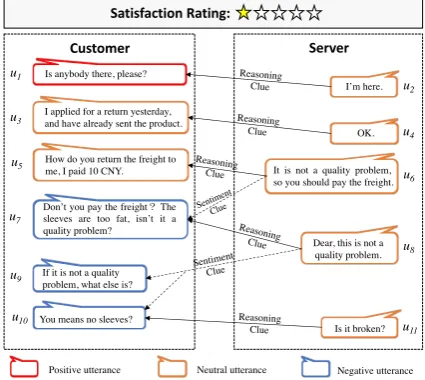
Figure 1: Customer utterance and context clues (i.e., sentiment and reasoning clues) alignments in multi-turn dialogue utterances of anunsatisfiedcustomer ser-vice. The utterances (ui) withpositive/neutral/negative
sentiments are denoted byred/orange/blueboxes.
instant messenger within the platform. The top-ics of relevant customer service dialogues involve various aspects of online shopping, such as prod-uct information, return or exchange, logistics, etc. Based on a previous survey, over77%of buyers on Taobao communicated with sellers before placing an order (Gao and Zhang,2011). Therefore, such service dialogue data contain very important clues for sellers to improve their service quality.
satisfaction from “very unsatisfied” to “very satis-fied”) via instant messages or a grading interface. Evidently, the customer feels unsatisfied with the response. Automatically detecting such unsatis-factory service is important. For the retail shop-keepers, they can quickly locate such service dia-logue and find out the reason to take remedial ac-tions. For the platform, by detecting and analyzing such cases, the platform can define clear-cut rules, say “not fitting well is not a quality issue, and the buyers should pay the freight for freight.”
In this paper, we define a new task named Ser-vice Satisfaction Analysis (SSA): Given a vice dialogue between the customer and the ser-vice staff, the task aims at predicting the cus-tomer’s satisfaction, i.e., if the customer is sat-isfied by the responses from the service staff, meanwhile locating possible sentiment reasons, i.e., sentiment identification of the customer ut-terances. For example, Figure 1 gives the sat-isfaction prediction of the service as “ unsatis-fied” and identifies the detailed sentiments of all customer utterances. Obviously, SSA fo-cuses on two special cases of text classification over predefined satisfaction labels (“well satis-fied/met/unsatisfied”) and predefined sentiment la-bels (“positive/neutral/negative”). Text classifica-tion has been widely studied for decades, such as sentiment classification on product reviews (Song et al., 2017; Chen et al., 2017; Li et al., 2018, 2019), stance classification on tweets or blogs (Du et al.,2017;Liu,2010), emotion classification for chit-chat (Majumder et al., 2018), etc. However, all these methods cannot deal with these two clas-sification tasks simultaneously in a unified frame-work. Although recent studies on multi-task learn-ing framework suggest that closely related tasks can improve each other mutually from separated supervision information (Ma et al.,2018;Cerisara et al., 2018;Wang et al., 2018b), the acquisition of sentence (or utterance)-level sentiment labels, which is required by multi-task learning, remains a laborious and expensive endeavor. In contrast, coarse-grained document (or dialogue)-level an-notations are relatively easy to obtain due to the widespread use of opinion grading interfaces (e.g., ratings).
Recently, Multiple Instance Learning (MIL) framework is adopted for performing document-level and sentence-document-level sentiment classification simultaneously while only using document-level
sentiment annotations (Zhou et al., 2009; Wang and Wan, 2018). However, these models are trained based on plain textual data which are in a much simpler form than our multi-turn dialogue structure. Specifically, customer service dialogue has unique characteristics. Customer utterances tend to have more sentiment changes during the customer service dialogue which affect customer’s final satisfaction. Figure1illustrates that satisfac-tion polarity (“unsatisfied”) is mostly embedded in the last few customer utterances (i.e.,u7, u9 and
u10)3. On the other hand, a well-trained server
varies less by always expressing positive/neutral utterances which contain helpful sentiment clues and reasoning clues. In this work, both sentiment clue and reasoning clue are called context clues which can directly or indirectly influence satisfac-tion polarity and need to be given special treat-ments in the model.
To deal with the issues, we propose a novel and extensible Context-Assisted Multiple Instance Learning (CAMIL) model for the new SSA task, and utterance-level sentiment classification and dialogue-level satisfaction classification will be done simultaneously only under the supervision of satisfaction labels. We motivate the idea of our context-assisted modeling solution based on the hypothesis that if a customer utterance does not have enough information to create a sound vec-tor representation for sentiment prediction, we try to enhance it with a complementary representation derived from context clues via our position-guided Context Clue Matching Mechanism (CCMM). Overall, our contributions are three-fold:
• We introduce a new SSA task based on cus-tomer service dialogues. We thus propose a novel CAMIL model to predict the senti-ment distributions of all customer utterances, and then aggregate those distributions to de-termine the final satisfaction polarity.
• We further propose an automatic CCMM to associate each customer utterance with its most relevant context clues, and then gener-ate a complementary vector which enhances the customer utterance representation for bet-ter sentiment classification to boost the final satisfaction classification.
3Given a specific customer utterance (u7) in Figure1, the
• Two real-world CS dialogue datasets are col-lected from a top E-commerce platform. The experimental results demonstrate that our model is effective for the SSA task.
2 Related Work
Service satisfaction analysis (SSA) is closely re-lated to sentiment analysis (SA), because the sen-timent of the customer utterances is a basic clue signaling the customer’s satisfaction. Existing SA works aim to predict sentiment polarities ( posi-tive, neutral andnegative) for subjective texts in different granularities, such as word (Feng et al., 2015; Song et al., 2016), sentence (Ma et al., 2017), short text (Song et al., 2015) and docu-ment (Yang et al.,2018a). In these studies, subjec-tive texts are always considered as a sequence of words4. More recently, some researchers started to explore the utterance-level structure for sentiment classification, such as modeling dialogues via a hierarchical RNN in both word level and utter-ance level (Cerisara et al.,2018) or keeping track of sentiment states of dialogue participants ( Ma-jumder et al., 2018). However, none of these works can do dialogue-level satisfaction classifi-cation and utterance-level sentiment classificlassifi-cation simultaneously. Recent studies (Cerisara et al., 2018; Ma et al., 2018; Wang et al., 2018b) em-ploying multi-task learning open a possibility to address this issue. However, these models must be trained under the supervision of both document-level and sentence-document-level sentiment labels in which the later are generally not easy to obtain.
Sentiment classification based on Multiple In-stance Learning (MIL) frameworks (Wang and Wan,2018;Angelidis and Lapata, 2018) aims to perform document-level and sentence-level senti-ment classification tasks simultaneously with the supervision of document labels only. Ange-lidis and Lapata (2018) proposed an MIL model for fine-grained sentiment analysis. Wang and Wan (2018) further applied the model to peer-reviewed research papers by integrating a memory built from abstracts. However, their models are not suitable for our SSA task because they ignore
4
From plain sentiment analysis viewpoint, sentence and utterance are treated the same since a dialogue is considered as a chunk of plain texts and the matching between utterances is ignored. So, an utterance is seen as a sentence and a dia-logue as a document. Here, we use sentence and utterance interchangeably when it comes to plain sentiment analysis models.
the dialogue structure of arbitrary interactions be-tween customers and servers. In contrast, we con-sider complex multi-turn interactions within di-alogues and explore context clue matching be-tween customer utterances and server utterances for multi-tasking in the SSA task. Specifically, we improve the basic MIL models by proposing a position-guided automatic context clue matching mechanism (CCMM) to conduct customer utter-ance and context clues alignments for better senti-ment classification to boost satisfaction classifica-tion. Other related work related to sentiment anal-ysis for subjective texts in different granularities include (Yang et al.,2016;Wu and Huang,2016; Yang et al., 2018b;Du et al., 2017;Wang et al., 2018a;Song et al.,2019).
3 Context-Assisted MIL Network
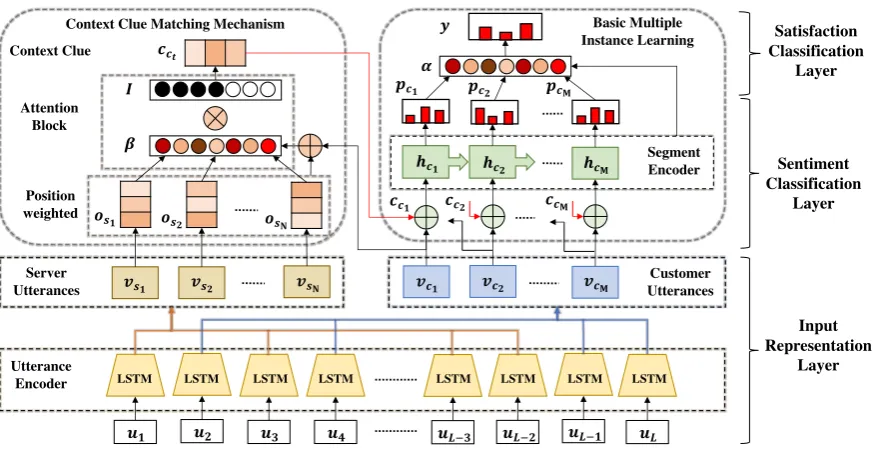
In order to predict service satisfaction and iden-tify sentiments of all customer utterances with available satisfaction labels, we propose a CAMIL model based on multiple instance learning ap-proach. Figure 2 shows the architecture of our model which consists of three layers: Input Rep-resentation Layer,Sentiment Classification Layer andSatisfaction Classification Layer. In this sec-tion, we will describe the model in detail.
3.1 Input Representation Layer
Let each utterance ui =
w1, ..., w|ui|
be a se-quence of words. By adopting word embeddings and semantic composition models such as Recur-rent Neural Network (RNN), we can learn the ut-terance representation. In this work, we adopt a standard LSTM model (Hochreiter and Schmidhu-ber,1997) to learn a fixed-size utterance represen-tationvui ∈R
k, wherekis the size of LSTM
hid-den state. Specifically, we first convert the words in each utteranceuito the corresponding word
em-beddings Eui ∈ R
d×|ui| which are then fed into
a LSTM for obtaining the last hidden state as the
vui, wheredis the dimensionality of word
embed-dings. Formally, we havevui = LSTM(Eui).
ut-𝒄𝒄𝟏
Server Utterances
Position weighted Attention Block Context Clue
Context Clue Matching Mechanism
Input Representation
Layer Sentiment Classification
Layer Satisfaction Classification
Layer
Utterance Encoder
Customer Utterances
𝒖𝟏 𝒖𝟐 𝒖𝟑 𝒖𝟒 𝒖𝑳(𝟑 𝒖𝑳(𝟐 𝒖𝑳(𝟏 𝒖𝑳
LSTM
Basic Multiple Instance Learning
𝒄𝒄𝟐 𝒄𝒄𝐌
𝒗𝒄𝟏 𝒗𝒄𝟐 𝒗𝒄𝐌
𝒄𝒄𝒕
𝒗𝒔𝟏 𝒗𝒔𝟐 𝒗𝒔𝐍
𝜶
𝜷
𝒚
𝒑𝒄𝐌 𝒑𝒄𝟐
𝒑𝒄𝟏
𝒐𝒔𝟏 𝒐𝒔𝟐 𝒐𝒔𝐍
Segment Encoder
𝒉𝒄𝟏 𝒉𝒄𝟐 𝒉𝒄𝐌
LSTM LSTM LSTM LSTM LSTM LSTM LSTM
[image:4.595.81.518.62.288.2]𝑰
Figure 2: The architecture of our Context-Assisted Multiple Instance Learning (CAMIL) network. The model consists of four modules: Input Representation Layer, Sentiment Classification Layer, Satisfaction Classification Layer and Context Clue Matching Mechanism.
terances and indirectly affect satisfaction polarity. Thus, we separately denote the customer utterance representations as {vc1,vc2, ...,vcM} and server
utterance representations as {vs1,vs2, ...,vsN},
where M + N = L and L is the total number of utterances in the dialogue.
3.2 Sentiment Classification Layer
Customer utterances tend to have more direct impact on the dominating satisfaction polarity. However, short utterance texts may not contain enough information for semantic representation. Thus, considering context to enhance utterance representation is a natural and reasonable choice. Given a specific customer utterance vectorvct, we
use a context clue matching mechanism, namely CCMM (see Section4), to produce matched con-text representationcct ∈R
kas below:
cct = CCMM vct,{vst0|1≤t
0 ≤N}
(1)
wherevst0 is any server utterance representation.
After that,vct can be enhanced bycct via
con-catenation for a combined representation v¯ct =
vct ⊕ cct. Compared to vct, v¯ct ∈ R
2k
contains more evidence for sentiment predic-tion. Then, we feed the representation sequence {v¯c1,v¯c2, ...,v¯cM}into a standard LSTM for
ob-taining a segment representationhct ∈R
kat each
time stept, i.e.,hct = LSTM ¯vct
.
Finally, each segment representationhct is fed
into a linear layer and then a softmax function for predicting its sentiment distribution over senti-ment labelsG={positive, neutral, negative}:
pct = softmax(W
sh ct +b
s) (2)
whereWs ∈ R|G|×k andbs ∈
R|G| are trainable
parameters shared across all segments, andpct ∈ R|G|is the sentiment distribution for utteranceuct.
3.3 Satisfaction Classification Layer
In the simplest case, satisfaction polarities C = {well satisfied, met, unsatisfied}can be computed by averaging all predicted sentiment distributions of customer utterances as y = M1 P
t∈[1,M]pct.
However, it is a crude way of combining senti-ment distributions uniformly, as not all distribu-tions convey equally important sentiment clues. In Figure1, for example, the satisfaction polarity (“unsatisfied”) is mostly determined by customer utterances u7, u9 and u10 which are relatively
more crucial than other ones. We opt for an atten-tion mechanism to reward segments that are more likely to be good sentiment predictors. Therefore, we measure the importance of each segment rep-resentation hct through a scoring function using
feed forward neural network as below:
αct = softmax v
Ttanh(Wuh ct +b
u)
where Wu ∈ Rk×k, bu ∈
Rk andv ∈ Rk are
trainable parameters,vcan be seen as a high-level representation of a fixed query “what is the in-formative segment” like that used in (Yang et al., 2016). Finally, we obtain the satisfaction distribu-tion y ∈ R|C| as the weighted sum of sentiment distributions of all the customer utterances by:
y= X
t∈[1,M]
αctpct (4)
3.4 Training and Parameter Learning
Note that in the training dataset, our approach only needs the dialogue’s satisfaction labels while the utterance sentiment labels are unobserved. There-fore, we use the categorical cross-entropy loss to minimize the error between the distribution of the output satisfaction polarity and that of the gold-standard satisfaction label of the dialogue by:
L(Θ) =− X
j∈[1,T]
X
i∈C
gji log(yij) (5)
wheregij is 1 or 0 indicating whether theithclass is a correct answer for the jth training instance,
yij is the predicted satisfaction probability distri-bution, andΘdenotes the trainable parameter set. After learning Θ, we feed each test instance into the final model, and the label with the high-est probability stands for the predicted satisfaction polarity. We use back propagation to calculate the gradients of all the model parameters, and update them with Momentum optimizer (Qian,1999).
4 Context Clue Matching Mechanism
Server utterances provide helpful context clues which can be defined as sentiment and reasoning clues by the positions of server utterances. Thus, we introduce the position-guided automatic con-text clue matching mechanism (CCMM) used to match each customer utterance with its most re-lated server utterances, which contain two layers: the position attention layerand the utterance at-tention layer.
Sentiment and Reasoning Clues:Server utter-ances provide helpful context clues for each tar-geted customer utterance. Here, we aim to locate helpful context clues in server utterances which are categorized as sentiment clues and reason-ing clues. Sentiment clues refer to the server ut-terances that appear preceding the targeted cus-tomer utterance and trigger its sentiment
expres-sion, such as server utterance u6 leading to
cus-tomer displeasure of the utterance u7 in the
Fig-ure 1. Reasoning clues are the server utterances that appear following the targeted customer utter-ance and respond to its concerns, such as server utteranceu6responding to the customer utterance
u5 in the Figure1. Both types of clues are
iden-tified by the proposed attention layers along with position information.
Position Attention Layer:Typically, customer utterances are more likely to be triggered or an-swered by the server utterances near them. Let p(·)denote the position function of any utterance in the original dialogue, such asp(uc2) = 3in Fig-ure1. For any customer utteranceuct, the
preced-ing server utterances{ust0|p(ust0)< p(uct)}may
provide sentiment clues, and the following server utterances {ust0|p(ust0) > p(uct)} may contain
reasoning clues. By considering both directions, we compute the position attention weightg(·)by:
g(uct, ust0) = 1−
|p(uct)−p(ust0)|
L (6)
Then, the weighted output after this layer is for-mulated as below:
ost0 =g(uct, ust0)∗hst0 ∗I(uct, ust0) (7)
where ost0 ∈ R
k is the weighted h
st0 for t
0 ∈
[1, N], the notationI(·)denotes a masking func-tion which can be used to reserve either only sen-timent clues (i.e., ifp(uct) > p(ust0),I(uct, ust0)
equals to 1, or 0 otherwise) or only reasoning clues (i.e., if p(uct) < p(ust0), I(uct, ust0) equals to
1, or 0 otherwise). Here, we suggest to consider both sentiment and reasoning clues, soI(uct, ust0)
is a constant 1. Finally, we construct memory
O∈Rk×N as below:
O= [os1;os2;. . .;osN] (8)
Utterance Attention Layer:Only a fraction of server utterances can match every customer utter-ance in sentiment or content, such as the exemplar dialogue in Figure1. So, we introduce an atten-tion strategy which enables our model to attend on server utterances of different importance when constructing a complementary context representa-tion for any customer utterance. Considering cus-tomer utterance representationhct as an index, we
can produce a context vector cct ∈ R
k using a
weighted sum of each pieceost0 of memoryO:
cct = X
t0∈[1,N]
Statistics items Clothes Makeup
[image:6.595.92.271.62.176.2]# Dialogues 10,000 3,540 # US (unsatisfied) 2,302 1,180 # MT (met) 6,399 1,180 # WS (well satisfied) 1,299 1,180 Avg# Utterances 25.99 26.67 Avg# Words 7.11 7.32 # Segments 123,242 46,255 # NG (negative) 12,619 6,130 # NE (neutral) 97,380 33,158 # PO (positive) 13,243 6,976
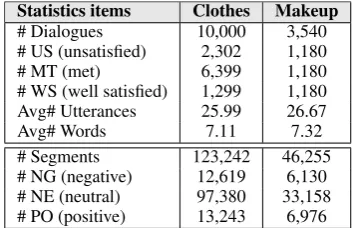
Table 1: Statistics of the datasets we collected.
whereβst0 ∈ [0,1]is the attention weight
calcu-lated based on a scoring function using a feed for-ward neural network as follow:
βst0 = softmax v¯
Ttanh(Wc
ost0
hct
+bc)
(10) whereWc ∈R2k×2k,¯v ∈
R2kandbc ∈R2kare
trainable parameters.
5 Experiments and Results
5.1 Dataset and Experimental Settings
Our experiments are conducted based on two Chi-nese CS dialogue datasets, namely Clothes and Makeup, collected from a top E-commerce plat-form. Note that our proposed method is language independent and can be applied to other languages directly. Clothesis a corpus with 10K dialogues in theClothesdomain andMakeupis a balanced corpus with 3,540 dialogues in the Makeup do-main. Both datasets have service satisfaction rat-ings in 1-5 stars from customer feedbacks. Mean-while, we also annotate all the utterances in both datasets with sentiment labels for testing. In this study, we conduct two classification tasks: one is to predict in three satisfaction classes, i.e., “ unsat-isfied” (1-2 stars), “met” (3 stars) and “satisfied” (4-5 stars), and the other is to predict in three senti-ment classes, i.e., “negative/neutral/positive”. All texts are tokenized by a popular Chinese word seg-mentation utility called jieba5. After preprocess-ing, the datasets are partitioned for trainpreprocess-ing, vali-dation and test with a 80/10/10 split. A summary of statistics for both datasets are given in Table1.
For all the methods, we apply fine-tuning for the word vectors, which can improve the perfor-mance. The word vectors are initialized by word embeddings that are trained on both datasets with
5https://pypi.org/project/jieba/
CBOW (Mikolov et al., 2013), where the dimen-sion is 300 and the vocabulary size is 23.3K. Other trainable model parameters are initialized by sampling values from a uniform distribution U(−0.01,0.01). The size of LSTM hidden states k is set as 128. The hyper-parameters are tuned on the validation set. Specifically, the initial learn-ing rate is fixed as 0.1, the dropout rate is 0.2, the batch size is 32 and the number of epochs is 20. The performances of both satisfaction and senti-ment classifications are evaluated using standard Macro F1andAccuracy.
5.2 Comparative Study
We compare our proposed approach with the fol-lowing state-of-the-art Sentiment Analysis (SA) methods which can be grouped into two types: plain SA models and dialogue SA models.
Plain SA modelsconsider dialogue as plain text and ignore utterance matching, say, utterance is seen as sentence and dialogue as document.
1)LSTM: We use word vectors as the input of a standard LSTM (Hochreiter and Schmidhuber, 1997) and feed the last hidden state into a softmax layer for satisfaction prediction.
2) HAN: A hierarchical attention network for document classification (Yang et al.,2016), which has two levels of attention mechanisms applied at word- and utterance-level, enabling it to attend differentially to more and less important content when constructing the dialogue representation and feeding it into a softmax layer for classification.
3) HRN: A hierarchical recurrent network for joint sentiment and act sequence recogni-tion (Cerisara et al.,2018). It uses a bi-directional LSTM to represent utterances which are then fed into a standard LSTM for dialogue representation as the input of a softmax layer for classification.
4)MILNET: A multiple instance learning net-work for document-level and sentence-level senti-ment analysis (Angelidis and Lapata,2018). The original method is designed for plain textual data, which does not consider CS dialogue structure. In addition, their method ignores long-range depen-dencies among customer sentiments (i.e., without segment encoder in Figure2).
Dialogue SA modelsconsider utterance match-ing between customer and server utterances.
vector of each QA pair (i.e., customer utterance, server utterance) and then characterizes the im-portance of the generated matching vectors via a self-matching attention layer (Shen et al., 2018). However, the amount of pairs within a dialogue is huge, which leads to expensive calculations. Meanwhile, it considers the sentiments of server utterances, which will mislead final prediction.
6) CAMILs, CAMILr and CAMILf ull: Our
CAMIL models with only sentiment clues, only reasoning clues, and both of them, respectively, by setting masking function (see Equation7).
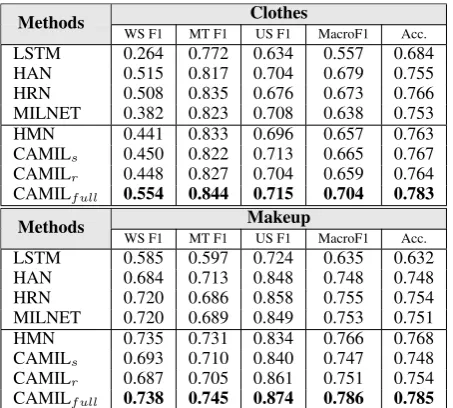
All the methods are implemented by ourselves with TensorFlow6and run on a server configured with a Tesla V100 GPU, 2 CPU and 32G memory. Results and Analysis: The results of compar-isons are reported in Table 2. It indicates that LSTM cannot compete with other methods be-cause it simply considers dialogues as word se-quences but ignores the utterance matching. HAN and HRN perform much better by using a two-layer architecture (i.e., utterance and dialogue), but they ignore the utterance interactions. Besides, HRN treats the sentiment analysis task and the service satisfaction analysis task separately, and ignores their sentiment dependence. HMN uses a heuristic question-answering matching strategy, which is not enough flexible and easily causes mismatching issues. MILNET is the most re-lated work, but its simplistic alignment model weakens prediction performance when facing on our complex customer service dialogue structure. MILNET however does not consider the dialogue structure and introduces unrelated sentiments from server utterances. CAMILr and CAMILs only
consider either sentiment or reasoning clues, so they cannot compete with CAMILf ull which
con-siders both in dialogues. Partially configured model CAMILr(or CAMILs) only considers
sen-timent (or reasoning) clues and performs worse than our full model CAMIL. This verifies that both types of clues are helpful and complementary, and they should be employed simultaneously.
On Clothes corpus, compared to themet class, the performances of all models on the satisfied class are much worse, because when the two classes cannot be well distinguished the models tend to predict the majority class (i.e.,met) to min-imize the loss. On Makeup corpus which is a bal-anced dataset, the performances on the met and
6https://www.tensorflow.org/
Clothes Methods
WS F1 MT F1 US F1 MacroF1 Acc.
LSTM 0.264 0.772 0.634 0.557 0.684 HAN 0.515 0.817 0.704 0.679 0.755 HRN 0.508 0.835 0.676 0.673 0.766 MILNET 0.382 0.823 0.708 0.638 0.753 HMN 0.441 0.833 0.696 0.657 0.763 CAMILs 0.450 0.822 0.713 0.665 0.767
CAMILr 0.448 0.827 0.704 0.659 0.764
CAMILf ull 0.554 0.844 0.715 0.704 0.783
Makeup Methods
WS F1 MT F1 US F1 MacroF1 Acc.
LSTM 0.585 0.597 0.724 0.635 0.632 HAN 0.684 0.713 0.848 0.748 0.748 HRN 0.720 0.686 0.858 0.755 0.754 MILNET 0.720 0.689 0.849 0.753 0.751 HMN 0.735 0.731 0.834 0.766 0.768 CAMILs 0.693 0.710 0.840 0.747 0.748
CAMILr 0.687 0.705 0.861 0.751 0.754
[image:7.595.307.534.61.265.2]CAMILf ull 0.738 0.745 0.874 0.786 0.785
Table 2: Results of different satisfaction classification methods. The best results are highlighted.
Clothes Methods
WS F1 MT F1 US F1 MacroF1 Acc.
Server 0.346 0.785 0.589 0.573 0.689 Customer 0.553 0.824 0.663 0.681 0.759 NoPos 0.554 0.838 0.673 0.688 0.771 Average 0.070 0.789 0.347 0.402 0.671 Voting 0.059 0.776 0.046 0.293 0.633 CAMILf ull 0.554 0.844 0.715 0.704 0.783
Makeup Methods
WS F1 MT F1 US F1 MacroF1 Acc.
Server 0.597 0.630 0.745 0.657 0.655 Customer 0.735 0.687 0.790 0.737 0.734 NoPos 0.731 0.742 0.864 0.779 0.779 Average 0.578 0.708 0.834 0.706 0.714 Voting 0.231 0.016 0.553 0.267 0.387 CAMILf ull 0.738 0.745 0.874 0.786 0.785
Table 3: Results of different model configurations.
satisfied classes are less distinctive, but both are consistently worse than theunsatisfiedclass.
5.3 Ablation Study
Different model configurations can largely affect the performance. We implement several model variants for ablation tests: ServerandCustomer consider only server and customer utterances in a dialogue, respectively. NoPos ignores the prior position information. Average takes the average of all the sentiment distributions for classification. Votingdirectly maps the majority sentiment into satisfaction prediction, i.e., negative → unsatis-fied, neutral→met, positive→well-satisfied. The results of comparisons are reported in Table3.
[image:7.595.307.533.311.474.2]Dataset Class positive neutral negative
Clothes
WS 0.278 0.712 0.009 MT 0.020 0.893 0.086 US 0.042 0.513 0.443
Makeup
[image:8.595.82.282.62.134.2]WS 0.273 0.718 0.009 MT 0.012 0.893 0.094 US 0.046 0.598 0.355
Table 4: Sentiment distribution in satisfaction classes.
Clothes Methods
PO F1 NE F1 NG F1 MacroF1 Acc.
MILNET 0.441 0.814 0.404 0.553 0.713 CAMILs 0.545 0.867 0.506 0.639 0.787
CAMILr 0.470 0.870 0.529 0.623 0.792
CAMILf ull 0.484 0.893 0.555 0.644 0.824
Makeup Methods
PO F1 NE F1 NG F1 MacroF1 Acc.
MILNET 0.447 0.387 0.416 0.417 0.410 CAMILs 0.566 0.672 0.501 0.580 0.609
CAMILr 0.556 0.600 0.488 0.548 0.561
[image:8.595.309.527.63.264.2]CAMILf ull 0.544 0.725 0.516 0.595 0.647
Table 5: Results of sentiment classification by different models. The best results are highlighted.
the sentiments embedded in the customer utter-ances. However, its performance is still lower than CAMILf ull, suggesting that server utterances can
provide helpful context clues. NoPos performs well but worse than CAMILf ull since the position
information provides prior knowledge for guiding context clue matching. Average and Voting are sub-optimal choices because not all the sentiment distributions contribute equally to the satisfaction polarity and the majority sentiment polarity also does not correlate strongly with it.
5.4 Results on Sentiment Classification
Table 4 shows another statistics of our datasets, i.e., the distribution of sentiment labels over each service satisfaction polarity, which reflects the im-balanced situation of utterance-level sentiments in real customer service dialogues.
In Table 5, we compare the sentiment pre-diction results of MILNET, CAMILr, CAMILs
and CAMILf ull. CAMILr and CAMILs perform
worse than CAMILf ullbecause they only consider
partial context information. CAMILf ullis the best
mainly due to its accurate context clue matching. Thus, our proposed approach is more adaptive to the service satisfaction analysis task based on the customer service dialogues.
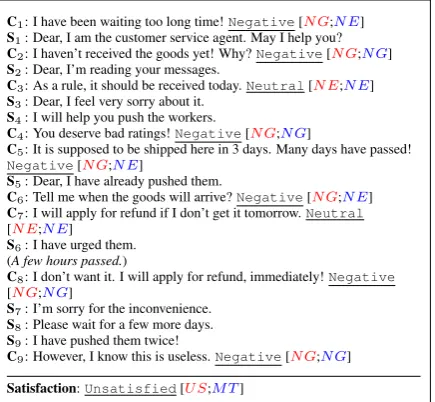
5.5 Case Study
Figure 1 illustrates our prediction results with an example dialogue which is translated from
Chi-C1: I have been waiting too long time!Negative[N G;N E] S1: Dear, I am the customer service agent. May I help you? C2: I haven’t received the goods yet! Why?Negative[N G;N G] S2: Dear, I’m reading your messages.
C3: As a rule, it should be received today.Neutral[N E;N E] S3: Dear, I feel very sorry about it.
S4: I will help you push the workers.
C4: You deserve bad ratings!Negative[N G;N G]
C5: It is supposed to be shipped here in 3 days. Many days have passed! Negative[N G;N E]
S5: Dear, I have already pushed them.
C6: Tell me when the goods will arrive?Negative[N G;N E] C7: I will apply for refund if I don’t get it tomorrow.Neutral
[N E;N E] S6: I have urged them.
(A few hours passed.)
C8: I don’t want it. I will apply for refund, immediately!Negative
[N G;N G]
S7: I’m sorry for the inconvenience. S8: Please wait for a few more days. S9: I have pushed them twice!
C9: However, I know this is useless.Negative[N G;N G]
Satisfaction:Unsatisfied[U S;M T]
Figure 3: An example dialogue with predictions. Ci
(Sj) are customer (server) utterances. True labels are
underlined. The predictions by our model and MIL-NET are colored inred and bluein the brackets, re-spectively.
nese text. For brevity, we useC/S to denote cus-tomer/server utterance. Our model predicts the la-bel “unsatisfied” correctly and also predicts rea-sonable sentiment polarities for customer ances. Considering the context, customer utter-ancesC1,5,6 are “negative” but predicted as “
neu-tral” by MILNET because MILNET predicts sen-timents only from target utterance itself and ig-nores context information. In addition, the senti-ments of the customer utterancesC4,5andC9tend
to have larger influences on deciding the satisfac-tion polarity because C4 clearly conveys “
unsat-isfied” attitude,C5 complains about delay andC9
criticizes the low service quality.
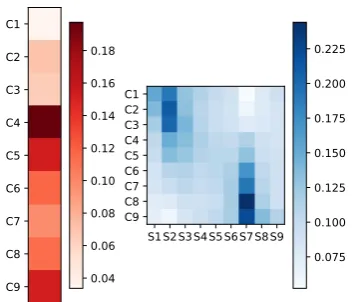
We also visualize the attention weights in Fig-ure 4 to explain our prediction results. For each customer utteranceCi, we give the attention
weightsβst0 on all the server utterances (see
For-mula10). Furthermore, we also visualize the at-tention rates αct on the customer utterances (see
Formula3).Lighter colors denote smaller values. From Figure4, we can see that the customer ut-terancesC4,5,9 have higher attention weights
be-cause customer attitudes are intuitively formed at the end of the dialogues (i.e.,C9) or determined by
explicit sentiments (i.e.,C4). In this example, the
[image:8.595.72.295.166.291.2]C1 C2 C3 C4 C5 C6 C7 C8
C9 0.04 0.06 0.08 0.10 0.12 0.14 0.16 0.18
S1S2S3S4S5S6S7S8S9 C1
C2 C3 C4 C5 C6 C7 C8 C9
[image:9.595.315.518.63.105.2]0.075 0.100 0.125 0.150 0.175 0.200 0.225
Figure 4: The visualization of attention ratesαct (Left
inred) andβst0 (Right inblue) for the given example.
utterances are influenced by server utterances. For example, C1−3 are related toS2, C4,5 are related
toS2,3,7, andC6−9 are related to S7. This again
validates the fact that customer utterances are re-lated to the server utterances near them. Mean-while, customer utterances may provide different types of context clues (i.e., sentiment and reason-ing). For a specific server utteranceS7, it provides
explicit sentiment clue forC9 and also gives
rea-soning clue forC8.
In-depth Analysis: CAMILf ull is only trained
based on satisfaction labels, thus the laborious ac-quisition of sentiment labels is unnecessary. How-ever, we would point out that lack of sentiment la-bels will inevitably lead to difficulties on identify-ing positive/negative utterances from those neutral ones. We will study to alleviate it in the future.
Our general observation is that the sentiment of customers at the beginning cannot largely deter-mine the service satisfaction at the end. This is be-cause the sentiment of the customers can vary with different quality of service during the dialogue, and the final service satisfaction results from the overall sentiments of important customer utter-ances in the dialogue (see the attention weights in Figure 4). To verify this, we design a heuristic baseline called Mapping which directly maps the initialnegative, neutralandpositivesentiment of customer to the corresponding service satisfaction, i.e.,unsatisfied,metandsatisfied. The satisfaction classification results are displayed in the Table6.
In Table 6, we can observe that the Mapping method is far worse than our model. One rea-son is that the service dialogues in our datasets have more than 25 utterances in average (See the statistics in Table1) and contain a large proportion
Clothes Makeup
Methods
MacroF1 Acc. MacroF1 Acc.
Mapping 0.625 0.487 0.471 0.430 CAMILf ull 0.704 0.783 0.786 0.785
Table 6: Satisfaction classification comparison be-tween our method and a heuristic mapping method.
of complex interactions. Besides, the sentiment change is closely related to the quality of service and it is very common in our datasets. Thus, using such simple correlation does not work well in our complex dialogue scenarios.
6 Conclusions and Future Work
In this paper, we propose a novel CAMIL model for the SSA task. We first propose a basic MIL approach with the inputs of context-matched customer utterances, then predict the utterance-level sentiment polarities and dialogue-utterance-level sat-isfaction polarities simultaneously. In addition, we propose a context clue matching mechanism (CCMM) to match any customer utterance with the most related server utterances. Experimen-tal results on two real-world datasets indicate our method clearly outperforms some state-of-the-art baseline models on the two SSA sub-tasks, i.e., service satisfaction polarity classifica-tion and utterance sentiment classificaclassifica-tion, which are performed simultaneously. We have made our datasets publicly available.
In the future, we will further improve our method by learning the correlation between the customer utterances and the server utterances. In addition, we will study other interesting tasks in customer service dialogues, such as outcome pre-diction or opinion change.
7 Acknowledgements
We thank all the reviewers for their insightful com-ments and helpful suggestions. This work is sup-ported by National Key R&D Program of China (2018YFC0830200; 2018YFC0830206).
References
Stefanos Angelidis and Mirella Lapata. 2018. Multi-ple instance learning networks for fine-grained sen-timent analysis.TACL, 6:17–31.
Christophe Cerisara, Somayeh Jafaritazehjani, Ade-dayo Oluokun, and Hoa T. Le. 2018. Multi-task di-alog act and sentiment recognition on mastodon. In
[image:9.595.93.271.65.216.2]Peng Chen, Zhongqian Sun, Lidong Bing, and Wei Yang. 2017. Recurrent attention network on mem-ory for aspect sentiment analysis. InProceedings of EMNLP, pages 452–461.
Jiachen Du, Ruifeng Xu, Yulan He, and Lin Gui. 2017. Stance classification with target-specific neural at-tention. InProceedings of IJCAI, pages 3988–3994.
Shi Feng, Kaisong Song, Daling Wang, and Ge Yu. 2015. A word-emoticon mutual reinforcement rank-ing model for buildrank-ing sentiment lexicon from mas-sive collection of microblogs. World Wide Web, 18(4):949–967.
Jie Gao and Zhenghua Zhang. 2011. User satisfac-tion of ali wangwang, an instant messenger tool. In
Theory, Methods, Tools and Practice - DUXU 2011, Part of HCI, pages 414–420.
Sepp Hochreiter and J¨urgen Schmidhuber. 1997. Long short-term memory. Neural Computation, 9(8):1735–1780.
Xin Li, Lidong Bing, Wai Lam, and Bei Shi. 2018. Transformation networks for target-oriented senti-ment classification. InProceedings of ACL, pages 946–956.
Xin Li, Lidong Bing, Piji Li, and Wai Lam. 2019. A unified model for opinion target extraction and target sentiment prediction. InProceedings of AAAI, pages 6714–6721.
Bing Liu. 2010. Sentiment analysis and subjectivity. In
Handbook of Natural Language Processing, Second Edition., pages 627–666.
Dehong Ma, Sujian Li, Xiaodong Zhang, and Houfeng Wang. 2017. Interactive attention networks for aspect-level sentiment classification. In Proceed-ings of IJCAI, pages 4068–4074.
Jing Ma, Wei Gao, and Kam-Fai Wong. 2018. Detect rumor and stance jointly by neural multi-task learn-ing. InProceedings of WWW, pages 585–593.
Navonil Majumder, Soujanya Poria, Devamanyu Haz-arika, Rada Mihalcea, Alexander F. Gelbukh, and Erik Cambria. 2018. Dialoguernn: An attentive RNN for emotion detection in conversations. CoRR, abs/1811.00405.
Tomas Mikolov, Kai Chen, Greg Corrado, and Jeffrey Dean. 2013. Efficient estimation of word represen-tations in vector space. In Proceedings of ICLR Workshop.
Ning Qian. 1999. On the momentum term in gradi-ent descgradi-ent learning algorithms. Neural Networks, 12(1):145–151.
Chenlin Shen, Changlong Sun, Jingjing Wang, Yangyang Kang, Shoushan Li, Xiaozhong Liu, Luo Si, Min Zhang, and Guodong Zhou. 2018. Senti-ment classification towards question-answering with hierarchical matching network. In Proceedings of EMNLP, pages 3654–3663.
Kaisong Song, Shi Feng, Wei Gao, Daling Wang, Ge Yu, and Kam-Fai Wong. 2015. Personalized sen-timent classification based on latent individuality of microblog users. In Proceedings of IJCAI, pages 2277–2283.
Kaisong Song, Wei Gao, Ling Chen, Shi Feng, Daling Wang, and Chengqi Zhang. 2016. Build emotion lexicon from the mood of crowd via topic-assisted joint non-negative matrix factorization. In Proceed-ings of SIGIR, pages 773–776.
Kaisong Song, Wei Gao, Shi Feng, Daling Wang, Kam-Fai Wong, and Chengqi Zhang. 2017. Recommen-dation vs sentiment analysis: A text-driven latent factor model for rating prediction with cold-start awareness. InProceedings of IJCAI, pages 2744– 2750.
Kaisong Song, Wei Gao, Lujun Zhao, Jun Lin, Chang-long Sun, and Xiaozhong Liu. 2019. Cold-start aware deep memory network for multi-entity aspect-based sentiment analysis. InProceedings of IJCAI, pages 5197–5203.
Jingjing Wang, Jie Li, Shoushan Li, Yangyang Kang, Min Zhang, Luo Si, and Guodong Zhou. 2018a. As-pect sentiment classification with both word-level and clause-level attention networks. InProceedings of IJCAI, pages 4439–4445.
Ke Wang and Xiaojun Wan. 2018. Sentiment analysis of peer review texts for scholarly papers. In Pro-ceedings of SIGIR, pages 175–184.
Weichao Wang, Shi Feng, Wei Gao, Daling Wang, and Yifei Zhang. 2018b. Personalized microblog sentiment classification via adversarial cross-lingual multi-task learning. In Proceedings of EMNLP, pages 338–348.
Fangzhao Wu and Yongfeng Huang. 2016. Person-alized microblog sentiment classification via multi-task learning. InProceedings of AAAI, pages 3059– 3065.
Jun Yang, Runqi Yang, Chongjun Wang, and Junyuan Xie. 2018a. Multi-entity aspect-based sentiment analysis with context, entity and aspect memory. In
Proceedings of AAAI, pages 6029–6036.
Jun Yang, Runqi Yang, Chongjun Wang, and Junyuan Xie. 2018b. Multi-entity aspect-based sentiment analysis with context, entity and aspect memory. In
Proceedings of AAAI.
Zichao Yang, Diyi Yang, Chris Dyer, Xiaodong He, Alexander J. Smola, and Eduard H. Hovy. 2016. Hi-erarchical attention networks for document classi-fication. In Proceedings of NAACL, pages 1480– 1489.