Proceedings of the 2019 Conference on Empirical Methods in Natural Language Processing and the 9th International Joint Conference on Natural Language Processing, pages 696–707,
696
Incorporating Visual Semantics into Sentence Representations
within a Grounded Space
Patrick Bordes∗1 and Eloi Zablocki´ ∗1 and Laure Soulier1 and Benjamin Piwowarski1 and Patrick Gallinari1,2 1Sorbonne Universit´e, CNRS, LIP6, F-75005 Paris, France
2 Criteo AI Lab, Paris, France
Abstract
Language groundingis an active field aiming at enriching textual representations with visual information. Generally, textual and visual el-ements are embedded in the same representa-tion space, which implicitly assumes a one-to-one correspondence between modalities. This hypothesis does not hold when representing words, and becomes problematic when used to learn sentence representations — the focus of this paper — as a visual scene can be de-scribed by a wide variety of sentences. To overcome this limitation, we propose to trans-fer visual information to textual tions by learning an intermediate representa-tion space: the grounded space. We further propose two new complementary objectives ensuring that (1) sentences associated with the same visual content are close in the grounded space and (2) similarities between related el-ements are preserved across modalities. We show that this model outperforms the previous state-of-the-art on classification and semantic relatedness tasks.
1 Introduction
Representing text by vectors that capture mean-ingful semantics is a long-standing issue in Artifi-cial Intelligence. Distributional Semantic Models (Mikolov et al.,2013;Peters et al.,2018) are well-known recent efforts in this direction, based on the
distributional hypothesis(Harris,1954). They rely on large text corpora to learn word embeddings. At another granularity level, having high-quality and general-purpose sentence representations is crucial for all models that encode sentences into semantic vectors, such as the ones used in machine translation (Bahdanau et al.,2014) or relation ex-traction (Wang et al., 2019). Moreover, encod-ing semantics of sentences is paramount because
∗
Equal contribution.
sentences describe relationships between objects, and thus convey complex and high-level knowl-edge better than individual words (Norman,1972). Relying only on text can lead to biased repre-sentations and unrealistic predictions such as “the sky is green” (Baroni,2016). Besides, it has been shown that human understanding of language is
groundedin physical reality and perceptual expe-rience (Fincher-Kiefer, 2001). To overcome this limitation, an emerging approach is toground lan-guage in the visual world: this consists in lever-aging visual information, usually from images, to enrich textual representations.∗
Leveraging images resulted in improved lin-guistic representations on intrinsic and down-stream tasks (Bruni et al.,2014;Silberer and La-pata, 2014). In most of these approaches, cross-modal projections are learned to incorporate vi-sual semantics in the final representations (Lazari-dou et al.,2015b;Collell et al.,2017;Kiela et al., 2018). These works rely on paired textual and vi-sual data and the hypothesis of a one-to-one cor-respondence between modalities is implicitly as-sumed: an image of an object univocally repre-sents a word. However, there is no obvious rea-son implying that the structure of the two spaces should match. Indeed,Collell and Moens (2018) empirically show that cross-modal projection of a source modality does not resemble the target modality in terms of its neighborhood structure. This is especially the case for sentences, where many different sentences can describe a simi-lar image. Therefore, we argue that learning grounded representations with projections to a vi-sual space is particularly inadequate in the case of sentences.
To overcome this issue, we propose an
alter-∗
native approach where the structure of the visual space ispartially transferredto the textual space. This is done by distinguishing two types of com-plementary information sources. First, the clus-ter information: the implicit knowledge that sen-tences associated with the same image refer to the same underlying reality. Second, the percep-tual information, which is contained within high-level representations of images. These two sources of information aim at transferring the structure of the visual space to the textual space. Besides, to preserve textual semantics and to avoid an over-constrained textual space, we propose to incorpo-rate the visual information to textual representa-tions using an intermediate representation space that we callgrounded space, on which cluster and perceptual objectives are trained.
Our contributions are the following: (1) we de-fine two complementary objectives to ground the textual space, based on implicit and explicit sual information; (2) we propose to incorporate vi-sual semantics through the means of an intermedi-ate space, within which the objectives are learned. Moreover (3) we perform quantitative and quali-tative evaluations on several transfer tasks, show-ing the advantages of our approach with respect to previous grounding methods.
2 Related work
Over the last years, several approaches have been proposed to learn semantic representations for sentences. This includes supervised and task-specific techniques with recursive networks (Socher et al., 2013), convolutional networks (Kalchbrenner et al., 2014) or self-attentive net-works (Lin et al.,2017;Conneau et al.,2017), but also unsupervised methods producing universal representations given large text corpora. Exam-ples of the latter include models such as FastSent (Hill et al., 2016), QuickThought (Logeswaran and Lee,2018), Word Information Series (Arroyo-Fern´andez et al., 2019), Universal Sentence En-coder (Cer et al., 2018), or SkipThought (Kiros et al.,2015), where a sentence is encoded with a Gated Recurrent Unit (GRU), and two GRU de-coders are trained to reconstruct the adjacent sen-tences in a dataset of ordered sensen-tences.
To model the way language conveys mean-ing, traditional approaches consider language as a purely symbolic system based on words and syn-tactic rules (Chomsky, 1980; Burgess and Lund,
1997). However, W. Barsalou (1999); Fincher-Kiefer(2001) insist on the intuition that language has to be grounded in physical reality and per-ceptual experience. The importance of language grounding is underlined inGordon and Van Durme (2013), where an important bias is reported: the frequency at which objects, relations, or events occur in natural language is significantly differ-ent from their real-world frequency (e.g., in texts, people are murdered four times more than they
breathe). Thus, leveraging visual resources, in ad-dition to textual resources, is a promising way to acquire commonsense knowledge (Lin and Parikh, 2015;Yatskar et al., 2016) and to cope with the bias between text and reality.
This intuition has motivated several works for learning visually grounded representations for words, using images — or abstract scenes (Kot-tur et al.,2016). Two lines of work can be distin-guished. First,sequentialtechniques combine tex-tual and visual representations that were learned separately (Bruni et al.,2014;Silberer and Lapata, 2014; Collell et al., 2017). Second, joint meth-ods learn a multimodal representation from mul-tiple sources simultaneously. The advantage is that visual information associated with concrete words can be transferred to more abstract ones, which usually have no associated visual data (Hill et al., 2014;Lazaridou et al., 2015b). Closer to our contribution, some approaches learn grounded word embeddings by building upon the skip-gram objective (Mikolov et al., 2013) and enforcing word vectors to be close to their corresponding visual features (Lazaridou et al., 2015b) or their visual context (Zablocki et al., 2018) in a mul-timodal representation space. These approaches learn word representations while we specifically target sentences. This task is more challenging since sentences are inherently different than words due to their sequential and compositional nature. Moreover, a great number of different sentences can be generated for the same image.
IS
Fi is LP
LC
Ft
LC
g g
visualspace
V
textualspace
T
groundedspace
[image:3.595.77.526.60.171.2]G
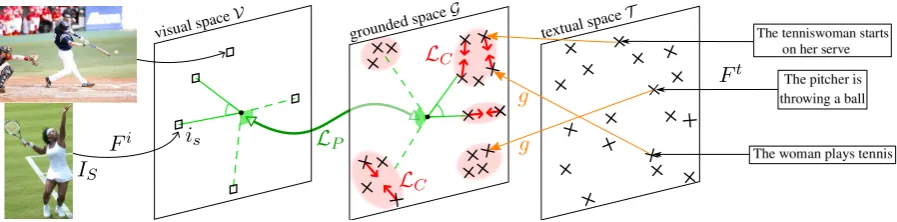
Figure 1: Model overview. Red circles indicate visual clusters. Red arrows represent the gradient of the cluster loss, which gathers visually equivalent sentences — the contrastive term in lossLCis not represented. The green arrow and angles illustrate
the perceptual loss, ensuring that cosine similarities correlate across modalities. The origin is at the center of each space.
hypothesizes that associated captions ground the meaning of a sentence. Both of these works learn a projection of the sentence representation to the corresponding image, which we argue is problem-atic as it over-constrains the textual space and can degrade textual representations. Indeed, Collell and Moens (2018) empirically demonstrated that when a cross-modal mapping is learned, the pro-jection of the source modality does not resemble the target modality, in the sense of nearest neigh-bor comparison. This suggests that cross-modal projections are not appropriate to incorporate vi-sual semantics in text representations.
3 Incorporating visual semantics within an intermediate grounded space
3.1 Model overview
In this work, we aim at learning grounded rep-resentations by jointly leveraging the textual and visual contexts of a sentence. We note S a sen-tence and s=Ft(S;θt) its representation
com-puted with a sentence encoderFtparametrized by θt. We follow the classical approach developed in
the language grounding literature at the word level (Lazaridou et al., 2015b; Zablocki et al., 2018), which balances a textual objectiveLT with an
ad-ditional grounding objectiveLG:
L(θt, θi) =LT(θt) +LG(θt, θi) (1)
The parameters θt of the sentence encoder Ft
are shared in LT and LG, and therefore benefit
from both textual and grounding objectives. θi
denotes extra grounding parameters, including the weights of the image encoder Fi. Note that any
textual objectiveLT and sentence encoderFtcan
be used. In our experiments, we choose the well-known SkipThought model (Kiros et al., 2015), trained on a corpus of ordered sentences.
In what follows, we focus on the modeling of the grounding objectiveLG, learned on a
caption-ing corpus, where each image is associated with several captions. Grounding approaches generally leverage visual information by embedding textual and visual elements within the same multimodal space (Silberer and Lapata, 2014; Kiela et al., 2018). However, it is not satisfying since texts and images are forced to be in one-to-one correspon-dence. Moreover, a caption can (1) have a wide va-riety of paraphrases and related sentences describ-ing the same scene (e.g.,the kitten is devouring a mouseversusa cat eating a mouse), (2) be visually ambiguous (e.g.,a cat is eatingcan be associated with many different images, depending on the vi-sual scene/context), or (3) carry non-vivi-sual infor-mation (e.g., cats often think about their meals). Usual grounding objectives, that embed sentences in the visual space, can discard non-visual infor-mation (3) through the projection function. They can handle (1) by projecting related sentences to the same location in the visual space. However, they are over-sensitive to visual ambiguity (2), be-cause ambiguous sentences should be projected to different locations of the visual space, which is not possible with current grounding models.
To overcome this lack of flexibility, we pro-pose the following approach, illustrated in Fig-ure 1. To cope with (1), sentences associated with the same image should be close — we call this
called grounded space, that allows textual repre-sentations to benefit from visual properties with-out degrading the semantics brought by the textual objectiveLT.
3.2 Grounding space and objectives
In this section, we introduce more formally the grounded space and the different information (cluster and perceptual) captured in the grounding lossLG.
Grounded space The grounded space relaxes the assumption that textual and visual representa-tions should be guided by one-to-one correspon-dences. It rather assumes that the structure of the textual space might be partially modeled on the structure of the visual space. Thus, instead of directly applying the grounding objectives on a sentence sembedding, we propose to train the grounding objectiveLG on an intermediate space
calledgrounded space. Practically, we use a pro-jection g(s;θi
g) of a sentence s from the textual
space to the grounded space. We denote it g(s)
for simplicity, where g is a multi-layer percep-tron with inputs = Ft(S;θt) and parametersθi
g
(θi g ⊂θi).
Cluster information (Cg) The cluster
informa-tion leverages the fact that two sentences describe, or not, the same underlying reality. In other words, the goal is to measure if two sentences arevisually equivalent (assumption (1) in Section 3.1) with-out considering the content of related images. For convenience, two sentences are said to bevisually equivalent(resp. visually different) if they are as-sociated with the same image (resp. different im-ages), i.e. if they describe the same (resp. differ-ent) underlying reality. We callclustera set of vi-sually equivalent sentences. For instance, in Fig-ure 1, sentences The tenniswoman starts on her serve and The woman plays tennis are visually equivalent and belong to the same cluster.
Our hypothesis is that the similarity be-tween visually equivalent sentences (s, s+)
should be higher than visually different sen-tences (s, s−). We translate this hypothesis
into the constraint in the grounded space:
cos(g(s), g(s+))≤cos(g(s), g(s−)). Following
(Karpathy and Li, 2015; Carvalho et al., 2018), we use a max-margin ranking loss to ensure the gap between both terms is higher than a fixed margin γ (cf. red elements inFigure 1) resulting
in the cluster lossLC:
LC=P
(s,s+,s−)
γ−cos(g(s), g(s+)) + cos(g(s), g(s−))
+
(2) where s+ (resp. s−) is a randomly sampled
vi-sually equivalent (resp. different) sentence to s. This loss function is also used in the cross-modal retrieval literature to enforce structure-preserving constraints between sentences describing a same image (Wang et al.,2016).
Perceptual information (Pg) The cluster
hy-pothesis alone ignores the structure of the visual space and only uses the visual modality as a proxy to assess if two sentences are visually equivalent or different. Moreover, the ranking lossLCsimply
drives apart visually different sentences in the rep-resentation space, which can be a problem when two images have a closely related content. For in-stance, the baseball and tennis images inFigure 1 may be different, but they are both sports images, and thus their corresponding sentences should be somehow close in the grounded space. Finally, it supposes that we have a dataset of images associ-ated with several captions.
To cope with these limitations, we consider the structure of the visual space and use the content of images. The intuition is that the structure of the textual space should be modeled on the struc-ture of the visual one to extract visual semantics. We choose to preservesimilaritiesbetween related elements across spaces (cf. green elements in Fig-ure 1). We thus assume thatthe similarity between two sentences in the grounded space should be correlated with the similarity between their corre-sponding images in the visual space.We translate this hypothesis into the perceptual lossLP:
LP =−ρ({simtextk1,k2},{simimk1,k2}) (3)
where ρ is the Pearson correlation, simtextk
1,k2 =
cos(g(sk1), g(sk2)) and sim im
k1,k2 = cos(ik1, ik2)
are respectively textual and visual similarities computed over several randomly sampled pairs of matching sentences and images.
Grounded loss Taking altogether, the grounded space and cluster/perceptual information leads to the grounding objectiveLG(θt, θi)as a linear
com-bination of the aforementioned objectives:
whereαCandαP are hyper-parameters weighting
contributions ofLC andLP.θicorresponds to all
the grounding-related parameters, i.e. those of the image encoderFiand of the projection functiong
(i.e.,θi g).
4 Evaluation protocol
4.1 Datasets
Textual dataset. Following (Kiros et al.,2015; Hill et al.,2016), we use the Toronto BookCorpus dataset as the textual corpus. This corpus consists of 11K books, and 74M ordered sentences, with an average of 13 words per sentence.
Visual dataset. We use the MS COCO (Lin et al.,2014) dataset as the visual corpus. This im-age captioning dataset consists of 118K/5K/41K (train/val/test) images, each with five English de-scriptions. Note that the number of sentences in the training set of COCO (590K sentences) only represents0.8%of the sentence data in BookCor-pus, which is negligible, and the additional textual training data cannot account for performance dis-crepancies between textual and grounded models.
4.2 Baselines and Scenarios
In the experiments, we focus on one of the most established sentence models: SkipThought (noted T) as the textual baseline: the parameters of the sentence embedding model are obtained by min-imizing LT. Then, we derive several baselines and scenarios based onT, each representing a dif-ferent approach of grounding. Since our focus is to study the impact of grounding on sentence rep-resentations, all baselines and scenarios share the same representation dimensiondt= 2048and are
trained on the same datasets (cf.sect. 4.1). We also report a textual model of dimensiondt
2 that we call
T1024, to compare with the GroundSent model of
(Kiela et al.,2018).
Model Scenarios. We test variants of our grounding model presented in sect. 3, all based onT: T+Cg, T+Pg, T+Cg +Pg, whereCg
(resp. Pg) represents the lossLC (resp. LP). We
also consider scenarios wheregequals the identity function (no grounded space), which we noteCid, Pid, Cid +Pid, etc. Finally, we also performed
preliminary analysis learning only from the visual modality:Cg/id,Pg/id,Cg/id+Pg/id.
Baselines. We adapt two classical multimodal word embedding models for sentences. Accord-ingly, models from the two existing model fami-lies are considered:
Cross-modal Projection (CM): Inspired by Lazaridou et al. (2015b), this baseline learns to project sentences in the visual space using a max-margin loss:
X
(s,is,i−)
γ0+ cos(f(s), i−)−cos(f(s), is)
+
where f is a MLP, γ0 a fixed margin and i− a non-matching image. Similarly to our scenarios, the sentence encoder is initialized withT.
Sequential (SEQ): Inspired by Collell et al. (2017), we learn a linear regression model(W, b)
to predict the visual representation of an image, from the representation of a matching caption. The grounded word embedding is the concatena-tion of the original SkipThought vectorTand its predicted (“imagined”) representation WT + b, which is projected using a PCA into dimensiondt. In both cases, the parameters to be learned, in addition to the sentence encoder, are the cross-modal projections – and the sentence representa-tion is obtained by averaging word vectors.
GroundSent Model We re-implement the GroundSent models of Kiela et al. (2018), ob-taining comparable results. The authors propose two objectives to learn a grounded vector: (a) Cap2Img: the cross-modal projections of sen-tences are pushed towards their respective images via a max-margin ranking loss, and (b) Cap2Cap: a visually equivalent sentence is predicted via a LSTM sentence decoder. The Cap2Both ob-jective is a combination of these two obob-jectives. Once the grounded vectors are learned, they are concatenated with a textual vector (learned via a SkipThought objective) to form the GS-Img, GS-Cap and GS-Both vectors.
4.3 Evaluation tasks and metrics
In line with previous works (Kiros et al.,2015;Hill et al., 2016), we consider several benchmarks to evaluate the quality of our grounded embeddings:
Structural measures Semantic relatedness
Model mNNO ρvis Cinter Cintra STS/All STS/Cap STS/News STS/Forum SICK
T 10.0 4.1 54.2 70.1 30 41 36 21 51
CM(text) 24.2 12.8 41.7 74.8 52 76 42 37 55
Pid 21.1 37.9 42.2 69.3 45 66 41 34 54
Cid 27.5 10.5 2.9 84.7 60 83 45 20 55
Cid+Pid 27.9 25.8 6.7 82.6 61 84 46 28 57
CM(vis.) 27.1 19.2 1.5 85.8 56 78 40 34 55
Pg 21.3 32.4 43.9 73.3 45 66 41 37 53
Cg 28.6 9.4 1.1 88.5 62 83 46 29 59
[image:6.595.73.526.63.174.2]Cg+Pg 28.9 29.1 4.7 87.5 63 84 48 33 60
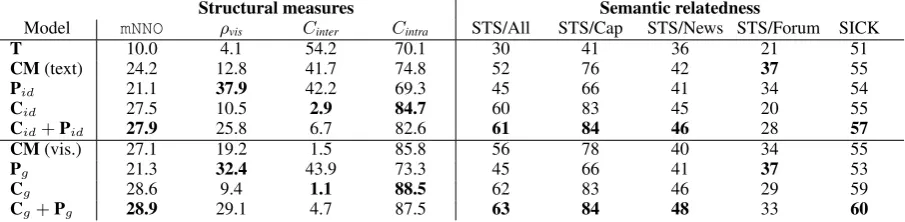
Table 1: Intrinsic evaluations carried out on the grounded space for models withg =MLP; the textual space for
T,CM(text) and models withg=id; and the visual space forCM(vis).
pairs of sentences that are associated with human-labeled similarity scores. STS is subdivided into three textual sources: Captions contain concrete sentences describing daily-life actions, whereas the others contain more abstract sentences: news headlines inNews and posts from user forums in
Forum. The Spearman correlations are measured between the cosine similarity of our learned sen-tence embeddings and human-labeled scores.
Classification benchmarks. All extrinsic eval-uations are carried out using the SentEval pipeline (Conneau and Kiela, 2018). The tasks are the following: opinion polarity (MPQA) (Wiebe and Cardie,2005), movie review sentiment (MR) (Pang and Lee, 2005), subjectivity/objectivity classification (SUBJ) (Pang and Lee,2004), cus-tomer reviews (CR) (Hu and Liu, 2004), binary sentiment analysis on SST (Socher et al., 2013), paraphrase identification (MSRP) (Dolan et al., 2004) as well as two entailment classification benchmarks: SNLI (Bowman et al., 2015) and SICK (Marelli et al., 2014b). For each dataset, a logistic regression classifier is learned from the extracted sentence embeddings, and we report the classification accuracy.
Structural measures. To probe the learned grounded space, we define structural measures, and report their values on the validation set of MS COCO (5K images, 25K captions). First, we re-port themean Nearest Neighbor Overlap(mNNO) metric, as defined in Collell and Moens (2018), that indicates the proportion of shared nearest neighbors between image representations and their corresponding captions in their respective spaces. To study perceptual information, we define ρvis, the Pearson correlation ρ(cos(s, s0),cos(vs, vs0))
between images and their corresponding sen-tences’ similarities. For cluster information, we introduce Cintra = Evs=vs0[cos(s, s
0)], which
measures the homogeneity of each cluster, and
Cinter = Evs6=vs0[cos(s, s
0)], which measures how
well clusters are separated from each other.
4.4 Implementation details
Images are processed using a pretrained Inception-v3 network (Szegedy et al., 2016) (di = 2048). The model is trained with ADAM (Kingma and Ba, 2014) and a learning rate lr = 8.10−4. As
done inKiros et al.(2015), our sentence encoder is a GRU with a vocabulary of 20K words, rep-resented in dimension 620; we perform vocab-ulary expansion at inference. All hyperparame-ters are tuned using the Pearson correlation mea-sure on the validation set of the SICK benchmark:
γ = γ0 = 0.5, αC = αP = 0.01, dg = 512; functions f and g are 2-layer MLP. As done in (Kiela et al., 2018), we set dt = 2048. Our code is available at https://github.com/
pbordes/multimodal_sentence_rep.
5 Experiments and Results
Our main objective is to study the contribution brought by the visual modality to the grounded sentence representations, and we do not attempt to outperform purely textual sentence encoders from the literature. We show that textual models can benefit from grounding approaches without requir-ing any changes to the original textual objectives
LT. We report quantitative and qualitative insights (sect. 5.1), and quantitative results on the SentEval benchmark (sect. 5.2).
5.1 Study of the grounded space
Query: A woman sitting on stone steps with a suitcase full of books.
A woman sitting on stairs has a suitcase full of books. A woman reads a book while sitting on steps near a suitcase full of books.
The woman is setting on the steps with a case of books. A woman sitting inside of an open suitcase. A woman sitting on the ground next to luggage. A young woman sits near three suitcases of luggage.
A young woman sitting cross legged on an apartment sofa.
A girl sitting next to three old suitcases. A woman sitting on a couch in front of a laptop.
A woman standing on a tennis court holding a racquet.
A woman standing on a tennis court holding a racquet.
Query image Nearest image
Q N
Q Q Q
N QThe woman is setting on the steps with a case of books. N
Q
[image:7.595.75.524.77.164.2]Grounded model Textual model
Figure 2: Nearest neighbors of a selected sentence in the validation set of MS COCO, for both grounded and purely textual models.Qis the query image,Nis the nearest neighbor ofQin the visual space. Sentences that are caption ofQorNare prefixed withQorN.
Query Textual model Grounded model
[image:7.595.76.287.310.382.2]Two people are inlove Two people are fencing indoors A couple just got married and are taking a picture with family A man ishorrified A man and a woman are smiling A teenage boy wearing a cap looks irritated This is atragedy A group of people are at a party Men doing a war reenactment
Table 2: Qualitative analysis: nearest neighbor of a given query (containing an abstract word) among Flickr30K sentences.
coast slum basilica ballroom music studio
Figure 3: t-SNE visualization on CMPlaces sentences for a set of randomly sampled visual scenes. Left: tex-tual modelT. Right: grounded modelCg+Pg.
The impact of grounding We investigate the ef-fect of grounding on sentence representations. Re-sults highlight that all grounded models improve over the baselineT. Moreover, our modelCg+Pg
is generally the most effective regarding themNNO
measure and semantic relatedness tasks.
Influence of concreteness To understand in which cases grounding is useful, we compute the average visual concreteness ¯cof the STS bench-mark, which is divided in three categories ( Cap-tions,News,Forum). This is done by using a con-creteness dataset built by Brysbaert et al. (2013) consisting of human ratings of concreteness (be-tween 0 and 5) for 40,000 English words; for a given benchmark, we compute the sum of these scores and average over all words that are in the concreteness dataset. The performance gain∆ be-tweenCg+PgandTare observed when the visual
concreteness¯c is high: forCaptions (¯c = 3.10), the improvement is substantial: (∆ = +43); for benchmarks with a lower concreteness (Newswith
¯
c = 2.61 and Forum with ¯c = 2.39), the im-provement is smaller (∆ = +12). Thus, ground-ing brground-ings useful complementary information, es-pecially for concrete sentences.
t-SNE visualization This finding is also sup-ported by a qualitative experiment showing that grounding groups together similar visual situa-tions. Using sentences from CMPlaces (Castrejon et al., 2016), which describe visual scenes (e.g.,
coast,shoe-shop,plaza, etc.) and are classified in 205 scene categories, we randomly sample 5 vi-sual scenes and plot inFigure 3 the correspond-ing sentences uscorrespond-ing t-SNE (Maaten and Hinton, 2008). We notice that our grounded model is bet-ter able to clusbet-ter sentences that have a close visual meaning than the text-only model. This is rein-forced by the structural measures computed on the five clusters ofFigure 3: Cinter = 19, Cintra = 22
forT, Cinter = 11, Cintra = 27forCg +Pg.
In-deed,Cinter (resp. Cintra), is lower (resp. higher) for the grounded modelCg+Pg compared toT,
which shows that clusters corresponding to differ-ent scenes are more clearly separated (resp. sen-tences corresponding to a given scene are more packed).
Model MR CR SUBJ MPQA MRPC SST SNLI SICK AVG
(Kiros et al.,2015)† T1024 72.7∗ 75.2∗ 90.6∗ 84.7∗ 71.8∗
/79.2∗
76.2∗ 68.8∗ 79.3∗ 77.4
(Kiela et al.,2018)† GS-Cap 72.0∗ 76.8∗ 90.7∗ 85.5∗ 72.9/80.6 76.7∗ 73.7 82.9 78.4 (Kiela et al.,2018)† GS-Img 74.5∗ 79.3∗ 90.8∗ 87.8∗ 73.0/80.3 80.0∗ 72.2∗ 80.9∗ 79.8 (Kiela et al.,2018)† GS-Both 72.5∗ 75.7∗ 90.7∗ 85.4∗ 72.9/81.3 76.7∗ 72.2∗ 81.4∗ 78.4 (Kiros et al.,2015)† T 75.9∗ 79.2∗ 92.0 86.7∗ 72.2/80.2 81.8∗ 72.0∗ 81.1∗ 80.1 (Lazaridou et al.,2015a)‡ T+CM 77.6 81.4 92.6 88.3 73.5/81.1 82.0∗ 73.0 81.4∗ 81.1 (Collell et al.,2017)‡ SEQ 76.1∗ 79.8∗ 92.5 86.7∗ 70.0∗
/79.5∗
81.7∗ 67.3∗ 76.7∗ 78.9
Model scenarios
[image:8.595.72.526.61.230.2]T+Pid 77.5 81.5 92.7 88.4 73.7/81.3 82.4 72.4 81.1 81.2 T+Pg 77.8 81.8 93.0 88.1 73.3/81.6 83.5 72.8 82.2 81.6 T+Cid 77.5 81.6 92.8 88.3 72.9/80.5 82.2 73.1 82.3 81.3 T+Cg 77.3 81.5 92.8 88.6 73.6/81.1 82.6 74.1 82.6 81.6 T+Cid+Pid 77.3 81.2 93.0 88.4 73.0/80.6 82.5 73.5 82.1 81.4 T+Cg+Pg 77.4 81.5 93.0 88.1 73.2/80.9 82.7 73.9 82.9 81.6
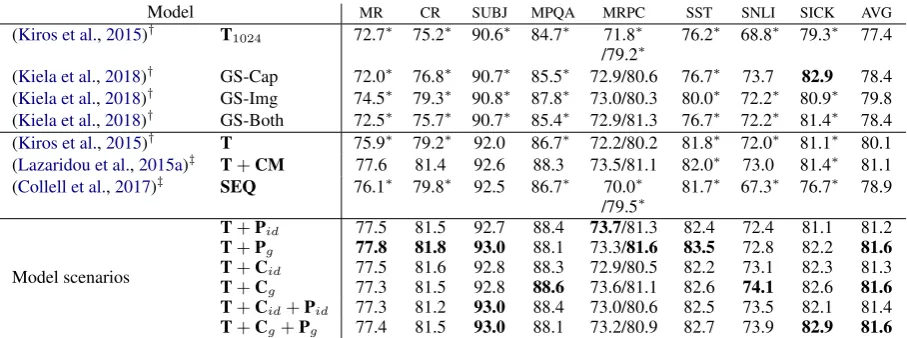
Table 3: Extrinsic evaluations with SentEval. All models give sentences in dimensiondt= 2048(exceptT1024). ‘AVG’
stands for the average accuracies reported in the other columns. ‘†’: the model has been re-implemented (we obtained higher scores than the one given in the original papers). ‘‡’: the baseline is an adaptation of the model to the case of sentences. ’∗’: significantly differs from the best scenario among our models.
concrete sentences to abstract ones is analogous to findings made in previous research on word em-beddings (Hill and Korhonen,2014).
Neighboring structure To illustrate the dis-crepancy on the mNNO metric observed between Cg+PgandT, we select a query imageQin the
validation set of MS COCO, along with its corre-sponding captionS; we display, in Figure 2, the nearest neighbor of Q in the visual space, noted
N, and the nearest neighbors ofSin the grounded space. With our grounded model, the neighbor-hoodSis mostly made of sentences corresponding toQorN.
Hypotheses validation We now validate our hy-potheses (cf. sect. 3.1) on the grounded space, using the Cross-Modal Projection baseline (CM) and our model scenarios as outlined in Table 1. For fair comparison, metrics for the baselineCM are estimated either on the visual or the textual space depending on whether our models rely on the grounded space (g) or not (id). These results correspond to the rowsCM (text) and CM(vis.) inTable 1.
Results highlight that: (1) Using a grounded space is beneficial; indeed, semantic relatedness and mNNO scores are higher in the lower half of Table 1, e.g.,Cg >Cid,Pg >PidandCg+Pg > Cid + Pid; (2) Solely using cluster information
leads to the highestCintraand lowestCinter, which suggests thatC•is the most efficient model at
sep-arating visually different sentences; (3) Using only perceptual information in P• logically leads to
highly correlated textual and visual spaces (high-est ρvis), but the local neighborhood structure is
not well preserved (lowestCintra); (4) Our model C•+P•is better thanCMat capturing cluster
in-formation (higherCintra, lowerCinter) and percep-tual information (higherρvis). This also translates in a highermNNO measure forC• +P•, leading
us to think that the conjunction of both perceptual and cluster information leads to high correlation of modalities, in terms of neighborhood structure. Moreover, this high mNNO score results in better performances for our modelC• +P• in terms of
semantic relatedness.
5.2 Evaluation on transfer tasks
We now focus on extrinsic evaluation of the em-beddings. Table 3reports evaluations of our base-lines and scenarios on SentEval (Conneau and Kiela,2018), a classical benchmark used for eval-uating sentence embeddings. Before further anal-ysis, we find that our grounded models system-atically outperform the textual baselineT, on all benchmarks, which shows the first substantial im-provement brought by grounding and visual infor-mation in a sentence representation model. In-deed, models GS-Cap, GS-Img and GS-Both from (Kiela et al.,2018), despite improving overT1024,
perform worse than the textual model of the same dimensionT — this is consistent with what they report in their paper.
models for all benchmarks. (2) Preserving the structure of the visual space is more effective than learning cross-modal projections; indeed, all our models outperform T+CM on average (‘AVG’ column). (3) Making use of a grounded space yields slightly improved sentence representations. Indeed, our models that use the grounded space (g = MLP) can take advantage of more expres-sion power provided by the trainablegthan mod-els which integrate grounded information directly in the textual space (g = id). (4) Among our model scenarios, T+Pg has maximal scores on
the most tasks; however, it shows lower scores on SNLI and SICK, which are entailment tasks. Mod-els using cluster informationCgare naturally more
suited for these tasks and hence obtain higher re-sults. Finally, the combined modelT+Cg+Pg
shows a good balance between classification and entailment tasks.
6 Conclusion
We proposed a multimodal model aiming at pre-serving the structure of visual and textual spaces to learn grounded sentence representations. Our contributions include (1) leveraging both percep-tual and cluster information and (2) using an in-termediate grounded space enabling to relax the constraints on the textual space. Our approach is the first to report consistent positive results against purely textual baselines on a variety of natural lan-guage tasks. As future work, we plan to use visual information to specifically target complex down-stream tasks requiring commonsense and reason-ing such as question answerreason-ing or visual dialogue.
Acknowledgments
This work is partially supported by the CHIST-ERA EU project MUSTER (ANR-15-CHR2-0005) and the Labex SMART (ANR-11-LABX-65) supported by French state funds managed by the ANR within the Investissements d’Avenir pro-gram under reference ANR-11-IDEX-0004-02.
References
Ignacio Arroyo-Fern´andez, Carlos-Francisco M´endez-Cruz, Gerardo Sierra, Juan-Manuel Torres-Moreno, and Grigori Sidorov. 2019. Unsupervised sentence representations as word information series: Re-visiting TF-IDF. Computer Speech & Language, 56:107–129.
Dzmitry Bahdanau, Kyunghyun Cho, and Yoshua Bengio. 2014. Neural machine translation by jointly learning to align and translate. CoRR, abs/1409.0473.
Marco Baroni. 2016. Grounding distributional seman-tics in the visual world. Language and Linguistics Compass, 10(1):3–13.
Samuel R. Bowman, Gabor Angeli, Christopher Potts, and Christopher D. Manning. 2015. A large an-notated corpus for learning natural language infer-ence. In Proceedings of the 2015 Conference on Empirical Methods in Natural Language Process-ing, EMNLP 2015, Lisbon, Portugal, September 17-21, 2015, pages 632–642.
Elia Bruni, Nam Khanh Tran, and Marco Baroni. 2014. Multimodal distributional semantics. J. Artif. Int. Res., 49(1):1–47.
Marc Brysbaert, Amy Beth Warriner, and Victor Ku-perman. 2013.Concreteness ratings for 40 thousand generally known english word lemmas. Behavior research methods, 46.
Curt Burgess and Kevin Lund. 1997. Modelling pars-ing constraints with high-dimensional context space. 12.
Micael Carvalho, R´emi Cad`ene, David Picard, Laure Soulier, Nicolas Thome, and Matthieu Cord. 2018. Cross-modal retrieval in the cooking context: Learn-ing semantic text-image embeddLearn-ings. InThe 41st International ACM SIGIR Conference on Research & Development in Information Retrieval, SIGIR 2018, Ann Arbor, MI, USA, July 08-12, 2018, pages 35–44.
Lluis Castrejon, Yusuf Aytar, Carl Vondrick, Hamed Pirsiavash, and Antonio Torralba. 2016. Learning aligned cross-modal representations from weakly aligned data. In Computer Vision and Pattern Recognition (CVPR), 2016 IEEE Conference on. IEEE.
Daniel Cer, Yinfei Yang, Sheng-yi Kong, Nan Hua, Nicole Limtiaco, Rhomni St. John, Noah Constant, Mario Guajardo-Cespedes, Steve Yuan, Chris Tar, Brian Strope, and Ray Kurzweil. 2018. Univer-sal sentence encoder for english. In Proceedings of the 2018 Conference on Empirical Methods in Natural Language Processing, EMNLP 2018: Sys-tem Demonstrations, Brussels, Belgium, October 31 - November 4, 2018, pages 169–174.
Daniel M. Cer, Mona T. Diab, Eneko Agirre, I˜nigo Lopez-Gazpio, and Lucia Specia. 2017. Semeval-2017 task 1: Semantic textual similarity multilin-gual and crosslinmultilin-gual focused evaluation. In Pro-ceedings of the 11th International Workshop on Se-mantic Evaluation, SemEval@ACL 2017, Vancou-ver, Canada, August 3-4, 2017, pages 1–14.
Grzegorz Chrupala, ´Akos K´ad´ar, and Afra Alishahi. 2015. Learning language through pictures. In Pro-ceedings of the 53rd Annual Meeting of the Associ-ation for ComputAssoci-ational Linguistics and the 7th In-ternational Joint Conference on Natural Language Processing of the Asian Federation of Natural Lan-guage Processing, ACL 2015, July 26-31, 2015, Bei-jing, China, Volume 2: Short Papers, pages 112– 118.
Guillem Collell and Marie-Francine Moens. 2018. Do neural network cross-modal mappings really bridge modalities? In Proceedings of the 56th Annual Meeting of the Association for Computational Lin-guistics, ACL 2018, Melbourne, Australia, July 15-20, 2018, Volume 2: Short Papers, pages 462–468.
Guillem Collell, Teddy Zhang, and Marie-Francine Moens. 2017. Imagined visual representations as multimodal embeddings. In Proceedings of the Thirty-First AAAI Conference on Artificial Intelli-gence (AAAI-17). AAAI.
Alexis Conneau and Douwe Kiela. 2018. Senteval: An evaluation toolkit for universal sentence representa-tions. InProceedings of the Eleventh International Conference on Language Resources and Evaluation, LREC 2018, Miyazaki, Japan, May 7-12, 2018.
Alexis Conneau, Douwe Kiela, Holger Schwenk, Lo¨ıc Barrault, and Antoine Bordes. 2017. Supervised learning of universal sentence representations from natural language inference data. InProceedings of the 2017 Conference on Empirical Methods in Nat-ural Language Processing, EMNLP 2017, Copen-hagen, Denmark, September 9-11, 2017, pages 670– 680.
Bill Dolan, Chris Quirk, and Chris Brockett. 2004. Unsupervised construction of large paraphrase cor-pora: Exploiting massively parallel news sources. InCOLING 2004, 20th International Conference on Computational Linguistics, Proceedings of the Con-ference, 23-27 August 2004, Geneva, Switzerland.
Rebecca Fincher-Kiefer. 2001. Perceptual compo-nents of situation models. Memory & Cognition, 29(2):336–343.
Jonathan Gordon and Benjamin Van Durme. 2013. Re-porting bias and knowledge acquisition. In Proceed-ings of the 2013 Workshop on Automated Knowledge Base Construction, AKBC ’13, pages 25–30, New York, NY, USA. ACM.
Zellig S Harris. 1954. Distributional structure. Word, 10(2-3):146–162.
Felix Hill, Kyunghyun Cho, and Anna Korhonen. 2016. Learning distributed representations of sentences from unlabelled data. In NAACL HLT 2016, The 2016 Conference of the North American Chapter of the Association for Computational Linguistics: Hu-man Language Technologies, San Diego California, USA, June 12-17, 2016, pages 1367–1377.
Felix Hill and Anna Korhonen. 2014. Learning ab-stract concept embeddings from multi-modal data: Since you probably can’t see what I mean. In Pro-ceedings of the 2014 Conference on Empirical Meth-ods in Natural Language Processing, EMNLP 2014, October 25-29, 2014, Doha, Qatar, A meeting of SIGDAT, a Special Interest Group of the ACL, pages 255–265.
Felix Hill, Roi Reichart, and Anna Korhonen. 2014. Multi-modal models for concrete and abstract con-cept meaning. Transactions of the Association for Computational Linguistics, 2:285–296.
Minqing Hu and Bing Liu. 2004. Mining and summa-rizing customer reviews. InProceedings of the Tenth ACM SIGKDD International Conference on Knowl-edge Discovery and Data Mining, KDD ’04, pages 168–177, New York, NY, USA. ACM.
Nal Kalchbrenner, Edward Grefenstette, and Phil Blun-som. 2014. A convolutional neural network for modelling sentences. In Proceedings of the 52nd Annual Meeting of the Association for Computa-tional Linguistics, ACL 2014, June 22-27, 2014, Baltimore, MD, USA, Volume 1: Long Papers, pages 655–665.
Andrej Karpathy and Fei-Fei Li. 2015. Deep visual-semantic alignments for generating image descrip-tions. InIEEE Conference on Computer Vision and Pattern Recognition, CVPR 2015, Boston, MA, USA, June 7-12, 2015, pages 3128–3137.
Douwe Kiela, Alexis Conneau, Allan Jabri, and Max-imilian Nickel. 2018. Learning visually grounded sentence representations. In Proceedings of the 2018 Conference of the North American Chapter of the Association for Computational Linguistics: Human Language Technologies, NAACL-HLT 2018, New Orleans, Louisiana, USA, June 1-6, 2018, Vol-ume 1 (Long Papers), pages 408–418.
Diederik P. Kingma and Jimmy Ba. 2014. Adam: A method for stochastic optimization. CoRR, abs/1412.6980.
Ryan Kiros, Yukun Zhu, Ruslan Salakhutdinov, Richard S. Zemel, Raquel Urtasun, Antonio Tor-ralba, and Sanja Fidler. 2015. Skip-thought vec-tors. In Advances in Neural Information Process-ing Systems 28: Annual Conference on Neural In-formation Processing Systems 2015, December 7-12, 2015, Montreal, Quebec, Canada, pages 3294– 3302.
Angeliki Lazaridou, Georgiana Dinu, and Marco Ba-roni. 2015a. Hubness and pollution: Delving into cross-space mapping for zero-shot learning. In Pro-ceedings of the 53rd Annual Meeting of the Associ-ation for ComputAssoci-ational Linguistics and the 7th In-ternational Joint Conference on Natural Language Processing (Volume 1: Long Papers), pages 270– 280. Association for Computational Linguistics.
Angeliki Lazaridou, Nghia The Pham, and Marco Ba-roni. 2015b. Combining language and vision with a multimodal skip-gram model. InNAACL HLT 2015, The 2015 Conference of the North American Chap-ter of the Association for Computational Linguistics: Human Language Technologies, Denver, Colorado, USA, May 31 - June 5, 2015, pages 153–163.
Tsung-Yi Lin, Michael Maire, Serge J. Belongie, James Hays, Pietro Perona, Deva Ramanan, Piotr Doll´ar, and C. Lawrence Zitnick. 2014. Microsoft COCO: common objects in context. InComputer Vision -ECCV 2014 - 13th European Conference, Zurich, Switzerland, September 6-12, 2014, Proceedings, Part V, pages 740–755.
Xiao Lin and Devi Parikh. 2015. Don’t just listen, use your imagination: Leveraging visual common sense for non-visual tasks. InIEEE Conference on Com-puter Vision and Pattern Recognition, CVPR 2015, Boston, MA, USA, June 7-12, 2015, pages 2984– 2993.
Zhouhan Lin, Minwei Feng, C´ıcero Nogueira dos San-tos, Mo Yu, Bing Xiang, Bowen Zhou, and Yoshua Bengio. 2017. A structured self-attentive sentence embedding.CoRR, abs/1703.03130.
Lajanugen Logeswaran and Honglak Lee. 2018. An efficient framework for learning sentence represen-tations. In6th International Conference on Learn-ing Representations, ICLR 2018, Vancouver, BC, Canada, April 30 - May 3, 2018, Conference Track Proceedings.
Laurens van der Maaten and Geoffrey Hinton. 2008. Visualizing data using t-sne. Journal of machine learning research, 9(Nov):2579–2605.
Marco Marelli, Luisa Bentivogli, Marco Baroni, Raf-faella Bernardi, Stefano Menini, and Roberto Zam-parelli. 2014a. Semeval-2014 task 1: Evaluation of compositional distributional semantic models on full sentences through semantic relatedness and tex-tual entailment. In Proceedings of the 8th In-ternational Workshop on Semantic Evaluation, Se-mEval@COLING 2014, Dublin, Ireland, August 23-24, 2014., pages 1–8.
Marco Marelli, Stefano Menini, Marco Baroni, Luisa Bentivogli, Raffaella Bernardi, and Roberto Zam-parelli. 2014b. A SICK cure for the evaluation of compositional distributional semantic models. In Proceedings of the Ninth International Confer-ence on Language Resources and Evaluation, LREC 2014, Reykjavik, Iceland, May 26-31, 2014., pages 216–223.
Tomas Mikolov, Ilya Sutskever, Kai Chen, Gregory S. Corrado, and Jeffrey Dean. 2013. Distributed rep-resentations of words and phrases and their com-positionality. In Advances in Neural Information Processing Systems 26: 27th Annual Conference on Neural Information Processing Systems 2013. Pro-ceedings of a meeting held December 5-8, 2013, Lake Tahoe, Nevada, United States., pages 3111– 3119.
Douglas L Nelson, Cathy L McEvoy, and Thomas A Schreiber. 2004. The university of south florida free association, rhyme, and word fragment norms. Be-havior Research Methods, Instruments, & Comput-ers, 36(3):402–407.
Donald A Norman. 1972. Memory, knowledge, and the answering of questions.
Bo Pang and Lillian Lee. 2004. A sentimental edu-cation: Sentiment analysis using subjectivity sum-marization based on minimum cuts. In Proceed-ings of the 42nd Annual Meeting of the Association for Computational Linguistics, 21-26 July, 2004, Barcelona, Spain., pages 271–278.
Bo Pang and Lillian Lee. 2005. Seeing stars: Exploit-ing class relationships for sentiment categorization with respect to rating scales. InACL 2005, 43rd An-nual Meeting of the Association for Computational Linguistics, Proceedings of the Conference, 25-30 June 2005, University of Michigan, USA, pages 115–124.
Matthew E. Peters, Mark Neumann, Mohit Iyyer, Matt Gardner, Christopher Clark, Kenton Lee, and Luke Zettlemoyer. 2018. Deep contextualized word rep-resentations. In Proceedings of the 2018 Confer-ence of the North American Chapter of the Associ-ation for ComputAssoci-ational Linguistics: Human Lan-guage Technologies, NAACL-HLT 2018, New Or-leans, Louisiana, USA, June 1-6, 2018, Volume 1 (Long Papers), pages 2227–2237.
Bryan A. Plummer, Liwei Wang, Chris M. Cervantes, Juan C. Caicedo, Julia Hockenmaier, and Svetlana Lazebnik. 2015. Flickr30k entities: Collecting region-to-phrase correspondences for richer image-to-sentence models. In 2015 IEEE International Conference on Computer Vision, ICCV 2015, Santi-ago, Chile, December 7-13, 2015, pages 2641–2649.
Carina Silberer and Mirella Lapata. 2014. Learn-ing grounded meanLearn-ing representations with autoen-coders. In Proceedings of the 52nd Annual Meet-ing of the Association for Computational LMeet-inguis- Linguis-tics, ACL 2014, June 22-27, 2014, Baltimore, MD, USA, Volume 1: Long Papers, pages 721–732.
Empirical Methods in Natural Language Process-ing, EMNLP 2013, 18-21 October 2013, Grand Hy-att SeHy-attle, SeHy-attle, Washington, USA, A meeting of SIGDAT, a Special Interest Group of the ACL, pages 1631–1642.
Christian Szegedy, Vincent Vanhoucke, Sergey Ioffe, Jonathon Shlens, and Zbigniew Wojna. 2016. Re-thinking the inception architecture for computer vi-sion. In 2016 IEEE Conference on Computer Vi-sion and Pattern Recognition, CVPR 2016, Las Ve-gas, NV, USA, June 27-30, 2016, pages 2818–2826.
Lawrence W. Barsalou. 1999. Perceptual symbol sys-tems. 22:577–609; discussion 610.
Hong Wang, Wenhan Xiong, Mo Yu, Xiaoxiao Guo, Shiyu Chang, and William Yang Wang. 2019. Sen-tence embedding alignment for lifelong relation ex-traction.NAACL.
Liwei Wang, Yin Li, and Svetlana Lazebnik. 2016. Learning deep structure-preserving image-text em-beddings. In 2016 IEEE Conference on Computer Vision and Pattern Recognition, CVPR 2016, Las Ve-gas, NV, USA, June 27-30, 2016, pages 5005–5013.
Janyce Wiebe and Claire Cardie. 2005. Annotating ex-pressions of opinions and emotions in language. lan-guage resources and evaluation. In Language Re-sources and Evaluation (formerly Computers and the Humanities, page 2005.
Fanyi Xiao, Leonid Sigal, and Yong Jae Lee. 2017. Weakly-supervised visual grounding of phrases with linguistic structures. In2017 IEEE Conference on Computer Vision and Pattern Recognition, CVPR 2017, Honolulu, HI, USA, July 21-26, 2017, pages 5253–5262.
Mark Yatskar, Vicente Ordonez, and Ali Farhadi. 2016. Stating the obvious: Extracting visual com-mon sense knowledge. In NAACL HLT 2016, The 2016 Conference of the North American Chapter of the Association for Computational Linguistics: Hu-man Language Technologies, San Diego California, USA, June 12-17, 2016, pages 193–198.
´