A R o b u s t P a r s e r B a s e d on S y n t a c t i c I n f o r m a t i o n
Kong Joo Lee
Cheol Jung Kweon
J u n g y u n Seo
Gil Chang Kim
Department of Computer Scinence and CAIR
Korea Advanced Institute of Science and Technology
Taejon, Korea 305-701
{kjlee,cjkwn}@csone.kaist.ac.kr
Abstract
An extragrammatical sentence is what a normal parser fails to analyze. It is important to recover it using only syn- tactic information although results of recovery are better if semantic factors are considered. A general algorithm .for least-errors recognition, which is based only on syntactic information, was pro- posed by G. Lyon to deal with the ex- tragrammaticality. We extended this algorithm to recover extragrammatical sentence into grammatical one in run- ning text. Our robust parser with re- covery mechanism - extended general algorithm for least-errors recognition - can be easily scaled up and modified be- cause it utilize only syntactic informa- tion. To upgrade this robust parser we proposed heuristics through the analy- sis on the Penn treebank corpus. The experimental result shows 68% ,~ 77% accuracy in error recovery.
1 I n t r o d u c t i o n
ExtragrammaticM sentences include patently un- grammatical constructions as well as utterances that may be grammaticMly acceptable but are be- yond the syntactic coverage of a parser, and any other difficult ones that are encountered in parsing (Carbonell and Hayes, 1983).
I am sure this is w h a t he means. T h i s is, I am sure, w h a t he means.
The progress of machine does not stop even a day. Not even a day does the progress of machine stop.
Above examples show that people are used to write same meaningful sentences differently. In addition, people are prone to mistakes in writing sentences. So, the bulk of written sentences are open to the extragrammaticality.
In the Penn treebank tree-tagged cor- pus(Marcus, 1991), for instance, about 80 per-
sentences which include inversive, elliptic, paren- thetic, or emphatic phrases. For example, we can drive a rule V P ---, vb N P comma rb comma P P from the following sentence.
( (S
The same jealousy can breed confusion, however, in the absence of any authoriza- tion bill this year.
(NP The/dr
(ADJP e a ~ e / j j ) j e a l o u s y / n n ) can/md
(VP breed/vb
(NP confusion/nn) , / , however/rb , / , (PP i n / i n
(NP
(NP t h e / d r absence/nn)
(PP o r l o n
(NP anyldt auZhorization/nnbi11/nn))
(NP t h i s / d t yearlnn)))))
./.)
A robust parser is one that can analyze these extragrammaticalsentences without failure. How- ever, if we try to preserve robustness by adding such rules whenever we encounter an extra- grammatical sentence, the rulebase will grow up rapidly, and thus processing and maintaining the excessive number of rules will become inefficient and impractical. Therefore, extragrammatical sentences should be handled by some recovery mechanism(s) rather than by a set of additional rules.
i m p o r t a n t to recover extragrammatical sentences using syntactic factors only, which are indepen- dent of any particular system and any particular domain.
Mellish (Mellish, 1989) introduced some chart- based techniques using only syntactic information for extragrammatical sentences. This technique has an advantage t h a t there is no repeating work for the chart to prevent the parser from generat- ing the same edge as the previously existed edge. Also, because the recovery process runs when a normal parser terminates unsuccessfully, the per- formance of the normal parser does not decrease in case of handling grammatical sentences. However, his experiment was not based on the errors in run- ning texts but on artificial ones which were ran- domly generated by human. Moreover, only one word error was considered though several word er- rors can occur simultaneously in the running text.
A general algorithm for least-errors recognition
(Lyon, 1974), proposed by G. Lyon, is to find out the least number of errors necessary to success- ful parsing and recover them. Because this algo- r i t h m is also syntactically oriented and baaed on a chart, it has the same advantzrge as t h a t of Mel- lish's parser. W h e n the original parsing algorithm terminates unsuccessfully, the algorithm begins to assume errors of insertion, deletion and m u t a t i o n of a word. For any input, including g r a m m a t - ical and extragrammatical sentences, this algo- r i t h m can generate the resultant parse tree. At the cost of the complete robustness, however, this algorithm degrades the efficiency of parsing, and generates m a n y intermediate edges.
I n this paper, we present a robust parser with a recovery mechanism. We extend
the general al-
gorithm for least-errors recognition
to adopt it as the recovery mechanism in our robust parser. Be- cause our robust parser handle extragrammatical sentences with this syntactic information oriented recovery mechanism, it can be independent of a particular system or particular domain. Also, we present the heuristics to reduce the number of edges so t h a t we can upgrade the performance of our parser.This paper is organized as follows : We first review a general algorithm for least-errors recog- nition. T h e n we present the extension of this al- gorithm, and the heuristics adopted by the robust parser. Next, we describe the implementation of the system and the result of the experiment of parsing real sentences. Finally, we make conclu- sion with future direction.
2
Algorithm and Heuristics
2.1 G e n e r a l a l g o r i t h m f o r l e a s t - e r r o r s r e c o g n i t i o n
T h e general algorithm for least-errors recognition (Lyon, 1974), which is based on Earley's algo- rithm, assumes t h a t sentences m a y have insertion,
RULE : T ~ a INPUT : t ( i )
l n u t a t i o n - e r r o r °," . . . ".,
';"
... ". hypothesis .:' ".• perfec~ match :
deletion-error ~ " ' ' ' , " T --* u . O !
hypothe,is i : '
: ~ T --* a . , 1 } insertion-error .'~T --*. a , 1 i
,, ..' h y p o t h e s i s ", :
"" .... S(i) ... "" t(i ) ... ~'(i+1) -'""
Figure 1: SCAN processing
deletion, and m u t a t i o n errors of terminal symbols. T h e objective of this algorithm is to parse input string with the least n u m b e r of errors.
A state
used in this algorithm is quadruple(p,
j, f, e J, where p is a production n u m b e r in gram- mar, j marks a position in
RHS(p),
f i s a start po- sition of the state in input string, and e is an error value. 1 Afinal state (p, p_-I-1, f, e)
denotes recog- nition of a phraseRHS(p)
with e errors where _p is a number of components in rule p. Astateset S(i),
where i is the position of the input, is an ordered set of states. States within a stateset are ordered by ascending value of 3", within a p within a f ; f takes descending value.
When adding to statesets, ff state
(p, j, f, e)
is a candidate for admission to a stateset which already has a similar m e m b e r
(p, j, f,, e') and e'
_~ e, then
(p,
j, f, e) is rejected. However, if e ' > e, then(p, j, f, e')
is replaced by(p, j, f, e).
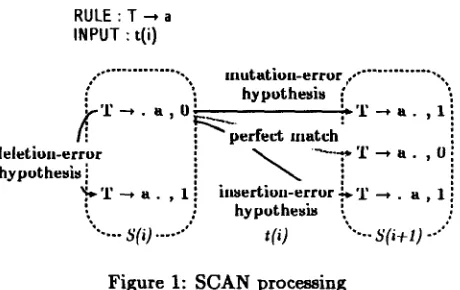
T h e algorithm works as follows : A procedure SCAN is carried out for each state in S(i). SCAN checks various correspondences of input token
t(i)
against terminal symbols in
RHS
of rules. Once SCAN is done, C O M P L E T E R substitutes all final states of S(i) into all other analyses which can use t h e m as components.S C A N
SCAN handles states of
S(i),
checking each in- put terminal against requirements of states inS(i)
and various error hypotheses. Figure 1 shows how SCAN processes.
Let
c(p,j)
bej-th
component ofRHS(p) and t(i)
be
i-th
word of input string.• perfect match :
i f
c(p,j) = t(i)
then add(p, j+l,
f, e) toS(i+l)
if possible.•
insertion-error hypothesis :
Add
(p,
j, f, ¢-/'cei,.,.er.on) toS(i-t-1)
if pos- sible.a~n,er~ion is the cost of an insertion-error for a terminal symbol.
• d e l e t i o n - e r r o r h y p o t h e s i s :
[image:2.596.323.553.78.223.2]I f
c(p,j) is
terminal, then add(p, j-l-l, .f,
e+OtdeZe.~) to
S(i)
if possible.od~z~.., is the cost of a deletion-error for a terminal symbol.
•
mutation-error hypothesis :
I f
c(p,j)
is terminal b u t not equal tot(i),
thenadd
(p, j+ l, f, e+~,,,to,on) to S(i+ l) if
pos-sible.
~muta,on is the cost of a m u t a t i o n - e r r o r for
S", [VP-> vb. NP PPI
S' " [,.NP I [PP|
• They ~ ~ t h e r e p o ~
s.[VP->vb NP PP]
< Phrase Perfect Ma~:h >
s"= IS-> NP. md VPI
a terminal symbol.2 ~ ~ ! _
C O M P L E T E R ~c ~ .rles " IneludlngW(mt G@rmany ~mlq "havell hltrd lime,.. . - ~ .
C O M P L E T E R handles substitution of final states " k . / ,
in
S(i)
like t h a t of original Earley's algorithm. ,-[s->,P , , vP|Each final state m e a n s the recognition of a non-
terminal. • Ph.~ ,..=r~,~-,.r~ . y p ~ - = , .
2.2 E x t e n s i o n o f l e a s t - e r r o r s r e c o g n i t i o n a l g o r i t h m
T h e algorithm in section 2.1 can analyze a n y in- p u t string with the least n u m b e r of errors. But this algorithm can handle only the errors of termi- nal symbols because it doesn't consider the errors of nonterminal nodes. In the real text, however, the insertion, deletion, or inversion of a phrase - namely, nonterminal node - occurs m o r e fre- quently. So, we extend the original algorithm in" order to handle the errors of nonterminal symbols as well.
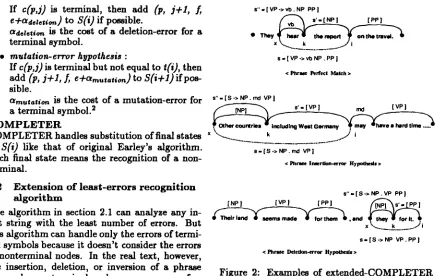
In our extended algorithm, the s a m e SCAN as t h a t of the original algorithm is used, while COM- P L E T E R is modified and extended. Figure 2 shows the processing of e x t e n d e d - C O M P L E T E R . In figure 2,
[NP]
denotes the final state whose rule has N P as itsLHS.
In other words, it means the recognition of a noun phrase.e x t e n d e d - C O M P L E T E R
I f there is a final s t a t e s' = (p',p~ + 1, k, e') in S(i),
• phrase perfect match
I f there exists a state s" = (p, j , x, e) in S(k) , t < i a n d j ) = L /S(f) t h e n a d d s = (p, j + 1, z, e + e') into
S(i).
• phrase insertion-error hypothesis a
I f there exists a state s" = (p, j, z, e) in S(k) then add s =
( p , j , z , e + / ~ , , , r , o , )
intoS(i)
if possible.
/Yinaertion
is the cost of a insertion-error for anonterminal symbol.
2ain.ertion,
Otdeletion , Ofmutation lEES st|] strictly 1 i n L y o n ' s o r i ~ - ~ l p ~ p e r~In fact, there axe cases that an inserted phrase cannot be constructed to form a nonterminal node. In phrase insertion-error hypothesis of figure 2, the orig- inal sentence is ~Other countries, including West Ger- many, m~y hgve . . . ' , where the inserted phrase VP is surrounded by commas. So, the substring( c o m m a
V~
c o m m a ) should be dealt with as a constituentin extended-COMPLETER. In fact, we implemented the algorithm to allow substring insertions ~, well as insertions of nontermlnal nodes.
S"- IS-> NP. VP PP] ~ s e e m , r[VP' n s d[PP] ~ / ~ S' -,PP ]
.and
s= [S-> NP VP.PP|
< Phrm¢ I~eaon-error Ilypoe,cds >
Figure 2: E x a m p l e s of e x t e n d e d - C O M P L E T E R processing
• phrase deletion-error hypothesis
I f there exists a s t a t e s" = (p, j, z, e) in
S(k)
and e(p,j)
is a nonterminal then add s :( p , j "~- 1, Z , e
"]'t~dele|ion)
into S(k) if possible. ~ d e l e , ~ is the cost of a deletion-error for a nonterminal symbol.•
phrase mutation-error hypothesis 4
I f there ~ t s a s t a t e 8" = (V, J, x, e) in S(k)
and c(p, j) is a
n o n t e r m i n a l b u t not equal to L ( p ' ) then add s = (p, j + 1, z, e + ~me*a.o.) intoS(i)
if possible.~m.ta.o. is
the cost of a m u t a t i o n - e r r o r for a nonterminM symbol.T h e extended least-errors recognition algorithm can handle not only terminal errors b u t also non- terminal errors.
2.3 H e u r i s t i c s
T h e robust pa~ser using the extended least-errors recognition algorithm overgenerates m a n y error- hypothesis edges during parsing process. To cope with this problem, we adjust error values accord- ing to the following heuristics. Edges with m o r e error values are regarded as less i m p o r t a n t ones, so t h a t those edges are processed later t h a n those of less error values.
[image:3.596.66.501.72.348.2]• H e u r i s t i c s 1: e r r o r t y p e s
T h e analysis on 3,538 sentences of the Penn treebank corpus WS:I shows t h a t there are 498 sentences with phrase deletions and 224 sentences with phrase insertions. So, we assign less error value to the deletion-error hypothesis edge t h a n to the insertion- and mutation-errors.
a < ~
~deletion <= Oeinsertion ~ ~ m u t a t i o n
~deletion ~ ~insergiort
where ~ is the error cost of a t e r m i n a l s y m - bol,/~ is the error cost of a n o n t e r m i n a l s y m - bol.
• H e u r i s t i c s 2: f i d u c i a l n o n t e r m i n a l
People often m a k e mistakes in writing En- glish. These mistakes usually take place rather between small constituents such as a verbal phrase, an adverbial phrase and noun phrase t h a n within small constituents themselves. T h e possibility of error occur- rence within noun phrases are lower t h a n be- tween a noun phrase and a verbal phrase, a preposition phrase, an adverbial phrase. So, we assume some phrases, for e x a m p l e noun phrases, as fiducial nonterminals, which m e a n s error-free nonterminals. W h e n han- dling sentences, the robust parser assings m o r e error values(61) to the error hypothesis edge occurring within a fiducial nonterminal. • H e u r i s t i c s 3: k i n d s o f t e r m i n a l s y m b o l s Some t e r m i n a l symbols like p u n c t u a t i o n symbols, conjunctions and particles are of- ten misused. So, the robust parser assigns less error v a l u e s ( - 5 2 ) to the error hypothesis edges with these symbols t h a n to the other t e r m i n a l symbols.
• H e u r i s t i c s 4 : i n s e r t e d p h r a s e s b e t w e e n c o m m a s o r p a r e n t h e s e s
Most of inserted phrases are surrounded by c o m m a s or parentheses. For example,
a. They're active , g e n e r a l l y , at night or on
damp, cloudy days.
b. All refrigerators , whether they are defrosted manually or n o t , need to be cleaned. c . I was a last-minute ( read i n t e d o p i n 9 ) at-
tendee at a French journalism convention .-.
We will assign less error v a l u e s ( - 6 a ) to the insertion-error hypothesis edges of nontermi- nals which are embraced b y c o m m a or paren- thesis.
61 and 62 are weights for the error of t e r m i n a l nodes, and 68 is a weight for the error of nonter- m i n a l nodes.
T h e error value e of an edge is calculated as follows. All error values are additive.
T h e error value e for a rule X ~ a l A l a 2 . . , a~Aj, where a is a t e r m i n a l node and A is a n o n t e r m i n a l node, is
1. e = eT +
e + 61 - 62 if t e r m i n a l error
2. eT : 0 otherwise
{
/~ - 6s -t- ech,d if n o n t e r m i n a l3. e N T - - " error
echild otherwise
where a E {ain..r:ion, adele.on,
amutation}, fl E
{/~in.er.o.,/~&/etion} and ech.d is an error value of a child edge.
By these heuristics, our robust parser can pro- cess only plausible edges first, i n s t e ~ i of process- ing all generated edges at the s a m e time, so t h a t we can enhance the p e r f o r m a n c e of the robust parser and result in the great reduction in the n u m b e r of resultant trees.
3 I m p l e m e n t a t i o n a n d E v a l u a t i o n
3.1 T h e r o b u s t p a r s e r
Our robust parsing s y s t e m is c o m p o s e d of two modules. One module is a n o r m a l parser which is the b o t t o m - u p chart parser. T h e other is a robust parser with the error recovery m e c h a n i s m proposed herein. At first, an input sentence is processed by the n o r m a l parser. I f the sentence is within the g r a m m a t i c a l coverage of the system, the n o r m a l parser succeed to analyze it. Other- wise, the n o r m a l parser fails, and then the robust parser starts to execute with edges generated by the n o r m a l parser. T h e result of the robust parser is the parse trees which are within the g r a m m a t - ical coverage of the system. T h e overview of the s y s t e m is shown in figure 3.
. ,
t
!
, , . . o , ,Figure 3: T h e overview of the s y s t e m
3.2 E x p e r i m e n t a l r e s u l t
To show usefulness of the robust parser proposed in this paper, we m a d e some experiments.
• R u l e
[image:4.596.324.544.528.633.2]Table 1: T h e results of the robust parser on WSJ Experiment 1 : WSJ 410 sentences
with Heuristics without Heuristics Average sentence length
Average processing time Average number of edges Accuracy (%)
no-crossing sentences % of < 1-crossing sentences % of < 2-crossing sentences
16.27 words (2-25 words) 6.52 sec
7726.03 77.1 23.28% 40.52% 55.17%
16.27 words (2-25 words) 22.47 sec
10346.6 72.8 20.28% 37.14% 48.57%
treebank tree-tagged corpus, the Wall Street Journal. T h e average frequency of each rule is 48 times in the corpus. Of these rules, we remove rules which occurs fewer times than the average frequency in the corpus, and then only 192 rules are left. These removed rules are almost for peculiar sentences and the left rules are very general rules. We can show t h a t our robust parser can compensate for lack of rules using only 192 rules with the recovery mechanism and heuristics.
• Test set
First, 1,000 sentences are selected randomly from the WSJ corpus, which we have referred to in proposing the robust parser. O f these sentences, 410 are failed in normal parsing, and are processed again by the robust parser. To show the validity of these heuristics, we compare the result of the robust parser us- ing heuristics with one not using heuristics. Second, to show the adaptability of our ro- bust parser, same experiments are carried out on 1,000 sentences from the ATIS cor- pus in Penn treebank, which we haven't re- ferred to when we propose the robust parser. A m o n g 1,000 sentences from the ATIS, 465 sentences are processed by the robust parser after the failure of the normal parsing.
• P a r a m e t e r a d j u s t m e n t
We chose the best parameters of heuristics by executing several experiments.
c ~ i n 0 e r t i ~ : 1 0 . 2 fii,~,e~t~on : 1 5 . 0
Ctd~:~,io, : 10.4 ~ a , ~ , t ~ : 20.0
otmuto.~ : 10.8
61 : 0.01 62 : 5.0
~3 : 1.0
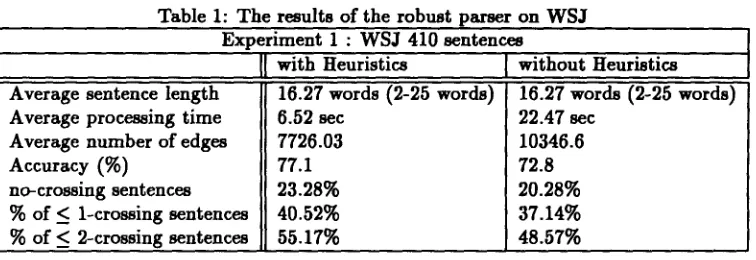
Accuracy is measured as the percentage of con- stituents in the test sentences which do not cross any Penn treebank constituents (Black, 1991). Table 1 shows the results of the robust parser on WSJ. In table 1, 5th, 6th and 7th raw mean that the percentage of sentences which have no crossing constituents, less than one crossing and less than two crossing respectively. With heuris-
tics, our robust parser can enhance the processing time and reduce the number of edges. Also, the accuracy is improved from 72.8% to 77.1% even if the heuristics differentiate edges and prefer some edges. It shows t h a t the proposed heuristics is valid in parsing the real sentences. T h e experi- ment says that our robust parser with heuristics can recover perfectly about 23 sentences out of 100 sentences which axe just failed in normal parsing, as the percentage of no-crossing sentences is a b o u t 23.28%.
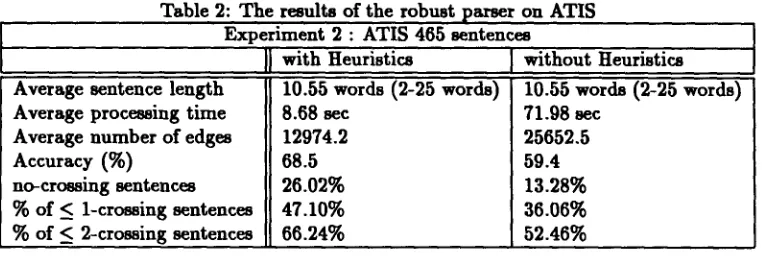
Table 2 is the results of the robust parser on ATIS which we did not refer to before. T h e accu- racy of the result on ATIS is lower t h a n WSJ be- cause the parameters of the heuristics are a~justed not by ATIS itself but by WSJ. However, the percentage of sentences with constituents crossing less than 2 is higher than the WSJ, as sentences of ATIS are more or less simple.
T h e experimental results of our robust parser show high accuracy in recovery even though 96% of total rules are removed. It is impossible to con- struct complete g r a m m a r rules in the real parsing system to succeed in analyzing every real sentence. So, parsing systems are likely to have extragram- matical sentences which cannot be analyzed by the systems. Our robust parser can recover these extragrammatical sentences with 68 ~ 77% accu- racy.
It is very interesting t h a t parameters of heuris- tics reflect the characteristics of the test corpus. For example, if people tend to write sentences with inserted phrases, then the parameter fli,~sert~on must increase. Therefore we can get better results if the parameter are fitted to the characteristics of the corpus.
4
Conclusion
[image:5.596.91.469.71.201.2]Table 2: The results of the robust parser on ATIS Experiment 2 : ATIS 465 sentences
Average sentence length Average processing time Average number of edges Accuracy (%)
no-crossing sentences % of _< 1-crossing sentences % of <_ 2-crossing sentences
with Heuristics without Heuristics
10.55 words (2-25 words) 8.68 sec
12974.2 68.5 26.02% 47.10% 66.24%
10.55 words (2-25 words) 71.98 sec
25652.5 59.4 13.28% 36.06% 52.46%
we proposed several heuristics. The heuristics as- sign the error values to each error-hypothesis edge, and edges which has less error values axe processed first. So, not all the generated edges are processed by the robust parser, but the most plausible parse trees can be generated first. The accuracy of the recovery in our robust parser is about 68% ,,~ 77~. Hence, this parser is suitable for systems in real application areas.
Our short term goal is to propose an automatic method that can learn parameter values of heuris- tics by analyzing the corpus. We expect that au- tomatically leaxned values of parameters can up- grade the performance of the parser.
Acknowledgement
This work was supported(in part) by Korea Science and Engineering Foundation(KOSEF) through Center for Artificial Intelligence Ke- search(CAIR), the Engineering Research Cen- ter(EKC) of Excellence Program.
References
[Black, 1991] E. Black e t a l . A Procedure for quantitatively comparing the syntactic cover-
age of English grammars.
Proceedings of Fourth
DARPA Speech and Natural Language Work-
shop,
pp. 306-311, 1991.[Carbonell and Hayes, 1983] J. G. Carbonell and P. :I. Hayes. Recovery Strategies for Parsing
Extragrsmmatical Language.
American Jour-
nal of Computational Linguistics,
vol. 9, no. 3-4, pp. 123-146, 1983.
[Hayes and C~rbonell, 1981] P. Hayes and J. Car-
bonell. Multi-strategy Construction-Specific
Parsing for Flexible Data Base Query Update.
Proceedings of the 7th International Joint Con-
ference on Artificial Intelligence,
pp. 432-439,1981.
[Hayes and Mouradian, 1981] P. J. Hayes and
G. V. Mouradian. Flexible Parsing.
American
Journal of Computational Linguistics,
vol. 7,no. 4, pp. 232-242, 1981.
[Hendrix, 1977] G. Hendrix. Human Engineer- ing for Applied Natural Language Processing.
Proceedings of the 5th International Joint Con-
ference on Artificial Intelligence,
pp. 183-191,1977.
[Kwasny and Sondheimer, 1981] S. Kwasny and N. Sondheimer. Relaxation Techniques for Parsing Grammatically Ill-Formed Input in Natural Language Understanding Systems.
American Journal of Computational Linguis-
tics,
vol. 7, no. 2, pp. 99-108, 1981.[Lyon, 1974] G. Lyon. Syntax-Directed Least- Errors Analysis for Context-Free Languages.
Communications of the ACM,
vol. 17, no. 1,pp. 3-14, 1974.
[Marcus, 1991] M. P. Marcus. Building very Large natural language corpora : the Penn Treebank, 1991.
[Mellish, 1989] C. S. Mellish. Some Chart-Based
Techniques for Parsing Ill-Formed Input.
Asso-
ciation for Computational Linguistics,
pp. 102-109, 1989.
[Schank e t a l . , 1980] R. C. Schank, M. Lebowitz
and L. Brinbaum. An Intergrated Under-
stander.