2857
Predicting Malware Attributes from Cybersecurity Texts
Arpita Roy1, Youngja Park2, Shimei Pan1 1University of Maryland, Baltimore County
Baltimore, Maryland, USA {arpita2, shimei}@umbc.edu
2IBM T. J. Watson Research Center
Yorktown Heights, New York, USA young [email protected]
Abstract
Text analytics is a useful tool for studying mal-ware behavior and tracking emerging threats. The task of automated malware attribute iden-tification based on cybersecurity texts is very challenging due to a large number of malware attribute labels and a small number of training instances. In this paper, we propose a novel feature learning method to leverage diverse knowledge sources such as small amount of human annotations, unlabeled text and speci-fications about malware attribute labels. Our evaluation has demonstrated the effectiveness of our method over the state-of-the-art mal-ware attribute prediction systems.
1 Introduction
Securing computer systems has become a neces-sity for both organizations and individuals, as many cyber attacks result in devastating conse-quences. An outbreak of the WannaCry ran-somware in 2017 affected more than 200,000 com-puters across 150 countries, with total damages ranging from hundreds of millions to billions of dollars (Berr, 2017). Detection of malware often relies on an understanding of the characteristics of malware behavior. To establish a standard for unambiguously characterizing malware, MAEC (Malware Attribute Enumeration and Characteri-zation), a community-based project organized by MITRE, has specified a set of standard malware attributes (Kirillov et al.,2011). Based on MAEC, the actions of a malware can be categorized by four attributes: ActionName,Capability, Strategi-cObjectives andTacticalObjectives. ActionName
specifies the actions taken by a malware. For example, “delete file” is a malware action that
deletes existing files from affected systems. Capa-bilitydefines the general capabilities of a malware. For example, “anti-removal” is a malware capabil-ity that prevents itself from being removed from a system. StrategicObjectivesand TacticalObjec-tives are subcategories of Capability to capture more details. For example, a malware can have a StrategicObjectiveof “staging data for exfiltra-tion” and aTacticalObjectiveof “moving data to a staging server”. In total, MAEC specified 211
ActionNames, 20Capabilities, 65 StrategicObjec-tives, and 148TacticalObjectives.
The goal of this research is to automatically as-sign malware attribute labels based on cybersecu-rity texts. The task is challenging. The system needs to assign a large number of labels (444 in total). However, it is difficult to obtain sufficient training examples for each label since malware attribute labeling requires extensive cybersecurity knowledge and only domain experts can do this re-liably. Given a large number of possible labels and a small number of training examples, typical su-pervised text classification techniques do not work well. In this work, we focus on incorporating addi-tional knowledge sources to improve feature learn-ing. The main contributions of this work include
1. Develop a novel malware attribute predic-tion system with the state of the art perfor-mance to automatically characterize malware behavior based on cybersecurity text.
3. Since WAE generates embeddings for both words and malware attribute labels, we con-structhigh-quality predicting featuresbased on both types of embeddings.
2 Related Work
Cybersecurity researchers have recently recog-nized the benefits of leveraging information ex-tracted from security documents. Most prior work utilizing NLP for cybersecurity has focused on pri-vacy policy analysis and Android security (Peng et al.,2012;Pandita et al., 2013;Qu et al.,2014; Slavin et al., 2016; Zhu and Dumitras, 2016). These systems aim to map written policies and the actual permission requests from Android applica-tions and assess the risk level of these applicaapplica-tions.
Lim et al.(2017) represents the first major effort to apply NLP techniques for general text-based malware behavior analysis. It processes reports by cybersecurity companies (e.g., FireEye, IBM X-Force, Symantec and Trend Micro) on malware or campaigns associated with Advanced Persistent Threat (APT) groups (Blanda and Westcott,2018) and assign attributes to identified malware actions. They use word unigrams as predicting features. SVM and Naive Bayes are used to build classifiers for attribute label prediction.
To extend this effort, SemEval organized a shared task (called SecureNLP) on semantic anal-ysis for cybersecurity texts. It adopted the same dataset and task definitions as (Lim et al.,2017). There are four subtasks in SemEval SecureNLP: (1) identifying sentences containing malware ac-tions from APT reports; (2) identifying “Mal-ware Action”, “Subject of Action”, “Object of Ac-tion” and “Modifier of AcAc-tion”in the identified sentences; (3) identifying four relations,“Subject-Action”, “Action-Object”, “Modifier-Action” and “Action-Modifier” in identified sentences; (4) as-signing attribute labels to each identified action based on the MAEC specification. Figure1shows an annotated example for these tasks. This paper describes our approach to solve subtask 4. The in-put to our system includes all the sentences iden-tified in subtask 1 with additional labels for the entities identified in subtask 2. Each training and testing instance used in SemEval SecureNLP only contains a single malware action.
Figure 1: Annotated sentence fragment for SemEval shared task.
3 System Overview
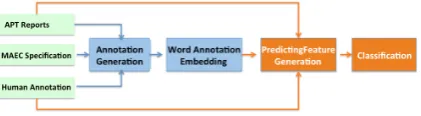
Figure2shows the high-level system architecture. First, we augment all the raw APT reports with an-notations to encode the knowledge from both the training data and MAEC. This allows us to design a unified representation for both types of knowl-edge. The annotated texts are then used by WAE to simultaneously learn embeddings for both words and malware attribute labels. The learned word and attribute label embeddings are then used to construct high qualify prediction features. Finally, we employ supervised machine learning to predict malware attribute labels. We build four classifiers, one for each malware attribute. Each classifier per-formsn+1-way classification, wherenis the num-ber of possible labels for each attribute and 1 is for ‘no value’ when the value of an attribute is not conveyed in the text.
4 Annotation Generation
To annotate text with additional information, the first step is to map each attribute label to a set of keywords based on both MAEC and the human an-notations in the training data.
Identify Keywords from MAEC:Figure3shows a snippet of the MAEC specification. Each mal-ware attribute label in MAEC includes a descrip-tion and a few keywords. The malware acdescrip-tion 004 in Figure3has a name ‘emulate driver’, a descrip-tion ‘specify the defined acdescrip-tion of emulating an existing driver on a system’ and two keywords: ‘driver’ and ‘emulate’. Since the keywords carry the most essential information about a malware
[image:2.595.312.523.684.742.2]Figure 3: A Snippet of the MAEC Specification
tribute label, we link each label with these key-words (e.g., ActionName004: ‘driver’, ‘emulate’).
Identify Keywords from Training Data: Since a malware attribute label in the training data is at the sentence level, to extract keywords for each at-tribute label, we extract all the sentences associ-ated with the same label and consider them one document. To select the most relevant keywords, we only keep those conveying “Malware Action”, “Subject of Action”, or “Object of Action” ( which were identified in subtask 2).
Keywords Ranking:For the same attribute label, we merge the keywords from MAEC and those from the training data to form a single document. We then use TF-IDF scores to select the most in-formative keywords to differentiate these labels. In our experiments, we use the top 25 keywords based on their TF-IDF scores.
Text Annotation GenerationFinally, for all the APT documents, we annotate the text with mal-ware attribute labels. Specifically, for any word in the APT documents, if it is a keyword associated withKdifferent labels, we annotate the word with Kattribute labels.
5 Word Annotation Embedding (WAE)
Similar to word embedding (Mikolov et al.,2013), we want to learn features that capture the semantic relations between words. In addition, to facilitate attribute classification, we want to capture the se-mantic relations between words and their labels. Specifically, we want the words and their attribute labels to be close to each other in the embedding space and the embeddings of different labels to be far away from each other.
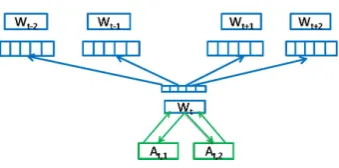
To achieve the goals, we developed a novel Word Annotation Embedding method. As shown in Figure 4, the target word is used to predict not only its context words but also its labels. To further strengthen their relations, the labels of the target word are also used to predict the target word. Specifically, given a sequence of T words (W1,..,Wt,...,WT) and their annotations
((A1,1,...,A1,M1),...,(AT,1,...,AT ,MT)), the
objec-Figure 4: Architecture of WAE Model
tive of the WAE model is to maximize the aver-age log probability shown in Equation1, whereC is the size of the context window,Wtis the target
word, Wt+j is a context word, Mt is number of
annotationsWthas andAt,kis thek-th annotation
ofWt.
1
T T X
t=1
X
−C≤j≤C,j6=0
logP(Wt+j|Wt)
+ X
0≤k≤Mt
(logP(At,k|Wt) + logP(Wt|At,k))
(1)
Label-aware Negative Sampling: Negative sampling (Mikolov et al., 2013) was introduced as an approximation method in word2vec to im-prove the efficiency of model training. Previously, negative samples were selected either randomly or based on popularity. The method, however, is in-sensitive to class labels. Here, we propose a new annotation-aware negative sampling method to (1) keep different annotations apart in the embedding space and (2) to keep words associated with dif-ferent labels apart, in addition to bringing words and their associated labels closer to each other via positive samples. To achieve this, WAE randomly selects (1) a word as a negative sample if it does not share the same annotations as the target word; (2) an attribute label as a negative sample if it is not the same as the labels of the target word.
6 Feature Generation and Classification
We construct six sets of features to train the clas-sifiers.
(S1) W AEW+Sim: Assume the average word
Models ActionName Capability StratObj TactObj
(B1) (Lim et al.,2017) 0.33 0.41 0.27 0.22
(B2) Word2vec 0.40 0.57 0.41 0.36
(B3) Word2vec+Cap NA NA 0.41 0.39
(S1)W AEW+Sim 0.44 0.61 0.43 0.41
(S2)w.W AEW+Sim 0.46 0.62 0.44 0.43
(S3)W AEW+W AEL+Sim 0.45 0.63 0.46 0.43
(S4)w.W AEW+W AEL+Sim 0.45 0.63 0.45 0.43
(s5)W AEW+W AEL+Sim+Cap NA NA 0.47 0.45
(S6)w.W AEW+W AEL+Sim+Cap NA NA 0.47 0.45
[image:4.595.70.528.61.206.2]∆1 :over (Lim et al.,2017) ↑39% (p <0.05) ↑54% (p <0.05) ↑74%(p <0.05) ↑105% (p <0.05) ∆2 :over word2vec ↑15% (p <0.05) ↑11%(p <0.05) ↑15%(p <0.05) ↑25%(p <0.05) ∆3 :over word2vec+Cap NA NA ↑15% (p <0.05) ↑15%(p <0.05)
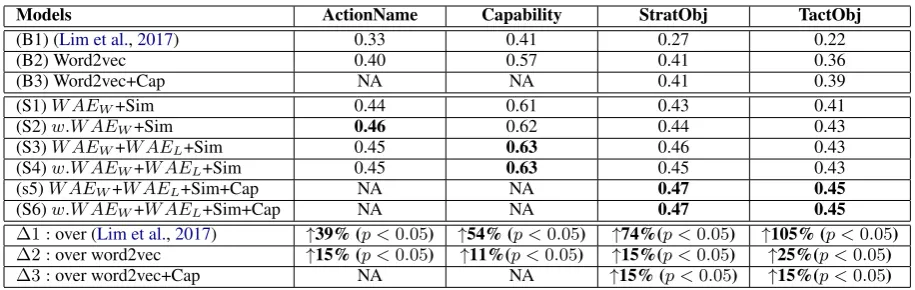
Table 1: Evaluation Results. B1-B3 are the three baselines. S1-S6 are our models with six different sets of predicting features.∆1-∆3are the improvements of our best models over the three baselines.
embedding learned by WAE is LabelEi for each
label i. For each LabelEi, we compute SIMi,
which is the cosine similarity between W Ewae
andLabelEi. W AEW+Simis the concatenation
ofW Ewaeand all theSIMi. For example, to
pre-dictActionName, the model will include 100 word embedding features learned by WAE plus 211 sim-ilarity features, one for eachActionNames.
(S2) w.W AEW+Sim: This feature set is similar
toW AEW+Simexcept when computingW Ewae,
we assign twice as much weight for a word with a label as one without a label. The intuition is words with labels are important keywords based on either MAEC or the training data.
(S3) W AEW+W AEL+Sim: It is similar to
W AEW+Simexcept we also include the average
embeddings of attribute labels associated with the instance.
(S4) w.W AEW+W AEL+Sim: This is the
weighted version of (S3).
(S5) W AEW+W AEL+Sim+Cap: Since the
la-bel of StrategicObjective and TacticalObjective
depends on the label ofCapability, we added the
capabilitylabel in the feature set. We use a 1-hot vector with 20 elements to encode a Capability
label. We use the ground truth and the predicted label ofCapabilityduring training and testing re-spectively.
(S6) w.W AEW+W AEL+Sim+Cap: This is the
weighted version of (S5)
7 Experiments
7.1 Dataset
The dataset used in the experiments was provided as a part of the SemEval shared task. It contains 456 APT reports (Blanda and Westcott,2018), 39
of them were annotated by humans. Among them, 2975 sentences contain malware actions, which are the data instances used in this study. The an-notated data are very sparse. Out of the 444 at-tribute labels, 190 labels do not appear in the la-beled data. For the remaining 254 attribute labels, 92 labels occur less than five times, and 50 labels occur only once. In our experiments, we used the raw text in all the APT reports to train WAE. There are 16423 unique tokens and a total of 2544645 to-kens in the dataset. We trained both word2vec and WAE with context window size 5 and 100 dimen-sion vectors. The 39 annotated documents were divided into a training set (23 documents), a val-idation set (8 documents) and a test set (8 docu-ments). Only the training dataset was used to gen-erate annotations for WAE.
7.2 Evaluation Results
For classification, we tried both SVM and neural network-based models such as multilayer percep-tron. After experimenting with different model pa-rameters, we found that the best SVM model with a linear kernel performed slightly better than the best neural network models. We speculate that this might be because SVM is less likely to overfit when the training data are sparse. Table1 shows the average F-scores over 5 runs by the SVM mod-els on the test data. We compare our modmod-els with three baseline systems: (B1) (Lim et al., 2017), (B2) word2vec and (B3) word2vec + cap. Among them, (B1) represents the best published results on the same dataset. (B2) and (B3) are all the comparable models with embeddings learned by word2vec.
improve-ment over the word2vec model is 15%, 11%, 15% and 25% respectively, and, the improve-ment over (Lim et al., 2017), a previous state of the art, is 39%, 54%, 74% and 105% respec-tively. The improvement overW ord2vec+Cap is 15% and 15% respectively for StrategicObjec-tive andTechnicalObjective. We also conducted t-tests to verify the significance of the improve-ments. The t-test results confirmed that our mod-els significantly outperformed the baseline modmod-els with p<0.05. Moreover, the value of ”Capability” seems to help the prediction ofStrategicObjective
andTechnicalObjective.
8 Conclusion
In this paper, we present a novel method to predict malware attribute labels from cybersecurity text. Given a large number of attribute labels and lim-ited training data, we propose a new feature learn-ing method to incorporate knowledge from diverse knowledge sources such as raw text, MAEC spec-ifications and human annotations. We tested our system using the SemEval shared task data and our evaluation demonstrates that the features learned by our models are much more effective than an existing state of the art as well as embedding fea-tures learned by word2vec. Our investigation has highlighted the importance of incorporating di-verse knowledge sources in complex classification tasks when human annotations are sparse.
References
Jonathan Berr. 2017. ”wannacry” ransomware attack losses could reach $4 billion. CBSNews.
Kiran Blanda and David Westcott. 2018. Aptnotes. https://github.com/aptnotes/.
Ivan Kirillov, Desiree Beck, Penny Chase, and Robert Martin. 2011. Malware attribute enumeration and characterization.
Swee Kiat Lim, Aldrian Obaja Muis, Wei Lu, and Chen Hui Ong. 2017. Malwaretextdb: A database for annotated malware articles. In Proceedings of the 55th Annual Meeting of the Association for Com-putational Linguistics, pages 1557–1567.
Tomas Mikolov, Ilya Sutskever, Kai Chen, Greg S Cor-rado, and Jeff Dean. 2013. Distributed representa-tions of words and phrases and their compositional-ity. InAdvances in neural information processing systems, pages 3111–3119.
Rahul Pandita, Xusheng Xiao, Wei Yang, William Enck, and Tao Xie. 2013. Whyper: Towards au-tomating risk assessment of mobile applications. In
USENIX Security Symposium, volume 2013.
Hao Peng, Chris Gates, Bhaskar Sarma, Ninghui Li, Yuan Qi, Rahul Potharaju, Cristina Nita-Rotaru, and Ian Molloy. 2012. Using probabilistic generative models for ranking risks of android apps. In Pro-ceedings of the 2012 ACM Conference on Computer
and Communications Security, CCS ’12.
Zhengyang Qu, Vaibhav Rastogi, Xinyi Zhang, Yan Chen, Tiantian Zhu, and Zhong Chen. 2014. Au-tocog: Measuring the description-to-permission fi-delity in android applications. InProceedings of the 2014 ACM SIGSAC Conference on Computer and
Communications Security (CCS), pages 1354–1365.
ACM.
Rocky Slavin, Xiaoyin Wang, Mitra Bokaei Hos-seini, James Hester, Ram Krishnan, Jaspreet Bhatia, Travis D Breaux, and Jianwei Niu. 2016. Toward a framework for detecting privacy policy violations in android application code. InProceedings of the 38th
International Conference on Software Engineering,
pages 25–36. ACM.
Ziyun Zhu and Tudor Dumitras. 2016. Featuresmith: Automatically engineering features for malware de-tection by mining the security literature. In Proceed-ings of the 2016 ACM SIGSAC Conference on
Com-puter and Communications Security (CCS), pages