Which Side are You on? Identifying Perspectives at the Document and
Sentence Levels
Wei-Hao Lin
Language Technologies Institute Carnegie Mellon University
Pittsburgh, PA 15213 [email protected]
Theresa Wilson, Janyce Wiebe Intelligent Systems Program
University of Pittsburgh Pittsburgh, PA 15260
{twilson,wiebe}@cs.pitt.edu
Alexander Hauptmann School of Computer Science
Carnegie Mellon University Pittsburgh, PA 15213
Abstract
In this paper we investigate a new problem of identifying the perspective from which a document is written. By perspective we mean a point of view, for example, from the perspective of Democrats or Repub-licans. Can computers learn to identify the perspective of a document? Not every sentence is written strongly from a per-spective. Can computers learn to identify which sentences strongly convey a partic-ular perspective? We develop statistical models to capture how perspectives are expressed at the document and sentence levels, and evaluate the proposed mod-els on articles about the Israeli-Palestinian conflict. The results show that the pro-posed models successfully learn how per-spectives are reflected in word usage and can identify the perspective of a document with high accuracy.
1 Introduction
In this paper we investigate a new problem of au-tomatically identifying the perspective from which a document is written. By perspective we mean a “subjective evaluation of relative significance, a point-of-view.”1 For example, documents about the Palestinian-Israeli conflict may appear to be about the same topic but reveal different perspectives:
1The American Heritage Dictionary of the English
Lan-guage, 4th ed.
(1) The inadvertent killing by Israeli forces of Palestinian civilians – usually in the course of shooting at Palestinian terrorists – is
considered no different at the moral and ethical level than the deliberate targeting of Israeli civilians by Palestinian suicide bombers.
(2) In the first weeks of the Intifada, for example, Palestinian public protests and civilian demonstrations were answered brutally by Israel, which killed tens of unarmed protesters.
Example 1 is written from an Israeli perspective; Example 2 is written from a Palestinian perspec-tive. Anyone knowledgeable about the issues of the Israeli-Palestinian conflict can easily identify the perspectives from which the above examples were written. However, can computers learn to identify the perspective of a document given a training cor-pus?
When an issue is discussed from different per-spectives, not every sentence strongly reflects the perspective of the author. For example, the follow-ing sentences were written by a Palestinian and an Israeli.
(3) The Rhodes agreements of 1949 set them as the ceasefire lines between Israel and the Arab states.
(4) The green line was drawn up at the Rhodes Armistice talks in 1948-49.
system to automatically discriminate between tences that strongly indicate a perspective and sen-tences that only reflect shared background informa-tion?
A system that can automatically identify the per-spective from which a document is written will be a valuable tool for people analyzing huge collec-tions of documents from different perspectives. Po-litical analysts regularly monitor the positions that countries take on international and domestic issues. Media analysts frequently survey broadcast news, newspapers, and weblogs for differing viewpoints. Without the assistance of computers, analysts have no choice but to read each document in order to iden-tify those from a perspective of interest, which is ex-tremely time-consuming. What these analysts need is to find strong statements from different perspec-tives and to ignore statements that reflect little or no perspective.
In this paper we approach the problem of learning individual perspectives in a statistical framework. We develop statistical models to learn how perspec-tives are reflected in word usage, and we treat the problem of identifying perspectives as a classifica-tion task. Although our corpus contains document-level perspective annotations, it lacks sentence-document-level annotations, creating a challenge for learning the perspective of sentences. We propose a novel sta-tistical model to overcome this problem. The ex-perimental results show that the proposed statisti-cal models can successfully identify the perspective from which a document is written with high accu-racy.
2 Related Work
Identifying the perspective from which a document is written is a subtask in the growing area of au-tomatic opinion recognition and extraction. Sub-jective language is used to express opinions, emo-tions, and sentiments. So far, research in automatic opinion recognition has primarily addressed learn-ing subjective language (Wiebe et al., 2004; Riloff et al., 2003), identifying opinionated documents (Yu and Hatzivassiloglou, 2003) and sentences (Yu and Hatzivassiloglou, 2003; Riloff et al., 2003), and dis-criminating between positive and negative language (Pang et al., 2002; Morinaga et al., 2002; Yu and
Hatzivassiloglou, 2003; Turney and Littman, 2003; Dave et al., 2003; Nasukawa and Yi, 2003; Popescu and Etzioni, 2005; Wilson et al., 2005). While by its very nature we expect much of the language that is used when presenting a perspective or point-of-view to be subjective, labeling a document or a sentence as subjective is not enough to identify the perspec-tive from which it is written. Moreover, the ideol-ogy and beliefs authors possess are often expressed in ways other than positive or negative language to-ward specific targets.
Research on the automatic classification of movie or product reviews as positive or negative (e.g., (Pang et al., 2002; Morinaga et al., 2002; Turney and Littman, 2003; Nasukawa and Yi, 2003; Mullen and Collier, 2004; Beineke et al., 2004; Hu and Liu, 2004)) is perhaps the most similar to our work. As with review classification, we treat perspective iden-tification as a document-level classification task, dis-criminating, in a sense, between different types of opinions. However, there is a key difference. A pos-itive or negative opinion toward a particular movie or product is fundamentally different from an overall perspective. One’s opinion will change from movie to movie, whereas one’s perspective can be seen as more static, often underpinned by one’s ideology or beliefs about the world.
There has been research in discourse analysis that examines how different perspectives are expressed in political discourse (van Dijk, 1988; Pan et al., 1999; Geis, 1987). Although their research may have some similar goals, they do not take a compu-tational approach to analyzing large collections of documents. To the best of our knowledge, our ap-proach to automatically identifying perspectives in discourse is unique.
3 Corpus
Our corpus consists of articles published on the
bitterlemonswebsite2. The website is set up to “contribute to mutual understanding [between Pales-tinians and Israelis] through the open exchange of ideas.”3 Every week an issue about the Israeli-Palestinian conflict is selected for discussion (e.g.,
2http://www.bitterlemons.org 3
“Disengagement: unilateral or coordinated?”), and a Palestinian editor and an Israeli editor each con-tribute one article addressing the issue. In addition, the Israeli and Palestinian editors invite one Israeli and one Palestinian to express their views on the issue (sometimes in the form of an interview), re-sulting in a total of four articles in a weekly edi-tion. We choose thebitterlemonswebsite for two reasons. First, each article is already labeled as either Palestinian or Israeli by the editors, allow-ing us to exploit existallow-ing annotations. Second, the
bitterlemonscorpus enables us to test the gen-eralizability of the proposed models in a very real-istic setting: training on articles written by a small number of writers (two editors) and testing on arti-cles from a much larger group of writers (more than 200 different guests).
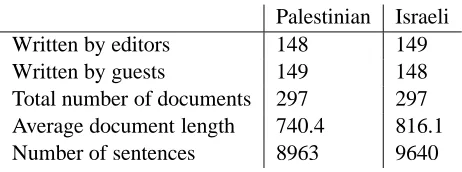
We collected a total of 594 articles published on the website from late 2001 to early 2005. The dis-tribution of documents and sentences are listed in Table 1. We removed metadata from all articles,
in-Palestinian Israeli
Written by editors 148 149
Written by guests 149 148
[image:3.612.72.303.351.437.2]Total number of documents 297 297 Average document length 740.4 816.1 Number of sentences 8963 9640
Table 1: The basic statistics of the corpus
cluding edition numbers, publication dates, topics, titles, author names and biographic information. We used OpenNLP Tools4 to automatically extract sen-tence boundaries, and reduced word variants using the Porter stemming algorithm.
We evaluated the subjectivity of each sentence us-ing the automatic subjective sentence classifier from (Riloff and Wiebe, 2003), and find that 65.6% of Palestinian sentences and 66.2% of Israeli sentences are classified as subjective. The high but almost equivalent percentages of subjective sentences in the two perspectives support our observation in Sec-tion 2 that a perspective is largely expressed using subjective language, but that the amount of subjec-tivity in a document is not necessarily indicative of
4http://sourceforge.net/projects/
opennlp/
its perspective.
4 Statistical Modeling of Perspectives
We develop algorithms for learning perspectives us-ing a statistical framework. Denote a trainus-ing corpus as a set of documentsWnand their perspectives
la-belsDn,n= 1, . . . , N, whereN is the total number
of documents in the corpus. Given a new document
˜
W with a unknown document perspective, the per-spectiveD˜ is calculated based on the following con-ditional probability.
P( ˜D|W ,˜ {Dn, Wn}Nn=1) (5)
We are also interested in how strongly each sen-tence in a document conveys perspective informa-tion. Denote the intensity of the m-th sentence of then-th document as a binary random variableSm,n.
To evaluate Sm,n, how strongly a sentence reflects
a particular perspective, we calculate the following conditional probability.
P(Sm,n|{Dn, Wn}Nn=1) (6)
4.1 Na¨ıve Bayes Model
We model the process of generating documents from a particular perspective as follows:
π ∼ Beta(απ, βπ)
θ ∼ Dirichlet(αθ)
Dn ∼ Binomial(1, π)
Wn ∼ Multinomial(Ln, θd)
First, the parametersπandθare sampled once from prior distributions for the whole corpus. Beta and Dirichlet are chosen because they are conjugate pri-ors for binomial and multinomial distributions, re-spectively. We set the hyperparametersαπ, βπ, and
αθ to one, resulting in non-informative priors. A
document perspectiveDnis then sampled from a
bi-nomial distribution with the parameterπ. The value ofDnis eitherd0(Israeli) ord1(Palestinian). Words
in the document are then sampled from a multino-mial distribution, whereLnis the length of the
π θ
Dn Wn
[image:4.612.140.241.55.145.2]N
Figure 1: Na¨ıve Bayes Model
The model described above is commonly known as a na¨ıve Bayes (NB) model. NB models have been widely used for various classification tasks, including text categorization (Lewis, 1998). The NB model is also a building block for the model described later that incorporates sentence-level per-spective information.
To predict the perspective of an unseen document using na¨ıve Bayes , we calculate the posterior distri-bution ofD˜ in (5) by integrating out the parameters,
Z Z
P( ˜D, π, θ|{(Dn, Wn)}Nn=1,W˜)dπdθ (7)
However, the above integral is difficult to compute. As an alternative, we use Markov Chain Monte Carlo (MCMC) methods to obtain samples from the posterior distribution. Details about MCMC meth-ods can be found in Appendix A.
4.2 Latent Sentence Perspective Model
We introduce a new binary random variable, S, to model how strongly a perspective is reflected at the sentence level. The value of S is either s1 ors0, where s1 indicates a sentence is written strongly from a perspective whiles0 indicates it is not. The whole generative process is modeled as follows:
π ∼ Beta(απ, βπ)
τ ∼ Beta(ατ, βτ)
θ ∼ Dirichlet(αθ)
Dn ∼ Binomial(1, π)
Sm,n ∼ Binomial(1, τ)
Wm,n ∼ Multinomial(Lm,n, θ)
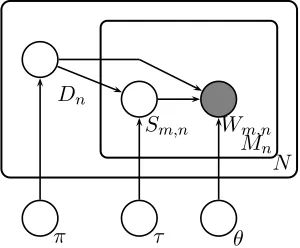
The parametersπandθhave the same semantics as in the na¨ıve Bayes model.Sis naturally modeled as a binomial variable, whereτ is the parameter ofS. Srepresents how likely it is that a sentence strongly conveys a perspective. We call this model the La-tent Sentence Perspective Model (LSPM) becauseS is not directly observed. The graphical model repre-sentation of LSPM is shown in Figure 2.
π τ θ
Dn
Sm,n Wm,n
N Mn
Figure 2: Latent Sentence Perspective Model
To use LSPM to identify the perspective of a new documentD˜with unknown sentence perspectivesS˜, we calculate posterior probabilities by summing out possible combinations of sentence perspective in the document and parameters.
Z Z Z X
Sm,n X
˜
S
P( ˜D, Sm,n,S, π, τ, θ|˜ (8)
{(Dn, Wn)}Nn=1,W˜)dπdτ dθ
As before, we resort to MCMC methods to sample from the posterior distributions, given in Equations (5) and (6).
[image:4.612.357.507.178.302.2]d0
θd0,s0 s0
θd0,s1 s1
d1
θd1,s0 s0
θd0,s0 s1
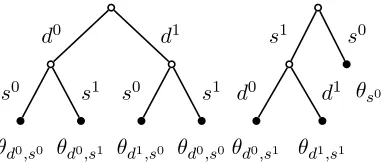
(a)s0ands1are not identifiable s1
θd0,s1 d0
θd1,s1 d1 θs0
s0
(b) sharingθd1,s0and
θd0,s0
Figure 3: Two different parameterization ofθ
due to the explicit modeling of sentence-level per-spective. S may capture aspects of the document collection that we never intended to model. For ex-ample,s0may capture the editors’ writing styles and s1the guests’ writing styles in thebitterlemons
corpus.
We solve the identifiability problem by forcing θd1,s0 and θd0,s0 to be identical and reducing the number ofθparameters to three. As shown in Fig-ure 3b, there are separate θparameters conditioned on the document perspective (left branch of the tree, d0is Israeli andd1is Palestinian), but there is single θparameter whenS=s0shared by both document-level perspectives (right branch of the tree). We as-sume that the sentences with little or no perspective information, i.e., S = s0, are generated indepen-dently of the perspective of a document. In other words, sentences that are presenting common back-ground information or introducing an issue and that do not strongly convey any perspective should look similar whether they are in Palestinian or Israeli doc-uments. By forcing this constraint, we become more confident that s0 represents sentences of little per-spectives ands1 represents sentences of strong per-spectives fromd1andd0 documents.
5 Experiments
5.1 Identifying Perspective at the Document Level
We evaluate three different models for the task of identifying perspective at the document level: two na¨ıve Bayes models (NB) with different infer-ence methods and Support Vector Machines (SVM)
(Cristianini and Shawe-Taylor, 2000). NB-B uses full Bayesian inference and NB-M uses Maximum a posteriori (MAP). We compare NB with SVM not only because SVM has been very effective for clas-sifying topical documents (Joachims, 1998), but also to contrast generative models like NB with discrimi-native models like SVM. For training SVM, we rep-resent each document as a V-dimensional feature vector, whereV is the vocabulary size and each co-ordinate is the normalized term frequency within the document. We use a linear kernel for SVM and search for the best parameters using grid methods.
To evaluate the statistical models, we train them on the documents in the bitterlemonscorpus and calculate how accurately each model predicts document perspective in ten-fold cross-validation experiments. Table 2 reports the average classi-fication accuracy across the the 10 folds for each model. The accuracy of a baseline classifier, which randomly assigns the perspective of a document as Palestinian or Israeli, is 0.5, because there are equiv-alent numbers of documents from the two perspec-tives.
Model Data Set Accuracy Reduction
Baseline 0.5
SVM Editors 0.9724
NB-M Editors 0.9895 61% NB-B Editors 0.9909 67% SVM Guests 0.8621
NB-M Guests 0.8789 12%
[image:5.612.92.283.66.147.2]NB-B Guests 0.8859 17%
Table 2: Results for Identifying Perspectives at the Document Level
The last column of Table 2 is error reduction relative to SVM. The results show that the na¨ıve Bayes models and SVM perform surprisingly well on both the Editors and Guests subsets of the
on NB-M, which only performs point estimation. The results suggest that the choice of words made by the authors, either consciously or subconsciously, reflects much of their political perspectives. Statis-tical models can capture word usage well and can identify the perspective of documents with high ac-curacy.
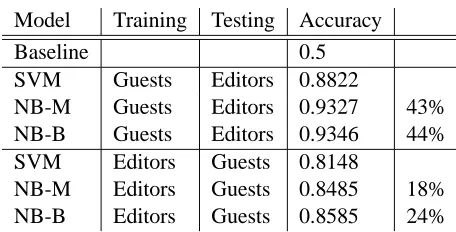
Given the performance gap between Editors and Guests, one may argue that there exist distinct edit-ing artifacts or writedit-ing styles of the editors and guests, and that the statistical models are capturing these things rather than “perspectives.” To test if the statistical models truly are learning perspectives, we conduct experiments in which the training and test-ing data are mismatched, i.e., from different subsets of the corpus. If what the SVM and na¨ıve Bayes models learn are writing styles or editing artifacts, the classification performance under the mismatched conditions will be considerably degraded.
Model Training Testing Accuracy
Baseline 0.5
SVM Guests Editors 0.8822
NB-M Guests Editors 0.9327 43% NB-B Guests Editors 0.9346 44% SVM Editors Guests 0.8148
[image:6.612.71.299.323.439.2]NB-M Editors Guests 0.8485 18% NB-B Editors Guests 0.8585 24%
Table 3: Identifying Document-Level Perspectives with Different Training and Testing Sets
The results on the mismatched training and test-ing experiments are shown in Table 3. Both SVM and the two variants of na¨ıve Bayes perform well on the different combinations of training and testing data. As in Table 2, the na¨ıve Bayes models per-form better than SVM with larger error reductions, and NB-B slightly outperforms NB-M. The high ac-curacy on the mismatched experiments suggests that statistical models are not learning writing styles or editing artifacts. This reaffirms that document per-spective is reflected in the words that are chosen by the writers.
We list the most frequent words (excluding stop-words) learned by the the NB-M model in Ta-ble 4. The frequent words overlap greatly be-tween the Palestinian and Israeli perspectives,
in-cluding “state,” “peace,” “process,” “secure” (“se-curity”), and “govern” (“government”). This is in contrast to what we expect from topical text classi-fication (e.g., “Sports” vs. “Politics”), in which fre-quent words seldom overlap. Authors from differ-ent perspectives often choose words from a simi-lar vocabusimi-lary but emphasize them differently. For example, in documents that are written from the Palestinian perspective, the word “palestinian” is mentioned more frequently than the word “israel.” It is, however, the reverse for documents that are written from the Israeli perspective. Perspectives are also expressed in how frequently certain people (“sharon” v.s. “arafat”), countries (“international” v.s. “america”), and actions (“occupation” v.s. “set-tle”) are mentioned. While one might solicit these contrasting word pairs from domain experts, our re-sults show that statistical models such as SVM and na¨ıve Bayes can automatically acquire them.
5.2 Identifying Perspectives at the Sentence Level
In addition to identifying the perspective of a docu-ment, we are interested in knowing which sentences of the document strongly conveys perspective in-formation. Sentence-level perspective annotations do not exist in thebitterlemonscorpus, which makes estimating parameters for the proposed La-tent Sentence Perspective Model (LSPM) difficult. The posterior probability that a sentence strongly covey a perspective (Example (6)) is of the most in-terest, but we can not directly evaluate this model without gold standard annotations. As an alterna-tive, we evaluate how accurately LSPM predicts the perspective of a document, again using 10-fold cross validation. Although LSPM predicts the perspec-tive of both documents and sentences, we will doubt the quality of the sentence-level predictions if the document-level predictions are incorrect.
Palestinian palestinian, israel, state, politics, peace, international, people, settle, occupation, sharon, right, govern, two, secure, end, conflict, process, side, negotiate
[image:7.612.84.282.155.266.2]Israeli israel, palestinian, state, settle, sharon, peace, arafat, arab, politics, two, process, secure, conflict, lead, america, agree, right, gaza, govern
Table 4: The top twenty most frequent stems learned by the NB-M model, sorted byP(w|d)
Model Training Testing Accuracy
Baseline 0.5
NB-M Guests Editors 0.9327 NB-B Guests Editors 0.9346 LSPM Guests Editors 0.9493 NB-M Editors Guests 0.8485 NB-B Editors Guests 0.8585 LSPM Editors Guests 0.8699
Table 5: Results for Perspective Identification at the Document and Sentence Levels
contain strong perspectives, i.e., largePr( ˜S = s1). Examples 3 and 4 from the introduction were pre-dicted by LSPM as likely to contain little or no per-spective information, i.e., highPr( ˜S=s0).
The comparable performance between the na¨ıve Bayes models and LSPM is in fact surprising. We can train a na¨ıve Bayes model directly on the sen-tences and attempt to classify a sentence as reflect-ing either a Palestinian or Israeli perspective. A sen-tence is correctly classified if the predicted perspec-tive for the sentence is the same as the perspecperspec-tive of the document from which it was extracted. Us-ing this model, we obtain a classification accuracy of only 0.7529, which is much lower than the accuracy previously achieved at the document level. Identify-ing perspectives at the sentence level is thus more difficult than identifying perspectives at the docu-ment level. The high accuracy at the docudocu-ment level shows that LSPM is very effective in pooling evi-dence from sentences that individually contain little perspective information.
6 Conclusions
In this paper we study a new problem of learning to identify the perspective from which a text is written
at the document and sentence levels. We show that much of a document’s perspective is expressed in word usage, and statistical learning algorithms such as SVM and na¨ıve Bayes models can successfully uncover the word patterns that reflect author per-spective with high accuracy. In addition, we develop a novel statistical model to estimate how strongly a sentence conveys perspective, in the absence of sentence-level annotations. By introducing latent variables and sharing parameters, the Latent Sen-tence Perspective Model is shown to capture well how perspectives are reflected at the document and sentence levels. The small but positive improvement due to sentence-level modeling in LSPM is encour-aging. In the future, we plan to investigate how con-sistently LSPM sentence-level predictions are with human annotations.
Acknowledgment
This material is based on work supported by the Advanced Research and Development Activity (ARDA) under contract number NBCHC040037.
A Gibbs Samplers
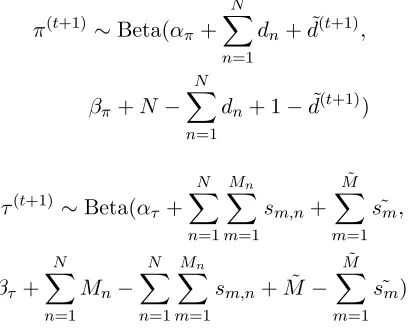
Based the model specification described in Sec-tion 4.2 we derive the Gibbs samplers (Chen et al., 2000) for the Latent Sentence Perspective Model as follows,
π(t+1) ∼Beta(απ+ N
X
n=1
dn+ ˜d(t+1),
βπ+N − N
X
n=1
dn+ 1−d˜(t+1))
τ(t+1) ∼Beta(ατ + N
X
n=1
Mn X
m=1
sm,n+
˜
M
X
m=1 ˜
sm,
βτ + N
X
n=1
Mn− N
X
n=1
Mn X
m=1
sm,n+ ˜M−
˜
M
X
m=1 ˜
[image:7.612.316.521.550.716.2]θ(t+1) ∼Dirichlet(αθ+ N
X
n=1
Mn X
m=1
wm,n)
Pr(Sn,m(t+1)=s1)∝P(Wm,n|Sm,n = 1, θ(t))
Pr(Sm,n(t+1)= 1|τ, Dn)
Pr( ˜D(t+1)=d1)∝
˜
M
Y
m=1
dbinom(τd(t+1))
˜
M
Y
m=1
dmultinom(θd,m˜(t))dbinom(π(t))
where dbinom and dmultinom are the density func-tions of binomial and multinomial distribufunc-tions, re-spectively. The superscripttindicates that a sample is from thet-th iteration. We run three chains and collect 5000 samples. The first half of burn-in sam-ples are discarded.
References
Philip Beineke, Trevor Hastie, and Shivakumar Vaithyanathan. 2004. The sentimental factor: Improving review classification via human-provided information. In Proceedings of ACL-2004.
Ming-Hui Chen, Qi-Man Shao, and Joseph G. Ibrahim. 2000. Monte Carlo Methods in Bayesian
Computa-tion. Springer-Verlag.
Nello Cristianini and John Shawe-Taylor. 2000. An Introduction to Support Vector Machines and Other Kernel-based Learning Methods. Cambridge
Univer-sity Press.
Kushal Dave, Steve Lawrence, and David M. Pennock. 2003. Mining the peanut gallery: Opinion extraction and semantic classification of product reviews. In
Pro-ceedings of WWW-2003.
Michael L. Geis. 1987. The Language of Politics.
Springer.
Minqing Hu and Bing Liu. 2004. Mining and summariz-ing customer reviews. In Proceedsummariz-ings of KDD-2004.
Thorsten Joachims. 1998. Text categorization with sup-port vector machines: Learning with many relevant features. In Proceedings of ECML-1998.
David D. Lewis. 1998. Naive (Bayes) at forty: The inde-pendence assumption in information retrieval. In
Pro-ceedings of ECML-1998.
S. Morinaga, K. Yamanishi, K. Tateishi, and
T. Fukushima. 2002. Mining product reputations on the web. In Proceedings of KDD-2002.
Tony Mullen and Nigel Collier. 2004. Sentiment analy-sis using support vector machines with diverse infor-mation sources. In Proceedings of EMNLP-2004.
T. Nasukawa and J. Yi. 2003. Sentiment analysis: Cap-turing favorability using natural language processing. In Proceedings of K-CAP 2003.
Andrew Y. Ng and Michael Jordan. 2002. On discrim-inative vs. generative classifiers: A comparison of lo-gistic regression and naive bayes. In NIPS-2002, vol-ume 15.
Zhongdang Pan, Chin-Chuan Lee, Joseph Man Chen, and Clement Y.K. So. 1999. One event, three stories: Me-dia narratives of the handover of hong kong in cultural china. Gazette, 61(2):99–112.
Bo Pang, Lillian Lee, and Shivakumar Vaithyanathan. 2002. Thumbs up? Sentiment classification using ma-chine learning techniques. In Proceedings of
EMNLP-2002.
Ana-Maria Popescu and Oren Etzioni. 2005. Extracting product features and opinions from reviews. In
Pro-ceedings of HLT/EMNLP-2005, pages 339–346.
Ellen Riloff and Janyce Wiebe. 2003. Learning extrac-tion patterns for subjective expressions. In
Proceed-ings of EMNLP-2003.
Ellen Riloff, Janyce Wiebe, and Theresa Wilson. 2003. Learning subjective nouns using extraction pattern bootstrapping. In Proceedings of CoNLL-2003.
Peter Turney and Michael L. Littman. 2003. Measuring praise and criticism: Inference of semantic orientation from association. ACM TOIS, 21(4):315–346.
T.A. van Dijk. 1988. News as Discourse. Lawrence Erlbaum, Hillsdale, NJ.
Janyce Wiebe, Theresa Wilson, Rebecca Bruce, Matthew Bell, and Melanie Martin. 2004. Learning subjective language. Computational Linguistics, 30(3).
Theresa Wilson, Janyce Wiebe, and Paul Hoffmann. 2005. Recognizing contextual polarity in phrase-level sentiment analysis. In Proceedings of
HLT/EMNLP-2005.