Effective Information Extraction with Semantic Affinity Patterns and
Relevant Regions
Siddharth Patwardhan and Ellen Riloff
School of Computing University of Utah Salt Lake City, UT 84112
{sidd,riloff}@cs.utah.edu
Abstract
We present an information extraction system that decouples the tasks of finding relevant regions of text and applying extraction pat-terns. We create a self-trained relevant sen-tence classifier to identify relevant regions, and use a semantic affinity measure to au-tomatically learn domain-relevant extraction patterns. We then distinguish primary pat-terns from secondary patpat-terns and apply the patterns selectively in the relevant regions. The resulting IE system achieves good per-formance on the MUC-4 terrorism corpus and ProMed disease outbreak stories. This approach requires only a few seed extraction patterns and a collection of relevant and ir-relevant documents for training.
1 Introduction
Many information extraction (IE) systems rely on rules or patterns to extract words and phrases based on their surrounding context (e.g., (Soderland et al., 1995; Riloff, 1996; Califf and Mooney, 1999; Yan-garber et al., 2000)). For example, a pattern like
“<subject>was assassinated” can reliably identify
a victim of a murder event. Classification-based IE systems (e.g., (Freitag, 1998; Freitag and McCal-lum, 2000; Chieu et al., 2003)) also generally de-cide whether to extract words based on properties of the words themselves as well as properties associ-ated with their surrounding context.
In this research, we propose an alternative ap-proach to IE that decouples the tasks of finding a rel-evant region of text and finding a desired extraction.
In a typical pattern-based IE system, the extraction patterns perform two tasks: (a) they recognize that a relevant incident has occurred, and (b) they iden-tify and extract some information about that event. In contrast, our approach first identifies relevant re-gions of a document that describes relevant events, and then applies extraction patterns only in these rel-evant regions.
This decoupled approach to IE has several po-tential advantages. First, even seemingly good pat-terns can produce false hits due to metaphor and id-iomatic expressions. However, by restricting their use to relevant regions of text, we could avoid such false positives. For example, “John Kerry attacked
George Bush” is a metaphorical description of a
ver-bal tirade, but could be easily mistaken for a physi-cal attack. Second, IE systems are prone to errors of omission when relevant information is not explicitly linked to an event. For instance, a phrase like “the
gun was found...” does not directly state that the the
gun was used in a terrorist attack. But if the gun is mentioned in a region that clearly describes a terror-ist attack, then it can be reasonably inferred to have been used in the attack. Third, if the IE patterns are restricted to areas of text that are known to be rel-evant, then it may suffice to use relatively general patterns, which may be easier to learn or acquire.
Our approach begins with a relevant sentence classifier that is trained using only a few seed pat-terns and a set of relevant and irrelevant documents (but no sentence-level annotations) for the domain of interest. The classifier is then responsible for identi-fying sentences that are relevant to the IE task. Next, we learn “semantically appropriate” extraction
terns by evaluating candidate patterns using a
se-mantic affinity metric. We then separate the
pat-terns into primary and secondary patpat-terns, and ap-ply them selectively to sentences based on the rel-evance judgments produced by the classifier. We evaluate our IE system on two data sets: the MUC-4 IE terrorism corpus and ProMed disease outbreak articles. Our results show that this approach works well, often outperforming the AutoSlog-TS IE sys-tem which benefits from human review.
2 Motivation and Related Work
Our research focuses on event-oriented information extraction (IE), where the goal of the IE system is to extract facts associated with domain-specific events from unstructured text. Many different ap-proaches to information extraction have been devel-oped, but generally speaking they fall into two cate-gories: classifier-based approaches and rule/pattern-based approaches.
Classifier-based IE systems use machine learning techniques to train a classifier that sequentially pro-cesses a document looking for words to be extracted. Examples of classifier-based IE systems are SRV (Freitag, 1998), HMM approaches (Freitag and Mc-Callum, 2000), ALICE (Chieu et al., 2003), and Re-lational Markov Networks (Bunescu and Mooney, 2004). The classifier typically decides whether a word should be extracted by considering features as-sociated with that word as well as features of the words around it.
Another common approach to information ex-traction uses a set of explicit patterns or rules
to find relevant information. Some older
sys-tems relied on hand-crafted patterns, while more recent systems learn them automatically or semi-automatically. Examples of rule/pattern-based ap-proaches to information extraction are FASTUS (Hobbs et al., 1997), PALKA (Kim and Moldovan, 1993), LIEP (Huffman, 1996), CRYSTAL (Soder-land et al., 1995), AutoSlog/AutoSlog-TS (Riloff, 1993; Riloff, 1996), RAPIER (Califf and Mooney, 1999), WHISK (Soderland, 1999), ExDisco (Yan-garber et al., 2000), SNOWBALL (Agichtein and Gravano, 2000), (LP)2 (Ciravegna, 2001), subtree patterns (Sudo et al., 2003), predicate-argument rules (Yakushiji et al., 2006) and KnowItAll
(Popescu et al., 2004).
One commonality behind all of these approaches is that they simultaneously decide whether a context is relevant and whether a word or phrase is a desir-able extraction. Classifier-based systems rely on fea-tures that consider both the word and its surround-ing context, and rule/pattern-based systems typi-cally use patterns or rules that match both the words around a candidate extraction and (sometimes) prop-erties of the candidate extraction itself.
There is a simplicity and elegance to having a sin-gle model that handles both of these problems at the same time, but we hypothesized that there may be benefits to decoupling these tasks. We investigate an alternative approach that involves two passes over a document. In the first pass, we apply a relevant
re-gion identifier to identify rere-gions of the text that
ap-pear to be especially relevant to the domain of inter-est. In the second pass, we apply extraction patterns inside the relevant regions. We hypothesize three possible benefits of this decoupled approach.
First, if a system is certain that a region is rele-vant, then it can be more aggressive about searching for extractions. For example, consider the domain of terrorist event reports, where a goal is to identify the weapons that were used. Existing systems gen-erally require rules/patterns to recognize a context in which a weapon is explicitly linked to an event or its consequences (e.g., “attack with <np>”, or “<np> caused damage”). However, weapons are
not always directly linked to an event in text, but they may be inferred through context. For instance, an article may mention that a weapon was “found” or “used” without explicitly stating that it was in-volved in a terrorist event. However, if we know in advance that we are in a relevant context, then we can reliably infer that the weapon was, most likely, used in the event.
Second, some patterns may seem to be relevant locally, but they can be deemed irrelevant when the global context is considered. For example, consider these sentences from the MUC-4 terrorism corpus:
D’Aubuisson unleashed harsh attacks on Duarte ...
Other brave minds that advocated reform had been killed before in that struggle.
attacks” and “<subject> had been killed” seem
likely to identify the perpetrators and victims of a physical attack. But when read in the full context of these sentences, it becomes clear that they are not related to a specific physical attack.
Third, decoupling these tasks may simplify the
learning process. Identifying relevant regions
amounts to a text classification task, albeit the goal is to identify not just relevant documents, but relevant sub-regions of documents. Within a relevant region the patterns may not need to be as discriminating. So a more general learning approach may suffice.
In this paper, we describe an IE system that con-sists of two decoupled modules for relevant sentence identification and extraction pattern learning. In Section 3, we describe the self-trained sentence clas-sifier, which requires only a few seed patterns and relevant and irrelevant documents for training. Sec-tion 4 describes the extracSec-tion pattern learning mod-ule, which identifies semantically appropriate pat-terns for the IE system using a semantic affinity mea-sure. Section 5 explains how we distinguish Primary patterns from Secondary patterns. Section 6 presents experimental results on two domains. Finally, Sec-tion 7 lists our conclusions and future work.
3 A Self-Trained Relevant Sentence Classifier
Our hypothesis is that if a system can reliably iden-tify relevant regions of text, then extracting informa-tion only from these relevant regions can improve IE performance. There are many possible definitions for relevant region (e.g., Salton et al. (1993), Callan (1994)), and exploring the range of possibilities is an interesting avenue for future work. For our ini-tial investigations of this idea, we begin by simply defining a sentence as our region size. This has the advantage of being an easy boundary line to draw (i.e., it is relatively easy to identify sentence bound-aries) and it is a small region size yet includes more context than most current IE systems do1.
Our goal is to create a classifier that can determine whether a sentence contains information that should be extracted. Furthermore, we wanted to create a classifier that does not depend on manually
anno-1
Most IE systems only consider a context window consisting of a few words or phrases on either side of a potential extraction.
tated sentence data so that our system can be eas-ily ported across domains. Therefore, we devised a method to self-train a classifier using a training set of relevant and irrelevant documents for the domain, and a few seed patterns as input. However, this re-sults in an asymmetry in the training set. By defini-tion, if a document is irrelevant to the IE task, then it cannot contain any relevant information. Con-sequently, all sentences in an irrelevant document
must be irrelevant, so these sentences form our
ini-tial irrelevant sentences pool. In contrast, if a doc-ument is relevant to the IE task, then there must be at least one sentence that contains relevant informa-tion. However, most documents contain a mix of both relevant and irrelevant sentences. Therefore, the sentences from the relevant documents form our
unlabeled sentences pool.
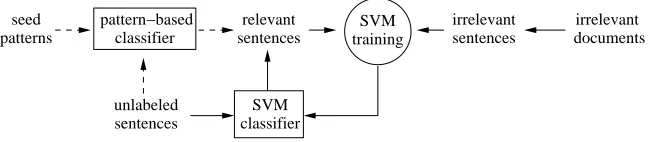
Figure 1 shows the self-training procedure, which begins with a handful of seed patterns to initiate the learning process. The seed patterns should be able to reliably identify some information that is relevant to the IE task. For instance, to build an IE system for terrorist incident reports, we used seed patterns such as “<subject>was kidnapped” and “assassination of<np>”. The patterns serve as a simple
pattern-based classifier to automatically identify some rel-evant sentences. In iteration 0 of the self-training loop (shown as dotted lines in Figure 1), the pattern-based classifier is applied to the unlabeled sentences to automatically label some of them as relevant.
Next, an SVM (Vapnik, 1995) classifier2 is
trained using these relevant sentences and an equal number of irrelevant sentences randomly drawn from the irrelevant sentences pool. We artificially created a balanced training set because the set of ir-relevant sentences is initially much larger than the set of relevant sentences, and we want the classi-fier to learn how to identify new relevant sentences. The feature set consists of all unigrams that appear in the training set. The SVM is trained using a lin-ear kernel with the default parameter settings. In a self-training loop, the classifier is then applied to the unlabeled sentences, and all sentences that it classi-fies as relevant are added to the relevant sentences pool. The classifier is then retrained with all of the
2
pattern−based classifier
relevant sentences seed
patterns
SVM classifier unlabeled
sentences
SVM training
irrelevant sentences
[image:4.612.144.469.62.133.2]irrelevant documents
Figure 1: The Training Process to Create a Relevant Sentence Classifier
relevant sentences and an equal number of irrelevant sentences, and the process repeats. We ran this self-training procedure for three iterations and then used the resulting classifier as our relevant sentence
clas-sifier in the IE experiments described in Section 6.3.
4 Learning Semantic Affinity-based Extraction Patterns
One motivation for creating a relevant region classi-fier is to reduce the responsibilities of the extraction patterns. Once we know that we are in a domain-relevant area of text, patterns that simply identify words and phrases belonging to a relevant seman-tic class may be sufficient. In this section, we de-scribe a method to automatically identify semanti-cally appropriate extraction patterns for use with the sentence classifier.
In previous work (Patwardhan and Riloff, 2006), we introduced a metric called semantic affinity which was used to automatically assign event roles to extraction patterns. Semantic affinity measures the tendency of a pattern to extract noun phrases that belong to a specific set of semantic categories. To use this metric for information extraction, a mapping must be defined between semantic cate-gories and the event roles that are relevant to the IE task. For example, one role in the terrorism do-main is physical target, which refers to physical ob-jects that are the target of an attack. Most phys-ical targets fall into one of two general semantic categories: BUILDINGor VEHICLE. Consequently, we define the mapping “Target → BUILDING, VE -HICLE”. Similarly, we might define the mapping
“Victim → HUMAN, ANIMAL, PLANT” to
charac-terize possible victims of disease outbreaks. Each semantic category must be mapped to a single event role. This is a limitation of our approach for do-mains where multiple roles can be filled by the same class of fillers. However, sometimes a general
se-mantic class can be partitioned into subclasses that are associated with different roles. For example, in the terrorism domain, both perpetrators and victims belong to the general semantic classHUMAN. But we used the subclassesTERRORIST-HUMAN, which represents likely perpetrator words (e.g., “terrorist”, “guerrilla”, and “gunman”) andCIVILIAN-HUMAN, which represents ordinary people (e.g., “photogra-pher”,“rancher”, and “tourist”), in order to generate different semantic affinity estimates for the perpetra-tor and victim roles.
To determine the semantic category of a noun, we use the Sundance parser (Riloff and Phillips, 2004), which contains a dictionary of words that have se-mantic category labels. Alternatively, a resource such as WordNet (Fellbaum, 1998) could be used to obtain this information. All semantic categories that cannot be mapped to a relevant event role are mapped to a special Other role.
To estimate the semantic affinity of a pattern p
for an event rolerk, the system computes f(p, rk),
which is the number of pattern p’s extractions that have a head noun belonging to a semantic category mapped tork. These frequency counts are obtained
by applying each pattern to the training corpus and collecting its extractions. The semantic affinity of a patternpwith respect to an event rolerkis formally
defined as:
sem aff(p, rk) =
f(p, rk) P|R|
i=1f(p, ri)
log2f(p, rk) (1)
whereRis the set of event roles{r1, r2, . . . , r|R|}.
Semantic affinity is essentially the probability that a phrase extracted by pattern p will be a semanti-cally appropriate filler for rolerk, weighted by the
log of the frequency.3 Note that it is possible for a
3
pattern to have a semantic affinity for multiple event roles. For instance, a terrorism pattern like “attack
on <np>” may have a semantic affinity for both
Targets and Victims.
To generate extraction patterns for an IE task, we first apply the AutoSlog (Riloff, 1993) extraction pattern generator to the training corpus exhaustively, so that it literally generates a pattern to extract every noun phrase in the corpus. Then for each event role, we rank the patterns based on their semantic affinity for that role.
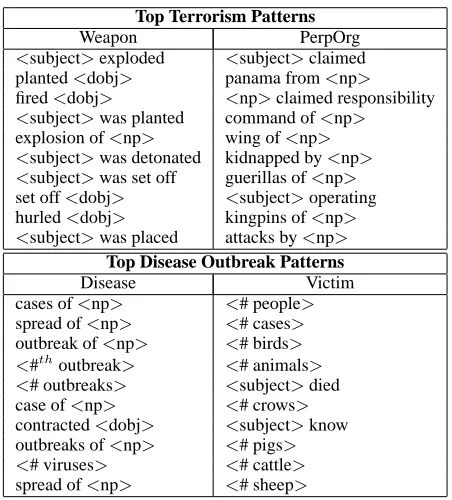
Figure 2 shows the 10 patterns with the highest se-mantic affinity scores for 4 event roles. In the terror-ism domain, we show patterns that extract weapons and perpetrator organizations (PerpOrg). In the dis-ease outbreaks domain, we show patterns that ex-tract diseases and victims. The patterns rely on shal-low parsing, syntactic role assignment (e.g., subject (subject) and direct object (dobj) identification), and active/passive voice recognition, but they are shown here in a simplified form for readability. The por-tion in brackets (between<and>) is extracted, and the other words must match the surrounding con-text. In some cases, all of the matched words are extracted (e.g., “<# birds>”). Most of the highest-ranked victim patterns recognize noun phrases that refer to people or animals because they are common in the disease outbreak stories and these patterns do not extract information that is associated with any competing event roles.
5 Distinguishing Primary and Secondary Patterns
So far, our goal has been to find relevant areas of text, and then apply semantically appropriate
patterns in those regions. Our expectation was
that fairly general, semantically appropriate patterns could be effective if their range is restricted to re-gions that are known to be relevant. If our relevant sentence classifier was perfect, then performing IE only on relevant regions would be ideal. However, identifying relevant regions is a difficult problem in its own right, and our relevant sentence classifier is far from perfect.
Consequently, one limitation of our proposed ap-proach is that no IE would be performed in sentences that are not deemed to be relevant by the classifier,
Top Terrorism Patterns
Weapon PerpOrg
<subject>exploded <subject>claimed planted<dobj> panama from<np>
fired<dobj> <np>claimed responsibility
<subject>was planted command of<np>
explosion of<np> wing of<np> <subject>was detonated kidnapped by<np> <subject>was set off guerillas of<np>
set off<dobj> <subject>operating
hurled<dobj> kingpins of<np> <subject>was placed attacks by<np>
Top Disease Outbreak Patterns
Disease Victim
cases of<np> <# people>
spread of<np> <# cases>
outbreak of<np> <# birds> <#thoutbreak> <# animals>
<# outbreaks> <subject>died case of<np> <# crows>
contracted<dobj> <subject>know outbreaks of<np> <# pigs> <# viruses> <# cattle>
[image:5.612.314.540.57.307.2]spread of<np> <# sheep>
Figure 2: Top-Ranked Extraction Patterns
and this could negatively affect recall. We addressed this issue by allowing reliable patterns to be applied to all sentences in the text, irrespective of the output of the sentence classifier. For example, the pattern
“<subject>was assassinated” is a clear indicator
of a murder event, and does not need to be restricted by the sentence classifier4. We will refer to such reliable patterns as Primary Patterns. In contrast, patterns that are not necessarily reliable and need to be restricted to relevant regions will be called
Sec-ondary Patterns.
To automatically distinguish Primary Patterns from Secondary Patterns, we compute the condi-tional probability of a pattern p being relevant,
Pr(relevant |p), based on the relevant and irrele-vant documents in our training set. We then define an upper conditional probability thresholdθuto
sep-arate Primary patterns from Secondary Patterns. If a pattern has a high correlation with relevant docu-ments, then our assumption is that it is generally a reliable pattern that is not likely to occur in irrele-vant contexts.
On the flip side, we can also use this condi-tional probability to weed out patterns that rarely
4
appear in relevant documents. Such patterns (e.g.,
“<subject> held”, “<subject> saw”, etc.) could
potentially have a high semantic affinity for one of the semantic categories, but they are not likely to be useful if they mainly occur in irrelevant documents. As a result, we also define a lower conditional proba-bility thresholdθlthat identifies irrelevant extraction
patterns.
The two thresholdsθuandθlare used with
seman-tic affinity to identify the most appropriate Primary and Secondary patterns for the task. This is done by first removing from our extraction pattern collection all patterns with probability less than θl. For each
event role, we then sort the remaining patterns based on their semantic affinity score for that role and se-lect the top N patterns. Next, we use theθu
prob-ability threshold to separate these N patterns into two subsets. Patterns with a probability above θu
are considered to be Primary patterns for that role, and those below become the Secondary patterns.
6 Experiments and Results
6.1 Data Sets
We evaluated the performance of our IE system on two data sets: the MUC-4 terrorism corpus (Sund-heim, 1992), and a ProMed disease outbreaks cor-pus. The MUC-4 IE task is to extract information about Latin American terrorist events. We focused our analysis on five MUC-4 string roles: perpetrator
individuals, perpetrator organizations, physical tar-gets, victims, and weapons. The disease outbreaks
corpus consists of electronic reports about disease outbreak events. For this domain we focused on two string roles: diseases and victims5.
The MUC-4 data set consists of 1700 documents, divided into 1300 development (DEV) texts, and four test sets of 100 texts each (TST1, TST2, TST3, and TST4). We used 1300 texts (DEV) as our train-ing set, 200 texts (TST1+TST2) for tuntrain-ing, and 200 texts (TST3+TST4) as a test set. All 1700 docu-ments have answer key templates. For the training set, we used the answer keys to separate the doc-uments into relevant and irrelevant subsets. Any document containing at least one relevant event was considered relevant.
5
The “victims” can be people, animals, or plants that are affected by a disease.
For the disease outbreak domain the data set was collected from ProMed-mail6, an open-source, global electronic reporting system for outbreaks of infectious diseases. We collected thousands of ProMed reports and created answer key templates for 245 randomly selected articles. We used 125 as a tuning set, and 120 as the test set. We used 2000 different documents as the relevant documents for training. Most of the ProMed articles contain email headers, footers, citations, and other snippets of non-narrative text, so we wrote a “zoner” program7 to
automatically strip off some of this extraneous in-formation.
To obtain irrelevant documents, we collected 4000 biomedical abstracts from PubMed8, a free archive of biomedical literature. We collected twice as many irrelevant documents because the PubMed articles are roughly half the size of the ProMed arti-cles, on average. To ensure that the PubMed articles were truly irrelevant (i.e. did not contain any disease outbreak reports) we used specific queries to exclude disease outbreak abstracts.
The complete IE task involves the creation of answer key templates, one template per incident9. Template generation is a complex process, requir-ing coreference resolution and discourse analysis to determine how many incidents were reported and which facts belong with each incident. Our work fo-cuses on extraction pattern learning and not template generation, so we evaluated our systems directly on the extractions themselves, before template genera-tion would take place. This approach directly mea-sures how accurately the patterns find relevant infor-mation, without confounding factors from the tem-plate generation process. For example, if a coref-erence resolver incorrectly decides that two extrac-tions are coreferent and merges them, then only one extraction would be scored. We used a head noun scoring scheme, where an extraction is considered to be correct if its head noun matches the head noun in the answer key10. Also, pronouns were discarded from both the system responses and the answer keys since no coreference resolution is done. Duplicate
6
http://www.promedmail.org
7
The term zoner was introduced by Yangarber et al. (2002).
8http://www.pubmedcentral.nih.gov
9Many of the stories have multiple incidents per article. 10
extractions (e.g., the same string extracted by differ-ent patterns) were conflated before being scored, so they count as just one hit or one miss.
6.2 Relevant Sentence Classifier Results
First, we evaluated the performance of the relevant sentence classifier described in Section 3. We auto-matically generated seed patterns from the training texts. AutoSlog (Riloff, 1993) was used to gener-ate all extraction patterns that appear in the train-ing documents, and only those patterns with fre-quency > 50 were kept. These were then ranked by Pr(relevant | p), and the top 20 patterns were chosen as seeds. In the disease outbreak domain, 54 patterns had a frequency>50 and probability of 1.0. We wanted to use the same number of seeds in both domains for consistency, so we manually reviewed them and used the 20 most domain-specific patterns as seeds.
Due to the greater stylistic differences between the relevant and irrelevant documents in the disease outbreak domain (since they were gathered from dif-ferent sources), we decided to make the classifier for that domain more conservative in classifying docu-ments as relevant. To do this we used the prediction scores output by the SVM as a measure of confi-dence in the classification. These scores are essen-tially the distance of the test examples from the sup-port vectors of the SVM. For the disease outbreaks domain we used a cutoff of 1.0 and in the terrorism domain we used the default of 0.
Since we do not have sentence annotated data, there is no direct way to evaluate the classifiers. However, we did an indirect evaluation by using the answer keys from the tuning set. If a sentence in a tuning document contained a string that occurred in the corresponding answer key template, then we considered that sentence to be relevant. Otherwise, the sentence was deemed irrelevant. This evaluation is not perfect for two reasons: (1) answer key strings do not always appear in relevant sentences.11, and
(2) some arguably relevant sentences may not con-tain an answer key string (e.g., they may concon-tain a pronoun that refers to the answer, but the pronoun it-self is not the desired extraction). However, judging
11
This happens due to coreference, e.g., when multiple oc-currences of an answer appear in a document, some of them may occur in relevant sentences while others do not.
Irrelevant Relevant Acc Rec Pr F Rec Pr F
Terrorism
Iter #1 .84 .93 .89 .91 .41 .55 .47 Iter #2 .84 .90 .91 .90 .54 .51 .53 Iter #3 .82 .85 .92 .89 .63 .46 .53
Disease Outbreaks
[image:7.612.322.532.59.164.2]Iter #1 .75 .96 .76 .85 .21 .66 .32 Iter #2 .71 .76 .82 .79 .58 .48 .53 Iter #3 .63 .60 .85 .70 .72 .41 .52
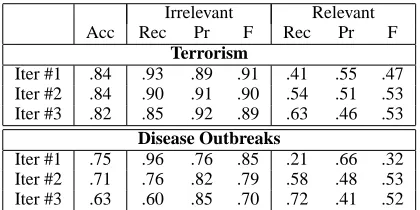
Table 1: Relevant Sentence Classifier Evaluation
the relevance of sentences without relying on answer keys is also tricky, so we decided that this approach was probably good enough to get a reasonable as-sessment of the classifier. Using this criterion, 17% of the sentences in the terrorism articles are relevant, and 28% of the sentences in the disease outbreaks articles are relevant.
Table 1 shows the accuracy, recall, precision, and F scores of the SVM classifiers after each self-training iteration. The classifiers generated after the third iteration were used in our IE experiments. The final accuracy is 82% in the terrorism domain, and 63% for the disease outbreaks domain. The preci-sion on irrelevant sentences is high in both domains, but the precision on relevant sentences is relatively weak. Despite this, we will show in Section 6.3 that the classifier is effective for the IE task. The rea-son why the classifier improves IE performance is because it favorably alters the proportion of relevant sentences that are passed along to the IE system. For example, an analysis of the tuning set shows that re-moving the sentences deemed to be irrelevant by the classifier increases the proportion of relevant sen-tences from 17% to 46% in the terrorism domain, and from 28% to 41% in the disease outbreaks do-main.
We will also see in Section 6.3 that IE recall only drops a little when the sentence classifier is used, despite the fact that its recall on relevant sentences is only 63% in terrorism and 72% for disease out-breaks. One possible explanation is that the an-swer keys often contain multiple acceptable anan-swer strings (e.g., “John Kennedy” and “JFK” might both
be acceptable answers). On average, the answer
do-Terrorism
Patterns App Rec Pr F Rec Pr F PerpInd PerpOrg ASlogTS All .49 .35 .41 .33 .49 .40 ASlogTS Rel .41 .50 .45 .27 .58 .37
Target Victim ASlogTS All .64 .42 .51 .52 .48 .50 ASlogTS Rel .57 .49 .53 .48 .54 .51
Weapon ASlogTS All .45 .39 .42 ASlogTS Rel .40 .51 .45 Disease Outbreaks
[image:8.612.77.295.58.215.2]Disease Victim ASlogTS All .51 .27 .36 .48 .35 .41 ASlogTS Rel .46 .31 .37 .44 .38 .41
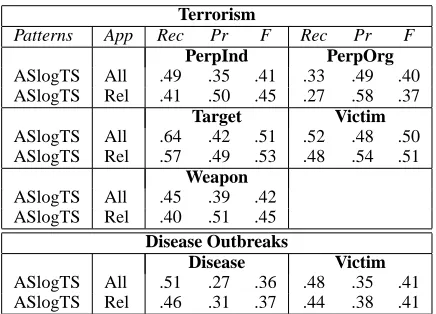
Table 2: AutoSlog-TS Results
main. Thus, even if the sentence classifier discards some relevant sentences, an equally acceptable an-swer may be found in a different sentence.
6.3 Information Extraction Results
We first conducted two experiments with an exist-ing IE pattern learner, AutoSlog-TS (Riloff, 1996) to give us a baseline against which to compare our results. The “All” rows in Table 2 show these results, where “All” means that the IE patterns were applied to all of the sentences in the test set. AutoSlog-TS12 produced F scores between 40-51% on the MUC-4 test set, and 36-41% on the ProMed test set. The terrorism scores are competitive with the MUC-4 scores reported by Chieu et al. (2003), although they are not directly comparable because those scores are based on template generation. Since we created the ProMed test set ourselves, we are the first to report results on it13.
Next, we evaluated the performance of AutoSlog-TS’ extraction patterns when they are applied only in the sentences deemed to be relevant by our relevant sentence classifier. The purpose of this experiment was to determine whether the relevant sentence clas-sifier can be beneficial when used with IE patterns known to be of good quality. The “Rel” rows in
Ta-12
AutoSlog-TS was trained on a much larger data set of 4,958 ProMed and 10,191 PubMed documents for the disease out-breaks domain. AutoSlog-TS requires a human review of the top-ranked patterns, which resulted in 396 patterns for the ter-rorism domain and 125 patterns for the disease outbreaks do-main.
13
Some previous work has been done with ProMed articles (Grishman et al., 2002a; Grishman et al., 2002b), but we are not aware of any IE evaluations on them.
Disease Victim Patterns App Rec Pr F Rec Pr F ASlogTS All .51 .27 .36 .48 .35 .41 SA-50 All .51 .25 .34 .47 .41 .44 SA-50 Rel .49 .31 .38 .44 .43 .43 SA-50 Sel .50 .29 .36 .46 .41 .44 SA-100 All .57 .22 .32 .52 .33 .40 SA-100 Rel .55 .28 .37 .49 .36 .41 SA-100 Sel .56 .26 .35 .51 .34 .41 SA-150 All .66 .20 .31 .55 .27 .37 SA-150 Rel .61 .26 .36 .51 .31 .38 SA-150 Sel .63 .24 .35 .53 .29 .37 SA-200 All .68 .19 .30 .56 .26 .36 SA-200 Rel .63 .25 .35 .52 .30 .38 SA-200 Sel .65 .23 .34 .54 .28 .37
Table 3: ProMed Disease Outbreak Results
ble 2 show the scores for this experiment. Precision increased substantially on all 7 roles, although with some recall loss. This shows that a sentence classi-fier that has a high precision on irrelevant sentences but only a moderate precision on relevant sentences can be useful for information extraction.
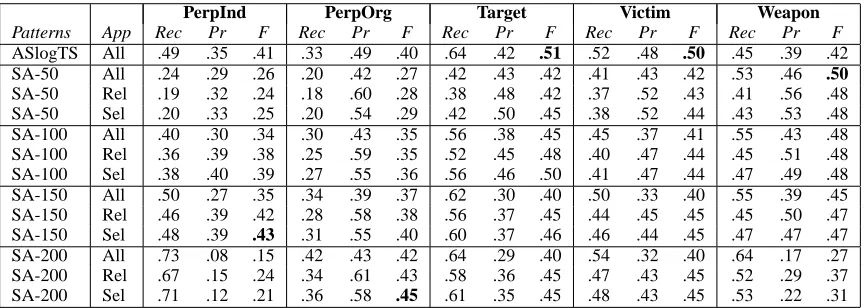
Tables 3 and 4 show the results of our IE system, which uses the topN Semantic Affinity (SA) pat-terns and the relevant sentence classifier. We also show the AutoSlog-TS results again in the top row for comparison. The best F score for each role is shown in boldface. We used a lower probability threshold θl of 0.5 to filter out irrelevant patterns.
We then ranked the remaining patterns based on se-mantic affinity, and evaluated the performance of the top 50, 100, 150, and 200 patterns. The App column indicates how the patterns were applied: for All they were applied in all sentences in the test set, for Rel they were applied only in the relevant sentences (as judged by our sentence classifier). For the Sel con-dition, the Primary patterns were applied in all sen-tences but the Secondary patterns were applied only in relevant sentences. To separate Primary and Sec-ondary patterns we used an upper probability thresh-oldθu of 0.8.
[image:8.612.319.536.59.212.2]PerpInd PerpOrg Target Victim Weapon Patterns App Rec Pr F Rec Pr F Rec Pr F Rec Pr F Rec Pr F ASlogTS All .49 .35 .41 .33 .49 .40 .64 .42 .51 .52 .48 .50 .45 .39 .42 SA-50 All .24 .29 .26 .20 .42 .27 .42 .43 .42 .41 .43 .42 .53 .46 .50 SA-50 Rel .19 .32 .24 .18 .60 .28 .38 .48 .42 .37 .52 .43 .41 .56 .48 SA-50 Sel .20 .33 .25 .20 .54 .29 .42 .50 .45 .38 .52 .44 .43 .53 .48 SA-100 All .40 .30 .34 .30 .43 .35 .56 .38 .45 .45 .37 .41 .55 .43 .48 SA-100 Rel .36 .39 .38 .25 .59 .35 .52 .45 .48 .40 .47 .44 .45 .51 .48 SA-100 Sel .38 .40 .39 .27 .55 .36 .56 .46 .50 .41 .47 .44 .47 .49 .48 SA-150 All .50 .27 .35 .34 .39 .37 .62 .30 .40 .50 .33 .40 .55 .39 .45 SA-150 Rel .46 .39 .42 .28 .58 .38 .56 .37 .45 .44 .45 .45 .45 .50 .47 SA-150 Sel .48 .39 .43 .31 .55 .40 .60 .37 .46 .46 .44 .45 .47 .47 .47 SA-200 All .73 .08 .15 .42 .43 .42 .64 .29 .40 .54 .32 .40 .64 .17 .27 SA-200 Rel .67 .15 .24 .34 .61 .43 .58 .36 .45 .47 .43 .45 .52 .29 .37 SA-200 Sel .71 .12 .21 .36 .58 .45 .61 .35 .45 .48 .43 .45 .53 .22 .31
Table 4: MUC-4 Terrorism Results
Next, we can compare each All row with the Rel row immediately below it. We observe that in every case precision improves, often dramatically. This demonstrates that our sentence classifier is having the desired effect. However, observe that the preci-sion gain comes with some loss in recall points.
Clearly, this drop in recall is due to the answers embedded inside relevant sentences incorrectly clas-sified as irrelevant. To counter this, we apply the Pri-mary patterns to all the sentences. Thus, if we com-pare each Rel row with the Sel row immediately be-low it, we see the effect of loosening the reins on the Primary patterns (the Secondary patterns are still re-stricted to the relevant sentences). In most cases, the recall improves with a relatively small drop in preci-sion, or no drop at all. In the terrorism domain, the highest F score for four of the five roles occurs under the Sel condition. In the disease outbreaks domain, the best F score for diseases occurs in the Rel con-dition, while the best score for victims is achieved under both the All and the Sel conditions.
Finally, we note that the best F scores produced by our information extraction system are higher than those produced by AutoSlog-TS for all of the roles except Targets and Victims, and our best perfor-mance on Targets is only slightly lower. These re-sults are particularly noteworthy because AutoSlog-TS requires a human to manually review the patterns and assign event roles to them. In contrast, our ap-proach is fully automated.
These results validate our hypothesis that decou-pling the processes of finding relevant regions and applying semantically appropriate patterns can
cre-ate an effective IE system.
7 Conclusions
In this work, we described an information extraction system based on a relevant sentence classifier and extraction patterns learned using a semantic
affin-ity metric. The sentence classifier was self-trained
using only relevant and irrelevant documents plus a handful of seed extraction patterns. We showed that separating the task of relevant region identification from that of pattern extraction can be effective for in-formation extraction. In addition, we observed that the use of a relevant sentence classifier is beneficial for an IE system.
There are several avenues that need to be explored for future work. First, it would be interesting to see if the use of richer features can improve classifier performance, and if that in turn improves the perfor-mance of the IE system. We would also like to ex-periment with different region sizes and study their effect on information extraction. Finally, other tech-niques for learning semantically appropriate extrac-tion patterns could be investigated.
Acknowledgments
References
E. Agichtein and L. Gravano. 2000. Snowball: Extract-ing Relations from Large Plain-Text Collections. In Proceedings of the Fifth ACM Conference on Digital Libraries, pages 85–94, San Antonio, TX, June.
R. Bunescu and R. Mooney. 2004. Collective Informa-tion ExtracInforma-tion with RelaInforma-tional Markov Networks. In Proceeding of the 42nd Annual Meeting of the Associ-ation for ComputAssoci-ational Linguistics, pages 438–445, Barcelona, Spain, July.
M. Califf and R. Mooney. 1999. Relational Learning of Pattern-matching Rules for Information Extraction. In Proceedings of the Sixteenth National Conference on Artificial Intelligence, pages 328–334, Orlando, FL, July.
J. Callan. 1994. Passage-Level Evidence in Document Retrieval. In Proceedings of the 17th Annual Interna-tional ACM SIGIR Conference on Research and De-velopment in Information Retrieval, pages 302–310, Dublin, Ireland, July.
H. Chieu, H. Ng, and Y. Lee. 2003. Closing the Gap: Learning-Based Information Extraction Rivaling Knowledge-Engineering Methods. In Proceedings of the 41st Annual Meeting of the Association for Compu-tational Linguistics, pages 216–223, Sapporo, Japan, July.
F. Ciravegna. 2001. Adaptive Information Extraction from Text by Rule Induction and Generalisation. In Proceedings of Seventeenth International Joint Con-ference on Artificial Intelligence, pages 1251–1256, Seattle, WA, August.
C. Fellbaum, editor. 1998. WordNet: An electronic lexi-cal database. MIT Press.
D. Freitag and A. McCallum. 2000. Information Ex-traction with HMM Structures Learned by Stochas-tic Optimization. In Proceedings of the Seventeenth National Conference on Artificial Intelligence, pages 584–589, Austin, TX, August.
D. Freitag. 1998. Toward General-Purpose Learning for Information Extraction. In Proceedings of the 36th Annual Meeting of the Association for Computa-tional Linguistics and 17th InternaComputa-tional Conference on Computational Linguistics, pages 404–408, Mon-treal, Quebec, August.
R. Grishman, S. Huttunen, and R. Yangarber. 2002a. In-formation Extraction for Enhanced Access to Disease Outbreak Reports. Journal of Biomedical Informatics, 35(4):236–246, August.
R. Grishman, S. Huttunen, and R. Yangarber. 2002b. Real-Time Event Extraction for Infectious Disease
Outbreaks. In Proceedings of the 3rd Annual Human Language Technology Conference, San Diego, CA, March.
J. Hobbs, D. Appelt, J. Bear, D. Israel, M. Kameyama, M. Stickel, and M. Tyson. 1997. FASTUS: A Cas-caded Finite-state Transducer for Extracting Informa-tion for Natural-Language Text. In E. Roche and Y. Schabes, editors, Finite-State Language Processing, pages 383–406. MIT Press, Cambridge, MA.
S. Huffman. 1996. Learning Information Extraction Patterns from Examples. In S. Wermter, E. Riloff, and G. Scheler, editors, Connectionist, Statistical, and Symbolic Approaches to Learning for Natural Lan-guage Processing, pages 246–260. Springer, Berlin.
T. Joachims. 1998. Text Categorization with Support Vector Machines: Learning with Many Relevant Fea-tures. In Proceedings of the Tenth European Confer-ence on Machine Learning, pages 137–142, April.
J. Kim and D. Moldovan. 1993. PALKA: A System for Lexical Knowledge Acquisition. In Proceedings of the Second International Conference on Information and Knowledge Management, pages 124–131, Wash-ington, DC, November.
S. Patwardhan and E. Riloff. 2006. Learning Domain-Specific Information Extraction Patterns from the Web. In Proceedings of the ACL 2006 Workshop on Information Extraction Beyond the Document, pages 66–73, Sydney, Australia, July.
A. Popescu, A. Yates, and O. Etzioni. 2004. Class Ex-traction from the World Wide Web. In Ion Muslea, editor, Adaptive Text Extraction and Mining: Papers from the 2004 AAAI Workshop, pages 68–73, San Jose, CA, July.
E. Riloff and W. Phillips. 2004. An Introduction to the Sundance and AutoSlog Systems. Technical Report UUCS-04-015, School of Computing, University of Utah.
E. Riloff. 1993. Automatically Constructing a Dictio-nary for Information Extraction Tasks. In Proceedings of the Eleventh National Conference on Artificial In-telligence, pages 811–816, Washington, DC, July.
E. Riloff. 1996. Automatically Generating Extrac-tion Patterns from Untagged Text. In Proceedings of the Thirteenth National Conference on Articial Intelli-gence, pages 1044–1049, Portland, OR, August.
S. Soderland, D. Fisher, J. Aseltine, and W. Lehnert. 1995. CRYSTAL: Inducing a Conceptual Dictionary. In Proceedings of the Fourteenth International Joint Conference on Artificial Intelligence, pages 1314– 1319, Montreal, Canada, August.
S. Soderland. 1999. Learning Information Extraction Rules for Semi-Structured and Free Text. Machine Learning, 34(1-3):233–272, February.
K. Sudo, S. Sekine, and R. Grishman. 2003. An Im-proved Extraction Patterns Representation Model for Automatic IE Pattern Acquisition. In Proceedings of the 41st Annual Meeting of the Association for Compu-tational Linguistics, pages 224–231, Sapporo, Japan, July.
B. Sundheim. 1992. Overview of the Fourth Message Understanding Evaluation and Conference. In Pro-ceedings of the Fourth Message Understanding Con-ference (MUC-4), pages 3–21, McLean, VA, June.
V. Vapnik. 1995. The Nature of Statistical Learning The-ory. Springer, New York, NY.
A. Yakushiji, Y. Miyao, T. Ohta, Y. Tateisi, and J. Tsu-jii. 2006. Construction of Predicate-argument Struc-ture Patterns for Biomedical Information Extraction. In Proceedings of the 2006 Conference on Empirical Methods in Natural Language Processing, pages 284– 292, Sydney, Australia, July.
R. Yangarber, R. Grishman, P. Tapanainen, and S. Hut-tunen. 2000. Automatic Acquisition of Domain Knowledge for Information Extraction. In Proceed-ings of the 18th International Conference on Computa-tional Linguistics, pages 940–946, Saarbr¨ucken, Ger-many, August.