Automatic Identification of Important Segments and Expressions for Mining
of Business-Oriented Conversations at Contact Centers
Hironori Takeuchi∗, L Venkata Subramaniam†, Tetsuya Nasukawa∗, and Shourya Roy†
∗IBM Research, Tokyo Research Laboratory †IBM Research, India Research Laboratory
Shimotsuruma 1623-14, Yamato-shi Institutional Area 4, Block-C, Vasant Kunj Kanagawa 2428502 Japan New Delhi 110070 India
{hironori, nasukawa}@jp.ibm.com {lvsubram, rshourya}@in.ibm.com
Abstract
Textual records of business-oriented conver-sations between customers and agents need to be analyzed properly to acquire useful business insights that improve productivity. For such an analysis, it is critical to iden-tify appropriate textual segments and ex-pressions to focus on, especially when the textual data consists of complete transcripts, which are often lengthy and redundant. In this paper, we propose a method to iden-tify important segments from the conversa-tions by looking for changes in the accuracy of a categorizer designed to separate differ-ent business outcomes. We extract effective expressions from the important segments to define various viewpoints. In text mining a viewpoint defines the important associations between key entities and it is crucial that the correct viewpoints are identified. We show the effectiveness of the method by using real datasets from a car rental service center.
1 Introduction
“Contact center” is a general term for customer ser-vice centers, help desks, and information phone lines. Many companies operate contact centers to sell their products, handle customer issues, and ad-dress product-related and services-related issues. In contact centers, analysts try to get insights for im-proving business processes from stored customer contact data. Gigabytes of customer contact records are produced every day in the form of audio record-ings of speech, transcripts, call summaries, email,
etc. Though analysis by experts results in insights that are very deep and useful, such analysis usually covers only a very small (1-2%) fraction of the total call volume and yet requires significant workload. The demands for extracting trends and knowledge from the whole text data collection by using text mining technology, therefore, are increasing rapidly.
In order to acquire valuable knowledge through text mining, it is generally critical to identify im-portant expressions to be monitored and compared within the textual data. For example, given a large collection of contact records at the contact center of a manufacturer, the analysis of expressions for products and expressions for problems often leads to business value by identifying specific problems in a specific product. If 30% of the contact records with expressions for a specific product such as “ABC” contain expressions about a specific trouble such as “cracked”, while the expressions about the same trouble appear in only 5% of the contact records for similar products, then it should be a clue that the product “ABC” may actually have a crack-related problem. An effective way to facilitate this type of analysis is to register important expressions in a lexicon such as “ABC” and “cracked” as associated respectively with their categories such as “product” and “problem” so that the behavior of terms in the same category can be compared easily. It is actu-ally one of the most important steps of text mining to identify such relevant expressions and their cate-gories that can potentially lead to some valuable in-sights. A failure in this step often leads to a failure in the text mining. Also, it has been considered an artistic task that requires highly experienced
tants to define such categories, which are often de-scribed as the viewpoint for doing the analysis, and their corresponding expressions through trial and er-ror.
In this paper, we propose a method to identify im-portant segments of textual data for analysis from full transcripts of conversations. Compared to the written summary of a conversation, a transcription of an entire conversation tends to be quite lengthy and contains various forms of redundancy. Many of the terms appearing in the conversation are not relevant for specific analysis. For example, the terms for greeting such as “Hello” and “Welcome to (Company A)” are unlikely to be associated with specific business results such as purchased-or-not and satisfied-or-not, especially because the conver-sation is transcribed without preserving the nonver-bal moods such as tone of voice, emotion etc. Thus it is crucial to identify key segments and notable expressions within conversations for analysis to ac-quire valuable insights.
We exploit the fact that business conversations follow set patterns such as an opening followed by a request and the confirmation of details followed by a closing, etc. By taking advantage of this feature of business conversations, we have developed a method to identify key segments and the notable expressions within conversations that tend to discriminate be-tween the business results. Such key segments, the trigger segments, and the notable expressions asso-ciated with certain business results lead us to easily understand appropriate viewpoints for analysis.
Application of our method for analyzing nearly one thousand conversations from a rental car reser-vation office enabled us to acquire novel insights for improving agent productivity and resulted in an ac-tual increase in revenues.
Organization of the Paper: We start by describ-ing the properties of the conversation data used in this paper. Section 3 describes the method for iden-tifying useful viewpoints and expressions that meet the specified purpose. Section 4 provides the results using conversational data. After the discussion in Section 5, we conclude the paper in Section 6.
2 Business-Oriented Conversation Data
We consider business-oriented conversation data collected at contact centers handling inbound tele-phone sales and reservations. Such business oriented conversations have the following properties.
• Each conversation is a one-to-one interaction between a customer and an agent.
• For many contact center processes the conver-sation flow is well defined in advance.
• There are a fixed number of outcomes and each conversation has one of these outcomes.
For example, in car rentals, the following conversa-tion flow is pre-defined for the agent. In practice most calls to a car rental center follow this call flow.
• Opening - contains greeting, brand name, name of agent
• Pick-up and return details - agent asks location, dates and times of pick up and return, etc.
• Offering car and rate - agent offers a car spec-ifying rate and mentions applicable special of-fers.
• Personal details - agent asks for customer’s in-formation such as name, address, etc.
• Confirm specifications - agent recaps reserva-tion informareserva-tion such as name, locareserva-tion, etc.
• Mandatory enquiries - agent verifies clean driv-ing record, valid license, etc.
• Closing - agent gives confirmation number and thanks the customer for calling.
In these conversations the participants speak in turns and the segments can be clearly identified. Figure 1 shows part of a transcribed call.
Each call has a specific outcome. For example, each car rental transaction has one of two call types, reservation or unbooked, as an outcome.
is very important, but it is very expensive and dif-ficult to find such unknown differences by human analysis. We show that it is possible to define proper viewpoints and corresponding expressions leading to insights on how to change the outcomes of the calls.
AGENT: Welcome to CarCompanyA. My name is Albert. How may I
[image:3.612.70.295.147.471.2] [image:3.612.69.293.149.469.2] [image:3.612.320.526.340.598.2]help you?
...
AGENT: Allright may i know the location you want to pick the
car from.
CUSTOMER: Aah ok I need it from SFO.
AGENT: For what date and time.
...
AGENT: Wonderful so let me see ok mam so we have a 12 or 15
passenger van avilable on this location on those dates and
for that your estimated total for those three dates just
300.58$ this is with Taxes with surcharges and with free
unlimited free milleage.
...
AGENT : alright mam let me recap the dates you want to pick
it up from SFO on 3rd August and drop it off on august 6th in
LA alright
CUSTOMER : and one more questions Is it just in states or
could you travel out of states
...
AGENT : The confirmation number for your booking is 221 384.
CUSTOMER : ok ok Thank you
Agent : Thank you for calling CarCompanyA and you have a
great day good bye
Figure 1: Transcript of a car rental dialog (partial)
3 Trigger Segment Detection and Effective Expression Extraction
In this section, we describe a method for automat-ically identifying valuable segments and concepts from the data for the user-specified difference anal-ysis. First, we present a model to represent the con-versational data. After that we introduce a method to detect the segments where the useful concepts for the analysis appear. Finally, we select useful expres-sions in each detected trigger segment.
3.1 Data Model
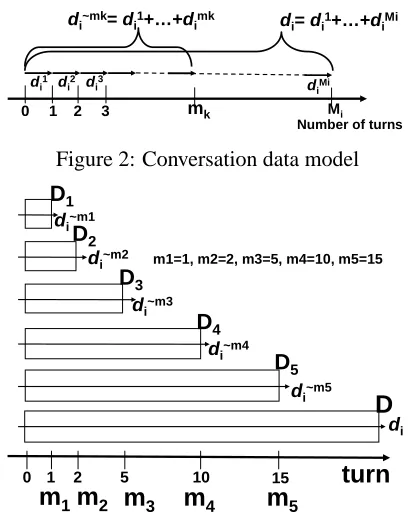
Each conversational data record in the collectionD is defined asdi. Eachdi can be seen as a sequence
of conversational turns in the conversational data,
and thendican be divided as
di=d1i +di2+· · ·+dMi i, (1)
wheredki is the k-th turn in di andMi is the total
number of turns indi. The+operator in the above
equation can be seen as an equivalent of the string concatenation operator. We defined∼i j as the por-tion ofdi from the beginning to turn j. Using the
same notation, d∼i j = d1i +d2i +· · ·+dji. The collection ofd∼i mk constitutes the Chronologically
Cumulative Data up to turnmk (Dk). Dk is
repre-sented as
Dk= (d∼1mk,d2∼mk, . . . ,d∼nmk). (2)
Figure 2 shows an image of the data model. We set somemk and prepare the chronologically
cumula-tive data set as shown in Figure 3. We represent bi-nary mutually exclusive business outcomes such as success and failure resulting from the conversations as “A” and “not A”.
di= di1+…+diMi
Number of turns
0 1 2 3 Mi
di1 d
i2 di3 diMi
mk
di~mk= di1+…+dimk
Figure 2: Conversation data model
m
5turn
m
1m
2m
3m
40 1 2 5 10 15
D
di di~m5D5 di~m4
D4 di~m3
D3 D2 D1
di~m2
di~m1
m1=1, m2=2, m3=5, m4=10, m5=15
Figure 3: Chronologically cumulative conversa-tional data
3.2 Trigger Segment Detection
To detect such segments, we divide each chrono-logically cumulative data setDk into two data sets,
training data Dktraining and test data Dtestk . Start-ing from D1, for each Dk we trained a classifier
using Dktraining and evaluated it on Dtestk . Using accuracy, the fraction of correctly classified docu-ments, as a metric of performance (Yang and Liu, 1999), we denote the evaluation result of the cat-egorization as acc(categorizer(Dk))for each Dk
and plot it along with its turn. Figure 4 shows the effect of gradually increasing the training data for the classification. The distribution of expressions
m1 m2 m3 m4 m5
acc(categorizer(Di))
trigger trigger
D1 D2
D3
D4
D5
D all
[image:4.612.70.299.240.348.2]turn
Figure 4: Plot ofacc(categorizer(Dk))
in a business-oriented conversation will change al-most synchronously because the call flow is pre-defined. Thereforeacc(categorizer(Dk)) will
in-crease if features that contribute to the categorization appear inDk. In contrast, acc(categorizer(Dk))
will decrease if no features that contribute to the categorization are in Dk. Therefore, from
the transitions of acc(categorizer(Dk)), we can
identify the segments with increases as triggers where the features that have an effect on the out-come appear. We denote a trigger segment as seg(start position, end position). Because the to-tal numbers of turns can be different, we do not detect the last section as a trigger. In Figure 4, seg(m1, m2) and seg(m4, m5) are triggers. It is
important to note that using the cumulative data is key to the detection of trigger segments. Using non-cumulative segment data would give us the catego-rization accuracy for the features within that seg-ment but would not tell us whether the features of this segment are improving the accuracy or decreas-ing it. It is this gradient information between seg-ments that is key to identifying trigger segseg-ments.
Many approaches have been proposed for
docu-ment classification (Yang and Liu, 1999). In this research, however, we are not interested in the clas-sification accuracy itself but in the increase and de-crease of the accuracy within particular segments. For example, the greeting, or the particular method of payment may not affect the outcome, but the mention of a specific feature of the product may have an effect on the outcome. Therefore in our research we are interested in identifying the partic-ular portion of the call where this product feature is mentioned, along with its mention, which has an effect on the outcome of the call. In our experi-ments we used the SVM (Support Vector Machine) classifier (Joachims, 1998), but almost any classifier should work because our approach does not depend on the classification method.
3.3 Effective Expression Extraction
In this section, we describe our method to extract effective expressions from the detected trigger seg-ments.
The effective expressions inDk are those which
are representative in the selected documents and appear for the first time in the trigger segments seg(mi, mj). Numerous methods to select features
exist (Hisamitsu and Niwa, 2002) (Yang and Ped-ersen, 1997). We use the χ2 statistic for each ex-pression in Dk as a representative metric. For the
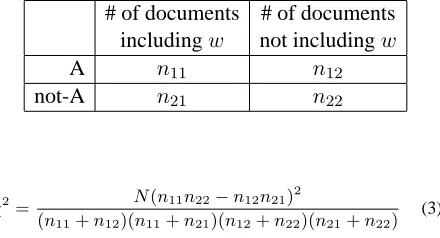
two-by-two contingency table of a expressionwand a class ”A” shown in Table 1, theχ2statistic is cal-culated as
Table 1: Contingency table for calculating theχ2 statistic
# of documents # of documents includingw not includingw
A n11 n12
not-A n21 n22
χ2= N(n11n22−n12n21)2
(n11+n12)(n11+n21)(n12+n22)(n21+n22) (3)
whereN is the number of documents. This statis-tic can be compared to theχ2 distribution with one degree of freedom to judge representativeness.
We also want to extract the expressions that have not had an effect on the outcome beforeDk. To
[image:4.612.316.536.505.624.2]new(w) = w(Dk) max(w(Dk−1),1)/
mk
mk−1
×sign(w(DAk)−w(DnotAk )), (4)
where w(Dk) is the frequency of expression w in
the chronologically cumulative dataDk, max(a, b)
selects the larger value in the arguments,mk is the
number of turns inDk,w(DkA) is the frequency of
winDkwith the outcome of the corresponding data
being “A”, andsign(·)is the signum function. When win class “A” appears inDkmuch more frequently
than Dk−1 compared with the ratio of their turns,
this metric will be more than 1. We detect signifi-cant expressions by considering the combined score χ2(w)·new(w). Using this combined score, we
can filter out the representative expressions that have already appeared beforeDk and distinguish
signifi-cant expressions that first appear inDkfor each class
“A” and “not A”.
3.4 Appropriate Viewpoint Selection
In a text mining system, to get an association that leads to a useful insight, we have to define appro-priate viewpoints. Viewpoints refer to objects in re-lation to other objects. In analysis using a conven-tional text mining system (Nasukawa and Nagano, 2001), the viewpoints are selected based on expres-sions in user dictionaries prepared by domain ex-perts. We have identified important segments of the conversations by seeing changes in the accuracy of a categorizer designed to segregate different business outcomes. We have also been able to extract effec-tive expressions from these trigger segments to de-fine various viewpoints. Hence, viewpoint selection is now based on the trigger segments and effective expressions identified automatically based on speci-fied business outcomes. In the next section we apply our technique to a real life dataset and show that we can successfully select useful viewpoints.
4 Experiments and Results 4.1 Experiment Data and System
We collected 914 recorded calls from the car rental help desk and manually transcribed them. Figure 1 shows part of a call that has been transcribed.
There are three types of calls:
1. Reservation Calls: Calls which got converted. Here, “converted” means the customer made a reservation for a car. Reserved cars can get
picked-up or not picked-up, so some reserved
cars do not eventually get picked-up by cus-tomers (no shows and cancellations).
2. Unbooked Calls: Calls which did not get con-verted.
3. Service Calls: Customers changing or enquir-ing about a previous bookenquir-ing.
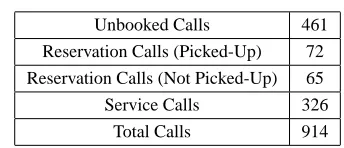
[image:5.612.335.507.269.343.2]The distribution of the calls is given in Table 2.
Table 2: Distribution of calls
Unbooked Calls 461
Reservation Calls (Picked-Up) 72
Reservation Calls (Not Picked-Up) 65
Service Calls 326
Total Calls 914
The reservation calls are most important in this context, so we focus on those 137 calls. In the reser-vation calls, there are two types of outcomes, car picked-up and car not picked-up. All reservation calls look similar in spite of having different out-comes (in terms of pick up). The reservation hap-pens during the call but the pick up haphap-pens at a later date. If we can find differences in the conver-sation that affect the outcome, it is expected that we could improve the agent productivity. Reservation calls follow the pre-defined reservation call flow that we mentioned in Section 2 and it is very difficult to find differences between them manually. In this experiment, by using the proposed method, we try to extract trigger segments and expressions to find viewpoints that affect the outcome of the reservation calls.
4.2 Results of Trigger Segment Detection and Effective Expression Extraction
Based on the pre-defined conversation flow de-scribed in Section 2, we set m1=1, m2=2,
m3=5, m4=10, m5=15, and m6=20 and prepared
D1, . . . , D6 and D. The features of di consist of
nouns, compound nouns, specified noun phrases (e.g. adjective+noun), and verbs. For each Dk
we calculatedacc(categorizer(Dk))for the classes
“picked-up” and “not picked-up.” In this process, we use a SVM-based document categorizer (Joachims, 2002). Of the 137 calls, we used 100 calls for training the categorizer and 37 calls for trigger segment detection. Figure 5 shows the results of acc(categorizer(Dk))for picked-up. The accuracy
of classification using the data of entire conversa-tions (acc(categorizer(D)) is 67.6% but we are try-ing to detect important segments by considertry-ing not the accuracy values themselves but the gradients be-tween segments. From these results, seg(1,2)and
0 10 20 30 40 50 60 70 80
0 5 10 15 20 25 30 35 40 45 Turn (m_j)
Ac cu ra cy [% ] D1
D2
D3
D4 D5
D
[image:6.612.311.540.73.188.2]D6
Figure 5: Result ofacc(categorizer(Dk))
seg(10,15) are detected as trigger segments. We now know that these segments are highly correlated to the outcome of the call.
For each detected trigger segment, we extract ef-fective expressions in each class using the metric de-scribed in Section 3.3. Table 3 shows some expres-sions with high values for the metric for each trigger. In this table, ”just NUMERIC dollars” is a canonical expression and an expression such as ”just 160 dol-lars” is mapped to this canonical expression in the information extraction process. From this result, in seg(1,2), “make”, “reservation” are correlated with “pick up” and “rate” and “check” are correlated with
Table 3: Selected expressions in trigger segments
Trigger Selected expressions
pick up not picked up
seg(1,2) make, return, tomorrow, rate, check, see
day, airport, look, want, week
assist, reservation, tonight
seg(10,15) number, corporate program, go, impala
contract, card, have, tax surcharge,
just NUMERIC dollars, discount, customer club, good rate, economy
“not-picked up”. By looking at some documents containing these expressions, we found customer in-tention phrases such as “would like to make a reser-vation”, “want to check a rate”, etc. Therefore, it can be induced that the way a customer starts the call may have an impact on the outcome. From ex-pressions inseg(10,15), it can be said that discount-related phrases and mentions of the good rates by the agent can have an effect on the outcome.
We can directly apply the conventional methods for representative feature selection to D. The fol-lowing expressions were selected as the top 20 ex-pressions from whole conversational data by using theχ2metric defined in (3).
corporate program, contract, counter, September, mile, rate, economy, last name,
valid driving license,BRAND NAME, driving, telephone, midsize, tonight, use, credit, moment, airline, afternoon
From these results, we see that looking at the call as a whole does not point us to the fact that discount-related phrases, or the first customers-utterance, af-fect the outcome. Detecting trigger segments and extracting important expressions from each trigger segment are key to identifying subtle differences be-tween very similar looking calls that have entirely opposite outcomes.
4.3 Results of Text Mining Analysis using Selected Viewpoints and Expressions
[image:6.612.70.297.350.495.2]• Customer intention at start of call: From the customer’s first utterance, we extract the fol-lowing intentions based on the patterns.
– strong start: would like to make a booking,
need to pick up a car,. . .
– weak start: would like to check the rates,
want to know the rate for vans,. . .
Under our hypotheses, the customer with a strong start has the intention of booking a car and we classify such a customer as a book-ing customer. The customer with a weak start usually just wants to know the rates and is clas-sified as a rates customer.
• discount-related phrases: discount, corporate
program, motor club, buying club . . .are reg-istered into the domain dictionary as discount-related phrases.
• value selling phrases: we extract phrases men-tioning good rates and good vehicles by match-ing patterns related to such utterances.
– mentions of good rates: good rate,
won-derful price, save money, just need to pay this low amount,. . .
– mentions of good vehicles: good car,
fan-tastic car, latest model,. . .
Using these three categories, we tried to find insights to improve agent productivity.
Table 4 shows the result of two-dimensional as-sociation analysis for 137 reservation calls. This ta-ble shows the association between customer types based on customer intention at the start of a call and pick up information. From these results, 67%
Table 4: Association between customer types and pick up information
Customer types extracted from texts Pick up information based on customer intent at start of call pick up not-picked up booking customer (w/ strong start) (70) 47 23
rates customer (w/ weak start) (37) 13 24
(47 out of 70) of the booking customers picked up the reserved car and only 35% (13 out of 37) of the rates customers picked it up. This supports our hy-pothesis and means that pick up is predictable from the customer’s first or second utterance.
It was found that cars booked by rates customers tend to be “not picked up,” so if we can find any
actions by agents that convert such customers into “pick up,” then the revenue will improve. In the booking customer case, to keep the “pick up” high, we need to determine specific agent actions that con-cretize the customer’s intent.
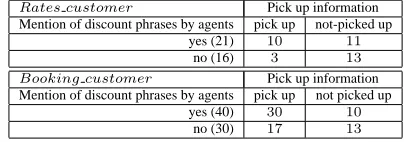
[image:7.612.321.524.213.284.2]Table 5 shows how mentioning discount-related phrases affects the pick up ratios for rates customers and booking customers. From this table, it can
Table 5: Association between mention of discount phrases and pick up information
Rates customer Pick up information Mention of discount phrases by agents pick up not-picked up
yes (21) 10 11
no (16) 3 13
Booking customer Pick up information Mention of discount phrases by agents pick up not picked up
yes (40) 30 10
no (30) 17 13
be seen that mentioning discount phrases affects the final status of both types of customers. In the rates customer case, the probability that the booked car will be picked up, P(pick-up) is improved to 0.476 by mentioning discount phrases. This means customers are attracted by offering discounts and this changes their intention from “just checking rate” to “make a reservation here”. We found similar trends for the association between mention of value selling phrases and pick up information.
4.4 Improving Agent Productivity
From the results of the text mining analysis experi-ment, we derived the following actionable insights:
• There are two types of customers in reservation calls.
– Booking customer (with strong start) tends to pick up the reserved car.
– Rates customer (with weak start) tends not to pick up the reserved car.
• In the rates customer case, “pick up” is im-proved by mentioning discount phrases.
groups over a period of one month we hoped to see how the actionable insights contributed to improv-ing agent performance. As the evaluation metric, we used the pick up ratio - that is the ratio of the number of “pick-ups” to the number of reservations.
Following the training the pick up ratio of the trained agents increased by 4.75%. The average pick up ratio for the remaining agents increased by 2.08%. Before training the ratios of both groups were comparable. The seasonal trends in this indus-try mean that depending on the month the bookings and pickups may go up or down. We believe this is why the average pick up ratio for the remaining agents also increased. Considering this, it can be es-timated that by implementing the actionable insights the pick up ratio for the pilot group was improved by about 2.67%. We confirmed that this difference is meaningful because the p-value of the t-test statistic is 0.0675 and this probability is close to the stan-dard t-test (α=0.05). Seeing this, the contact center trained all of its agents based on the insights from the text mining analysis.
5 Discussion
There has been a lot of work on specific tools for analyzing the conversational data collected at con-tact centers. These include call type classification for the purpose of categorizing calls (Tang et al., 2003) (Zweig et al., 2006), call routing (Kuo and Lee, 2003) (Haffner et al., 2003), obtaining call log summaries (Douglas et al., 2005), agent assisting and monitoring (Mishne et al., 2005), and building of domain models (Roy and Subramaniam, 2006). Filtering problematic dialogs automatically from an automatic speech recognizer has also been studied (Hastie et al., 2002) (Walker et al., 2002). In trast to these technologies, in this paper we con-sider the task of trying to find insights from a col-lection of complete conversations. In (Nasukawa and Nagano, 2001), such an analysis was attempted for agent-entered call summaries of customer con-tacts by extracting phrases based on domain-expert-specified viewpoints. In our work we have shown that even for conversational data, which is more complex, we could identify proper viewpoints and prepare expressions for each viewpoint. Call sum-maries by agents tend to mask the customers’ inten-tion at the start of the call. We get more valuable
insights from the text mining analysis of conversa-tional data. For such an analysis of conversaconversa-tional data, our proposed method has an important role. With our method, we find the important segments in the data for doing analyses. Also our analyses are closely linked to the desired outcomes.
In trigger detection, we created a chronologically cumulative data set based on turns. We can also use the segment information such as the “opening” and “enquiries” described in Section 2. We prepared data with segment information manually assigned, made the chronologically cumulative data and ap-plied our trigger detection method. Figure 6 shows the results ofacc(categorizer(Dk)). The trend in
40 45 50 55 60
call start -->
opening call start -->details call start -->offering call start -->personal details
call start --> confirmation, mandatory questions, closing Conversation flow
[image:8.612.312.538.264.407.2]A cc ur ac y [% ]
Figure 6: Result of acc(categorizer(Dk)) using
segment information
Figure 6 is similar to that in Figure 5. From this result, it is observed that ”opening” and ”offering” segments are trigger segments. Usually, segmenta-tion is not done in advance and to assign such infor-mation automatically we need data with labeled seg-mentation information. The results show that even in the absence of labeled data our trigger detection method identifies the trigger segments. In the exper-iments in Section 4, we set turns for each chrono-logically cumulative data by taking into account the pre-defined call flow.
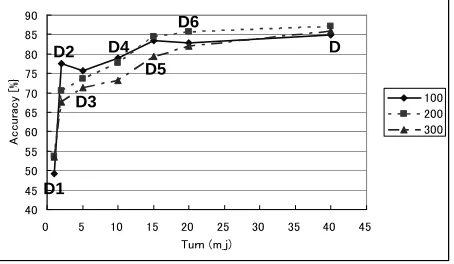
when constructing a categorizer. It is known that se-lecting only significant features improves the clas-sification accuracy (Yang and Pedersen, 1997). We used Information Gain for selecting features from the document collection. This method selects the most discriminative features between two classes. As expected the classification accuracy improved significantly as we reduced the total number of fea-tures from over 2,000 to the range of 100 to 300. Figure 7 shows the changes in accuracy. In the
pro-40 45 50 55 60 65 70 75 80 85 90
0 5 10 15 20 25 30 35 40 45 Turn (m_j)
A cc ur ac y [% }
100 200 300
D1 D2
D3 D4
D5
[image:9.612.71.298.210.342.2]D D6
Figure 7: Result ofacc(categorizer(Dk))with top
100 to 300 features selected using information gain
posed method, we detect trigger segments using the increases and decreases of the classification accu-racy. By selecting features, the noisy features are not added in the segments. Decreasing portions, there-fore are not observed. In this situation, as a trigger segment, we can detect the portion where the gra-dient of the accuracy curve increases. Also using feature selection, we find that the classification ac-curacy is highest when using the entire document, which is expected. However, we notice that the trig-ger segments obtained with and without feature se-lection are almost the same.
In the experiment, we use manually transcribed data. As future work we would like to use the noisy output of an automatic speech recognition system to obtain viewpoints and expressions.
6 Conclusion
In this paper, we have proposed methods for iden-tifying appropriate segments and expressions auto-matically from the data for user specified difference analysis. We detected the trigger segments using the property that a business-oriented conversation
fol-lows a pre-defined flow. After that, we identified the appropriate expressions from each trigger seg-ment. It was found that in a long business-priented conversation there are important segments affecting the outcomes that can not been easily detected by just looking through the conversation, but such seg-ments can be detected by monitoring the changes of the categorization accuracy. For the trigger seg-ment detection, we do not use semantic segseg-ment in-formation but only the positional segment informa-tion based on the conversainforma-tional turns. Because our method does not rely on the semantic information in the data, therefore our method can be seen as robust. Through experiments with real conversational data, using identified segments and expressions we were able to define appropriate viewpoints and concepts leading to insights for improving the car rental busi-ness process.
Acknowledgment
The authors would like to thank Sreeram Balakr-ishnan, Raghuram Krishnapuram, Hideo Watanabe, and Koichi Takeda at IBM Research for their sup-port. The authors also appreciate the efforts of Jatin Joy Giri at IBM India in providing domain knowl-edge about the car rental process and thank him for help in constructing the dictionaries.
References
S. Douglas, D. Agarwal, T. Alonso, R. M. Bell, M. Gilbert, D. F. Swayne, and C. Volinsky. 2005. Mining customer care dialogs for “daily news”. IEEE Transaction on Speech and Audio Processing, 13(5):652–660.
P. Haffner, G. Tur, and J. H. Wright. 2003. Optimizing svms for complex call classification. In Proceedings of IEEE International Conference on Acoustics, Speech, and Signal Processing (ICASSP), pages 632–635.
H. W. Hastie, R. Prasad, and M. A. Walker. 2002. What’s the trouble: Automatically identifying problematic di-alogues in darpa communicator dialogue systems. In Proceedings of the 40th Annual Meeting of the ACL, pages 384–391.
T. Joachims. 1998. Text categorization with support vec-tor machines: Learning with many relevant features. In Proceedings of the 10th European Conference on Machine Learning (ECML), pages 137–142.
T. Joachims. 2002. Optimizing search engines using clickthrough data. In Proceedings of the ACM Con-ference on Knowledge Discovery and Data Mining (KDD), pages 133–142.
H.-K J. Kuo and C.-H. Lee. 2003. Discriminative train-ing of natural language call routers. IEEE Transaction on Speech and Audio Processing, 11(1):24–35.
G. Mishne, D. Carmel, R. Hoory, A. Roytman, and A. Soffer. 2005. Automatic analysis of call-center conversations. In Proceedings of ACM Conference on Information and Knowledge Management (CIKM), pages 453–459.
T. Nasukawa and T. Nagano. 2001. Text analysis and knowledge mining system. IBM Systems Journal, pages 967–984.
S. Roy and L. V. Subramaniam. 2006. Automatic generation of domain models for call centers from noisy transcriptions. In Proceedings of the 21st In-ternational Conference on Computational Linguistics and 44th Annual Meeting of the ACL (COLING/ACL), pages 737–744.
M. Tang, B. Pellom, and K. Hacioglu. 2003. Call-type classification and unsupervised training for the call center domain. In Proceesings of IEEE Workshop on Automatic Speech Recognition and Understanding, pages 204–208.
M. A. Walker, I. Langkilde-Geary, H. W. Hastie, J. Wright, and A. Gorin. 2002. Automatically train-ing a problematic dialogue predictor for a spoken di-alogue system. Journal of Artificial Intelligence Re-search, 16:393–319.
Y. Yang and X. Liu. 1999. A re-examination of text cate-gorization methods. In Proceedings of the 22th Annual International ACM SIGIR Conference on Research and Development in Information Retrieval, pages 42– 49.
Y. Yang and J. O. Pedersen. 1997. A comparative study on feature selection in text categorization. In Proceed-ings of the 14th International Conference on Machine Learning (ICML), pages 412–420.