101
Contextualized Word Representations from Distant Supervision
with and for NER
Abbas Ghaddar
RALI-DIRO Universit´e de Montr´eal
Montr´eal, Canada
Philippe Langlais
RALI-DIRO Universit´e de Montr´eal
Montr´eal, Canada
Abstract
We describe a special type of deep contex-tualized word representation that is learned fromdistant supervision annotations and dedi-cated tonamed entity recognition. Our exten-sive experiments on 7 datasets show system-atic gains across all domains over strong base-lines, and demonstrate that our representation is complementary to previously proposed em-beddings. We report new state-of-the-art re-sults on CONLL and ONTONOTESdatasets.
1 Introduction
Contextualized word representations are nowa-days a resource of choice for most NLP tasks ( Pe-ters et al.,2018). These representations are trained with unsupervised language modelling ( Jozefow-icz et al.,2016), masked-word prediction (Devlin et al., 2018), or supervised objectives like ma-chine translation (McCann et al., 2017). Despite their strength, best performances on downstream tasks (Akbik et al., 2018; Lee et al., 2018; He et al.,2018) are always obtained when these rep-resentations are stacked with traditional (classic) word embeddings (Mikolov et al.,2013; Penning-ton et al.,2014).
Our main contribution in this work is to re-visit the work of Ghaddar and Langlais (2018a) that explores distant supervision for learning clas-sicword representations, used later as features for Named Entity Recognition (NER). Motivated by the recent success of pre-trained language model embeddings, we propose a contextualized word representation trained on the distant supervision material made available by the authors. We do so by training a model to predict the entity type of each word in a given sequence (e.g. paragraph).
We run extensive experiments feeding our rep-resentation, along side with previously proposed traditional and contextualized ones, as features to
a vanilla Bi-LSTM-CRF (Ma and Hovy, 2016). Results shows that our contextualized represen-tation leads to significant boost in performances on 7 NER datasets of various sizes and domains. The proposed representation surpasses the one of Ghaddar and Langlais (2018a) and is com-plementary to popular contextualized embeddings like ELMo (Peters et al.,2018).
By simply stacking various representations, we report new state-of the-art performances on CONLL-2003 (Tjong Kim Sang and De Meulder, 2003) and ONTONOTES5.0 (Pradhan et al.,2013) with a F1 score of 93.22 and 89.95 respectively.
2 Related Work
Pre-trained contextualized word-embeddings have shown great success in NLP due to their ability to capture both syntactic and semantic properties. ELMo representations (Peters et al., 2018) are built from internal states of forward and backward word-level language models. Akbik et al. (2018) showed that pure character-level language mod-els can also be used. Also,McCann et al.(2017) used the encoder of a machine translation model to compute contextualized representations. Recently, (Devlin et al., 2018) proposed BERT, an encoder based on the Transformer architecture (Vaswani et al.,2017). To overcome the unidirectionality of the language model objective, the authors propose two novel tasks for unsupervised learning: masked words and next sentence prediction.
Ghaddar and Langlais (2018a) applied distant supervision (Mintz et al., 2009) in order to in-duce traditional word representations. They used WiFiNE1 (Ghaddar and Langlais, 2018b, 2017), a Wikipedia dump with massive amount of auto-matically annotated entities, using the fine-grained
1http://rali.iro.umontreal.ca/rali/en/
tagset proposed in (Ling and Weld,2012). Mak-ing use of Fasttext (Bojanowski et al.,2016), they embedded words and (noisy) entity types in this resource into the same space from which they induced a 120-dimensional word-representation, where each dimension encodes the similarity of a word with one of the 120 types they considered. While the authors claim the resulting representa-tion captures contextual informarepresenta-tion, they do not specifically train it to do so. Our work revisits pre-cisely this.
3 Data and Preprocessing
We leverage the entity type annotations in WiFiNE which consists of 1.3B tokens annotated with 159.4M mentions, which cover 15% of the to-kens. A significant amount of named enti-ties such as person names and countries can actually be resolved via their mention tokens only (Ghaddar and Langlais, 2016a,b). With the hope to enforce context, we use the fine-grained type annotation available in the resource (e.g. /person/politician). Also, inspired by the recent success of masked-word prediction (Devlin et al.,2018), we further apply preprocessing to the original annotations by(a)replacing an entity by a special token [MASK] with a probability of 0.2, and(b)replacing primary entity mentions, e.g. all mentions of Barack Obama within its dedicated article, by the special mask token with a probabil-ity of 0.5. In WiFiNE, named-entities that do not have a Wikipedia article (e.g. Malia Annin Fig-ure2) are left unannotated, which introduces false negatives. Therefore, we mask non-entity words when we calculate the loss.
Although contextualized representation learn-ing has access to arbitrary large contexts (e.g. the document), in practice representations mainly depend on sentence level context (Chang et al.,
2019). To overcome this limitation to some extent, we use the Wikipedia layout provided in WiFiNE to concatenate sentences of the same paragraphs, sections and document up to a maximum size of 512 tokens.
An illustration of the preprocessing is depicted in Figure2 where for the sake of space, a single sentence is being showed. Masked entities encour-age the model to learn good representations for non-entity words even if they do not participate in the final loss. Because our examples are sec-tions and paragraphs, the model will be forced to
encode sentence- as well as document-based con-text. In addition, training on (longer) paragraphs is much faster and memory efficient than batching sentences.
4 Learning our Representation
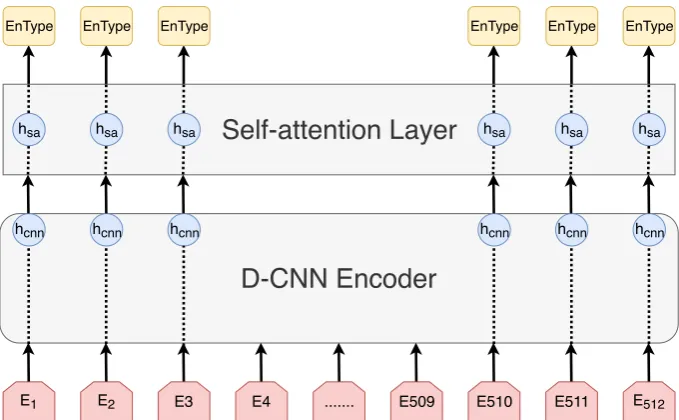
We use a model (Figure 1) composed of a multi-layer bidirectional encoder that produces hidden states for each token in the input sequence. At the output layer, the last hidden states are fed into a softmax layer for predicting entity types. Fol-lowing (Strubell et al.,2017), we used as our en-coder the Dilated Convolutional Neural Network (DCNN) with an exponential increasing dilated width. DCNN was first proposed by (Yu and Koltun, 2015) for image segmentation, and was successfully deployed for NER by (Strubell et al.,
2017). The authors show that stacked layers of DCNN that incorporate document context have comparable performance to Bi-LSTM while be-ing 8 times faster. DCNN with a size 3 convolu-tion window needs 8 stacked layers to incorporate the entire input context of a sequence of 512 to-kens, compared to 255 layers using a regular CNN. This greatly reduces the number of parameters and makes training more scalable and efficient. Be-cause our examples are paragraphs rather than sen-tences, we employ a self-attention mechanism on top of DCNN output with the aim to encourage the model to focus on salient global information. In this paper, we adopt the multi-head self-attention formulation by Vaswani et al. (2017). Compar-atively, Transformer-based architectures (Devlin et al.,2018) require a much larger2amount of re-sources and computations. To improve the han-dling of rare and unknown words, our input se-quence consists of WordPiece embeddings (Wu et al.,2016) as used byDevlin et al.(2018); Rad-ford et al.(2018). We use the same vocabulary dis-tributed by the authors, as it was originally learned on Wikipedia. Model parameters and training de-tails are provided in AppendixA.1.
5 Experiments on NER
5.1 Datasets
To compare with state-of-the-art models, we consider two well-established NER benchmarks: CONLL-2003 (Tjong Kim Sang and De Meulder,
2003) and ONTONOTES5.0 (Pradhan et al.,2012).
E1 E2 E3 E4 ... E509 E510 E511 E512
D-CNN Encoder
hcnn hcnn hcnn hcnn hcnn hcnn
Self-attention Layer
hsa hsa hsa hsa hsa hsa
[image:3.595.129.469.60.270.2]EnType EnType EnType EnType EnType EnType
Figure 1: Illustration of the architecture of the model used for learning our representation. It consists of stacked layers of dilated convolutional neural network followed by a self-attention layer. The input is a sequence of tokens with a maximum length of 512, where the output is the associated entity type se-quence. We use the hidden state of the last DCNN layer and the self-attention layer as our representation.
before [Obama] first daughter, Malia Ann, was born in[July 1998]at[Chicago],[Illinois].
after [MASK] first daughter, Malia Ann, was born in[July 1998]at[Chicago],[Illinois].
tags /person/politicianX X X X X X X X X/date /dateX/location/city
X/location/provinceX
Figure 2: Sequence before and after masking, along with output tags. X indicates that no pre-diction is made for the corresponding token.
To further determine how useful our learned repre-sentation is on other domains, we also considered three additional datasets: WNUT17 ( Derczyn-ski et al.,2017) (social media), I2B2 (Stubbs and Uzuner, 2015) (biomedical), and FIN (Alvarado et al., 2015) (financial). In addition, we per-form an out-domain evaluation for models trained on CONLL-2003 and tested on WIKIGOLD( Bal-asuriya et al., 2009) (wikipedia) and WEB -PAGES (Ratinov and Roth, 2009) (web pages). Statistics of the datasets are provided in Ap-pendixA.2.
5.2 Input Representations
Our NER model is a vanilla Bi-LSTM-CRF (Ma and Hovy,2016) that we feed with various repre-sentations (hereafter described) at the input layer.
Model parameters and training details are pro-vided in AppendixA.3.
5.2.1 Word-Shape Features
We use 7 word-shape features: allUpper, allLower, upperFirst, upperNotFirst, numeric, punctuation or noAlphaNum. We randomly allocate a 25-dimensional vector for each feature, and learn them during training.
5.2.2 Traditional Word Embeddings
We use the 100-dimensional case sensitive SSKIP (Ling et al.,2015) word embeddings. We also compare with the previously described 120-dimensional vector representation of (Ghaddar and Langlais,2018a), they call it LS.
5.2.3 Contextualized Word Embeddings
Conll Ontonotes
X LS ours X LS ours
ws+sskip 90.37 91.23 (+0.9) 91.76 (+1.4) 86.44 87.95 (+0.9) 88.13 (+0.9)
ws+sskip+elmo 92.47 92.49 (+0.0) 92.82 (+0.4) 89.37 89.44 (+0.1) 89.68 (+0.3)
ws+sskip+elmo+flair 92.69 92.75 (+0.1) 93.22 (+0.5) 89.55 89.59 (+0.0) 89.73 (+0.2)
ws+sskip+elmo+flair+bert 92.91 92.87 (+0.0) 93.01 (+0.1) 89.66 89.70 (+0.0) 89.95 (+0.3)
(Peters et al.,2018) 92.20
-(Clark et al.,2018) 92.61 88.81
(Devlin et al.,2018) 92.80
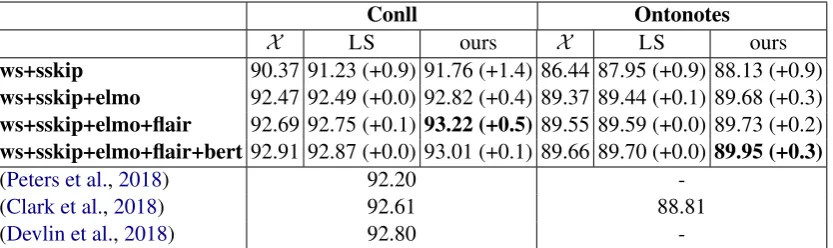
-Table 1: F1 scores over five runs on CONLL and ONTONOTES test set of ablation experiments. We evaluate 4 baselines without additional embeddings (columnX) and with LS embeddings (Ghaddar and Langlais,2018a) or ours. Figures in parenthesis indicate the gain over the baselines.
during training. We use concatenation to stack the resulting representations in the input layer of our vanilla Bi-LSTM-CRF model, since Coates and Bollegala(2018) show that concatenation per-forms reasonably well in many NLP tasks.
6 Experiments
6.1 Comparison to LS embeddings
Since we used the very same distant supervision material for training our contextual representation, we compare it to the one ofGhaddar and Langlais
(2018a). We concentrate on CONLL-2003 and ONTONOTES5.0, the datasets most often used for benchmarking NER systems.
Table 1 reports results of 4 strong baselines that use popular embeddings (columnX), further adding either the LS representation (Ghaddar and Langlais, 2018a) or ours. In all experiments, we report the results on the test portion of models per-forming the best on the official development set of each dataset. As a point of comparison, we also report 2018 state-of-the-art systems.
First we observe that adding our representation to all baseline models leads to systematic improve-ments, even for the very strong baseline which ex-ploits all three contextual representations (fourth line). The LS representation does not deliver such gains, which demonstrates that our way of ex-ploiting the very same distant supervision mate-rial is more efficient. Second, we see that adding our representation to the weakest baseline (line 1), while giving a significant boost, does not deliver as good performance as when adding other contex-tual embeddings. Nevertheless, combining all em-beddings yields state-of-the-art on both CONLL and ONTONOTES.
6.2 Comparing Contextualized Embeddings
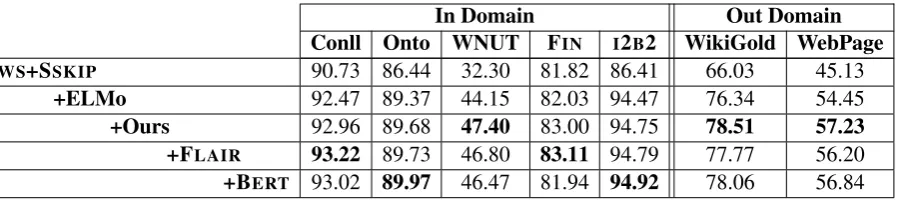
Table 2 reports F1 scores on the test portion of the 7 datasets we considered, for models trained with different embedding combinations. Our base-line is composed of word-shape and traditional (SSKIP) embeddings. Then, contextualized word representations are added greedily, that is, the rep-resentation that yields the largest gain when con-sidered is added first and so forth.
Expectedly, ELMo is the best representation to add to the baseline configuration, with significant F1 gains for all test sets. We are pleased to ob-serve that the next best representation to consider is ours, significantly outperforming FLAIR. This is likely due to the fact that both FLAIR and ELMo embeddings are obtained by training a language model, therefore encoding similar information.
Continuously aggregating other contextual em-beddings (FLAIR and BERT) leads to some im-provements on some datasets, and degradations on others. In particular, stacking all representations leads to the best performance on 2 datasets only: ONTONOTESandI2B2. Those datasets are large, domain diversified, and have more tags than other ones. In any case, stacking word-shapes, SSKIP, ELMo and our representation leads to a strong configuration across all datasets. Adding our rep-resentation to ELMo, actually brings noticeable gains (over 2 absolute F1 points) in out-domain settings, a very positive outcome.
[image:4.595.93.510.62.186.2]In Domain Out Domain
Conll Onto WNUT FIN I2B2 WikiGold WebPage
WS+SSKIP 90.73 86.44 32.30 81.82 86.41 66.03 45.13
+ELMo 92.47 89.37 44.15 82.03 94.47 76.34 54.45
+Ours 92.96 89.68 47.40 83.00 94.75 78.51 57.23
+FLAIR 93.22 89.73 46.80 83.11 94.79 77.77 56.20
[image:5.595.79.528.62.162.2]+BERT 93.02 89.97 46.47 81.94 94.92 78.06 56.84
Table 2: Mention-level F1 scores. The baseline (first line) uses word shape and traditional (classic) embeddings. Variants stacking various representations are presented in decreasing order of F1 return. So for instance, ELMo is the best representation to add to the baseline one.
but as many others,3 our results were disappoint-ing.
6.3 Analysis
We suspect one reason for the success of our repre-sentation is that it captures document wise context. We inspected the words the most attended accord-ing to the the self-attention layer of some docu-ments, an excerpt of which is reported in Figure3. We observe that attended words in the document are often related to the topic of the document.
84 economic Stock, mark, Wall, Treasury, bond
148 sport World, team, record, game, win
201 news truck, Fire, store, hospital, arms
Figure 3: top 5 attended words for some randomly picked documents in the dev set of CONLL. Col-umn 1 indicate document number, while colCol-umn 2 is our appreciation of the document topic.
We further checked whether the gain could be imputable to the fact that WiFiNE contains the mentions that appear in the test sets we consid-ered. While this of course happens (for instance 38% of the test mentions in ONTONOTES are in the resource), the performance on those mentions with our representation is no better than the per-formance on other mentions.
7 Conclusion and Future Work
We have explored the idea of generating a contex-tualized word representation from distant super-vision annotations coming from Wikipedia, im-proving over the static representation of Ghad-dar and Langlais (2018a). When combined with
3https://github.com/google-research/
bert/issues?utf8=%E2%9C%93&q=NER
popular contextual ones, our representation leads to state-of-the-art performance on both CONLL and ONTONOTES. We are currently analyzing the complementarity of our representation to others.
We plan to investigate tasks such as coref-erence resolution and non-extractive machine reading comprehension, where document level context and entity type information is crucial. The source code and the pre-trained models we used in this work are publicly available
at http://rali.iro.umontreal.ca/
rali/en/wikipedia-ds-cont-emb
Acknowledgments
We gratefully acknowledge the support of NVIDIA Corporation with the donation of the Ti-tan Xp and TiTi-tan V GPUs used for this research. We thank the anonymous reviewers for their in-sightful comments.
References
Mart´ın Abadi, Ashish Agarwal, Paul Barham, Eugene Brevdo, Zhifeng Chen, Craig Citro, Greg S Corrado, Andy Davis, Jeffrey Dean, Matthieu Devin, et al. 2016. Tensorflow: Large-scale machine learning on heterogeneous distributed systems. arXiv preprint arXiv:1603.04467.
Alan Akbik, Duncan Blythe, and Roland Vollgraf. 2018. Contextual string embeddings for sequence labeling. In Proceedings of the 27th International Conference on Computational Linguistics, pages 1638–1649.
Julio Cesar Salinas Alvarado, Karin Verspoor, and Timothy Baldwin. 2015. Domain adaption of named entity recognition to support credit risk assessment. InProceedings of the Australasian Language Tech-nology Association Workshop 2015, pages 84–90.
Entity Recognition in Wikipedia. In Proceed-ings of the 2009 Workshop on The People’s Web Meets NLP: Collaboratively Constructed Semantic Resources, pages 10–18. Association for Computa-tional Linguistics.
Piotr Bojanowski, Edouard Grave, Armand Joulin, and Tomas Mikolov. 2016. Enriching Word Vec-tors with Subword Information. arXiv preprint arXiv:1607.04606.
Ming-Wei Chang, Kristina Toutanova, Kenton Lee, and Jacob Devlin. 2019. Language Model Pre-training for Hierarchical Document Representations. arXiv preprint arXiv:1901.09128.
Kevin Clark, Minh-Thang Luong, Christopher D Man-ning, and Quoc V Le. 2018. Semi-supervised se-quence modeling with cross-view training. arXiv preprint arXiv:1809.08370.
Joshua Coates and Danushka Bollegala. 2018. Frus-tratingly easy embedding–computing meta-embeddings by averaging source word meta-embeddings.
arXiv preprint arXiv:1804.05262.
Leon Derczynski, Eric Nichols, Marieke van Erp, and Nut Limsopatham. 2017. Results of the WNUT2017 shared task on novel and emerging en-tity recognition. InProceedings of the 3rd Workshop on Noisy User-generated Text, pages 140–147.
Jacob Devlin, Ming-Wei Chang, Kenton Lee, and Kristina Toutanova. 2018. Bert: Pre-training of deep bidirectional transformers for language understand-ing. arXiv preprint arXiv:1810.04805.
Abbas Ghaddar and Philippe Langlais. 2016a. Wiki-Coref: An English Coreference-annotated Corpus of Wikipedia Articles. InProceedings of the Tenth In-ternational Conference on Language Resources and Evaluation (LREC 2016), Portoroˇz, Slovenia.
Abbas Ghaddar and Phillippe Langlais. 2016b. Coref-erence in Wikipedia: Main concept resolution. In
Proceedings of The 20th SIGNLL Conference on Computational Natural Language Learning, pages 229–238.
Abbas Ghaddar and Phillippe Langlais. 2017. WiNER: A Wikipedia Annotated Corpus for Named Entity Recognition. InProceedings of the Eighth Interna-tional Joint Conference on Natural Language Pro-cessing (Volume 1: Long Papers), volume 1, pages 413–422.
Abbas Ghaddar and Phillippe Langlais. 2018a. Ro-bust Lexical Features for Improved Neural Network Named-Entity Recognition. InCOLING 2018, 27th International Conference on Computational Lin-guistics, pages 1896–1907.
Abbas Ghaddar and Phillippe Langlais. 2018b. Trans-forming Wikipedia into a Large-Scale Fine-Grained Entity Type Corpus. InProceedings of the Eleventh International Conference on Language Resources and Evaluation (LREC-2018).
Luheng He, Kenton Lee, Omer Levy, and Luke Zettle-moyer. 2018. Jointly predicting predicates and ar-guments in neural semantic role labeling. arXiv preprint arXiv:1805.04787.
Rafal Jozefowicz, Oriol Vinyals, Mike Schuster, Noam Shazeer, and Yonghui Wu. 2016. Exploring the limits of language modeling. arXiv preprint arXiv:1602.02410.
Diederik Kingma and Jimmy Ba. 2014. Adam: A method for stochastic optimization. arXiv preprint arXiv:1412.6980.
Kenton Lee, Luheng He, and Luke Zettlemoyer. 2018. Higher-order coreference resolution with coarse-to-fine inference. arXiv preprint arXiv:1804.05392.
Wang Ling, Yulia Tsvetkov, Silvio Amir, Ramon Fer-mandez, Chris Dyer, Alan W Black, Isabel Tran-coso, and Chu-Cheng Lin. 2015. Not all contexts are created equal: Better word representations with variable attention. InProceedings of the 2015 Con-ference on Empirical Methods in Natural Language Processing, pages 1367–1372.
Xiao Ling and Daniel S Weld. 2012. Fine-Grained En-tity Recognition. InAAAI.
Xuezhe Ma and Eduard Hovy. 2016. End-to-end sequence labeling via bi-directional lstm-cnns-crf.
arXiv preprint arXiv:1603.01354.
Bryan McCann, James Bradbury, Caiming Xiong, and Richard Socher. 2017. Learned in translation: Con-textualized word vectors. InAdvances in Neural In-formation Processing Systems, pages 6297–6308.
Tomas Mikolov, Ilya Sutskever, Kai Chen, Greg S Cor-rado, and Jeff Dean. 2013. Distributed representa-tions of words and phrases and their compositional-ity. InAdvances in neural information processing systems, pages 3111–3119.
Mike Mintz, Steven Bills, Rion Snow, and Dan Juraf-sky. 2009. Distant supervision for relation extrac-tion without labeled data. In Proceedings of the Joint Conference of the 47th Annual Meeting of the ACL and the 4th International Joint Conference on Natural Language Processing of the AFNLP: Vol-ume 2-VolVol-ume 2, pages 1003–1011. Association for Computational Linguistics.
Jeffrey Pennington, Richard Socher, and Christopher D Manning. 2014. Glove: Global Vectors for Word Representation. In EMNLP, volume 14, pages 1532–1543.
Matthew E Peters, Mark Neumann, Mohit Iyyer, Matt Gardner, Christopher Clark, Kenton Lee, and Luke Zettlemoyer. 2018. Deep contextualized word rep-resentations. arXiv preprint arXiv:1802.05365.
Robust Linguistic Analysis using OntoNotes. In
CoNLL, pages 143–152.
Sameer Pradhan, Alessandro Moschitti, Nianwen Xue, Olga Uryupina, and Yuchen Zhang. 2012. CoNLL-2012 shared task: Modeling multilingual unre-stricted coreference in OntoNotes. InJoint Confer-ence on EMNLP and CoNLL-Shared Task, pages 1– 40.
Alec Radford, Karthik Narasimhan, Tim Salimans, and Ilya Sutskever. 2018. Improving language under-standing by generative pre-training. URL https://s3-us-west-2. amazonaws. com/openai-assets/research-covers/languageunsupervised/language under-standing paper. pdf.
Lev Ratinov and Dan Roth. 2009. Design challenges and misconceptions in named entity recognition. In
Proceedings of the Thirteenth Conference on Com-putational Natural Language Learning, pages 147– 155. Association for Computational Linguistics.
Nitish Srivastava, Geoffrey E Hinton, Alex Krizhevsky, Ilya Sutskever, and Ruslan Salakhutdinov. 2014. Dropout: a simple way to prevent neural networks from overfitting. Journal of machine learning re-search, 15(1):1929–1958.
Emma Strubell, Patrick Verga, David Belanger, and Andrew McCallum. 2017. Fast and Accurate En-tity Recognition with Iterated Dilated Convolutions. In Proceedings of the 2017 Conference on Empiri-cal Methods in Natural Language Processing, pages 2660–2670.
Amber Stubbs and ¨Ozlem Uzuner. 2015. Annotating longitudinal clinical narratives for de-identification: The 2014 i2b2/UTHealth corpus. Journal of biomedical informatics, 58:S20–S29.
Erik F Tjong Kim Sang and Fien De Meulder. 2003. Introduction to the CoNLL-2003 shared task: Language-independent named entity recognition. In
Proceedings of the seventh conference on Natural language learning at HLT-NAACL 2003-Volume 4, pages 142–147. Association for Computational Lin-guistics.
Ashish Vaswani, Noam Shazeer, Niki Parmar, Jakob Uszkoreit, Llion Jones, Aidan N Gomez, Łukasz Kaiser, and Illia Polosukhin. 2017. Attention is all you need. InAdvances in Neural Information Pro-cessing Systems, pages 5998–6008.
Yonghui Wu, Mike Schuster, Zhifeng Chen, Quoc V Le, Mohammad Norouzi, Wolfgang Macherey, Maxim Krikun, Yuan Cao, Qin Gao, Klaus Macherey, et al. 2016. Google’s neural ma-chine translation system: Bridging the gap between human and machine translation. arXiv preprint arXiv:1609.08144.
A Appendices
A.1 Training Representation
We use 8 stacked layers of DCNN to encode input sequences of maximum length of 512. WordPiece and position embeddings, number of filters in each dilated layer and self-attention hidden units were all set to 384. For self-attention, we use 6 attention heads and set intermediate hidden unit to 512. We apply a dropout mask (Srivastava et al.,2014) with a probability of 0.3 at the end of each DCNN layer, and at the input and output of the self-attention layer. We adopt the Adam (Kingma and Ba,2014) optimization algorithm, set the initial learning rate to1e−4, and use an exponential decay. We train our model up to 1.5 millions steps with mini-batch size of 64. We implemented our system using the Tensorflow (Abadi et al.,2016) library, and train-ing requires about 5 days on a strain-ingle TITAN XP GPU.
A.2 Dataset
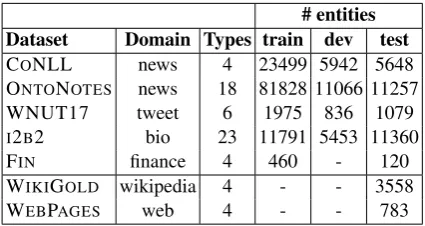
Table 3 list the dataset used in this study do-main, label size, and number of mentions in train/dev/test portions.
# entities
Dataset Domain Types train dev test
CONLL news 4 23499 5942 5648 ONTONOTES news 18 81828 11066 11257 WNUT17 tweet 6 1975 836 1079 I2B2 bio 23 11791 5453 11360
FIN finance 4 460 - 120
WIKIGOLD wikipedia 4 - - 3558
[image:8.595.76.289.410.523.2]WEBPAGES web 4 - - 783
Table 3: Statistics on the datasets used in our ex-periments.
We used the last 2 datasets to perform an out-of-domain evaluation of CONLL models. Those are small datasets extracted from Wikipedia articles and web pages respectively, and manually anno-tated following CONLL-2003 annotation scheme.
A.3 NER Model Training
Our system is a single Bi-LSTM layer with a CRF decoder, with 128 hidden units for all datasets except for ONTONOTES and I2B2 where we use 256 hidden units. For each learned representa-tions (ours, ELMo, FLAIR, BERT), we use the weighted sum of all layers as input, where weights are learned during training. For each word, we
stack the embeddings by concatenating them to form the input feature of the encoder.