26
Neural Speech Translation using Lattice Transformations and Graph
Networks
Daniel Beck† Trevor Cohn† Gholamreza Haffari‡ †School of Computing and Information Systems
University of Melbourne, Australia
{d.beck,t.cohn}@unimelb.edu.au
‡Faculty of Information Technology
Monash University, Australia
Abstract
Speech translation systems usually follow a pipeline approach, using word lattices as an intermediate representation. However, previ-ous work assume access to the original tran-scriptions used to train the ASR system, which can limit applicability in real scenarios. In this work we propose an approach for speech trans-lation through lattice transformations and neu-ral models based on graph networks. Experi-mental results show that our approach reaches competitive performance without relying on transcriptions, while also being orders of mag-nitude faster than previous work.
1 Introduction
Translation from speech utterances is a challeng-ing problem that has been studied both under sta-tistical, symbolic approaches (Ney, 1999; Casacu-berta et al., 2004; Kumar et al., 2015) and more re-cently using neural models (Sperber et al., 2017). Most previous work rely on pipeline approaches, using the output of a speech recognition system (ASR) as an input to a machine translation (MT) one. These inputs can be simply the 1-best sen-tence returned by the ASR system or a more struc-tured representation such as a lattice.
Some recent work on end-to-end systems by-pass the need for intermediate representations, with impressive results (Weiss et al., 2017). How-ever, such a scenario has drawbacks. From a prac-tical perspective, it requires access to the original speech utterances and transcriptions, which can be unrealistic if a user needs to employ an out-of-the-box ASR system. From a theoretical perspec-tive, intermediate representations such as lattices can be enriched through external, textual resources such as monolingual corpora or dictionaries.
Sperber et al. (2017) proposes a lattice-to-sequence model which, in theory, can address both problems above. However, their model suffers
from training speed performance due to the lack of efficient batching procedures and they rely on transcriptions for pretraining. In this work, we address these two problems by applying lattice transformations and graph networks as encoders. More specifically, we enrich the lattices by apply-ing subword segmentation usapply-ing byte-pair encod-ing (Sennrich et al., 2016, BPE) and perform a minimisation step to remove redundant nodes aris-ing from this procedure. Together with the stan-dard batching strategies provided by graph net-works, we are able to decrease training time by two orders of magnitude, enabling us to match their translation performance under the same train-ing speed constraintswithout relying on gold tran-scriptions.
2 Approach
Many graph network options exist in the litera-ture (Bruna et al., 2014; Duvenaud et al., 2015; Kipf and Welling, 2017; Gilmer et al., 2017): in this work we opt for a Gated Graph Neural Net-work (Li et al., 2016, GGNN), which was re-cently incorporated in an encoder-decoder archi-tecture by Beck et al. (2018). Assume a directed graph G = {V,E, LV, LE}, where V is a set of
nodes (v, `v), E is a set of edges (vi, vj, `e) and
LVandLEare respectively vocabularies for nodes
and edges, from which node and edge labels (`v
and `e) are defined. Given an input graph with
node embeddingsX, a GGNN is defined as
h0v =xv
rtv =σ crv X
u∈Nv
W`reh(ut−1)+br`e
!
ztv =σ czv X
u∈Nv
W`zeh(ut−1)+bz`e
e
htv =ρ cv
X
u∈Nv W`e
rtuh(ut−1)+b`e
!
hvt = (1−ztv)hv(i−1)+ztvehtv
wheree= (u, v, `e)is the edge between nodesu
andv,N(v)is the set of neighbour nodes forv,ρ
is a non-linear function,σis the sigmoid function and cv = czv = crv = |Nv|−1 are normalisation
constants.
Intuitively, a GGNN reduces to a GRU (Cho et al., 2014) if the graph is a linear chain. There-fore, the GGNN acts as a generalised encoder that updates nodes according to their neighbourhood. Multiple layers can be stacked, allowing informa-tion to be propagated through longer paths in the graph. Batching can be done by using adjacency matrices and matrix operations to perform the up-dates, enabling efficient processing on a GPU.
2.1 Lattice Transformations
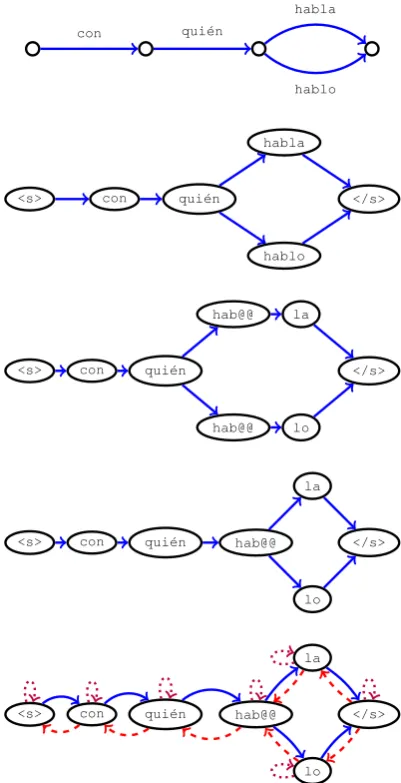
As pointed out by Beck et al. (2018), GGNNs can suffer from parameter explosion when the edge la-bel space is large, as the number of parameters is proportional to the set of edge labels. This is a problem for lattices, since most of the information is encoded on the edges. We tackle this problem by transforming the lattices into their correspond-ing line graphs, which swaps nodes and edges.1 After this transformation, we also add start and end symbols, which enable the encoder to prop-agate information through all possible paths in the lattice. Importantly, we also remove node scores from the lattice in most of our experiments, but we do revisit this idea in§3.3.
Having lattices as inputs allow us to incorpo-rate additional steps of textual transformations. To showcase this, in this work we perform subword segmentation on the lattice nodes using BPE. If a node is not present in the subword vocabulary, we split it into subwords and connect them in a left-to-right manner.
The BPE segmentation can lead to redundant nodes in the lattice. Our next transformation step is a minimisation procedure, where such nodes are joined into a single node in the graph. To perform this step, we leverage an efficient algorithm for automata minimisation (Hopcroft, 1971), which traverses the graph detecting redundant nodes by using equivalence classes, running in O(nlogn)
time, wherenis the number of nodes.
1This procedure is also done in Sperber et al. (2017).
con qui´en
habla
hablo
<s> con qui´en
habla
hablo
</s>
<s> con qui´en
hab@@ la
hab@@ lo
</s>
<s> con qui´en hab@@ la
lo </s>
<s> con qui´en hab@@ la
[image:2.595.315.516.63.455.2]lo </s>
Figure 1: Proposed lattice transformations. From top to bottom: 1) Original lattice with scores removed; 2) Line graph transformation; 3) Subword segmenta-tion; 4) Lattice minimisasegmenta-tion; 5) Addition of reverse and self-loop edges.
The final step adds reverse and self-loop edges to the lattice, where these new edges have specific parameters in the encoder. This eases propaga-tion of informapropaga-tion and is standard practice when using graph networks as encoders (Marcheggiani and Titov, 2017; Bastings et al., 2017; Beck et al., 2018). We show an example of all the transforma-tion steps on Figure 1.
In Figure 2 we show the architecture of our sys-tem, using the final lattice from Figure 1 as an example. Nodes are represented as embeddings that are updated according to the lattice structure, resulting in a set of hidden states as the output. Other components follow a standard seq2seq
Bilinear Attention
with
who
am
I
speaking
Embeddings GGNN Encoder Attention RNN Decoder
<s>
con
quién
hab@@
la
lo
</s>
[image:3.595.141.461.61.248.2]...
Figure 2: Model architecture, using the final Spanish lattice from Figure 1 and its corresponding English translation as an example.
Schmidhuber, 1997) as the decoder.
3 Experiments
Data We perform experiments using the Fisher/Callhome Speech Translation corpus, composed of Spanish telephone conversations with their corresponding English translations. We use the original release by Post et al. (2013), containing both 1-best and pruned lattice outputs from an ASR system for each Spanish utterance.2 The Fisher corpus contain 150K instances and we use the original splits provided with the datasets. Following previous work (Post et al., 2013; Sperber et al., 2017), we lowercase and remove punctuation from the English translations. To build the BPE models, we extract the vocabulary from the Spanish training lattices, using 8K split operations.
Models and Evaluation All our models are
trained on the Fisher training set. For the 1-best baseline we use a standardseq2seqarchitecture and for the GGNN models, we use the same setup as Beck et al. (2018). Our implementation is based on the Sockeye toolkit (Hieber et al., 2017) and we use default values for most hyperparameters, except for batch size (16) and GGNN layers (8).3 For regularisation, we apply 0.5 dropout on the in-put embeddings and perform early stopping on the corresponding Fisher dev set.
2
We refer the reader to Post et al. (2013) for details on the ASR system and how the lattices were generated.
3A complete description of hyperparameter values is
available in the Supplementary Material.
1-best L L+S L+S+M
Median 32.4 34.4 34.5 34.3
Ensemble 36.1 38.3 38.7 39.1
Table 1: Out-of-the-box scenario results, in BLEU scores. “L” corresponds to word lattice inputs, “L+S” and “L+S+M” correspond to lattices after subword seg-mentation and after minimisation, respectively.
Each model is trained using 5 different seeds and we report BLEU (Papineni et al., 2001) re-sults using the median performance according to the dev set and an ensemble of the 5 models. For the word-based models, we remove any tokens with frequency lower than 2 (as in Sperber et al. (2017)), while for subword models we do not per-form any threshold pruning. We report all results on the Fisher “dev2” set.4
3.1 Out-of-the-box ASR scenario
In this scenario we assume only lattices and 1-best outputs are available, simulating a setting where we do not have access to the transcriptions. Ta-ble 1 shows that results are consistent with pre-vious work: lattices provide significant improve-ments over simply using the 1-best output. More importantly though, the results also highlight the benefits of our proposed transformations and we obtain the best ensemble performance using min-imised lattices.
4We also experimented with the Callhome test set,
L+S+M L+S+M+T
Median 34.3 37.1
Ensemble 39.1 42.3
Previous Work - no lattice scores
Sperber et al. (2017) – 36.9
Previous Work - with lattice scores
[image:4.595.77.286.64.194.2]Post et al. (2013) – 36.8 Sperber et al. (2017) – 38.5
Table 2: Results with transcriptions, in BLEU scores. “L+S+M” corresponds to the same results in Table 1 and “L+S+M+T” is the setting with gold transcriptions added to the training set.
3.2 Adding Transcriptions
The out-of-the-box results in §3.1 are arguably more general in terms of applicability in real sce-narios. However, in order to compare with the state-of-the-art, we also experiment with a sce-nario where we have access to the original Spanish transcriptions. To incorporate transcriptions into our model, we convert them into a linear chain graph, after segmenting using BPE. With this, we can simply take the union of transcriptions and lat-tices into a single training set. We keep the dev and test sets with lattices only, as this emulates test time conditions.
The results shown in Table 2 are consistent with previous work: adding transcriptions further en-hance the system performance. We also slightly outperform Sperber et al. (2017) in the setting where they ignore lattice scores, as in our ap-proach. Most importantly, we are able to reach those results while being two orders of magnitude faster at training time: Sperber et al. (2017) report taking 1.5 days for each epoch while our archi-tecture can process each epoch in 15min. The rea-son is because their model relies on the CPU while our GGNN-based model can be easily batched and computed in a GPU.
Given those differences in training time, it is worth mentioning that the best model in Sperber et al. (2017) is surpassed by our best ensemble us-ing lattices only. This means that we can obtain state-of-the-art performance even in an out-of-the-box scenario, under the same training speed con-straints. While there are other constraints that may be considered (such as parameter budget), we nev-ertheless believe this is an encouraging result for real world scenarios.
3.3 Adding Lattice Scores
Our approach is not without limitations. In par-ticular, the GGNN encoder ignores lattice scores, which can help the model disambiguate between different paths in the lattice. As a simple first ap-proach to incorporate scores, we embed them us-ing a multilayer perceptron, usus-ing the score as the input. This however did not produce good results: performance dropped to 32.9 BLEU in the single model setting and 38.4 for the ensemble.
It is worth noticing that Sperber et al. (2017) has a more principled approach to incorporate scores: by modifying the attention module. This is ar-guably a better choice, since the scores can di-rectly inform the decoder about the ambiguity in the lattice. Since this approach does not affect the encoder, it is theoretically possible to combine our GGNN encoder with their attention module, we leave this avenue for future work.
4 Conclusions and Future Work
In this work we proposed an architecture for lattice-to-string translation by treating lattices as general graphs and leveraging on recent advances in neural networks for graphs.5 Compared to pre-vious similar work, our model permits easy mini-batching and allows one to freely enrich the lat-tices with additional information, which we ex-ploit by incorporating BPE segmentation and lat-tice minimisation. We show promising results and outperform baselines in speech translation, partic-ularly in out-of-the-box ASR scenarios, when one has no access to transcriptions.
For future work, we plan to investigate better approaches to incorporate scores in the lattices. The approaches used by Sperber et al. (2017) can provide a starting point in this direction. The same minimisation procedures we employ can be adapted to weighted lattices (Eisner, 2003). An-other important avenue is to explore this approach in low-resource scenarios such as ones involving endangered languages (Adams et al., 2017; Anas-tasopoulos and Chiang, 2018).
Acknowledgements
This work was supported by the Australian Re-search Council (DP160102686). The research reported in this paper was partly conducted at the 2017 Frederick Jelinek Memorial Summer
5Code to replicate results available at github.com/
Workshop on Speech and Language Technolo-gies, hosted at Carnegie Mellon University and sponsored by Johns Hopkins University with un-restricted gifts from Amazon, Apple, Facebook, Google, and Microsoft.
References
Oliver Adams, Trevor Cohn, Graham Neubig, and Alexis Michaud. 2017. Phonemic transcription of low-resource tonal languages. In Proceedings of ALTA, pages 53–60.
Antonis Anastasopoulos and David Chiang. 2018. Tied Multitask Learning for Neural Speech Translation. InProceedings of NAACL.
Joost Bastings, Ivan Titov, Wilker Aziz, Diego Marcheggiani, and Khalil Sima’an. 2017. Graph Convolutional Encoders for Syntax-aware Neural Machine Translation. In Proceedings of EMNLP, pages 1947–1957.
Daniel Beck, Gholamreza Haffari, and Trevor Cohn. 2018. Graph-to-Sequence Learning using Gated Graph Neural Networks. InProceedings of ACL.
Joan Bruna, Wojciech Zaremba, Arthur Szlam, and Yann LeCun. 2014. Spectral Networks and Locally Connected Networks on Graphs. InProceedings of ICLR, page 14.
Francisco Casacuberta, Hermann Ney, Franz Josef Och, Enrique Vidal, Juan Miguel Vilar, Sergio Bar-rachina, Ismael Garc´ıa-Varea, David Llorens, Car-los D. Mart´ınez, Sirko Molau, Francisco Nevado, Mois´es ´Angeles Pastor, David Pic´o, Alberto San-chis, and Christoph Tillmann. 2004. Some ap-proaches to statistical and finite-state speech-to-speech translation. Computer Speech and Lan-guage, 18(1):25–47.
Kyunghyun Cho, Bart van Merrienboer, Caglar Gul-cehre, Dzmitry Bahdanau, Fethi Bougares, Hol-ger Schwenk, and Yoshua Bengio. 2014. Learn-ing Phrase Representations usLearn-ing RNN Encoder-Decoder for Statistical Machine Translation. In Pro-ceedings of EMNLP, pages 1724–1734.
David Duvenaud, Dougal Maclaurin, Jorge Aguilera-Iparraguirre, Rafael G´omez-Bombarelli, Timothy Hirzel, Al´an Aspuru-Guzik, and Ryan P Adams. 2015. Convolutional Networks on Graphs for Learning Molecular Fingerprints. InProceedings of NIPS, pages 2215–2223.
Jason Eisner. 2003. Simpler and More General Min-imization for Weighted Finite-State Automata. In Proceedings of NAACL, pages 64–71.
Justin Gilmer, Samuel S. Schoenholz, Patrick F. Riley, Oriol Vinyals, and George E. Dahl. 2017. Neural Message Passing for Quantum Chemistry. In Pro-ceedings of ICML.
Felix Hieber, Tobias Domhan, Michael Denkowski, David Vilar, Artem Sokolov, Ann Clifton, and Matt Post. 2017. Sockeye: A Toolkit for Neural Machine Translation. arXiv preprint, pages 1–18.
Sepp Hochreiter and J¨urgen Schmidhuber. 1997. Long Short-Term Memory. Neural Computation, 9(8):1735–1780.
John Hopcroft. 1971. An O(n log n) Algorithm for Minimizing States in a Finite Automaton. Theory of machines and computations.
Thomas N. Kipf and Max Welling. 2017. Semi-Supervised Classification with Graph Convolutional Networks. InProceedings of ICLR.
Gaurav Kumar, Graeme Blackwood, Jan Trmal, Daniel Povey, and Sanjeev Khudanpur. 2015. A Coarse-Grained Model for Optimal Coupling of ASR and SMT Systems for Speech Translation. In Proceed-ings of EMNLP, pages 1902–1907.
Yujia Li, Daniel Tarlow, Marc Brockschmidt, and Richard Zemel. 2016. Gated Graph Sequence Neu-ral Networks. InProceedings of ICLR, 1, pages 1– 20.
Minh-Thang Luong, Hieu Pham, and Christopher D. Manning. 2015. Effective Approaches to Attention-based Neural Machine Translation. InProceedings of EMNLP, pages 1412–1421.
Diego Marcheggiani and Ivan Titov. 2017. Encod-ing Sentences with Graph Convolutional Networks for Semantic Role Labeling. In Proceedings of EMNLP.
Hermann Ney. 1999. Speech Translation: Coupling of Recognition and Translation. In Proceedings of ICASSP, pages 517–520.
Kishore Papineni, Salim Roukos, Todd Ward, and Wei-Jing Zhu. 2001. Bleu: a method for automatic eval-uation of machine translation. In Proceedings of ACL, pages 311–318.
Matt Post, Gaurav Kumar, Adam Lopez, Damianos Karakos, Chris Callison-Burch, and Sanjeev Khu-danpur. 2013. Improved Speech-to-Text Transla-tion with the Fisher and Callhome Spanish–English Speech Translation Corpus. In Proceedings of IWSLT.
Rico Sennrich, Barry Haddow, and Alexandra Birch. 2016. Neural Machine Translation of Rare Words with Subword Units. InProceedings of ACL, pages 1715–1725.