Challenges in Data-to-Document Generation
Sam Wiseman and Stuart M. Shieber and Alexander M. Rush
School of Engineering and Applied Sciences Harvard University
Cambridge, MA, USA
{swiseman,shieber,srush}@seas.harvard.edu
Abstract
Recent neural models have shown signif-icant progress on the problem of generat-ing short descriptive texts conditioned on a small number of database records. In this work, we suggest a slightly more dif-ficult data-to-text generation task, and in-vestigate how effective current approaches are on this task. In particular, we introduce a new, large-scale corpus of data records paired with descriptive documents, pro-pose a series of extractive evaluation meth-ods for analyzing performance, and ob-tain baseline results using current neural generation methods. Experiments show that these models produce fluent text, but fail to convincingly approximate human-generated documents. Moreover, even templated baselines exceed the perfor-mance of these neural models on some metrics, though copy- and reconstruction-based extensions lead to noticeable im-provements.
1 Introduction
Over the past several years, neural text genera-tion systems have shown impressive performance on tasks such as machine translation and summa-rization. As neural systems begin to move toward generating longer outputs in response to longer and more complicated inputs, however, the gener-ated texts begin to display reference errors, inter-sentence incoherence, and a lack of fidelity to the source material. The goal of this paper is to suggest a particular, long-form generation task in which these challenges may be fruitfully explored, to provide a publically available dataset for this task, to suggest some automatic evaluation met-rics, and finally to establish how current, neural
text generation methods perform on this task. A classic problem in natural-language
genera-tion (NLG) (Kukich,1983;McKeown,1992;
Re-iter and Dale, 1997) involves taking structured data, such as a table, as input, and producing text that adequately and fluently describes this data as output. Unlike machine translation, which aims for a complete transduction of the sentence to be translated, this form of NLG is typically taken to require addressing (at least) two separate chal-lenges:what to say, the selection of an appropriate
subset of the input data to discuss, andhow to say
it, the surface realization of a generation (Reiter and Dale,1997;Jurafsky and Martin,2014). Tra-ditionally, these two challenges have been modu-larized and handled separately by generation sys-tems. However, neural generation systems, which are typically trained end-to-end as conditional
lan-guage models (Mikolov et al., 2010; Sutskever
et al.,2011,2014), blur this distinction.
In this context, we believe the problem of generating multi-sentence summaries of tables or database records to be a reasonable next-problem for neural techniques to tackle as they begin to consider more difficult NLG tasks. In particu-lar, we would like this generation task to have the following two properties: (1) it is relatively easy to obtain fairly clean summaries and their corre-sponding databases for dataset construction, and (2) the summaries should be primarily focused on conveying the information in the database. This latter property ensures that the task is somewhat congenial to a standard encoder-decoder approach, and, more importantly, that it is reasonable to
eval-uate generations in terms of their fidelity to the
database.
One task that meets these criteria is that of gen-erating summaries of sports games from associ-ated box-score data, and there is indeed a long history of NLG work that generates sports game
summaries (Robin,1994;Tanaka-Ishii et al.,1998; Barzilay and Lapata,2005). To this end, we make the following contributions:
• We introduce a new large-scale corpus
con-sisting of textual descriptions of basketball games paired with extensive statistical tables. This dataset is sufficiently large that fully data-driven approaches might be sufficient.
• We introduce a series of extractive
evalua-tion models to automatically evaluate output generation performance, exploiting the fact that post-hoc information extraction is signif-icantly easier than generation itself.
• We apply a series of state-of-the-art neural
methods, as well as a simple templated ation system, to our data-to-document gener-ation task in order to establish baselines and study their generations.
Our experiments indicate that neural systems are quite good at producing fluent outputs and generally score well on standard word-match met-rics, but perform quite poorly at content selection and at capturing long-term structure. While the use of copy-based models and additional recon-struction terms in the training loss can lead to im-provements in BLEU and in our proposed extrac-tive evaluations, current models are still quite far from producing human-level output, and are sig-nificantly worse than templated systems in terms of content selection and realization. Overall, we believe this problem of data-to-document genera-tion highlights important remaining challenges in neural generation systems, and the use of extrac-tive evaluation reveals significant issues hidden by standard automatic metrics.
2 Data-to-Text Datasets
We consider the problem of generating descriptive text from database records. Following the notation inLiang et al.(2009), lets={rj}Jj=1be a set of
records, where for eachr∈swe definer.t∈ T to
be thetypeofr, and we assume eachr to be a
bi-narized relation, wherer.eandr.mare a record’s
entity and value, respectively. For example, a database recording statistics for a basketball game
might have a recordr such thatr.t=POINTS,r.e
= RUSSELL WESTBROOK, and r.m = 50. In this case,r.egives the player in question, andr.m
gives the number of points the player scored. From
these records, we are interested in generating de-scriptive text,yˆ1:T = ˆy1, . . . ,yˆT ofT words such thatyˆ1:T is an adequate and fluent summary ofs. A dataset for training data-to-document systems typically consists of(s, y1:T)pairs, wherey1:T is a document consisting of a gold (i.e., human
gen-erated) summary for databases.
Several benchmark datasets have been used in recent years for the text generation task, the most
popular of these being WEATHERGOV (Liang
et al., 2009) and ROBOCUP (Chen and Mooney,
2008). Recently, neural generation systems have
show strong results on these datasets, with the
sys-tem ofMei et al. (2016) achieving BLEU scores
in the 60s and 70s on WEATHERGOV, and BLEU
scores of almost 30 even on the smaller ROBOCUP
dataset. These results are quite promising, and suggest that neural models are a good fit for text generation. However, the statistics of these
datasets, shown in Table 1, indicate that these
datasets use relatively simple language and record structure. Furthermore, there is reason to believe
that WEATHERGOV is at least partially
machine-generated (Reiter, 2017). More recently, Lebret
et al. (2016) introduced the WIKIBIO dataset, which is at least an order of magnitude larger in terms of number of tokens and record types.
How-ever, as shown in Table 1, this dataset too only
contains short (single-sentence) generations, and relatively few records per generation. As such, we believe that early success on these datasets is not yet sufficient for testing the desired linguistic ca-pabilities of text generation at a document-scale.
With this challenge in mind, we introduce a new dataset for data-to-document text
gen-eration, available at https://github.com/
harvardnlp/boxscore-data. The dataset
is intended to be comparable to WEATHERGOV
in terms of token count, but to have significantly longer target texts, a larger vocabulary space, and to require more difficult content selection.
The dataset consists of two sources of arti-cles summarizing NBA basketball games, paired with their corresponding box- and line-score ta-bles. The data statistics of these two sources, RO
-TOWIRE and SBNATION, are also shown in
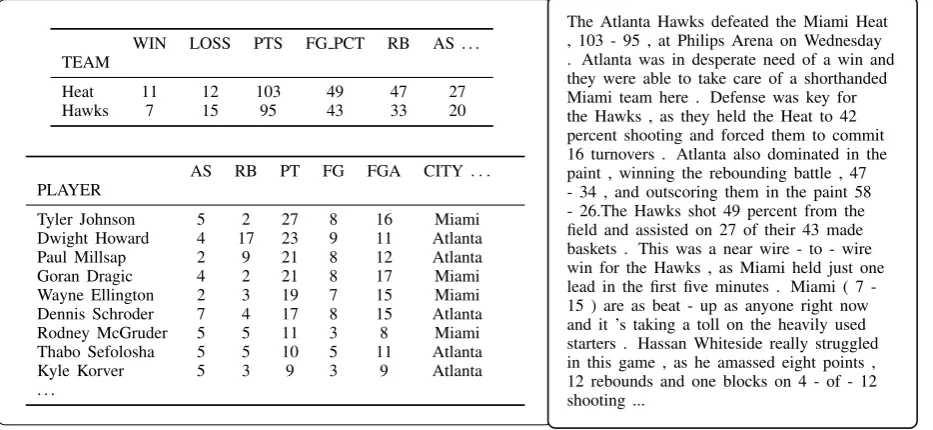
WIN LOSS PTS FG PCT RB AS . . . TEAM
Heat 11 12 103 49 47 27
Hawks 7 15 95 43 33 20
AS RB PT FG FGA CITY. . .
PLAYER
Tyler Johnson 5 2 27 8 16 Miami
Dwight Howard 4 17 23 9 11 Atlanta
Paul Millsap 2 9 21 8 12 Atlanta
Goran Dragic 4 2 21 8 17 Miami
Wayne Ellington 2 3 19 7 15 Miami
Dennis Schroder 7 4 17 8 15 Atlanta
Rodney McGruder 5 5 11 3 8 Miami
Thabo Sefolosha 5 5 10 5 11 Atlanta
Kyle Korver 5 3 9 3 9 Atlanta
. . .
[image:3.595.76.543.65.280.2]The Atlanta Hawks defeated the Miami Heat , 103 - 95 , at Philips Arena on Wednesday . Atlanta was in desperate need of a win and they were able to take care of a shorthanded Miami team here . Defense was key for the Hawks , as they held the Heat to 42 percent shooting and forced them to commit 16 turnovers . Atlanta also dominated in the paint , winning the rebounding battle , 47 - 34 , and outscoring them in the paint 58 - 26.The Hawks shot 49 percent from the field and assisted on 27 of their 43 made baskets . This was a near wire - to - wire win for the Hawks , as Miami held just one lead in the first five minutes . Miami ( 7 -15 ) are as beat - up as anyone right now and it ’s taking a toll on the heavily used starters . Hassan Whiteside really struggled in this game , as he amassed eight points , 12 rebounds and one blocks on 4 - of - 12 shooting ...
Figure 1: An example data-record and document pair from the ROTOWIREdataset. We show a subset of the game’s records (there are 628 in total), and a selection from the gold document. The document mentions only a select subset of the records, but may express them in a complicated manner. In addition to capturing the writing style, a generation system should select similar record content, express it clearly, and order it appropriately.
RC WG WB RW SBN
Vocab 409 394 400K 11.3K 68.6K
Tokens 11K 0.9M 19M 1.6M 8.8M
Examples 1.9K 22.1K 728K 4.9K 10.9K Avg Len 5.7 28.7 26.1 337.1 805.4
Rec. Types 4 10 1.7K 39 39
Avg Records 2.2 191 19.7 628 628
Table 1: Vocabulary size, number of total tokens, number of distinct examples, average generation length, total number of record types, and average number of records per example for the ROBOCUP(RC), WEATHERGOV(WG), WIKIBIO(WB), ROTOWIRE(RW), and SBNATION(SBN) datasets.
statistics. The second dataset, SBNATION, uses
fan-written summaries targeted at other fans. This dataset is significantly larger, but also much more challenging, as the language is very informal, and often tangential to the statistics themselves. We
show some sample text from ROTOWIREin
Fig-ure 1. Our primary focus will be on the RO
-TOWIREdata.
3 Evaluating Document Generation We begin by discussing the evaluation of gener-ated documents, since both the task we introduce and the evaluation methods we propose are moti-vated by some of the shortcomings of current ap-proaches to evaluation. Text generation systems are typically evaluated using a combination of
au-tomatic measures, such as BLEU (Papineni et al.,
2002), and human evaluation. While BLEU is
perhaps a reasonably effective way of evaluating short-form text generation, we found it to be un-satisfactory for document generation. In particu-lar, we note that it primarily rewards fluent text generation, rather than generations that capture the most important information in the database, or that report the information in a particularly coherent way. While human evaluation, on the other hand, is likely ultimately necessary for evaluating gener-ations (Liu et al.,2016;Wu et al.,2016), it is much less convenient than using automatic metrics. Fur-thermore, we believe that current text generations are sufficiently bad in sufficiently obvious ways that automatic metrics can still be of use in evalu-ation, and we are not yet at the point of needing to rely solely on human evaluators.
3.1 Extractive Evaluation
that are primarily intended to summarize informa-tion. While many generation problems do not fall into this category, we believe this to be an
interest-ing category, and one worth focusinterest-ing on because
it is amenable to this sort of evaluation.
To see how a simple information extraction sys-tem might work, consider the document in
Fig-ure 1. We may first extract candidate entity
(player, team, and city) and value (number and cer-tain string) pairs r.e, r.m that appear in the text, and then predict the typer.t(or none) of each can-didate pair. For example, we might extract the entity-value pair (“Miami Heat”, “95”) from the first sentence in Figure1, and then predict that the
typeof this pair isPOINTS, giving us an extracted recordrsuch that(r.e, r.m, r.t) =(MIAMIHEAT, 95, POINTS). Indeed, many relation extraction systems reduce relation extraction to multi-class classification precisely in this way (Zhang,2004; Zhou et al., 2008; Zeng et al., 2014; dos Santos et al.,2015).
More concretely, given a document yˆ1:T, we
consider all pairs of word-spans in each sentence
that represent possible entities e and values m.
We then model p(r.t|e, m;θ) for each pair,
us-ingr.t =to indicate unrelated pairs. We use
ar-chitectures similar to those discussed inCollobert
et al.(2011) anddos Santos et al.(2015) to param-eterize this probability; full details are given in the Appendix.
Importantly, we note that the (s, y1:T) pairs typically used for training data-to-document sys-tems are also sufficient for training the informa-tion extracinforma-tion model presented above, since we can obtain (partial) supervision by simply check-ing whether a candidate record lexically matches
a record ins.1 However, since there may be
mul-tiple recordsr∈swith the sameeandmbut with
different typesr.t, we will not always be able to
determine the type of a given entity-value pair found in the text. We therefore train our clas-sifier to minimize a latent-variable loss: for all
document spans e and m, with observed types
t(e, m) = {r.t : r∈s, r.e=e, r.m=m}
(possi-bly{}), we minimize
L(θ) =−X
e,m
log X
t0∈t(e,m)
p(r.t=t0|e, m;θ).
We find that this simple system trained in this way is quite accurate at predicting relations. On the 1Alternative approaches explicitly align the document
with the table for this task (Liang et al.,2009).
ROTOWIREdata it achieves over 90% accuracy on held-out data, and recalls approximately 60% of the relations licensed by the records.
3.2 Comparing Generations
With a sufficiently precise relation extraction sys-tem, we can begin to evaluate how well an auto-matic generationyˆ1:T has captured the information in a set of recordss. In particular, since the pre-dictions of a precise information extraction system serve to align entity-mention pairs in the text with database records, this alignment can be used both to evaluate a generation’s content selection (“what the generation says”), as well as content placement (“how the generation says it”).
We consider in particular three induced metrics:
• Content Selection (CS): precision and
re-call of unique relations r extracted from
ˆ
y1:T that are also extracted from y1:T. This measures how well the generated document matches the gold document in terms of se-lecting which records to generate.
• Relation Generation (RG): precision and
number of unique relationsr extracted from
ˆ
y1:T that also appear ins. This measures how well the system is able to generate text con-taining factual (i.e., correct) records.
• Content Ordering (CO): normalized
Damerau-Levenshtein Distance (Brill
and Moore, 2000)2 between the sequences
of records extracted from y1:T and that
extracted fromyˆ1:T. This measures how well the system orders the records it chooses to discuss.
We note that CS primarily targets the “what to say” aspect of evaluation, CO targets the “how to say it” aspect, and RG targets both.
We conclude this section by contrasting the automatic evaluation we have proposed with
recently proposed adversarial evaluation
ap-proaches, which also advocate automatic metrics
backed by classification (Bowman et al., 2016;
Kannan and Vinyals, 2016;Li et al.,2017). Un-like adversarial evaluation, which uses a black-box classifier to determine the quality of a gener-ation, our metrics are defined with respect to the 2DLD is a variant of Levenshtein distance that allows
predictions of an information extraction system. Accordingly, our metrics are quite interpretable, since by construction it is always possible to deter-mine which fact (i.e., entity-value pair) in the gen-eration is determined by the extractor to not match the database or the gold generation.
4 Neural Data-to-Document Models In this section we briefly describe the neural gener-ation methods we apply to the proposed task. As a base model we utilize the now standard
attention-based encoder-decoder model (Sutskever et al.,
2014;Cho et al.,2014;Bahdanau et al.,2015). We also experiment with several recent extensions to this model, including copy-based generation, and training with a source reconstruction term in the loss (in addition to the standard per-target-word loss).
Base Model For our base model, we map each recordr∈sinto a vectorr˜by first embeddingr.t
(e.g.,POINTS),r.e(e.g., RUSSELLWESTBROOK),
and r.m (e.g., 50), and then applying a 1-layer
MLP (similar toYang et al.(2016)).3 Our source
data-records are then represented as˜s={˜rj}Jj=1.
Given s˜, we use an LSTM decoder with
atten-tion and input-feeding, in the style ofLuong et al.
(2015), to compute the probability of each target
word, conditioned on the previous words and on
s. The model is trained end-to-end to minimize
the negative log-likelihood of the words in the gold texty1:T given corresponding source materials.
Copying There has been a surge of recent work involving augmenting encoder-decoder models to copy words directly from the source material on which they condition (Gu et al., 2016;G¨ulc¸ehre et al., 2016; Merity et al., 2016; Jia and Liang, 2016;Yang et al.,2016). These models typically introduce an additional binary variableztinto the per-timestep target word distribution, which indi-cates whether the target wordyˆtis copied from the source or generated:
p(ˆyt|yˆ1:t−1,s) =
X
z∈{0,1}
p(ˆyt, zt=z|yˆ1:t−1,s).
In our case, we assume that target words are
copied from the value portion of a recordr; that
is, a copy impliesyˆt=r.mfor somerandt. 3We also include an additional feature for whether the
player is on the home- or away-team.
Joint Copy Model The models of Gu et al.
(2016) and Yang et al. (2016) parameterize the
jointdistribution table overyˆtandztdirectly:
p(ˆyt, zt|yˆ1:t−1,s)∝
copy(ˆyt,yˆ1:t−1,s) zt= 1,yˆt∈s
0 zt= 1,yˆt6∈s
gen(ˆyt,yˆ1:t−1,s) zt= 0,
wherecopy andgenare functions parameterized
in terms of the decoder RNN’s hidden state that as-sign scores to words, and where the notationyˆt∈s indicates thatyˆtis equal tor.mfor somer∈s.
Conditional Copy Model G¨ulc¸ehre et al.
(2016), on the other hand, decompose the joint
probability as:
p((ˆyt, zt|yˆ1:t−1,s) =
pcopy(ˆyt|zt,yˆ1:t−1,s)p(zt|yˆ1:t−1,s) zt=1
pgen(ˆyt|zt,yˆ1:t−1,s)p(zt|yˆ1:t−1,s) zt=0,
where an MLP is used to modelp(zt|yˆ1:t−1,s).
Models with copy-decoders may be trained to minimize the negative log marginal probability, marginalizing out the latent-variablezt(Gu et al., 2016;Yang et al.,2016;Merity et al.,2016).
How-ever, if it is known which target words yt are
copied, it is possible to train with a loss that does not marginalize out the latentzt. G¨ulc¸ehre et al.
(2016), for instance, assume that any target word
yt that also appears in the source is copied, and
train to minimize the negative joint log-likelihood of theytandzt.
In applying such a loss in our case, we again
note that there may be multiple records r such
that r.m appears in yˆ1:T. Accordingly, we
slightly modify the pcopy portion of the loss of
G¨ulc¸ehre et al. (2016) to sum over all matched records. In particular, we model the probability
of relations r ∈ s such that r.m = yt and r.e
is in the same sentence as r.m. Lettingr(yt) =
{r∈s:r.m=yt,same−sentence(r.e, r.m)}, we have:
pcopy(yt|zt, y1:t−1,s) =
X
r∈r(yt)
p(r|zt, y1:t−1,s).
source records compete only with each other. In the Joint Copy model, however, the source records also compete with words that cannot be copied. As a result, training the Conditional Copy model with the supervised loss ofG¨ulc¸ehre et al. (2016) can be seen as training with a word-level reconstruc-tion loss, where the decoder is trained to choose the record insthat gives rise toyt.
Reconstruction Losses Reconstruction-based techniques can also be applied at the document-or sentence-level during training. One simple approach to this problem is to utilize the hidden states of the decoder to try to reconstruct the database. A fully differentiable approach using the decoder hidden states has recently been successfully applied to neural machine translation by Tu et al.(2017). Unlike copying, this method is applied only at training, and attempts to learn decoder hidden states with broader coverage of the input data.
In adopting this reconstruction approach we
segment the decoder hidden states ht into dBTe
contiguous blocks of size at mostB. Denoting a
single one of these hidden state blocks as bi, we
attempt to predict each field value in some record
r∈sfrombi. We definep(r.e, r.m|bi), the prob-ability of the entity and value in recordrgivenbi, to besoftmax(f(bi)), wheref is a parameterized function ofbi, which in our experiments utilize a convolutional layer followed by an MLP; full de-tails are given in the Appendix. We further extend this idea and predictKrecords insfrombi, rather than one. We can train with the following recon-struction loss for a particularbi:
L(θ) =−XK
k=1
min
r∈slogpk(r|bi;θ)
=−XK
k=1
min r∈s
X
x∈{e,m,t}
logpk(r.x|bi;θ),
where pk is the k’th predicted distribution over
records, and where we have modeled each
com-ponent ofr independently. This loss attempts to
make themostprobable record insgivenbimore
probable. We found that augmenting the above loss with a term that penalizes the total variation
distance (TVD) between the pk to be helpful.4
4Penalizing the TVD between thep
kmight be useful if, for instance,K is too large, and only a smaller number of records can be predicted frombi. We also experimented with
Both L(θ) and the TVD term are simply added
to the standard negative log-likelihood objective at training time.
5 Experimental Methods
In this section we highlight a few important de-tails of our models and methods; full dede-tails are
in the Appendix. For our ROTOWIREmodels, the
record encoder produces ˜rj in R600, and we use
a 2-layer LSTM decoder with hidden states of the same size as the˜rj, and dot-product attention and input-feeding in the style of Luong et al. (2015). Unlike past work, we use two identically struc-tured attention layers, one to compute the standard generation probabilities (genorpgen), and one to
produce the scores used incopyorpcopy.
We train the generation models using SGD and
truncated BPTT (Elman, 1990; Mikolov et al.,
2010), as in language modeling. That is, we split
each y1:T into contiguous blocks of length 100,
and backprop both the gradients with respect to the current block as well as with respect to the en-coder parameters for each block.
Our extractive evaluator consists of an ensem-ble of 3 layer convolutional and 3 single-layer bidirectional LSTM models. The convolu-tional models concatenate convolutions with ker-nel widths 2, 3, and 5, and 200 feature maps in the style of (Kim,2014). Both models are trained with SGD.
Templatized Generator In addition to neu-ral baselines, we also use a problem-specific, template-based generator. The template-based generator first emits a sentence about the teams playing in the game, using a templatized sentence taken from the training set:
The <team1> (<wins1>-<losses1>) de-feated the<team2>(<wins2>-<losses2>)
<pts1>-<pts2>.
Then, 6 player-specific sentences of the following form are emitted (again adapting a simple sentence from the training set):
<player> scored <pts> points (<fgm>
-<fga> FG, <tpm>-<tpa> 3PT, <ftm>
-<fta>FT) to go with<reb>rebounds.
The 6 highest-scoring players in the game are used to fill in the above template. Finally, a typical end sentence is emitted:
The <team1>’ next game will be at home against the Dallas Mavericks, while the
<team2>will travel to play the Bulls.
Code implementing all models can be found at https://github.com/harvardnlp/ data2text. Our encoder-decoder models are
based on OpenNMT (Klein et al.,2017).
6 Results
We found that all models performed quite poorly
on the SBNATION data, with the best model
achieving a validation perplexity of 33.34 and a BLEU score of 1.78. This poor performance is presumably attributable to the noisy quality of the SBNATION data, and the fact that many docu-ments in the dataset focus on information not in the box- and line-scores. Accordingly, we focus
on ROTOWIREin what follows.
The main results for the ROTOWIREdataset are
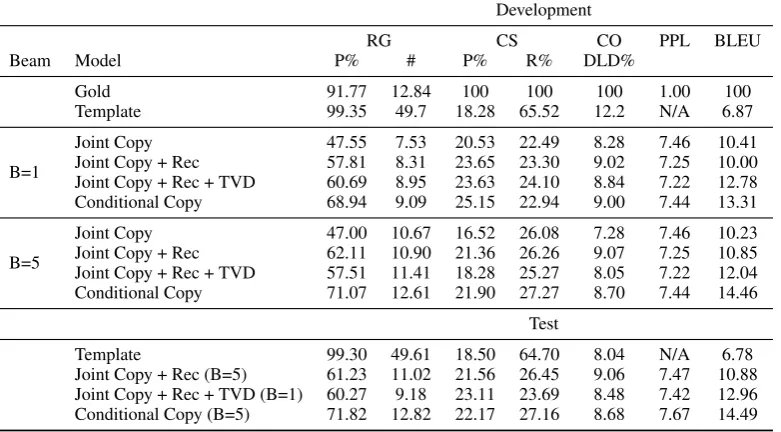
shown in Table2, which shows the performance
of the models in Section4in terms of the metrics
defined in Section3.2, as well as in terms of per-plexity and BLEU.
6.1 Discussion
There are several interesting relationships in the
development portion of Table2. First we note that
the Template model scores very poorly on BLEU, but does quite well on the extractive metrics, pro-viding an upper-bound for how domain knowledge could help content selection and generation. All the neural models make significant improvements terms of BLEU score, with the conditional copy-ing with beam search performcopy-ing the best, even though all the neural models achieve roughly the same perplexity.
The extractive metrics provide further insight into the behavior of the models. We first note
that on the gold documents y1:T, the extractive
model reaches 92% precision. Using the Joint
Copy model, generation only has a record
gen-eration (RG) precision of 47%indicating that
re-lationships are often generated incorrectly. The best Conditional Copy system improves this value
to71%, a significant improvement and potentially
the cause of the improved BLEU score, but still far below gold.
TheUtah Jazz(38-26)defeatedtheHouston Rockets(38 -26)117 - 91on Wednesday atEnergy Solutions Arena in Salt Lake City. TheJazzgot out to a quick start in this one , out - scoring theRockets 31-15in the first quarter alone . Along with the quick start , theRocketswere the superior shooters in this game , going54 percent from the fieldand
43 percent from the three - point line, while theJazzwent
38percent from the floor and a meager19percent from deep . TheRocketswere able to out - rebound theRockets49 -49, giving them just enough of an advantage to secure the victory in front of theirhome crowd. TheJazzwere led by the duo ofDerrick FavorsandJames Harden. Favors went2 - for - 6from the field and0 - for - 1from the three - point line to score agame - highof15 points, while also addingfour reboundsandfour assists....
Figure 2: Example document generated by the Conditional Copy system with a beam of size 5. Text that accurately re-flects a record in the associated box- or line-score is high-lighted inblue, and erroneous text is highlighted inred.
Notably, content selection (CS) and content or-dering (CO) seem to have no correlation at all with BLEU. There is some improvement with CS for the conditional model or reconstruction loss, but not much change as we move to beam search. CO actually gets worse as beam search is utilized, possibly a side effect of generating more records (RG#). The fact that these scores are much worse than the simple templated model indicates that fur-ther research is needed into better copying alone for content selection and better long term content ordering models.
Test results are consistent with development re-sults, indicating that the Conditional Copy model is most effective at BLEU, RG, and CS, and that reconstruction is quite helpful for improving the joint model.
6.2 Human Evaluation
We also undertook two human evaluation studies, using Amazon Mechanical Turk. The first study attempted to determine whether generations con-sidered to be more precise by our metrics were also considered more precise by human raters. To accomplish this, raters were presented with a par-ticular NBA game’s box score and line score, as well as with (randomly selected) sentences from summaries generated by our different models for those games. Raters were then asked to count how many facts in each sentence were supported by records in the box or line scores, and how many were contradicted. We randomly selected 20 dis-tinct games to present to raters, and a total of 20 generated sentences per game were evaluated by
Development
RG CS CO PPL BLEU
Beam Model P% # P% R% DLD%
Gold 91.77 12.84 100 100 100 1.00 100
Template 99.35 49.7 18.28 65.52 12.2 N/A 6.87
B=1
Joint Copy 47.55 7.53 20.53 22.49 8.28 7.46 10.41
Joint Copy + Rec 57.81 8.31 23.65 23.30 9.02 7.25 10.00 Joint Copy + Rec + TVD 60.69 8.95 23.63 24.10 8.84 7.22 12.78 Conditional Copy 68.94 9.09 25.15 22.94 9.00 7.44 13.31
B=5
Joint Copy 47.00 10.67 16.52 26.08 7.28 7.46 10.23
Joint Copy + Rec 62.11 10.90 21.36 26.26 9.07 7.25 10.85 Joint Copy + Rec + TVD 57.51 11.41 18.28 25.27 8.05 7.22 12.04 Conditional Copy 71.07 12.61 21.90 27.27 8.70 7.44 14.46
Test
Template 99.30 49.61 18.50 64.70 8.04 N/A 6.78
[image:8.595.106.497.66.282.2]Joint Copy + Rec (B=5) 61.23 11.02 21.56 26.45 9.06 7.47 10.88 Joint Copy + Rec + TVD (B=1) 60.27 9.18 23.11 23.69 8.48 7.42 12.96 Conditional Copy (B=5) 71.82 12.82 22.17 27.16 8.68 7.67 14.49
Table 2: Performance of induced metrics on gold and system outputs of RotoWire development and test data. Columns indicate Record Generation (RG) precision and count, Content Selection (CS) precision and recall, Count Ordering (CO) in normalized Damerau-Levenshtein distance, perplexity, and BLEU. These first three metrics are described in Section3.2. Models com-pare Joint and Conditional Copy also with addition Reconstruction loss and Total Variation Distance extensions (described in Section4).
average numbers of supporting and contradicting facts per sentence as determined by the raters, for each model. We see that these results are generally in line with the RG and CS metrics, with the Con-ditional Copy model having the highest number of supporting facts, and the reconstruction terms sig-nificantly improving the Joint Copy models.
Using a Tukey HSD post-hoc analysis of an ANOVA with the number of contradicting facts as the dependent variable and the generating model and rater id as independent variables, we found significant (p <0.01) pairwise differences in con-tradictory facts between the gold generations and all models except “Copy+Rec+TVD,” as well as a significant difference between “Copy+Rec+TVD” and “Copy”. We similarly found a significant pair-wise difference between “Copy+Rec+TVD” and “Copy” for number of supporting facts.
Our second study attempted to determine whether generated summaries differed in terms of
how natural theirorderingof records (as captured,
for instance, by the DLD metric) is. To test this, we presented raters with random summaries gen-erated by our models and asked them to rate the naturalness of the ordering of facts in the maries on a 1-7 Likert scale. 30 random sum-maries were used in this experiment, each rated 3 times by distinct raters. The average Likert
rat-ings are shown in the rightmost column of Table3.
# Supp. # Cont. Order Rat.
Gold 2.04 0.70 5.19
Joint Copy 1.65 2.31 3.90
Joint Copy + Rec 2.33 1.83 4.43 Joint Copy + Rec +TVD 2.43 1.16 4.18 Conditional Copy 3.05 1.48 4.03
Table 3: Average rater judgment of number of box score fields supporting (left column) or contradicting (middle col-umn) a generated sentence, and average rater Likert rating for the naturalness of a summary’s ordering (right column). All generations use B=1.
While it is encouraging that the gold summaries received a higher average score than the gener-ated summaries (and that the reconstruction term again improved the Joint Copy model), a Tukey HSD analysis similar to the one presented above revealed no significant pairwise differences.
6.3 Qualitative Example
Figure2shows a document generated by the
Con-ditional Copy model, using a beam of size 5. This particular generation evidently has several nice properties: it nicely learns the colloquial style of the text, correctly using idioms such as “19 per-cent from deep.” It is also partially accurate in its use of the records; we highlight in blue when it generates text that is licensed by a record in the associated box- and line-scores.
major logical errors. First, there are basic copy-ing mistakes, such as flippcopy-ing the teams’ win/loss records. The system also makes obvious seman-tic errors; for instance, it generates the phrase “the Rockets were able to out-rebound the Rock-ets.” Finally, we see the model hallucinates fac-tual statements, such as “in front of their home crowd,” which is presumably likely according to the language model, but ultimately incorrect (and not supported by anything in the box- or line-scores). In practice, our proposed extractive eval-uation will pick up on many errors in this pas-sage. For instance, “four assists” is an RG error, repeating the Rockets’ rebounds could manifest in a lower CO score, and incorrectly indicating the win/loss records is a CS error.
7 Related Work
In this section we note additional related work not noted throughout. Natural language generation
has been studied for decades (Kukich,1983;
McK-eown,1992;Reiter and Dale,1997), and generat-ing summaries of sports games has been a topic of interest for almost as long (Robin,1994; Tanaka-Ishii et al.,1998;Barzilay and Lapata,2005).
Historically, research has focused on both
con-tent selection (“what to say”) (Kukich, 1983;
McKeown,1992;Reiter and Dale,1997;Duboue and McKeown,2003;Barzilay and Lapata,2005),
and surface realization (“how to say it”) (
Gold-berg et al., 1994;Reiter et al., 2005) with earlier work using (hand-built) grammars, and later work
using SMT-like approaches (Wong and Mooney,
2007) or generating from PCFGs (Belz, 2008)
or other formalisms (Soricut and Marcu, 2006;
White et al., 2007). In the late 2000s and early 2010s, a number of systems were proposed that did both (Liang et al., 2009;Angeli et al., 2010; Kim and Mooney,2010;Lu and Ng, 2011; Kon-stas and Lapata,2013).
Within the world of neural text generation, some recent work has focused on conditioning
language models on tables (Yang et al., 2016),
and generating short biographies from Wikipedia
Tables (Lebret et al., 2016; Chisholm et al.,
2017). Mei et al. (2016) use a neural encoder-decoder approach on standard record-based gen-eration datasets, obtaining impressive results, and motivating the need for more challenging NLG problems.
8 Conclusion and Future Work
This work explores the challenges facing neural data-to-document generation by introducing a new dataset, and proposing various metrics for auto-matically evaluating content selection, generation, and ordering. We see that recent ideas in copying and reconstruction lead to improvements on this task, but that there is a significant gap even be-tween these neural models and templated systems. We hope to motivate researchers to focus further on generation problems that are relevant both to content selection and surface realization, but may not be reflected clearly in the model’s perplexity.
Future work on this task might include ap-proaches that process or attend to the source records in a more sophisticated way, generation models that attempt to incorporate semantic or reference-related constraints, and approaches to conditioning on facts or records that are not as ex-plicit in the box- and line-scores.
Acknowledgments
We gratefully acknowledge the support of a Google Research Award.
References
Gabor Angeli, Percy Liang, and Dan Klein. 2010. A simple domain-independent probabilistic approach to generation. InProceedings of the 2010 Confer-ence on Empirical Methods in Natural Language
Processing, pages 502–512. Association for
Com-putational Linguistics.
Dzmitry Bahdanau, Kyunghyun Cho, and Yoshua Ben-gio. 2015. Neural machine translation by jointly learning to align and translate. InICLR.
Regina Barzilay and Mirella Lapata. 2005. Collective content selection for concept-to-text generation. In
Proceedings of the conference on Human Language Technology and Empirical Methods in Natural
Lan-guage Processing, pages 331–338. Association for
Computational Linguistics.
Anja Belz. 2008. Automatic generation of weather forecast texts using comprehensive probabilistic generation-space models. Natural Language
Engi-neering, 14(04):431–455.
Samuel R. Bowman, Luke Vilnis, Oriol Vinyals, An-drew M. Dai, Rafal J´ozefowicz, and Samy Ben-gio. 2016. Generating sentences from a continuous space. InCoNLL, pages 10–21.
Proceedings of the 38th Annual Meeting on
Associa-tion for ComputaAssocia-tional Linguistics, pages 286–293.
Association for Computational Linguistics.
David L Chen and Raymond J Mooney. 2008. Learn-ing to sportscast: a test of grounded language acqui-sition. InProceedings of the 25th international
con-ference on Machine learning, pages 128–135. ACM.
Andrew Chisholm, Will Radford, and Ben Hachey. 2017. Learning to generate one-sentence biogra-phies from wikidata. CoRR, abs/1702.06235. KyungHyun Cho, Bart van Merrienboer, Dzmitry
Bah-danau, and Yoshua Bengio. 2014. On the properties of neural machine translation: Encoder-decoder ap-proaches. Eighth Workshop on Syntax, Semantics
and Structure in Statistical Translation.
Ronan Collobert, Jason Weston, L´eon Bottou, Michael Karlen, Koray Kavukcuoglu, and Pavel P. Kuksa. 2011. Natural language processing (almost) from scratch. Journal of Machine Learning Research, 12:2493–2537.
Pablo A Duboue and Kathleen R McKeown. 2003. Sta-tistical acquisition of content selection rules for nat-ural language generation. In EMNLP, pages 121– 128. Association for Computational Linguistics. Jeffrey L. Elman. 1990. Finding structure in time.
Cognitive Science, 14(2):179–211.
Eli Goldberg, Norbert Driedger, and Richard I Kit-tredge. 1994. Using natural-language processing to produce weather forecasts. IEEE Expert, 9(2):45– 53.
Jiatao Gu, Zhengdong Lu, Hang Li, and Victor O. K. Li. 2016. Incorporating copying mechanism in sequence-to-sequence learning. InACL.
C¸aglar G¨ulc¸ehre, Sungjin Ahn, Ramesh Nallapati, Bowen Zhou, and Yoshua Bengio. 2016. Pointing the unknown words. InACL.
Robin Jia and Percy Liang. 2016. Data recombination for neural semantic parsing. InACL Volume 1: Long
Papers.
Dan Jurafsky and James H Martin. 2014. Speech and
language processing, volume 3. Pearson London.
Anjuli Kannan and Oriol Vinyals. 2016. Adversarial evaluation of dialogue models. InNIPS 2016
Work-shop on Adversarial Training.
Joohyun Kim and Raymond J Mooney. 2010. Gen-erative alignment and semantic parsing for learn-ing from ambiguous supervision. In Proceedings of the 23rd International Conference on
Computa-tional Linguistics: Posters, pages 543–551.
Associ-ation for ComputAssoci-ational Linguistics.
Yoon Kim. 2014. Convolutional neural networks for sentence classification. In EMNLP, pages 1746– 1751.
Guillaume Klein, Yoon Kim, Yuntian Deng, Jean Senellart, and Alexander M. Rush. 2017. Opennmt: Open-source toolkit for neural machine translation.
CoRR, abs/1701.02810.
Ioannis Konstas and Mirella Lapata. 2013. A global model for concept-to-text generation. J. Artif. Intell.
Res.(JAIR), 48:305–346.
Karen Kukich. 1983. Design of a knowledge-based re-port generator. InACL, pages 145–150.
R´emi Lebret, David Grangier, and Michael Auli. 2016. Neural text generation from structured data with application to the biography domain. In EMNLP, pages 1203–1213.
Jiwei Li, Will Monroe, Tianlin Shi, Alan Ritter, and Dan Jurafsky. 2017. Adversarial learning for neural dialogue generation. CoRR, abs/1701.06547.
Percy Liang, Michael I Jordan, and Dan Klein. 2009. Learning semantic correspondences with less super-vision. InACL, pages 91–99. Association for Com-putational Linguistics.
Chia-Wei Liu, Ryan Lowe, Iulian Serban, Michael Noseworthy, Laurent Charlin, and Joelle Pineau. 2016. How NOT to evaluate your dialogue system: An empirical study of unsupervised evaluation met-rics for dialogue response generation. In EMNLP, pages 2122–2132.
Wei Lu and Hwee Tou Ng. 2011. A probabilistic forest-to-string model for language generation from typed lambda calculus expressions. InProceedings of the Conference on Empirical Methods in
Natu-ral Language Processing, pages 1611–1622.
Asso-ciation for Computational Linguistics.
Thang Luong, Hieu Pham, and Christopher D. Man-ning. 2015. Effective approaches to attention-based neural machine translation. In Proceedings of the 2015 Conference on Empirical Methods in Natural
Language Processing, EMNLP 2015, pages 1412–
1421.
Kathleen McKeown. 1992. Text generation - using dis-course strategies and focus constraints to generate
natural language text. Studies in natural language
processing. Cambridge University Press.
Hongyuan Mei, Mohit Bansal, and Matthew R. Walter. 2016. What to talk about and how? selective gener-ation using lstms with coarse-to-fine alignment. In
NAACL HLT, pages 720–730.
Stephen Merity, Caiming Xiong, James Bradbury, and Richard Socher. 2016. Pointer sentinel mixture models. CoRR, abs/1609.07843.
Kishore Papineni, Salim Roukos, Todd Ward, and Wei-Jing Zhu. 2002. Bleu: a method for automatic eval-uation of machine translation. In Proceedings of the 40th annual meeting on association for
compu-tational linguistics, pages 311–318. Association for
Computational Linguistics.
Ehud Reiter. 2017. You need to understand your corpora! the weathergov example. https://ehudreiter.com/2017/05/ 09/weathergov/.
Ehud Reiter and Robert Dale. 1997. Building applied natural language generation systems. Natural
Lan-guage Engineering, 3(1):57–87.
Ehud Reiter, Somayajulu Sripada, Jim Hunter, Jin Yu, and Ian Davy. 2005. Choosing words in computer-generated weather forecasts. Artificial Intelligence, 167(1-2):137–169.
Jacques Robin. 1994. Revision-based generation of Natural Language Summaries providing historical
Background. Ph.D. thesis, Citeseer.
C´ıcero Nogueira dos Santos, Bing Xiang, and Bowen Zhou. 2015. Classifying relations by ranking with convolutional neural networks. InACL, pages 626– 634.
Radu Soricut and Daniel Marcu. 2006. Stochastic lan-guage generation using widl-expressions and its ap-plication in machine translation and summarization.
InProceedings of the 21st International Conference
on Computational Linguistics and the 44th annual meeting of the Association for Computational
Lin-guistics, pages 1105–1112. Association for
Compu-tational Linguistics.
Ilya Sutskever, James Martens, and Geoffrey E Hin-ton. 2011. Generating text with recurrent neural networks. InProceedings of the 28th International
Conference on Machine Learning (ICML), pages
1017–1024.
Ilya Sutskever, Oriol Vinyals, and Quoc VV Le. 2014. Sequence to sequence learning with neural net-works. InAdvances in Neural Information
Process-ing Systems (NIPS), pages 3104–3112.
Kumiko Tanaka-Ishii, Kˆoiti Hasida, and Itsuki Noda. 1998. Reactive content selection in the generation of real-time soccer commentary. InCOLING-ACL, pages 1282–1288.
Zhaopeng Tu, Yang Liu, Lifeng Shang, Xiaohua Liu, and Hang Li. 2017. Neural machine translation with reconstruction. InAAAI, pages 3097–3103.
Michael White, Rajakrishnan Rajkumar, and Scott Martin. 2007. Towards broad coverage surface real-ization with ccg. InProceedings of the Workshop on Using Corpora for NLG: Language Generation and
Machine Translation (UCNLG+ MT), pages 267–
276.
Yuk Wah Wong and Raymond J Mooney. 2007. Gen-eration by inverting a semantic parser that uses sta-tistical machine translation. InHLT-NAACL, pages 172–179.
Yonghui Wu, Mike Schuster, Zhifeng Chen, Quoc V Le, Mohammad Norouzi, Wolfgang Macherey, Maxim Krikun, Yuan Cao, Qin Gao, Klaus Macherey, et al. 2016. Google’s neural ma-chine translation system: Bridging the gap between human and machine translation. arXiv preprint
arXiv:1609.08144.
Zichao Yang, Phil Blunsom, Chris Dyer, and Wang Ling. 2016. Reference-aware language models.
CoRR, abs/1611.01628.
Daojian Zeng, Kang Liu, Siwei Lai, Guangyou Zhou, Jun Zhao, et al. 2014. Relation classification via convolutional deep neural network. In COLING, pages 2335–2344.
Zhu Zhang. 2004. Weakly-supervised relation classifi-cation for information extraction. InProceedings of the thirteenth ACM international conference on
In-formation and knowledge management, pages 581–
588. ACM.
GuoDong Zhou, JunHui Li, LongHua Qian, and Qiaoming Zhu. 2008. Semi-supervised learning for relation extraction. In Third International
Joint Conference on Natural Language Processing,