From Textbooks to Knowledge
: A Case Study in Harvesting Axiomatic
Knowledge from Textbooks to Solve Geometry Problems
Mrinmaya Sachan Avinava Dubey Eric P. Xing
School of Computer Science Carnegie Mellon University
{mrinmays, akdubey, epxing}@cs.cmu.edu
Abstract
Textbooks are rich sources of knowledge. Harvesting knowledge from textbooks is a key challenge in many educational appli-cations. In this paper, we present an ap-proach to obtain axiomatic knowledge of geometry in the form of horn-clause rules from math textbooks. The approach uses rich contextual and typographical features extracted from the textbooks. It also lever-ages the redundancy and shared ordering of axioms across multiple textbooks to ac-curately harvest axioms. These axioms are then parsed into horn-clause rules that are used to improve the state-of-the-art in solving geometry problems.
1 Introduction
Recently, researchers have proposed standardized tests as “drivers for progress in AI” (Clark and Etzioni, 2016). There is a growing body of work in solving standardized tests such as reading comprehensions (Richardson et al.,2013;Sachan et al.,2015, inter alia), science question answering (Schoenick et al., 2016; Sachan et al., 2016, in-ter alia), algebra word problems (Kushman et al.,
2014, inter alia), geometry problems (Seo et al.,
2015), pre-university entrance exams (Fujita et al.,
2014), etc. A major challenge in building these solvers is the lack of subject knowledge. For ex-ample, geometry tests require knowledge of ge-ometry axioms and pre-university exams require knowledge of laws of physics, chemistry, etc.
In this paper, we present an automatic approach that can (a) harvest such subject knowledge from textbooks, and (b) parse the extracted knowledge to structured programs that the solvers can use. Unlike information extraction systems trained on domains such as web documents (Chang et al.,
Figure 1: An excerpt of a textbook from our dataset that introduces the Pythagoras theorem. The textbook has a lot of typographical features that can be used to harvest this theorem: The textbook explicitly labels it as a “the-orem”; there is a colored bounding box around it; an equation writes down the rule and there is a supporting figure. Our models leverages such rich con-textual and typographical information (when available) to accurately harvest axioms and then parses them to horn-clause rules. The horn-clause rule de-rived by our approach for the Pythagoras theorem is:isT riangle(ABC)∧ perpendicular(AC, BC) =⇒ BC2+AC2=AB2.
2003;Etzioni et al.,2004, inter alia), learning an information extraction system that can extract ax-iomatic knowledge from textbooks is challenging because of the small amount of in-domain labeled data available for these tasks. We tackle this chal-lenge by (a) leveraging theredundancyandshared orderingof axiom mentions across multiple text-books1, and (b) utilizing rich contextual and
typo-graphical features2 from textbooks to effectively
extract and parse axioms. Finally, we also provide an approach to parse the extracted axiom men-tions from various textbooks and reconcile them to achieve the best program for each axiom.
As a case study, we use our approach to har-vest axiomatic knowledge of geometry from math textbooks, and use this knowledge to improve the state-of-the-art system for solving SAT style ge-ometry problems. Seo et al.(2015) recently
pre-sented GEOS, an automated end-to-end system
that solves SAT style geometry questions such as the one shown in Figure2. GEOSderives a logi-cal expression that represents the meaning of the
1The same axiom can be potentially mentioned in a
num-ber of textbooks in different ways. All textbooks typically introduce axioms in roughly the same order – for example, pythagorous theorem would typically be introduced after in-troducing the notion of a right angled triangle.
2Textbooks contain rich context and typographical
infor-mation (see Figure1for an illustrative example). We use this rich information as features in our model.
Text Description:
measure( MAO, 30o) isCircle(O) radius(O, 4 cm)
?x
Diagram:
liesOn( A, circle O), liesOn( B, circle O), liesOn( C, circle O), liesOn( D, circle O) isLine(AB), isLine(BC), isLine(CA), isLine(BD), isLine(DA)
isTriangle(ABC), isTriangle(ABD), isTriangle(AOM) measure( ADB, x), measure( MAO, 30o)
[image:2.595.75.298.60.216.2]measure( AMO, 90o) …
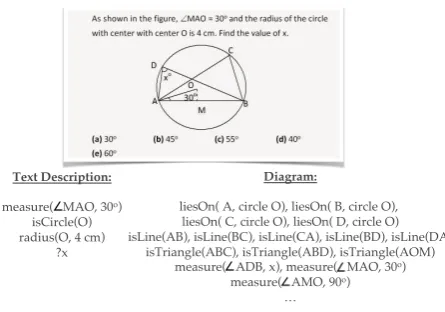
Figure 2: An example SAT style geometry problem with the question text, corresponding diagram and (optionally) answer candidates. Below: A logical expression that represents the meaning of the text description and the diagram in the problem.GEOSderives a weighted logical expression where each pred-icates also carries a weighted score but we do not show them here for clarity.
text description and the diagram (also shown in Figure2), and then solves the geometry question by checking the satisfiablity of the derived logical expression. While this solver has its basis in co-ordinate geometry and indeed works, it has some key issues:GEOSrequires an explicit mapping of each predicate into a set of constraints over point coordinates3. These constraints can be non-trivial
to write, requiring significant manual engineering. As a result, GEOS’s constraint set is incomplete and it cannot solve a number of SAT style geome-try questions. Furthermore, this solver is not in-terpretable. As our user studies show, it is not natural for a student to understand the solution of these geometry questions in terms of satisfiability of constraints over coordinates. A more natural way for students to understand and reason about these questions is through deductive reasoning us-ing axioms of geometry4.
We use our model to extract and parse axiomatic knowledge from a novel dataset of 20 publicly available math textbooks. We use this structured axiomatic knowledge to build a new axiomatic solver that performs logical inference to solve
ge-3For example, the predicateisPerpendicular(AB, CD) is
mapped to the constraintyB−yA
xB−xA×
yD−yC
xD−xC =−1.
4For example, the deductive reasoning required to solve
the question in Figure2is: (1) Use the axiom that the sum of interior angles of a triangle is 180◦and the fact that∠AMO is 90◦to conclude that∠MOA is 60◦. (2)4MOA∼ 4MOB (using a similar triangle axiom) and then,∠MOB =∠MOA = 60◦(using the axiom that corresponding angles of similar triangles are equal). (3) Use angle sum rule to conclude that
∠AOB =∠MOB +∠MOA = 120◦. (4) Use the axiom that the angle subtended by an arc of a circle at the centre is double the angle subtended by it at any point on the circle to conclude that∠ADB = 0.5×∠AOB = 60◦.
ometry problems. Our axiomatic solver outper-formsGEOSon all existing test sets introduced in
Seo et al.(2015) as well as a new test set of geom-etry questions collected from these textbooks. We also performed user studies on a number of school students studying geometry who found that our axiomatic solver is moreinterpretableanduseful
compared toGEOS.
2 Background: GEOS
Our work reusesGEOSto parse the question text and diagram into its formal problem description
as shown in Figure 2. GEOS parses the
ques-tion text and the diagram to a formal problem de-scription. GEOS uses a logical formula, a first-order logic expression that includes known num-bers or geometrical entities (e.g. 4 cm) as con-stants, unknown numbers or geometrical entities (e.g. O) as variables, geometric or arithmetic re-lations (e.g. isLine, isTriangle) as predicates and properties of geometrical entities (e.g. measure, liesOn) as functions.
This is done by learning a set of relations that potentially correspond to the question text (or the diagram) along with a confidence score. For dia-gram parsing,GEOSuses a publicly available di-agram parser for geometry problems (Seo et al.,
2014). For text parsing,GEOStakes a multi-stage approach, which maps words or phrases in the text to their corresponding concepts, and then identi-fies relations between identified concepts. Given this formal problem description,GEOSuse a nu-merical method to check the satisfiablity of literals by defining a relaxed indicator function for each literal. These indicator functions are manually en-gineered for every predicate. Since this is a
cum-bersome process, GEOShas an incomplete
map-ping of literals to indicator functions.
3 Set up for the Axiomatic Solver
sort point = {A, B, C, D, O, M}
sort line = {AB, BC, CA, BD, DA, OA, OM} //Symmetrically define BA, CB, …
sort angle = {ABC, BCA, CAB, ABD, BDA, DAB, AMO, MOA, OAM, BMO} //Symmetrically define CBA, ACB, … sort triangle = {ABC, ABD, AMO} //Symmetrically define CBA, ACB, …
sort circle = {O}
0.4 perpendicular(OM, AB) 0.8 measure(ADB, x) 0.9 liesOn(A, O) 0.9 liesOn(B, O) 0.9 liesOn(C, O) 0.9 liesOn(D, O) 0.9 liesOn(M, AB) 0.9 liesInInterior(M, AOB)
0.9 measure(OAM, 30) 0.9 measure(radius(O), 4 cm) 0.9 query(x, _)
0.8 measure(ABC, 90.0) :- perpendicular(AB, CD), liesOn(B, CD) 0.8 measure(XAC, 180-t) :- liesOn(A, BC), measure(XAB, t)
0.7 equals(length(AX), length(XB)) :- liesOn(A, O), liesOn(B, O), perpendicular(OX, AB), liesOn(X, AB) 0.7 similar(ABC, DEF) :- equals(length(BC), length(EF)), equals(measure(ABC), measure(DEF)),
equals(measure(BCA), measure(EFD)) // ASA rule. Similar rules for SAS, SSS, RHS rules of similarity 0.7 equals(measure(CAB), measure(FED)) :- similar(ABC, DEF) // Similar rules for other corresponding angles 0.7 equals(measure(ABC), u+v)) :- equals(measure(ABD), u)), equals(measure(DBC), v)), liesInInterior(D, ABC) 0.6 equals(measure(ADB), t/2) :- equals(measure(AOB), t), liesOn(A, O), liesOn(B, O)
1 2 3 4
5 6 7
D
at
ast
ru
ct
u
re
s
D
ia
gr
am
P
ar
se
T
ex
t P
ar
se
Ax
iomati
[image:3.595.75.292.64.199.2]c Rules
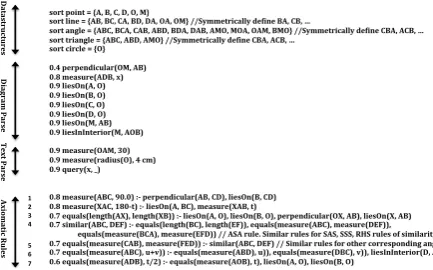
Figure 3:A sample logical program (in prolog style) that solves the prob-lem in Figure2. The program consists of a set of data structure declarations that correspond to types in the prolog program, a set of declarations from the diagram and text parse and a subset of the geometry axioms written as horn clause rules. The axioms are used as the underlying theory with the aforemen-tioned declarations to yield the solution upon logical inference. Normalized confidence weights from the diagram, text and axiom parses are used as proba-bilities. For readers understanding, we list the axioms in the order (1 to 7) they are used to solve the problem. However, this ordering is not required. Other (less probable) declarations and axiom rules are not shown here for clarity but they can be assumed to be present.
and the parsed horn clause rules describe the un-derlying theory. Normalized confidence scores from question text, diagram and axiom parsing models are used as probabilities in the program. Next, we describe how we harvest structured ax-iomatic knowledge from textbooks.
4 Harvesting Axiomatic Knowledge
We present a structured prediction model that identifies axioms in textbooks and then parses them. Since harvesting axioms from a single book is a very hard problem, we use multiple text-books and leverage the redundancy of information to accurately extract and parse axioms. We first define a joint model that identifies axiom mentions in each textbook and aligns repeated mentions of the same axiom across textbooks. Then, given a set of axioms (with possibly, multiple mentions of each axiom), we define a parsing model that maps each axiom to a horn clause rule by utilizing the various mentions of the axiom.
Given a set of textbooksBin machine readable form (XML in our experiments), we extract chap-ters relevant for geometry in each of them to ob-tain a sequence of sentences (with associated ty-pographical information) from each textbook. Let Sb ={s(0b), s1(b), . . . s(|Sb)b|}denote the sequence of sentences in textbookb. |Sb|denotes the number
of sentences in textbookb.
4.1 Axiom Identification and Alignment
We decompose the problem of extracting axioms from textbooks into two tractable sub-problems: (a) identification of axiom mentions in each text-book using a sequence labeling approach, and (b) aligning repeated mentions of the same axiom across textbooks. Then, we combine the learned models for these sub-problems into a joint opti-mization framework that simultaneously learns to identify and align axiom mentions. Joint modeling of the axiom identification and alignment is neces-sary as both sub-problems can help each other.
4.1.1 Axiom Identification
Linear-chain CRF formulation (Lafferty et al.,
2001) can be used for the subproblem of axiom identification. Given{Sb|b∈ B}, the model labels
each sentences(ib)asBefore,Inside orOutside an axiom. Hereon, a contiguous block of sentences labeled B or I will be considered as an axiom mention. LetT = {B,I,O} denote the tag set. Lety(ib)be the tag assigned tos(ib)andYb be the
tag sequence assigned toSb. The CRF defines:
p(Yb|Sb;θθθ) ∝ |QSb| k=1exp
P
i,j∈Tθθθ T
ijfij(yk−(b)1, yk(b),Sb) !
We find the parameters θθθ using
maximum-likelihood estimation with L2 regularization: θθθ∗= arg max
θθθ P
b∈Blogp(Yb|Sb;θθθ)−λ||θθθ|| 2 2
We use L-BFGS to optimize the objective and Viterbi decoding for inference.
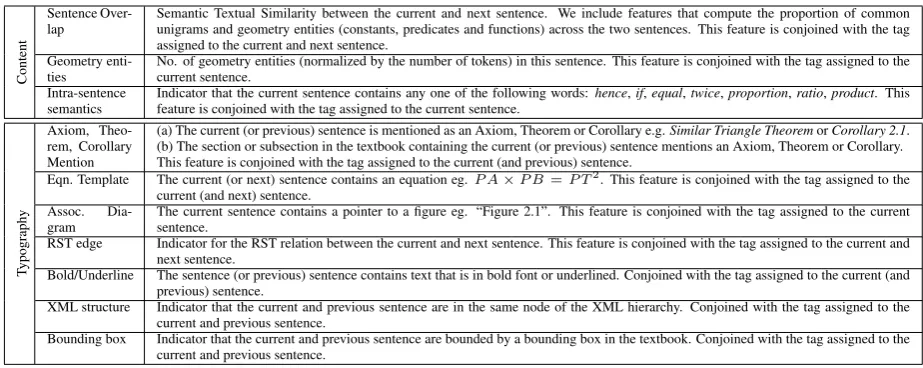
Features: Features f look at a pair of adjacent tagsyk(b−)1,yk(b), the input sequenceSb, and where
we are in the sequence. The features (listed in Ta-ble 1) include various content based features en-coding various notions of similarity between pairs of sentences as well as various typographical fea-tures such as whether the sentences are annotated as an axiom (or theorem or corollary) in the text-book, contain equations, diagrams, text that is bold or italicized, are in the same node of the xml hier-archy, are contained in a bounding box, etc.
Some extracted axiom mentions contain point-ers to a diagram eg. “Figure 2.1”. We consider the diagram to be a part of the axiom mention.
4.1.2 Axiom Alignment
Content
Sentence
Over-lap Semantic Textual Similarity between the current and next sentence. We include features that compute the proportion of commonunigrams and geometry entities (constants, predicates and functions) across the two sentences. This feature is conjoined with the tag assigned to the current and next sentence.
Geometry
enti-ties No. of geometry entities (normalized by the number of tokens) in this sentence. This feature is conjoined with the tag assigned to thecurrent sentence. Intra-sentence
semantics Indicator that the current sentence contains any one of the following words:feature is conjoined with the tag assigned to the current sentence. hence,if,equal,twice,proportion,ratio,product. This
Typograph
y
Axiom, Theo-rem, Corollary Mention
(a) The current (or previous) sentence is mentioned as an Axiom, Theorem or Corollary e.g.Similar Triangle TheoremorCorollary 2.1. (b) The section or subsection in the textbook containing the current (or previous) sentence mentions an Axiom, Theorem or Corollary. This feature is conjoined with the tag assigned to the current (and previous) sentence.
Eqn. Template The current (or next) sentence contains an equation eg.P A×P B=P T2. This feature is conjoined with the tag assigned to the current (and next) sentence.
Assoc.
Dia-gram The current sentence contains a pointer to a figure eg. “Figure 2.1”. This feature is conjoined with the tag assigned to the currentsentence. RST edge Indicator for the RST relation between the current and next sentence. This feature is conjoined with the tag assigned to the current and
next sentence.
Bold/Underline The sentence (or previous) sentence contains text that is in bold font or underlined. Conjoined with the tag assigned to the current (and previous) sentence.
XML structure Indicator that the current and previous sentence are in the same node of the XML hierarchy. Conjoined with the tag assigned to the current and previous sentence.
[image:4.595.70.532.61.245.2]Bounding box Indicator that the current and previous sentence are bounded by a bounding box in the textbook. Conjoined with the tag assigned to the current and previous sentence.
Table 1:Feature set for our axiom identification model. The features are based on content and typography.
LetAb =
A(1b), A(2b), . . . , A(|Ab)b|be the axiom mentions extracted from textbookb. LetAdenote the collection of axiom mentions extracted from all textbooks. We assume a global ordering of axiomsA∗= (A∗
1, A∗2, . . . , A∗U)whereU is some
pre-defined upper bound on the total number of axioms in geometry. Then, we emphasize that the axiom mentions extracted from each textbooks (roughly) follow this ordering. Let
Zij(b) be a random variable that denotes if axiom
A(ib) extracted from book b refers to the global axiom A∗
j. We introduce a log-linear model that
factorizes over alignment pairs: P(Z|A;φφφ) = 1
Z(A;φφφ)×
exp
P
b1,b2∈B b16=b2
P
1≤k≤U P
1≤i≤|Ab1| 1≤j≤|Ab2|
Zik(b1)Zjk(b2)φφφTg(A(b1) i , A(jb2))
Here, Z(A;φφφ) is the partition function of the log-linear model. g denotes the feature function
described later. We introduce the following
constraints on the alignment structure:
C1: An axiom appears in one book at-most once
C2: An axiom refers to exactly one theorem in the global ordering
C3: Ordering Constraint: Ifith axiom in a book
refers to thejthaxiom in the global ordering then
no axiom succeeding theith axiom can refer to a
global axiom precedingj.
Learning with Hard Constraints: We find the optimal parametersφφφ using maximum-likelihood estimation with L2 regularization:
φφφ∗= arg max
φφφlogP(Z|A;φφφ)−µ||φφφ||22
We use L-BFGS to optimize the objective. To
compute feature expectations appearing in the gra-dient of the objective, we use a Gibbs sampler. The sampling equations forZb
ikare:
P(Zik(b)|rest)∝exp (Tb(i, k)) (1) Tb(i, k) =Zik(b) P
b0∈B
b06=b P
1≤j≤|Ab0| Z(b0)
jk φφφTg(A(ib), A(b
0)
j )
Note that the constraintsC1. . .3define the fea-sible space of alignments. Our sampler always samples the nextZik(b)in this feasible space.
Learning with Soft Constraints:We might want to treat some constraints, in particular, the order-ing constraints C3 as soft constraints. We can write down the constraintC3using the alignment variables:
Zij(b)≤1−Zkl(b)
∀ 1≤i < k≤ |Ab|,1≤l < j≤U
∀ b∈ B
To model these constraints as soft constraints, we penalize the model for violating these con-straints. Let the penalty for violating the above constraint be exp
νmax
0,1−Z(b) ij −Zkl(b)
. We introduce a new regularization term: R(Z) =
P
1≤i<k≤|Ab|
1≤l<j≤U b∈B
expνmax0,1−Zij(b)−Zkl(b). Here
νis a hyper-parameter to tune the cost of violating a constraint. We write down the following regular-ized objective:
φφφ∗= arg max
φφφlogP(Z|A;φφφ)−R(Z)−µ||φφφ||22 We use L-BFGS to find the optimal parameters
φφφ∗. We perform Gibbs sampling to compute fea-ture expectations. The sampling equation forZik(b)
is similar (eq 1), but: Tb(i, k) = P
b0∈B
b06=b P
1≤j≤|Ab0|Z (b) ikZ(b
0)
jk φφφTg(A(ib), A(b
0)
B I I I
B I I
B I I I
[image:5.595.108.256.65.146.2]Update Axiom Delete Axiom Create Axiom B I I I
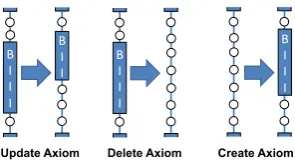
Figure 4:An illustration of the three operations to sample axiom blocks.
+ν P b0∈B
b06=b P
i<j≤|Ab0| P
1≤l<k
1−Zik(b)−Zjl(b0)
+ν P b0∈B
b06=b P
1≤j<i| P
k<l≤U
1−Z(b) ik −Z(b
0)
jl
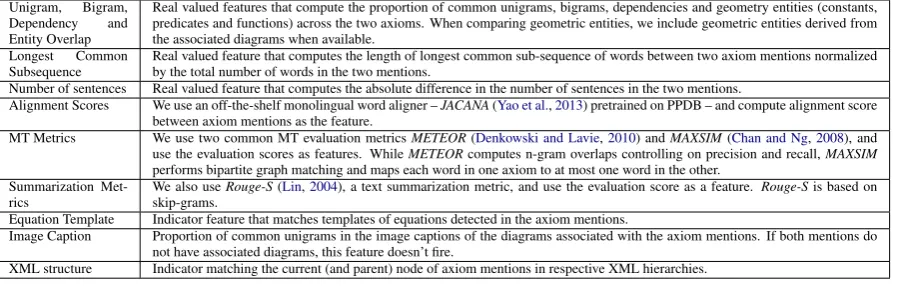
Features:Now, we describe the featuresg. These too include content based features encoding var-ious notions of similarity between pairs of ax-iom mentions as well as various typographical fea-tures. The features are listed in Table2.
4.1.3 Joint Identification and Alignment
Joint modeling of axiom identification and align-ment components is useful as both problems po-tentially help each other. LetYij(b)denote that the sentences(ib)from bookbhas tagj. We reuse the definitions of the alignment variables Zij(b) as be-fore. We further define Zi(0b) such that it denotes that theith axiom in textbookbis not aligned to
any global axiom. We again define a log-linear model with factors that score axiom identification and axiom alignments.
p(Y,Z|{Sb};θθθ, φφφ)∝fAI(Y|{Sb};θθθ)×fAA(Z|Y,{Sb};φφφ)
Here, the factors:
fAI= exp(P b∈B
|Sb| P
k=1
P
i,j∈TY (b)
k−1iYkj(b)θθθTijfij(i, j,Sb))
fAA= exp( P b1,b2∈B
b16=b2
P
1≤k≤U P
1≤i≤|Ab1| 1≤j≤|Ab2|
Z(b1)
ik Z(jkb2)φφφTg(A(ib1), A(jb2)))
We write down the model constraints below:
C1’: Every sentence has a unique label
C2’Tag O cannot be followed by tag I
C3’Consistency betweenY’s andZ’s i.e. axiom boundaries defined byY’s andZ’s must agree.
C4’= C3.
We use L-BFGS for learning. To compute fea-ture expectations, we use a Metropolis Hastings sampler that samples Y0s and Z0s alternatively. Sampling forZ0sreduces to Gibbs sampling and the sampling equations are as same as before (Sec-tion 4.1.2). For better mixing, we sample Y in blocks. Consider blocks ofY’s which denote ax-iom boundaries at time stampt, we define three operations to sample axiom blocks at the next time
stamp. The operations (shown in Figure4) are:
Update axiom: The axiom boundary can be shrunk, expanded or moved. The new axiom, how-ever, cannot overlap with other axioms.
Delete axiom:The axiom can be deleted by label-ing all its sentences asO.
Introduce axiom: Given a contiguous sequence of sentences labeledO, a new axiom can be intro-duced.
Note that these three operations define an ergodic Markov chain. We use the axiom identification part of the model as the proposal:
Q(Y¯|Y)∝exp P b∈B
|Sb|
P
k=1 P
i,j∈T
¯
Yk−(b)1iY¯kj(b)θθθT
ijfij(i, j,Sb) !
Hence, the acceptance ratio only depends on the alignment part of the model: R(Y¯|Y) = min1,U(Y)¯
U(Y)
where U(Y) = fAA. We again have two variants, where we model the ordering con-straints (C40) as soft or hard constraints.
4.2 Axiom Parsing
After harvesting axioms, we build a parser for these axioms that maps raw axioms to horn clause rules. The axiom harvesting step provides us
a multi-set of axiom extractions. Let A =
{A1,A2, . . . ,A|A|}represent the multi-set where each axiomAiis mentioned at least once.
First, we describe a base parser that parses ax-iom mentions to horn clause rules. Then, we uti-lize the redundancy of axiom extractions from var-ious sources (textbooks) to improve our parser.
4.2.1 Base Axiomatic Parser
Our base parser identifies thepremiseand conclu-sionportions of each axiom and then usesGEOS’s text parser to parse the two portions into a logical formula. Then, the two logical formulas are put together to form horn clause rules.
Axiom mentions (for example, the Pythagoras theorem mention in Figure1) are often accompa-nied by equations or diagrams. When the men-tion has an equamen-tion, we simply treat the equamen-tion as the conclusion and the rest of the mention as the premise. When the axiom has an associated diagram, we always include the diagram in the premise. We learn a model to predict the split of the axiom text into two parts forming thepremise and theconclusionspans. Then, theGEOSparser maps thepremiseandconclusionspans topremise andconclusionlogical formulas, respectively.
Let Zs represent the split that demarcates the
ax-Unigram, Bigram, Dependency and Entity Overlap
Real valued features that compute the proportion of common unigrams, bigrams, dependencies and geometry entities (constants, predicates and functions) across the two axioms. When comparing geometric entities, we include geometric entities derived from the associated diagrams when available.
Longest Common
Subsequence Real valued feature that computes the length of longest common sub-sequence of words between two axiom mentions normalizedby the total number of words in the two mentions. Number of sentences Real valued feature that computes the absolute difference in the number of sentences in the two mentions.
Alignment Scores We use an off-the-shelf monolingual word aligner –JACANA(Yao et al.,2013) pretrained on PPDB – and compute alignment score between axiom mentions as the feature.
MT Metrics We use two common MT evaluation metricsMETEOR(Denkowski and Lavie,2010) andMAXSIM(Chan and Ng,2008), and use the evaluation scores as features. WhileMETEORcomputes n-gram overlaps controlling on precision and recall,MAXSIM performs bipartite graph matching and maps each word in one axiom to at most one word in the other.
Summarization
Met-rics We also useskip-grams. Rouge-S(Lin,2004), a text summarization metric, and use the evaluation score as a feature. Rouge-Sis based on Equation Template Indicator feature that matches templates of equations detected in the axiom mentions.
Image Caption Proportion of common unigrams in the image captions of the diagrams associated with the axiom mentions. If both mentions do not have associated diagrams, this feature doesn’t fire.
[image:6.595.77.526.63.207.2]XML structure Indicator matching the current (and parent) node of axiom mentions in respective XML hierarchies.
Table 2:Feature set for our axiom alignment model. The features are based on content, structure and typography.
iom split as a log-linear model: p(Zs|a;w) ∝ exp wTh(a, Zs). Here, hare feature functions
described later. We found that in most cases (>95%), the premise and conclusion are contigu-ous spans in the axiom mention where the left span corresponds to thepremiseand the right span cor-responds to theconclusion. Hence, we search over the space of contiguous spans to inferZs. We use
L-BGFGS for learning.
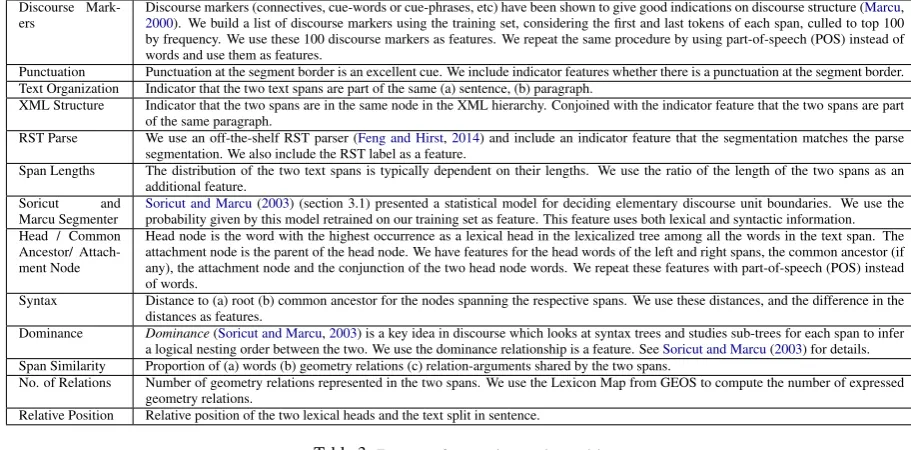
Features: We list the featureshin Table3. The features are defined over candidate spans forming the text split, are strongly inspired from rhetori-cal structure theory (Mann and Thompson,1988) and previous works on discourse parsing (Marcu,
2000;Soricut and Marcu,2003). Given a beam of PremiseandConclusionsplits, we use theGEOS parser to getPremiseandConclusionlogical for-mulas for each split in the beam and obtain a beam of axiom parses for each axiom in each textbook.
4.2.2 Multi-source Axiomatic Parser
Now, we describe a multi-source parser that uti-lizes the redundancy of axiom extractions from various sources (textbooks). Given a beam of 10-best parses for each axiom from each source, we use a number of heuristics to determine the best parse for the axiom:
1. Majority Voting: For each axiom, pick the parse that occurs most frequently across beams.
2. Average Score: Pick the parse that has the highest average parse score (only counting top 5 parses for each source), for each axiom.
3. Learn Source Confidence: Learn a set of weights{µ1, µ2, . . . , µS}, one for each source and
then picks the parse that has the highest average weighted parse score for each axiom.
4. Predicate Score:Instead of selecting from one of the top parses across various sources, treat each axiom parse as a bag of premise predicates and a
bag of conclusion predicates. Then, pick a subset of premise and conclusion predicates for the final parse using average scoring with thresholding.
5 Experiments
Datasets: We use a collection of grade 6-10 In-dian high school math textbooks by four publish-ers/authors –NCERT,R S Aggarwal,R D Sharma andM L Aggarwal– a total of5×4 = 20 text-books to validate our model. Millions of students in India study geometry from these books every year and these books are readily available online. We manually marked chapters relevant for geom-etry in these books and then parsed them using
Adobe Acrobat’s pdf2xml parser. Then, we
an-notated geometry axioms, alignments and parses for grade 6, 7 and 8 textbooks by the four pub-lishers/authors. We use grade 6, 7 and 8 textbook annotations for development, training, and testing, respectively. All the hyper-parameters in all the models are tuned on the development set using grid search.
Discourse
Mark-ers Discourse markers (connectives, cue-words or cue-phrases, etc) have been shown to give good indications on discourse structure (2000). We build a list of discourse markers using the training set, considering the first and last tokens of each span, culled to top 100Marcu, by frequency. We use these 100 discourse markers as features. We repeat the same procedure by using part-of-speech (POS) instead of words and use them as features.
Punctuation Punctuation at the segment border is an excellent cue. We include indicator features whether there is a punctuation at the segment border. Text Organization Indicator that the two text spans are part of the same (a) sentence, (b) paragraph.
XML Structure Indicator that the two spans are in the same node in the XML hierarchy. Conjoined with the indicator feature that the two spans are part of the same paragraph.
RST Parse We use an off-the-shelf RST parser (Feng and Hirst,2014) and include an indicator feature that the segmentation matches the parse segmentation. We also include the RST label as a feature.
Span Lengths The distribution of the two text spans is typically dependent on their lengths. We use the ratio of the length of the two spans as an additional feature.
Soricut and
Marcu Segmenter Soricut and Marcuprobability given by this model retrained on our training set as feature. This feature uses both lexical and syntactic information.(2003) (section 3.1) presented a statistical model for deciding elementary discourse unit boundaries. We use the Head / Common
Ancestor/ Attach-ment Node
Head node is the word with the highest occurrence as a lexical head in the lexicalized tree among all the words in the text span. The attachment node is the parent of the head node. We have features for the head words of the left and right spans, the common ancestor (if any), the attachment node and the conjunction of the two head node words. We repeat these features with part-of-speech (POS) instead of words.
Syntax Distance to (a) root (b) common ancestor for the nodes spanning the respective spans. We use these distances, and the difference in the distances as features.
Dominance Dominance(Soricut and Marcu,2003) is a key idea in discourse which looks at syntax trees and studies sub-trees for each span to infer a logical nesting order between the two. We use the dominance relationship is a feature. SeeSoricut and Marcu(2003) for details. Span Similarity Proportion of (a) words (b) geometry relations (c) relation-arguments shared by the two spans.
No. of Relations Number of geometry relations represented in the two spans. We use the Lexicon Map from GEOS to compute the number of expressed geometry relations.
[image:7.595.69.525.64.289.2]Relative Position Relative position of the two lexical heads and the text split in sentence.
Table 3:Feature set for our axiom parsing model.
Strict Comp. Relaxed Comp.
P R F P R F
Identification 64.3 69.3 66.7 84.3 87.9 86.1
Joint-Hard 68.0 68.1 68.0 85.4 87.1 86.2
Joint-Soft 69.7 71.1 70.4 86.9 88.4 87.6
Table 4: Test set Precision, Recall and F-measure scores for axiom identi-fication when performed alone and when performed jointly with axiom align-ment. We show results for both strict as well as relaxed comparison modes. For the joint model, we show results when we model ordering constraints as hard or soft constraints.
development (150 questions) and test (906 tions) with equal proportion of grade 6-10 ques-tions. We annotated the 500 training and devel-opment questions with ground-truth logical forms. We use the training set to train another version of GEOSwith expanded set of entity types, functions and predicates. We call this systemGEOS++.
Results: We first evaluate the axiom identifica-tion, alignment and parsing models individually.
For axiom identification, we compare the results of automatic identification with gold axiom identi-fications and compute the precision, recall and F-measure on the test set. We use strict as well as re-laxed comparison. In strict comparison mode the automatically identified mentions and gold men-tions must match exactly to get credit, whereas, in the relaxed comparison mode only a majority (>50%) of sentences in the automatically identi-fied mentions and gold mentions must match to get credit. Table4shows the results of axiom identifi-cation where we clearly see improvements in per-formance when we jointly model axiom identifica-tion and alignment. This is due to the fact that both the components reinforce each other. We also
ob-P R F NMI Alignment 71.8 74.8 73.3 0.60
Joint-Hard 75.0 76.4 75.7 0.65
Joint-Soft 79.3 81.4 80.3 0.69
Table 5: Test set Precision, Recall, F-measure and NMI scores for axiom alignment when performed alone and when performed jointly with axiom iden-tification. For the joint model, we show results when we model ordering con-straints as hard or soft concon-straints.
serve that modeling the ordering constraints as soft constraints leads to better performance than mod-eling them as hard constraints. This is because the ordering of presentation of axioms is generally (yet not always) consistent across textbooks.
To evaluate axiom alignment, we first view it as a series of decisions, one for each pair of ax-iom mentions and compute precision, recall and F-score by comparing automatic decisions with gold decisions. Then, we also use a standard clustering metric, Normalized Mutual Information (NMI) (Strehl and Ghosh, 2002) to measure the quality of axiom mention clustering. Table 5 shows the results on the test set when gold axiom identifica-tions are used. We observe improvements in ax-iom alignment performance too when we jointly model axiom identification and alignment jointly both in terms of F-score as well as NMI. Modeling ordering constraints as soft constraints again leads to better performance than modeling them as hard constraints in terms of both metrics.
[image:7.595.79.284.314.361.2]re-Literals Full Parse
P R F P R F
GEOS 86.7 70.9 78.0 64.2 56.6 60.2
GEOS++
Single Src. 91.6 75.3 82.6 68.8 60.4 64.3
Maj. Voting 90.2 78.5 83.9 70.0 63.3 66.5
Avg. Score 90.8 79.6 84.9 71.7 66.4 69.0
Src. Confid. 91.0 79.9 85.1 73.3 68.1 70.6
[image:8.595.80.287.60.131.2]Pred. Score 92.8 82.8 87.5 76.6 70.1 73.2
Table 6:Test set Precision, Recall and F-measure scores for axiom parsing. These scores are computed over literals derived in axiom parses or full axiom parses. We show results for the oldGEOSsystem, for the improvedGEOS++ system with expanded entity types, functions and predicates, and for the multi-source parsers presented in this paper.
Practice Official Textbook
GEOS 61 49 32
Our System 64 55 51 Oracle 80 78 72
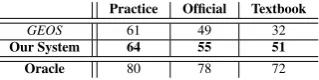
Table 7: Scores for solving geometry questions on the SAT practice and official datasets and a dataset of questions from the 20 textbooks. We use SATs grading scheme that rewards a correct answer with a score of 1.0 and penalizes a wrong answer with a negative score of 0.25. Oracleuses gold axioms but automatic text and diagram interpretation in our logical solver. All differences betweenGEOSand our system are significant (p¡0.05 using the two-tailed paired t-test).
sults of axiom parsing for GEOS (trained on the training set) as well as various versions of our
best performing system (GEOS++ with our
ax-iomatic solver) with various heuristics for multi-source parsing. The results show that our system (single source) performs better thanGEOSas it is trained with the expanded set of entity types, func-tions and predicates. The results also show that the choice of heuristic is important for the multi-source parser – though all the heuristics lead to improvements over the single source parser. The average score heuristic that chooses the parse with the highest average score across sources performs better than majority voting which chooses the best parse based on a voting heuristic. Learning the confidence of every source and using a weighted average is an even better heuristic. Finally, pred-icate scoring which chooses the parse by scoring predicates on the premise and conclusion sides performs the best leading to 87.5 F1 score (when computed over parse literals) and 73.2 F1 score (when computed on the full parse). The high F1 score for axiom parsing on the test set shows that our approach works well and we can accurately harvest axiomatic knowledge from textbooks.
Finally, we use the extracted horn clause rules in our axiomatic solver for solving geometry prob-lems. For this, we over-generate a set of horn clause rules by generating 3 horn clause parses for each axiom and use them as the underlying theory in prolog programs such as the one shown in Fig-ure3. We use weighted logical expressions for the
Interpretability Usefulness
GEOS O.S. GEOS O.S.
[image:8.595.337.497.63.135.2]Grade 6 2.7 2.9 2.9 3.2 Grade 7 3.0 3.7 3.3 3.6 Grade 8 2.7 3.5 3.1 3.5 Grade 9 2.4 3.3 3.0 3.7 Grade 10 2.8 3.1 3.2 3.8 Overall 2.7 3.3 3.1 3.6
Table 8:User study ratings forGEOSand our system (O.S.) by students in grade 6-10. Ten students in each grade were asked to rate the two systems on a scale of 1-5 on two facets: ‘interpretability’ and ‘usefulness’. Each cell shows the mean rating computed over ten students in that grade for that facet.
question description and the diagram derived from GEOS++ as declarations, and the (normalized) score of the parsing model multiplied by the score of the joint axiom identification and alignment model as weights for the rules. Table7shows the results for our best end-to-end system and com-pares it toGEOSon the practice and official SAT dataset fromSeo et al.(2015) as well as questions from the 20 textbooks. On all the three datasets, our system outperformsGEOS. Especially on the dataset from the 20 textbooks (which is indeed a harder dataset and includes more problems which require complex reasoning based on geometry), GEOSdoesn’t perform very well whereas our sys-tem still achieves a good score. Oracle shows the performance of our system when gold ax-ioms (written down by an expert) are used along with automatic text and diagram interpretations in GEOS++. This shows that there is scope for fur-ther improvement in our approach.
Interpretability:Students around the world solve geometry problems through rigorous deduction whereas the numerical solver in GEOS does not provide such interpretability. One of the key ben-efits of our axiomatic solver is that it provides an easy-to-understand student-friendly deductive so-lution to geometry problems.
To test the interpretability of our axiomatic solver, we asked 50 grade 6-10 students (10 stu-dents in each grade) to use GEOS and our
sys-tem (GEOS++ with our axiomatic solver) as a
[image:8.595.102.262.198.238.2]6 Related Work
Solving Geometry Problems: While the prob-lem of using computers to solve geometry ques-tions is old (Feigenbaum and Feldman, 1963;
Schattschneider and King, 1997; Davis, 2006), NLP and computer vision techniques were first used to solve geometry problems in Seo et al.
(2015). While Seo et al.(2014) only aligned ge-ometric shapes with their textual mentions, Seo et al. (2015) also extracted geometric relations and built GEOS, the first automated system to solve SAT style geometry questions. GEOSused a coordinate geometry based solution by translat-ing each predicate into a set of manually writ-ten constraints. A boolean satisfiability problem posed with these constraints was used to solve the multiple-choice question. GEOShad two key issues: (a) it needed access to answer choices which may not always be available for such prob-lems, and (b) it lacked the deductive geometric reasoning used by students to solve these prob-lems. Our axiomatic solver mitigates these is-sues by performing deductive reasoning using ax-iomatic knowledge extracted from textbooks.
Information Extraction from Textbooks: Our model builds upon ideas from Information extrac-tion (IE), which is the task of automatically ex-tracting structured information from unstructured and/or semi-structured documents. While there has been a lot of work in IE on domains such as web documents (Chang et al.,2003;Etzioni et al.,
2004;Cafarella et al., 2005; Chang et al., 2006;
Banko et al., 2007;Etzioni et al.,2008;Mitchell et al.,2015) and scientific publication data (Shah et al., 2003;Peng and McCallum, 2006;Saleem and Latif,2012), work on IE from educational ma-terial is much more sparse. Most of the research in IE from educational material deals with extract-ing simple educational concepts (Shah et al.,2003;
Canisius and Sporleder, 2007; Yang et al., 2015;
Wang et al., 2015;Liang et al., 2015;Wu et al.,
2015; Liu et al., 2016b; Wang et al., 2016) or binary relational tuples (Balasubramanian et al.,
2002; Clark et al., 2012; Dalvi et al., 2016) us-ing existus-ing IE techniques. On the other hand, our approach extracts axioms and parses them to horn clause rules. This is much more challenging. Raw application of rule mining or sequence label-ing techniques used to extract information from web documents and scientific publications to ed-ucational material usually leads to poor results as
the amount of redundancy in educational material is lower and the amount of labeled data is sparse. Our approach tackles these issues by making ju-dicious use of typographical information, the re-dundancy of information and ordering constraints to improve the harvesting and parsing of axioms. This has not been attempted in previous work.
Language to Programs:After harvesting axioms from textbooks, we also present an approach to parse the axiom mentions to horn clause rules. This work is related to a large body of work on semantic parsing (Zelle and Mooney,1993,1996;
Kate et al.,2005;Zettlemoyer and Collins, 2012, inter alia). Semantic parsers typically map natu-ral language to formal programs such as database queries (Liang et al., 2011; Berant et al., 2013;
Yaghmazadeh et al., 2017, inter alia), commands to robots (Shimizu and Haas, 2009; Matuszek et al.,2010;Chen and Mooney, 2011, inter alia), or even general purpose programs (Lei et al.,2013;
Ling et al., 2016; Yin and Neubig, 2017; Ling et al.,2017). More specifically,Liu et al.(2016a) and Quirk et al. (2015) learn Then” and “If-This-Then-That” rules, respectively. In theory, these works can be adapted to parse axiom men-tions to horn-clause rules. However, this would require a large amount of supervision which would be expensive to obtain. We mitigated this issue by using redundant axiom mention extractions from multiple textbooks and then combining the parses obtained from various textbooks to achieve a bet-ter final parse for each axiom.
7 Conclusion
References
Niranjan Balasubramanian, Stephen Soderland,
Oren Etzioni Mausam, and Robert Bart. 2002. out of the box information extraction: a case study using bio-medical texts. Technical report.
Michele Banko, Michael J. Cafarella, Stephen Soder-land, Matthew Broadhead, and Oren Etzioni. 2007.
Open information extraction from the web. In
IJ-CAI 2007, Proceedings of the 20th International Joint Conference on Artificial Intelligence, Hyder-abad, India, January 6-12, 2007, pages 2670–2676. Jonathan Berant, Andrew Chou, Roy Frostig, and Percy Liang. 2013. Semantic parsing on freebase from
question-answer pairs. In Proceedings of the 2013
Conference on Empirical Methods in Natural Lan-guage Processing, EMNLP 2013, 18-21 October 2013, Grand Hyatt Seattle, Seattle, Washington, USA, A meeting of SIGDAT, a Special Interest Group of the ACL, pages 1533–1544.
Michael J. Cafarella, Doug Downey, Stephen Soder-land, and Oren Etzioni. 2005. Knowitnow: Fast, scalable information extraction from the web. In
HLT/EMNLP 2005, Human Language Technology Conference and Conference on Empirical Methods in Natural Language Processing, Proceedings of the Conference, 6-8 October 2005, Vancouver, British Columbia, Canada, pages 563–570.
Sander Canisius and Caroline Sporleder. 2007. Boot-strapping information extraction from field books. InEMNLP-CoNLL, pages 827–836.
Yee Seng Chan and Hwee Tou Ng. 2008. Maxsim: A maximum similarity metric for machine translation
evaluation. In The 2008 Annual Conference of the
Association for Computational Linguistics (ACL). Chia-Hui Chang, Chun-Nan Hsu, and Shao-Cheng Lui.
2003. Automatic information extraction from
semi-structured web pages by pattern discovery. Decision
Support Systems, 35(1):129–147.
Chia-Hui Chang, Mohammed Kayed, Moheb R Gir-gis, and Khaled F Shaalan. 2006. A survey of web
information extraction systems. IEEE transactions
on knowledge and data engineering, 18(10):1411– 1428.
David L. Chen and Raymond J. Mooney. 2011. Learn-ing to interpret natural language navigation
instruc-tions from observainstruc-tions. InProceedings of the 25th
AAAI Conference on Artificial Intelligence (AAAI-2011), pages 859–865.
Peter Clark and Oren Etzioni. 2016. My computer is an honor student - but how intelligent is it?
stan-dardized tests as a measure of ai. InProceedings of
AI Magazine.
Peter Clark, Phil Harrison, Niranjan Balasubramanian, and Oren Etzioni. 2012. Constructing a textual kb
from a biology textbook. InProceedings of the Joint
Workshop on Automatic Knowledge Base Construc-tion and Web-scale Knowledge ExtracConstruc-tion, pages 74–78. Association for Computational Linguistics.
Bhavana Dalvi, Sumithra Bhakthavatsalam, Chris Clark, Peter Clark, Oren Etzioni, Anthony Fader, and Dirk Groeneveld. 2016. IKE - an interactive tool
for knowledge extraction. InProceedings of the 5th
Workshop on Automated Knowledge Base Construc-tion, AKBC@NAACL-HLT 2016, San Diego, CA, USA, June 17, 2016, pages 12–17.
Tom Davis. 2006. Geometry with computers. Techni-cal report.
Michael Denkowski and Alon Lavie. 2010. Extending the meteor machine translation evaluation metric to
the phrase level. InHuman Language Technologies:
The 2010 Annual Conference of the North American Chapter of the Association for Computational Lin-guistics, pages 250–253. Association for Computa-tional Linguistics.
Oren Etzioni, Michele Banko, Stephen Soderland, and Daniel S Weld. 2008. Open information
extrac-tion from the web. Communications of the ACM,
51(12):68–74.
Oren Etzioni, Michael J. Cafarella, Doug Downey, Ana-Maria Popescu, Tal Shaked, Stephen Soder-land, Daniel S. Weld, and Alexander Yates. 2004. Methods for domain-independent information ex-traction from the web: An experimental comparison. In Proceedings of the Nineteenth National Confer-ence on Artificial IntelligConfer-ence, Sixteenth ConferConfer-ence on Innovative Applications of Artificial Intelligence, July 25-29, 2004, San Jose, California, USA, pages 391–398.
Edward A Feigenbaum and Julian Feldman. 1963.
Computers and thought. The AAAI Press.
Vanessa Wei Feng and Graeme Hirst. 2014. A linear-time bottom-up discourse parser with constraints
and post-editing. InProceedings of the 52nd Annual
Meeting of the Association for Computational Lin-guistics (Volume 1: Long Papers), pages 511–521.
Akira Fujita, Akihiro Kameda, Ai Kawazoe, and Yusuke Miyao. 2014. Overview of todai robot project and evaluation framework of its nlp-based
problem solving. World History, 36:36.
Rohit J Kate, Yuk Wah, Wong Raymond, and J Mooney. 2005. Learning to transform natural to
formal languages. InProceedings of AAAI-05.
Cite-seer.
Nate Kushman, Yoav Artzi, Luke Zettlemoyer, and Regina Barzilay. 2014. Learning to automatically
solve algebra word problems. In Proceedings of
John Lafferty, Andrew McCallum, and Fernando Pereira. 2001. Conditional random fields: Prob-abilistic models for segmenting and labeling
se-quence data. In Proceedings of the eighteenth
in-ternational conference on machine learning, ICML, volume 1, pages 282–289.
Tao Lei, Fan Long, Regina Barzilay, and Martin C Ri-nard. 2013. From natural language specifications to program input parsers. Association for Computa-tional Linguistics (ACL).
Chen Liang, Zhaohui Wu, Wenyi Huang, and C Lee
Giles. 2015. Measuring prerequisite relations
among concepts. InEMNLP, pages 1668–1674.
Percy Liang, Michael I Jordan, and Dan Klein. 2011. Learning dependency-based compositional
seman-tics. InProceedings of the 49th Annual Meeting of
the Association for Computational Linguistics: Hu-man Language Technologies-Volume 1, pages 590– 599. Association for Computational Linguistics. Chin-Yew Lin. 2004. Rouge: A package for
auto-matic evaluation of summaries. InText
summariza-tion branches out: Proceedings of the ACL-04
work-shop, volume 8. Barcelona, Spain.
Wang Ling, Edward Grefenstette, Karl Moritz Her-mann, Tom´aˇs Koˇcisk`y, Andrew Senior, Fumin Wang, and Phil Blunsom. 2016. Latent
predic-tor networks for code generation. arXiv preprint
arXiv:1603.06744.
Wang Ling, Dani Yogatama, Chris Dyer, and Phil Blun-som. 2017. Program induction for rationale gener-ation: Learning to solve and explain algebraic word problems. Association for Computational Linguis-tics (ACL) – To appear.
Chang Liu, Xinyun Chen, Eui Chul Shin, Mingcheng
Chen, and Dawn Song. 2016a. Latent attention
for if-then program synthesis. In D. D. Lee, M. Sugiyama, U. V. Luxburg, I. Guyon, and R.
Gar-nett, editors, Advances in Neural Information
Pro-cessing Systems 29, pages 4574–4582. Curran As-sociates, Inc.
Hanxiao Liu, Wanli Ma, Yiming Yang, and Jaime Car-bonell. 2016b. Learning concept graphs from online
educational data. Journal of Artificial Intelligence
Research, 55:1059–1090.
William C Mann and Sandra A Thompson. 1988.
{Rhetorical Structure Theory: Toward a functional
theory of text organisation}. Text, 3(8):234–281.
Christopher D. Manning, Mihai Surdeanu, John Bauer, Jenny Finkel, Steven J. Bethard, and David
Mc-Closky. 2014. The Stanford CoreNLP natural
lan-guage processing toolkit. InAssociation for Compu-tational Linguistics (ACL) System Demonstrations, pages 55–60.
Daniel Marcu. 2000. The theory and practice of
dis-course parsing and summarization.
Cynthia Matuszek, Dieter Fox, and Karl Koscher. 2010. Following directions using statistical
ma-chine translation. In 2010 5th ACM/IEEE
Inter-national Conference on Human-Robot Interaction (HRI), pages 251–258. IEEE.
T. Mitchell, W. Cohen, E. Hruschka, P. Talukdar, J. Betteridge, A. Carlson, B. Dalvi, M. Gardner, B. Kisiel, J. Krishnamurthy, N. Lao, K. Mazaitis, T. Mohamed, N. Nakashole, E. Platanios, A. Rit-ter, M. Samadi, B. Settles, R. Wang, D. Wijaya, A. Gupta, X. Chen, A. Saparov, M. Greaves, and
J. Welling. 2015. Never-ending learning. In
Pro-ceedings of the Twenty-Ninth AAAI Conference on Artificial Intelligence (AAAI-15).
Fuchun Peng and Andrew McCallum. 2006. Infor-mation extraction from research papers using
con-ditional random fields. Information processing &
management, 42(4):963–979.
Chris Quirk, Raymond J. Mooney, and Michel Galley. 2015. Language to code: Learning semantic parsers
for if-this-then-that recipes. In Proceedings of the
53rd Annual Meeting of the Association for Compu-tational Linguistics and the 7th International Joint Conference on Natural Language Processing of the Asian Federation of Natural Language Processing, ACL 2015, July 26-31, 2015, Beijing, China, Volume 1: Long Papers, pages 878–888.
Matthew Richardson, Christopher JC Burges, and Erin Renshaw. 2013. Mctest: A challenge dataset for the open-domain machine comprehension of text. In
Proceedings of Empirical Methods in Natural Lan-guage Processing (EMNLP).
Mrinmaya Sachan, Avinava Dubey, Eric P Xing, and
Matthew Richardson. 2015. Learning
answer-entailing structures for machine comprehension. In
Proceedings of the Annual Meeting of the Associa-tion for ComputaAssocia-tional Linguistics.
Mrinmaya Sachan, Kumar Avinava Dubey, and Eric P. Xing. 2016. Science question answering using
in-structional materials. InProceedings of the 54th
An-nual Meeting of the Association for Computational Linguistics, ACL 2016, August 7-12, 2016, Berlin, Germany, Volume 2: Short Papers.
Mrinmaya Sachan and Eric P. Xing. 2016. Easy ques-tions first? A case study on curriculum learning for
question answering. InProceedings of the 54th
An-nual Meeting of the Association for Computational Linguistics, ACL 2016, August 7-12, 2016, Berlin, Germany, Volume 1: Long Papers.
Ozair Saleem and Seemab Latif. 2012. Information extraction from research papers by data integration and data validation from multiple header extraction
sources. In Proceedings of the World Congress
Doris Schattschneider and James King. 1997. Geom-etry Turned On: Dynamic Software in Learning, Teaching, and Research. Mathematical Association of America Notes.
Carissa Schoenick, Peter Clark, Oyvind Tafjord,
Pe-ter D. Turney, and Oren Etzioni. 2016. Moving
be-yond the turing test with the allen AI science chal-lenge.CoRR, abs/1604.04315.
Min Joon Seo, Hannaneh Hajishirzi, Ali Farhadi, and Oren Etzioni. 2014. Diagram understanding in
ge-ometry questions. InProceedings of AAAI.
Min Joon Seo, Hannaneh Hajishirzi, Ali Farhadi, Oren Etzioni, and Clint Malcolm. 2015. Solving geome-try problems: combining text and diagram
interpre-tation. InProceedings of EMNLP.
Parantu K Shah, Carolina Perez-Iratxeta, Peer Bork, and Miguel A Andrade. 2003. Information extrac-tion from full text scientific articles: Where are the
keywords? BMC bioinformatics, 4(1):20.
Nobuyuki Shimizu and Andrew R. Haas. 2009. Learn-ing to follow navigational route instructions. In
IJCAI 2009, Proceedings of the 21st Interna-tional Joint Conference on Artificial Intelligence, Pasadena, California, USA, July 11-17, 2009, pages 1488–1493.
Radu Soricut and Daniel Marcu. 2003. Sentence level discourse parsing using syntactic and lexical
infor-mation. In Proceedings of the 2003 Conference
of the North American Chapter of the Association for Computational Linguistics on Human Language Technology-Volume 1, pages 149–156. Association for Computational Linguistics.
Alexander Strehl and Joydeep Ghosh. 2002. Clus-ter ensembles—a knowledge reuse framework for
combining multiple partitions. Journal of machine
learning research, 3(Dec):583–617.
Shuting Wang, Chen Liang, Zhaohui Wu, Kyle Williams, Bart Pursel, Benjamin Brautigam, Sher-wyn Saul, Hannah Williams, Kyle Bowen, and C Lee Giles. 2015. Concept hierarchy extraction
from textbooks. In Proceedings of the 2015 ACM
Symposium on Document Engineering, pages 147– 156. ACM.
Shuting Wang, Alexander Ororbia, Zhaohui Wu, Kyle Williams, Chen Liang, Bart Pursel, and C Lee Giles. 2016. Using prerequisites to extract concept maps
from textbooks. In Proceedings of the 25th ACM
International on Conference on Information and Knowledge Management, pages 317–326. ACM. Jian Wu, Jason Killian, Huaiyu Yang, Kyle Williams,
Sagnik Ray Choudhury, Suppawong Tuarob, Cor-nelia Caragea, and C. Lee Giles. 2015. Pdfmef: A multi-entity knowledge extraction framework for
scholarly documents and semantic search. In
Pro-ceedings of the 8th International Conference on Knowledge Capture, K-CAP 2015.
Navid Yaghmazadeh, Yuepeng Wang, Isil Dillig, and
Thomas Dillig. 2017. Type- and content-driven
syn-thesis of SQL queries from natural language.CoRR, abs/1702.01168.
Yiming Yang, Hanxiao Liu, Jaime G. Carbonell, and Wanli Ma. 2015. Concept graph learning from
ed-ucational data. InProceedings of the Eighth ACM
International Conference on Web Search and Data Mining, WSDM 2015, Shanghai, China, February 2-6, 2015, pages 159–168.
Xuchen Yao, Benjamin Van Durme, Chris Callison-Burch, and Peter Clark. 2013. A lightweight and high performance monolingual word aligner. In
ACL (2), pages 702–707.
Pengcheng Yin and Graham Neubig. 2017. A
syntac-tic neural model for general-purpose code genera-tion. InThe 55th Annual Meeting of the Associa-tion for ComputaAssocia-tional Linguistics (ACL), Vancou-ver, Canada.
John M. Zelle and Raymond J. Mooney. 1993. Learn-ing semantic grammars with constructive inductive
logic programming. InProceedings of the 11th
Na-tional Conference on Artificial Intelligence. Wash-ington, DC, USA, July 11-15, 1993., pages 817–822. John M Zelle and Raymond J Mooney. 1996. Learn-ing to parse database queries usLearn-ing inductive logic
programming. InIn Proceedings of the Thirteenth
National Conference on Artificial Intelligence. Luke S Zettlemoyer and Michael Collins. 2012.
Learn-ing to map sentences to logical form: Structured classification with probabilistic categorial