Exploring Vector Spaces for Semantic Relations
Kata Gábor1, Haïfa Zargayouna1, Isabelle Tellier2, Davide Buscaldi1, Thierry Charnois1 1 LIPN, CNRS (UMR 7030), Université Paris 13
2LaTTiCe, CNRS (UMR 8094), ENS Paris, Université Sorbonne Nouvelle, PSL Research University, SPC
Abstract
Word embeddings are used with success for a variety of tasks involving lexical semantic similarities between individual words. Us-ing unsupervised methods and just cosine similarity, encouraging results were ob-tained for analogical similarities. In this pa-per, we explore the potential of pre-trained word embeddings to identify generic types of semantic relations in an unsupervised experiment. We propose a new relational similarity measure based on the combina-tion of word2vec’s CBOW input and output vectors which outperforms alternative vec-tor representations, when used for unsuper-vised clustering on SemEval 2010 Relation Classification data.
1 Introduction
Vector space word representations orword embed-dings, both ’count’ models (Turney and Pantel, 2010) and learned vectors (Mikolov et al.,2013a; Pennington et al.,2014), were proven useful for a variety of semantic tasks (Mikolov et al.,2013b; Baroni et al.,2014). Word vectors are used with success because they capture a notion of seman-tics directly extracted from corpora. Distributional representations allow to compute a functional or topical semantic similarity between two words or, more recently, bigger text units (Le and Mikolov, 2014). The more similar two entities are semanti-cally, the closer they are in the vector space (quan-tified usually, but not necessarily in terms of cosine similarity). Semantic similarity can be exploited for lexical substitution, synonym detection, sub-categorization learning etc. Recent studies sug-gest that neural word embeddings show higher per-formance than count models (Baroni et al.,2014; Krebs and Paperno,2016) for most semantic tasks,
although Levy et al. (2015a) argue that this is only due to some specific hyperparameters that can be adapted to count vectors. In what follows, we will concentrate on exploring whether and how pre-trained, general-purpose word embeddings encode relational similarities.
1.1 Relational analogies as vector offsets
Relation extraction and classification deal with identifying the semantic relation linking two en-tities or concepts based on different kinds of in-formation, such as their respective contexts, their co-occurrences in a corpus and their position in an ontology or other kind of semantic hierarchy. Whether the vector spaces of pre-trained word em-beddings are appropriate for discovering or iden-tifyingrelationalsimilarities remains to be seen. Mikolov et al. (2013b) claimed that the embed-dings created by a recursive neural network indeed encode a specific kind of relational similarities, i.e.
analogiesbetween pairs of words. He found that by using simple vector arithmetic, analogy questions in the form of "a1is toa2asb1is tob2" (man~king ::woman~queen) could be solved. Relationships are assumed to be present as vector offsets, so that in the embedding space, all pairs of words sharing a particular relation are related by the same constant offset. Vector arithmetics give us the vector which fills the analogy, and we can search for the wordb2 whose embedding vector has the greatest similarity to it:
argmaxb2 =sim(b2,(b1−a1+a2)) (1)
Levy et al. (2015a) suggested that instead of a vector offset method, this calculation can also be considered as a combination of similarities. Using cosine similarity forsim, equation1can be written as a combination of similarities (Levy et al.,2015a)
as
argmaxb2 =sim(b2, b1)−sim(b2, a1)+ +sim(b2, a2) (2)
Analogy pairs, however, are a special case of relational similarity because not onlya1(man) re-lates toa2 (king) the same way that b1 (woman) relates tob2(queen); the relation betweena1(man) andb1 (woman) is also parallel to the relation be-tweena2 (king) andb2(queen.) This is not always the case: when it comes to different types of se-mantic relations, their instances may or may not be analogical.
1.2 Criticism of the vector offset method
As precise as neural word embeddings combined with cosine similarity may be for calculating se-mantic proximity between individual words, recent results seem to suggest that their value in identi-fying relational analogies using vector arithmetics is limited. In fact, a big part of their merits is likely to come from the precise calculation of indi-vidual similarities instead of relational similarities. Hence, they can be approximated using relation-independent baselines. Linzen (2016) remarks that currently used analogy tasks evaluate not only the consistency of the offsetsa1−a2andb1−b2, but also the neighborhood structure of the words in the vector space. Concretely, "ifa1anda2are very similar to each other (...) the nearest word tob2may simply be the nearest neighbor ofb1(...) regardless of offset consistency" (Linzen,2016). Moreover, some of the success obtained by the vector offset method on analogies can also be obtained by base-lines that ignorea2, or even botha1 anda2. Levy et al. (2015b) point out similar limitations: word embedding combinations in supervised learn-ing of taxonomical relations do not seem to learn the relations themselves, but individual properties of words. They tested previously suggested vec-tor compositions for supervised learning of infer-ence relations: concatenation, differinfer-ence, compar-ing only the first or only the second element of the pairs. The study concludes that the classifiers only learn individual properties (e.g. a "category" type word is a good hypernym candidate), but not se-mantic relations between words. Altogether, these studies suggest that the semantic information ob-tained from word embeddings is correct for iden-tifying similar or related units, but is already
self-contained and difficult to enrich in order to retrieve more specific semantic contents such as relational similarities or specific relations.
In this paper, we aim to challenge this conclusion within a large scale semantic relation classification experiment, and show that it is possible to achieve improvements compared to baselines and current methods. We apply known vector composition me-thods, and propose a new one, to unsupervised large-scale clustering of entity pairs categorized according to their semantic relation. While large scale semantic relation classification is a very diffi-cult task and the state of the art does not perform yet at human level, we expect that the experiment provides information to compare the potential of different vector/similarity combinations in a setting (i.e. clustering) that is more reliant on the global structure of the data instead of the close neighbor-hood structure of selected items.
2 Semantic Relations in Vector Spaces
2.1 Related work
The first one aims to find specific types of semantic or functional analogies (Herdaˇgdelen and Baroni, 2009;Makrai et al.,2013;Levy et al.,2015a). The second one tries to infer taxonomical relations, i.e. hypernymy, or lexical entailment, in supervised experiments (Weeds et al.,2014;Turney and Mo-hammad,2014). For the hypernymy detection task, relation directionality can be captured by the inclu-sion of the hyponym’s context in the broader term (Kotlerman et al.,2010), as well as by measuring the informativeness of their contexts (Santus et al., 2014).
A few experiments have been specifically tar-geted at combining different kinds of linguistic information for calculating relational similarities. Turney (2012) suggested a dual distributional fea-ture space, composed of adomain spaceand a syn-tacticfunction space, for supervised classification. Herdaˇgdelen and Baroni (2009) combine individual entity vectors with co-occurrence contexts in their vector space. These works either aim to identify very specific relation types (typically taxonomical relations) with a mixture of features and a super-vised classifier, or target analogy pairs: a task in which, as we have seen, relation-unaware baselines approximate relation-aware representations. How-ever, more recently, Shwartz et al. (2016) achieved promising results on the hypernymy detection task by combining dependency path-based context rep-resentations with distributional vectors; this finding can be relevant for a broader range of semantic re-lations as well.
2.2 Task definition
Whether we use the vector offset method or any pairwise similarity combination, finding the miss-ing word in an analogy depends on two factors:
1. Vector quality (do semantically close elements have a higher cosine similarity?);
2. Density and structure of the vector space. If we adapt 1) above to the more generic relational similarity task, the question can be formulated as follows:
3. How much information about the semantic relation is actually in the text and how fit is the vector combination method to encode this information?
In accordance with Linzen (2016) and Levy et al. (2015b), we also think that analogy test sets
are not optimal to answer this question. It was al-ready confirmed that word embeddings are precise in identifying closely related items, while it is an open question whether they are useful for inferring a global structure from potentially noisy data in a large scale experiment. We propose to study re-lational similarity using a more generic and large scale relation classification task (Hendrickx et al., 2010), and clustering pairs according to semantic relations, instead of finding the one missing word in an analogy. This way, we rely less on the neigh-borhood structure and more on actual "linguistic regularities".
We evaluate different vector combination me-thods, and propose a new one, for calculating re-lational similarities. The evaluation concentrates on the aspects above. We test whether cosine si-milarity over these vector spaces is adapted for discovering groups and classifying individual in-stances. We report clustering results and compare the vector combinations by their performance.
2.3 Motivation
The semantic relation classification task, super-vised or not, is a difficult one with a strong upper bound: relations vary considerably with respect to the way they are defined and expressed in the text. Some relation types are more lexical by nature: re-lations such asdogis ananimal; ateacherworks at aschool; acar is kept at aparking lot, can be identified out of context. On the other hand, many relations are contextual; they are time-anchored or tied to extra-linguistic, situational context. Con-textual relations (e.g. "theaccidentwas caused by thewoman") tend to be expressed explicitly, but rarely, in a corpus. A similar distinction underlies the notion ofclassicalvsnon-classicallexical se-mantic relations coined by Morris and Hirst (2004); however, their distinction is made on the level of relationtypes, while different instances of the same relation type can also be different with respect to their lexical or contextual nature. Other types of relations are defined exclusively through examples or analogies (e.g.badgeis topolicemanascrown
is toking).
e.g. Message (chapters in this book investigate issues), Instrument (telescopeassists the eye), Col-lection (essays collected in thisvolume), Container (image is hidden in acarafe). We expect vector space models (VSMs) to capture such semantic groups through pairwise similarity combinations.
Semantic relation types and instances differ with respect to the degree of semantic constraint on their arguments, the analogical nature of the relation, and the lexical/contextual aspect. We expect distri-butional VSMs to contribute to capture analogical similarities, as well as the semantic types of the arguments and lexical or prototypical relation in-stances. Since their ability to capture contextual relations is limited, they need to be complemented with e.g. pattern-based or dependency-based ap-proaches when it comes to less typical examples.
In the scope of the current experiment, our pri-mary goal is to argue that vector combinations may encode lexical relational similarities in themselves. If a representation is more capable than others to group together word pairs according to relational similarities, this potential can further be exploited in unsupervised as well as in supervised experi-ments.
The current task requires a change of perspective compared to the analogical task: when we look for missing elements in an analogy, we know the word exists and we presume to know where it will be in the vector space. In unsupervised clustering, our aim is to infer a global structure from the data.
2.4 Semantic relation data
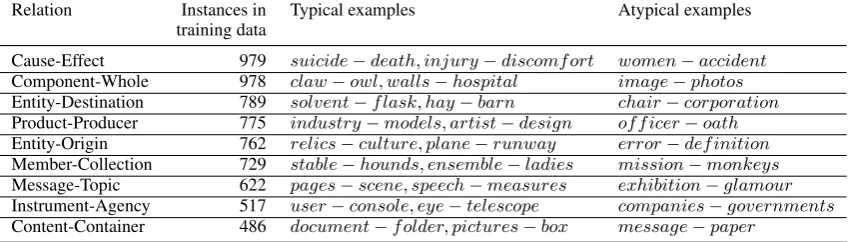
The SemEval 2010 Task 8 data we used (Hendrickx et al.,2010) contains examples of relation instances for 9 relations with sufficiently broad coverage to be of general and practical interest (Table1). There is no overlap between classes, but there are two groups of strongly related relations to assess models’ ability to make fine-grained distinctions (CONTENT-CONTAINER, COMPONENT-WHOLE, MEMBER-COLLECTION and ENTITY-ORIGIN, ENTITY-DESTINATION). Human agreement rates, when annotated in context, range from 58.2% to 98.5% depending on the relation type (Hendrickx et al., 2010). This data set is very challenging, not only because of the fine semantic distinctions, but also because semantic relations were annotated in context and contain many less typical relation instances. In the current experiment, the goal we set for ourselves is
to explore models’ abilities to capture the structure of the data, rather then in achieving a classification precision close to that of humans.
We used 6637 pairs of single word instances from the training data. Contexts in the training data were discarded. Class bias is present: the most frequent relation has 979 instances, the least frequent has 486.
3 Vector combination methods
If a1, a2, b1, b2 are entities (nouns or nominal compositions) from a corpus, each of them assigned a pre-trained word embedding, we would like to classify entity pairs a = (a1, a2) and b = (b1, b2) according to their semantic relation. This means that we are looking for an efficient combination ofa1, a2 andb1, b2 vectors that encode their relational attributes. We aim to find effective methods to calculate a relational similaritysim(a, b) by combining entity vectors a1, a2andb1, b2.
Pairwise similaritiesbuild on the idea that if a1 is semantically similar tob1 anda2 is similar to b2, the relation betweena1 anda2is similar to the relation betweenb1 andb2. The recall of this ap-proach is expected to be limited: the same relation can hold between different types of entities.
Analogical similaritiespresume thatb1−b2shares the direction witha1−a2, ignoring the pairwise similarities. We adapt this measure, while aware that analogy pairs are a specific case of relational similarity in that analogies work both ways (man
~king:: woman~queenand alsoman~woman::
king~queen).
IN-OUT similarities: a new combination that builds on the integration of second order similari-ties.
Onlya1: In this baseline solution, the similarity between two pairs is calculated as the similarity between the first entity of each pair, the other pair being ignored.
sim(a, b) =sim(a1, b1) (3)
3.1 Pairwise similarities
Different combinations proposed in the literature were compared.
vec-Relation Instances in Typical examples Atypical examples training data
Cause-Effect 979 suicide−death, injury−discomfort women−accident
Component-Whole 978 claw−owl, walls−hospital image−photos
Entity-Destination 789 solvent−flask, hay−barn chair−corporation
Product-Producer 775 industry−models, artist−design officer−oath
Entity-Origin 762 relics−culture, plane−runway error−definition
Member-Collection 729 stable−hounds, ensemble−ladies mission−monkeys
Message-Topic 622 pages−scene, speech−measures exhibition−glamour
Instrument-Agency 517 user−console, eye−telescope companies−governments
[image:5.595.87.512.66.187.2]Content-Container 486 document−folder, pictures−box message−paper
Table 1: Semantic Relation Classification data
tors of the two entities.
sim(a, b) =sim((a1⊕a2),(b1⊕b2)) (4)
• pairwise addition Pairwise similarities be-tween respective entities are added up. If we use cosine similarity, this is only slightly dif-ferent from the concatenative method. Vec-tor addition proved to work well as a compo-sitional representation (Mitchell and Lapata, 2010), despite the fact that word order is ig-nored.
sim(a, b) =sim(a1, b1) +sim(a2, b2) (5)
A potential problem with this addition objective is that different properties of words are expressed on a different scale and, as a consequence, terms sharing these properties have a higher cosine simi-larity than terms that are similar with respect to a flatter property. It can be overcome by using multi-plication instead of addition (Levy and Goldberg, 2014):
• pairwise multiplication
sim(a, b) =sim(a1, b1)×sim(a2, b2) (6)
3.2 Analogies
This is an adaptation of the measure proposed for
queen = king - man + woman (Mikolov et al., 2013b). Vector arithmetics give us the vector which fills the analogy, and we can search for the wordb2 whose embedding vector has the greatest similarity to it:
argmaxb2 =sim(b2,(b1−a1+a2)) (7)
which, using cosine similarity forsim, can be writ-ten as a combination of similarities (Levy et al.,
2015a), as
argmaxb2 =sim(b2, b1)−sim(b2, a1) +sim(b2, a2) (8)
Mikolov (2013b) notes that this measure is qualita-tively similar to the relational similarity model in (Turney,2012), which predicts similarity between members of the word pairs(xb, xd),(xc, xd)and dissimilarity for(xa, xd).
In the current context, we do not look for the miss-ingb2which maximizes the equation. Instead, we have different pairsaandb, and we aim to calcu-latesim(a, b)to quantify how much the analogy
queen - woman = king - manholds.
• differenceFocuses on the similarity ofb1,b2 and a1, a2, but does not take into account the pairwise distances between the individual entity vectors.
sim(a, b) =sim((a1−a2),(b1−b2)) (9)
Levy et al. (2015a) propose a multiplicative ver-sion of the analogy formula. We tried to adapt it; however, this measure is not symmetrical (con-ceived to findb2 which maximizes the form) and the adaptation produced bad results.
3.3 IN-OUT similarities
This metric is a combination of first order and se-cond order similarities between the two entity pairs, adapted to relational similarity:aandbare similar ifa1is similar tob1and also similar to thecontexts
of b2, the opposite entity inb.
Words with a high input-output similarity tend to appear in the context of each other. This similarity combination was recently included for a few, dif-ferent tasks. It was shown to improve information retrieval (Nalisnick et al., 2016). Pennington et al. (2014) propose to use second-order similarity to improve similarity calculation between words. Their proposed formula combines first and second order similarity, normalized by the reflective se-cond order similarity of the words with themselves. Finally, Melamud et al. (2015) used a combination of input-output similarities for lexical substitution. In these contexts, the use of second-order simi-larities1is based on the observation that words are
similar if they tend to appear in similar contexts, or if they tend to appear in the contexts of each other. In our experiment, second order similarities are used in a different way and with a different purpose. Second-order similarities are calculated betweenopposite elementsof the entity pairs. We combine those similarities by taking the in-in simi-larity betweena1andb1, and the in-out similarities betweena1andb2, and betweena2andb1. Our mo-tivation is to add relational information in a form which also preserves pairwise similarity informa-tion, as both are relevant for calculating relational similarities. We do it by using a co-occurrence component which gives higher score between more prototypical example pairs. A pairwise similarity can be high even if the entities are similar, but their relation is not: an obvious example is ambiguity (when they are similar with respect to a meaning, but co-occur with their pair in an other meaning). If an entity is similar to one argument of a relation and is also likely to appear in the context of the other argument, it indicates a higher likelihood of being an instance of the same relation.
• additive in-out
sim(a, b) =sim(a1, b1) +sim(a2, b2)
+sim2(a1, b2) +sim2(a2, b1) (10)
wheresim2designates the second order similarity and is calculated as follows:
sim2(x1, y2) =sim(xin1 , y2out) +sim(xout1 , y2in) (11) 1Note that we use the term "second order similarity" in the sense of word-to-context similarity, unlike Pennington et al. (2014).
• multiplicative in-out: The same as above, but addition is replaced by multiplication in simandsim2.
sim(a, b) =sim(a1, b1)∗sim(a2, b2)
∗sim2(a1, b2)∗sim2(a2, b1)
(12)
where
sim2(x1, y2) =sim(xin1 , y2out)∗sim(xout1 , y2in) (13)
4 Clustering Experiments
For supervised classification tasks, it is desirable to adapt word2vec’s hyperparameters to the task and the data at hand (Levy et al., 2015a). The interaction between hyperparameters is also to be considered (Krebs and Paperno,2016). However, our experiment is a clustering scenario aimed at exploratory analysis on a vector space created by pre-trained word embeddings; therefore, we set the parameters once and in advance.
We trained a word2vec CBOW model (Mikolov et al.,2013a) with negative sampling and a window size of 10 words on the ukWaC corpus (Baroni et al.,2009), and extracted both input and output vectors of size = 400 to build the vector combina-tions above. This size corresponds to the best per-forming model in the comparative paper by Baroni et al. (2012). An adjacency matrix was constructed for each vector/similarity combination using cosine similarity.
Clustering was implemented with Cluto’s (Zhao et al., 2005) clustering function which takes the adjacency matrix as input. We used a hierarchi-cal agglomerative clustering with the unweighted average distance (UPGMA) criterion function2.
4.1 Evaluation as classification
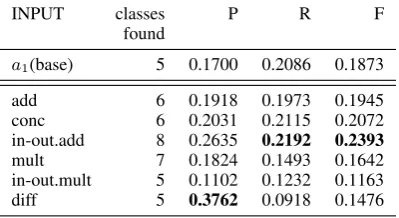
At first, we ran the clustering with 9 clusters (the number of classes in the standard) and tried to make one-to-one correspondences between the standard and the output. Every cluster is mapped to the stan-dard class that shares the more elements with. We
then calculate precision and recall for each stan-dard class (zero if the class doesn’t show up as a majority class in any cluster). Average class-based precision and recall is reported, as well as the num-ber of classes in the standard that could be assigned. These scores were published for the SemEval task participants, but ours are not comparable because we only consider one cluster for each class, and because we did the clustering on the training data.
INPUT classes P R F
found
a1(base) 5 0.1700 0.2086 0.1873
add 6 0.1918 0.1973 0.1945
conc 6 0.2031 0.2115 0.2072
in-out.add 8 0.2635 0.2192 0.2393
mult 7 0.1824 0.1493 0.1642
[image:7.595.316.516.61.240.2]in-out.mult 5 0.1102 0.1232 0.1163 diff 5 0.3762 0.0918 0.1476
Table 2: Class-based results for 9 clusters
4.2 Evaluation as clustering
While the scores above can be indicative of the potential of different representations, they do not provide information on other aspects as cluster sta-bility, purity, the amount of post-processing needed. Above all, in a completely unsupervised setting, the number of classes in the standard is not known and cluster quality (precision) plays an important role with respect to interpretability: it is easier to unify two homogeneous clusters than to separate a noisy one. We ran complementary experiments with dif-ferent numbers of clusters. Table3indicates results for 20 and 30 clusters. The input-output combina-tion method still has an advantage, and concatena-tion and multiplicaconcatena-tion also perform well. However, the advantages over the baseline are less significant than when the number of clusters was identical to the standard.
In the next runs, we measure how stable the differ-ent clustering solutions are with settings that are structurally very different from the standard, i.e. have significantly more clusters. Class-based pre-cision and recall are less relevant measures in this setting, since they take the average over the nine standard classes and not over the produced clusters. We therefore decided to usemodified purity( Korho-nen et al.,2008), adapted for structurally different clustering solution. Modified purity gives the pro-portion of word pairs belonging to the majority
INPUT #clust P R F
a1(base) 20 0.3429 0.1642 0.2221
add 20 0.2434 0.1843 0.2098
conc 20 0.2718 0.2116 0.2380 in-out.add 20 0.2947 0.2076 0.2436 mult 20 0.3405 0.1886 0.2428 in-out.mult 20 0.2711 0.1432 0.1874 diff 20 0.2997 0.1161 0.1674
a1(base) 30 0.3855 0.1712 0.2371
add 30 0.2714 0.1726 0.2110
conc 30 0.3331 0.1862 0.2389 in-out.add 30 0.3548 0.1947 0.2514 mult 30 0.3037 0.1995 0.2408 in-out.mult 30 0.3916 0.1304 0.1957 diff 30 0.3770 0.1318 0.1953
Table 3: Class-based results for 20 and 30 clusters
classcin their clusterk:
P UR= P|K|
i=1maxj|w in ki∩w in cj|
P|K|
i=1w in ki
(14)
Modified purity is indicative of the quality and interpretability of the clusters. It favorizes small clusters, but singleton clusters were discarded. This measure corresponds to prediction accuracy in clas-sification if we assign the majority label to clusters. Two series of runs were evaluated: for 10, 20... up to 50, and for 60, 70... up to 100 clusters. Aver-age results are reported. These scores indicate the average purity of clusters over different runs.
INPUT PUR
a1(baseline) 0.2940
add 0.3059
conc 0.3107
in-out.add 0.3235
mult 0.2575
in-out.mult 0.2119
[image:7.595.82.282.202.311.2]diff 0.2297
Table 4: Cluster-based results, 10-50 clusters
INPUT PUR
a1(baseline) 0.3291
add 0.3578
conc 0.3737
in-out.add 0.3674
mult 0.3235
in-out.mult 0.2587
diff 0.3058
[image:7.595.369.466.632.729.2]5 Discussion
We note that the baseline and the simple pairwise combinations have a high performance because they already capture arguments’ semantic types successfully. This also lies behind previous suc-cess on the analogy dataset. Moreover, the nature of semantic spaces and of semantic datasets is such that they typically contain close or quasi-identical variants for the same phenomenon, that the base-lines identify easily.
The additive input-output combination shows promising results, especially when it comes to cap-turing the structure: in the clustering setting with 9 clusters, it identifies 8 classes out of 9 in the standard. This indicates a good potential in differ-entiating between relation types, especially because the standard is conceived in a way that it contains strongly related classes. It outperforms every other measure until the number of clusters grows signifi-cantly above those in the standard (Table5), when the concatenative measure catches up. The base-line performs well, but additive methods all beat it, while difference is especially weak. Pairwise multiplication is good at recognizing the structure (7 classes out of 9), but not good at assigning ele-ments.
Multiplicative methods show a fluctuating perfor-mance, especially the multiplicative input-output combination. This is due to the higher variance in similarities obtained by multiplication (in the case of input-output combination, 6 operands are multi-plied), combined with the agglomerative clustering, which is sensitive to chaining.
The very high precision of the baseline method with a large number of clusters (Table3) is note-worthy but not unexpected. Individual similarities have a strong precision for the easily identifiable clusters, while additional relational information is mostly expected to improve recall.
6 Conclusion and Future Work
We presented an experiment to identify relational similarities in word embedding compositions at a large scale, using an unsupervised approach. On the one hand, our results confirm the recent find-ing that many of the success attributed to vector arithmetics for analogies come from similarities between individual elements. On the other hand, taking second order similarity into account, we can improve relational similarities and take a step to-ward a meaningful representation for entity couples
in a semantic relation.
The baseline performs well and is difficult to enrich with relation-aware information. The results indicate that the vector offset method for analogies, which replaces the pairwise similarity, is the least efficient in capturing generic semantic relations at a large scale. The vector difference representation does not conserve pairwise similar-ities and the offsets do not prove to be constant enough for unsupervised clustering. Multiplicative methods do not scale up either, although to a lesser extent: they capture some of the relational information, but this happens at the expense of losing precision from individual similarities. Pairwise similarities can be better exploited in an additive or concatenative setting. Moreover, they can be meaningfully complemented by including second order similarities without losing too much information for precise classification. The input-output combination measure coherently outperformed the other combinations in almost every setting, indicating a better potential for unsupervised experiments.
Unsupervised relation classification is a very challenging task for several reasons. Some relation instances are lexical by nature and, therefore, can be expected to show up in the same cluster based on distributional cues. On the other hand, contex-tual relation instances tend to have relation-specific indicators when they co-occur, but their individual vectors will not reveal this information (unless they co-occur very often). Moreover, semantic relations differ with respect to the semantic constraints they put on their arguments. For instance, the second argument of the Content-Container relation tend to belong to a specific semantic class in the stan-dard (bag, box, trunk, case, drawer...), while both arguments of the Cause-Effect relation are much freer (gas, prices, pain, acts, species and pyrol-ysis, collapse, contraction, society, noise). Any future development towards an automated unsu-pervised classification needs to take these aspects into account and work towards a hybrid solution by separating relations with semantically constrained arguments from free ones, as well as adapting the clustering method to handle outliers.
Acknowledgments
the French National Research Agency, ANR-10-LABX-0083 (Labex EFL). We are grateful to the anonymous reviewers for their valuable comments that helped to improve the paper.
References
Marco Baroni, Raffaela Bernardi, Ngoc-Quynh Do, and Chung-Chieh. Shan. 2012. Entailment above
the word level in distributional semantics. InACL
’12.
Marco Baroni, Silvia Bernardini, Adriano Ferraresi, and Eros Zanchetta. 2009. The wacky wide web: A collection of very large linguistically processed
web-crawled corpora. Language Resources and
Evalua-tion, 43(3).
Marco Baroni, Georgiana Dinu, and Germán
Kruszewski. 2014. Dont count, predict! a
systematic comparison of context-counting vs. context-predicting semantic vectors. InACL ’14. Marco Baroni and Roberto Zamparelli. 2010. Nouns
are vectors, adjectives are matrices: Representing adjective-noun constructions in semantic space. In
EMNLP’10.
Iris Hendrickx, Su Nam Kim, Zornitsa Kozareva, Preslav Nakov, Diarmuid O Séaghdha, Sebastian Padó, Marco Pennacchiotti, Lorenza Romano, and
Stan Szpakowicz. 2010. Semeval-2010 task 8:
Multi-way classification of semantic relations be-tween pairs of nominals. InProceedings of the Work-shop on Semantic Evaluations.
Amaç Herdaˇgdelen and Marco Baroni. 2009. Bag-pack: A general framework to represent semantic
relations. In Proceedings of the Workshop on
Ge-ometrical Models of Natural Language Semantics, GEMS ’09.
Jerry Hobbs and Ellen Riloff. 2010. Information
ex-traction. InHandbook of Natural Language
Process-ing, Second Edition.
David Jurgens, Peter Turney, Saif M. Mohammad, and Keith Holyoak. 2012. Semeval-2012 task 2: Measur-ing degrees of relational similarity. InProceedings of the Workshop on Semantic Evaluations.
Anna Korhonen, Yuval Krymolowski, and Nigel Col-lier. 2008. The choice of features for classification of verbs in biomedical texts. InCOLING’08. Lili Kotlerman, Ido Dagan, Idan Szpektor, and Maayan
Zhitomirsky-Geffet. 2010. Directional
distribu-tional similarity for lexical inference. Natural Lan-guage Engineering, 21:5.
Alicia Krebs and Denis Paperno. 2016. When hyperpa-rameters help: Beneficial parameter combinations in distributional semantic models. InJoint Conference on Lexical and Computational Semantics (*SEM).
Quoc V. Le and Tomas Mikolov. 2014. Distributed representations of sentences and documents. In
ICML’14.
Omer Levy and Yoav Goldberg. 2014. Linguistic reg-ularities in sparse and explicit word representations. InCONLL’14.
Omer Levy, Yoav Goldberg, and Ido Dagan. 2015a. Im-proving distributional similarity with lessons learned
from word embeddings. TACL, 3.
Omer Levy, Steffen Remus, Chris Biemann, and Ido Dagan. 2015b. Do supervised distributional me-thods really learn lexical inference relations? In
ACL ’15.
Tal Linzen. 2016. Issues in evaluating semantic
spaces using word analogies. InRepEval Workshop,
ACL’16.
Márton Makrai, Dávid Nemeskey, and András Kornai. 2013. Applicative structure in vector space models. In Workshop on Continuous Vector Space Models and their Compositionality.
Oren Melamud, Omer Levy, and Ido Dagan. 2015. A simple word embedding model for lexical
substitu-tion. InProceedings of the Vector Space Modeling
for NLP Workshop, NAACL.
Tomas Mikolov, Kai Chen, Greg S. Corrado, and Jeff Dean. 2013a. Efficient estimation of word represen-tations in vector space. InProceedings of Workshop at ICLR.
Tomas Mikolov, Wen-tau Yih, and Geoffrey Zweig. 2013b. Linguistic regularities in continuous space
word representations. InNAACL’13.
Jeff Mitchell and Mirella Lapata. 2010. Composition in distributional models of semantics. Cognitive Sci-ence, 34:8.
Jane Morris and Graeme Hirst. 2004. Non-classical
lexical semantic relations. InWorkshop on
Compu-tational Lexical Semantics, HLT-NAACL’04.
Eric Nalisnick, Bhaskar Mitra, Nick Craswell, and Rich Caruana. 2016. Improving document ranking
with dual word embeddings. InProceedings of the
WWW Conference.
Jeffrey Pennington, Richard Socher, and Christopher Manning. 2014. Glove: Global vectors for word
rep-resentation. InEMNLP’14.
Stephen Roller, Katrin Erk, and Gemma Boleda. 2014. Inclusive yet selective: Supervised distributional
hy-pernymy detection. InCOLING’14.
Vered Shwartz, Yoav Goldberg, and Ido Dagan. 2016. Improving hypernymy detection with an integrated path-based and distributional method. InACL’16. Peter Turney. 2005. Measuring semantic similarity by
latent relational analysis. InIJCAI’05.
Peter Turney. 2006. Similarity of semantic relations.
CoRR, abs/cs/0608100.
Peter Turney. 2012. Domain and function: A dual-space model of semantic relations and compositions.
Journal of Artificial Intelligence Research, 44. Peter Turney and Saif M. Mohammad. 2014.
Experi-ments with three approaches to recognizing lexical
entailment. Natural Language Engineering, 21:3.
Peter Turney and Patrick Pantel. 2010. From fre-quency to meaning: Vector space models of seman-tics. CoRR, abs/1003.1141.
Julie Weeds, Daoud Clarke, Jeremy Reffin, David Weir, and Bill Keller. 2014. Learning to distinguish
hyper-nyms and co-hypohyper-nyms. InCOLING ’14.
Ying Zhao, George Karypis, and Usama Fayyad. 2005. Hierarchical clustering algorithms for document
datasets. Data Mining for Knowledge Discovery,
10.