Using the Web for Language Independent Spellchecking and
Autocorrection
Casey Whitelaw and Ben Hutchinson and Grace Y Chung and Gerard Ellis Google Inc.
Level 5, 48 Pirrama Rd, Pyrmont NSW 2009, Australia
{whitelaw,benhutch,gracec,ged}@google.com
Abstract
We have designed, implemented and eval-uated an end-to-end system spellcheck-ing and autocorrection system that does not requireanymanually annotated train-ing data. The World Wide Web is used as a large noisy corpus from which we infer knowledge about misspellings and word usage. This is used to build an er-ror model and ann-gram language model. A small secondary set of news texts with artificially inserted misspellings are used to tune confidence classifiers. Because no manual annotation is required, our sys-tem can easily be instantiated for new lan-guages. When evaluated on human typed data with real misspellings in English and German, our web-based systems outper-form baselines which use candidate cor-rections based on hand-curated dictionar-ies. Our system achieves 3.8% total error rate in English. We show similar improve-ments in preliminary results on artificial data for Russian and Arabic.
1 Introduction
Spellchecking is the task of predicting which words in a document are misspelled. These pre-dictions might be presented to a user by under-lining the misspelled words. Correction is the task of substituting the well-spelled hypotheses for misspellings. Spellchecking and autocorrec-tion are widely applicable for tasks such as word-processing and postword-processing Optical Character Recognition. We have designed, implemented and evaluated an end-to-end system that performs spellchecking and autocorrection.
The key novelty of our work is that the sys-tem was developed entirely without the use of manually annotated resources or any explicitly
compiled dictionaries of well-spelled words. Our multi-stage system integrates knowledge from sta-tistical error models and language models (LMs) with a statistical machine learning classifier. At each stage, data are required for training models and determining weights on the classifiers. The models and classifiers are all automatically trained from frequency counts derived from the Web and from news data. System performance has been validated on a set of human typed data. We have also shown that the system can be rapidly ported across languages with very little manual effort.
Most spelling systems today require some hand-crafted language-specific resources, such as lex-ica, lists of misspellings, or rule bases. Sys-tems using statistical models require large anno-tated corpora of spelling errors for training. Our statistical models require no annotated data. In-stead, we rely on the Web as a large noisy corpus in the following ways. 1) We infer information about misspellings from term usage observed on the Web, and use this to build an error model. 2) The most frequently observed terms are taken as a noisy list of potential candidate corrections. 3)
Token n-grams are used to build an LM, which
we use to make context-appropriate corrections. Because our error model is based on scoring sub-strings, there is no fixed lexicon of well-spelled words to determine misspellings. Hence, both novel misspelled or well-spelled words are allow-able. Moreover, in combination with ann-gram LM component, our system can detect and correct real-word substitutions, ie, word usage and gram-matical errors.
Confidence classifiers determine the thresholds for spelling error detection and autocorrection, given error and LM scores. In order to train these classifiers, we require some textual content with some misspellings and corresponding well-spelled words. A small subset of the Web data from news pages are used because we assume they contain
relatively few misspellings. We show that con-fidence classifiers can be adequately trained and tuned without real-world spelling errors, but rather with clean news data injected with artificial mis-spellings.
This paper will proceed as follows. In Section 2, we survey related prior research. Section 3 de-scribes our approach, and how we use data at each stage of the spelling system. In experiments (Sec-tion 4), we first verify our system on data with ar-tificial misspellings. Then we report performance on data with real typing errors in English and Ger-man. We also show preliminary results from port-ing our system to Russian and Arabic.
2 Related Work
Spellchecking and correction are among the oldest text processing problems, and many different so-lutions have been proposed (Kukich, 1992). Most approaches are based upon the use of one or more manually compiled resources. Like most areas of natural language processing, spelling systems have been increasingly empirical, a trend that our system continues.
The most direct approach is to model the causes of spelling errors directly, and encode them in an algorithm or an error model. Damerau-Levenshtein edit distance was introduced as a way to detect spelling errors (Damerau, 1964). Phonetic indexing algorithms such as Metaphone, used by GNU Aspell (Atkinson, 2009), repesent
words by their approximate ‘soundslike’ pronun-ciation, and allow correction of words that ap-pear orthographically dissimilar. Metaphone relies upon data files containing phonetic information. Linguistic intuition about the different causes of spelling errors can also be represented explicitly in the spelling system (Deorowicz and Ciura, 2005). Almost every spelling system to date makes use of a lexicon: a list of terms which are treated as ‘well-spelled’. Lexicons are used as a source of corrections, and also to filter words that should be ignored by the system. Using lexicons in-troduces the distinction between ‘non-word’ and ‘real-word’ errors, where the misspelled word is another word in the lexicon. This has led to the two sub-tasks being approached separately (Golding and Schabes, 1996). Lexicon-based ap-proaches have trouble handling terms that do not appear in the lexicon, such as proper nouns, for-eign terms, and neologisms, which can account for
a large proportion of ‘non-dictionary’ terms (Ah-mad and Kondrak, 2005).
A word’s context provides useful evidence as to its correctness. Contextual information can be represented by rules (Mangu and Brill, 1997) or
more commonly in an n-gram LM. Mays et al
(1991) used a trigram LM and a lexicon, which was shown to be competitive despite only allow-ing for a sallow-ingle correction per sentence (Wilcox-O’Hearn et al., 2008). Cucerzan and Brill (2004) claim that an LM is much more important than the channel model when correcting Web search queries. In place of an error-free corpus, the Web has been successfully used to correct real-word errors using bigram features (Lapata and Keller, 2004). This work uses pre-defined confusion sets. The largest step towards an automatically train-able spelling system was the statistical model for spelling errors (Brill and Moore, 2000). This re-places intuition or linguistic knowledge with a training corpus of misspelling errors, which was compiled by hand. This approach has also been extended to incorporate a pronunciation model (Toutanova and Moore, 2002).
There has been recent attention on using Web search query data as a source of training data, and as a target for spelling correction (Yang Zhang and Li, 2007; Cucerzan and Brill, 2004). While query data is a rich source of misspelling information in the form of query-revision pairs, it is not available for general use, and is not used in our approach.
The dependence upon manual resources has created a bottleneck in the development of spelling systems. There have been few language-independent, multi-lingual systems, or even sys-tems for languages other than English. Language-independent systems have been evaluated on Per-sian (Barari and QasemiZadeh, 2005) and on Ara-bic and English (Hassan et al., 2008). To our knowledge, there are no previous evaluations of a language-independent system across many lan-guages, for the full spelling correction task, and indeed, there are no pre-existing standard test sets for typed data with real errors and language con-text.
3 Approach
confidence classifiers
Web with artificial News data misspellings
corrected text input text
language model error model
term list
[image:3.595.125.476.74.245.2]scored suggestions
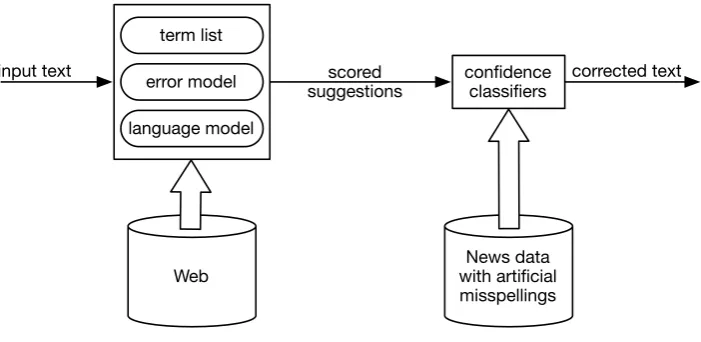
Figure 1: Spelling process, and knowledge sources used.
The text processing workflow and the data used in building the system are outlined in Figure 1 and detailed in this section. For each token in the in-put text, candidate suggestions are drawn from the term list (Section 3.1), and scored using an error model (Section 3.2). These candidates are eval-uated in context using an LM (Section 3.3) and re-ranked. For each token, we use classifiers (Sec-tion 3.4) to determine our confidence in whether a word has been misspelled and if so, whether it should be autocorrected to the best-scoring sug-gestion available.
3.1 Term List
We require a list of terms to use as candidate cor-rections. Rather than attempt to build a lexicon of words that are well-spelled, we instead take the most frequent tokens observed on the Web. We used a large (>1 billion) sample of Web pages, tokenized them, and took the most frequently oc-curring ten million tokens, with very simple filters for non-words (too much punctuation, too short or long). This term list is so large that it should con-tain most well-spelled words, but also a large num-ber of non-words or misspellings.
3.2 Error Model
We use a substring error model to estimate
P(w|s). To derive the error model, let R be a partitioning of s into adjacent substrings, and similarly let T be a partitioning of w, such that
|T| = |R|. The partitions are thus in one-to-one alignment, and by allowing partitions to be empty, the alignment models insertions and deletions of
substrings. Brill and Moore estimate P(w|s) as follows:
P(w|s)≈ max
R, T s.t.|T|=|R| |R| Y
i=1
P(Ti|Ri) (1)
Our system restricts partitionings that have sub-strings of length at most 2.
To train the error model, we require triples of (intended word, observed word, count), which are described below. We use maximum likelihood es-timates ofP(Ti|Ri).
3.2.1 Using the Web to Infer Misspellings
To build the error model, we require as train-ing data a set of (intended word, observed word, count) triples, which is compiled from the World Wide Web. Essentially the triples are built by start-ing with the term list, and a process that auto-matically discovers, from that list, putative pairs of spelled and misspelled words, along with their counts.
We believe the Web is ideal for compiling this set of triples because with a vast amount of user-generated content, we believe that the Web con-tains a representative sample of both well-spelled and misspelled text. The triples are not used di-rectly for proposing corrections, and since we have a substring model, they do not need to be an ex-haustive list of spelling mistakes.
misspellings derived from single instances of in-sertion, deletion, or substitution; and 2) words are usually spelled as intended.
For the error model, we use a large corpus (up to
3.7×10⁸pages) of crawled public Web pages. An
automatic language-identification system is used to identify and filter pages for the desired lan-guage. As we only require a small window of con-text, it would also be possible to use an n-gram collection such as the Google Web 1T dataset.
Finding Close Words. For each term in the term list (defined in Section 3.1), we find all other terms in the list that are “close” to it. We define closeness using Levenshtein-Damerau edit distance, with a conservative upper bound that in-creases with word length (one edit for words of up to four characters, two edits for up to twelve characters, and three for longer words). We com-pile the term list into a trie-based data structure which allows for efficient searching for all terms within a maximum edit distance. The computa-tion is ‘embarassingly parallel’ and hence easily distributable. In practice, we find that this stage takes tens to hundreds ofCPU-hours.
Filtering Triples. At this stage, for each term we have a cluster of orthographically similar terms, which we posit are potential misspellings. The set of pairs is reflexive and symmetric, e.g. it contains both (recieve, receive) and (receive, re-cieve). The pairs will also include e.g. (deceive,
receive). On the assumption that words are spelled correctly more often than they are misspelled, we next filter the set such that the first term’s fre-quency is at least 10 times that of the second term. This ratio was chosen as a conservative heuristic filter.
Using Language Context. Finally, we use the contexts in which a term occurs to gather direc-tional weightings for misspellings. Consider a term w; from our source corpus, we collect the set of contexts{ci}in whichwoccurs. The defi-nition of a context is relatively arbitrary; we chose to use a single word on each side, discarding con-texts with fewer than a total of ten observed occur-rences. For each contextci, candidate “intended” terms arewandw’s close terms (which are at least 10 times as frequent asw). The candidate which appears in contextci the most number of times is deemed to be the term intended by the user in that context.
The resulting dataset consists of triples of the
original observed term, one of the “intended” terms as determined by the above algorithm, and the number of times this term was intended. For a single term, it is possible (and common) to have multiple possible triples, due to the context-based assignment.
Inspecting the output of this training process shows some interesting patterns. Overall, the dataset is still noisy; there are many instances where an obviously misspelled word is not as-signed a correction, or only some of its instances are. The dataset contains around 100 million triples, orders of magnitude larger than any man-ually compiled list of misspellings . The kinds of errors captured in the dataset include stereotypi-cal spelling errors, such asacomodation, but also
OCR-style errors. computationaUy was detected
as a misspelling ofcomputationallywhere the ‘U’ is anOCRerror for ‘ll’; similarly,Postmodemwas
detected as a misspelling ofPostmodern(an exam-ple of ‘keming’).
The data also includes examples of ‘real-word’ errors. For example, 13% of occurrences of
occidental are considered misspellings of acci-dental; contrasting with 89% of occurrences of the non-word accidential. There are many ex-amples of terms that would not be in a normal lexicon, including neologisms (mulitplayer for
multiplayer), companies and products ( Playsta-tonforPlaystation), proper nouns (Schwarznegger
for Schwarzenegger) and internet domain names (mysapce.comformyspace.com).
3.3 Language Model
We estimate P(s) using n-gram LMs trained on data from the Web, using Stupid Backoff (Brants et al., 2007). We use both forward and back-ward context, when available. Contrary to Brill and Moore (2000), we observe that user edits of-ten have both left and right context, when editing a document.
When combining the error model scores with the LM scores, we weight the latter by taking their
λ’th power, that is
can reduce the value ofP(w|w)∗P(w)λ relative toPs6=wP(s|w)∗P(s)λ.
We train λ by optimizing the average inverse rank of the correct word on our training corpus, where the rank is calculated over all suggestions that we have for each token.
During initial experimentation, it was noticed that our system predicted many spurious autocor-rections at the beginnings and ends of sentences (or in the case of sentence fragments, the end of the fragment). We hypothesized that we were weighting the LM scores too highly in such cases. We therefore conditionedλon how much context was available, obtaining valuesλi,jwherei,j rep-resent the amount of context available to the LM to the left and right of the current word.iandjare capped atn, the order of the LM.
While conditioningλin this way might at first appear ad hoc, it has a natural interpretation in terms of our confidence in the LM. When there is no context to either side of a word, the LM simply uses unigram probabilities, and this is a less trust-worthy signal than when more context is available. To trainλi,j we partition our data into bins cor-responding to pairsi,jand optimize eachλi,j in-dependently.
Training a constant λ, a value of 5.77 was ob-tained. The conditioned weights λi,j increased with the values of iand j, ranging from λ0,0 =
0.82toλ4,4 = 6.89. This confirmed our
hypoth-esis that the greater the available context the more confident our system should be in using the LM scores.
3.4 Confidence Classifiers for Checking and Correction
Spellchecking and autocorrection were imple-mented as a three stage process. These em-ploy confidence classifiers whereby precision-recall tradeoffs could be tuned to desirable levels for both spellchecking and autocorrection.
First, all suggestionssfor a wordware ranked according to their P(s|w) scores. Second, a spellchecking classifier is used to predict whether
wis misspelled. Third, ifwis both predicted to be misspelled andsis non-empty, an autocorrection classifier is used to predict whether the top-ranked suggestion is correct.
The spellchecking classifier is implemented us-ing two embedded classifiers, one of which is used when s is empty, and the other when it is
non-empty. This design was chosen because the use-ful signals for predicting whether a word is mis-spelled might be quite different when there are no suggestions available, and because certain features are only applicable when there are suggestions.
Our experiments will compare two classifier types. Both rely on training data to determine threshold values and training weights.
A “simple” classifier which compares the value oflog(P(s|w))−log(P(w|w)), for the original word w and the top-ranked suggestions, with a threshold value. If there are no suggestions other thanw, then thelog(P(s|w))term is ignored.
A logistic regression classifier that uses five feature sets. The first set is a scores feature that combines the following scoring information (i) log(P(s|w)) − log(P(w|w)) for top-ranked suggestion s. (ii) LM score difference between the original word w and the top suggestion s. (iii)log(P(s|w))−log(P(w|w))for second top-ranked suggestions. (iv) LM score difference be-tweenwand second top-rankeds. The other four feature sets encode information about case signa-tures, number of suggestions available, the token length, and the amount of left and right context.
Certain categories of tokens are blacklisted, and so never predicted to be misspelled. These are numbers, punctuation and symbols, and single-character tokens.
The training process has three stages. (1) The context score weighting is trained, as described in Section 3.3. (2) The spellchecking classifier is trained, and tuned on held-out development data. (3) The autocorrection classifier is trained on the instances with suggestions that the spellchecking classifier predicts to be misspelled, and it too is tuned on held-out development data.
In the experiments reported in this paper, we trained classifiers so as to maximize theF1-score
on the development data. We note that the desired behaviour of the spellchecking and autocorrection classifiers will differ depending upon the applica-tion, and that it is a strength of our system that these can be tuned independently.
3.4.1 Training Using Artificial Data
Language Sentences
Train Test
English 116k 58k
German 87k 44k
Arabic 8k 4k
[image:6.595.118.245.53.140.2]Russian 8k 4k
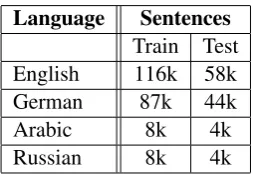
Table 1: Artificial data set sizes. The development set is approximately the same size as the training set.
not generally available, we instead use a clean corpus into which we artificially introduce mis-spellings. While this data is not ideal, we show that in practice it is sufficient, and removes the need for manually-annotated gold-standard data.
We chose data from news pages crawled from the Web as the original, well-spelled documents. We chose news pages as an easily identifiable source of text which we assume is almost entirely well-spelled. Any source of clean text could be used. For each language the news data were di-vided into three non-overlapping data sets: the training and development sets were used for train-ing and tuntrain-ing the confidence classifiers, and a test set was used to report evaluation results. The data set sizes, for the languages used in this paper, are summarized in Table 1.
Misspelled documents were created by artifi-cially introducing misspelling errors into the well-spelled text. For all data sets, spelling errors were randomly inserted at an average rate of 2 per hundred characters, resulting in an average word misspelling rate of 9.2%. With equal likelihood, errors were either character deletions, transposi-tions, or insertions of randomly selected charac-ters from within the same document.
4 Experiments
4.1 Typed Data with Real Errors
In the absence of user data from a real application, we attempted our initial evaluation with typed data via a data collection process. Typed data with real errors produced by humans were collected. We recruited subjects from our coworkers, and asked them to use an online tool customized for data collection. Subjects were asked to randomly se-lect a Wikipedia article, copy and paste several text-only paragraphs into a form, and retype those paragraphs into a subsequent form field. The sub-jects were asked to pick an article about a favorite city or town. The subjects were asked to type
at a normal pace avoiding the use of backspace or delete buttons. The data were tokenized, au-tomatically segmented into sentences, and manu-ally preprocessed to remove certain gross typing errors. For instance, if the typist omitted entire phrases/sentences by mistake, the sentence was re-moved. We collected data for English from 25 subjects, resulting in a test set of 11.6k tokens, and 495 sentences. There were 1251 misspelled tokens (10.8% misspelling rate.)
Data were collected for German Wikipedia arti-cles. We asked 5 coworkers who were German na-tive speakers to each select a German article about a favorite city or town, and use the same online tool to input their typing. For some typists who used English keyboards, they typedASCII
equiva-lents to non-ASCIIcharacters in the articles. This
was accounted for in the preprocessing of the ar-ticles to prevent misalignment. Our German test set contains 118 sentences, 2306 tokens with 288 misspelled tokens (12.5% misspelling rate.)
4.2 System Configurations
We compare several system configurations to in-vestigate each component’s contribution.
4.2.1 Baseline Systems Using Aspell
Systems 1 to 4 have been implemented as base-lines. These useGNUAspell, an open source spell
checker (Atkinson, 2009), as a suggester compo-nent plugged into our system instead of our own Web-based suggester. Thus, with Aspell, the sug-gestions and error scores proposed by the system would all derive from Aspell’s handcrafted custom dictionary and error model. (We report results us-ing the best combination of Aspell’s parameters that we found.)
System 1 uses Aspell tuned with the logistic regression classifier. System 2 adds a context-weighted LM, as per Section 3.3, and uses the “simple” classifier described in Section 3.4. Sys-tem 3 replaces the simple classifier with the logis-tic regression classifier. System 4 is the same but does not perform blacklisting.
4.2.2 Systems Using Web-based Suggestions
The Web-based suggester proposes suggestions and error scores from among the ten million most frequent terms on the Web. It suggests the 20 terms with the highest values of P(w|s)×f(s)
Systems 5 to 8 correspond with Systems 1 to 4, but use the Web-based suggestions instead of Aspell.
4.3 Evaluation Metrics
In our evaluation, we aimed to select metrics that we hypothesize would correlate well with real per-formance in a word-processing application. In our intended system, misspelled words are auto-corrected when confidence is high and misspelled words are flagged when a highly confident sug-gestion is absent. This could be cast as a simple classification or retrieval task (Reynaert, 2008), where traditional measures of precision, recall and
F metrics are used. However we wanted to
fo-cus on metrics that reflect the quality of end-to-end behavior, that account for the combined ef-fects of flagging and automatic correction. Es-sentially, there are three states: a word could be unchanged, flagged or corrected to a suggested word. Hence, we report on error rates that mea-sure the errors that a user would encounter if the spellchecking/autocorrection were deployed in a word-processor. We have identified 5 types of er-rors that a system could produce:
1. E1: A misspelled word is wrongly corrected.
2. E2: A misspelled word is not corrected but is
flagged.
3. E3: A misspelled word is not corrected or
flagged.
4. E4: A well spelled word is wrongly
cor-rected.
5. E5: A well spelled word is wrongly flagged. It can be argued that these errors have varying impact on user experience. For instance, a well spelled word that is wrongly corrected is more frustrating than a misspelled word that is not cor-rected but is flagged. However, in this paper, we treat each error equally.
E1, E2, E3 and E4 pertain to the correction task. Hence we can define Correction Error Rate (CER):
CER= E1+E2+E3+E4 T
whereT is the total number of tokens. E3andE5
pertain to the nature of flagging. We define Flag-ging Error Rate (FER) and Total Error Rate (TER):
FER= E3+E5 T
TER= E1+E2+E3+E4+E5 T
For each system, we computed a No Good Sugges-tion Rate (NGS) which represents the proportion
of misspelled words for which the suggestions list did not contain the correct word.
5 Results and Discussion
5.1 Experiments with Artificial Errors
System TER CER FER NGS
1. Aspell, noLM,LR 17.65 6.38 12.35 18.3
2. Aspell,LM, Sim 4.82 2.98 2.86 18.3
3. Aspell,LM,LR 4.83 2.87 2.84 18.3
4. Aspell,LM,LR 22.23 2.79 19.89 16.3
(no blacklist)
5. WS, noLM,LR 9.06 7.64 6.09 10.1
6. WS,LM, Sim 2.62 2.26 1.43 10.1
7. WS,LM,LR 2.55 2.21 1.29 10.1
8. WS,LM,LR 21.48 2.21 19.75 8.9
[image:7.595.309.546.196.357.2](no blacklist)
Table 2: Results for English news data on an in-dependent test set with artificial spelling errors. Numbers are given in percentages. LM: Language
Model, Sim: Simple, LR: Logistic Regression, WS: Web-based suggestions. NGS: No good
sug-gestion rate.
Results on English news data with artificial spelling errors are displayed in Table 2. The sys-tems which do not employ the LM scores per-form substantially poorer that the ones with LM scores. The Aspell system yields a total error rate of 17.65% and our system with Web-based sug-gestions yieldsTERof 9.06%.
When comparing the simple scorer with the lo-gistic regression classifier, the Aspell Systems 2 and 3 generate similar performances while the confidence classifier afforded some gains in our Web-based suggestions system, with total error re-duced from 2.62% to 2.55%. The ability to tune each phase during development has so far proven more useful than the specific features or classifier used. Blacklisting is crucial as seen by our results for Systems 4 and 8. When the blacklisting mech-anism is not used, performance steeply declines.
gains are evident for each error metric that was ex-amined. Total error rate for our best system (Sys-tem 7) reduces the error of the best Aspell sys-tem (Syssys-tem 3) by 45.7% (from 4.83% to 2.62%). In addition, our no good suggestion rate is only 10% compared to 18% in the Aspell system. Even where no LM scores are used, our Web-based sug-gestions system outperforms the Aspell system.
The above results suggest that the Web-based suggestions system performs at least as well as the Aspell system. However, it must be high-lighted that results on the test set with artificial errors does not guarantee similar performance on real user data. The artificial errors were generated at a systematically uniform rate, and are not mod-eled after real human errors made in real word-processing applications. We attempt to consider the impact of real human errors on our systems in the next section.
5.2 Experiments with Human Errors System TER CER FER NGS
English Aspell 4.58 3.33 2.86 23.0
EnglishWS 3.80 3.41 2.24 17.2
German Aspell 14.09 10.23 5.94 44.4
[image:8.595.311.519.383.539.2]GermanWS 9.80 7.89 4.55 32.3
Table 3: Results for Data with Real Errors in En-glish and German.
Results for our system evaluated on data with real misspellings in English and in German are shown in Table 3. We used the systems that per-formed best on the artificial data (System 3 for As-pell, and System 7 for Web suggestions). The mis-spelling error rates of the test sets were 10.8% and 12.5% respectively, higher than those of the arti-ficial data which were used during development. For English, the Web-based suggestions resulted in a 17% improvement (from 4.58% to 3.80%) in total error rate, but the correction error rate was slightly (2.4%) higher.
By contrast, in German our system improved to-tal error by 30%, from 14.09% to 9.80%. Correc-tion error rate was also much lower in our Ger-man system, comparing 7.89% with 10.23% for the Aspell system. The no good suggestion rates for the real misspelling data are also higher than that of the news data. Our suggestions are lim-ited to an edit distance of 2 with the original, and it was found that in real human errors, the aver-age edit distance of misspelled words is 1.38 but
for our small data, the maximum edit distance is 4 in English and 7 in German. Nonetheless, our no good suggestion rates (17.2% and 32.3%) are much lower than those of the Aspell system (23% and 44%), highlighting the advantage of not using a hand-crafted lexicon.
Our results on real typed data were slightly worse than those for the news data. Several fac-tors may account for this. (1) While the news data test set does not overlap with the classifier train-ing set, the nature of the content is similar to the train and dev sets in that they are all news articles from a one week period. This differs substantially from Wikipedia article topics that were generally about the history and sights a city. (2) Second, the method for inserting character errors (random generation) was the same for the news data sets while the real typed test set differed from the ar-tificial errors in the training set. Typed errors are less consistent and error rates differed across sub-jects. More in depth study is needed to understand the nature of real typed errors.
1 2 3 4 5 6
100 1000 10000 100000 1e+06 1e+07 1e+08 1e+09
Error rate
Corpus size
Typed TER Typed CER Typed FER Artificial TER Artificial CER Artificial FER
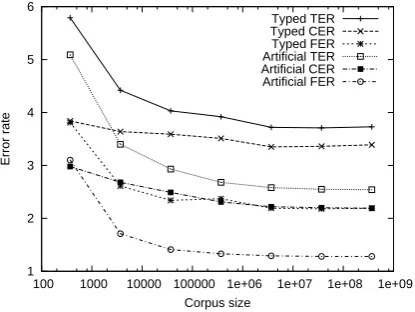
Figure 2: Effect of corpus size used to train the error model.
5.3 Effect of Web Corpus Size
To determine the effects of the corpus size on our automated training, we evaluated System 7 using error models trained on different corpus sizes. We used corpora containing 103,104, . . . ,109 Web
pages. We evaluated on the data set with real er-rors. On average, about 37% of the pages in our corpus were in English. So the number of pages we used ranged from about 370 to about3.7×108.
5.4 Correlation across data sets
We wanted to establish that performance improve-ment on the news data with artificial errors are likely to lead to improvement on typed data with real errors. The seventeen English systems re-ported in Table 3, Table 2 and Figure 2 were each evaluated on both English test sets. The rank cor-relation coefficient between total error rates on the two data sets was high (τ = 0.92; p <5×10⁻⁶).
That is, if one system performs better than another on our artificial spelling errors, then the first sys-tem is very likely to also perform better on real typing errors.
5.5 Experiments with More Languages System TER CER FER NGS
German Aspell 8.64 4.28 5.25 29.4
GermanWS 4.62 3.35 2.27 16.5
Arabic Aspell 11.67 4.66 8.51 25.3
ArabicWS 4.64 3.97 2.30 15.9
Russian Aspell 16.75 4.40 13.11 40.5
RussianWS 3.53 2.45 1.93 15.2
Table 4: Results for German, Russian, Arabic news data.
Our system can be trained on many languages with almost no manual effort. Results for German, Arabic and Russian news data are shown in Ta-ble 4. Performance improvements by the Web sug-gester over Aspell are greater for these languages than for English. Relative performance improve-ments in total error rates are 47% in German, 60% in Arabic and 79% in Russian. Differences in no good suggestion rates are also very pronounced between Aspell and the Web suggester.
It cannot be assumed that the Arabic and Rus-sian systems would perform as well on real data. However the correlation between data sets re-ported in Section 5.4 lead us to hypothesize that a comparison between the Web suggester and As-pell on real data would be favourable.
6 Conclusions
We have implemented a spellchecking and au-tocorrection system and evaluated it on typed data. The main contribution of our work is that while this system incorporates several knowledge sources, an error model, LM and confidence clas-sifiers, it does not require any manually annotated resources, and infers its linguistic knowledge en-tirely from the Web. Our approach begins with a
very large term list that is noisy, containing both spelled and misspelled words, and derived auto-matically with no human checking for whether words are valid or not.
We believe this is the first published system to obviate the need for any hand labeled data. We have shown that system performance improves from a system that embeds handcrafted knowl-edge, yielding a 3.8% total error rate on human typed data that originally had a 10.8% error rate. News data with artificially inserted spellings were sufficient to train confidence classifiers to a sat-isfactory level. This was shown for both Ger-man and English. These innovations enable the rapid development of a spellchecking and correc-tion system for any language for which tokeniz-ers exist and string edit distances make sense. We have done so for Arabic and Russian.
In this paper, our results were obtained without any optimization of the parameters used in the pro-cess of gathering data from the Web. We wanted to minimize manual tweaking particularly if it were necessary for every language. Thus heuristics such as the number of terms in the term list, the criteria for filtering triples, and the edit distance for defin-ing close words were crude, and could easily be improved upon. It may be beneficial to perform more tuning in future. Furthermore, future work will involve evaluating the performance of the sys-tem for these language on real typed data.
7 Acknowledgment
We would like to thank the anonymous reviewers for their useful feedback and suggestions. We also thank our colleagues who participated in the data collection.
References
Farooq Ahmad and Grzegorz Kondrak. 2005. Learn-ing a spellLearn-ing error model from search query logs. InHLT ’05: Proceedings of the conference on Hu-man Language Technology and Empirical Methods in Natural Language Processing, pages 955–962, Morristown, NJ, USA. Association for Computa-tional Linguistics.
K. Atkinson. 2009. Gnu aspell. In Available at
http://aspell.net.
Confer-ence on Artificial IntelligConfer-ence and Machine Learn-ing AIML 05, volume 05, pages 65–71, Cairo, Egypt, Dec. ICGST, ICGST.
Thorsten Brants, Ashok C. Popat, Peng Xu, Franz J. Och, and Jeffrey Dean. 2007. Large language models in machine translation. In Proceedings of the 2007 Joint Conference on Empirical Meth-ods in Natural Language Processing and Com-putational Natural Language Learning (EMNLP-CoNLL), pages 858–867.
Eric Brill and Robert C. Moore. 2000. An improved error model for noisy channel spelling correction. InACL ’00: Proceedings of the 38th Annual Meet-ing on Association for Computational LMeet-inguistics, pages 286–293. Association for Computational Lin-guistics.
S. Cucerzan and E. Brill. 2004. Spelling correction as an iterative process that exploits the collective knowledge of web users. InProceedings of EMNLP 2004, pages 293–300.
F.J. Damerau. 1964. A technique for computer detec-tion and correcdetec-tion of spelling errors. Communica-tions of the ACM 7, pages 171–176.
S. Deorowicz and M.G. Ciura. 2005. Correcting spelling errors by modelling their causes. Interna-tional Journal of Applied Mathematics and Com-puter Science, 15(2):275–285.
Andrew R. Golding and Yves Schabes. 1996. Com-bining trigram-based and feature-based methods for context-sensitive spelling correction. InIn Proceed-ings of the 34th Annual Meeting of the Association for Computational Linguistics, pages 71–78.
Ahmed Hassan, Sara Noeman, and Hany Hassan. 2008. Language independent text correction using finite state automata. InProceedings of the 2008 In-ternational Joint Conference on Natural Language Processing (IJCNLP, 2008).
Mark D. Kernighan, Kenneth W. Church, and William A. Gale. 1990. A spelling correction pro-gram based on a noisy channel model. In Proceed-ings of the 13th conference on Computational lin-guistics, pages 205–210. Association for Computa-tional Linguistics.
K. Kukich. 1992. Techniques for automatically cor-recting words in texts. ACM Computing Surveys 24, pages 377–439.
Mirella Lapata and Frank Keller. 2004. The web as a baseline: Evaluating the performance of unsuper-vised web-based models for a range of nlp tasks. In Daniel Marcu Susan Dumais and Salim Roukos, ed-itors, HLT-NAACL 2004: Main Proceedings, pages 121–128, Boston, Massachusetts, USA, May 2 -May 7. Association for Computational Linguistics.
Lidia Mangu and Eric Brill. 1997. Automatic rule acquisition for spelling correction. In Douglas H. Fisher, editor,ICML, pages 187–194. Morgan Kauf-mann.
Eric Mays, Fred J. Damerau, and Robert L. Mercer. 1991. Context based spelling correction. Informa-tion Processing and Management, 27(5):517. M.W.C. Reynaert. 2008. All, and only, the errors:
More complete and consistent spelling and ocr-error correction evaluation. In Proceedings of the sixth international language resources and evaluation.
Kristina Toutanova and Robert Moore. 2002. Pronun-ciation modeling for improved spelling correction. In Proceedings of the 40th Annual Meeting of the Association for Computational Linguistics (ACL), pages 144–151.
L. Amber Wilcox-O’Hearn, Graeme Hirst, and Alexan-der Budanitsky. 2008. Real-word spelling cor-rection with trigrams: A reconsideration of the mays, damerau, and mercer model. In Alexan-der F. Gelbukh, editor, CICLing, volume 4919 of
Lecture Notes in Computer Science, pages 605–616. Springer.
Wei Xiang Yang Zhang, Pilian He and Mu Li. 2007. Discriminative reranking for spelling correction. In