Efficient Inner-to-outer Greedy Algorithm
for Higher-order Labeled Dependency Parsing
Xuezhe Ma and Eduard Hovy Language Language Technologies Institute
Carnegie Mellon University Pittsburgh, PA 15213, USA
[email protected], [email protected]
Abstract
Many NLP systems use dependency parsers as critical components. Jonit learn-ing parsers usually achieve better parslearn-ing accuracies than two-stage methods. How-ever, classical joint parsing algorithms significantly increase computational com-plexity, which makes joint learning im-practical. In this paper, we proposed an ef-ficient dependency parsing algorithm that is capable of capturing multiple edge-label features, while maintaining low computa-tional complexity. We evaluate our parser on 14 different languages. Our parser consistently obtains more accurate results than three baseline systems and three pop-ular, off-the-shelf parsers.
1 Introduction
Natural language processing (NLP) systems, like machine translation (Xie et al., 2011), resource-low languages processing (McDonald et al., 2013; Ma and Xia, 2014), word sense disambigua-tion (Fauceglia et al., 2015) , and entity corefer-ence resolution (Durrett and Klein, 2013), are be-coming more sophisticated, in part because of uti-lizing syntacitc knowledges such as dependency parsing trees.
Dependency parsers predict dependency struc-tures and dependency type labels on each edge. However, most graph-based dependency parsing algorithms only produce unlabeled dependency trees, particularly when higher-order factoriza-tions are used (Koo and Collins, 2010; Ma and Zhao, 2012b; Martins et al., 2013; Ma and Zhao, 2012a). A two-stage method (McDonald, 2006) is often used because the complexity of some joint learning models is unacceptably high. On the other hand, joint learning models can benefit from edge-label information that has proven to be
im-portant to provide more accurate tree structures and labels (Nivre and Scholz, 2004).
Previous studies explored the trade-off between computational costs and parsing performance. Some work (McDonald, 2006; Carreras, 2007) simplified labeled information to only single la-bel features. Other work (Johansson and Nugues, 2008; Bohnet, 2010) used richer label features but increased systems’ complexities significantly, while achieving better parsing accuracy. Yet, there are no previous work addressing the problem of good balance between parsing accuracy and com-putational costs for joint parsing models.
In this paper, we propose a new dependency parsing algorithm that can utilize edge-label infor-mation of more than one edge, while simultane-ously maintaining low computational complexity. The component needed to solve this dilemma is an inner-to-outer greedy approximation to avoid an exhaustive search. The contributions of this work are (i) showing the effectiveness of edge-label in-formation on both UAS and LAS. (ii) proposing a joint learning parsing model which achieves both effectiveness and efficience. (iii) giving empiri-cal evaluations of this parser on different treebanks over 14 languages.
2 Joint Parsing Algorithm
2.1 Basic Notations
In the following,xrepresents a generic input
sen-tence, andyrepresents a generic dependency tree.
Formally, for a sentencex, dependency parsing is
the task of finding the dependency treeywith the
highest-score forx:
y∗(x) = argmax
y∈Y(x) Score(x, y). (1)
HereY(x)denotes the set of possible dependency
trees for sentencex.
In this paper, we adopt the second-order sib-ling factorization (Eisner, 1996; McDonald and
Pereira, 2006), in which each sibling part consists
of a tuple of indices (h, m, c) where (h, m) and
(h, c)are a pair of adjacent edges to the same side
of the headh. By adding labele information to this
factorization,Score(x, y)can be rewritten as:
Score(x, y) = P
(h,m,c,l1,l2)∈y
Ssib(h, m, c, l1, l2)
= P
(h,m,c,l1,l2)∈y
λTf(h, m, c, l1, l2) (2)
whereSsib(h, m, c, l1, l2)is the score function for
the sibling part(h, m, c) withl1 andl2 being the
labels of edge (h, m) and(h, c), respectively. f
are feature functions and λ is the parameters of
parsing model.
2.2 Exact Search Parsing
The unlabeled sibling parser introduces three
types of dynamic-programming structures:
com-pletespansC(s,t), which consist of the headword
sand its descendents on one side with the endpoint
t,incompletespansI(s,t), which consist of the
de-pendency(s, t)and the region between the heads
and the modifiert, andsiblingspansS(s,t), which
represent the region between successive modifiers
s and t of some head. To capture label
infor-mation, we have to extend each incomplete span
Is,t toIs,t,l to store the label of dependency edge
from s tot. The reason is that there is an edge
shared by two adjacent sibling parts (e.g.(h, m, c)
and (h, c, c0) share the edge (h, c)). So the
in-complete spanI(s,t) does not only depend on the
label of dependency (s, t), but also the label of
the dependency(s, r)for each split pointr. The
dynamic-programming procedure for new
incom-plete spans1are
I(s,t,l)= max
s<r≤tS(r,t)+maxl0∈LI(s,r,l0)+Ssib(s, r, t, l
0, l) (3)
whereLis set of all edge labels. Then we have,
I(s,t) = max
l∈L I(s,t,l) (4)
l∗
(s,t) = argmax
l∈L I(s,t,l) (5)
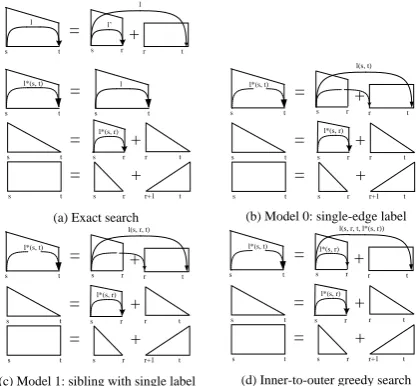
The graphical specification of the this parsing al-gorithm is provided in Figure 1 (a). The compu-tational complexity of the exactly searching
algo-rithm isO(|L|2n3) time andO(|L|n2)space. In
practice, |L| is probably large. For English, the
number of edge labels in Stanford Basic Depen-dencies (De Marneffe et al., 2006) is 45, and the
1Symmetric right-headed versions are elided for brevity
(b) Model 0: single-edge label (a) Exact search
=
+
s t
s r r+1 t
= +
s t s r r t
= s t s r + r t l l’ l
s t s t
l
= =
s t s r
+
r t
l(s, t)
+
s r r+1 t
= +
s t s r r t
=
s t
(c) Model 1: sibling with single label
=
s r
+
r t
l(s, r, t)
+
s r r+1 t
= +
s t r t
= s t l*(s, t) l*(s, r) l*(s, t) l*(s, r) s t l*(s, t) s r l*(s, r)
(d) Inner-to-outer greedy search
=
s r
+
r t
l(s, r, t, l*(s, r))
+
s r r+1 t
= +
s t r t
[image:2.595.312.521.63.256.2]= s t s t l*(s, t) s r l*(s, r) l*(s, r)
Figure 1: The dynamic-programming structures
and derivation of four parsing algorithms. I(s,t,l)
andI(s,t)are depicted as trapezoids with solid and
dashed lines, respectively. C(s,t) are depicted as
triangles and S(s,t) are depicted as boxes.
Sym-metric right-headed versions are elided for brevity.
number in the treebank of CoNLL-2008 shared task is 70. So it is impractical to perform an ex-haustive search for parsing, and more efficient ap-proximating algorithms are needed.
2.3 Two Intermediate Models
In this section, we describe two intuitive simpli-fications of the labeled parsing model presented above. For the two simplified parsing models, ef-ficient algorithms are available.
2.3.1 Model 0: Single-edge Label
In this parsing model, labeled features are re-stricted to a single edge. Specifically,
Ssib(h, m, c, l1, l2) = Ssib(h, c, l2).
Then the dynamic-programming derivation for each incomplete span becomes
I(s,t) = s<rmax≤t
n
I(s,r)+S(r,t)+ maxl∈L Ssib(s, t, l)
o
= max
s<r≤t
n
I(s,r)+S(r,t)+ Ssib(s, t, l(s, t))
o
wherel(s, t) = argmax
l∈L Ssib(s, t, l).
In this case, therefore, we do not have to ex-tend incomplete spans. The computational cost to
calculate l(s, t) isO(|L|n2) time, so the
compu-tational complexity of this algorithm is O(n3 +
2.3.2 Model 1: Sibling with Single Label
As remarked in McDonald (2006), Model 0 can be slightly enriched to include single label features associated with a sibling part. Formally,
Ssib(h, m, c, l1, l2) = Ssib(h, m, c, l2).
Now, the dynamic-programming derivation is
I(s,t)= max
s<r≤t
n
I(s,r)+S(r,t)+ Ssib(s, r, t, l(s, r, t))
o
wherel(s, r, t) = argmax
l∈L Ssib(s, r, t, l).
The additional algorithm to calculate the best
edge label l(s, r, t) takes O(|L|n3) time.
There-fore, this algorithm requires O(|L|n3) time and
O(n2) space2. Figure 1 (b) and Figure 1 (c)
pro-vide the graphical specifications for Model 0 and Model 1, respectively.
2.4 Inner-to-outer Greedy Search
Though the two intermediate parsing models, model 0 and model 1, encode edge-label infor-mation and have efficient parsing algorithms, the labeled features they are able to capture are rela-tively limited due to restricting their labeled fea-ture functions to a single label. Our experimental results show that utilizing these edge-label infor-mation yields a slight improvement of parsing ac-curacy (see Section 3 for details). In this section, we describe our new labeled parsing model that can exploit labeled features involving two edge-labels in a sibling part. To achieve efficient search, we adopt an method characterized by inferring la-bels of outer parts from the lala-bels of inner ones.
Formally, consider the maximization problem in Eq 3. It can be treated as a two-layer
maxi-mization: first fixes a split pointrand maximizes
over all edge-labell, then maximizes over all
pos-sible split points. Our approach approximates the maximization in the first layer:
max
l0∈LI(s,r,l0)+ Ssib(s, r, t, l
0, l)
≈ I(s,r)+ Ssib(s, r, t, l∗(s,r), l) (6)
Then the dynamic-programming derivation for each incomplete span is
I(s,t)= max
s<r≤tI(s,r)+S(r,t)+maxl∈LSsib(s, r, t, l ∗
(s,r), l) (7)
To computeI(s,t), we need to calculate
l(s, r, t, l∗(s,r)) = argmax
l∈L Ssib(s, r, t, l ∗
(s,r), l), (8)
2We do not have to storel(s, r, t), as eachl(s, r, t)will be calculated exactly once.
which is similar to the calculation ofl(s, r, t) in
Model 1. The only difference between them is
l∗
(s,r)that can be calculated in previous derivations.
Thus, their computation costs are almost the same. The procedure of our algorithm to derivate in-complete spans can be regarded as two steps. At the first step, the algorithm goes through all pos-sible split points (Eq 7). Then at the second
step, at each split point r, it calculate the label
l(s, r, t, l∗
(s,r)) (Eq 8) based on the sibling part
(s, r, t) and the labell∗
(s,r) which is the “best”
la-bel for dependency edge (s, r) based on
incom-plete spanI(s,r). The key insight of this algorithm
is the inner-to-outer dynamic-programming
struc-ture: inner modifiers (r) of a head (s) and their
“best” labels (l∗
(s,r)) are generated before outer
ones (t). Thus, using already computed “best”
la-bels of inner dependency edges makes us get rid
of maximizing over two labels,l0andl. Moreover,
we do not have to extend each incomplete span by the augmentation with a “label” index. This makes
the space complexity remainsO(n2), which is
im-portant in practice. The graphical specification is provided in Figure 1 (d).
3 Experiments
3.1 Setup
We conduct our experiments on 14 languages, in-cluding the English treebank from CoNLL-2008 shared task (Surdeanu et al., 2008) and all 13 tree-banks from CoNLL-2006 shared task (Buchholz
and Marsi, 2006). We train our parser using Thek
-best version of the Margin Infused Relaxed Algo-rithm (MIRA) (Crammer and Singer, 2003; Cram-mer et al., 2006; McDonald, 2006). In our
experi-ments, we setk= 1and fix the number of iteration
to 10, instead of tuning these parameters on devel-opment sets. Following previous work, all exper-iments are evaluated on the metrics of unlabeled attachment score (UAS) and Labeled attachment
score (LAS), using the official scorer3of
CoNLL-2006 shared task.
3.2 Non-Projective Parsing
The parsing algorithms described in the paper fall
into the category ofprojectivedependency parsers,
which exclude crossing dependency edges. Since the treebanks from CoNLL shared tasks con-tain non-projective edges, we use the “mouncon-tain-
Two-stage Model 0 Model 1 Our Model Best in CoNLL
UAS LAS UAS LAS UAS LAS UAS LAS UAS LAS System
[image:4.595.107.490.60.233.2]ar 78.52 64.69 79.38 66.91 78.72 66.67 79.60 67.09 79.34 66.91 MD06 bg 91.98 86.75 92.34 87.47 92.12 87.41 92.68 87.79 92.04 87.57 MD06 zh 91.25 86.50 91.81 87.53 92.27 88.23 92.58 88.51 93.18 89.96 RD06 cs 87.32 76.56 87.36 78.42 87.72 78.90 88.01 79.31 87.30 80.18 MD06 da 90.96 84.63 91.24 85.47 91.50 85.79 91.44 85.55 90.58 84.79 MD06 nl 83.79 78.81 84.25 80.49 84.27 80.41 84.45 80.31 83.57 79.19 MD06 en 91.92 88.09 92.10 88.96 92.19 89.18 92.45 89.43 92.38 90.13 JN08 de 90.52 87.46 90.52 87.12 90.40 87.30 90.79 87.74 90.38 87.34 MD06 ja 93.14 90.95 93.32 91.29 93.52 91.80 93.54 91.80 93.10 91.65 NV06 pt 91.60 86.05 91.04 86.46 91.02 87.30 91.54 87.68 91.22 87.60 NV06 sl 83.03 70.80 83.23 72.88 83.93 73.38 84.39 73.74 83.17 73.44 MD06 es 85.61 80.95 86.05 82.83 86.42 83.59 86.44 83.29 86.05 82.25 MD06 sv 89.07 81.88 89.74 82.77 89.82 83.13 89.94 83.09 89.50 84.58 NV06 tr 75.02 57.78 75.40 60.25 74.75 59.73 75.32 60.39 75.82 65.68 NV06 av 87.41 80.14 87.70 81.35 87.76 81.63 88.08 81.84 87.69 82.23 – –
Table 1: UAS and LAS of non-projective versions of our parsing algorithms on 14 treebanks from CoNLL shared tasks, together with three baseline systems and the best systems for each language re-ported in CoNLL shared tasks. MD06 is McDonald et al. (2006), RD06 is Riedel et al. (2006), JN08 is Johansson and Nugues (2008), and NV06 is Nivre et al. (2006) Bold indicates the best result for a language. Red values represent statistically significant improvements over two-stage baseline system
on the corresponding metrics with p < 0.01, using McNemar’s test. Blue values indicate statistically
significant improvements withp <0.05.
climbing” non-projective parsing algorithm pro-posed in McDonald and Pereira (2006). This ap-proximating algorithm first searches the highest scoring projective parse tree and then it rearranges edges in the tree until the rearrangements do not
increase the score for the tree anymore4.
3.3 Results and Comparison
Table 1 illustrates the parsing results our parser with non-projective parsing algorithm, together with three baseline systems—the two-stage sys-tem (McDonald, 2006) and the two intermediate models, Model 0 and Model 1—and the best sys-tems reported in CoNLL shared tasks for each lan-guage. Our parser achieves better parsing perfor-mance on both UAS and LAS than all the three baseline systems for 12 languages. The two ex-ceptions are Portuguese and Turkish, on which our parser achieves better LAS and comparable UAS. Comparing with the best systems from CoNLL, our parser achieves better performance on both UAS and LAS for 9 languages. Moreover, the av-erage UAS of our parser over the 14 languages is better than that of the best systems in CoNLL. It should be noted that the best results for 14 lan-guages in CoNLL are not from one single system, but different systems that achieved best results for
4Additional care is required in the non-projective approx-imation since a change of one edge could result in a label change for multiple edges
System UAS LAS
MaltParser 89.3 86.9
MSTParser 90.7 87.6
DNNParser 91.8 89.6
[image:4.595.351.480.354.426.2]This Paper 92.4 89.9
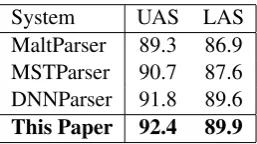
Table 2: Parsing performance on PTB. The re-sults for MaltParser, MSTParser and DNNParser are from table 5 of Chen and Manning (2014).
different languages. The system of McDonald et al. (2006) achieved the best average parsing per-formance over 13 languages (excluding English) in CoNLL-2006 shared tasks. Its average UAS and LAS are 87.03% and 80.83%, respectively, while our average UAS and LAS excluding English are 87.79% and 81.29%. So our parser shows signif-icant improvement over the single best system re-ported in CoNLL-2006 shared task.
3.4 Experiments on PTB
F1 (UAS) F1 (LAS)
Label Description TST Ours diff TST Ours diff
MNR Adverbial of manner 54.01 66.10 12.10 52.23 62.15 9.92
OPRD Predicative complement of raising/control verb 86.61 96.92 10.31 86.61 89.89 3.28
APPO Apposition 77.40 82.62 5.22 72.74 77.03 4.29
ADV General adverbial 73.33 77.65 4.32 69.86 73.14 3.28
AMOD Modifier of adjective or adverbial 75.49 79.58 4.09 72.60 76.91 4.30 TMP Temporal adverbial or nominal modifier 73.47 76.76 3.29 64.50 68.59 4.09 DIR Adverbial of direction 62.42 65.02 2.60 62.42 64.61 2.19 LOC Locative adverbial or nominal modifier 75.78 78.35 2.57 63.11 65.83 2.72
[image:5.595.94.504.60.174.2]OBJ Object 91.69 94.08 2.39 90.62 93.23 2.61
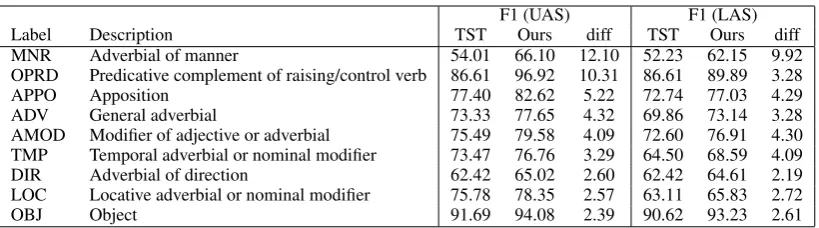
Table 3: Top 10 dependency labels on which our algorithm achieves most improvements on the F1 score of UAS, together with the corresponding improvements of LAS. “TST” indicates the two-stage system. The first column is the label name in the treebank. The second column is the label’s description from Surdeanu et al. (2008).
(DNNParser) (Chen and Manning, 2014). The re-sults are listed in Table 2. Clearly, our parser is superior in terms of both UAS and LAS.
3.5 Analysis
To better understand the performance of our parser, we analyze the distribution of our parser’s UAS and LAS over different dependency labels on the English CoNLL treebank, compared with the ones of the two-stage model. Table 3 lists the top 10 dependency labels on which our algorithm achieves most improvements on the F1 score of UAS, together with the corresponding improve-ments of LAS.
From Table 3 we can see among the 10 labels, there are 5 labels — “MNR”, “ADV”, “TMP”, “DIR”, “LOC” — which are a specific kind of ad-verbials. This illustrates that our parser performs well on the recognition of different kinds of ad-verbials. Moreover, the label “OPRD” and “OBJ” indicate dependency relations between verbs and their modifiers, too. In addition, our parser also significantly improves the accuracy of apposi-tional relations (“APPO”).
4 Conclusion
We proposed a new dependency parsing algo-rithm which can jointly learn dependency struc-tures and edge labels. Our parser is able to use multiple edge-label features, while maintaining low computational complexity. Experimental re-sults on 14 languages show that our parser sig-nificantly improves the accuracy of both depen-dency structures (UAS) and edge labels (LAS), over three baseline systems and three off-the-shelf parsers. This demonstrates that jointly learning dependency structures and edge labels can
bene-fit both performance of tree structures and label-ing accuracy. Moreover, our parser outperforms the best systems of different languages reported in CoNLL shared task for 9 languages.
In future, we are interested in extending our parser to higher-order factorization by increas-ing horizontal context (e.g., from siblincreas-ings to “tri-siblings”) and vertical context (e.g., from siblings to “grand-siblings”) and validating its effective-ness via a wide range of NLP applications.
Acknowledgements
This research was supported in part by DARPA grant FA8750-12-2-0342 funded under the DEFT program. Any opinions, findings, and conclusions or recommendations expressed in this material are those of the authors and do not necessarily reflect the views of DARPA.
References
Bernd Bohnet. 2010. Very high accuracy and fast de-pendency parsing is not a contradiction. In Proceed-ings of Coling-2010, pages 89–97, Beijing, China, August.
Sabine Buchholz and Erwin Marsi. 2006. CoNLL-X shared task on multilingual dependency parsing. In
Proceeding of CoNLL-2006, pages 149–164, New York, NY.
Xavier Carreras. 2007. Experiments with a higher-order projective dependency parser. In Proceed-ings of the CoNLL Shared Task Session of EMNLP-CONLL, pages 957–961.
Koby Crammer and Yoram Singer. 2003. Ultracon-servative online algorithms for multiclass problems.
Journal of Machine Learining Research, 3:951–991.
Koby Crammer, Ofer Dekel, Joseph Keshet, Shai Shalev-Shwartz, and Yoram Singer. 2006. Online passive-aggressive algorithms. Jornal of Machine Learning Research, 7:551–585.
Marie-Catherine De Marneffe, Bill MacCartney, Christopher D Manning, et al. 2006. Generat-ing typed dependency parses from phrase structure parses. InProceedings of LREC-2006, pages 449– 454.
Greg Durrett and Dan Klein. 2013. Easy victories and uphill battles in coreference resolution. In Pro-ceedings of EMNLP-2013, pages 1971–1982, Seat-tle, Washington, USA, October.
Jason Eisner. 1996. Three new probabilistic models for dependency parsing: An exploration. In Pro-ceedings of COLING-1996, pages 340–345. Nicolas R Fauceglia, Yiu-Chang Lin, Xuezhe Ma, and
Eduard Hovy. 2015. Word sense disambiguation via propstore and ontonotes for event mention de-tection. InProceedings of the The 3rd Workshop on EVENTS: Definition, Detection, Coreference, and Representation, pages 11–15, Denver, Colorado, June.
Richard Johansson and Pierre Nugues. 2008. Dependency-based syntactic-semantic analysis with propbank and nombank. In Proceedings of the CoNLL-2008, pages 183–187.
Terry Koo and Michael Collins. 2010. Efficient third-order dependency parsers. InProceedings of ACL-2010, pages 1–11, Uppsala, Sweden, July.
Xuezhe Ma and Fei Xia. 2014. Unsupervised de-pendency parsing with transferring distribution via parallel guidance and entropy regularization. In
Proceedings of ACL-2014, pages 1337–1348, Bal-timore, Maryland, June.
Xuezhe Ma and Hai Zhao. 2012a. Fourth-order depen-dency parsing. In Proceedings of COLING 2012: Posters, pages 785–796, Mumbai, India, December.
Xuezhe Ma and Hai Zhao. 2012b. Probabilistic mod-els for high-order projective dependency parsing.
Technical Report, arXiv:1502.04174.
Mitchell Marcus, Beatrice Santorini, and Mary Ann Marcinkiewicz. 1993. Building a large annotated corpus of English: the Penn Treebank. Computa-tional Linguistics, 19(2):313–330.
Andre Martins, Miguel Almeida, and Noah A. Smith. 2013. Turning on the turbo: Fast third-order non-projective turbo parsers. In Proceedings of ACL-2013 (Volume 2: Short Papers), pages 617–622, Sofia, Bulgaria, August.
Ryan McDonald and Fernando Pereira. 2006. Online learning of approximate dependency parsing algo-rithms. InProceedings of EACL-2006, pages 81–88, Trento, Italy, April.
Ryan McDonald, Fernando Pereira, Kiril Ribarov, and Jan Hajic. 2005. Non-projective dependency pars-ing uspars-ing spannpars-ing tree algorithms. InProceedings of HLT/EMNLP-2005, pages 523–530, Vancouver, Canada, October.
Ryan McDonald, Kevin Lerman, and Fernando Pereira. 2006. Multilingual dependency analysis with a two-stage discriminative parser. In Proceedings of the Tenth Conference on Computational Natural Lan-guage Learning (CoNLL-X), pages 216–220, New York City, June.
Ryan McDonald, Joakim Nivre, Yvonne Quirmbach-Brundage, Yoav Goldberg, Dipanjan Das, Kuz-man Ganchev, Keith Hall, Slav Petrov, Hao Zhang, Oscar T¨ackstr¨om, Claudia Bedini, N´uria Bertomeu Castell´o, and Jungmee Lee. 2013. Uni-versal dependency annotation for multilingual pars-ing. In Proceedings of ACL-2013, pages 92–97, Sofia, Bulgaria, August.
Ryan McDonald. 2006.Discriminative learning span-ning tree algorithm for dependency parsing. Ph.D. thesis, University of Pennsylvania.
Joakim Nivre and Mario Scholz. 2004. Deterministic dependency parsing of English text. InProceedings of COLING-2004, pages 64–70, Geneva, Switzer-land, August 23-27.
Joakim Nivre, Johan Hall, Jens Nilsson, G¨uls¸en Eryiˇgit, and Svetoslav Marinov. 2006. Labeled pseudo-projective dependency parsing with support vector machines. InProceedings of the Tenth Con-ference on Computational Natural Language Learn-ing (CoNLL-X), pages 221–225, New York City, June.
Sebastian Riedel, Ruket C¸akıcı, and Ivan Meza-Ruiz. 2006. Multi-lingual dependency parsing with incre-mental integer linear programming. InProceedings of the Tenth Conference on Computational Natu-ral Language Learning (CoNLL-X), pages 226–230, New York City, June.
Mihai Surdeanu, Richard Johansson, Adam Meyers, Llu´ıs M`arquez, and Joakim Nivre. 2008. The conll-2008 shared task on joint parsing of syntactic and semantic dependencies. InProceedings of CoNLL-2008, pages 159–177.
Jun Xie, Haitao Mi, and Qun Liu. 2011. A novel dependency-to-string model for statistical machine translation. InProceedings of EMNLP-2011, pages 216–226, Edinburgh, Scotland, UK., July.
Yue Zhang and Joakim Nivre. 2011. Transition-based dependency parsing with rich non-local features. In