A Model of Zero-Shot Learning of Spoken Language Understanding
Majid Yazdani
Computer Science Department University of Geneva [email protected]
James Henderson
Xerox Research Center Europe [email protected]
Abstract
When building spoken dialogue systems for a new domain, a major bottleneck is developing a spoken language understand-ing (SLU) module that handles the new domain’s terminology and semantic con-cepts. We propose a statistical SLU model that generalises to both previously unseen input words and previously unseen out-put classes by leveraging unlabelled data. After mapping the utterance into a vector space, the model exploits the structure of the output labels by mapping each label to a hyperplane that separates utterances with and without that label. Both these mappings are initialised with unsupervised word embeddings, so they can be com-puted even for words or concepts which were not in the SLU training data.
1 Introduction
Spoken Language Understanding (SLU) in dia-logue systems is the task of taking the utterance output by a speech recognizer and assigning it a semantic label that represents the dialogue actions of that utterance accompanied with their associ-ated attributes and values. For example, the utter-ance ”I would like Chinese food” is labelled with
inform(food=Chinese), in whichinformis the dia-logue action that provides the value of the attribute
foodthat isChinese.
Dialogue systems often use hand-crafted gram-mars for SLU, such as Phoenix (Ward, 1994), which are expensive to develop, and expensive to extend or adapt to new attributes and values. Statistical SLU models are usually trained on the data obtained from a specific domain and loca-tion, using a structured output classifier that can be discriminative (Pradhan et al., 2004; Kate and Mooney, 2006; Henderson et al., 2012) or genera-tive (Schwartz et al., 1996; He and Young, 2005).
Gathering and annotating SLU data is costly and time consuming and therefore SLU datasets are small compare to the number of possible labels.
Because training sets for a new domain are small, or non-existent, learning is often an in-stance of Zero-shot or One-shot learning prob-lems (Palatucci et al., 2009; L. Fei-Fei; Fergus, 2006), in which zero or few examples of some output classes are available during the training. For example, in the restaurant reservation domain, not all possible combinations of foods and dia-logue actions may be included in the training set. The general idea to solve this type of problems is to map the input and class labels to a semantic space of usually lower dimension in which simi-lar classes are represented by closer points in the space (Palatucci et al., 2009; Weston et al., 2011; Weston et al., 2010). Usually unsupervised knowl-edge sources are used to form semantic codes of the labels that helps us to generalize to unseen la-bels.
On the other hand, there are also different ways to express the same meaning, and similarly, most of them can not be included in the training set. For instance, the system may have seen ”Please give me the telephone number” in training, but the user might ask ”Please give me the phone” at test time. This problem, feature sparsity, is a common issue in many NLP tasks. Decomposition of in-put feature parameters using vector-matrix mul-tiplication (Bengio et al., 2003; Collobert et al., 2011; Collobert and Weston, 2008) has addressed this sparsity issue successfully in previous work. In this way, by sharing the word representations and composition matrices, we can overcome fea-ture sparsity by producing similar representations for similar utterances.
In order to represent words and concepts we use word embeddings, which are a form of vec-tor space model. Word embeddings have proven to be effective models of semantic representation
of words in various NLP tasks (Baroni et al., 2014; Yazdani and Popescu-Belis, 2013; Collobert et al., 2011; Collobert and Weston, 2008; Huang et al., 2012; Mikolov et al., 2013b). In addition to pa-rameter sharing, these representations enable us to leverage large scale unlabelled data. Because word embeddings trained on unlabeled data reflect the similarity between words, they help the model generalize from the words in the original training corpora to the words in the new extended domain, and help generalize from small amounts of data in the extended domain.
The contribution of this paper is to build a rep-resentation learning classifier for the SLU task that can generalize to unseen words and labels. For ev-ery utterance we learn how to compose the word vectors to form the semantics of that utterance for this task of language understanding. Furthermore, we learn how to compose the semantics of each la-bel from the semantics of the words used to name that label. This enables us to generalize to unseen labels.
In this work we use the word2vec software of Mikolov et al. (2013a)1 to induce unsupervised
word embeddings that are used to initialize word embedding parameters. For this, we use an En-glish Wikipedia dump as our unlabelled training corpus, which is a diverse broad-coverage corpus. It has been shown (Baroni et al., 2014; Mikolov et al., 2013b) that these embeddings capture lex-ical similarities even when they are trained on a diverse corpus like Wikipedia. We test our models on a restaurant booking domain. We investigate domain adaptation by adding new attribute types (e.g. goodformeal) and new attribute values (e.g.
Hayes Valleyas a restaurant location). Our exper-iments indicate that our model has better perfor-mance compared to a hand-crafted system as well as a SVM baseline.
2 SLU Datasets
The dialogue utterances used to build the SLU dataset were collected during a trial of online di-alogue policy adaptation for a restaurant reserva-tion system based in San Francisco. The trial be-gan with (area,pricerangeandfood), and adapted the Interaction Manager online to handle the ad-ditional attribute types near, allowedforkids, and
goodformeal(Gaˇsic et al., 2014). User utterances from these trials were transcribed and annotated
1https://code.google.com/p/word2vec/
with dialogue acts by an expert, and afterwards edited by another expert2. Each user utterance was
annotated with a set of labels, where each label consists of an act type (e.g. inform, request), an attribute type (e.g. foodtype, pricerange), and an attribute value (e.g. Chinese, Cheap).
The dataset is separated into four subsets,
SFCore,SF1Ext,SF2ExtandSF3Ext, each with an increasing set of attribute types, as speci-fied in Table 1. This table also gives the total num-ber of utterances in each data set. For our first ex-periment, we split each dataset into about 15% for the testing set and 85% for the training set. For our second experiment we use each extended subset for testing and its preceding subsets for training.
Ontology Attribute types ( # of values ) # of utterances SFCore food(59),area(155),pricerange(3) 1103 SF1Ext SFCore +near(39) 1810 SF2Ext SF1Ext +allowedforkids(2) 1571 SF3Ext SF2Ext +goodformeal(4) 1518
Table 1: Domains for San Francisco (SF) restau-rants expanding in complexity
3 A Dialogue Act Representation Learning Classifier
The SLU model is run on each hypothesis output by the ASR component, and tries to predict the correct set of dialogue act labels for each hypoth-esis. This problem is in general an instance of multi-label classification, because a single utter-ance can have multiple dialogue act labels. Also, these labels are structured, since each label consist of an act type, an attribute type, and an attribute value. Each label component also has canonical text associated with it, which is the text used to name the label component (e.g. “Chinese” as a value).
The number of possible dialogue acts grows rapidly as the domain is extended with new at-tribute types and values, making this task one of multi-label classification with a very large number of labels. One natural approach to this task is to train one binary classifier for each possible label, to decide whether or not to include it in the output. In our case, this requires training a large number of classifiers, and it is impossible to generalize to
2This data is publically available from
dialogue acts that include attributes or values that were not in the training set since there won’t be any parameter sharing among label classifiers.
In our alternative approach, we build the rep-resentation of the utterance and the reprep-resentation of the label from their constituent words, then we check if these representations match or not. In the following we explain in details this representation learning model.
3.1 Utterance Representation Learning
In this section we explain how to build the utter-ance representation from its constituent words. In addition to words, we use bigrams, since they have been shown previously to be effective features for this task (Henderson et al., 2012). Following the success in transfer learning from parsing to under-standing tasks (Henderson et al., 2013; Socher et al., 2013), we use dependency parse bigrams in our features as well. We learn to build a local rep-resentation at each word position in the utterance by using the word representation, adjacent word representations, and the head word representation. Letφ(w)be a ddimensional vector representing the wordw, andφ(Ui)be ahdimensional vector
which is the local representation at word position
i. We compute the local representation as follows:
φ(Ui) =σ(φ(wi)Wword+φ(wh)WparseRk+
φ(wj)Wprevious+φ(wk)Wnext) (1)
in which wh is the head word with the
depen-dency relation Rk towi, and wj andwk are the
previous and next words. Wword is ad×h
ma-trix that transforms the word embedding to hidden representation inputs. WparseRk is a d×h ma-trix for the relation Rk that similarly transforms
the head word embedding (soWparseis a tensor),
andWprevious andWnext similarly transform the
previous and next words’ embeddings. Figure 1 depicts this representation building at each word.
3.2 Label Representation Learning
[image:3.595.317.511.65.234.2]One standard way to address the problem of multi-label classification is building binary classifiers for each possible label. Large margin classifiers have been shown to be an effective tool for this task (Pradhan et al., 2004; Kate and Mooney, 2006). We use the same idea of binary classifiers to learn one hyperplane per label, which separates the utterances with this label from all other utter-ances, with a large margin. In the standard way of
Figure 1: The multi-label classifier
building the classifier, each label’s hyperplane is independent of other labels. To extend this model to a zero-shot learning classifier, we use parame-ter sharing among label hyperplanes so that similar labels have similar hyperplanes.
We exploit the structure of labels by assuming that each hyperplane representation is a compo-sition of representations of the label’s constituent components, namely dialogue action, attribute and attribute value. We learn the composition function and the constituent representations while training the classifiers, using the labelled SLU data. The constituent representations are initialised as the word embeddings for the label constituent’s name string, such as “inform”, “food” and “Chinese”, where these embeddings are trained on the unla-belled data. Figure 1 depicts the classifier model.
We define the hyperplane of the labelaj(attk =
vall)with its normal vectorWaj,attk,vallas:
Waj,attk,vall =σ([φ(aj), φ(attk), φ(vall)]Wih)Who
whereφ(·)is the same mapping toddimensional word vectors that is used above in the utterance representation,Wihis a3d×hmatrix andWhois
ah×hmatrix. The score of each local represen-tation vector φ(Ui) is its distance from this label
hyperplane, which is computed as the dot product of the local vectorφ(Ui) with the normal vector
Waj,attk,vall.
We sum these local scores for each po-sition i to build the whole utterance score: P
iφ(Ui)WaTj,attk,vall. Alternatively we can think
of this computation as summing the local vectors to get a whole-utterance representation φ(U) = P
pooling method (sum) used in the model is (inten-tionally) over-simplistic. We did not want to dis-tract from the main contribution of the paper, and our dataset did not justify any more complex solu-tion since utterances are short. It can be replaced by more powerful approaches if it is needed.
To train a large margin classifier, we train all the parameters such that the score of an utterance is bigger than a margin for its labels and less than the negative margin for all other labels. Thus, the loss function is as follows:
min
θ
λ
2θ2+ X
U
max(0,1−yX
i
φ(Ui)WaTj,attk,vall)
(2) whereθis all the parameters of the model, namely
φ(wi) (word embeddings), Wword, WP arse,
Wprevious,Wnext,Wih, andWho. yis either1or
−1depending whether the inputU has that label or not.
To optimize this large margin classifier we per-form stochastic gradient descent by using the ada-grad algorithm on this primal loss function, sim-ilarly to Pegasos SVM (Shalev-Shwartz et al., 2007), but here we backpropagate the errors to the representations to train the word embeddings and composition functions. In each iteration of the stochastic training algorithm, we randomly select an utterance and its labels as positive examples and choose randomly another utterance with a dif-ferent label as a negative example. When choos-ing the negative sample randomly, we sample ut-terances with the same dialogue act but different attribute or value with 4 times higher probability than utterances with a different dialogue act. This biased negative sampling speeds up the training process since it provides more difficult training ex-amples to the learner.
The model is able to address the adaptivity is-sues because the utterance and the dialogue act representations are in the same space using the same shared parameters φ(w), which are ini-tialised with unsupervised word embeddings. It has been shown that such word embeddings cap-ture word similarities and hence the classifier is no longer ignorant about any new attribute type or attribute value. Also, there is parameter sharing between dialogue acts because these word/label embeddings are shared, and the matrices for the composition of these representations are the same across all dialogue acts. This can help overcome sparsity in the SLU training set by transferring
learning between similar situations and similar dialogue act triples. For example, if the train-ing set does not contain any examples of the act ”request(postcode)”, but many examples of ”re-quest(phone)”, sharing the parameters can help with the recognition of ”request(postcode)” in ut-terances similar to ”request(phone)”. Moreover, the SLU model is to some extent robust against paraphrasing in the input utterance because it maps the utterance to a semantic space, and uses parse bigrams. More sophisticated vector-space semantic representations of the utterance are an area for future work, but should be largely orthog-onal to the contribution of this paper.
To find the set of compatible dialogue acts for a given utterance, we should check all possible dia-logue acts. This can severely slow down SLU. To avoid testing all possible dialogue combinations, we build three different classifiers: The first one recognises the act types in the utterance, the sec-ond one recognises the attribute types for each of the chosen act types, and the third classifier recog-nises the full dialogue acts as we described above, but only for the chosen pairs of act types and at-tribute types.
4 SLU Experiments
In the first experiment, we measure SLU perfor-mance trained on all available data, by building a dataset that is the union of all the above datasets. This measures the performance of SLU when there is a small amount of data for an extended do-main. This dataset, similarly to SF3Ext, has 6 main attribute types. Table 2 shows the perfor-mance of this model. We report as baselines the performance of the Phoenix system (hand crafted for this domain) and a binary linear SVM trained on the same data. The hidden layers have size
h=d=50. For this experiment, we split each dataset into about 15% for the testing set and 85% for the training set.
System Outputs Precision Recall F-core Phoenix 516 84.10 41.65 55.71 SVM 690 65.03 52.45 58.06 Our 932 90.24 81.15 85.45
Table 2: Performance on union of data (SF-Core+SF1Ext+SF2Ext+SF3Ext)
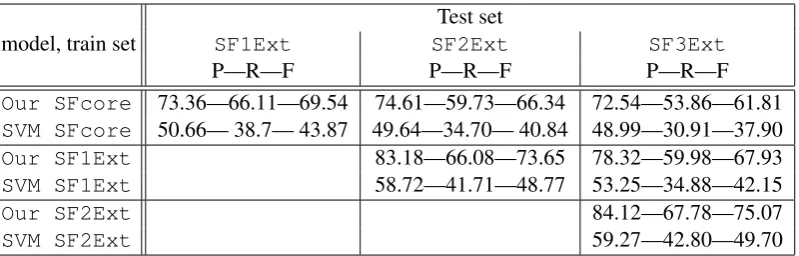
Test set
model, train set SF1Ext SF2Ext SF3Ext
P—R—F P—R—F P—R—F
Our SFcore 73.36—66.11—69.54 74.61—59.73—66.34 72.54—53.86—61.81
SVM SFcore 50.66— 38.7— 43.87 49.64—34.70— 40.84 48.99—30.91—37.90
Our SF1Ext 83.18—66.08—73.65 78.32—59.98—67.93
SVM SF1Ext 58.72—41.71—48.77 53.25—34.88—42.15
Our SF2Ext 84.12—67.78—75.07
[image:5.595.101.501.61.189.2]SVM SF2Ext 59.27—42.80—49.70
Table 3: SLU performance: trained on a smaller domain and tested on more inclusive domains.
particularly that the recall is almost twice as high as the hand-crafted baseline. This shows that our SLU can recognise most of the dialogue acts in an utterance, where the rule-based Phoenix sys-tem and a classifier without composed output can-not. Overall there are 1042 dialogue acts in the test set. SLU recall is very important in the over-all dialogue system performance, as the effect of a missed dialogue act is hard to handle for the Inter-action Manager. Both hand-crafted and our system show relatively high precision.
In the next experiment, we measure how well the new SLU model performs in an extended do-main without any training examples from that ex-tended domain. We train a SLU model on each subset, and test it on each of the more inclusive subsets. Table 3 shows the results.
Not surprisingly, the performance is better if SLU is trained on a similar domain to the test do-main, and adding more attribute types and values decreases the performance more. But our SLU can generalise very well to the extended domain, achieving much better generalisation that the SVM model.
4.1 Conclusion
In this paper, we describe a new SLU model that is designed for improved domain adaptation. The multi-label classification problem of dialogue act recognition is addressed with a classifier that learns to build an utterance representation and a dialogue act representation, and decides whether or not they are compatible. The dialogue act repre-sentation is a vector composition of its constituent labels’ embeddings, and is trained as the hyper-plane of a large margin binary classifier for that di-alogue act. The utterance representation is trained as a composition of word embeddings. Since the utterance and the dialogue act representations are
both built using unsupervised word embeddings and share these embedding parameters, the model can address the issues of domain adaptation. Word embeddings capture word similarities, and hence the classifier is able to generalise from known at-tribute types or values to similar novel atat-tribute types or values. We tested this SLU model on datasets where the number of attribute types and values is increased, and show much better re-sults than the baselines, especially in recall. The model succeeds in both adapting to an extended domain using relatively few training examples and in recognising novel attribute types and values.
Acknowledgments
The research leading to this work was funded by the EC FP7 programme FP7/2011-14 under grant agreement no. 287615 (PARLANCE), and Hasler foundation project no. 15019, Deep Neural Net-work Dependency Parser for Context-aware Rep-resentation Learning. The authors also would like to thank Dr.Helen Hastie for her help in annotating the dataset.
References
Marco Baroni, Georgiana Dinu, and Germ´an Kruszewski. 2014. Don’t count, predict! a systematic comparison of context-counting vs. context-predicting semantic vectors. InProceedings of the 52nd Annual Meeting of the Association for Computational Linguistics, pages 238–247.
Yoshua Bengio, R´ejean Ducharme, Pascal Vincent, and Christian Janvin. 2003. A neural probabilistic lan-guage model.J. Mach. Learn. Res., 3:1137–1155. Ronan Collobert and Jason Weston. 2008. A unified
Ronan Collobert, Jason Weston, L´eon Bottou, Michael Karlen, Koray Kavukcuoglu, and Pavel Kuksa. 2011. Natural language processing (almost) from scratch. The Journal of Machine Learning Re-search, 12:2493–2537.
M Gaˇsic, D Kim, P Tsiakoulis, C Breslin, M Hender-son, M Szummer, B ThomHender-son, and S Young. 2014. Incremental on-line adaptation of pomdp-based dia-logue managers to extended domains.
Yulan He and Steve Young. 2005. Semantic process-ing usprocess-ing the hidden vector state model. Computer Speech and Language, 19:85–106.
Matthew Henderson, Milica Gaˇsi´c, Blaise Thom-son, Pirros Tsiakoulis, Kai Yu, and Steve Young. 2012. Discriminative Spoken Language Under-standing Using Word Confusion Networks. In Spo-ken Language Technology Workshop, 2012.
James Henderson, Paola Merlo, Ivan Titov, and Gabriele Musillo. 2013. Multilingual joint parsing of syntactic and semantic dependencies with a latent variable model.Comput. Linguist., 39(4):949–998.
Eric H. Huang, Richard Socher, Christopher D. Man-ning, and Andrew Y. Ng. 2012. Improving Word Representations via Global Context and Multiple Word Prototypes. In Annual Meeting of the Asso-ciation for Computational Linguistics (ACL).
Rohit J. Kate and Raymond J. Mooney. 2006. Us-ing strUs-ing-kernels for learnUs-ing semantic parsers. In Proceedings of the 21st International Conference on Computational Linguistics and the 44th Annual Meeting of the Association for Computational Lin-guistics, ACL-44, pages 913–920.
R.; Perona L. Fei-Fei; Fergus. 2006. One-shot learning of object categories. IEEE Transactions on Pattern Analysis Machine Intelligence, 28:594–611, April.
Tomas Mikolov, Kai Chen, Greg Corrado, and Jef-frey Dean. 2013a. Efficient estimation of word representations in vector space. arXiv preprint arXiv:1301.3781.
Tomas Mikolov, Wen tau Yih, and Geoffrey Zweig. 2013b. Linguistic regularities in continuous space word representations. In Proceedings of the 2013 Conference of the North American Chapter of the Association for Computational Linguistics: Human Language Technologies (NAACL-HLT-2013).
Mark Palatucci, Dean Pomerleau, Geoffrey E. Hinton, and Tom M. Mitchell. 2009. Zero-shot learning with semantic output codes. In Advances in Neu-ral Information Processing Systems 22, pages 1410– 1418.
Sameer Pradhan, Wayne Ward, Kadri Hacioglu, and James H. Martin. 2004. Shallow semantic parsing using support vector machines.
Richard Schwartz, Scott Miller, David Stallard, and John Makhoul. 1996. Language understanding us-ing hidden understandus-ing models. In Spoken Lan-guage, 1996. ICSLP 96. Proceedings., Fourth Inter-national Conference on, volume 2, pages 997–1000. IEEE.
Shai Shalev-Shwartz, Yoram Singer, and Nathan Sre-bro. 2007. Pegasos: Primal estimated sub-gradient solver for svm. InProceedings of the 24th Interna-tional Conference on Machine Learning, pages 807– 814.
Richard Socher, Alex Perelygin, Jean Wu, Jason Chuang, Christopher D. Manning, Andrew Y. Ng, and Christopher Potts. 2013. Recursive deep mod-els for semantic compositionality over a sentiment treebank. InProceedings of the 2013 Conference on Empirical Methods in Natural Language Process-ing, pages 1631–1642.
Wayne Ward. 1994. Extracting information in sponta-neous speech. InICSLP.
Jason Weston, Samy Bengio, and Nicolas Usunier. 2010. Large scale image annotation: Learning to rank with joint word-image embeddings. Mach. Learn., 81.
Jason Weston, Samy Bengio, and Nicolas Usunier. 2011. Wsabie: Scaling up to large vocabulary image annotation. In Proceedings of the Twenty-Second International Joint Conference on Artificial Intelli-gence - Volume Volume Three, pages 2764–2770. Majid Yazdani and Andrei Popescu-Belis. 2013.