Multi-Perspective Question Answering Using the OpQA Corpus
Veselin Stoyanov and Claire Cardie
Department of Computer Science Cornell University
Ithaca, NY 14850, USA
{ves,cardie}@cs.cornell.edu
Janyce Wiebe
Department of Computer Science University of Pittsburgh Pittsburgh, PA 15260, USA
Abstract
We investigate techniques to support the answering of opinion-based questions. We first present the OpQA corpus of opin-ion questopin-ions and answers. Using the cor-pus, we compare and contrast the proper-ties of fact and opinion questions and an-swers. Based on the disparate characteris-tics of opinion vs. fact answers, we argue that traditional fact-based QA approaches may have difficulty in an MPQA setting without modification. As an initial step towards the development of MPQA sys-tems, we investigate the use of machine learning and rule-based subjectivity and opinion source filters and show that they can be used to guide MPQA systems.
1 Introduction
Much progress has been made in recent years in automatic, open-domain question answering (e.g., Voorhees (2001), Voorhees (2002), Voorhees and Buckland (2003)). The bulk of the research in this area, however, addresses fact-based questions like: “When did McDonald’s open its first restaurant?” or “What is the Kyoto Protocol?”. To date, how-ever, relatively little research been done in the area of Multi-Perspective Question Answering (MPQA), which targets questions of the following sort:
• How is Bush’s decision not to ratify the Kyoto Protocol looked upon by Japan and other US allies?
• How do the Chinese regard the human rights record of the United States?
In comparison to fact-based question answering (QA), researchers understand far less about the prop-erties of questions and answers in MPQA, and have yet to develop techniques to exploit knowledge of those properties. As a result, it is unclear whether approaches that have been successful in the domain of fact-based QA will work well for MPQA.
We first present the OpQA corpus of opinion ques-tions and answers. Using the corpus, we compare and contrast the properties of fact and opinion ques-tions and answers. We find that text spans identi-fied as answers to opinion questions: (1) are approx-imately twice as long as those of fact questions, (2) are much more likely (37% vs. 9%) to represent par-tial answers rather than complete answers, (3) vary much more widely with respect to syntactic cate-gory – covering clauses, verb phrases, prepositional phrases, and noun phrases; in contrast, fact answers are overwhelming associated with noun phrases, and (4) are roughly half as likely to correspond to a sin-gle syntactic constituent type (16-38% vs. 31-53%). Based on the disparate characteristics of opinion vs. fact answers, we argue that traditional fact-based QA approaches may have difficulty in an MPQA setting without modification. As one such modifi-cation, we propose that MPQA systems should rely on natural language processing methods to identify information about opinions. In experiments in opin-ion questopin-ion answering using the OpQA corpus, we find that filtering potential answers using machine learning and rule-based NLP opinion filters substan-tially improves the performance of an end-to-end MPQA system according to both a mean reciprocal rank (MRR) measure (0.59 vs. a baseline of 0.42)
and a metric that determines the mean rank of the first correct answer (MRFA) (26.2 vs. a baseline of 61.3). Further, we find that requiring opinion an-swers to match the requested opinion source (e.g., does<source>approve of the Kyoto Protocol) dra-matically improves the performance of the MPQA system on the hardest questions in the corpus.
The remainder of the paper is organized as fol-lows. In the next section we summarize related work. Section 3 describes the OpQA corpus. Sec-tion 4 uses the OpQA corpus to identify poten-tially problematic issues for handling opinion vs. fact questions. Section 5 briefly describes an opin-ion annotatopin-ion scheme used in the experiments. Sec-tions 6 and 7 explore the use of opinion information in the design of MPQA systems.
2 Related Work
There is a growing interest in methods for the auto-matic identification and extraction of opinions, emo-tions, and sentiments in text. Much of the relevant research explores sentiment classification, a text cat-egorization task in which the goal is to assign to a document either positive (“thumbs up”) or nega-tive (“thumbs down”) polarity (e.g. Das and Chen (2001), Pang et al. (2002), Turney (2002), Dave et al. (2003), Pang and Lee (2004)). Other research has concentrated on analyzing opinions at, or below, the sentence level. Recent work, for example, indi-cates that systems can be trained to recognize opin-ions, their polarity, their source, and their strength to a reasonable degree of accuracy (e.g. Dave et al. (2003), Riloff and Wiebe (2003), Bethard et al. (2004), Pang and Lee (2004), Wilson et al. (2004), Yu and Hatzivassiloglou (2003), Wiebe and Riloff (2005)).
Related work in the area of corpus development includes Wiebe et al.’s (2005) opinion annotation scheme to identify subjective expressions — expres-sions used to express opinions, emotions, sentiments and other private states in text. Wiebe et al. have applied the annotation scheme to create the MPQA corpus consisting of 535 documents manually an-notated for phrase-level expressions of opinion. In addition, the NIST-sponsored TREC evaluation has begun to develop data focusing on opinions — the 2003 Novelty Track features a task that requires
sys-tems to identify opinion-oriented documents w.r.t. a specific issue (Voorhees and Buckland, 2003).
While all of the above work begins to bridge the gap between text categorization and question answering, none of the approaches have been em-ployed or evaluated in the context of MPQA.
3 OpQA Corpus
To support our research in MPQA, we created the OpQA corpus of opinion and fact questions and an-swers. Additional details on the construction of the corpus as well as results of an interannotator agree-ment study can be found in Stoyanov et al. (2004).
3.1 Documents and Questions
The OpQA corpus consists of 98 documents that ap-peared in the world press between June 2001 and May 2002. All documents were taken from the aforementioned MPQA corpus (Wilson and Wiebe, 2003)1 and are manually annotated with phrase-level opinion information, following the annotation scheme of Wiebe et al. (2005), which is briefly summarized in Section 5. The documents cover four general (and controversial) topics: President Bush’s alternative to the Kyoto protocol (kyoto); the US annual human rights report (humanrights); the 2002 coup d’etat in Venezuela (venezuela); and the 2002 elections in Zimbabwe and Mugabe’s reelec-tion (mugabe). Each topic is covered by between 19 and 33 documents that were identified automatically via IR methods.
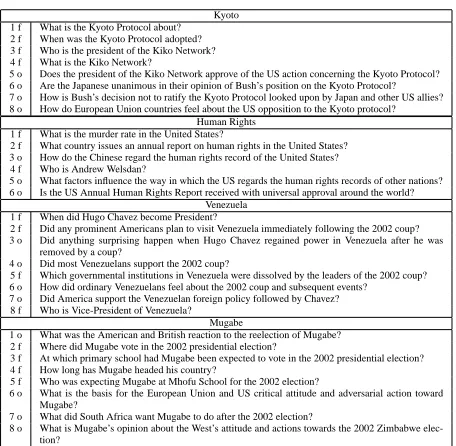
Both fact and opinion questions for each topic were added to the OpQA corpus by a volunteer not associated with the current project. The volunteer was provided with a set of instructions for creat-ing questions together with two documents on each topic selected at random. He created between six and eight questions on each topic, evenly split be-tween fact and opinion. The 30 questions are given in Table 1 sorted by topic.
3.2 Answer annotations
Answer annotations were added to the corpus by two annotators according to a set of annotation
Kyoto 1 f What is the Kyoto Protocol about? 2 f When was the Kyoto Protocol adopted? 3 f Who is the president of the Kiko Network? 4 f What is the Kiko Network?
5 o Does the president of the Kiko Network approve of the US action concerning the Kyoto Protocol? 6 o Are the Japanese unanimous in their opinion of Bush’s position on the Kyoto Protocol? 7 o How is Bush’s decision not to ratify the Kyoto Protocol looked upon by Japan and other US allies? 8 o How do European Union countries feel about the US opposition to the Kyoto protocol?
Human Rights 1 f What is the murder rate in the United States?
2 f What country issues an annual report on human rights in the United States? 3 o How do the Chinese regard the human rights record of the United States? 4 f Who is Andrew Welsdan?
5 o What factors influence the way in which the US regards the human rights records of other nations? 6 o Is the US Annual Human Rights Report received with universal approval around the world?
Venezuela 1 f When did Hugo Chavez become President?
2 f Did any prominent Americans plan to visit Venezuela immediately following the 2002 coup? 3 o Did anything surprising happen when Hugo Chavez regained power in Venezuela after he was
removed by a coup?
4 o Did most Venezuelans support the 2002 coup?
5 f Which governmental institutions in Venezuela were dissolved by the leaders of the 2002 coup? 6 o How did ordinary Venezuelans feel about the 2002 coup and subsequent events? 7 o Did America support the Venezuelan foreign policy followed by Chavez? 8 f Who is Vice-President of Venezuela?
Mugabe
1 o What was the American and British reaction to the reelection of Mugabe? 2 f Where did Mugabe vote in the 2002 presidential election?
3 f At which primary school had Mugabe been expected to vote in the 2002 presidential election? 4 f How long has Mugabe headed his country?
5 f Who was expecting Mugabe at Mhofu School for the 2002 election?
6 o What is the basis for the European Union and US critical attitude and adversarial action toward Mugabe?
7 o What did South Africa want Mugabe to do after the 2002 election?
[image:3.612.73.301.51.274.2]8 o What is Mugabe’s opinion about the West’s attitude and actions towards the 2002 Zimbabwe elec-tion?
Table 1: Questions in the OpQA collection by topic. f in column 1 indicates a fact question; o, an opinion question.
tions.2 Every text segment that contributes to an answer to any of the 30 questions is annotated as an answer. In particular, answer annotations include segments that constitute a partial answer. Partial an-swers either (1) lack the specificity needed to consti-tute a full answer (e.g., “before May 2004” partially answers the question When was the Kyoto protocol ratified? when a specific date is known) or (2) need to be combined with at least one additional answer segment to fully answer the question (e.g., the ques-tion Are the Japanese unanimous in their opposiques-tion of Bush’s position on the Kyoto protocol? is an-swered only partially by a segment expressing a sin-gle opinion). In addition, annotators mark the min-imum answer spans (e.g., “a Tokyo organization,” vs. “a Tokyo organization representing about 150 Japanese groups”).
4 Characteristics of opinion answers
Next, we use the OpQA corpus to analyze and com-pare the characteristics of fact vs. opinion questions. Based on our findings, we believe that QA systems based solely on traditional QA techniques are likely
2The annotation instructions are available
at http://www.cs.cornell.edu/ ves/ Publications/publications.htm.
to be less effective at MPQA than they are at tradi-tional fact-based QA.
4.1 Traditional QA architectures
Despite the wide variety of approaches implied by modern QA systems, almost all systems rely on the following two steps (subsystems), which have em-pirically proven to be effective:
• IR module. The QA system invokes an IR subsystem that employs traditional text similarity measures (e.g., tf/idf) to retrieve and rank document fragments (sentences or paragraphs) w.r.t. the question (query).
• Linguistic filters. QA systems employ a set of filters and text processing components to discard some docu-ment fragdocu-ments. The following filters have empirically proven to be effective and are used universally:
Semantic filters prefer an answer segment that matches
the semantic class(es) associated with the question type (e.g., date or time for when questions; person or
organi-zation for who questions).
Syntactic filters are also configured on the type of
ques-tion. The most common and effective syntactic filters se-lect a specific constituent (e.g., noun phrase) according to the question type (e.g., who question).
QA systems typically interleave the above two subsystems with a variety of different processing steps of both the question and the answer. The goal of the processing is to identify text fragments that contain an answer to the question. Typical QA sys-tems do not perform any further text processing; they return the text fragment as it occurred in the text.3
4.2 Corpus-based analysis of opinion answers
We hypothesize that QA systems that conform to this traditional architecture will have difficulty han-dling opinion questions without non-trivial modifi-cation. In support of this hypothesis, we provide statistics from the OpQA corpus to illustrate some of the characteristics that distinguish answers to opin-ion vs. fact questopin-ions, and discuss their implicatopin-ions for a traditional QA system architecture.
Answer length. We see in Table 2 that the
aver-age length of opinion answers in the OpQA corpus
3
Number of answers Length Number of partials fact 124 5.12 12 (9.68%) opinion 415 9.24 154 (37.11%)
Table 2: Number of answers, average answer length (in tokens), and number of partial answers for fact/opinion questions.
is 9.24 tokens, almost double that of fact answers. Unfortunately, longer answers could present prob-lems for some traditional QA systems. In particu-lar, some of the more sophisticated algorithms that perform additional processing steps such as logi-cal verifiers (Moldovan et al., 2002) may be less ac-curate or computationally infeasible for longer an-swers. More importantly, longer answers are likely to span more than a single syntactic constituent, ren-dering the syntactic filters, and very likely the se-mantic filters, less effective.
Partial answers. Table 2 also shows that over 37%
of the opinion answers were marked as partial vs. 9.68% of the fact answers. The implications of par-tial answers for the traditional QA architecture are substantial: an MPQA system will require an
an-swer generator to (1) distinguish between partial
and full answers; (2) recognize redundant partial swers; (3) identify which subset of the partial an-swers, if any, constitutes a full answer; (4) determine whether additional documents need to be examined to find a complete answer; and (5) asemble the final answer from partial pieces of information.
Syntactic constituent of the answer. As discussed
in Section 4.1, traditional QA systems rely heav-ily on the predicted syntactic and semantic class of the answer. Based on answer lengths, we specu-lated that opinion answers are unlikely to span a sin-gle constituent and/or semantic class. This specula-tion is confirmed by examining the phrase type as-sociated with OpQA answers using Abney’s (1996) CASS partial parser.4 For each question, we count the number of times an answer segment for the ques-tion (in the manual annotaques-tions) matches each con-stituent type. We consider four concon-stituent types – noun phrase (n), verb phrase (v), prepositional phrase (p), and clause (c) – and three matching cri-teria:
4The parser is available from http://www.vinartus.net/spa/.
Fact Opinion
Ques- # of Matching Criteria syn Ques- # of Matching Criteria syn tion answers ex up up/dn type tion answers ex up up/dn type
H 1 1 0 0 0 H 3 15 5 5 5 c
H 2 4 2 2 2 n H 5 24 5 5 10 n
H 4 1 0 0 0 H 6 123 17 23 52 n
K 1 48 13 14 24 n K 5 3 0 0 1
K 2 38 13 13 19 n K 6 34 6 5 12 c
K 3 1 1 1 1 c n K 7 55 9 8 19 c
K 4 2 1 1 1 n K 8 25 4 4 10 v
M 2 3 0 0 1 M 1 74 10 12 29 v
M 3 1 0 0 1 M 6 12 3 5 7 n
M 4 10 2 2 5 n M 7 1 0 0 0
M 5 3 1 1 2 c M 8 3 0 0 1
V 1 4 3 3 4 n V 3 1 1 0 1 c
V 2 1 1 1 1 n V 4 13 2 2 2 c
V 5 3 0 1 1 V 6 9 2 2 5 c n
V 8 4 2 4 4 n V 7 23 3 1 5
Cov- 124 39 43 66 Cov- 415 67 70 159
erage 31% 35% 53% erage 16% 17% 38%
Table 3: Syntactic Constituent Type for Answers in the OpQA Corpus
1. The exact match criterion is satisfied only by answer seg-ments whose spans exactly correspond to a constituent in the CASS output.
2. The up criterion considers an answer to match a CASS constituent if the constituent completely contains the an-swer and no more than three additional (non-anan-swer) to-kens.
3. The up/dn criterion considers an answer to match a CASS constituent if it matches according to the up crite-rion or if the answer completely contains the constituent and no more than three additional tokens.
The counts for the analysis of answer segment syntactic type for fact vs. opinion questions are sum-marized in Table 3. Results for the 15 fact ques-tions are shown in the left half of the table, and for the 15 opinion questions in the right half. The leftmost column in each half provides the question topic and number, and the second column indicates the total number of answer segments annotated for the question. The next three columns show, for each of the ex, up, and up/dn matching criteria, respec-tively, the number of annotated answer segments that match the majority syntactic type among an-swer segments for that question/criterion pair. Us-ing a traditional QA architecture, the MPQA sys-tem might filter answers based on this majority type. The syn type column indicates the majority syntac-tic type using the exact match criterion; two values in the column indicate a tie for majority syntactic type, and an empty syntactic type indicates that no answer exactly matched any of the four constituent types. With only a few exceptions, the up and up/dn matching criteria agreed in majority syntactic type.
ques-tions, the syntactic type filter would keep 31%, 35%, or 53% of the correct answers, depending on the matching criterion. For opinion questions, there is unfortunately a two-fold reduction in the percentage of correct answers that would remain after filtering — only 16%, 17% or 38%, depending on the match-ing criterion. More importantly, the majority syntac-tic type among answers for fact questions is almost always a noun phrase, while no single constituent type emerges as a useful syntactic filter for opinion questions (see the syn phrase columns in Table 3). Finally, because semantic class information is gener-ally tied to a particular syntactic category, the effec-tiveness of traditional semantic filters in the MPQA setting is unclear.
In summary, identifying answers to questions in an MPQA setting within a traditional QA architec-ture will be difficult. First, the implicit and explicit assumptions inherent in standard linguistic filters are consistent with the characteristics of fact- rather than opinion-oriented QA. In addition, the presence of relatively long answers and partial answers will re-quire a much more complex answer generator than is typically present in current QA systems.
In Sections 6 and 7, we propose initial steps to-wards modifying the traditional QA architecture for use in MPQA. In particular, we propose and evaluate two types of opinion filters for MPQA:
subjectiv-ity filters and opinion source filters. Both types of
linguistic filters rely on phrase-level and sentence-level opinion information, which has been manually annotated for our corpus; the next section briefly de-scribes the opinion annotation scheme.
5 Manual Opinion Annotations
Documents in our OpQA corpus come from the larger MPQA corpus, which contains manual opin-ion annotatopin-ions. The annotatopin-ion framework is de-scribed in detail in (Wiebe et al., 2005). Here we give a high-level overview.
The annotation framework provides a basis for subjective expressions: expressions used to express opinions, emotions, and sentiments. The framework allows for the annotation of both directly expressed private states (e.g., afraid in the sentence “John is afraid that Sue might fall,”) and opinions expressed
by the choice of words and style of language (e.g., it is about time and oppression in the sentence “It is about time that we end Saddam’s oppression”). In addition, the annotations include several attributes, including the intensity (with possible values low, medium, high, and extreme) and the source of the private state. The source of a private state is the per-son or entity who holds or experiences it.
6 Subjectivity Filters for MPQA Systems
This section describes three subjectivity filters based on the above opinion annotation scheme. Be-low (in Section 6.3), the filters are used to remove fact sentences from consideration when answering opinion questions, and the OpQA corpus is used to evaluate their effectiveness.
6.1 Manual Subjectivity Filter
Much previous research on automatic extraction of opinion information performed classifications at the sentence level. Therefore, we define sentence-level opinion classifications in terms of the phrase-level annotations. For our gold standard of manual opin-ion classificatopin-ions (dubbedMANUALfor the rest of the paper) we will follow Riloff and Wiebe’s (2003) convention (also used by Wiebe and Riloff (2005)) and consider a sentence to be opinion if it contains at least one opinion of intensity medium or higher, and to be fact otherwise.
6.2 Two Automatic Subjectivity Filters
As discussed in section 2, several research efforts have attempted to perform automatic opinion clas-sification on the clause and sentence level. We in-vestigate whether such information can be useful for MPQA by using the automatic sentence level opin-ion classifiers of Riloff and Wiebe (2003) and Wiebe and Riloff (2005).
precision recall F MPQA corpus RULEBASED 90.4 34.2 46.6
NAIVE BAYES 79.4 70.6 74.7
Table 4: Precision, recall, and F-measure for the two classifiers.
the classifier that was created by the reimplemen-tation of this bootstrapping process in Wiebe and Riloff (2005). We will use RULEBASED to denote
the opinion information output by this classifier. In addition, Wiebe and Riloff used the RULE
-BASED classifier to produce a labeled data set for training. They trained a Naive Bayes subjectivity classifier on the labeled set. We will use NAIVE BAYES to refer to Wiebe and Riloff’s naive Bayes
classifier.5 Table 4 shows the performance of the two classifiers on the MPQA corpus as reported by Wiebe and Riloff.
6.3 Experiments
We performed two types of experiments using the subjectivity filters.
6.3.1 Answer rank experiments
Our hypothesis motivating the first type of exper-iment is that subjectivity filters can improve the an-swer identification phase of an MPQA system. We implement the IR subsystem of a traditional QA sys-tem, and apply the subjectivity filters to the IR re-sults. Specifically, for each opinion question in the corpus6, we do the following:
1. Split all documents in our corpus into sentences.
2. Run an information retrieval algorithm7on the set of all
sentences using the question as the query to obtain a
ranked list of sentences.
3. Apply a subjectivity filter to the ranked list to remove all fact sentences from the ranked list.
We test each of the MANUAL, RULEBASED, and NAIVE BAYES subjectivity filters. We compare the rank of the first answer to each question in the
5
Specifically, the one they label Naive Bayes 1.
6We do not evaluate the opinion filters on the 15 fact
ques-tions. Since opinion sentences are defined as containing at least one opinion of intensity medium or higher, opinion sentences can contain factual information and sentence-level opinion fil-ters are not likely to be effective for fact-based QA.
7We use the Lemur toolkit’s standard tf.idf implementation
available fromhttp://www.lemurproject.org/.
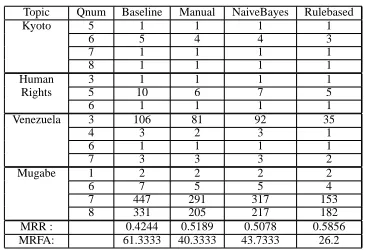
Topic Qnum Baseline Manual NaiveBayes Rulebased Kyoto 5 1 1 1 1
6 5 4 4 3
7 1 1 1 1
8 1 1 1 1
Human 3 1 1 1 1 Rights 5 10 6 7 5
6 1 1 1 1
Venezuela 3 106 81 92 35
4 3 2 3 1
6 1 1 1 1
7 3 3 3 2
Mugabe 1 2 2 2 2
6 7 5 5 4
[image:6.612.335.518.52.177.2]7 447 291 317 153 8 331 205 217 182 MRR : 0.4244 0.5189 0.5078 0.5856 MRFA: 61.3333 40.3333 43.7333 26.2
Table 5: Results for the subjectivity filters.
ranked list before the filter is applied, with the rank of the first answer to the question in the ranked list after the filter is applied.
Results. Results for the opinion filters are compared
to a simple baseline, which performs the informa-tion retrieval step with no filtering. Table 5 gives the results on the 15 opinion questions for the baseline and each of the three subjectivity filters. The table shows two cumulative measures – the mean recip-rocal rank (MRR)8 and the mean rank of the first answer (MRFA).9
Table 5 shows that all three subjectivity filters out-perform the baseline: for all three filters, the first answer in the filtered results for all 15 questions is ranked at least as high as in the baseline. As a result, the three subjectivity filters outperform the baseline in both MRR and MRFA. Surprisingly, the best per-forming subjectivity filter is RULEBASED, surpass-ing the gold standardMANUAL, both in MRR (0.59 vs. 0.52) and MRFA (40.3 vs. 26.2). Presum-ably, the improvement in performance comes from the fact that RULEBASEDidentifies subjective sen-tences with the highest precision (and lowest recall). Thus, the RULEBASED subjectivity filter discards non-subjective sentences most aggressively.
6.3.2 Answer probability experiments
The second experiment, answer probability, be-gins to explore whether opinion information can be
8The MRR is computed as the average of1/r, whereris
the rank of the first answer.
9
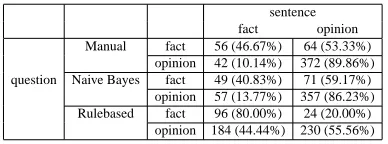
sentence fact opinion Manual fact 56 (46.67%) 64 (53.33%)
opinion 42 (10.14%) 372 (89.86%) question Naive Bayes fact 49 (40.83%) 71 (59.17%)
opinion 57 (13.77%) 357 (86.23%) Rulebased fact 96 (80.00%) 24 (20.00%)
[image:7.612.89.283.54.126.2]opinion 184 (44.44%) 230 (55.56%)
Table 6: Answer probability results.
used in an answer generator. This experiment con-siders correspondences between (1) the classes (i.e., opinion or fact) assigned by the subjectivity filters to the sentences containing answers, and (2) the classes of the questions the answers are responses to (ac-cording to the OpQA annotations). That is, we com-pute the probabilities (where ans = answer):
P(ans is in a C1 sentence|ans is the answer to a C2
ques-tion) for all four combinations of C1=opinion, fact and C2=opinion, fact.
Results. Results for the answer probability
experi-ment are given in Table 6. The rows correspond to the classes of the questions the answers respond to, and the columns correspond to the classes assigned by the subjectivity filters to the sentences contain-ing the answers. The first two rows, for instance, give the results for theMANUALcriterion.MANUAL
placed 56 of the answers to fact questions in fact sentences (46.67% of all answers to fact questions) and 64 (53.33%) of the answers to fact questions in opinion sentences. Similarly, MANUAL placed 42 (10.14%) of the answers to opinion questions in fact sentences, and 372 (89.86%) of the answers to opin-ion questopin-ions in opinopin-ion sentences.
The answer probability experiment sheds some light on the subjectivity filter experiments. All three subjectivity filters place a larger percentage of an-swers to opinion questions in opinion sentences than they place in fact sentences. However, the differ-ent filters exhibit differdiffer-ent degrees of discrimination. Answers to opinion questions are almost always placed in opinion sentences by MANUAL (89.86%) and NAIVE BAYES (86.23%). While that aspect of
their performance is excellent,MANUALandNAIVE BAYESplace more answers to fact questions in opin-ion rather than fact sentences (though the percent-ages are in the 50s). This is to be expected, because
MANUAL andNAIVE BAYESare more conservative and err on the side of classifying sentences as
opin-ions: for MANUAL, the presence of any subjective expression makes the entire sentence opinion, even if parts of the sentence are factual; NAIVE BAYES
shows high recall but lower precision in recognizing opinion sentences (see Table 4). Conversely,RULE
-BASED places 80% of the fact answers in fact
sen-tences and only 56% of the opinion answers in opin-ion sentences. Again, the lower number of assign-ments to opinion sentences is to be expected, given the high precision and low recall of the classifier. But the net result is that, for RULEBASED, the off-diagonals are all less than 50%: it places more an-swers to fact questions in fact rather than opinion sentences (80%), and more answers to opinion ques-tions in opinion rather than fact sentences (56%). This is consistent with its superior performance in the subjectivity filtering experiment.
In addition to explaining the performance of the subjectivity filters, the answer rank experiment shows that the automatic opinion classifiers can be used directly in an answer generator module. The two automatic classifiers rely on evidence in the sen-tence to predict the class (the information extraction patterns used byRULEBASEDand the features used
byNAIVE BAYES). In ongoing work we investigate ways to use this evidence to extract and summarize the opinions expressed in text, which is a task simi-lar to that of an answer generator module.
7 Opinion Source Filters for MPQA
Systems
In addition to subjectivity filters, we also define an opinion source filter based on the manual opinion annotations. This filter removes all sentences that do not have an opinion annotation with a source that matches the source of the question10. For this filter we only used theMANUALsource annotations since
we did not have access to automatically extracted source information. We employ the same Answer Rank experiment as in 6.3.1, substituting the source filter for a subjectivity filter.
Results. Results for the source filter are mixed. The filter outperforms the baseline on some ques-tions and performs worst on others. As a result the MRR for the source filter is worse than the
base-10We manually identified the sources of each of the 15
line (0.4633 vs. 0.4244). However, the source fil-ter exhibits by far the best results using the MRFA measure, a value of 11.267. The performance im-provement is due to the filter’s ability to recognize the answers to the hardest questions, for which the other filters have the most trouble (questions mu-gabe 7 and 8). For these questions, the rank of the first answer improves from 153 to 21, and from 182 to 11, respectively. With the exception of question venezuela 3, which does not contain a clear source (and is problematic altogether because there is only a single answer in the corpus and the question’s qualification as opinion is not clear) the source filter always ranked an answer within the first 25 answers. Thus, source filters can be especially useful in sys-tems that rely on the presence of an answer within the first few ranked answer segments and then in-voke more sophisticated analysis in the additional
processing phase.
8 Conclusions
We began by giving a high-level overview of the OpQA corpus. Using the corpus, we compared the characteristics of answers to fact and opinion ques-tions. Based on the different characteristics, we sur-mise that traditional QA approaches may not be as effective for MPQA as they have been for fact-based QA. Finally, we investigated the use of machine learning and rule-based opinion filters and showed that they can be used to guide MPQA systems.
Acknowledgments We would like to thank Di-ane Litman for her work eliciting the questions for the OpQA corpus, and the anonymous reviewers for their helpful comments.This work was supported by the Advanced Research and Development Activ-ity (ARDA), by NSF Grants 0208028 and IIS-0208798, by the Xerox Foundation, and by a NSF Graduate Research Fellowship to the first author.
References
Steven Abney. 1996. Partial parsing via finite-state cascades. In Proceedings of the ESSLLI ’96 Robust Parsing Workshop.
S. Bethard, H. Yu, A. Thornton, V. Hativassiloglou, and D. Ju-rafsky. 2004. Automatic extraction of opinion propositions and their holders. In 2004 AAAI Spring Symposium on
Ex-ploring Attitude and Affect in Text.
S. Das and M. Chen. 2001. Yahoo for amazon: Extracting mar-ket sentiment from stock message boards. In Proceedings of
the 8th Asia Pacific Finance Association Annual Conference.
Kushal Dave, Steve Lawrence, and David Pennock. 2003. Min-ing the peanut gallery: Opinion extraction and semantic clas-sification of product reviews. In International World Wide
Web Conference, pages 519–528.
D. Moldovan, S. Harabagiu, R. Girju, P. Morarescu, F. Laca-tusu, A. Novischi, A. Badulescu, and O. Bolohan. 2002. LCC tools for question answering. In Proceedings of TREC
2002.
Bo Pang and Lillian Lee. 2004. A sentimental education: Sen-timent analysis using subjectivity summarization based on minimum cuts. In Proceedings of the ACL, pages 271–278.
Bo Pang, Lillian Lee, and Shivakumar Vaithyanathan. 2002. Thumbs up? sentiment classification using machine learning techniques. In Proceedings of EMNLP.
E. Riloff and J. Wiebe. 2003. Learning extraction patterns for subjective expressions. In Proceesings of EMNLP.
Ellen Riloff. 1996. Automatically generating extraction pat-terns from untagged text. Proceedings of AAAI.
V. Stoyanov, C. Cardie, J. Wiebe, and D. Litman. 2004. Eval-uating an opinion annotation scheme using a new Multi-Perspective Question and Answer corpus. In 2004 AAAI
Spring Symposium on Exploring Attitude and Affect in Text.
Peter Turney. 2002. Thumbs up or thumbs down? Semantic orientation applied to unsupervised classification of reviews. In Proceedings of the ACL, pages 417–424.
E. Voorhees and L. Buckland. 2003. Overview of the TREC 2003 Question Answering Track. In Proceedings of
TREC 12.
Ellen Voorhees. 2001. Overview of the TREC 2001 Question Answering Track. In Proceedings of TREC 10.
Ellen Voorhees. 2002. Overview of the 2002 Question Answer-ing Track. In ProceedAnswer-ings of TREC 11.
Janyce Wiebe and Ellen Riloff. 2005. Creating subjective and objective sentence classifiers from unannotated texts. In
Proceedings of CICLing.
Janyce Wiebe, Theresa Wilson, and Claire Cardie. 2005. An-notating expressions of opinions and emotions in language.
Language Resources and Evaluation, 1(2).
Theresa Wilson and Janyce Wiebe. 2003. Annotating opinions in the world press. 4th SIGdial Workshop on Discourse and
Dialogue (SIGdial-03).
T. Wilson, J. Wiebe, and R. Hwa. 2004. Just how mad are you? Finding strong and weak opinion clauses. In Proceedings of
AAAI.
H. Yu and V. Hatzivassiloglou. 2003. Towards answering opin-ion questopin-ions: Separating facts from opinopin-ions and identi-fying the polarity of opinion sentences. In Proceedings of