Generating artificial errors for grammatical error correction
Mariano Felice
Computer Laboratory University of Cambridge
United Kingdom
Zheng Yuan
Computer Laboratory University of Cambridge
United Kingdom
Abstract
This paper explores the generation of ar-tificial errors for correcting grammatical mistakes made by learners of English as a second language. Artificial errors are in-jected into a set of error-free sentences in a probabilistic manner using statistics from a corpus. Unlike previous approaches, we use linguistic information to derive error generation probabilities and build corpora to correct several error types, including open-class errors. In addition, we also analyse the variables involved in the selec-tion of candidate sentences. Experiments using the NUCLE corpus from the CoNLL 2013 shared task reveal that: 1) training on artificially created errors improves pre-cision at the expense of recall and 2) dif-ferent types of linguistic information are better suited for correcting different error types.
1 Introduction
Building error correction systems using machine learning techniques can require a considerable amount of annotated data which is difficult to ob-tain. Available error-annotated corpora are often focused on particular groups of people (e.g. non-native students), error types (e.g. spelling, syn-tax), genres (e.g. university essays, letters) or top-ics so it is not clear how representative they are or how well systems based on them will gener-alise. On the other hand, building new corpora is not always a viable solution since error annotation is expensive. As a result, researchers have tried to overcome these limitations either by compiling corpora automatically from the web (Mizumoto et al., 2011; Tajiri et al., 2012; Cahill et al., 2013) or using artificial corpora which are cheaper to pro-duce and can be tailored to their needs.
Artificial error generation allows researchers to create very large error-annotated corpora with lit-tle effort and control variables such as topic and error types. Errors can be injected into candidate texts using a deterministic approach (e.g. fixed rules) or probabilities derived from manually an-notated samples in order to mimic real data.
Although artificial errors have been used in pre-vious work, we present a new approach based on linguistic information and evaluate it using the test data provided for the CoNLL 2013 shared task on grammatical error correction (Ng et al., 2013).
Our work makes the following contributions. First, we are the first to use linguistic informa-tion (such as part-of-speech (PoS) informainforma-tion or semantic classes) to characterise contexts of natu-rally occurring errors and replicate them in error-free text. Second, we apply our technique to a larger number of error types than any other pre-vious approach, including open-class errors. The resulting datasets are used to train error correction systems aimed at learners of English as a second language (ESL). Finally, we provide a detailed de-scription of the variables that affect artificial error generation.
2 Related work
The use of artificial data to train error correction systems has been explored by other researchers us-ing a variety of techniques.
Izumi et al. (2003), for example, use artificial errors to target article mistakes made by Japanese learners of English. A corpus is created by replac-inga,an,theor the zero article by a different ar-ticle chosen at random in more than 7,500 correct sentences and used to train a maximum entropy model. Results show an improvement for omis-sion errors but no change for replacement errors.
Brockett et al. (2006) describe the use of a sta-tistical machine translation (SMT) system for cor-recting a set of 14 countable/uncountable nouns
which are often confusing for ESL learners. Their training corpus consists of a large number of sen-tences extracted from news articles which were de-liberately modified to include typical countability errors based on evidence from a Chinese learner corpus. Their approach to artificial error injec-tion is deterministic, using hand-coded rules to change quantifiers (much→many), generate plu-rals (advice→ advices) or insert unnecessary de-terminers. Experiments show their system was generally able to beat the standard Microsoft Word 2003 grammar checker, although it produced a rel-atively higher rate of erroneous corrections.
SMT systems are also used by Ehsan and Faili (2013) to correct grammatical errors and context-sensitive spelling mistakes in English and Farsi. Training corpora are obtained by injecting arti-ficial errors into well-formed treebank sentences using predefined error templates. Whenever an original sentence from the corpus matches one of these templates, a pair of correct and incorrect sen-tences is generated. This process is repeated mul-tiple times if a single sentence matches more than one error template, thereby generating many pairs for the same original sentence. A comparison be-tween the proposed systems and rule-based gram-mar checkers show they are complementary, with a hybrid system achieving the best performance.
2.1 Probabilistic approaches
A few researchers have explored probabilistic methods in an attempt to mimic real data more ac-curately. Foster and Andersen (2009), for exam-ple, describe a tool for generating artificial errors based on statistics from other corpora, such as the Cambridge Learner Corpus (CLC).1Their
experi-ments show a drop in accuracy when artificial sen-tences are used as a replacement for real incorrect sentences, suggesting that they may not be as use-ful as genuine text. Their report also includes an extensive summary of previous work in the area.
Rozovskaya and Roth propose more sophis-ticated probabilistic methods to generate artifi-cial errors for articles (2010a) and prepositions (2010b; 2011), also based on statistics from an ESL corpus. In particular, they compile a set of sentences from the English Wikipedia and apply the following generation methods:
1http://www.cup.cam.ac.uk/gb/elt/
catalogue/subject/custom/item3646603/ Cambridge-International-Corpus-Cambridge-Learner-Corpus/
General
Target words (e.g. articles) are replaced with oth-ers of the same class with probabilityx (varying from 0.05 to 0.18). Each new word is chosen uni-formly at random.
Distribution before correction (in ESL data) Target words in the error-free text are changed to match the distribution observed in ESL error-annotated data before any correction is made.
Distribution after correction (in ESL data) Target words in the error-free text are changed to match the distribution observed in ESL error-annotated data after corrections are made.
Native language-specific distributions
It has been observed that second language produc-tion is affected by a learner’s native language (L1) (Lee and Seneff, 2008; Leacock et al., 2010). A common example is the difficulty in using English articles appropriately by learners whose L1 has no article system, such as Russian or Japanese. Because word choice errors follow systematic pat-terns (i.e. they do not occur randomly), this infor-mation is extremely valuable for generating errors more accurately.
L1-specific errors can be imitated by computing word confusions in an error-annotated ESL cor-pora and using these distributions to change tar-get words accordingly in error-free text. More specifically, if we estimate P(source|target) in an error-tagged corpus (i.e. the probability of an incorrect source word being used when the cor-recttargetis expected), we can generate more ac-curate confusion sets where each candidate has an associated probability depending on the ob-served word. For example, supposing that a group of learners use the preposition to in 10% of cases where the prepositionforshould be used (that is, P(source=to|target=for)=0.10), we can replicate this error pattern by replacing the oc-currences of the preposition for with to with a probability of 0.10 in a corpus of error-free sen-tences. When the source and target words are the same, P(source=x|target=x) expresses the proba-bility that a learner produces the correct/expected word.
low recall. In order to address this issue during ar-tificial error generation, Rozovskaya et al. (2012) propose aninflation methodthat boosts confusion probabilities in order to generate a larger propor-tion of artificial instances. This reformulapropor-tion is shown to improve F-scores when correcting deter-miners and prepositions.
Experiments reveal that these approaches yield better results than assuming uniform probabilis-tic distributions where all errors and correc-tions are equally likely. In particular, classifiers trained on artificially generated data outperformed those trained on native error-free text (Rozovskaya and Roth, 2010a; Rozovskaya and Roth, 2011). However, it has also been shown that using arti-ficially generated data as a replacement for non-native error-corrected data can lead to poorer per-formance (Sj¨obergh and Knutsson, 2005; Foster and Andersen, 2009). This would suggest that ar-tificial errors are more useful than native data but less useful than corrected non-native data.
Rozovskaya and Roth also control other vari-ables in their experiments. On the one hand, they only evaluate their systems on sentences that have no spelling mistakes so as to avoid degrading per-formance. This is particularly important when training classifiers on features extracted with lin-guistic tools (such as parsers or taggers) as they could provide inaccurate results for malformed in-put. On the other hand, the authors work on a lim-ited set of error types (mainly articles and preposi-tions) which are closed word classes and therefore have reduced confusion sets. Thus, it becomes in-teresting to investigate how their ideas extrapolate to open-class error types, like verb form or content word errors.
Their probabilistic error generation approach has also been used by other researchers. Imamura et al. (2012), for example, applied this method to generate artificial incorrect sentences for Japanese particle correction with an inflation factor ranging from 0.0 (no errors) to 2.0 (double error rates). Their results show that the performance of artifi-cial corpora depends largely on the inflation rate but can achieve good results when domain adapta-tion is applied.
In a more exhaustive study, Cahill et al. (2013) investigate the usefulness of automatically-compiled sentences from Wikipedia revisions for correcting preposition errors. A number of classifiers are trained using error-free text,
automatically-compiled annotated corpora and ar-tificial sentences generated using error probabili-ties derived from Wikipedia revisions and Lang-8.2 Their results reveal a number of interesting
points, namely that artificial errors provide com-petitive results and perform robustly across differ-ent test sets. A learning curve analysis also shows system performance increases as more training data is used, both real and artificial.
More recently, some teams have also reported improvements by using artificial data in their submissions to the CoNLL 2013 shared task. Rozovskaya et al. (2013) apply their inflation method to train a classifier for determiner errors that achieves state-of-the-art performance while Yuan and Felice (2013) use naively-generated arti-ficial errors within an SMT framework that places them third in terms of precision.
3 Advanced generation of artificial errors
Our work is based on the hypothesis that using carefully generated artificial errors improves the performance of error correction systems. This im-plies generating errors in a way that resembles available error-annotated data, using similar texts and accurate injection methods. Like other proba-bilistic approaches, our method assumes we have access to an error-corrected reference corpus from which we can compute error generation probabili-ties.
3.1 Base text selection
We analyse a set of variables that we consider im-portant for collecting suitable texts for error injec-tion, namely:
Topic
Replicating errors on texts about the same topic as the training/test data is more likely to produce better results than out-of-domain data, as vocab-ulary and word senses are more likely to be sim-ilar. In addition, similar texts are more likely to exhibit suitable contexts for error injection and consequently help the system focus on particularly useful information.
Genre
In cases where no a priori information about topic is available (for example, because the test set is
unknown or the system will be used in different scenarios), knowing the genre or type of text the system will process can also be useful. Example genres include expository (descriptions, essays, reports, etc.), narrative (stories), persuasive (re-views, advertisements, etc.), procedural (instruc-tions, recipes, experiments, etc.) and transactional texts (letters, interviews, etc.).
Style/register
As with the previous aspects, style (colloquial, academic, etc.) and register (from formal writ-ten to informal spoken) also affect production and should therefore be modelled accurately in the training data.
Text complexity/language proficiency
Candidate texts should exhibit the same reading complexity as training/test texts and be written by or targeted at learners with similar English profi-ciency. Otherwise, the overlap in vocabulary and grammatical structures is more likely to be small and thus hinder error injection.
Native language
Because second language production is known to be affected by a learner’s L1, using candidate texts produced by groups of the same L1 as the train-ing/test data should provide more suitable contexts for error injection. When such texts are not avail-able, using data by speakers of other L1s that ex-hibit similar phenomena (e.g. no article system, agglutinative languages, etc.) might also be use-ful. However, finding error-free texts written in English by a specific population can be difficult, which is why most approaches resort to native English text.
In our experiments, the aforementioned vari-ables are manually controlled although we believe many of them could be assessed automatically. For example, topics could be estimated using text similarity measures, genres could be predicted us-ing structural information and L1s could be in-ferred using a native language identifier.3
For an analysis of other variables such as do-main and error distributions, the reader should re-fer to Cahill et al. (2013).
3See the First Edition of the Shared Task on Native
Language Identification (Tetreault et al., 2013) athttps:// sites.google.com/site/nlisharedtask2013/
3.2 Error replication
Our approach to artificial error generation is sim-ilar to the one proposed by Rozovskaya and Roth (2010a) in that we also estimate probabilities in a corpus of ESL learners which are then used to distort error-free text. However, unlike them, we refine our probabilities by imposing restrictions on the linguistic functions of the words and the contexts where they occur. Because we extend generation to open-class error types (such as verb form errors), this refinement becomes necessary to overcome disambiguation issues and lead to more accurate replication.
Our work is the first to exploit linguistic infor-mation for error generation, as described below.
Error type distributions
We compute the probability of each error typep(t)
occurring over the total number of relevant in-stances (e.g. noun phrases are relevant inin-stances for article errors). During generation,p(t)is uni-formly distributed over all the possible choices for the error type (e.g. for articles, choices area,an, theor the zero article). Relevant instances are de-tected in the base text and changed for an alter-native at random using the estimated probabilities. The probability of leaving relevant instances un-changed is1−p(t).
Morphology
We believe morphological information such as person or number is particularly useful for identi-fying and correcting specific error types, such as articles, noun number or subject-verb agreement. Thus, we compute the conditional probability of words in specific classes for different morpholog-ical contexts (such as noun number or PoS). The following example shows confusion probabilities for singular head nouns requiringan:
P(source-det=an|target-det=anhead-noun=NN) = 0.942
P(source-det=the|target-det=anhead-noun=NN) = 0.034
P(source-det=a|target-det=anhead-noun=NN) = 0.015
P(source-det=other|target-det=anhead-noun=NN) = 0.005
P(source-det=∅|target-det=anhead-noun=NN) = 0.004
PoS disambiguation
a different part of speech in the text. However, when we consider open-class error types, we should perform PoS disambiguation since the same surface form could play different roles in a sentence. For example, consider generating artificial verb form errors for the verbto playafter observing its distribution in an error-annotated corpus. By using PoS tags, we can easily deter-mine if an occurrence of the wordplayis a verb or a noun and thus compute or apply the appropriate probabilities:
P(source=play|target=playV) = 0.98
P(source=plays|target=playV) = 0.02
P(source=play|target=playN) = 0.84
P(source=plays|target=playN) = 0.16
Semantic classes
We hypothesise that semantic information about concepts in the sentences can shed light on specific usage patterns that may otherwise be hidden. For example, we could refine confusion sets for prepositions according to the type of object they are applied to (a location, a recipient, an instrument, etc.):
P(prep=in|noun class=location) = 0.39 P(prep=to|noun class=location) = 0.31 P(prep=at|noun class=location) = 0.16 P(prep=from|noun class=location) = 0.07 P(prep=∅|noun class=location) = 0.05 P(prep=other|noun class=location) = 0.03
By abstracting from surface forms, we can also generate faithful errors for words that have not been previously observed, e.g. we may have not seen hospital but we may have seen school, my sister’s houseorchurch.
Word senses
Polysemous words with the same PoS can exhibit different patterns of usage for each of their mean-ings (e.g. one meaning may co-occur with a spe-cific preposition more often than the others). For this reason, we introduce probabilities for each word sense in an attempt to capture more accurate usage. As an example, consider a hypothetical sit-uation in which a group of learners confuse prepo-sitions used with the wordbankas a financial insti-tution but they produce the right preposition when it refers to a river bed:
P(prep=in|noun=bank1) = 0.76
P(prep=at|noun=bank1) = 0.18
P(prep=on|noun=bank1) = 0.06
P(prep=on|noun=bank2) = 1.00
Although it is rare that occurrences of the same word will refer to different meanings within a document (the so-called ‘one sense per discourse’ assumption (Gale et al., 1992)), this is not the case when large corpora containing different doc-uments are used for characterising and generating errors. In such scenarios, word sense disambigua-tion should produce more accurate results.
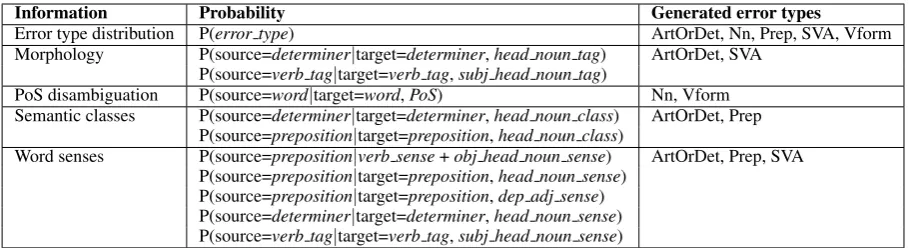
Table 1 lists the actual probabilities computed from each type of information and the errors they are able to generate.
4 Experimental setup 4.1 Corpora and tools
We use the NUCLE v2.3 corpus (Dahlmeier et al., 2013) released for the CoNLL 2013 shared task on error correction, which comprises error-annotated essays written in English by students at the National University of Singapore. These essays cover topics such as environmental pollu-tion, health care, welfare, technology, etc. All the sentences were manually annotated by human ex-perts using a set of 27 error types, but we used the filtered version containing only the five types se-lected for the shared task: ArtOrDet (article or de-terminer), Nn (noun number), Prep (preposition), SVA (subject-verb agreements) and Vform (verb form) errors. The training set of the NUCLE cor-pus contains 57,151 sentences and 1,161,567 to-kens while the test set comprises 1,381 sentences and 29,207 tokens. The training portion of the cor-pus was used to estimate the required conditional probabilities and train a few variations of our sys-tems while the test set was reserved to evaluate performance.
Candidate native texts for error injection were extracted from the English Wikipedia, controlling the variables described Section 3.1 as follows:
Information Probability Generated error types
Error type distribution P(error type) ArtOrDet, Nn, Prep, SVA, Vform Morphology P(source=determiner|target=determiner,head noun tag) ArtOrDet, SVA
P(source=verb tag|target=verb tag,subj head noun tag)
PoS disambiguation P(source=word|target=word,PoS) Nn, Vform Semantic classes P(source=determiner|target=determiner,head noun class) ArtOrDet, Prep
P(source=preposition|target=preposition,head noun class)
Word senses P(source=preposition|verb sense+obj head noun sense) ArtOrDet, Prep, SVA P(source=preposition|target=preposition,head noun sense)
[image:6.595.72.527.61.185.2]P(source=preposition|target=preposition,dep adj sense) P(source=determiner|target=determiner,head noun sense) P(source=verb tag|target=verb tag,subj head noun sense)
Table 1: Probabilities computed for each type of linguistic information. Error codes correspond to the five error types in the CoNLL 2013 shared task: ArtOrDet (article or determiner), Nn (noun number), Prep (prepositions), SVA (subject-verb agreement) and Vform (verb form).
wikicode tags, yielding 54,945 sentences and approximately 1,123,739 tokens.
Genre: Both NUCLE and Wikipedia contain ex-pository texts, although they are not necessar-ily similar.
Style/register: Written, academic and formal.
Text complexity/language proficiency: Essays in the NUCLE corpus are written by ad-vanced university students and are therefore comparable to standard English Wikipedia articles. For less sophisticated language, the Simple English Wikipedia could be an alternative.
Native language: English Wikipedia articles are mostly written by native speakers whereas NUCLE essays are not. This is the only dis-cordant variable.
PoS tagging was performed using RASP (Briscoe et al., 2006). Word sense dis-ambiguation was carried out using the WordNet::SenseRelate:AllWords Perl module (Pedersen and Kolhatkar, 2009) which assigns a sense from WordNet (Miller, 1995) to each content word in a text. As for semantic in-formation, we use WordNet classes which are readily available in NLTK (Bird et al., 2009). WordNet classes respond to a classification in lexicographers’ files4 and are defined for content
words as shown in Table 2, depending on their location in the hierarchy.
4http://wordnet.princeton.edu/man/
lexnames.5WN.html
Part of speech WordNet classification Adjective all, pertainyms, participial
Adverb all
Noun act, animal, artifact, attribute, body, cognition, communication, event, feeling, food, group, location, motive, object, person, phenomenon, plant, possession, process, quantity, relation, shape, state, substance, time
[image:6.595.307.525.251.415.2]Verb body, change, cognition, communication, competition, consumption, contact, creation, emotion, motion, perception, possession, social, stative, weather Table 2: WordNet classes for content words.
Name Composition
ED errors based on error type distributions
MORPH errors based on morphology
POS errors based on PoS disambiguation
SC errors based on semantic classes
WSD errors based on word senses
Table 3: Generated artificial corpora based on dif-ferent types of linguistic information.
4.2 Error generation
For each type of information in Table 1, we com-pute the corresponding conditional probabilities using the NUCLE training set. These probabili-ties are then used to generate six different artificial corpora using theinflation method(Rozovskaya et al., 2012), as listed in Table 3.
4.3 System training
in-Original Revised
C M U P R F1 C M U P R F1
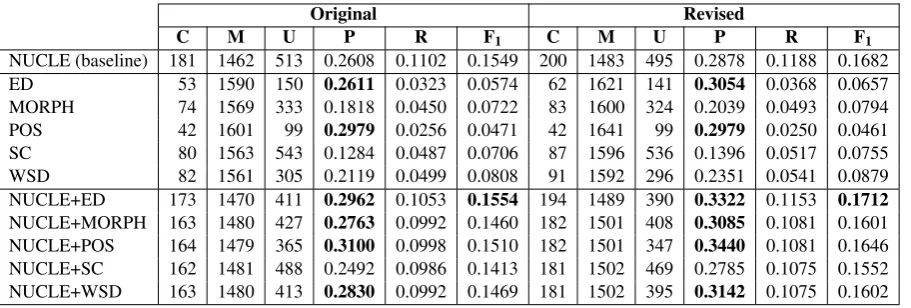
[image:7.595.73.529.61.215.2]NUCLE (baseline) 181 1462 513 0.2608 0.1102 0.1549 200 1483 495 0.2878 0.1188 0.1682 ED 53 1590 150 0.2611 0.0323 0.0574 62 1621 141 0.3054 0.0368 0.0657 MORPH 74 1569 333 0.1818 0.0450 0.0722 83 1600 324 0.2039 0.0493 0.0794 POS 42 1601 99 0.2979 0.0256 0.0471 42 1641 99 0.2979 0.0250 0.0461 SC 80 1563 543 0.1284 0.0487 0.0706 87 1596 536 0.1396 0.0517 0.0755 WSD 82 1561 305 0.2119 0.0499 0.0808 91 1592 296 0.2351 0.0541 0.0879 NUCLE+ED 173 1470 411 0.2962 0.1053 0.1554 194 1489 390 0.3322 0.1153 0.1712 NUCLE+MORPH 163 1480 427 0.2763 0.0992 0.1460 182 1501 408 0.3085 0.1081 0.1601 NUCLE+POS 164 1479 365 0.3100 0.0998 0.1510 182 1501 347 0.3440 0.1081 0.1646 NUCLE+SC 162 1481 488 0.2492 0.0986 0.1413 181 1502 469 0.2785 0.1075 0.1552 NUCLE+WSD 163 1480 413 0.2830 0.0992 0.1469 181 1502 395 0.3142 0.1075 0.1602 Table 4: Evaluation of our correction systems over the original and revised NUCLE test set using the M2
Scorer. Columns C, M and U show the number of correct, missed and unnecessary corrections suggested by each system. Results in bold show improvements over the baseline.
correct sentences and the target side contains their corrected versions. Our setup is similar to the one described by Yuan and Felice (2013) in that we train a PoS-factored phrase-based model (Koehn, 2010) using Moses (Koehn et al., 2007), Giza++ (Och and Ney, 2003) for word alignment and the IRSTLM Toolkit (Federico et al., 2008) for lan-guage modelling. However, unlike them, we do not optimise decoding parameters but use default values instead.
We build 11 different systems in total: a base-line system using only the NUCLE training set, one system per artificial corpus and other addi-tional systems using combinations of the NUCLE training data and our artificial corpora. Each of these systems uses a single translation model that tackles all error types at the same time.
5 Results
Each system was evaluated in terms of precision, recall and F1 on the NUCLE test data using the
M2Scorer (Dahlmeier and Ng, 2012), the official
evaluation script for the CoNLL 2013 shared task. Table 4 shows results of evaluation on the original test set (containing only one gold standard correc-tion per error) and a revised version (which allows for alternative corrections submitted by participat-ing teams).
Results reveal our ED and POS corpora are able to improve precision for both test sets. It is surpris-ing, however, that the least informed dataset (ED) is one of the best performers although this seems reasonable if we consider it is the only dataset that includes artificial instances for all error types (see Table 1). Hybrid datasets containing the NUCLE
training set plus an artificial corpus also gener-ally improve precision, except for NUCLE+SC. It could be argued that the reason for this improve-ment is corpus size, since our hybrid datasets are double the size of each individual set, but the small differences in precision between the ED and POS datasets and their corresponding hybrid versions seem to contradict that hypothesis. In fact, re-sults would suggest artificial and naturally occur-ring errors are not interchangeable but rather com-plementary.
The observed improvement in precision, how-ever, comes at the expense of recall, for which none of the systems is able to beat the baseline. This contradicts results by Rozovskaya and Roth (2010a), who show their error inflation method in-creases recall, although this could be due to differ-ences in the training paradigm and data. Still, re-sults are encouraging since precision is generally preferred over recall in error correction scenarios (Yuan and Felice, 2013).
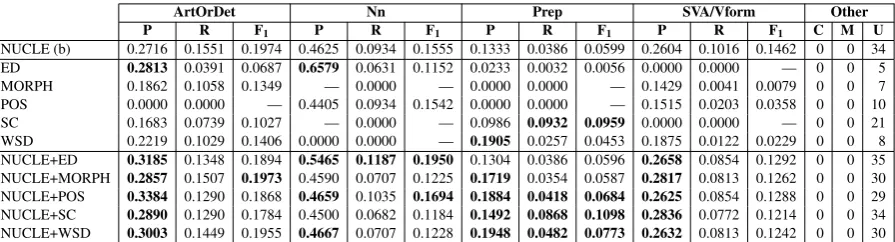
We also evaluated performance by error type on the original (Table 5) and revised (Table 6) test data using an estimation approach similar to the one in CoNLL 2013. Results show that the per-formance of each dataset varies by error type, sug-gesting that certain types of information are bet-ter suited for specific error types. In particular, we find that on the original test set, ED achieves the highest precision for article and determiners, WSD maximises precision for prepositions and SC achieves the highest recall and F1. When
ArtOrDet Nn Prep SVA/Vform Other
P R F1 P R F1 P R F1 P R F1 C M U
NUCLE (b) 0.2716 0.1551 0.1974 0.4625 0.0934 0.1555 0.1333 0.0386 0.0599 0.2604 0.1016 0.1462 0 0 34 ED 0.2813 0.0391 0.0687 0.6579 0.0631 0.1152 0.0233 0.0032 0.0056 0.0000 0.0000 — 0 0 5 MORPH 0.1862 0.1058 0.1349 — 0.0000 — 0.0000 0.0000 — 0.1429 0.0041 0.0079 0 0 7 POS 0.0000 0.0000 — 0.4405 0.0934 0.1542 0.0000 0.0000 — 0.1515 0.0203 0.0358 0 0 10 SC 0.1683 0.0739 0.1027 — 0.0000 — 0.0986 0.0932 0.0959 0.0000 0.0000 — 0 0 21 WSD 0.2219 0.1029 0.1406 0.0000 0.0000 — 0.1905 0.0257 0.0453 0.1875 0.0122 0.0229 0 0 8 NUCLE+ED 0.3185 0.1348 0.1894 0.5465 0.1187 0.1950 0.1304 0.0386 0.0596 0.2658 0.0854 0.1292 0 0 35 NUCLE+MORPH 0.2857 0.1507 0.1973 0.4590 0.0707 0.1225 0.1719 0.0354 0.0587 0.2817 0.0813 0.1262 0 0 30 NUCLE+POS 0.3384 0.1290 0.1868 0.4659 0.1035 0.1694 0.1884 0.0418 0.0684 0.2625 0.0854 0.1288 0 0 29 NUCLE+SC 0.2890 0.1290 0.1784 0.4500 0.0682 0.1184 0.1492 0.0868 0.1098 0.2836 0.0772 0.1214 0 0 34 NUCLE+WSD 0.3003 0.1449 0.1955 0.4667 0.0707 0.1228 0.1948 0.0482 0.0773 0.2632 0.0813 0.1242 0 0 30
Table 5: Error type analysis of our correction systems over the original NUCLE test set using the M2
Scorer. Columns C, M and U show the number of correct, missed and unnecessary corrections outside the main categories suggested by each system. Results in bold show improvements over the baseline.
ArtOrDet Nn Prep SVA/Vform Other
P R F1 P R F1 P R F1 P R F1 C M U
NUCLE (b) 0.3519 0.2026 0.2572 0.6163 0.1302 0.2150 0.2069 0.0682 0.1026 0.4105 0.1718 0.2422 0 0 34 ED 0.4063 0.0579 0.1014 0.7297 0.0684 0.1250 0.0465 0.0077 0.0132 0.1818 0.0183 0.0332 0 0 5 MORPH 0.2270 0.1311 0.1662 — 0.0000 — 0.0000 0.0000 — 0.2857 0.0092 0.0179 0 0 7 POS 0.0000 0.0000 — 0.5465 0.1169 0.1926 0.0000 0.0000 — 0.4242 0.0631 0.1098 0 0 10 SC 0.2112 0.0944 0.1305 — 0.0000 — 0.1088 0.1221 0.1151 0.0000 0.0000 — 0 0 21 WSD 0.2781 0.1313 0.1784 0.0000 0.0000 — 0.2143 0.0347 0.0598 0.2000 0.0138 0.0259 0 0 8 NUCLE+ED 0.4334 0.1849 0.2592 0.7000 0.1552 0.2540 0.1685 0.0575 0.0857 0.4744 0.1630 0.2426 0 0 35 NUCLE+MORPH 0.3791 0.2006 0.2624 0.6308 0.1017 0.1752 0.2295 0.0536 0.0870 0.4714 0.1454 0.2222 0 0 30 NUCLE+POS 0.4601 0.1761 0.2547 0.6087 0.1383 0.2254 0.2424 0.0613 0.0979 0.4430 0.1549 0.2295 0 0 29 NUCLE+SC 0.3961 0.1773 0.2450 0.6154 0.0993 0.1709 0.1844 0.1250 0.1490 0.4848 0.1410 0.2184 0 0 34 NUCLE+WSD 0.3994 0.1933 0.2605 0.6308 0.1017 0.1752 0.2432 0.0690 0.1075 0.4667 0.1535 0.2310 0 0 30
Table 6: Error type analysis of our correction systems over the revised NUCLE test set using the M2
Scorer. Columns C, M and U show the number of correct, missed and unnecessary corrections outside the main categories suggested by each system. Results in bold show improvements over the baseline.
(Prep) and NUCLE+SC (SVA/Vform). As ex-pected, the use of alternative annotations in the re-vised test set improves results but it does not reveal any qualitative difference between datasets.
Finally, when compared to other systems in the CoNLL 2013 shared task in terms of F1, our best
systems would rank 9th on both test sets. This would suggest that using an off-the-shelf SMT system trained on a combination of real and ar-tificial data can yield better results than other ma-chine learning techniques (Yi et al., 2013; van den Bosch and Berck, 2013; Berend et al., 2013) or rule-based approaches (Kunchukuttan et al., 2013; Putra and Szabo, 2013; Flickinger and Yu, 2013; Sidorov et al., 2013).
6 Conclusions
This paper presents early results on the genera-tion and use of artificial errors for grammatical error correction. Our approach uses conditional probabilities derived from an ESL error-annotated corpus to replicate errors in native error-free data. Unlike previous work, we propose using linguistic information such as PoS or sense disambiguation
to refine the contexts where errors occur and thus replicate them more accurately. We use five differ-ent types of information to generate our artificial corpora, which are later evaluated in isolation as well as coupled to the original ESL training data.
General results show error distributions and PoS information produce the best results, although this varies when we analyse each error type separately. These results should allow us to generate errors more efficiently in the future by using the best ap-proach for each error type.
We have also observed that precision improves at the expense of recall and this is more pro-nounced when using purely artificial sets. Finally, artificially generated errors seem to be a comple-ment rather than an alternative to genuine data.
7 Future work
There are a number of issues we plan to address in future research, as described below.
Scaling up artificial data
[image:8.595.76.524.61.182.2]However, we plan to study the performance of our systems as corpus size is increased. We are cur-rently using a larger selection of Wikipedia ar-ticles to produce new artificial datasets ranging from 50K to 5M sentences. The resulting corpora will be used to train new error correction systems and study how precision and recall vary as more data is added during the training process, similar to Cahill et al. (2013).
Reducing differences between datasets
As shown in Table 1, we are unable to produce the same set of errors for each different type of in-formation. This is a limitation of our conditional probabilities which encode different information in each case. In consequence, comparing overall results between datasets seems unfair as they do not target the same error types. In order to over-come this problem, we will define new probabili-ties so that we can generate the same types of error in all cases.
Exploring larger contexts
Our current probabilities model error contexts in a limited way, mostly by considering rela-tions between two or three words (e.g. arti-cle+noun, verb+preposition+noun, etc.). In or-der to improve error injection, we will define new probabilities using larger contexts, such as P(source=verb|target=verb, subject class, auxil-iary verbs, object class) for verb form errors. Using more specific contexts can also be useful for correcting complex error types, such as the use of pronouns, which often requires analysing corefer-ence chains.
Using new linguistic information
In this work we have used five types of linguis-tic information. However, we believe other types of information and their associated probabilities could also be useful, especially if we aim to cor-rect more error types. Examples include spelling, grammatical relations (dependencies) and word order (syntax). Additionally, we believe the use of semantic role labels can be explored as an al-ternative to semantic classes, as they have proved useful for error correction (Liu et al., 2010). Mixed error generation
In our current experiments, each artificial corpus is generated using only one type of information at a time. However, having found that certain types of
information are more suitable than others for cor-recting specific error types (see Tables 5 and 6), we believe better artificial corpora could be created by generating instances of each error type using only the most appropriate linguistic information.
Acknowledgments
We would like to thank Prof Ted Briscoe for his valuable comments and suggestions as well as Cambridge English Language Assessment, a divi-sion of Cambridge Assessment, for supporting this research.
References
Gabor Berend, Veronika Vincze, Sina Zarrieß, and Rich´ard Farkas. 2013. Lfg-based features for noun number and article grammatical errors. In Proceedings of the Seventeenth Conference on Computational Natural Language Learning: Shared Task, pages 62–67, Sofia, Bulgaria, August. Association for Computational Linguistics.
Steven Bird, Edward Loper, and Ewan Klein. 2009. Natural Language Processing with Python. O’Reilly Media Inc.
Ted Briscoe, John Carroll, and Rebecca Watson. 2006. The second release of the RASP sys-tem. In Proceedings of the COLING/ACL on Interactive presentation sessions, COLING-ACL ’06, pages 77–80, Sydney, Australia. Association for Computational Linguistics.
Chris Brockett, William B. Dolan, and Michael Gamon. 2006. Correcting ESL Errors Using Phrasal SMT Techniques. In Proceedings of the 21st International Conference on Computational Linguistics and 44th Annual Meeting of the Association for Computational Linguistics, pages 249–256, Sydney, Australia, July. Association for Computational Linguistics.
Aoife Cahill, Nitin Madnani, Joel Tetreault, and Diane Napolitano. 2013. Robust systems for preposition error correction using wikipedia revi-sions. In Proceedings of the 2013 Conference of the North American Chapter of the Association for Computational Linguistics: Human Language Technologies, pages 507–517, Atlanta, Georgia, June. Association for Computational Linguistics.
Daniel Dahlmeier, Hwee Tou Ng, and Siew Mei Wu. 2013. Building a Large Annotated Corpus of Learner English: The NUS Corpus of Learner English. In Proceedings of the 8th Workshop on Innovative Use of NLP for Building Educational Applications, BEA 2013, pages 22–31, Atlanta, Georgia, USA, June. Association for Computational Linguistics.
Nava Ehsan and Heshaam Faili. 2013. Grammatical and context-sensitive error correction using a sta-tistical machine translation framework. Software: Practice and Experience, 43(2):187–206.
Marcello Federico, Nicola Bertoldi, and Mauro Cettolo. 2008. IRSTLM: an open source toolkit for handling large scale language models. In
Proceedings of the 9th Annual Conference of the International Speech Communication Association, INTERSPEECH 2008, pages 1618–1621, Brisbane, Australia, September. ISCA.
Dan Flickinger and Jiye Yu. 2013. Toward more precision in correction of grammatical er-rors. InProceedings of the Seventeenth Conference on Computational Natural Language Learning: Shared Task, pages 68–73, Sofia, Bulgaria, August. Association for Computational Linguistics.
Jennifer Foster and Øistein Andersen. 2009. Generrate: Generating errors for use in grammati-cal error detection. In Proceedings of the Fourth Workshop on Innovative Use of NLP for Building Educational Applications, pages 82–90, Boulder, Colorado, June. Association for Computational Linguistics.
William A. Gale, Kenneth W. Church, and David Yarowsky. 1992. One sense per discourse. In Proceedings of the workshop on Speech and Natural Language, HLT ’91, pages 233– 237, Harriman, New York. Association for Computational Linguistics.
Kenji Imamura, Kuniko Saito, Kugatsu Sadamitsu, and Hitoshi Nishikawa. 2012. Grammar error correc-tion using pseudo-error sentences and domain adap-tation. InProceedings of the 50th Annual Meeting of the Association for Computational Linguistics (Volume 2: Short Papers), pages 388–392, Jeju Island, Korea, July. Association for Computational Linguistics.
Emi Izumi, Kiyotaka Uchimoto, Toyomi Saiga, Thepchai Supnithi, and Hitoshi Isahara. 2003. Automatic Error Detection in the Japanese Learners’ English Spoken Data. In Proceedings of the 41st Annual Meeting on Association for Computational Linguistics - Volume 2, ACL ’03, pages 145– 148, Sapporo, Japan. Association for Computational Linguistics.
Philipp Koehn, Hieu Hoang, Alexandra Birch, Chris Callison-Burch, Marcello Federico, Nicola Bertoldi, Brooke Cowan, Wade Shen, Christine Moran,
Richard Zens, Chris Dyer, Ondˇrej Bojar, Alexandra Constantin, and Evan Herbst. 2007. Moses: open source toolkit for statistical machine translation. In
Proceedings of the 45th Annual Meeting of the ACL on Interactive Poster and Demonstration Sessions, ACL ’07, pages 177–180, Prague, Czech Republic. Association for Computational Linguistics.
Philipp Koehn. 2010.Statistical Machine Translation. Cambridge University Press, New York, NY, USA, 1st edition.
Anoop Kunchukuttan, Ritesh Shah, and Pushpak Bhattacharyya. 2013. Iitb system for conll 2013 shared task: A hybrid approach to grammatical er-ror correction. In Proceedings of the Seventeenth Conference on Computational Natural Language Learning: Shared Task, pages 82–87, Sofia, Bulgaria, August. Association for Computational Linguistics.
Claudia Leacock, Martin Chodorow, Michael Gamon, and Joel Tetreault. 2010. Automated Grammatical Error Detection for Language Learners. Morgan and Claypool Publishers.
John Lee and Stephanie Seneff. 2008. An analysis of grammatical errors in non-native speech in English. In Amitava Das and Srinivas Bangalore, editors,
Proceedings of the 2008 IEEE Spoken Language Technology Workshop, SLT 2008, pages 89–92, Goa, India, December. IEEE.
Xiaohua Liu, Bo Han, Kuan Li, Stephan Hyeonjun Stiller, and Ming Zhou. 2010. SRL-based verb selection for ESL. In Proceedings of the 2010 Conference on Empirical Methods in Natural Language Processing, pages 1068– 1076, Cambridge, MA, October. Association for Computational Linguistics.
George A. Miller. 1995. WordNet: a lexical database for English. Communications of the ACM, 38(11):39–41, November.
Tomoya Mizumoto, Mamoru Komachi, Masaaki Nagata, and Yuji Matsumoto. 2011. Mining Revision Log of Language Learning SNS for Automated Japanese Error Correction of Second Language Learners. In Proceedings of 5th International Joint Conference on Natural Language Processing, pages 147–155, Chiang Mai, Thailand, November. Asian Federation of Natural Language Processing.
Ted Pedersen and Varada Kolhatkar. 2009. WordNet::SenseRelate::AllWords: a broad cover-age word sense tagger that maximizes semantic relatedness. In Proceedings of Human Language Technologies: The 2009 Annual Conference of the North American Chapter of the Association for Computational Linguistics, Companion Volume: Demonstration Session, NAACL-Demonstrations ’09, pages 17–20, Boulder, Colorado. Association for Computational Linguistics.
Desmond Darma Putra and Lili Szabo. 2013. Uds at conll 2013 shared task. In Proceedings of the Seventeenth Conference on Computational Natural Language Learning: Shared Task, pages 88–95, Sofia, Bulgaria, August. Association for Computational Linguistics.
Alla Rozovskaya and Dan Roth. 2010a. Training paradigms for correcting errors in grammar and us-age. InHuman Language Technologies: The 2010 Annual Conference of the North American Chapter of the Association for Computational Linguistics, HLT ’10, pages 154–162, Los Angeles, California. Association for Computational Linguistics.
Alla Rozovskaya and Dan Roth. 2010b. Generating confusion sets for context-sensitive error correction. InProceedings of the 2010 Conference on Empirical Methods in Natural Language Processing, EMNLP ’10, pages 961–970, Cambridge, Massachusetts. Association for Computational Linguistics.
Alla Rozovskaya and Dan Roth. 2011. Algorithm selection and model adaptation for ESL correction tasks. InProceedings of the 49th Annual Meeting of the Association for Computational Linguistics: Human Language Technologies - Volume 1, HLT ’11, pages 924–933, Portland, Oregon. Association for Computational Linguistics.
Alla Rozovskaya, Mark Sammons, and Dan Roth. 2012. The UI system in the HOO 2012 shared task on error correction. InProceedings of the Seventh Workshop on Building Educational Applications Using NLP, pages 272–280, Montreal, Canada. Association for Computational Linguistics.
Alla Rozovskaya, Kai-Wei Chang, Mark Sammons, and Dan Roth. 2013. The University of Illinois System in the CoNLL-2013 Shared Task. In Proceedings of the Seventeenth Conference on Computational Natural Language Learning: Shared Task, pages 13–19, Sofia, Bulgaria, August. Association for Computational Linguistics.
Grigori Sidorov, Anubhav Gupta, Martin Tozer, Dolors Catala, Angels Catena, and Sandrine Fuentes. 2013. Rule-based system for automatic grammar correc-tion using syntactic n-grams for english language learning (l2). In Proceedings of the Seventeenth Conference on Computational Natural Language Learning: Shared Task, pages 96–101, Sofia, Bulgaria, August. Association for Computational Linguistics.
Jonas Sj¨obergh and Ola Knutsson. 2005. Faking errors to avoid making errors: Very weakly su-pervised learning for error detection in writing. In Proceedings of RANLP 2005, pages 506–512, Borovets, Bulgaria, September.
Toshikazu Tajiri, Mamoru Komachi, and Yuji Matsumoto. 2012. Tense and aspect error cor-rection for esl learners using global context. In
Proceedings of the 50th Annual Meeting of the Association for Computational Linguistics (Volume 2: Short Papers), pages 198–202, Jeju Island, Korea, July. Association for Computational Linguistics. Joel Tetreault, Daniel Blanchard, and Aoife Cahill.
2013. A Report on the First Native Language Identification Shared Task. In Proceedings of the Eighth Workshop on Innovative Use of NLP for Building Educational Applications, pages 48–57, Atlanta, Georgia, June. Association for Computational Linguistics.
Antal van den Bosch and Peter Berck. 2013. Memory-based grammatical error correction. InProceedings of the Seventeenth Conference on Computational Natural Language Learning: Shared Task, pages 102–108, Sofia, Bulgaria, August. Association for Computational Linguistics.
Bong-Jun Yi, Ho-Chang Lee, and Hae-Chang Rim. 2013. Kunlp grammatical error correction sys-tem for conll-2013 shared task. In Proceedings of the Seventeenth Conference on Computational Natural Language Learning: Shared Task, pages 123–127, Sofia, Bulgaria, August. Association for Computational Linguistics.