Abstract—Technology transfer between countries has been a widely undertaken activity, serving both the advanced and developing country symbiotically to better position themselves in world business. However, the problem with technology transfer is still the lack of scientific methodology by which to conduct it. Although there have been numerous research activities addressing this problem, the issue is too broad to be fixed by a single solution. One specific problem that may be cited is that different users of technology have different needs and capabilities that require the technology to be appropriately presented for effective and efficient utilization by the user.
This research proposes the breakdown of technologies using the Two-Stage Multi-Variable Technology Breakdown Model to clarify the presentation of the technology by the transferor. This model breaks down technologies first into explicit and implicit components. Then, the model proceeds to breaking down technologies into common and user-specific components. It is the aim that this clearer presentation will lead to better understanding, better absorption and better retention of the technology by the transferee. Through case studies of process planning and operational planning technologies of Japanese, Korean and Taiwanese machine tool manufacturers, this research is able to present to some extent how the proposed breakdown can contribute to more effective and more efficient technology transfer.
Index Terms—Common Technology, Explicit Technology, Implicit Technology, Two-Stage Multi-Variable Technology Breakdown Model, User-specific Technology
I. INTRODUCTION
Technology or the use of mechanical arts and applied sciences [1] has been seen to be vital to the advancement of countries. However, while some countries have progressed very far in terms of developing their own technologies, some have seen slower rates of development. While this may sound unfortunate, it is actually advantageous from a different perspective. Because not all have succeeded equally, different countries can take on different positions in symbiotic
Manuscript received December 23, 2008. This work was supported in part by the Japan Society for the Promotion of Science.
Iris Ann G. Martinez is a Third Year Dr. Dissertation (Ronpaku) student at the University of Tokyo. She is also an Assistant Professor at the Department of Industrial Engineering and Operations Research, University of the Philippines, Diliman, Quezon City 1101 PHILIPPINES (email:
[email protected]; Tel. No. +63-2-981-8500 ext. 3128 or 3149) Shin’ichi Warisawa is an Associate Professor at the Department of Engineering Synthesis, University of Tokyo, 7-3-1 Hongo, Bunkyo-ku, Tokyo 113-8656 JAPAN (email: [email protected]; Tel. No. +81-3-5841-6334)
relationships for globalized manufacturing. Specifically, this means that while advanced countries can concentrate on new products, less developed ones can take care of producing the mature products. This has resulted in economic gains on both sides and more technology transfer activities between the advanced countries and the less developed ones.
Technology transfer has been a widely undertaken activity. However, it has always encountered difficulties such as the inability of the technology to be adapted to the conditions within the transferee. For example, previous studies have found the following to have resulted in problems [2]: a.Decision-making priorities. The emphasis placed on
decision-making criteria may differ between the transferor and the transferee. For example, research and development-intensive technologies have difficulty in surviving in countries that place very low priority and little investment on research and development.
b.Degree of utilization of labor versus automated systems. In some countries, automated systems are seen as “unqualified replacements for human labor.” Their reason for this is that these automated systems have very limited capabilities.
The problems cited above show that the deeply rooted decision-making practice and/or the attitude/feelings of the user of the technology with regard to tools may be instrumental to the success of the technology transfer. With this, it can thus be said that technology transfer needs to be addressed beyond specifying a recipe or instructional manual of how to use the technology. Addressing the thoughts of the user is necessary. It must be emphasized that until the present, there are very few studies that have tackled the thoughts, mentality or mindset of the user. Thus, this research addresses this issue in its objective to find a methodology for technology transfer.
II. THE OBJECTIVE,HYPOTHESIS AND PROPOSAL OF THIS
RESEARCH
A.The Objective
The objective of this research is to propose a methodology for successful technology transfer. Successful means effective and efficient technology transfer. This research defines effective technology transfer to be technology transfer that results in the sustainable adoption of the foreign technology by the transferee. Here, sustainable adoption means that the foreign technology is able to thrive in the mindset and culture of the transferee while being able to produce goods and
The Two-Stage Multi-Variable Technology
Breakdown Model: A Proposal for Technology
Breakdown for More Effective and Efficient
Technology Transfer
services as intended by the technology transfer activity. As the International Energy Agency has described it, “Successful technology transfer requires the right ‘framework’ to meet the needs and account for the capabilities of the recipient [3].” Furthermore, this research defines efficient technology transfer to be that which results in rapid and cost effective movement of technology from the transferor to the transferee. Research works that aim to find means for efficient technology transfer commonly find systematic methodology and depart from trial-and-error methods. For example, the research entitled “Improving the Efficiency and Effectiveness of Technology Transfer Process in Semiconductor Industry” proposed to improve efficiency by finding a systematic methodology for transferring technology from design to manufacturing [4].
The objective of this research is similar to the objective of producing region-harmonized products [5]. The idea of the region-harmonized product is to produce goods that are fit to the regional and cultural specifications of the user. One of the earliest research works on region-harmonized products discussed how machine tools could be localized to be culturally adaptive to the region of use [6]. Logically, the more responsive products are to the needs and wants of users, the more satisfied the users would be. In the case of machine tools, having a machine tool that is designed to the culture of the region using it will lead to better production systems and consequently higher productivity.
Truly, harmonization of products with users is ideal. However, materializing this concept is not easy. The full customization of products to various users usually leads to inefficiency in production, resulting in more expensive products. In the recent decade, concepts like mass customization and modular design or modularity have been introduced and utilized to solve this problem. Specifically, the concept of modularity provides the necessary foundation for organizations to design products that can respond rapidly to market needs and allow the changes in product design to happen in a cost-effective manner [7].
B. The Hypothesis
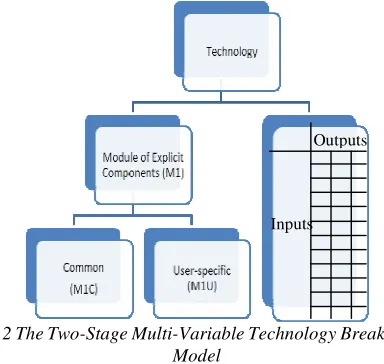
Having stated the objective of this research and using the concept of modularity as reference, the basic hypothesis of this research may be stated as follows: “Technology is made up of two components: (1) the common component and (2) the user-specific component. Fig. 1 illustrates this hypothesis. The common components are those that can be transferred unaltered to any geographical region in the world. Transfer can be done even with minimal to no adjustments to the components. In many cases, transfer can be done readily because the steps can be executed straightforward. On the other hand, the user-specific components are those that must be significantly adjusted to the conditions of the transferee for the technology to be effective.
The Assumption of this Research
Aside from the hypothesis of this research that there are two components of technology, namely the common component and the user-specific component, this research assumes yet another way of classifying the components of technologies. These two classifications are the (1) explicit and the (2) implicit components.
Fig.1 The Hypothesis of this Research
Explicit components are those that are articulated, codified, captured and stored. On the other hand, implicit components are the opposite – those that cannot be articulated, codified, captured or stored. Technology has been defined as the practical application of knowledge. And, knowledge has been classified as explicit or tacit (implicit) from the time Polanyi [8] noted that “we know more than we can tell.” Following that, technology has been said to be composed of parts that can be readily codified (explicit) and those that can be transferred only through extended human contact (implicit or tacit).
C.The Proposal
To facilitate the effective and efficient transfer of technologies, the proposal of this research is as follows: 1. Break down the technology into two modules (Stage 1
breakdown):
1-a. Module 1: Those that can be articulated, codified, captured or stored (explicit components); 1-b. Module 2: Those that can be taught by demonstration
only (implicit components).
2. Break down Module 1 further into common components and user-specific components (Stage 2 breakdown). Transfer the common components as is. Allow the user-specific components to be customized to the user’s needs and capabilities during the entire process of technology transfer.
3. For Module 2, identify the input variables to the technology that can possibly result to differing outputs. Based on the specific situation, the user will be allowed to use his own judgment on how to utilize the technology given that he is provided with information about the consequences (outputs) of his inputs.
To aid in the visualization of the proposed methodology for technology transfer, this research proposes the Two-Stage Multi-Variable Technology Breakdown Model. Fig. 2 illustrates this model.
1. Breakdown of the Technology into Two Modules: Module 1 (Module of Explicit Components) and Module 2 (Module of Implicit Components)
The first stage in the proposed methodology is the breaking down of the technology into two modules. These are Module 1 (module of explicit components) and Module 2 (module of implicit components).
Fig. 2 The Two-Stage Multi-Variable Technology Breakdown Model
those that can be readily codified. These are the components that are written down in some physical form. Examples of these are design specification, drawings, process flows and formulations. In order to transfer a technology, it will be ideal to fully express the technology in terms of its explicit components. However, it is not realistically possible to do so. There are aspects of knowledge (and technology) that cannot be articulated, abstracted, codified, captured and stored. These can only be shared to a learner by immersing the learner in the practice itself, under the guidance of the mentor and whilst situated in a particular environment [9]. These are the implicit components.
Notice that in Fig. 2, the module for the explicit components (M1), as well as its sub-modules (M1C and M1U), is represented by a box without grids. On the other hand, the module for the implicit components is represented by a box with grids. The difference in representation reflects the difference in the complexity of transferring the technology. An example of an explicit component is the enumeration of the basic processes that make up the technology. Basic processes are to the end-to-end processes that are aligned with a specific or manufacturing technology. For instance, in the case of the Process Planning technology of companies that are involved in parts machining, the basic processes would usually be the following: (1) drawing interpretation, (2) material evaluation, (3) process selection, (4) production equipment selection, (5) tooling selection, (6) determination of process parameters, and (7) determination of workholding devices [10].
Compared to explicit components, implicit components are usually more complex. They cannot be simply enumerated. Instead, these components such as decision-making considerations can only be characterized to some extent in terms of variables. For example, characterization may be done by stating what inputs to these components cause what specific outputs. In the module for implicit components, there is no limit to the number of input variables or output variables. This is the reason for the “Multi-Variable” part in the name of the model proposed by this research. The idea of this research is that the module for the implicit components will be continuously updated by both the technology transferor and the transferee. As the technology is observed, experienced and utilized, the transferor or the transferee may find input variables that can change the specific way that the technology is implemented. This specific way by which the technology is
implemented can be the output variable of the technology. As an example, an input variable may be the culture-based mindset of “having to pay monetary penalty when products are not delivered on time.” This mindset may be viewed differently between the transferor and the transferee. The transferor may place a high importance on this while the transferee may simply think that this is negligible. Therefore, it becomes necessary that this differing mindset and its effect be identified in the implicit module as input and output, respectively. Possibly, the effect of this mindset is that transferor will prioritize on-time delivery during decision-making while the transferee will not significantly do so.
The authors are now working on the methodology for identifying the necessary and sufficient input variables that will describe the implicit components of technologies. It is the aim that some significant findings will be presented in a subsequent paper. Ultimately, the objective is to arrive at a concrete workflow that can be validated to result in effective and efficient technology transfer activities.
2.Breakdown of the Explicit Module into Common and User-specific
The second stage is the breakdown of the explicit module into the sub-modules of common and user-specific.
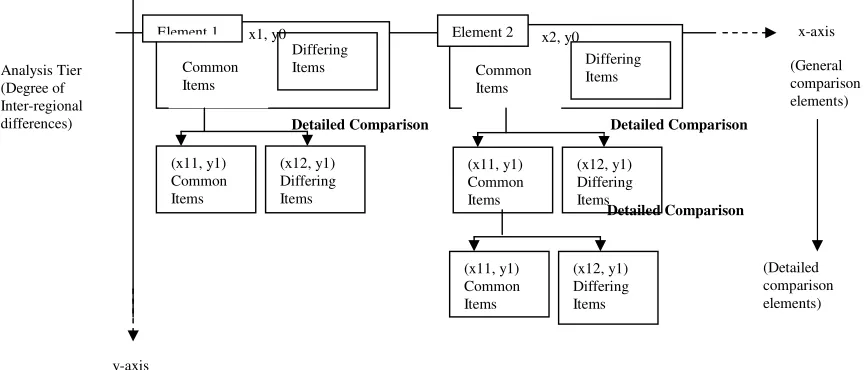
In 1995, the authors have proposed a model that can be used to unveil the common and user-specific components of a technology. The model was named the Two-Dimensional Hierarchical Model [11]. Briefly, the following describes the model:
a. The x-axis shows the basic processes that make up a technology.
b. The y-axis shows the tier/stage of the comparative analysis. At y = 0, which is the uppermost tier, the basic processes are shown. As the analysis proceeds downwards, the analysis performs more detailed comparisons. Similar or common elements that are found in the prior tier are investigated for possible diverging orientations or differing characteristics. If the analysis finds the existence of diverging orientations, these diverging orientations are then identified in the subsequent tier. Otherwise, the analysis may consider other factors that enable diverging orientations to be identified.
Using the Two-Dimensional Hierarchical Model as basis, the authors were able to consequently prove both qualitatively [12] and quantitatively [13] that even when technologies appear to be utilized in the same way by different countries, there is a component of the technology that is conducted differently by those countries.
The implication of breaking down the explicit components into common and user-specific is to fit the technology to the needs and capabilities of the user. As mentioned above, this fitting or customization will enable the effective transplantation of technology and improve the sustainability of the transfer. A simple example would be that if the same part drawing is presented to the user, comprehension will expectedly be higher if the labels contained in the drawings are written in the user’s native language. A more complex example would be the presentation of standard time. As will be discussed later in a case study, the computation of standard time may be commonly understood between the transferor and the transferee but the actual formula by which standard
Fig. 3 The Two-Dimensional Hierarchical Model for the Analysis and Comparison of Technologies
time is computed may be different between them.
Regarding the level of detail to which the explicit components should be broken down, it has been noted from preliminary investigations that the following conditions would favor a more detailed breakdown:
• The knowledge of the transferee about the technology is not high. If the technology is new to the transferee, more detailed documentation is needed to teach/transfer the technology.
• Deviation from the set method of executing the technology cannot be allowed. If the transferor desires that the technology be executed with minimal to no deviations from how the transferor executes it, more detailed documentation is needed to teach/transfer the technology.
Further study on the results of the preliminary investigations mentioned above is now being undertaken by the authors. 3.Identification of the Input Variables to the Technology That Can Possibly Result in Differing Outputs (For Module 2)
The difference between the Two-Dimensional Hierarchical Model and the Two-Stage Multi-Variable Technology Breakdown Model is as regards the breakdown of components into common and user-specific. The Two-Stage Multi-Variable Technology Breakdown Model that is proposed herein performs the classification only on the explicit components and not on the implicit components. The difficulty of articulating the implicit components makes it also difficult for anyone to discern whether these components are common or not between the transferor and the transferee. Aside from this, unlike explicit components, implicit components like decision-making priorities can quickly change for the same decision maker/user, depending on the situation that the user is in. Therefore, whether these implicit components are common or user-specific may be situational and not fixed over time.
Looking at the objective of the Two-Stage Technology Breakdown Model, it seems that leaving the implicit module as is and not broken down into common and user-specific is realistic. As discussed above, implicit components can be
learned through immersion into the practice itself, under the guidance of the mentor. Therefore, this implies that it may really be impossible to write these components down. At best, a model of the guidance of transferor could contribute to better technology transfer. The guidance may be in the form of specifying the input variables that can cause changes in outputs. With this, the transferee can perform subsequent independent analysis by himself on which input variables he would wish to alter, in order to try to improve overall desired results. Since systematic documentation is expected to be difficult, a journal, log, or real-time recording can help capture some nuances that cannot be immediately identified. This research continues the activities that have been done previously by the authors. The Two-Dimensional Hierarchical Model is further developed into the Two-Stage Multi-Variable Technology Breakdown Model. The Two-Dimensional Hierarchical Model was able to unveil the user-specific technology components. That model is hereby restructured and re-engineered to move towards the objective of proposing a methodology for successful technology transfer.
Based on the discussions above, the following summarizes the proposal of this research: “Hitherto, technology transfer has been conducted on a trial-and-error basis. Some succeeded while others unfortunately did not. This research believes that success may be found by a formula that is two-fold: (1) Find a systematic methodology for transferring technology and (2) To some extent, allow the technology to be implemented by the transferee according to his needs and capabilities. The first of the two-fold formula will contribute to the efficiency of the technology transfer while the second will improve the effectiveness.”
III. CASESTUDIES
1.Case Study 1: Process Planning Technology of Japanese, Taiwanese and Korean Machine Tool Manufacturers To investigate the ability of the Two-Stage Multi-Variable Technology Breakdown Model to illustrate a technology, the process planning technology of machine tool manufacturers is taken as case study. For the investigation, 7 Japanese, 4 Taiwanese and 5 Korean machine tool manufacturers were
Element 1
Common Items
Differing Items x1, y0
Main components that make up the technology
Element 2
Common Items
Differing Items x2, y0
Analysis Tier (Degree of Inter-regional differences)
(x11, y1) Common Items
(x12, y1) Differing Items
Detailed Comparison
(x11, y1) Common Items
(x12, y1) Differing Items
Detailed Comparison
(x11, y1) Common Items
(x12, y1) Differing Items
Detailed Comparison
x-axis
y-axis
(General comparison elements)
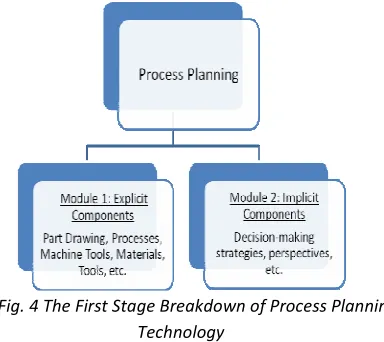
interviewed. Figure 4 shows the first stage breakdown of the technology into its basic processes. Based on the results of the interview investigation, explicit technology components include part drawings, lists of basic processes, machine tools, materials and cutting tools. The results of the investigation showed that the explicit components of process planning are organized around the basic processes. Thus, further representation of this technology may be done using the basic processes as reference. Fig. 5 illustrates this.
Fig. 4 The First Stage Breakdown of Process Planning Technology
Common to all Japanese, Taiwanese and Korean machine tool manufacturers are the basic processes which are as follows: (1) Determination of raw material size, (2) Determination of machining process, (3) Arrangement of machining sequence, (4) Selection of machine tool, and (5) Determination of standard time.
For the second stage breakdown, all of the basic processes identified above can be modeled by the proposed Two-Stage Multi-Variable Technology Breakdown Model. Fig. 5-a shows sample separation of the explicit and implicit components. Furthermore, the explicit components are classified into common and region-specific based on the results of the investigation. These figures are for the Determination of raw material size and Determination of standard time, respectively.
To illustrate in detail, the basic processes of Determining the Raw Material Size and Determining the Standard Time will be discussed. It is interesting to note the following for the implicit components of Process Planning technology: • Determination of raw material size
Input variable: Labor cost → Output variable: Decision-making priority: Cost of raw material Input variable: Practice raw material sourcing →
Output variable: Decision-making priority: Quality of raw material
Input variable: Practice of raw material sourcing → Output variable: Decision-making priority: Production speed
Input variable: Engineer experience → Output variable: Fixing method → Output variable: Machining cost
A concrete example of the input-output relationship between labor cost and the cost of raw material is the case of Japanese machine tool manufacturers. In Japan, the wages are high so
cost minimization are seriously being sought in other areas of production such as in the procurement of raw materials. This is to pull down the product cost in order to make the product competitive.
While cost is also being considered by Taiwanese machine tool manufacturers, the weightiest factor during decision-making for raw material size determination is quality. In Taiwan, raw material like cast iron is purchased from external suppliers. This is being done to minimize the cost of in-house production. Although this is an advantage in terms of cost, the quality of raw material is not consistent. Because of this, the manufactures have to pay more attention to raw material quality during selection. Allowances for further machining are taken into account so that the accuracy of the final product becomes acceptable.
Unlike in Taiwan, the bulk of the raw material is produced in-house by Korean machine tool manufacturers. This is because outsourcing is less prevalent in Korea than it is in Taiwan. The big Korean enterprises have relatively vertically-integrated technologies because of tie-ups with foreign companies. On the other hand, the small and medium-sized enterprises do not have the technology to produce parts with very high precision. Thus, these small and medium-sized enterprises do not have the capability of producing raw materials that otherwise could be sourced from them by bigger enterprises. Major parts such as ball bearings and linear guideway are imported from foreign countries. With the ordering of these parts consuming some time, Korean manufacturers must choose raw materials whose processing will lead to higher production speed.
Apart from the above-mentioned input variables, the experience of the engineer (input) can cause him to consider various fixing methods that may influence his decision on the raw material. The experienced engineer knows that the design and production of special jig and fixture translates to additional production cost. Thus, when determining the raw material and its size, the fixing method is particularly considered by the Japanese engineer. Fig. 5-a shows this as a three-variable relationship among experience of the engineer, fixing method and production cost.
• Determination of standard time (Fig. 5-b)
The computation of standard time is a basic process in the Process Planning technology of machine tool manufacturers. The common component of this basic process is the documentation of the standard times. However, a user-specific component is the actual procedure for computing standard times. To illustrate this clearly, the results of the interview investigation may be cited. Standard time for Taiwanese manufacturers is not usually computed per machining operation. Rather, it is computed as the total time from the procurement of the raw materials to the production of the finished product. This is different from the computation procedure of Japanese and Korean machine tool manufacturers. In Japan and Korea, standard times are computed per machining operation. However, compared to Korea, standard time computation in Japan is more prevalently based on an automated system such as Computer-Aided Process Planning (CAPP).
delivered to the customer on time. In Taiwan, delivery date is critical that there is monetary penalty associated with not being able to deliver the products on time. The concrete system for penalty has not been investigated in detail by this research. However, it appears that with penalty being very critical in Taiwan, the standard time for each machining operation is not strictly computed so that the detailed machining time is left flexible or adjustable. This is done to be able adjust slack times in between operations in order to come up with the product on the specified delivery date for the finished product.
Fig. 5 Representing Process Planning Technology Using the Two-Stage Multi-Variable Technology Breakdown Model
Fig. 5-a Input and Output Variables for the Implicit Components of the Determination of Raw Material Size
Process
Fig. 5-b Input and Output Variables for the Implicit Components of the Determination of Standard Time Process
Figure 5-b thus shows that the input variables to the implicit components of this basic process of determining the standard time are the availability of automation and the mindset of penalty.
2.Case Study 2: Operational Planning Technology of Japanese, Taiwanese and Korean Machine Tool Manufacturers
A case study similar to Process Planning was conducted on 12 Japanese, 9 Taiwanese and 7 Korean machine tool manufacturers. However, the second case study was done on Operational Planning. Operational Planning is a subset of Process Planning but deals with more detailed activities. From the first stage technology breakdown, the basic processes identified which are to be taught during technology transfer include: (1) Selection of jig and fixture, (2) Reconfirmation of machining sequence, (3) Tool selection, (4) Determination of cutting conditions and (5) Determination of tool path.
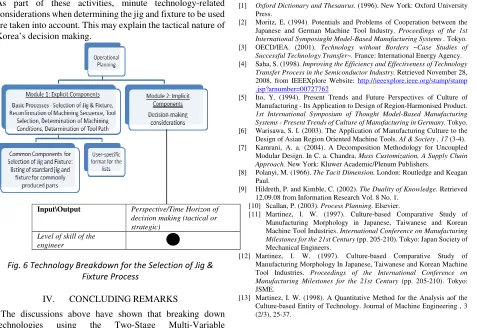
Similar to the results of the Case Study 1, results of Case Study 2 show that the Operational Planning Technology can be modeled by the proposed Two-Stage Multi-Variable Technology Breakdown Model. Figure 6 presents a sample illustration for the basic process of Selection of jig and fixture.
To illustrate, the Selection of jig and fixture can be taken as an example. Like the basic processes of the Process Planning technology, the Selection of jig and fixture may be decomposed into its explicit components and implicit components. Furthermore, the explicit components can be classified into common and user-specific. A common component is the listing of standard jig and fixture for commonly produced parts. On the other hand, an implicit component is decision-making which can be short-term
Technical considera tion
Top consideration during decision-making
\Output Input
Fixing method
Quality of raw material
Production speed
Production cost
Cost of raw mate rial Labor cost
Outsourcing
Experience of engineer
Input\Output Method for computing standard
time
Use of CAPP for determining standard times Mentality on penalty
for late delivery Availability of and
(tactical) or long-term (strategic). Take for example the case of comparing Japanese, Taiwanese and Korean machine tool manufacturers. Decision-making when selecting jig and fixture tends to be tactical for Korea. This may be attributed to the level of skill of the Korean engineer relative to Japanese and Taiwanese engineers. Although production equipment may be the same between Korean and Japanese manufacturers, the production of part drawings in Korea is a problem. The high volume-low variety production in Korea suggests that the ability to produce many variants of machine tools is not very high. Actually, the root cause of this is the problem of finding part designers. In Korea, there is an ample supply of electrical engineers but machinists and mechanical engineers are not that many. Furthermore, the companies that were interviewed said that another problem is that the basic training of mechanical engineers relies heavily on the training given by the university alone. Training in the university is very much different from the actual machining activities in companies. Thus, problems arise during actual work. From the interviews, it was found that for some time before the beginning of the 1990s, the Korean machine tool industry engaged in technological cooperation or tie-ups with foreign manufacturers. These were primarily Japanese. The usual objective of these cooperation activities was to improve the skill of Korean engineers in part drawings. During the 1990s, Korea further realized that the ability to produce part drawings is vital to produce different kinds of machine tools. Thus, some manufacturers instituted the related training curricula within their companies.
[image:7.612.74.551.404.732.2]Korean machine tool manufacturers are now producing part drawings on their own. Relative to Japan and Taiwan, Korea started quite late but is continuing its improvement activities. As part of these activities, minute technology-related considerations when determining the jig and fixture to be used are taken into account. This may explain the tactical nature of Korea’s decision making.
Fig. 6 Technology Breakdown for the Selection of Jig & Fixture Process
IV. CONCLUDINGREMARKS
The discussions above have shown that breaking down technologies using the Two-Stage Multi-Variable
Technology Breakdown Model will clarify the presentation of the technology by the transferor. Hopefully, this clearer presentation will lead to better understanding, better absorption and better retention of the technology by the transferee.
The case studies that have been conducted on Process Planning and Operational Planning Technologies have shown the effectiveness of the proposed Two-Stage Multi-Variable Technology Breakdown Model in terms of representing and analyzing a technology. Indeed, it seems that the hypothesis of this research that technology has common and user-specific components is valid. Furthermore, it appears that these common and user-specific components may be clarified by classifying the components into explicit or implicit beforehand. Aside from this, it has been noted that it is the explicit components that must be clarified as to whether they are to be in the common form or user-specific form that will make technology transfer to have better fit with the needs and capabilities of the transferee. Transferees may be able to learn more and retain more when they are comfortable with the technology. Thus, this may result in effective technology transfer.
This research has found also that the implicit components may be characterized to some level such as by specifying the inputs that may lead the technology to different outputs. This finding can be an improvement to the unsystematic description of technology that has led advanced countries to conduct technology transfers mostly on trial-and-error basis. This improvement may lead to more efficient technology transfer.
REFERENCES
[1] Oxford Dictionary and Thesaurus. (1996). New York: Oxford University Press.
[2] Moritz, E. (1994). Potentials and Problems of Cooperation between the Japanese and German Machine Tool Industry. Proceedings of the 1st International Symposiught Model-Based Manufacturing Systems . Tokyo. [3] OECD/IEA. (2001). Technology without Borders ~Case Studies of Successful Technology Transfer~. France: International Energy Agency. [4] Saha, S. (1998). Improving the Efficiency and Effectiveness of Technology
Transfer Process in the Semiconductor Industry. Retrieved November 28, 2008, from IEEEXplore Website: http://ieeexplore.ieee.org/stamp/stamp .jsp?arnumber=00727762
[5] Ito, Y. (1994). Present Trends and Future Perspectives of Culture of Manufacturing - Its Application to Design of Region-Harmonised Product. 1st International Symposium of Thought Model-Based Manufacturing Systems - Present Trends of Culture of Manufacturing in Germany. Tokyo. [6] Warisawa, S. I. (2003). The Application of Manufacturing Culture to the Design of Asian Region Oriented Machine Tools. AI & Society, 17 (3-4). [7] Kamrani, A. a. (2004). A Decomposition Methodology for Uncoupled
Modular Design. In C. a. Chandra, Mass Customization, A Supply Chain
Approach. New York: Kluwer Academic/Plenum Publishers.
[8] Polanyi, M. (1966). The Tacit Dimension. London: Routledge and Keagan Paul.
[9] Hildreth, P. and Kimble, C. (2002). The Duality of Knowledge. Retrieved 12.09.08 from Information Research Vol. 8 No. 1.
[10] Scallan, P. (2003). Process Planning. Elsevier.
[11] Martinez, I. W. (1997). Culture-based Comparative Study of Manufacturing Morphology in Japanese, Taiwanese and Korean Machine Tool Industries. International Conference on Manufacturing Milestones for the 21st Century (pp. 205-210). Tokyo: Japan Society of Mechanical Engineers.
[12] Martinez, I. W. (1997). Culture-based Comparative Study of Manufacturing Morphology In Japanese, Taiwanese and Korean Machine Tool Industries. Proceedings of the International Conference on Manufacturing Milestones for the 21st Century (pp. 205-210). Tokyo: JSME.
[13] Martinez, I. W. (1998). A Quantitative Method for the Analysis aof the Culture-based Entity of Technology. Journal of Machine Engineering , 3 (2/3), 25-37.
Input\Output Perspective/Time Horizon of decision making (tactical or strategic)