Exploiting Reducibility in Unsupervised Dependency Parsing
David Mareˇcek and Zdenˇek ˇZabokrtsk´y
Charles University in Prague, Faculty of Mathematics and Physics Institute of Formal and Applied Linguistics
Malostransk´e n´amˇest´ı 25, 11800 Prague, Czech Republic {marecek,zabokrtsky}@ufal.mff.cuni.cz
Abstract
The possibility of deleting a word from a sen-tence without violating its syntactic correct-ness belongs to traditionally known manifes-tations of syntactic dependency. We introduce a novel unsupervised parsing approach that is based on a new n-gram reducibility measure. We perform experiments across 18 languages available in CoNLL data and we show that our approach achieves better accuracy for the majority of the languages then previously re-ported results.
1 Introduction
The true nature of the notion of dependency (af-ter removing sedimentary deposits of rules imposed only by more or less arbitrary conventions) remains still somewhat vague and elusive. This holds in spite of a seemingly strong background intuition and even after a decade of formalized large-scale dependency-based resources being available to the research com-munity. It is undeniable that a huge progress has been reached in the field of supervised dependency parsing, especially due to the CoNLL shared task se-ries. However, when it comes to unsupervised pars-ing, there are surprisingly few clues we could rely on.
As mentioned e.g. by K¨ubler et al. (2009), one of the traditional linguistic criteria for recognizing de-pendency relations (including their head-dependent orientation) is that a headHof a constructionC de-termines the syntactic category ofC and can often replaceC. Or, in words of Dependency Analysis by
Reduction (Lopatkov´a et al., 2005), stepwise dele-tion of dependent elements within a sentence pre-serves its syntactic correctness. A similar idea of dependency analysis by splitting a sentence into all possible acceptable fragments is used by Gerdes and Kahane (2011).
Of course, all the above works had to respond to the notorious fact that there are many language phe-nomena precluding the ideal (word by word) sen-tence reducibility (e.g. in the case of prepositional groups, or in the case of subjects in English finite clauses). However, we disregard their solutions ten-tatively and borrow only the very core of the re-ducibility idea: if a word can be removed from a sentence without damaging it, then it is likely to be dependent on some other (still present) word.
As it is usual with dichotomies in natural lan-guages, it seems more adequate to use a continuous scale instead of the reducible-irreducible opposition. That is why we introduce a simple reducibility mea-sure based on n-gram corpus statistics. We employ this reducibility measure as the main feature in our unsupervised parsing procedure.
The procedure is based on a commonly used Bayesian inference technique called Gibbs sampling (Gilks et al., 1996). In our sampler, the more re-ducible a given token is, the more likely it is to be sampled as a dependant and not as a head. Af-ter certain number of sampling iAf-terations, for each sentence a final dependency tree is created (one to-ken per node, including punctuation) that maximizes the product of edge probabilities gathered along the sampling history.
Our approach allows to utilize information from
very large corpora. While the computationally de-manding sampling procedure can be applied only on limited data, the unrepeated precomputation of statistics for reducibility estimates can easily exploit much larger data.
We are not aware of any other published work on unsupervised parsing employing reducibility or a similar idea. Dominating approaches in unsuper-vised parsing are typically based on repeated pat-terns, and not on the possibility of a deletion inside a pattern. It seems that the two views of depen-dency (frequent co-occurrence of head-dependant pair, versus reducibility of the dependant) are rather complementary, so fruitful combinations can be hopefully expected in future.
The remainder of this paper is structured as fol-lows. Section 2 briefly outlines the state of the art in unsupervised dependency parsing. Our measure of reducibility based on a large monolingual corpus is presented in Section 3. Section 4 shows our models which serve for generating probability estimates for edge sampling described in Section 5. Experimen-tal parsing results for languages included in CoNLL shared task treebanks are summarized in Section 6. Section 7 concludes this article.
2 Related Work
The most popular approach in unsupervised de-pendency parsing of the recent years is to employ Dependency Model with Valence (DMV), which was introduced by Klein and Manning (2004). The inference algorithm was further improved by Smith (2007) and Cohen et al. (2008). Headden, Johnson and McClosky (2009) introduced the Ex-tended Valence Grammar (EVG) and added lexical-ization and smoothing. Blunsom and Cohn (2010) use tree substitution grammars, which allow learn-ing larger dependency fragments.
Unfortunately, many of these works show results only for English.1 However, the main feature of unsupervised methods should be their applicabil-ity across a wide range of languages. Such exper-iments were done by Spitkovsky (2011b; 2011c), where the parsing algorithm was evaluated on all 19 languages included in CoNLL 2006 (Buchholz and
1The state-of-the-art unsupervised parsers achieve more than 50% of attachment score measured on the Penn Treebank.
Marsi, 2006) and 2007 (Nivre et al., 2007) shared tasks.
The fully unsupervised linguistic analysis (Spitkovsky et al., 2011a) shows that the unsuper-vised part-of-speech tags may be more useful for this task than the supervised ones.
Another possibility for obtaining dependency structures for languages without any linguistically annotated resources can be the projection using a parallel treebank with a resource-rich language (typ-ically English). McDonald et al. (2011) showed that such projection produce better structures than the current unsupervised parsers do. However, our task is different. We would like to produce structures that are not burdened by any linguistic conventions.
In this paper, we describe a novel approach to un-supervised dependency parsing. Our model differs from DMV, since we employ thereducibilityfeature and usefertilityof nodes instead of generatingSTOP signs.
We use Gibbs sampling procedure for inference instead of Variational Bayes, which has been more common for induction of linguistic strucures. Gibbs sampling algorithm for grammar induction was used also by Mareˇcek and ˇZabokrtsk´y (2011). However, their sampling algorithm produces generally non-projective trees. Our sampler, which is described in Section 5, introduces a completely different small-change operator that guarantees projective edges.
3 Computing Reducibility scores
We call a word (or a sequence of words) in a sen-tencereducible, if the sentence after removing the word remains grammatically correct. Although we cannot automatically recognize grammaticality of such newly created sentence, we can search for it in a large corpus. If we find it, we assume the word was reducible in the original sentence.
Since the number of such reducible word se-quences found in any corpus will be low, we de-termine the reducibility scores from their individual types (part-of-speech tags). This then implicitly al-lows some sharing of the scores between different word sequences.
neigh-bor), which would lead to lower sparsity, is rational-ized by the following example:
Their children went to school. I took their children to school.
The verb ‘went’would be reducible in the context ‘their children went to school’, because the sequence ‘their children to school’occurs in the second sen-tence. One could find such examples frequently even for large contexts. For instance, verbs in free word-order languages can be placed almost at any posi-tion in a sentence; therefore, without the full sen-tence context, they would have to be considered as reducible. To prevent this, we decided to work ex-clusively with the full sentence context instead of shorter contexts.
Other way that would lead to lower sparsity would be searching for sequences of part-of-speech tags in-stead of sequences of word forms. However, this also does not bring desired results. For instance, the two following sentence patterns
DT NNS VBD IN DT NN . DT NNS VBD DT NN .
are quite frequent in English and we can deduce from them that the preposition IN is reducible. But this is of course a wrong deduction, since the prepo-sition cannot be removed from the prepoprepo-sitional phrase. Using part-of-speech tags instead of word forms is thus not suitable for computing reducibility scores.
Although we search for reducible sequences of word forms in the corpus, we compute reducibil-ity scores for sequences of part-of-speech tags. This requires to have the corpus morphologically disam-biguated. A sequences of part-of-speech tags will be denoted as “PoS n-gram” in the following text.
Assume a PoS n-gram g = [t1, . . . , tn]. We go through the corpus and search for all its occurrences. For each such occurrence, we remove the respec-tive words from the current sentence and check in the corpus whether the rest of the sentence occurs at least once elsewhere in the corpus.2 If so, then such occurrence of PoS n-gram is reducible, otherwise it is not. We denote the number of such reducible
oc-2
We do not take into account sentences with less then 10 words, because they could be nominal (without any verb) and might influence the reducibility scores of verbs.
[image:3.612.315.542.59.223.2]unigrams R bigrams R trigrams R VB 0.04 VBN IN 0.00 IN DT JJ 0.00 TO 0.07 IN DT 0.02 JJ NN IN 0.00 IN 0.11 NN IN 0.04 NN IN NNP 0.00 VBD 0.12 NNS IN 0.05 VBN IN DT 0.00 CC 0.13 JJ NNS 0.07 JJ NN . 0.00 VBZ 0.16 NN . 0.08 DT JJ NN 0.04 NN 0.22 DT NNP 0.09 DT NNP NNP 0.05 VBN 0.24 DT NN 0.09 NNS IN DT 0.14 . 0.32 NN , 0.11 NNP NNP . 0.15 NNS 0.38 DT JJ 0.13 NN IN DT 0.23 DT 0.43 JJ NN 0.14 NNP NNP , 0.46 NNP 0.78 NNP . 0.15 IN DT NNP 0.55 JJ 0.84 NN NN 0.22 DT NN IN 0.59 RB 2.07 IN NN 0.67 NNP NNP NNP 0.64 , 3.77 NNP NNP 0.76 IN DT NN 0.80 CD 55.6 IN NNP 1.81 IN NNP NNP 4.27
Table 1: Reducibility scores of the most frequent English n-grams. (V*are verbs,N*are nouns,DET are determiners, IN are prepositions, JJ are adjec-tives,RBare adverbs,CDare numerals, andCCare coordinating conjunctions)
currences of PoS n-gramgbyr(g). The number of all its occurrences isc(g).
The relative reducibilityR(g)of a PoS n-gramg is then computed as
R(g) = 1
N
r(g) +σ1
c(g) +σ2
, (1)
where the normalization constant N, which ex-presses relative reducibility over all the PoS n-grams (denoted byG), causes the scores are concentrated around the value 1.
N =
P
g∈G(r(g) +σ1)
P
g∈G(c(g) +σ2)
(2)
Smoothing constants σ1 andσ2, which prevent re-ducibility scores from being equal to zero, are set to
σ1=
P
g∈Gr(g) P
g∈Gc(g)
, σ2 = 1 (3)
This setting causes that even if a given PoS n-gram is not reducible anywhere in the corpus, its reducibility score is1/(c(g) + 1).
unigrams R bigrams R trigrams R VVPP 0.00 NN APPR 0.00 NN APPR NN 0.01 APPR 0.27 APPR ART 0.00 ADJANN APPR 0.01 VVFIN 0.28 ART ADJA 0.00 APPR ART ADJA 0.01 APPRART0.32 NN VVPP 0.00 NN KON NN 0.01 VAFIN 0.37 NN $( 0.01 ADJANN $. 0.01 KON 0.37 NN NN 0.01 NN ART NN 0.32 NN 0.43 NN ART 0.21 ART NN ART 0.49 ART 0.49 ADJANN 0.28 NN ART ADJA 0.90 $( 0.57 NN $, 0.67 ADJA NN ART 0.95 $. 1.01 NN VAFIN 0.85 NN APPR ART 0.95 NE 1.14 NN VVFIN 0.89 NN VVPP$. 1.01 CARD 1.38 NN $. 0.95 ART NN APPR 1.35 ADJA 2.38 ART NN 1.07 ART ADJA NN 1.58 $, 2.94 NN KON 2.41 APPR ART NN 2.60 ADJD 3.54 APPR NN 2.65 APPR ADJANN 2.65 ADV 7.69 APPRARTNN 3.06 ART NN VVFIN 9.51
Table 2: Reducibility scores of the most frequent German n-grams. (V*are verbs,N*are nouns,ART are articles,APPR* are prepositions, ADJ* are ad-jectives,ADVare adverbs,CARDare numerals, and KONare conjunctions)
and adverbs are very high for all three examined lan-guages. That is desired, because the reducible uni-grams will more likely become leaves in dependency trees. Considering bigrams, the couples [determiner –noun], [adjective–noun], and [preposition–noun] obtained reasonably high scores. However, there are also n-grams such as the German trigram [de-terminer – noun – preposition] (ART-NN-APPR) whose reducibility score is undesirably high.3
4 Models
We introduce a new generative model that is dif-ferent from the widely used Dependency Model with Valence (DMV). In DMV (Klein and Manning, 2004) and in the extended model EVG (Headden III et al., 2009), there is aSTOPsign indicating that no more dependents in a given direction will be gener-ated. Given a certain head, all its dependents in left direction are generated first, then theSTOPsign in that direction, then all its right dependents and then STOPin the other direction. This process continues recursively for all generated dependents.
Our model introduces fertility of a node, which substitutes theSTOPsign. For a given head, we first generate the number of its left and right children
3
The high reducibility score of ART-NN-APPR was proba-bly caused by German particles, which have the same PoS tag as prepositions.
unigrams R bigrams R trigrams R P4 0.00 RR AA 0.00 RR NN Z: 0.00 RV 0.00 Z: J, 0.00 NN RR AA 0.00 Vp 0.06 Vp NN 0.00 NN AA NN 0.16 Vf 0.06 VB NN 0.12 AA NN RR 0.23 P7 0.16 NN Vp 0.13 NN RR NN 0.46 J, 0.24 NN VB 0.18 NN Jˆ NN 0.46 RR 0.28 NN RR 0.22 AA NN NN 0.47 VB 0.33 NN AA 0.23 NN Z: Z: 0.48 NN 0.72 NN Jˆ 0.62 NN Z: NN 0.52 Jˆ 1.72 AA NN 0.62 NN NN NN 0.70 C= 1.85 NN NN 0.70 AA AA NN 0.72 PD 2.06 NN Z: 0.97 AA NN Z: 0.86 AA 2.22 Z: NN 1.72 NN NN Z: 1.38 Dg 3.21 Z: Z: 1.97 RR NN NN 2.26 Z: 4.01 Jˆ NN 2.05 RR AA NN 2.65 Db 4.62 RR NN 2.20 Z: NN Z: 8.32
Table 3: Reducibility scores of the most frequent Czech n-grams. (V*are verbs,N*are nouns,P*are pronouns,R*are prepositions,A*are adjectives,D* are adverbs, C*are numerals, J* are conjunctions, andZ*is punctuation)
(fertility model) and then we fill these positions by generating its individual dependents (edge model). If a zero fertility is generated in both the directions, the head becomes a leaf.
Besides the fertility model and the edge model, we use two more models (subtree model and dis-tance model), which force the generated trees to have more desired shape.4
4.1 Fertility Model
We express a fertility of a node by a pair of bers: the number of its left dependents and the num-ber of its right dependents. For example, fertility “1-3” means that the node has one left and three right dependents, fertility “0-0” indicates that it is a leaf. Fertility is conditioned by part-of-speech tag of the node and it is computed following the Chi-nese restaurant process. This means that if a specific fertility has been frequent for a given PoS tag in the past, it is more likely to be generated again. The formula for computing probability of fertilityfiof a word on the positioniin the corpus is as follows:
Pf(fi|ti) = c
−i(“ti, fi”) +αP
0(fi)
c−i(“ti”) +α , (4)
4
[image:4.612.297.538.59.224.2]wheretiis part-of-speech tag of the word on the po-sition i, c−i(“t
i, fi”)stands for the count of words with PoS tag ti and fertility fi in the history, and P0is a prior probability for the given fertility which depends on the total number of node dependents de-noted by|fi|(the sum of numbers of left and right dependents):
P0(fi) =
1
2|fi|+1 (5)
This prior probability has a nice property: for a given number of nodes, the product of fertility prob-abilities over all the nodes is equal for all possible dependency trees. This ensures the stability of this model during the inference.
Besides the basic fertility model, we introduce also an extended fertility model, which uses fre-quency of a given word form for generating number of children. We assume that the most frequent words are mostly function words (e.g. determiners, prepo-sitions, auxiliary verbs, conjunctions). Such words tend to have a stable number of children, for exam-ple (i) some function words are exclusively leaves, (ii) prepositions have just one child, and (iii) attach-ment of auxiliary verbs depends on the annotation style, but number of their children is also not very variable. The higher the frequency of a word form, the higher probability mass is concentrated on one specific number of children and the lower Dirichlet hyperparameterαin Equation 4 is needed. The ex-tended fertility is described by equation
Pf0(fi|ti, wi) =
c−i(“ti, fi”) +Fαe(wi)P0(fi)
c−i(“t
i”) + Fαe(wi)
, (6)
whereF(wi) is a frequency of the wordwi, which is computed as a number of wordswi in our corpus divided by number of all words.
4.2 Edge Model
After the fertility (number of left and right depen-dents) is generated, the individual slots are filled us-ing theedge model. A part-of-speech tag of each de-pendent is conditioned by part-of-speech tag of the head and the edge direction (position of the depen-dent related to the head).5
5For the edge model purposes, the PoS tag of the technical root is set to ‘<root>’ and it is in the zero-th position in the
Similarly as for the fertility model, we employ Chinese restaurant process to assign probabilities of individual dependent.
Pe(tj|ti, dj) = c
−i(“t
i, tj, dj”) +β
c−i(“ti, dj”) +β|T|, (7)
where ti and tj are the part-of-speech tags of the head and the generated dependent respectively;djis a direction of edge between the wordsiandj, which can have two values:leftandright. c−i(“ti, tj, dj”) stands for the count of edgesti ←tj with the direc-tiondjin the history,|T|is a number of unique tags in the corpus andβis a Dirichlet hyperparameter.
4.3 Distance Model
Distance model is an auxiliary model that prevents the resulting trees from being too flat. Ideally, it would not be needed, but experiments showed that it helps to infer better trees. This simple model says that shorter edges are more probable than longer ones. We define probability of a distance between a word and its parent as its inverse value,6which is then normalized by the normalization constantd.
Pd(i, j) =
1
d
1
|i−j| γ
(8)
The hyperparameterγ determines the weight of this model.
4.4 Subtree Model
The subtree model uses the reducibility measure. It plays an important role since it forces the reducible words to be leaves and reducible n-grams to be sub-trees. Words with low reducibility are forced to-wards the root of the tree. We definedesc(i) as a sequence of tags[tl, . . . , tr]that corresponds to all the descendants of the wordwiincludingwi, i.e. the whole subtree of wi. The probability of such sub-tree is proportional to its reducibility R(desc(i)). The hyperparameterδdetermines the weight of the model;sis a normalization constant.
Ps(i) =
1
s
R(desc(i))δ (9)
sentence, so the head word of the sentence is always its right dependent.
6
4.5 Probability of the Whole Treebank
We want to maximize the probability of the whole generated treebank, which is computed as follows:
Ptreebank =
n Y
i=1
(Pf0(fi|ti, wi) (10)
Pe(ti|tπ(i), di) (11)
Pd(i, π(i)) (12) Ps(i)), (13)
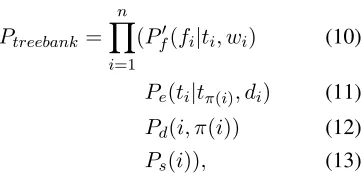
where π(i) denotes the parent of the word on the position i. We multiply the probabilities of fertil-ity, edge, distance from parent, and subtree over all words (nodes) in the corpus. The extended fertility modelPf0 can be substituted by its basic variantPf.
5 Sampling Algorithm
For stochastic searching for the most probable de-pendency trees, we employ Gibbs sampling, a stan-dard Markov Chain Monte Carlo technique (Gilks et al., 1996). In each iteration, we loop over all words in the corpus in a random order and change the de-pendencies in their neighborhood (a small change described in Section 5.2). In the end, “average” trees based on the whole sampling are built.
5.1 Initialization
Before the sampling starts, we initialize the projec-tive trees randomly. For doing so, we tried the fol-lowing two initializers:
• For each sentence, we choose randomly one word as the head and attach all other words to it.
• We are picking one word after another in a ran-dom order and we attach it to the nearest left (or right) neighbor that has not been attached yet. The left-right choice is made by a coin flip. If it is not possible to attach a word to one side, we attach it to the other side. The last unattached word becomes the head of the sentence.
While the first method generates only flat trees, the second one can generate all possible projective trees. However, the sampler converges to similar re-sults for both the initializations. Therefore we con-clude that the choice of the initialization mechanism
The dog was in the park .
[image:6.612.118.299.121.211.2](((The) dog) was (in ((the) park)) (.))
Figure 1: Arrow and bracketing notation of a projec-tive dependency tree.
(((The) dog) was in ((the) park) (.))
(((The) dog) was in ((the) park) (.)) (((The) dog) was in ((the) park) (.)) (((The) dog) was in ((the) park) (.))
(
(
(
)
)
)
(((The) dog) was in ((the) park) (.)) (((The) dog) was in ((the) park) (.))
(
(
)
[image:6.612.341.515.170.255.2])
Figure 2: An example of small change in a projec-tive tree. The bracket (in the park) is removed and there are five possibilities how to replace it.
is not so important here and we choose the first one due to its simplicity.
5.2 Small Change Operator
We use the bracketing notation for illustrating the small change operator. Each projective dependency tree consisting of n words can be expressed by n pairs of brackets. Each bracket pair belongs to one node and delimits its descendants from the rest of the sentence. Furthermore, each bracketed segment contains just one word that is not embedded deeper; this node is the segment head. An example of this notation is in Figure 1.
The small change is then very simple. We remove one pair of brackets and add another, so that the con-ditions defined above are not violated. An example of such change is in Figure 2.
From the perspective of dependency structures, the small change can be described as follows:
1. Pick a random non-root wordw (the word in in our example) and find its parentp(the word was).
2. Find all other children ofw andp (the words dog,park, and.) and denote this set byC. 3. Choose the new head out ofwandp. Mark the
4. Select a neighborhoodDadjacent to the wordd as a continuous subset ofCand attach all words fromDtod.Dmay be also empty.
5. Attach the remaining words from C that were not inDto the new headg.
5.3 Building “Average” Trees
The “burn-in” period is set to 10 iterations. After this period, we begin to count how many times an edge occurs at a particular location in the corpus. These counts are collected over the whole corpus with the collection-rate 0.01.7
When the samling is finished, we build final de-pendency trees based on the edge counts obtained during the sampling. We employ the maximum spanning tree (MST) algorithm (Chu and Liu, 1965) to find them; the weights of edges for computing MST correspond to the number of times they were present during the sampling. This averaging method was used also by Mareˇcek and ˇZabokrtsk´y (2011).
Other possibilities for obtaining final depen-dency trees would be using Eisner’s projective al-gorithm (Eisner, 1996) or using annealing method (favoring more likely changes) at the end of the sam-pling. However, the general non-projective MST al-gorithm enable non-projective edges, which are by no means negligible in treebanks (Havelka, 2007).
6 Experiments and Evaluation
We evaluate our parser on 20 treebanks (18 languages) included in CoNLL shared tasks 2006 (Buchholz and Marsi, 2006) and 2007 (Nivre et al., 2007).
Similarly to some previous papers on unsuper-vised parsing (Gillenwater et al., 2011; Spitkovsky et al., 2011b), the tuning experiments were per-formed on English only. We used English for check-ing functionality of the individual models and for optimizing hyperparameter values. The best config-uration of the parser achieved on English develop-ment data was then used for parsing all other lan-guages. This simulates the situation in which we have only one treebank (English) on which we can tune our parser and we want to parse other languages for which we have no manually annotated treebanks.
7After each small change is made, the edges from the whole corpus are collected with a probability 0.01.
language tokens (mil.) language tokens (mil.)
Arabic 19.7 Greek 20.9
Basque 14.1 Hungarian 26.3
Bulgarian 18.8 Italian 39.7
Catalan 27.0 Japanese 2.6
Czech 20.3 Portuguese 31.7
Danish 15.9 Slovenian 13.7
Dutch 27.1 Spanish 53.4
English 85.0 Swedish 19.2
[image:7.612.316.546.61.198.2]German 56.9 Turkish 16.5
Table 4: Wikipedia texts statistics
6.1 Data
We need two kinds of data for our experiments: a smaller treebank, which is used for sampling and for evaluation, and a large corpus, from which we com-pute n-gram reducibility scores.
The treebanks are taken from the CoNLL shared task 2006 and 2007. The experiments are per-formed for all languages except for Chinese.8 We use only the testing parts of the treebanks (the files
test.conll) for the dependency tree induction. As a source of the part-of-speech tags, we use the fine-grained gold PoS tags, which are in the fifth col-umn in the CoNLL format.
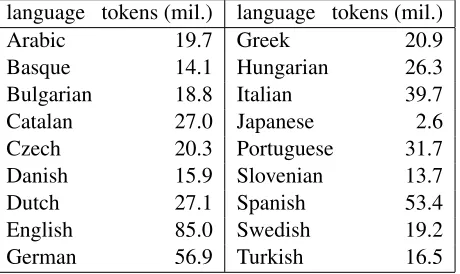
For obtaining reducibility scores, we used the W2C corpus9 of Wikipedia articles, which was downloaded by Majliˇs and ˇZabokrtsk´y (2012). Their statistics across languages are shown in Table 4. To make them useful, the necessary preprocessing steps must have been done. The texts were first automati-cally segmented and tokenized10and then they were part-of-speech tagged by TnT tagger (Brants, 2000), which was trained on the respective CoNLL train-ing data (the filestrain.conll). The quality of such tagging is not very high, since we do not use any lexicons11 or pretrained models. However, it is sufficient for obtaining good reducibility scores.
8We do not have appropriate Chinese segmenter that would segment Chinese texts in the same way as in CoNLL.
9
http://ufal.mff.cuni.cz/˜majlis/w2c/ 10The segmentation to sentences and tokenization was per-formed using the TectoMT framework (Popel and ˇZabokrtsk´y, 2010).
11
6.2 Setting the Hyperparameters
The applicability of individual models and their pa-rameters were tested on development data set of English (the file en/dtest.conll in CoNLL shared task 2007).
After several experiments, we have observed that the extended fertility model provides better results than the basic fertility model; the parser using the basic fertility model achieved 44.1% attachment score for English, whereas the extended fertility model increased the score to 46.8%. The four hy-perparametersαe(extended fertility model),β(edge model), γ (distance model), andδ (subtree model), were set by a grid search algorithm,12 which found the following optimal values:
αe= 0.01, β = 1, γ = 1.5, δ= 1
In informal experiments, parameters were tuned also for other treebanks and we found out that they vary across languages. Therefore, adjusting the hy-perparameters on another language would probably change the scores significantly.
6.3 Evaluation
The best setting from the experiments on English is now used for evaluating our parser on all CoNLL languages. To be able to compare our parser attach-ment score to previously published results, the fol-lowing steps must be done:
• We take the testing part of each treebank (the filetest.conll) and remove all the punctu-ation marks. If the punctupunctu-ation node is not a leaf, its children are attached to the parent of the removed node.
• Some previous papers report results on up-to-10-words sentences only. Therefore we extract such sentences from the test data and evaluate on this subsets as well.
12
Here we make use of manually annotated trees. However, we use only English treebank an we are setting only four num-bers out of several previously given values (e.gαeout of 0.01, 0.1, 1, 10). These numbers could be tuned also by inspecting the outputs. So we believe this method can be treated as unsu-pervised.
CoNLL ≤10 tokens all sentences language year gil11 our spi11 our
Arabic 06 – 40.5 16.6 26.5
Arabic 07 – 48.0 49.5 27.9
Basque 07 – 30.8 24.0 26.8
Bulgarian 06 58.3 53.2 43.9 46.0
Catalan 07 – 63.5 59.8 47.0
Czech 06 53.2 58.9 27.7 49.5
Czech 07 – 63.7 28.4 48.0
Danish 06 45.9 49.5 38.3 38.6
Dutch 06 33.5 48.8 27.8 44.2
English 07 – 64.1 45.2 49.2
German 06 46.7 60.8 30.4 44.8
Greek 07 – 30.2 13.2 20.2
Hungarian 07 – 61.8 34.7 51.8
Italian 07 – 50.5 52.3 43.3
Japanese 06 57.7 65.4 50.2 50.8
Portuguese 06 54.0 62.3 36.7 50.6
Slovenian 06 50.9 21.0 32.2 18.1
Spanish 06 57.9 67.3 50.6 51.9
Swedish 06 45.0 60.5 50.0 48.2
Turkish 07 – 13.0 35.9 15.7
[image:8.612.313.545.71.385.2]Average: 50.3∗ 54.7∗ 37.4 40.0
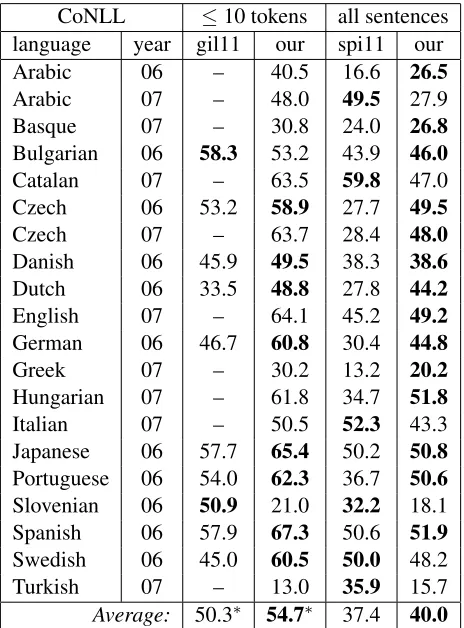
Table 5: Comparison of directed attachment scores with previously reported results on CoNLL tree-banks. The column “gil11” contains results reported by Gillenwater et al (2011) (see the best configura-tion in Table 7 in their paper). They provided only results on sentences of up to 10 tokens from CoNLL 2006 treebanks. Results in the column “spi11” are taken from Spitkovsky et al (2011b), best configu-ration in Table 6 in their paper. The average score in the last line is computed across all comparable results, i.e. for comparison with “gil11” only the CoNLL’06 results are averaged (∗). Our parser was not evaluated on Turkish CoNLL’06 data and Chi-nese data, because we have not them available.
with the highest average attachment score across all the tested languages.
We can see that our parser outperforms the pre-viously published ones. In one case, it is better for 8 out of 10 data sets, in the other case, it is better for 14 out of 20 data sets. The average attachment scores, which are computed only from the results present for both compared parsers, also confirm the improvement.
However, it is important to note that we used an additional source of information, namely large unan-notated corpora for computing reducibility scores, while the others used only the CoNLL data.
6.4 Error Analysis
Our main motivation for developing an unsupervised dependency parser was that we wanted to be able to parse any language. However, the experiments show that our parser fails for some languages. In this section, we try to analyze and explain some of the most substantial types of errors.
Auxiliary verbs in Slovenian – In the Slovenian treebank, many verbs are composed of two words: main verb (marked as Verb-main) and auxiliary verb (Verb-copula). Our parser choose the aux-iliary verb as the head and the main verb and all its dependants become its children. That is why the at-tachment score is so poor (only 18.1%). In fact, the induced structure is not so bad. The main verb is switched with the auxiliary one which causes also the wrong attachment of all its dependants.
Articles in German – Attachment of about one half of German articles is wrong. Instead of the ar-ticle being attached below the appropriate noun, the noun is attached below the article. It is a similar problem as the aforementioned Slovenian auxiliary verbs. The dependency between content and func-tion word is switched and the dependants of the con-tent word are attached to the function word. Klein and Manning (2004) observed a similar behavior in their experiments with DMV.
Noun phrases in English – The structure of phrases that consist of more nouns are often induced badly. This is caused probably by ignoring word forms. For example, the structure of the sequence ‘NN NN NN’ can be hardly recognized by our parser.
fert. edge dist. subtr. en de cs
(random baseline) 19.8 18.4 26.7
X 8.71 13.7 14.9
X 18.9 20.2 26.5
X 23.6 19.5 25.3 X 28.2 23.7 33.5
X X 21.2 22.9 23.5
X X 19.9 19.7 25.5
X X 7.8 17.5 22.7
X X 24.1 19.5 27.1
X X 25.5 27.5 40.7
X X 31.2 25.2 33.1
X X X 30.7 26.2 22.0
X X X 14.1 18.1 34.6
X X X 36.1 32.2 38.9
X X X 34.8 26.7 42.4
[image:9.612.314.540.60.293.2]X X X X 46.8 36.5 47.2
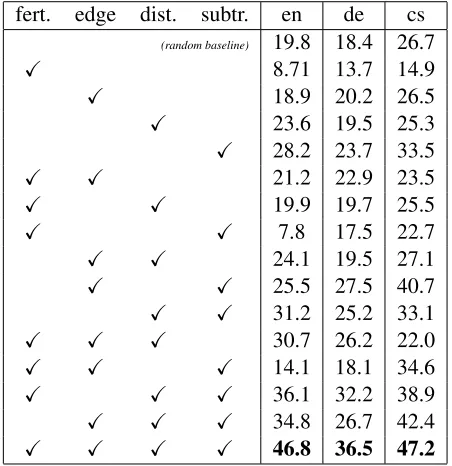
Table 6: Ablation analysis. Unlabeled attachment scores for different combinations of model compo-nents (fertility model, edge model, distance model and subtree model). The scores are computed on all sentences of the development data. Punctuation is included into the evaluation.
6.5 Ablation Analysis
To investigate the impact of individual components of the model, we run the parser for all possible com-ponent combinations. We choose three languages along the scale of word order freedom: English (very rigid word order), Czech (relatively free word order), and German (somewhere in the middle). The attachment scores are shown in Table 6. If no model is used for the inference and the sampling algorithm samples completely random trees, we get the ran-dom baseline score, which is 19.8% for English13. From the perspective of the subtree model, which implements the reducibility feature, we can see that it is the most useful model here. Alone, it improves the score for English to 28.2%. If we do not use it, the score decreases from 46.8% (when all mod-els are used) to 30.7%. Very important is also the distance model which eliminates the possibility of attaching all words to one head word. If we omit
13
it, the score for English falls drastically to 14.1%. Some combinations of models have their scores far below the baseline. This is caused by the fact that some regularities have been found but the structures are induced differently and thus all attachments are wrong.
6.6 Induction without Wikipedia Corpus
We have performed also experiments using exclu-sively the CoNLL data. However, the numbers of reducible words in CoNLL training set were very low (50 words at maximum in CoNLL 2006 train-ing data and 10 words at maximum in CoNLL 2007 training data). This led to completely unreliable re-ducibility scores and the consequent poor results.
7 Conclusions and Future Work
We have shown that employing the reducibility fea-ture is useful in unsupervised dependency parsing task. We extracted the n-gram reducibility scores from a large corpus, and then made the computation-ally demanding inference on smaller data using only these scores. We evaluated our parser on 18 lan-guages included in CoNLL and for 14 of them, we achieved higher attachment scores than previously published results.
The most errors were caused by function words, which sometimes take over the dependents of adja-cent content words. This can be caused by the fact that the reducibility cannot handle function words correctly, because they must be reduced together with a content word, not one after another.
In future work, we would like to estimate the hyperparameters automatically. Furthermore, we would like to get rid of manually designed PoS tags and use some kind of unsupervised clusters in order to have all the annotation process completely unsu-pervised. We would also like to employ lexicalized models that should help in situations in which the PoS tags are too coarse.
Finally, we would like to move towards deeper syntactic structures, where the tree would be formed only by content words and the function words would be treated in a different way.
Software
The source code of our unsupervised dependency parser including the script for computing reducibil-ity scores from large corpora is available at
http://ufal.mff.cuni.cz/˜marecek/udp.
Acknowledgement
This research was supported by the grants GAUK 116310, GA201/09/H057 (Res Infor-matica), LM2010013, MSM0021620838, and by the European Commission’s 7th Framework Program (FP7) under grant agreement n◦ 247762 (FAUST). We thank anonymous reviewers for their valuable comments and suggestions.
References
Phil Blunsom and Trevor Cohn. 2010. Unsupervised induction of tree substitution grammars for depen-dency parsing. InProceedings of the 2010 Conference on Empirical Methods in Natural Language Process-ing, EMNLP ’10, pages 1204–1213, Stroudsburg, PA, USA. Association for Computational Linguistics. Thorsten Brants. 2000. TnT - A Statistical
Part-of-Speech Tagger. Proceedings of the sixth conference on Applied natural language processing, page 8. Sabine Buchholz and Erwin Marsi. 2006.
CoNLL-X shared task on multilingual dependency parsing. In Proceedings of the Tenth Conference on Compu-tational Natural Language Learning, CoNLL-X ’06, pages 149–164, Stroudsburg, PA, USA. Association for Computational Linguistics.
Y. J. Chu and T. H. Liu. 1965. On the Shortest Arbores-cence of a Directed Graph. Science Sinica, 14:1396– 1400.
Shay B. Cohen, Kevin Gimpel, and Noah A. Smith. 2008. Logistic normal priors for unsupervised prob-abilistic grammar induction. In Neural Information Processing Systems, pages 321–328.
Jason Eisner. 1996. Three New Probabilistic Models for Dependency Parsing: An Exploration. In Proceed-ings of the 16th International Conference on Com-putational Linguistics (COLING-96), pages 340–345, Copenhagen, August.
Kim Gerdes and Sylvain Kahane. 2011. Defining depen-dencies (and constituents). InProceedings of Depen-dency Linguistics 2011, Barcelona.
Jennifer Gillenwater, Kuzman Ganchev, Jo˜ao Grac¸a, Fer-nando Pereira, and Ben Taskar. 2011. Posterior Sparsity in Unsupervised Dependency Parsing. The Journal of Machine Learning Research, 12:455–490, February.
Jiˇr´ı Havelka. 2007. Beyond Projectivity: Multilin-gual Evaluation of Constraints and Measures on Non-Projective Structures. InProceedings of the 45th An-nual Meeting of the Association for Computational Linguistics, pages 608–615.
William P. Headden III, Mark Johnson, and David Mc-Closky. 2009. Improving unsupervised dependency parsing with richer contexts and smoothing. In Pro-ceedings of Human Language Technologies: The 2009 Annual Conference of the North American Chap-ter of the Association for Computational Linguistics, NAACL ’09, pages 101–109, Stroudsburg, PA, USA. Association for Computational Linguistics.
Dan Klein and Christopher D. Manning. 2004. Corpus-based induction of syntactic structure: models of de-pendency and constituency. In Proceedings of the 42nd Annual Meeting on Association for Computa-tional Linguistics, ACL ’04, Stroudsburg, PA, USA. Association for Computational Linguistics.
Sandra K¨ubler, Ryan T. McDonald, and Joakim Nivre. 2009. Dependency Parsing. Synthesis Lectures on Human Language Technologies. Morgan & Claypool Publishers.
Mark´eta Lopatkov´a, Martin Pl´atek, and Vladislav Kuboˇn. 2005. Modeling syntax of free word-order languages: Dependency analysis by reduction. In V´aclav Ma-touˇsek, Pavel Mautner, and Tom´aˇs Pavelka, editors,
Lecture Notes in Artificial Intelligence, Proceedings of the 8th International Conference, TSD 2005, volume 3658 of Lecture Notes in Computer Science, pages 140–147, Berlin / Heidelberg. Springer.
Martin Majliˇs and Zdenˇek ˇZabokrtsk´y. 2012. Language richness of the web. InProceedings of the Eight In-ternational Conference on Language Resources and Evaluation (LREC 2012), Istanbul, Turkey, May. Eu-ropean Language Resources Association (ELRA). David Mareˇcek and Zdenˇek ˇZabokrtsk´y. 2011. Gibbs
Sampling with Treeness constraint in Unsupervised Dependency Parsing. InProceedings of RANLP Work-shop on Robust Unsupervised and Semisupervised Methods in Natural Language Processing, pages 1–8, Hissar, Bulgaria.
Ryan McDonald, Slav Petrov, and Keith Hall. 2011. Multi-source transfer of delexicalized dependency parsers. In Proceedings of the 2011 Conference on Empirical Methods in Natural Language Processing, pages 62–72, Edinburgh, Scotland, UK., July. Associ-ation for ComputAssoci-ational Linguistics.
Joakim Nivre, Johan Hall, Sandra K¨ubler, Ryan McDon-ald, Jens Nilsson, Sebastian Riedel, and Deniz Yuret. 2007. The CoNLL 2007 Shared Task on Depen-dency Parsing. InProceedings of the CoNLL Shared Task Session of EMNLP-CoNLL 2007, pages 915–932, Prague, Czech Republic, June. Association for Com-putational Linguistics.
Martin Popel and Zdenˇek ˇZabokrtsk´y. 2010. TectoMT: modular NLP framework. InProceedings of the 7th international conference on Advances in natural lan-guage processing, IceTAL’10, pages 293–304, Berlin, Heidelberg. Springer-Verlag.
Noah Ashton Smith. 2007. Novel estimation methods for unsupervised discovery of latent structure in natu-ral language text. Ph.D. thesis, Baltimore, MD, USA. AAI3240799.
Valentin I. Spitkovsky, Hiyan Alshawi, Angel X. Chang, and Daniel Jurafsky. 2011a. Unsupervised depen-dency parsing without gold part-of-speech tags. In
Proceedings of the 2011 Conference on Empirical Methods in Natural Language Processing (EMNLP 2011).
Valentin I. Spitkovsky, Hiyan Alshawi, and Daniel Juraf-sky. 2011b. Lateen EM: Unsupervised training with multiple objectives, applied to dependency grammar induction. InProceedings of the 2011 Conference on Empirical Methods in Natural Language Processing (EMNLP 2011).