Cross-caption coreference resolution for automatic image understanding
Micah Hodosh Peter Young Cyrus Rashtchian Julia Hockenmaier
Department of Computer Science University of Illinois at Urbana-Champaign
{mhodosh2, pyoung2, crashtc2, juliahmr}@illinois.edu
Abstract
Recent work in computer vision has aimed to associate image regions with keywords describing the depicted entities, but ac-tual image ‘understanding’ would also re-quire identifying their attributes, relations and activities. Since this information can-not be conveyed by simple keywords, we have collected a corpus of “action” photos each associated with five descriptive cap-tions. In order to obtain a consistent se-mantic representation for each image, we need to first identify which NPs refer to the same entities. We present three hierar-chical Bayesian models for cross-caption coreference resolution. We have also cre-ated a simple ontology of entity classes that appear in images and evaluate how well these can be recovered.
1 Introduction
Many photos capture a moment in time, telling a brief story of people, animals and objects, their at-tributes, and their relationship to each other. Al-though different people may give different inter-pretations to the same picture, people can read-ily interpret photos and describe the entities and events they perceive in complex sentences. This level of image understanding still remains an elu-sive goal for computer vision: although current methods may be able to identify the overall scene (Quattoni and Torralba, 2009) or some specific classes of entities (Felzenszwalb et al., 2008), they are only starting to be able to identify attributes of entities (Farhadi et al., 2009), and are far from recovering a complete semantic interpretation of the depicted situation. Like natural language pro-cessing, computer vision requires suitable training data, and there are currently no publicly available data sets that would enable the development of such systems.
Photo sharing sites such as Flickr allow users to annotate images with keywords and other de-scriptions, and vision researchers have access to large collections of images annotated with key-words (e.g. the Corel collection). A lot of recent work in computer vision has been aimed at pre-dicting these keywords (Blei et al., 2003; Barnard et al., 2003; Feng and Lapata, 2008; Deschacht and Moens, 2007; Jeon et al., 2003). But key-words alone are not expressive enough to capture relations between entities. Some research has used the text that surrounds an image in a news arti-cle as a proxy (Feng and Lapata, 2008; Deschacht and Moens, 2007). However, in many cases, the surrounding text or a user-provided caption does not simply describe what is depicted in the image (since this is usually obvious to the human reader for which this text is intended), but provides ad-ditional information. We have collected a corpus of 8108 images associated with several simple de-scriptive captions. In contrast to the text near an image on the web, the captions in our corpus pro-vide direct, if partial and slightly noisy, descrip-tions of the image content. Our data set differs from paraphrase corpora (Barzilay and McKeown, 2001; Dolan et al., 2004) in that the different cap-tions of an image are produced independently by different writers. There are many ways of describ-ing the same image, because it is often possible to focus on different aspects of the depicted situ-ation, and because certain aspects of the situation may be unclear to the human viewer.
One of our goals is to use these captions to obtain a semantic representation of each image that is consistent with all of its captions. In or-der to obtain such a representation, it is neces-sary to identify the entities that appear in the im-age, and to perform cross-caption coreference res-olution, i.e. to identify all mentions of the same entity in the five captions associated with an im-age. In this paper, we compare different
A golden retriever (ANIMAL) is playing with a smaller black and brown dog(ANIMAL) in a pink collar (CLOTHING).
A smaller black dog (ANIMAL) is fighting with a larger brown dog (ANIMAL) in a forest (NAT_BACKGROUND).
A smaller black and brown dog (ANIMAL) is jumping on a large orange dog (ANIMAL).
Brown dog (ANIMAL) with mouth (BODY_PART) open near head(BODY_PART) of black and tan dog (ANIMAL). Two dogs (ANIMAL) playing near the woods (NAT_BACKGROUND).
Figure 1: An image with five captions from our corpus. Coreference chains and ontological classes are indicated in color.
ods of cross-caption coreference resolution on our corpus. In order to facilitate further computer vi-sion research, we have also defined a set of coarse-grained ontological classes that we use to automat-ically categorize the entities in our data set.
2 A corpus of action images and captions
Image collection and sentence annotation We have constructed a corpus consisting of 8108 pho-tographs from Flickr.com, each paired with five one-sentence descriptive captions written by Ama-zon’s Mechanical Turk1workers. We downloaded a few thousand images from each of six selected Flickr groups2. To facilitate future computer vi-sion research on our data, we filtered out images in black-and-white or sepia, as well as images with watermarks, signatures, borders or other obvious editing. Since our collection focuses on images depicting actions, we then filtered out images of scenery, portraits, and mood photography. This was done independently by two members of our group and adjudicated by a third.
We paid Turk workers $0.10 to write one de-scriptive sentence for each of five distinct and ran-domly chosen images that were displayed one at a time. We required a small qualification test that examined the workers’ English grammar and spelling and we restricted the task to U.S. work-ers (see Rashtchian et al. (2010) for more details). Our final corpus contains five sentences for each of our 8108 images, totaling 478,317 word tokens, and an average sentence length of 11.8 words. We first spell-checked3these sentences, and used
OpenNLP4 to POS-tag them. We identified NPs
using OpenNLP’s chunker, followed by a
semi-1
https://www.mturk.com
2
The groups:“strangers!”, “Wild-Child (Kids in Action)”, “Dogs in Action (Read the Rules)”, “Outdoor Activities”, “Action Photography”, “Flickr-Social (two or more people in the photo)”.
3
We used Unix’s aspell to generate possible correc-tions and chose between them based on corpus frequencies.
4http://opennlp.sourceforge.net
automatic procedure to correct for a number of systematic chunking errors that could easily be corrected. We randomly selected 200 images for further manual annotation, to be used as test and development data in our experiments.
Gold standard coreference annotation We
manually annotated NP chunks, ontological
classes, and cross-caption coreference chains for each of the 200 images in our test and development data. Each image was annotated independently by two annotators and adjudicated by a third.5 The development set contains 1604 mentions. On av-erage, each caption has 3.2 mentions, and each im-age has 5.9 coreference chains (distinct entities).
Ontological annotation of entities In order to understand the role entities mentioned in the sen-tences play in the image, we have defined a simple ontology of entity classes (Table 1). We distin-guish entities that constitute the background of an image from those that appear in the foreground. These entities can be animate (people or animals) or inanimate. For inanimate objects, we distin-guish static objects from “movable” objects. We also distinguish man-made from natural objects and backgrounds, since this matters for computer
vision algorithms. We have labeled the entity
mentions in our test and development data with classes from this ontology. Again, two of us an-notated each image’s mentions, and adjudication was performed by a single person. Our ontology is similar to, but smaller than the one proposed by Hollink and Worring (2005) for video retrieval, which in turn is based on Hoogs et al. (2003) and Hunter (2001).
3 Predicting image entities from captions
Figure 1 shows an image from our corpus. Dif-ferent captions use difDif-ferent words to refer to the
5We used MMAX2 (M¨uller and Strube, 2006) both for
Ontological Class Examples
animal dog, horse, cow
background man-made street, pool, carpet
background natural ocean, field, air
body part hair, mouth, arms
clothing shirt, hat, sunglasses
event trick, sunset, game
fixed object man-made furniture, statue, ramp
fixed object natural rock, puddle, bush
image attribute camera, picture, closeup
material man-made paint, frosting
material natural water, snow, dirt
movable man-made ball, toy, bowl
movable natural leaves, snowball
nondepictable something, Batman
orientation front, top, [the] distance
part of edge, side, top, tires
person family, skateboarder
property of shadow, shade, theme
vehicle surfboard, bike, boat
[image:3.595.74.296.60.281.2]writing graffiti, map
Table 1: Our ontology for entities in images.
same entity, or even seemingly contradictory mod-ifiers (“orange” vs. “brown” dog). In order to predict what entities appear in an image from its captions, we need to identify how many entities each sentence describes, and what role these enti-ties play in the image (e.g. person, animal, back-ground). Because we have five sentences asso-ciated with each image, we also need to identify which noun phrases in the different captions of the same image refer to the same entity. Because the captions were generated independently, there are no discourse cues such as anaphora to identify coreference. This creates problems for standard coreference resolution systems trained on regular text. Our data also differs from standard corefer-ence data sets in that entities are rarely referred to by proper nouns.
Our first task is to identify which noun phrases may refer to the same entity. We do this by identi-fying the set of entity types that each NP may refer to. We use WordNet (Fellbaum, 1998) to iden-tify the possible entity types (WordNet synsets) of each head noun. Since the salient entities in each image are likely to be mentioned by more than one caption writer, we then aim to restrict those types to those that may be shared by some head nouns in the other captions of the same image. This gives us an inventory of entity types for each mention, which we use to identify coreferences, restricted by the constraint that all coreferent mentions refer to an entity of the same type.
4 Using WordNet to identify entity types
WordNet (Fellbaum, 1998) provides a rich ontol-ogy of entity types that facilitates our coreference task.6 We use WordNet to obtain a lexicon of pos-sible entity types for each mention (based on their lexical heads, assumed to be the last word with a nominal POS tag7). We first generate a set of can-didate synsets based solely on the lexical heads, and then generate lexicon entries based on rela-tions between the candidates.
WordNet synsets provide us with synonyms, and hypernym/hyponym relations. For each men-tion, we generate a list of candidate synsets. We require that the candidates are one of the first four synsets reported and that their fre-quency is to be at least one-tenth of the most
frequent synset. We limit candidates to ones
with “physical entity#n#1”, “event#n#1”, or “vi-sual property#n#1” as a hypernym, in order to en-sure that the synset describes something that is de-pictable. To avoid word senses that refer to a per-son in a metaphorical fashion, (e.g. pigmeaning
slovenly person or red meaning communist), we
ignore synsets that refer to people if the word has a synset that is an animal or color.8
In general, we would like for mentions to be able to take on more specific word senses. For ex-ample, we would like to be able to identify that
“woman” and “person” may refer to the same
entity, whereas “man” and “woman” typically
would not. However, we also do not want a type inventory that is too large or too fine-grained.
Once the candidate synsets are generated, we consider all pairs of nouns (n1, n2) that occur in
different captions of the same image and exam-ine all corresponding pairs of candidate synsets
(s1, s2). Ifs2is a synonym or hypernym ofs1, it
is possible that two captions have different words describing the same entity, so we adds1 ands29
to the lexicon ofn1. Addings2ton1’s lexicon
al-lows it to act as an umbrella sense covering other nouns describing the same entity.10 We adds2 to
6
For the prediction of ontological classes, we use our own ontology because WordNet is too fine-grained for this pur-pose.
7
If there are two NP chunks that form a “[NP ... group] of [NP... ]” construction, we only use the second NP chunk.
8
An exception list handles cases (diver, blonde), where the human sense is more likely than the animal or color sense.
9
We don’t adds2if it is “object#n#1” or “clothing#n#1”.
10This is needed when captions use different aspects of
the lexicon ofn2(since ifn1is using the senses1,
thenn2 must be using the senses2) and ifn1
oc-curs at least five times in the corpus, we adds1 to
the lexicon ofn2.
5 A heuristic coreference algorithm
Based on WordNet candidate synsets, we define a heuristic algorithm that finds the optimal entity assignment for the mentions associated with each image. This algorithm is based on the principles driving our generative model described below, and on the observation that salient entities will be men-tioned in many captions and that captions tend to use similar words to describe the same entity.
Simple heuristic algorithm:
1. For each noun, choose the synset that appears in the most number of captions of an image, and break ties by choosing the synset that covers the fewest distinct lemmatized nouns.
2. Group all of the noun phrase chunks that share a synset into a single coreference chain.
6 Bayesian coreference models
Since we cannot afford to manually annotate our entire data set with coreference information, we follow Haghighi and Klein (2007)’s work on un-supervised coreference resolution, and develop a series of generative Bayesian models for our task.
6.1 Model 0: Simple Mixture Model
In our first model, based on Haghighi and Klein’s baseline Dirichlet Process model, each image i
corresponds to the set of observed mentions wi
from across its captions. Image i has a hidden global topic Ti, drawn from a distribution with a GEM prior with hyperparameterγas explained by Teh et al. (2006). In a Dirichlet process, the GEM distribution is an infinite analog of the Dirich-let distribution, allowing for a potentially infinite number of mixture components.P(Ti=t)is pro-portional to γ if tis a new component, or to the number of times t has been drawn before other-wise. Given a topic choice Ti = t, entity type assignments Zj for all mentions wj in image i are in turn drawn from a topic-specific multino-mial θt over all possible entity types E that was drawn from a Dirichlet prior with hyperparameter
β. Similarly, given an entity type Zi = z, each corresponding (observed) head wordwj is drawn
from an entity type-specific multinomialφz over all possible wordsV, drawn from a finite Dirich-let prior with hyperparameterα. The set of all im-ages belonging to the same topic is analogous to an individual document in Haghighi and Klein’s baseline model.11 All headwords of the same en-tity type are assumed to be coreferent, similar to Haghighi and Klein’s model. As described in sec-tion 4, we use WordNet to identify the subset of types that can actually produce the given words. Therefore, similar to the way Andrzejewski and Zhu (2009) handled a priori knowledge of topics, we will define an indicator variable δij that is 1 iff the WordNet information allows word ito be produced from entity setjand0otherwise.
6.1.1 Sampling Model 0
We find arg maxZ,TP(Z,T|X) with Gibbs sam-pling. Here, Z and T are the collection of type and topic assignments, withZ−j =Z− {Zj}and
T−i = T− {Ti}. This style of notation will be extended analogously to other variables. Letne,x represent the number of times wordxis produced from entity e across all topics and let pj be the number of images assigned to topic j. Let mt,e represent the number of times entity type e is generated by topic t. Each iteration consists of two steps: first, each Zi is resampled, fixing T; and then eachTiis resampled based onZ12.
1. SamplingZj:
P(Zj=e|wj∈wi,Z −j
,T) ∝ P(wj|Zj=e)P(Zj=e|Ti)
P(wj=x|Zj=e) ∝
„ n−j e,x+α P
x0n −j e,x0+α
«
δxe
P(Zj=e|Ti=t) =
m−t,ej+β P
e0m −j t,e0+β
2. SamplingTi:
P(Ti=j|w,Z,T−i) ∝ P(Ti=j|T−i)P(Z|Ti=j,T−i)
∝ P(Ti=j|T −i
)Y k∈wi
P(Zk|Ti=j)
= P(Ti=j|T−i) Y
k∈wi m−j,Zi
k+β P
e0m−j,ei0+β
P(Ti=j|T−i) ∝ (
γ, If its a new topic
pj Otherwise
11Since we do not have multiple images of the same
well-known people or places, referred to by their names, we do not perform any cross-image coreference
12Sampling on the exponentiated posterior to find the mode
Caption 1: {x21,1:a golden retriever; x21,2:a smaller black and brown dog; x21,3:a pink collar}
Caption 2: {x21,4:a smaller black dog; x21,5:a larger brown dog; x21,6:a forest}
Caption 3: {x21,7:small black and brown dog; x21,8:a large orange dog}
Caption 4: {x21,9:brown dog; x21,10:mouth; x21,11:head; x21,12:black and tan dog}
Caption 5: {x21,13:two dogs; x21,14:the woods}
DOG
attr:5 DOGattr:3 CLOTHINGattr:2 FORESTattr:8
Image 21:
x21,1 x21,5 x21,8
x21,9
MOUTH
attr:0
...
x21,2x21,4 x21,7 x21,12
x21,3 x21,6
x21,14
[image:5.595.90.513.64.172.2]x21,10 Restaurant 211
Figure 2: Models 1 and 2 as Chinese restaurant franchises: each image topic is a franchise, each image is a restaurant, each entity is a table, each mention is a customer. Model 2 adds attributes (in italics).
6.2 Model 1: Explicit Entities
Model 0 does not have an explicit representation of entities beyond their type and thus cannot dis-tinguish multiple entities of the same type in an image. Although Model 1 also represents men-tions only by their head words (and thus cannot distinguishblack dogfrombrown dog), it creates explicit entities based on the Chinese restaurant franchise interpretation of the hierarchical Dirich-let Process model (Teh et al., 2006). Figure 2 (ig-noring the modifiers / attributes for now) illustrates the Chinese restaurant franchise interpretation of our model. Using this metaphor, there are a se-ries of restaurants (= images), each consisting of a potentially infinite number of tables (= entities), that are frequented by customers (= entity men-tions) who will be seated at the tables. Restau-rants belong to franchises (= image topics). Each table is served one dish (= entity type, e.g. DOG, CLOTHING) shared by all the customers. The head word of a mentionxi,j is generated in the follow-ing manner: customer j enters restaurant i (be-longing to franchise Ti) and sits down at one of the existing tables with probability proportional to the number of other customers there, or sits at a new table with probability proportional to a con-stant. A disheia (DOG) from a potentially infinite
menu is served to each new tablea, with probabil-ity proportional to the total number of tables it is served at in the franchiseTi (or to a constant if it is a new dish). The (observed) head word of the mention xj,i (dog, retriever) is then drawn from the multinomial distribution over words defined by the entity type (DOG) at the table. The menu (set of dishes) available to each restaurant and table is restricted by our lexicon of WordNet synsets for each mention. More formally, each image topic
tdefines a distribution over entities drawn from a global GEM prior with hyperparameterκ.
There-fore, the probability of an entityais proportional to the number of its existing mentions in images of the same topic, or toκ, if it is previoulsy unmen-tioned. The type of each entity,ea, is drawn from a topic-dependent multinomial with global Dirich-let prior. The head words of mentions are gener-ated by their entity type as in Model 0. Mentions assigned to the same entity are considered to be coreferent. Based on the nature of our corpus, we again assume that two words cannot be coreferent within a sentence, restrict the distribution to not allow inter-sentence coreference and renormalize the values accordingly.
6.2.1 Sampling Model 1
There are three parts to our resampling procedure: resampling the entity assignment for each word, resampling the entity type for each entity, and re-sampling the topic of each image. The kth word of imagei, sentencej, will now bewj,ki ;eiais the entity type of entity ain image i; aij,k is the en-tity that wordkof sentencej is produced from in imagei, andZj,ki represents that entity’s type. a
is the set of all current entity assignments and e
are the type assignments for entities.mis now de-fined as the number of entities of a certain type be-ing drawn for an image,nis defined as before and
ci,ais the number of times entityais expressed in imagei. Topics are resampled as in Model 0.
Model 1:
P(eia=e|a,w, Ti=t,e−i,a)∝(m−e
i,a
t,e +β) Q
{wi
j,k=x|aij,k=a}
n−ei,a e,x +α
P y(n
−ei,a
e,y +α) δx,e
P(aij,k=a|a
−(i,j,k0|k0≥k)
,e,T)∝ (
c−i,aj,k0P(wi
j,k|Zj,ki =eia,a
−(i,j,k0|k0≥k))ρi
j,a, ifais not new κP(ei
a|e
−i,a, Ti)P(wi
j,k|Zij,k=eia,a
−(i,j,k0|k0≥k)),o/w
With:
P(wij,k=x|Z i j,k=e,a
−(i,j,k0|k0≥k)
)∝ n
−(i,j,k0|k0≥k)
e,x +α
P y(n
−(i,j,k0|k0≥k)
e,y +α)
δx,e
P(eia=e|e−i,a, Ti=t)∝
m−t,eei,a+β P
e0(m −ei,a
t,e0 +β) Model 2:
P(aij,k=a|a
−(i,j,k0|k0≥k)
,e,T,b)∝ (
c−i,aj,k0P(wi
j,k|Zj,ki =eia,a
−(i,j,k0|k0≥k))ρi
j,aP(dij,k|bia), ifais not new κP(ei
a|e
−i,a, Ti)P(wi
j,k|Zij,k=eia,a
−(i,j,k0|k0≥k))P(bi
a)P(dia|bia),o/w P(bia=b|Dia,b−i,a)∝P(bia=b|b−i,a)Qd∈Di
a
(s−b,di,a+ζ)
P d0(s
−i,a b,d0 +ζ)
Figure 3: Sampling equations for Models 1 and 2
drawn entity type with probability proportionalκ, the probability that the entity type is for an im-age of the given topic (normalized over WordNet’s possible entities for the word), and the probability the drawn type produces the word. ρij,a = 1iff entityaof imageidoes not appear in sentencej
andρij,a = 0otherwise. a−(i,j,k0|k0≥k) represents removing the kth or later words in sentence j of imagei
Entity Type Resampling Fixing the assign-ments, the type of each entity is redrawn based on the distribution in Figure 3. It is proportional to the probability that a certain entity type is in an image of a given topic and, independently for each of the words, the probability that the given word expresses the type. n−e,xei,a is the number of times entity typeeis expressed as wordxnot counting the words attached to the currently entity being re-sampled andm−t,eei,a is the number of times an en-tity of type e appears in an image of topic tnot counting the current entity being resampled. The probability of a given image belonging to a topic is proportional the number of images already in the topic (orγ) followed by the probability that each of the entities in the image were drawn from that topic.
6.3 Model 2: Explicit Entities and Modifiers
Certain entities cannot be distinguished simply by head word alone, such in the example in Figure 2. Model 2 augments Model 1 with the ability to gen-erate modifiers. In addition to an entity type, each entity draws an attribute from a global distribution drawn from a GEM distribution with
hyperparam-eterη. An attribute is a multinomial distribution, on possible modifier words, drawn from a Dirich-let prior with parameterζ. From the attribute, each
modifier word is drawn independently.
There-fore given an attributeband a set of modifiersd:
P(d|b) ∝ Q
d∈d(sd+ζ)where sd is number of times modifierdis produced by attributeb. In ad-dition, the probability of a certain attributebgiven all other assignments is given by:
P(bia=b|b −i,a
)∝ (
η, If its a new attribute
rb, Otherwise
where rb is the number of entities with at-tribute b. As in Model 1, mentions assigned to the same entity are considered coreferent. Con-sider the“smaller black dog”mention in Figure 2. When the mention is being resampled, the at-tribute choice for each table will bias the probabil-ity distribution towards the table whose attribute is more likely to produce“smaller”and“black”. Therefore, the model can now better distinguish the two dogs in the image.
6.3.1 Sampling Model 2
entity a of image i, and s−i,ab,d as the number of times attributeb produces modifierdwithout the current assignment of entityaof imagei.
6.4 Implementation
The topic assignments for each image are initial-ized to correspond to the Flickr groups the images were taken from. Each mention was initialized as its own entity with type and attribute sampled from a uniform distribution.
As our training is unsupervised, each of the models were ran on the entire dataset. For Model
0, after burn-in, 20 samples of Z were taken
spaced 200 iterations apart, while for Model 1 samples were taken spaced 100 apart, and 25 apart for Model 2. The implementation of Model 2 ran too slow to effectively judge when burn in oc-curred, impacting the results.
The values of parameters α, β,γ,κ,η, ζ, and the number of initial attributes were hand-tuned based on the average performance on our anno-tated development subset of 100 images.13
7 Evaluation of coreference resolution
We evaluate each of the generative models and the heuristic coreference algorithm on the annotated test subset of our corpus consisting of 100 images with both the OpenNLP chunking and the gold standard chunking. We report our scores based on the MUC evaluation metric. The results are reported in Table 2 as the average scores across all the samples of two independent runs of each model. We also present results on Model 0 with-out using WordNet where every word can be an expression of one of 200 fake entity sets. The same table also shows the performance of a base-line model and the upper bound on performance imposed by WordNet.
A baseline model: In our baseline model, two noun phrases in captions of the same image are coreferent if they share the same head noun.
Upper bound on performance: Although WordNet synsets provide a good indication of whether two mentions can refer to the same entity or not, they may also be overly restrictive
in other cases. We measure the upper bound
on performance that our reliance on WordNet imposes by finding the best-scoring coreference assignment that is consistent with our lexicon.
13(0.1,0.1,100,0.001875,100,0.0002,20)respectively.
This achieves an F-score of 90.2 on the test data with gold chunks.
Performance increases in each subsequent model. The heuristic beats each of the models, but in some sense it is an extreme version of Model 1. Both it and Model 1 attempt to produce en-tity sets that cover as many captions as possible, while minimizing the number of distinct words in-volved. The heuristic locally forces this case, at the expense of no longer being a generative model.
8 Ontological Class Prediction
As a further step towards understanding the se-mantics of images, we develop a model that labels each entity with one of the ontological classes de-fined in section 2. The immediate difficulty of this task is that our ontology includes not only seman-tic distinctions, but also spatial and visual ones. While it may be easy to tell which words are an-imals and which are people, there is only a fine distinction at the language level whether an object is movable, fixed, or part of the background.14
8.1 Model and Features
We define our task as a classification problem, where each entity must be assigned to one of twenty classes defined by our ontology. We use a Maximum Entropy classifier, implemented in the MALLET toolkit (McCallum, 2002), and define
the following text features:
NP Chunk: We include all the words in the NP chunk, unfiltered.
WordNet Synsets and Hypernyms: The most likely synset is either the first one that appears in WordNet or one of the ones predicted by our coref-erence system. For each of these possibilities, we include all of that synset’s hypernyms.
Syntactic Role: We parsed our captions with the C&C parser (Clark and Curran, 2007), and record whether the word appears as a direct object of a verb, as the object of a preposition, as the subject of the sentence, or as a modifier. If it is a modi-fier, we also add the head word of the phrase being modified.
14For example, we deem bowls and silverware to be
Model OpenNLP chunks Gold chunks
Rec. Prec. F1 Rec. Prec. F1
Baseline 57.3 89.5 69.9 64.1 96.2 77.0
Upper bound 82.1 100 90.2
WN Heuristic 70.6 84.8 77.0 80.4 90.6 85.2
Model 0 w/o WN 79.7 59.8 68.4 85.1 62.7 72.2
Model 0 66.8 83.1 74.1 75.9 90.3 82.5
Model 1 69.6 83.8 76.0 78.0 90.8 83.9
[image:8.595.170.432.62.158.2]Model 2 69.2 84.4 76.1 77.9 91.5 84.1
Table 2: Coreference resolution results (MUC scores; Models 0-2 are averaged over all samples)
8.2 Experiments
We use two baselines. The naive baseline catego-rizes words by selecting the most frequent class of the word. If no instances of the word have oc-curred, it uses the overall most frequent class. The WordNet baseline works by finding the most fre-quent class amongst the most relevant synsets for a word. It calculates the class frequency for each synset by assuming each word has the sense of its first synset and incrementing the frequency of the first synset and its hypernyms. When categorizing a word, it finds the set of closest hypernyms of the word that have a non-zero frequency, and chooses the class with the greatest sum of frequency counts amongst those hypernyms.
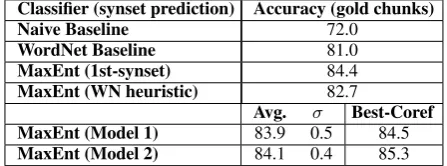
We train the MaxEnt classifier using semi-supervised learning. Initially, we train a classifier using the 500 sentence gold standard development set. For each class, we use the top 5%15of the la-bels to label the unlabeled data and provide addi-tional training data. We then retrain the classifier on the newly labeled examples and the develop-ment set, and run it on the test set. For each coref-erence chain in the test set, we relabel all of the mentions in the chain to use the majority class, if a clear majority exists. If no such majority exists, we leave the labels as is. The MaxEnt classifier experiments were conducted by varying the source of the synset assigned to each word. For each of our coreference systems, we report two scores (Ta-ble 3). The first is the average accuracy when us-ing the output from two runs of each model with about 20 samples per run, and the second uses the output that performs best on the coreference task when scored on the development data.
Discussion Although we use WordNet to clas-sify our entity mentions, we designed our ontology by considering only the images and their captions, with no particular mapping to WordNet in mind.
15This was tuned using 10-fold cross-validation of the
de-velopment set.
Classifier (synset prediction) Accuracy (gold chunks)
Naive Baseline 72.0
WordNet Baseline 81.0
MaxEnt (1st-synset) 84.4
MaxEnt (WN heuristic) 82.7
Avg. σ Best-Coref MaxEnt (Model 1) 83.9 0.5 84.5
MaxEnt (Model 2) 84.1 0.4 85.3
Table 3: Prediction of ontological classes
Therefore, these experiments provide of a proof of concept for the semi-supervised labeling of a cor-pus using any semantic/visual ontology.
Overall, Model 2 had the best performance for this task. This demonstrates that the additional features of Model 2 force synset selections that are consistent across the entire corpus, and are sen-sitive to the modifiers appearing with them. The WordNet heuristic selects synsets in a fairly ar-bitrary manner - all other things being equal, the synsets are chosen without reference to what other synsets are chosen by similar clusters of nouns.
9 Evaluating entity prediction
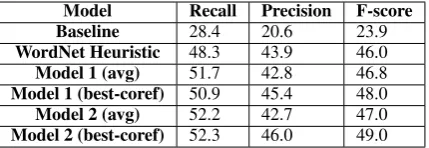
Together, the coreference resolution algorithm and ontology classification model provide us with a set of distinct, ontologically-categorized entities ap-pearing in each image. We perform a final experi-ment to evaluate how well our models can recover the mentioned entities and their ontological types for each image. We now represent each entity as a tuple(L, c), whereLis its coreference chain, and
cis the ontological class of these mentions.16 We compute the precision and recall between the predicted and gold standard tuples for each im-age. We consider a tuple (L0, c0) correctly pre-dicted only when a copy of (L0, c0) occurs both in the set of predicted tuples and the set of gold standard tuples.17 Then, as usual, for precision we
16
Note that for each image, the tuples of all entities corre-spond to a partition of the set of the head-word mentions in an image.
[image:8.595.305.529.197.280.2]Model Recall Precision F-score Baseline 28.4 20.6 23.9
WordNet Heuristic 48.3 43.9 46.0
Model 1 (avg) 51.7 42.8 46.8
Model 1 (best-coref) 50.9 45.4 48.0
Model 2 (avg) 52.2 42.7 47.0
[image:9.595.73.288.62.136.2]Model 2 (best-coref) 52.3 46.0 49.0
Table 4: Overall entity recovery. We measure
how many entities we identify correctly (requiring complete recovery of their coreference chains and correct prediction of their ontological class.
normalize the number of overlapping tuples by the number of predicted tuples, and for recall, by the number of gold standard tuples. We report average precision and recall over all images in our test set. We report scores for four different pairs of on-tological class and coreference chain predictions. As a baseline, we use the ontological classes dicted by the our naive baseline and the chains pre-dicted by the “same-words-are-coreferent” coref-erence resolution baseline.
We also report results using the classes and chains predicted by Model 1, Model 2, and the WordNet Heuristic Algorithm. The influence of the different coreference algorithms comes from the entity types that are used to determine corefer-ence chains, and that also correspond to WordNet candidate synsets. In other words, although the final coreference chain may be predicted by two different models, the synsets they use to do so may differ, affecting the synset and hypernym features used for ontological prediction. We present results in Table 4 for these four different set-ups.
The synsets chosen by the different corefer-ence algorithms clearly have different applicabil-ity when it comes to ontological class prediction. Although Model 2 performs comparably to Model 1 and does worse than the WordNet heuristic al-gorithm for coreference chain prediction, it cer-tainly does better on this task. Since our end goal is creating a unified semantic representation, this final task judges the effectiveness of our models to capture the most detailed entity information. The success of Model 2 means that the incorporation of adjectives informs the proper choice of synsets that are useful in predicting ontological classes.
10 Conclusion
As a first step towards automatic image under-standing, we have collected a corpus of images
as-incomplete coreference chaining both completely change the semantics of an image.
sociated with several simple descriptive captions, which provide more detailed information about the image than simple keywords. We plan to make this data set available for further research in com-puter vision and natural language processing. In order to enable the creation of a semantic repre-sentation of the image content that is consistent with the captions in our data set, we use Word-Net and a series of Bayesian models to perform cross-caption coreference resolution. Similar to Haghighi and Klein (2009), who find that linguis-tic heurislinguis-tics can provide very strong baselines for standard coreference resultion, relatively simple heuristics based on WordNet alone perform sur-prisingly well on our task, although they are out-performed by our Bayesian models for overall en-tity prediction. Since our generative models are based on Dirichlet Process priors, they are de-signed to favor a small number of unique entities per image. In the heuristic algorithm, this bias is built in explicitly, resulting in slightly higher performance on the coreference resolution task. However, while the generative models can use global information to learn what entity type each word is likely to represent, the heuristic is unable to capture any non-local information about the en-tities, and thus provides less useful input for the prediction of ontological classes.
Future work will aim to improve on these re-sults by overcoming the upper bound on perfor-mance imposed by WordNet, and through a more sophisticated model of modifiers. We will also in-vestigate how image features can be incorporated into our model to improve performance on entity detection. Ultimately, identifying the depicted en-tities from multiple image captions will require novel ways to correctly handle the semantics of plural NPs (i.e. that one caption’s“two dogs” con-sist of another’s“golden retreiver”and“smaller black dog”). We foresee similar challenges when dealing with verbs and events.
Acknowledgements
This research was funded by NSF grant IIS 08-03603 INT2-Medium: Understanding the Mean-ing of Images. We are grateful for David Forsyth and Dan Roth’s advice, and for Alex Sorokins sup-port with MTurk.
References
David Andrzejewski and Xiaojin Zhu. 2009. Latent Dirichlet allocation with topic-in-set knowledge. In
NAACL HLT 2009 Workshop on Semi-Supervised Learning for Natural Language Processing, pages 43–48.
Kobus Barnard, Pinar Duygulu, David Forsyth, Nando De Freitas, David M. Blei, and Michael I. Jordan. 2003. Matching words and pictures. Jour-nal of Machine Learning Research, 3:1107–1135.
Regina Barzilay and Kathleen R. McKeown. 2001. Extracting paraphrases from a parallel corpus. In
Proceedings of the 39th annual meeting of the Asso-ciation for Computational Linguistics, pages 50–57, Toulouse, France, July.
David M. Blei, Michael I, David M. Blei, and Michael I. 2003. Modeling annotated data. InProceedings of the 26th International ACM SIGIR Conference, pages 127–134.
Stephen Clark and James R. Curran. 2007. Wide-coverage efficient statistical parsing with CCG and log-linear models. Computational Linguistics, 33(4):493–552.
Koen Deschacht and Marie-Francine Moens. 2007. Text analysis for automatic image annotation. In
Proceedings of the 45th Annual Meeting of the As-sociation of Computational Linguistics.
Bill Dolan, Chris Quirk, and Chris Brockett. 2004. Unsupervised construction of large paraphrase cor-pora: Exploiting massively parallel news sources. In Proceedings of Coling 2004, pages 350–356, Geneva, Switzerland, August. COLING.
A. Farhadi, I. Endres, D. Hoiem, and D. Forsyth. 2009. Describing objects by their attributes. InIEEE Con-ference on Computer Vision and Pattern Recogni-tion, pages 1778–1785, June.
Christiane Fellbaum, editor. 1998. WordNet An Elec-tronic Lexical Database. The MIT Press, Cam-bridge, MA ; London, May.
P. Felzenszwalb, D. McAllester, and D. Ramanan. 2008. A discriminatively trained, multiscale, de-formable part model. InIEEE Conference on Com-puter Vision and Pattern Recognition, pages 1–8, June.
Yansong Feng and Mirella Lapata. 2008. Automatic image annotation using auxiliary text information. In Proceedings of ACL-08: HLT, pages 272–280, Columbus, Ohio, June.
Aria Haghighi and Dan Klein. 2007. Unsupervised coreference resolution in a nonparametric Bayesian model. In Proceedings of the 45th Annual Meet-ing of the Association of Computational LMeet-inguistics, pages 848–855, Prague, Czech Republic.
Aria Haghighi and Dan Klein. 2009. Simple coref-erence resolution with rich syntactic and semantic features. InProceedings of the 2009 Conference on Empirical Methods in Natural Language Process-ing, pages 1152–1161, Singapore, August. Associ-ation for ComputAssoci-ational Linguistics.
L. Hollink and M. Worring. 2005. Building a vi-sual ontology for video retrieval. InMULTIMEDIA ’05: Proceedings of the 13th annual ACM interna-tional conference on Multimedia, pages 479–482, New York, NY, USA. ACM.
A. Hoogs, J. Rittscher, G. Stein, and J. Schmiederer. 2003. Video content annotation using visual anal-ysis and a large semantic knowledgebase. InIEEE Computer Society Conference on Computer Vision and Pattern Recognition, volume 2, pages II–327 – II–334 vol.2, June.
Jane Hunter. 2001. Adding multimedia to the semantic web - building an mpeg-7 ontology. InIn Interna-tional Semantic Web Working Symposium (SWWS, pages 261–281.
Lavrenko Manmatha Jeon, V. Lavrenko, R. Manmatha, and J. Jeon. 2003. A model for learning the seman-tics of pictures. InSeventeenth Annual Conference on Neural Information Processing Systems (NIPS). MIT Press.
Andrew Kachites McCallum. 2002. Mal-let: A machine learning for language toolkit. http://mallet.cs.umass.edu.
Christoph M¨uller and Michael Strube. 2006. Multi-level annotation of linguistic data with MMAX2. In Sabine Braun et al, editor, Corpus Technology and Language Pedagogy, pages 197–214. Peter Lang, Frankfurt a.M., Germany.
Ariadna Quattoni and Antonio B. Torralba. 2009. Recognizing indoor scenes. In IEEE Conference on Computer Vision and Pattern Recognition, pages 413–420. IEEE.
Cyrus Rashtchian, Peter Young, Micah Hodosh, and Julia Hockenmaier. 2010. Collecting image anno-tations using amazons mechanical turk. InNAACL Workshop Creating Speech and Language Data With Amazons Mechanical Turk.