Automatic Selection of High Quality Parses Created By a Fully
Unsupervised Parser
Roi Reichart
ICNC
The Hebrew University
Ari Rappoport
Institute of computer science The Hebrew University
Abstract
The average results obtained by unsupervised statistical parsers have greatly improved in the last few years, but on many specific sentences they are of rather low quality. The output of such parsers is becoming valuable for vari-ous applications, and it is radically less expen-sive to create than manually annotated training data. Hence, automatic selection of high qual-ity parses created by unsupervised parsers is an important problem.
In this paper we presentPUPA, a POS-based
Unsupervised Parse Assessment algorithm.
The algorithm assesses the quality of a parse tree using POS sequence statistics collected from a batch of parsed sentences. We eval-uate the algorithm by using an unsupervised POS tagger and an unsupervised parser, se-lecting high quality parsed sentences from En-glish (WSJ) and German (NEGRA) corpora.
We show that PUPA outperforms the leading
previous parse assessment algorithm for su-pervised parsers, as well as a strong
unsuper-vised baseline. Consequently, PUPA allows
obtaining high quality parses without any hu-man involvement.
1 Introduction
In unsupervised parsing an algorithm should un-cover the syntactic structure of an input sentence without using any manually created structural train-ing data. The last decade has seen significant progress in this field of research (Klein and Man-ning, 2002; Klein and ManMan-ning, 2004; Bod, 2006a; Bod, 2006b; Smith and Eisner, 2006; Seginer, 2007).
Many NLP systems use the output of supervised parsers (e.g., (Kwok et al., 2001) for QA, (Moldovan et al., 2003) for IE, (Punyakanok et al., 2008) for SRL, (Srikumar et al., 2008) for Textual Inference and (Avramidis and Koehn, 2008) for MT). To achieve good performance, these parsers should be trained on large amounts of manually created train-ing data from a domain similar to that of the sen-tences they parse (Lease and Charniak, 2005; Mc-Closky and Charniak, 2008). In the highly variable Web, where many of these systems are used, it is very difficult to create a representative corpus for manual annotation. The high cost of manual annota-tion of training data for supervised parsers imposes a significant burden on their usage.
A possible answer to this problem can be pro-vided by high quality parses produced by unsuper-vised parsers that require little to no manual efforts for their training. These parses can be used either as input for applications, or as training material for modern supervised parsers whose output will in turn be used by applications.
Although unsupervised parser results improve, the quality of many of the parses they produce is still too low for such goals. For example, the Seginer (2007) parser achieves an F-score of 75.9% on the
WSJ10 corpus and 59% on the NEGRA10 corpus, but the percentage of individual sentences with an F-score of 100% is 21.5% for WSJ10 and 11% for
NEGRA10. When requirements are relaxed, only asking for an F-score higher than 85%, percentage is still low, 42% forWSJ10 and 15% forNEGRA10. In this paper we address the task of a fully un-supervised assessment of high quality parses
ated by an unsupervised parser. The assessment should be unsupervised in order to avoid the prob-lems mentioned above with manually trained super-vised parsers. Assessing the quality of a learning al-gorithm’s output and selecting high quality instances has been addressed for supervised algorithms (Caru-ana and Niculescu-Mizil, 2006) and specifically for supervised parsers (Yates et al., 2006; Reichart and Rappoport, 2007; Kawahara and Uchimoto, 2008; Ravi et al., 2008). Moreover, it has been shown to be valuable for supervised parser adaptation be-tween domains (Sagae and Tsujii, 2007; Kawahara and Uchimoto, 2008; Chen et al., 2008). However, as far as we know the present paper is the first to address the task of unsupervised assessment of the quality of parses created by unsupervised parsers.
Our POS-based Unsupervised Parse Assessment (PUPA) algorithm uses statistics about POS tag
se-quences in a batch of parsed sentences1. The con-stituents in the batch are represented using the POS sequences of their yield and of the yields of neigh-boring constituents. Constituents whose representa-tion is frequent in the output of the parser are con-sidered to be of a high quality. A score for each range of constituent length is calculated, reflecting the robustness of statistics used for the creation of the constituents of that length. The final sentence score is a weighted average of the scores calculated for each constituent length. The score thus integrates the quality of short and long constituents into one score reflecting the quality of the whole parse tree.
PUPAprovides a quality score for every sentence in a parsed sentences set. An NLP application can then decide if to use a parse or not, according to its own definition of a high quality parse. For ex-ample, it can select every sentence whose score is above some threshold, or thektop scored sentences. The selection strategy is application dependent and is beyond the scope of this paper.
The unsupervised parser we use is the Seginer (2007) incremental parser2, which achieves
state-of-1The algorithm can be used with supervised POS taggers
and parsers, but we focus here on the fully unsupervised sce-nario, which is novel and more useful. For completeness of analysis, we experimented withPUPAusing a supervised POS tagger (see Section 5). UsingPUPAwith supervised parsers is left for future work.
2www.seggu.net/ccl.
the-art results without using manually created POS tags. The POS tags we use are induced by the un-supervised tagger of (Clark, 2003)3. Since both tag-ger and parser do not require any manual annotation,
PUPAidentifies high quality parses without any hu-man involvement.
The incremental parser of (Seginer, 2007) does not give any prediction of its output quality, and extracting such a prediction from its internal data structures is not straightforward. Such a predic-tion can be given by supervised parsers in terms of the parse likelihood, but this was shown to be of medium quality (Reichart and Rappoport, 2007). While the algorithms of Yates et al. (2006), Kawa-hara and Uchimoto (2008) and Ravi et al. (2008) are supervised (Section 3), the ensemble basedSEPA al-gorithm (Reichart and Rappoport, 2007) can be ap-plied to unsupervised parsers in a way that preserves the unsupervised nature of the selection task.
To compare between two algorithms, we use each of them to assess the quality of the sentences in En-glish and German corpora (WSJ and NEGRA)4. We show that for every sentence length (up to 20) the quality of the top scored k sentences according to
PUPA is higher than the quality of SEPA’s list (for everyk). As in (Reichart and Rappoport, 2007), the quality of a set selected from the parser’s output is evaluated using two measures: constituent F-score5 and average sentence F-score.
Section 2 describes the PUPA algorithm, Sec-tion 3 discusses previous work, and SecSec-tions 4 and 5 present the evaluation setup and results.
2 The POS-based Unsupervised Parse
Assessment (PUPA) Algorithm
In this section we detail our parse assessment algo-rithm. Its input consists of a set I of parsed sen-tences, which in our evaluation scenario are pro-duced by an unsupervised parser. The algorithm assigns each parsed sentence a score reflecting its quality.
3
www.cs.rhul.ac.uk/home/alexc/RHUL/Downloads.html, the neyessenmorph model.
4This is in contrast to algorithms for selection from the
re-sults of supervised constituency parsers, which were evaluated only for English (Yates et al., 2006; Reichart and Rappoport, 2007; Ravi et al., 2008).
The algorithm has three steps. First, the words in I are POS tagged (in our case, using the fully unsu-pervised POS induction algorithm of Clark (2003)). Second, POS statistics about the constituents in I are collected. Finally, a quality score is calculated for each parsed sentence in I using the POS statis-tics. In the following we detail the last two steps.
Collecting POS statistics. In its second step, the
algorithm collects statistics about the constituents in the input setI. Recall that the yield of a constituent is the set of words covered by it. The PUPA con-stituent representation (PCR) consists of three fea-tures: (1) the ordered POS tag sequence of the con-stituent’s yield, (2) the constituents’ right context, and (3) the constituents’ left context.
We define context to be the leftmost and rightmost POS tags in the yield of the neighbor of the con-stituent (if there is only one POS tag in the neigh-bor’s yield, this POS tag is the context). For the right and left contexts we consider the right and left neighbors respectively. A constituentC1is the right
neighbor of a constituentC2ifC1is the highest level
constituent such that the first word in the yield ofC1
comes immediately after the last word in the yield of C2. A constituentC1 is the left neighbor of a
con-stituentC2ifC1is the highest level constituent such
that the first word in the yield ofC2comes
immedi-ately after the last word in the yield ofC1.
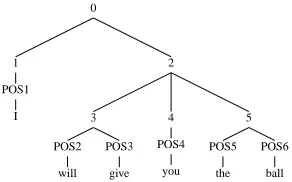
Figure 1 shows an example, an unlabeled tree for the sentence ‘I will give you the ball’. The tree has 6 constituents (C0-C5). C3 and C4 have both right and left neighbors. For C3, the POS sequence of its yield isPOS2, POS3, the left neighbor is C1 and thus the left context isPOS1, and the right neighbor is C4 and thus the right context is POS4. Note that the left and right neighbors of C3 have only one POS tag in their yield and therefore this POS tag is the context. For C4 the yield isPOS4, the left neighbor is C3 (and thus the left context isPOS2,POS3), and the right neighbor is C5 (and thus the right context
isPOS5,POS6). C1, whose yield isPOS1, has only
a right neighbor, C2, and thus its right context is
POS2,POS6and its left context isNULL. C2 and C5
(whose yields arePOS2, POS3, POS4, POS5, POS6for C2 andPOS5, POS6for C5) have only a left neigh-bor. For C2, this is C1 (and the context is POS1) while for C5 this is C4 (with the context POS4).
0
1
POS1
I
2
3
POS2
will POS3
give 4
POS4
you
5
POS5
the POS6
[image:3.612.354.500.54.145.2]ball
Figure 1: An example parse tree for contexts and neigh-bors (see text).
The right context of both constituents isNULL. As all sentence level constituents, C0 has no neighbors, and thus both its left and right contexts areNULL.
We have also explored other representations of left and right contexts based on the POS tags of their yields. In these, we represented the left/right neigh-bor using only the leftmost/rightmost POS tags of its yield or other subsets of the yield’s POS tags. These variations produced lower quality results than the main variant above in our experiments, which were for English and German. Exploring the suit-ability of our representation for other languages is left for future research.
Score computation. The third and last step of the
algorithm is a second pass overI for computing a quality score for each parse tree.
Short constituents tend to be more frequent than long ones. In order not to distort our score due to parsing errors in short constituents,PUPAcomputes the grade using a division into lengths, in three steps. First, constituents are assigned to bins according to their length, each bin containing the constituents of a certain range of lengths. Denote this range by W (for width), and the number of bins by N(W). For example, in our experiments the longest possible constituent is of length 20, so we can takeW = 5, resulting in N(W) = 4: bin 1 for constituents of length 1-5, bin2for constituents of length 6-10, and so on for bins 3, 4.
The score ofbiniis given by
(1)BinScore(bini) =Pt=Xt=2 (X−t+ 2)·| Ci
t|
|Ci|
least t times in the batch of parsed sentences, and |Ci|is the number of constituents in bini. In words, the score is a weighted average: the fraction of the constituents in the bin occuring at least 2 times (with weightX), plus the fraction of the constituents in the bin occuring at least 3 times (with weight X−1), etc, until the fraction of the constituents in the bin occuring at leastXtimes (with weight 2).
A score for the division intoN bins is given by
(2)Score(N(W)) =
PN(W)
i=1 BinScore(bini)
Z·M
WhereZis the maximum bin score (according to (1)) andM is the number of bins containing at least one constituent. If, for example, N(W) = 4 and there is no constituent whose length is between 11 and 15 then bin number 3 is empty. If every other bin contains at least one constituent,M = 3.
To get a final score for the parse tree of sentence S that is independent of a specific bin division, we sum the scores of the various bin division:
(3)P upaScore(S) =
PW=Y
W=1 Score(N(W))
Y
whereY is the length ofS(which is also its max-imum bin width). P upaScore thus takes values in the[0,1]range.
In equation (1), if, for example, X = 20 then the weight of the fraction of the bin’s constituents occurring at least 2 times is 20 while the weight of the fraction of the constituents occurring at least 10 times is 12 and of the fraction of constituents occur-ring at least 20 times is 2. We consider the number of times a constituent appears in a batch to be an in-dication of its correctness. The difference between 3 and 2 occurrences is therefore more indicative than the difference between 20 and 19 occurrences. More generally, the more times a constituent occurs, the less indicative any additional appearance is.
In equation (2) we give all bins the same weight. Short constituents are more frequent and are gener-ally more likely to be correct. However, the cor-rectness of long constituents is an indication that the parser has a correct interpretation of the tree struc-ture and that it is likely to create a high quality tree. The usage of equal bin weights was done to balance the tendency of parse trees to have more short con-stituents.
Parameters. PUPA has two parameters: X, the
maximal number of occurrences considered in equa-tion (1), andP, the number of POS tags induced by the unsupervised POS tagger. In the following we present the unsupervised technique we used to tune these parameters.
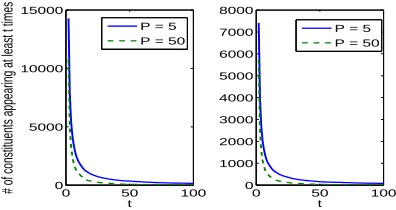
Figure 2 showsnc(t), the number of constituents appearing at least t times in WSJ20 (left) and NE -GRA20 (right). For both corpora, the pattern is shown when using 5 POS tags (P = 5, solid line) and 50 POS tags (P = 50, dashed line). The distri-bution obeys Zipf’s law: many constituents appear a small number of times while a few constituents ap-pear a large number of times. We denote thetvalue where the slope changes from steep to moderate by telbow. Practically, we approximate the ‘real’ elbow
value and definetelbowto be the smallesttfor which
nc(t+ 1)−nc(t) = 1. WhenP = 5,telbow is 32
for WSJ and 19 for NEGRA. When P = 50,telbowis
15 for WSJ and 9 for NEGRA.
The number of constituents appearing more than telbowtimes is considerably smaller than the number
of constituents appearingtelbowtimes or less.
There-fore, the fact that a constituent appears telbow+S
times (for a positive integerS) is not a better indica-tion of its quality than the fact that it appearstelbow
times. We thus selectXto betelbow.
The graphs also demonstrate that for both cor-pora, telbow for P = 50 is smaller than telbow for
P = 5. Generally,telbowis a monotonically
decreas-ing function ofP. Lower telbow values imply that PUPAwould be less distinctive between constituents quality (see equation (1); recall thatX = telbow).
We thus want to select theP value that maximizes telbow. We therefore minimizeP. telbowvalues for
P ∈ {3, . . . ,10} are very similar. Indeed, PUPA
achieves its best performance for P ∈ {3, . . . ,10} and it is insensitive to the selection of P in this range. In Section 5 we report results withP = 5.
3 Related Work
mod-0 50 100 0
5000 10000 15000
t
# of constituents appearing at least t times 00 50 100 1000
2000 3000 4000 5000 6000 7000 8000
t P = 5
P = 50
[image:5.612.79.277.58.163.2]P = 5 P = 50
Figure 2: Number of constituents appearing at least t times (nc(t)) as a function oft. Shown are WSJ (left) and NEGRA (right), where constituents are represented according toPUPA’s PCR with 5 POS tags (P = 5, solid line) or 50 POS tags (P = 50, dashed line).
els (Bod, 2006a; Bod, 2006b), an exemplar based approach (Dennis, 2005), guiding EM using con-trastive estimation (Smith and Eisner, 2006), and the incremental parser of Seginer (2007) that we use in this work. To obtain good results, manually created POS tags are used as input in all of these algorithms except Seginer’s, which uses plain text.
Quality assessment of a learning algorithm’s out-put and selection of high quality instances have been addressed for supervised algorithms (see (Caruana and Niculescu-Mizil, 2006) for a survey) and specif-ically for supervised constituency parsers (Yates et al., 2006; Reichart and Rappoport, 2007; Ravi et al., 2008). For dependency parsing in a corpus adapta-tion scenario, (Kawahara and Uchimoto, 2008) built a binary classifier that classifies each parse in the parser’s output as reliable or not. To do that, they selected 2500 sentences from the parser’s output, compared them to their manually created gold stan-dard, and used accurate (inaccurate) parses as posi-tive (negaposi-tive) examples for the classifier. Their ap-proach is supervised and the features used by the classifier are dependency motivated .
As far as we know, the present paper is the first to address the task of selecting high quality parses from the output of unsupervised parsers. The algorithms of Yates et al. (2006), Kawahara and Uchimoto (2008) and Ravi et al. (2008) are supervised, per-forming semantic analysis of the parse tree and gold standard-based calssification, respectively. How-ever, theSEPAalgorithm of Reichart and Rappoport (2007), an algorithm for supervised constituency parsers, can be applied to unsupervised parsers in
a way that preserves the unsupervised nature of the selection task. In Section 5 we provide a detailed comparison between PUPA and SEPA showing the first to be superior. Below is a brief description of theSEPAalgorithm.
The input of the SEPA algorithm consists of a parsing algorithm A, a training set, and a test set (which in the unsupervised case might be the same set). The algorithm provides, for each of the test set’s parses generated byAwhen trained on the full training set, a grade assessing the parse quality, on a continuous scale between 0 to 100. The qual-ity grade is calculated in the following way:N ran-dom samples of sizeS are sampled from the train-ing data and used for traintrain-ing the parstrain-ing algorithm A. In that way N committee members are created. Then, each of the test sentences is parsed by each of theN committee members and an agreement score ranging from 0 to 100 between the committee mem-bers is calculated. All unsupervised parsers men-tioned above (including the Seginer parser), have a training phase where parameter values are estimated from unlabeled data.SEPAcan thus be applied to the unsupervised case.
Automatic selection of high quality parses has been shown to improve parser adaptation. Sagae and Tsujii (2007) and Kawahara and Uchimoto (2008) applied a self-training protocol to a parser adaptation scenario but used only high quality parses to retrain the parser. In the first work, high quality parses were selected using an ensemble method, while in the sec-ond a binary classifier was used (see above). The first system achieved the highest score in the CoNLL 2007 shared task on domain adaptation of depen-dency parsers, and the second system improved over the basic self-training protocol. Chen et al. (2008) parsed target domain sentences and used short de-pendencies information, which is often accurate, to adapt a dependency parser to the Chinese language. Automatic quality assessment has been exten-sively explored for machine translation (Ueffing and Ney, 2007) and speech recognition (Koo et al., 2001). Other NLP tasks where it has been explored include semi-supervised relation extraction (Rosen-feld and Feldman, 2007), IE (Culotta and McCal-lum, 2004), QA (Chu-Carroll et al., 2003), and dia-log systems (Lin and Weng, 2008).
and (a different definition of) context is used by the CCM unsupervised parsing model (Klein and Man-ning, 2002). As far as we know the current work is the first to use unsupervised POS tags for the selec-tion of high quality parses.
4 Evaluation Setup
We experiment with sentences of up to 20 words from the English WSJ Penn Treebank (WSJ20,
25236 sentences, 225126 constituents) and the Ger-man NEGRA corpus (Brants, 1997) (NEGRA20, 15610 sentences, 108540 constiteunts), both con-taining newspaper texts.
The unsupervised parsers of the kind addressed in this paper output unlabeled parse trees. To eval-uate the quality of a single parse tree with respect to another, we use the unlabeled F-score (U F =
2·U R·U P
U R+U P), whereU R and U P are unlabeled recall
and unlabeled precision respectively.
Following the unsupervised parsing literature, multiple brackets and brackets covering a single word are not counted, but the sentence level bracket is. We exclude punctuation and null elements ac-cording to the scheme of (Klein, 2005).
The performance of unsupervised parsers markedly degrades as sentence length increases. For example, the Average sentence F–score for WSJ sentences of length 10 is 71.4% compared to 58.5 for sentences of length 20 (the numbers for NEGRA are 48.2% and 36.9%). We therefore evaluatePUPA
(and the baseline) for sentences of a given length. We do this for every sentence of length 2-20 in
WSJ20 andNEGRA20.
For every sentence lengthL, we usePUPAand the baseline algorithm (SEPA) to give a quality score to each of the sentences of that length in the experi-mental corpus. We then compare the quality of the topkparsed sentences according to each algorithm. We do this for everykfrom 1 to the number of sen-tences of lengthL.
Following Reichart and Rappoport (2007), we use two measures to evaluate the quality of a set of parses: the constituent score (the traditional F-score used in the parsing literature), and the average F-score of the parses in the set. In the first mea-sure we treat the whole set as a bag of constituents. Each constituent is marked as correct (if it appears
in the gold standard parses of the set) or erroneous (if it does not). Then, recall, precision and F-score are calculated over these constituents. In the sec-ond measure, the constituent F-score of each of the parses in the set is computed, and then results are averaged.
There are applications that use individual con-stituents from the output of a parser while others need the whole parse tree. For example, if the se-lected set is used for training supervised parsers such as the Collins parser (Collins, 1999), which collects constituent statistics, the constituent F-score of the selected set is the important measure. In applica-tions such as the syntax based machine translation model of (Yamada and Knight, 2001), a low qual-ity tree might lead to errorenous translation of the sentence. For such applications the average F-score is more indicative. These measures thus represent complementary aspects of a set quality and we con-sider both of them.
The parser we use is the incremental parser of (Seginer, 2007), POS tags are induced using the un-supervised POS tagger of ((Clark, 2003), neyessen-morph model). In each experiment, the tagger was trained with the raw sentences of the experiment cor-pus, and then the corpus words were POS tagged.
The output of the unsupervised POS tagger de-pends on a random initialization. We ran the tagger 5 times, each time with a different random initializa-tion, and then ranPUPAwith its output. The results
we report forPUPAare the average over these 5 runs. Random selection results (given for reference) were also averages over 5 samples.
PUPA’s parameter estimation is completely unsu-pervised (see Section 2). No development data was used to tune its parameters.
A 200 sentences development set from each cor-pus was used for calibrating the parameters of the
SEPAalgorithm. Based on the analysis ofSEPA per-formance with different assignments of its param-eters given by Reichart and Rappoport (2007) (see Section 3), we ran the SEPA algorithm with sam-ple size (SEPA parameter S) of 30% and 80%, and
with 2 – 10 committee members (N)6. The optimal parameters wereN = 10,S = 80 for WSJ20, and
6
We tried higherNvalues but observed no improvements in
0 200 400 600 70 75 80 85 90 95 100
Number of Sentences
Average F Score
(a) WSJ, length 5
0 500 1000 60 65 70 75 80 85 90
Number of Sentences
Average F Score
(b) WSJ, length 10
0 500 1000 1500 50 55 60 65 70 75 80
Number of Sentences
Average F Score
(c) WSJ, length 15
0 500 1000 1500 2000 48 50 52 54 56 58 60 62 64
Number of Sentences
Average F Score
(d) WSJ, length 20
0 200 400 600 800 50 55 60 65 70 75 80
Number of Sentneces
Average F Score
(e) NEGRA, length5
0 200 400 600 800 1000 40 45 50 55 60 65
Number of Sentences
Average F Score
(f) NEGRA, length 10
0 200 400 600 800 30 35 40 45 50 55 60
Number of Sentences
Average F Score
(g) NEGRA, length 15
0 200 400 600 800 50 55 60 65 70 75 80
Number of Sentneces
Average F Score
(h) NEGRA, length 20
0 500 1000 1500 2000 70 75 80 85 90 95
Number of Constituents
Constituents F Score
(i) WSJ, length 5
0 2000 4000 6000 8000 10000 60 65 70 75 80 85
Number of Constituents
Constituents F Score
(j) WSJ, length 10
0 0.5 1 1.5 2 x 10⁴
55 60 65 70
Number of Constituents
Constituents F Score
(k) WSJ, length 15
0 0.5 1 1.5 2 2.5 x 10⁴
54 56 58 60 62 64
Number of Constituents
Constituents F Score
(l) WSJ, length 20
0 500 1000 1500 2000 2500 3000 62 63 64 65 66 67 68 69
Number of Constituents
Constituents F Score
(m) NEGRA, length5
0 1000 2000 3000 4000 5000 44 46 48 50 52 54 56 58
Number of Constituents
Constituent F Score
(n) NEGRA, length 10
0 2000 4000 6000 8000 40 42 44 46 48 50
Number of Constituents
Constituents F Score
(o) NEGRA, length 15
0 500 1000 1500 2000 2500 3000 62 63 64 65 66 67 68 69
Number of Constituents
Constituents F Score
[image:7.612.80.525.60.470.2](p) NEGRA, length 20
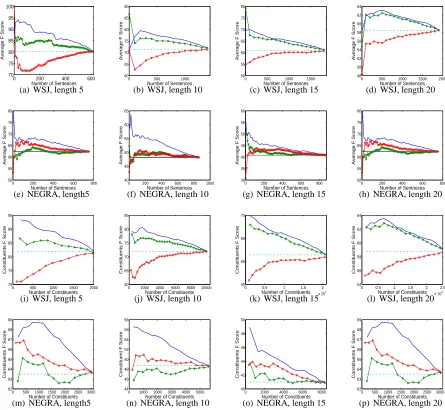
Figure 3: In all graphs: PUPA: solid line. SEPA: line with triangles. MC: line with circles. Random selection is presented for reference as a dotted line. Top two rows: Average F-score forPUPA,SEPAandMCfor sentences from
WSJ (top row) and NEGRA (bottom row). Bottom two rows: Constituents F-score for PUPA, SEPA andMC for
sentences from WSJ (top row) and NEGRA (bottom row). Results are presented for sentence lengths of 5,10,15 and 20 (patterns for other sentence lengths between 2 and 20 are very similar). PUPAis superior in all cases. The graphs forPUPAandSEPAshow a downward trend because parsed sentences were sorted according to score, which correlates positively with F-score (unlikeMC). The graphs converge because on the extreme right all test sentences were selected.
N = 10,S = 30forNEGRA20.
We also comparePUPAto a baseline selecting the
sentences with the lowest number of constituents. Since the number of constituents is an indication of the complexity of the syntactic structure of a sen-tence, it is reasonable to assume that selecting the sentences with the lowest number of constituents is a good selection strategy. We denote this baseline by
MC(for minimum constituents).
The incremental parser does not give any predic-tion of its output quality as supervised generative parsers do. We are thus not able to compare to such a score.
5 Results
of lengths 5,10,15 and 20 inWSJ20 andNEGRA20. The top two rows are for Average F-score (top row: WSJ, bottom row: NEGRA), while the bottom two rows are for Constituents F-score (top row: WSJ, bottom row: NEGRA).
PUPAandSEPAare both better than random
selec-tion for both corpora for every sentence length. The
MCbaseline is better than random selection only for NEGRA (in which case it outperforms SEPA). For
WSJ, however, random selection is a better strategy thanMC.
It is clear from the graphs that PUPAoutperforms SEPA and MC in all experimental conditions. We observed very similar patterns in all other sentence lengths in WSJ20 and NEGRA20 for both Average
F-score and Constituent F-score. In other words, for every sentence length in both corpora,PUPA outper-formsSEPA andMCin terms of both measures. we
present our results per sentence length to deprive the possibility that PUPA is useful only for short sen-tences or that it prefers sensen-tences whose syntactic structure is not complex (i.e. with a small number of constituents, likeMC).
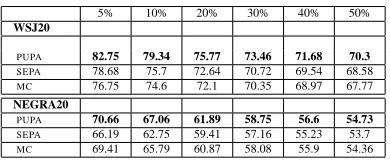
Table 1 shows that the same pattern of results holds when evaluating on the whole corpus (WSJ20 or NEGRA20) without any sentence length restric-tion.
Note that while PUPAis a fully unsupervised al-gorithm,SEPArequires a few hundreds of sentences for its parameters tuning.
The main result of this paper is for sentences whose length is up to 20 words (note that most un-supervised parser literature reports numbers for sen-tences up to length 10). We have also ran the exper-iments for the remaining length range, 20-40. For NEGRA,PUPAis superior overMCup to length 36,
and both are much better thanSEPA. For WSJ,PUPA
andSEPAboth outperformMC, butSEPAis a bit bet-ter thanPUPA. When evaluating on the whole corpus
(i.e. without sentence length restriction, like in Ta-ble 1)PUPAis superior over both SEPAand MCfor
WSJ40 andNEGRA40.
For completeness of analysis we also experi-mented in the condition wherePUPAuses gold stan-dard POS tags as input. The number of these tags is 35 for WSJ and 57 for NEGRA. Interestingly,PUPA
achieves in this condition the same performance as when using the same number of POS tags induced
by an unsupervised POS tagger. Since PUPA’s per-formance for a smaller number of POS tags is better (see our parameter tuning discussion above), the bot-tom line is thatPUPApefers using induced POS tags over gold POS tags.
5% 10% 20% 30% 40% 50%
WSJ20
PUPA 82.75 79.34 75.77 73.46 71.68 70.3 SEPA 78.68 75.7 72.64 70.72 69.54 68.58 MC 76.75 74.6 72.1 70.35 68.97 67.77 NEGRA20
[image:8.612.330.525.130.210.2]PUPA 70.66 67.06 61.89 58.75 56.6 54.73 SEPA 66.19 62.75 59.41 57.16 55.23 53.7 MC 69.41 65.79 60.87 58.08 55.9 54.36
Table 1: Average F–score for the top k% of constituents selected fromWSJ20 (up) andNEGRA20 (down). No sen-tence length restriction is imposed. Results presented for
PUPA , SEPA and MC. Average F–score of random
se-lection is 66.55 (WSJ20) and 47.05 (NEGRA20).PUPAis superior over all methods.
6 Conclusions
We introducedPUPA, an algorithm for unsupervised parse assessment that utilizes POS sequence statis-tics. PUPAis a fully unsupervised algorithm whose parameters can be tuned in an unsupervised man-ner. Experimenting with the Seginer unsupervised parser and Clark’s unsupervised POS tagger on En-glish and German corpora,PUPAwas shown to out-perform both the leading parse assessment algorithm for supervised parsers (SEPA, even when its param-eters are tuned on manually annotated development data) and a strong baseline (MC).
Using PUPA, we extracted high quality parses from the output of a parser which requires raw text as input, using POS tags induced by an unsupervised tagger. PUPAthus provides a way of obtaining high quality parses without any human involvement.
References
Eleftherios Avramidis and Philipp Koehn, 2008. En-riching Morphologically Poor Languages for Statisti-cal Machine Translation. ACL ’08.
Rens Bod, 2006a. An All-Subtrees Approach to Unsu-pervised Parsing. ACL ’06.
Rens Bod, 2006b. Unsupervised Parsing with U-DOP.
CoNLL X.
Thorsten Brants, 1997. The NEGRA Export Format.
CLAUS Report, Saarland University.
Rich Caruana and Alexandru Niculescu-Mizil, 2006. An Empirical Comparison of Supervised Learning Algo-rithms. ICML ’06.
Jennifer Chu-Carroll, Krzysztof Czuba, John Prager and Abraham Ittycheriah, 2003. In Question Answering, Two Heads Are Better Than One. HLT-NAACL ’03. Wenliang Chen, Youzheng Wu and Hitoshi Isahara,
2008. Learning Reliable Information for Dependency Parsing Adaptation. Coling ’08.
Alexander Clark, 2003. Combining Distributional and Morphological Information for Part of Speech Induc-tion. EACL ’03.
Michael Collins, 1999. Head-driven Statistical Models
for Natural Language Parsing. Ph.D. thesis,
Univer-sity of Pennsylvania.
Aron Culotta and Andrew McCallum, 2004. Confidence Estimation for Information Extraction. HLT-NAACL
’04.
Simon Dennis, 2005. An Exemplar-based Approach to Unsupervised Parsing. Proceedings of the 27th
Con-ference of the Cognitive Science Society.
Aria Haghighi and Dan Klein, 2006. Prototype-driven Grammar Induction. ACL ’06.
Daisuke Kawahara and Kiyotaka Uchimoto 2008.
Learning Reliability of Parses for Domain Adaptation of Dependency Parsing. IJCNLP ’08.
Dan Klein and Christopher Manning, 2002. A Gener-ative Constituent-Context Model for Improved Gram-mar Induction. ACL ’02.
Dan Klein and Christopher Manning, 2004. Corpus-based Induction of Syntactic Structure: Models of De-pendency and Constituency. ACL ’04.
Dan Klein, 2005. The Unsupervised Learning of Natural
Language Structure. Ph.D. thesis, Stanford University.
Myoung–Wan Koo, Chin-Hui Lee and Biing–Hwang Juang 2001. Speech Recognition and Utterance Ver-ification Based on a Generalized Confidence Score.
IEEE Transactions on Speech and Audio Processing,
9(8):821–832.
Cody Kwok, Oren Etzioni and Daniel S. Weld, 2001. Scaling Question Answering to the Web. WWW ’01. Matthew Lease and Eugene Charniak, 2005. Towards a
Syntactic Account of Punctuation. IJCNLP ’05.
Feng Lin and Fuliang Weng, 2008. Computing Confi-dence Scores for All Sub Parse Trees. ACL ’08, short
paper.
David McClosky and Eugene Charniak, 2008.
Self-Training for Biomedical Parsing. ACL ’08, short
pa-per.
Dan Moldovan, Christine Clark, Sanda Harabagiu and Steve Maiorano, 2003. Cogex: A Logic Prover for Question Answering. HLT-NAACL ’03.
Vasin Punyakanok and Dan Roth and Wen-tau Yih, 2008. The Importance of Syntactic Parsing and Inference in Semantic Role Labeling. Computational Linguistics, 34(2):257-287.
Sujith Ravi, Kevin Knight and Radu Soricut, 2008. Au-tomatic Prediction of Parser Accuracy. EMNLP ’08. Roi Reichart and Ari Rappoport, 2007. An Ensemble
Method for Selection of High Quality Parses. ACL
’07.
Roi Reichart and Ari Rappoport, 2008. Unsupervised Induction of Labeled Parse Trees by Clustering with Syntactic Features. COLING ’08.
Benjamin Rosenfeld and Ronen Feldman, 2007. Us-ing Corpus Statistics on Entities to Improve Semi– Supervised Relation Extraction From The WEB. ACL
’07.
Kenji Sagae and Junichi Tsujii, 2007. Dependency
Parsing and Domain Adaptation with LR Models and Parser Ensemble. EMNLP-CoNLL ’07.
Yoav Seginer, 2007. Fast Unsupervised Incremental
Parsing. ACL ’07.
Vivek Srikumar, Roi Reichart, Mark Sammons, Ari Rap-poport and Dan Roth, 2008. Extraction of Entailed Semantic Relations Through Syntax-based Comma Resolution. ACL ’08.
Noah A. Smith and Jason Eisner, 2006. Annealing Struc-tural Bias in Multilingual Weighted Grammar Induc-tion. ACL ’06.
Nicola Ueffing and Hermann Ney, 2007.
Word-Level Confidence Estimation for Machine Translation.
Computational Linguistics, 33(1):9–40.
Kenji Yamada and Kevin Knight, 2001. A Syntax-Based Statistical Translation Model. ACL ’01.
Alexander Yates, Stefan Schoenmackers and Oren
Et-zioni, 2006. Detecting Parser Errors Using