Resolving PP attachment Ambiguities with Memory-Based
Learning
Jakub Zavrel, Walter Daelemans, Jorn Veenstra
Computational Linguistics, Tilburg University
PO Box 90153, 5000
LE Tilburg, The Netherlands
zavrel, walter, veenstra©kub, nl
Abstract
In this paper we describe the application of Memory-Based Learning to the problem of Prepositional Phrase attachment disam- biguation. We compare Memory-Based Learning, which stores examples in mem- ory and generalizes by using intelligent sim- ilarity metrics, with a number of recently proposed statistical methods that are well suited to large numbers of features. We evaluate our methods on a common bench- mark dataset and show that our method compares favorably to previous methods, and is well-suited to incorporating vari- ous unconventional representations of word patterns such as value difference metrics and Lexical Space.
1
I n t r o d u c t i o n
A central issue in natural language analysis is structural ambiguity resolution. A sentence is structurally ambiguous when it can be assigned more than one syntactic structure. The drosophila of structural ambiguity resolution is Prepositional Phrase (PP) attachment. Several sources of infor- mation can be used to resolve PP attachment am- biguity. Psycholinguistic theories have resulted in disambiguation strategies which use syntactic infor- mation only, i.e. structural properties of the parse tree are used to choose between different attachment sites. Two principles based on syntactic informa- tion are Minimal Attachment (MA) and Late Clo- sure (LC) (Frazier, 1979). MA tries to construct the parse tree that has the fewest nodes, whereas LC tries to attach new constituents as low in the parse tree as possible. These strategies always choose the same attachment regardless of the lexical content of the sentence. This results in a wrong attachment in one of the following sentences:
1 She cats pizza with a fork. 2 She cats pizza with anchovies.
In sentence 1, the PP "with a fork" is attached to the verb "eats" (high attachment). Sentence 2 dif- fers only minimally from the first sentence; here, the PP "with anchovies" does not attach to the verb but to the NP "pizza" (low attachment). In languages like English and Dutch, in which there is very little overt case marking, syntactic information alone does not suffice to explain the difference in attachment sites between such sentences. The use of syntac- tic principles makes it necessary to re-analyse the sentence, using semantic or even pragmatic infor- mation, to reach the correct decision. In the exam- ple sentences 1 and 2, the meaning of the head of the object of 'with' determines low or high attach- ment. Several semantic criteria have been worked out to resolve structural ambiguities. However, pin- ning down the semantic properties of all the words is laborious and expensive, and is only feasible in a very restricted domain. The modeling of pragmatic inference seems to be even more difficult in a com- putational system.
Due to the difficulties with the modeling of se- mantic strategies for ambiguity resolution, an at- tractive alternative is to look at the statistics of word patterns in annotated corpora. In such a cor- pus, different kinds of information used to resolve attachment ambiguity are, implicitly, represented in co-occurrence regularities. Several statistical tech- niques can use this information in learning attach- ment ambiguity resolution.
Hindle and Rooth (1993) were the first to show that a corpus-based approach to PP attachment am- biguity resolution can lead to good results. For sentences with a verb~noun attachment ambigu- ity, they measured the lexical association between the noun and the preposition, and the verb and the preposition in unambiguous sentences. Their method bases attachment decisions on the ratio and
Zavrcl, Daelemans ~4 Veenstra 136 Memory-Based P P Attachment
Jakub Zavrel, Walter Daelemans and Jorn Veenstra (1997) Resolving P P a t t a c h m e n t Ambiguities w i t h
Memory-Based Learning. In T.M. EUison (ed.) CoNLL97: Computational Natural Language Learning, ACL ~ 136-144.
reliability of these association strengths. Note that Hindle and Rooth did not include information about the second noun and therefore could not distinguish between sentence 1' and 2. Their method is also dif- ficult to extend to'more elaborate combinations of information sources.
More recently, a number of statistical meth- ods better suited to larger numbers of features have been proposed for PP-attachment. Brill and Resnik (1994) appl!ed Error-Driven Transformation- Based Learning, Ratnaparkhi, Reynar and Roukos (1994) applied a Maximum Entropy model, Franz (1996) used a Loglinear model, and Collins and Brooks (1995) obtained good results using a Back- Off model.
In this paper, we examine whether Memory-Based Learning (MBL), a family of statistical methods from the field of Machine Learning, can improve on the performance of previous approaches. Memory- Based Learning is described in Section 2. In order to make a fair comparison, we evaluated our meth- ods on the common benchmark dataset first used in Ratnaparkhi, Reynar, and Roukos (1994). in sec- tion 3, the experiments with our method on this data are described. An important advantage of MBL is its use of similarity-based reasoning. This makes it suited to the use of various unconventional represen- tations of word patterns (Section 2). In Section 3 a comparison is provided between two promising rep- resentational forms, Section 4 contains a comparison of our method to previous work, and we conclude with section 5.
2 M e m o r y - B a s e d L e a r n i n g
Classification-based machine learning algorithms can be applied in learning disambiguation problems by providing them with a set of examples derived from an annotated corpus. Each example consists of an input vector representing the context of an attachment ambiguity in terms of features (e.g. syn- tactic features, words, or lexical features in the case of PP-attachment); and an output class (one of a finite number of possible attachment positions rep- resenting the correct attachment position for the in- put context). Machine learning algorithms extrap- olate from the examples to new input cases, either by extracting regularities from the examples in the form of rules, decision trees, connection weights, or probabilities in greedy learning algorithms, or by a more direct use of analogy in lazy learning algo- rithms. It is the latter approach which we investigate in this paper. It is our experience that lazy learn- ing (such as the Memory-Based Learning approach adopted here) is more effective for several language-
processing problems (see Daelemans (1995) for an overview) than more eager learning approaches. Be- cause language-processing tasks typically can only be described as a complex interaction of regularities, subregularities and (families of) exceptions, storing all empirical data as potentially useful in analogical extrapolation works better than extracting the main regularities and forgetting the individual examples (Daelemans, 1996).
A n a l o g y f r o m N e a r e s t N e i g h b o r s
The techniques used are variants and extensions of the classic k-nearest neighbor (k-NN) classifier al- gorithm. The instances of a task are stored in a table, together with the associated "correct" out- put. When a new pattern is processed, the k nearest neighbors of the pattern are retrieved from memory using some similarity metric. The output is deter- mined by extrapolation from the k nearest neigh- bors. The most common extrapolation method is
majority voting which simply chooses the most com- mon class among the k nearest neighbors as an out- put.
S i m i l a r i t y m e t r i c s
The most basic metric for patterns with symbolic features is the O v e r l a p m e t r i c given in Equations 1 and 2; where A(X, Y) is the distance between pat- terns X and Y, represented by n features, wi is a weight for feature i, and 5 is the distance per fea- ture. The k-NN algorithm with this metric, and equal weighting for all features is called IB1 (Aha, Kibler, and Albert, 1991). Usually k is set to 1.
A(X, Y) = f i w~ 5(x~, Yi) (1)
i = l
where:
5(x,, y~) = 0 i f x, = Yi, else 1 (2) This metric simply counts the r/umber of (mis)matching feature values in both patterns. If no information about the importance of features is available, this is a reasonable choice. But if we have information about feature relevance, we can add linguistic bias to weight or select different features (Cardie, 1996). An alternative, more empiricist, approach is to look at the behavior of features in the set of examples used for training. We can compute Statistics about the relevance of features by looking at which features are good predictors of the class labels. Information Theory provides a useful tool for measuring feature rele- vance in this way, see Quinlan (1993).
I n f o r m a t i o n G a i n (IG) weighting looks at each feature in isolation, and measures how much infor- mation it contributes to our knowledge of the cor- rect class label. T h e Information Gain of feature f is measured by computing the difference in un- certainty (i.e. entropy) between the situations with- out and with knowledge of the value of t h a t feature (Equation 3):
w! = H(C) - Eveyf P(v) × H(CIv)
sift)
(3)
si(f) = - E P(v)log 2 P(v) (4)
veVf
Where C is the set of class labels, V!
is the set of values for feature f , and
H(C) : - E e e C P(c) log 2 P ( c ) is the entropy of the class labels. T h e probabilities are estimated from relative frequencies in the training set. T h e normalizing factor si(f) (split info) is included to avoid a bias in favor of features with more values. It represents the a m o u n t of information needed to represent all values of the feature (Equation 4). The resulting IG values can then be used as weights in Equation 1. T h e k-NN algorithm with this metric is called IBI-IG, see Daelemans and van den Bosch (1992).
T h e possibility of automatically determining the relevance of features implies t h a t m a n y different and possibly irrelevant features can be added to the fea- ture set. This is a very convenient methodology if theory does not constrain the choice sufficiently be- forehand, or if we wish to measure the importance of various information sources experimentally.
M V D M a n d L e x S p a c e
Although IBI-IG solves the problem of feature rele- vance to a certain extent, it does not take into ac- count t h a t the symbols used as values in the input vector features (in this case words, syntactic cate- gories, etc.) are not all equally similar to each other. According to the Overlap metric, the words Japan
and China are as similar as Japan and pizza. We would like Japan and China to be more similar to each other t h a n Japan and pizza. This linguistic knowledge could be encoded into the word represen- tations by hand, e.g. by replacing words with se- mantic labels, but again we prefer a more empiricist approach in which distances between values of the same feature are computed differentially on the ba- sis of properties of the training set. To this end, we use the Modified Value Difference Metric (MVDM),
see Cost and Salzberg (1993); a variant of a met- ric first defined in Stanfill and Waltz (1986). This metric (Equation 5) computes the frequency distri- bution of each value of a feature over the categories. Depending on the similarity of their distributions, pairs of values are assigned a distance.
5(v1, v2) = ~ IP(CdV1) - P(CdV2)[
(5)
i = 1In this equation, V1 and V2 are two possible val- ues for feature f ; the distance is the sum over all n categories; and P (C~ ]1~) is estimated by the relative frequency of the value ~ being classified as category i.
In our P P - a t t a c h m e n t problem, the effect of this metric is t h a t words (as feature values) are grouped according to the category distribution of the pat- terns they belong to. It is possible to cluster the distributions of the values over the categories, and obtain classes of similar words in this fashion. For an example of this type of unsupervised learning as a side-effect of supervised learning, see Daelemans, Berck, and Gillis (1996). In a sense, the MVDM can be interpreted as implicitly implementing a sta- tistically induced, distributed, non-symbolic repre- sentation of the words. In this case, the category distribution for a specific word is its lexical represen- tation. Note t h a t the representation for each word is entirely dependent on its behavior with respect to a particular classification task.
In m a n y practical applications of MB-NLP, we are confronted with a very limited set of examples. This poses a serious problem for the MVD metric. Many values occur only once in the whole d a t a set. This means t h a t if two such values occur with the same class, the MVDM will regard t h e m as identical, and if they occur with two different classes their distance will be maximal. In m a n y cases, the latter condition reduces the MVDM to the overlap metric, and additionaly some cases will be counted as an exact m a t c h on the basis of very shaky evidence. It is, therefore, worthwile to investigate whether the value difference m a t r i x 5 ( ~ , ~ ) can be reused from one task to another. This would make it possible to reliably estimate all the 5 parameters on a task for which we have a large amount of training material, and to profit from their availability for the MVDM of a smaller domain.
Such a possibility of reuse of lexical similarity is found in the application of Lexical Space represen- tation (Schiitze, 1994, Zavrel and Veenstra, 1995). In LexSpace, each word is represented by a vector of
real numbers t h a t s t a n d s for a "fingerprint" of the words' distributional behavior across local contexts in a large corpus. T h e distances between vectors can be taken as a m e ~ u r e of similarity. In Table 1, a n u m b e r of examples of nearest neighbors are shown. For each focus-word f , a score is kept of the num- ber of co-occurrences of words f r o m a fixed set of C context-words wl (1 < i < C) in a large corpus. Previous work by Hughes (1994) indicates t h a t the two neighbors on the left and on the right (i.e. the words in positions n - 2, n - 1, n + 1, n + 2, rela- tive to word n) are a good choice of context. T h e position of a word in Lexical Space is thus given by a four c o m p o n e n t vector, of which each c o m p o n e n t has as m a n y dimensions as there are context words. T h e dimensions represent the conditional probabili- ties
P(w~-2[f)... P(w~+ilf).
We derived the distributional vectors of all 71479 unique words present in the 3 million words of Wall Street Journal text, taken from the A C L / D C I CD- ROM I (1991). For the contexts, i.e. the dimen- sions of Lexical Space, we t o o k the 250 most frequent words.
To reduce the 1000 dimensional Lexical Space vec- tors to a m a n a g e a b l e f o r m a t we applied Principal C o m p o n e n t Analysis 1 (PCA) to reduce t h e m to a much lower n u m b e r of dimensions. P C A accom- plishes the dimension reduction t h a t preserves as much of the structure of the original d a t a as pos- sible. Using a measure of the correctness of the clas- sification of a word in Lexical Space with respect to a linguistic categorization (see Zavrel and Veenstra (1995)) we found t h a t P C A can reduce the dimen- sionality from 1000 to as few as 25 dimensions with virtually no loss, and sometimes even an improve- m e n t of the quality of the organization.
Note t h a t the LexSpace representations are task independent in t h a t they only reflect the structure of neighborhood relations between words in text. How- ever, if the task a t hand has some positive relation to context prediction, Lexical Space representations are useful.
3 M B L f o r P P a t t a c h m e n t
This section describes experiments with a n u m b e r of Memory-Based models for P P a t t a c h m e n t disam- biguation. T h e first model is based on the lexical in- f o r m a t i o n only, i.e. the a t t a c h m e n t decision is m a d e by looking only at the identity of the words in the pattern. T h e second model considers the issue oflex-
1 Using the simplesvd package, which was kindly provided by Hinrich Schfitze. This software can be obtained from f t p : / / c s l i . s t a n f o r d . e d u
/pub/pr os it/papers/s implesvd/.
ical representation in the MBL framework, by taking as features either task dependent (MVDM) or task independent (LexSpace) syntactic vector represen- tations for words. T h e introduction of vector repre- senations leads to a n u m b e r of modifications to the distance metrics and extrapolation rules in the MBL framework. A final experiment examines a n u m b e r of weighted voting rules.
T h e experiments in this section are conducted on a simplified version of the "full" P P - a t t a c h m e n t problem, i.e. the a t t a c h m e n t of a P P in the se- quence: VP NP PP. T h e d a t a consist of four-tuples of words, extracted f r o m the Wall Street Journal Treebank (Marcus, Santorini, and Marcinkiewicz, 1993) by a group at IBM ( R a t n a p a r k h i , Reynar, and Roukos, 1994). 2 T h e y t o o k all sentences t h a t con- tained the p a t t e r n VP NP PP and extracted the head words f r o m the constituents, yielding a V N1 P N2 pattern. For each p a t t e r n t h e y recorded whether the P P was attached to the verb or to the noun in the treebank parse. E x a m p l e sentences 1 and 2 would then become:
3 eats, pizza, with, fork, Y.
4 eats, pizza, with, anchovies, N.
T h e d a t a set contains 20801 training patterns, 3097 test patterns, and an independent validation set of 4039 p a t t e r n s for p a r a m e t e r optimization. It has been used in statistical d i s a m b i g u a t i o n m e t h - ods by R a t n a p a r k h i , Reynar, and Roukos (1994) and Collins and Brooks (1995); this allows a comparison of our models to the m e t h o d s they tested. All of the models described below were trained on all of the training examples and the results are given for the 3097 test patterns. For the b e n c h m a r k comparison with other m e t h o d s f r o m the literature, we use only results for which all p a r a m e t e r s have been optimized on the validation set.
In addition to the c o m p u t a t i o n a l work, R a t n a - parkhi, Reynar, and Roukos (1994) performed a study with three h u m a n subjects, all experienced treebank annotators, who were given a small ran- d o m sample of the test sentences (either as four- tuples or as full sentences), and who had to give the same binary decision. T h e humans, when given the four-tuple, gave the same answer as the Treebank parse 88.2 % of the time, and when given the whole sentence, 93.2 % of the time. As a baseline, we can consider either the Late Closure principle, which al- ways attaches to the noun and yields a score of only
2 The dataset is avaliable from
ftp://ftp, cis. upenn, edu/pub/adwait/PPatt achDat a/.
We would like to thank Michael Collins for pointing this benchmark out to us.
"iN
for(in)0.05 ~n since(in)0.10 at(in)0.11 after(in)0.11 under(in)0.11 on(in)0.12 until(in) 0.12 by(in)0.13 among(in)0.14 before(in)0.16
' " G R O U P n n
network(nn)0.08 firm(nn)0.11 measure(nn. )0.11 package(nn)0.11 chain(nn)0.11 ] club(np)0.11 bin(nn)0.11 partnership(nn)0.12 panel(nn)0.12 fund(nn)0.12 J JAPAN n p
china(rip)0.16 france(np)0.16 britain(np)0.19 canada(np)0.19 mexico(rip)0.19 J india(rip)0.19 australia(np)0.20 korea(np)0.22 ital~(np)0.23 detroit (np)0.23
Table 1: Some examples of the direct neighbors of words in a Lexical Space (context:250 lexicon:5000 n o r m : l ) . T h e 10 nearest neighbors of the word in upper case are listed by ascending distance.
59.0 % correct, or the most likely attachment associ- ated with the preposition, which reaches an accuracy of 72.2 %.
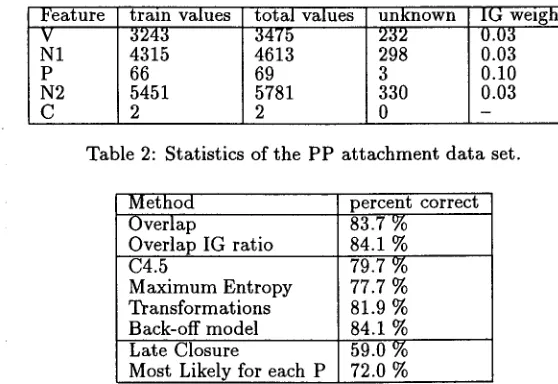
T h e training d a t a for this task are rather sparse. Of the 3097 test patterns, only 150 (4.8 %) occurred in the training set; 791 (25.5 %) patterns had at least 1 mismatching word with any pattern in the training set; 1963 (63.4 %) patterns at least 2 mismatches; and 193 (6.2 %) patterns at least 3 mismatches. Moreover, the test set contains m a n y words t h a t are not present in any of the patterns in the training set. Table 2 shows the counts of feature values and un- known values. This table also gives the Information Gain estimates of feature relevance.
O v e r l a p - B a s e d M o d e l s
In a first experiment, we used the IB1 algorithm and the I B i - I G algorithm. The results of these al- gorithms and other methods from the literature are given in Table 3. T h e addition of IG weights clearly helps, as the high weight of the P feature in effect pe- nalizes the retrieval of patterns which do not match in the preposition. As we have argued in Zavrel and Daelemans (1997), this corresponds exactly to the behavior of the Back-Off algorithm of Collins and Brooks (1995), so t h a t it comes as no surprise t h a t the accuracy of both methods is the same. Note t h a t the Back-Off model was constructed after per- forming a number of validation experiments on held- out d a t a to determine which terms to include and, more importantly, which to exclude from the back- off sequence. This process is much more laborious than the a u t o m a t i c c o m p u t a t i o n of IG-weights on the training set.
T h e other methods for which results have been reported on this dataset include decision trees, M a x i m u m Entropy (Ratnaparkhi, Reynar, and Roukos, 1994), and Error-Driven Transformation- Based Learning (Brill and Resnik, 1994), 3 which were clearly outperformed by both IB1 and IBI-IG, even though e.g. Brill ~ Resnik used more elaborate feature sets (words and WordNet classes). Adding
aThe results of Brill's method on the present bench- mark were reconstructed by Collins and Brooks (1995).
more elaborate features is also possible in the MBL framework. In this paper, however, we focus on more effective use of the existing features. Because the Overlap metric neglects information about the de- gree of mismatch if feature-values are not identical, it is worthwhile to look at more finegrained repre- sentations and metrics.
Continuous Vector Representations f o r Words
In experiments with Lexical Space representations, every word in a pattern was replaced by its PCA compressed LexSpace vector, yielding patterns with 25x4 numerical features and a discrete target cate- gory. T h e distance metric used was the sum of the LexSpace vector distance per feature, where the dis- tance between two vectors is c o m p u t e d as one minus the cosine, normalized by the cumulative norm. Be- cause no two patterns have the same distance in this case, to use only the nearest neighbor(s) means ex- trapolating from exactly one nearest neighbor.
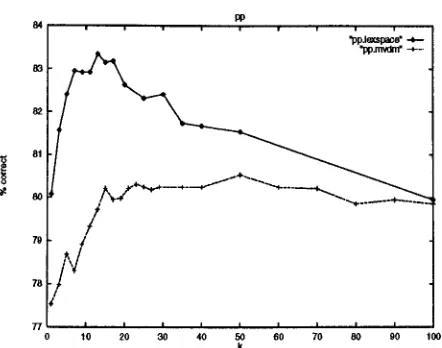
In preliminary experiments, this was found to give bad results, so we also experimented with various settings for k : the parameter t h a t determines the number of neighbors considered for the analogy. T h e same was done for the MVDM metric which has a similar behavior. We found t h a t LexSpace per- formed best when k was set to 13 (83.3 % correct); MVDM obtained its best score when k was set to 50 (80.5 % correct). Although these parameters were found by optimization on the test set, we can see in Figure 1 t h a t LexSpace actually outperforms MVDM for all settings of k. Thus, the represen- tations from LexSpace which represent the behav- ior of the values independent of the requirements of this particular classification task o u t p e r f o r m the task specific representations used by MVDM. T h e reason is t h a t the task specific representations are derived only from the small number of occurrences of each value in the training set, whereas the a m o u n t of text available to refine the LexSpace vectors is practically unlimited. Lexical Space however, does not outperform the simple Overlap metric (83.7 % correct) in this form. We suspected t h a t the reason for this is the fact t h a t when continuous represen-
[image:5.596.71.432.106.173.2]Feature V N1 P N2 C
train values total v a l u e s unknown IG weight
3243 3475 232 0.03
4315 4613 298 0.03
66 69 3 0.10
5451 5781 330 0.03
2 2 0 -
Table 2: Statistics of the P P attachment d a t a set.
Method Overlap
Overlap IG ratio C4.5
Maximum Entropy Transformations Back-off model Late Closure
Most Likely for each P
percent 83.7 % 8 4 . 1 % 79.7 % 77.7 % 81.9 % 8 4 . 1 % 59.0 % 72.0 %
correct
Table 3: Scores on the Ratnaparkhi et al. P P - a t t a c h m e n t test set (see text); the scores of M a x i m u m Entropy are taken from Ratnaparkhi et al. (1994); the scores of Transformations and Back-off are taken from Collins & Brooks (1995). T h e C4.5 decision tree results, and the baselines have been computed by the authors.
tations are used, the number of neighbors is exactly fixed to k, whereas the number of neighbors used in the Overlap metric is, in effect, dependent on the specificity of the match.
Weighted Voting
This section examines possibilities for improving the behavior of LexSpace vectors for MBL by consider- ing various weighted voting methods.
T h e fixed number of neighbors in the continuous metrics can result in an oversmoothing effect. The k-NN classifier tries to estimate the conditional class probabilities from samples in a local region of the d a t a space. T h e radius of the region is deter- mined by the distance of the k-furthest neighbor. If k is very small and i) the nearest neighbors are not nearby due to d a t a sparseness, or ii) the nearest neighbor classes are unreliable due to noise, the "local" estimate tends to be very poor, as illustrated in Figure 1. Increasing k and thus taking into account a larger region around the query in the dataspace makes it possible to overcome this effect by smoothing the estimate. However, when the m a j o r i t y voting m e t h o d is used, smoothing can easily become oversmoothing, because the radius of the neighborhood is as large as the distance of the k'th nearest neighbor, irrespective of the local properties of the data. Selected points from beyond the "relevant neighborhood" will receive a weight equal to the close neighbors in the voting function, which can result i n unnecessary classification errors.
A solution to this problem is the use of a weighted
voting rule which weights the vote of each of the nearest neighbors by a function of their distance to the test pattern (query). This type of voting rule was first proposed by Dudani (1976). In his scheme, the nearest neighbor gets a weight of 1, the furthest neighbor a weight of 0, and the other weights are scaled linearly to the interval in between.
dk-dj if dk ~ dl
4k-d, (6)
Wj = 1 if dk = dl
where dj is the distance to the query of the j ' t h nearest neighbor, dl the distance of the nearest neighbor, and dk the distance of the furthest (k'th) neighbor.
Dudani further proposed the inverse distance weight (Equation 7), which has recently become pop- ular in the MBL literature (Wettschereck, 1994). In Equation 7, a small constant is usually added to the denominator to avoid division by zero.
1
(7)
w j = ~ jAnother weighting function considered here is based on the work of Shepard (1987), who argues for a universal perceptual law, in which the relevance of a previous stimulus for the generalization to a new stimulus is an exponentially decreasing function of its distance in a psychological space. This gives the weighed voting function of Equation 8, where o~ and fl are constants determining the slope and the power of the exponential decay function. In the experi- ments reported below, oe = 3.0 and fl = 1.0.
[image:6.596.132.411.99.291.2]84
77
PP
"pp.l~.,space" pp.nwdm" - - * -
/
4
2'o . . . :o
1 30 40 50 60 70 80 100
k
Figure 1: Accuracy on the PP-attachment test set of of MVDM and LexSpace representations as a function of k, the number of nearest neighbors.
Method
LexSpace (Dudani, k=30) LexSpace (Dudani, k=5O, IG)
% correct 84.2 % 84.4 %
Table 4: Scores on the Ratnaparkhi et al. PP- attachment test set with Lexical Space representa- tions. The values of k, the voting function, and the IG weights were determined on the training and val- idation sets.
= ( 8 )
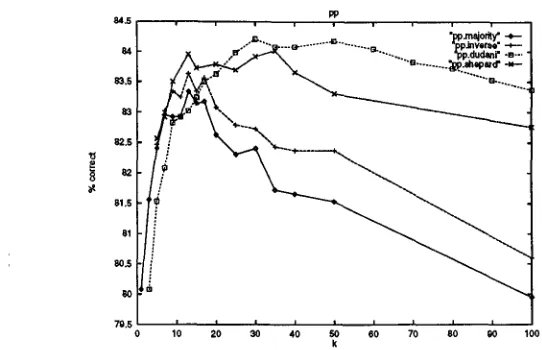
Figure 2 shows the results on the test set for a wide range of k for these voting methods when applied to the LexSpace represented PP-attachment dataset.
With the inverse distance weighting function the results are better than with majority voting, but here, too, we see a steep drop for k's larger than 17. Using Dudani's weighting function, the results be- come optimal for larger values of k, and remain good for a wide range of k values. Dudani's weighting function also gives us the best overall result, i.e. if we use the best possible setting for k for each method, as determined by performance on the validation set (see Table 4).
The Dudani weighted k-nearest neighbor classi- fier (k=30) slightly outperforms Collins ~ Brooks' (1995) Back-Off model. A luther small increase was obtained by combining LexSpace representa- tions with IG weighting of the features, and Dudani's weighted voting function. Although the improve- ment over Back-Off is quite limited, these results are nonetheless interesting because they show that MBL can gain from the introduction of extra information sources, whereas this is very difficult in the Back- Off algorithm. For comparison, consider that the
performance of the Maximum Entropy model with distributional word-class features is still only 81.6% on this data.
4 D i s c u s s i o n
If we compare the accuracy of humans on the V,N,P,N patterns (88.2 % correct) with that of our most accurate method (84.4 %), we see that the paradigm of learning disambiguation methods from corpus statistics offers good prospects for an effec- tive solution to the problem. After the initial effort by Hindle and Rooth (1993), it has become clear that this area needs statistical methods in which an easy integration of many information sources is pos- sible. A number of methods have been applied to the task with this goal in mind.
Brill and Resnik (1994) applied Error-Driven Transformation-Based Learning to this task, using the verb, nounl, preposition, and noun2 features. Their method tries to maximize accuracy with a minimal amount of rules. They found an increase in performance by using semantic information from WordNet. Ratnaparkhi, Reynar, and Roukos (1994) used a Maximum Entropy model and a decision tree on the dataset they extracted from the Wall Street Journal corpus. They also report performance gains with word features derived by an unsupervised clus- tering method. Ratnaparkhi et al. ignored low frequency events. The accuracy of these two ap- proaches is not optimal. This is most likely due to the fact that they treat low frequency events as noise, though these contain a lot of information in a sparse domain such as PP-attachment. Franz (1996) used a Loglinear model for PP attachment. The fea- tures he used were the preposition, the verb level
[image:7.596.196.417.100.274.2]pp
g1.5 81
71~.5
0 10 20 30 40 50 60 70 80 90 100 k
Figure 2: Accuracy on the PP-attachment test set of various voting methods as a function of k, the number of nearest neighbors.
(the lexical association between the verb and the
preposition), the noun level (idem dito for nounl),
the noun tag (POS-tag for nounl), noun definite- ness (of nounl), and the PP-object tag (POS-tag for noun2). A Loglinear model keeps track of the interaction between all the features, though at a fairly high computational cost. The dataset that was used in Franz' work is no longer available, mak- ing a direct comparison of the performance impos- sible. Collins and Brooks (1995) used a Back-Off model, which enables them to take low frequency ef- fects into account on the Ratnaparkhi dataset (with good results). In Zavrel and Daelemans (1997) it is shown that Memory-Based and Back-Off type meth- ods are closely related, which is mirrored in the per- formance levels. Collins and Brooks got slightly bet- ter results (84.5 %) after reducing the sparse data problem by preprocessing the dataset, e.g. replacing all four-digit words with 'YEAR'. The experiments with Lexical Space representations have as yet not shown impressive performance gains over Back-Off, but they have demonstrated that the MBL frame- work is well-suited to experimentation with rich lex- ical representations.
5
C o n c l u s i o n
We have shown that our MBL approach is very com- petent in solving attachment ambiguities; it achieves better generalization performance than many previ- ous statistical approaches. Moreover, because we can measure the r'elevance of the features using an information gain metric (IBI-IG), we are able to add features without a high cost in model selection or an explosion in the number of parameters.
An additional advantage of the MBL approach is
that, in contrast to the other statistical approaches, it is founded in the use of similarity-based reasoning. Therefore, it makes it possible to experiment with different types of distributed non-symbolic lexical representations extracted from corpora using unsu- pervised learning. This promises to be a rich source of extra information. We have also shown that task specific similarity metrics such as MVDM are sen- sitive to the sparse data problem. LexSpace is less sensitive to this problem because of the large amount of data which is available for its training.
Acknowledgements
This research was done in the context of the "Induc- tion of Linguistic Knowledge" research programme, partially supported by the Foundation for Lan- guage Speech and Logic (TSL), which is funded by the Netherlands Organization for Scientific Research (NWO).
R e f e r e n c e s
Aha, D., D. Kibler, and M. Albert. 1991. Instance- based learning algorithms. Machine Learning,
6:37-66.
Brill, E. and P. Resnik. 1994. A rule-based ap- proach to prepositional phrase attachment dis- ambiguation. In Proc. of 15th annual confer- ence on Computational Linguistics.
Cardie, Claire. 1996. Automatic feature set selection for case-based learning of linguistic knowledge. In Proc. of Conference on Empirical Methods in NLP. University of Pennsylvania.
Collins, M.J and J. Brooks. 1 9 9 5 . Preposi- tional phrase attachment through a backed-off
[image:8.596.131.402.97.272.2]model. In Proc. of Third Workshop on Very Large Corpora, Cambridge.
Cost, S. and S. Salzberg. 1993. A weighted near- est neighbour algorithm for learning with sym- bolic features. Machine Learning, 10:57-78.
Daelemans, W. 1995. Memory-based lexical acqui- sition and processing. In P. Steffens, editor, Machine Translation and the Lexicon, volume 898 of Lecture Notes in Artificial Intelligence. Springer-Verlag, Berlin, pages 85-98.
Daelemans, W. 1996. Abstraction considered harm- ful: Lazy learning of language processing. In Proc. of 6th Belgian-Dutch Conference on Ma- chine Learning, pages 3-12. Benelearn.
Daelemans, Walter, Peter Berck, and Steven Gillis. 1996. Unsupervised discovery of phonological categories through supervised learning of mor- phological rules. In Proc. of 16th Int. Conf. on Computational Linguistics, pages 95-100. Center for Sprogteknologi.
Daelemans, Walter and Antal van den Bosch. 1992. Generalisation performance of backpropaga- tion learning on a syllabification task. In Proc. of TWLT3: Connectionism and NLP, pages 27-37. Twente University.
Dudani, S.A. 1976. The distance-weighted k-nearest neighbor rule. In IEEE Transactions on Sys- tems, Man, and Cybernetics, volume SMC-6, pages 325-327.
Franz, A. 1996. Learning PP attachment from cor- pus statistics. In S. Wermter, E. Riloff, and G. Scheler, editors, Connectionist, Statistical, and Symbolic Approaches to Learning for Nat- ural Language Processing, volume 1040 of Lec- ture Notes in Artificial Intelligence. Springer- Verlag, New York, pages 188-202.
Frazier, L. 1979. On Comprehending Sentences: Syntactic Parsing Strategies. Ph.d thesis, Uni- versity of Connecticut.
Hindle, D. and M. Rooth. 1993. biguity and lexical relations. Linguistics, 19:103-120.
Structural am- Computational
Hughes, J. 1994. Automatically Acquiring a Classi- fication of Words. Ph.d thesis, School of Com- puter Studies, The University of Leeds.
Marcus, M., B. Santorini, and M.A. Marcinkiewicz. 1993. Building a large annotated corpus of en- glish: The penn treebank. Computational Lin- guistics, 19(2):313-330.
Quinlan, J.R. 1993. c4.5: Programs for Machine Learning. San Marco, CA: Morgan Kaufmann.
Ratnaparkhi, A., J. Reynar, and S. Roukos. 1994. A maximum entropy model for prepositional phrase attachment. In Workshop on Human Language Technology, Plainsboro, N J, March. ARPA.
Schfitze, H. 1994. Distributional part-of-speech tag- ging. In Proc. of 7th Conference of the Euro- pean Chapter of the Association for Computa- tional Linguistics, Dublin, Ireland.
Shepard, R.N. 1987. Toward a universal law of gen- eralization for psychological science. Science, 237:1317-1228.
Stanfill, C. and D. Waltz. 1986. Toward memory- based reasoning. Communications of the ACM, 29(12):1213-1228, December.
Wettschereck, D. 1994. A study of distance-based machine learning algorithms. Ph.d thesis, Ore- gon State University.
Zavrel, J. and W. Daelemans. 1997. Memory- based learning: Using similarity for smooth- ing. In Proc. of 35th annual meeting of the A CL, Madrid.
Zavrel, J. and J. Veenstra. 1995. The language envi- ronment and syntactic word class acquisition. In F. Wijnen and C. Koster, editors, Proc. of
Groningen Assembly on Language Acquisition (GALA95), Groningen.