http://www.scirp.org/journal/jep ISSN Online: 2152-2219
ISSN Print: 2152-2197
DOI: 10.4236/jep.2018.94024 Apr. 30, 2018 368 Journal of Environmental Protection
Assessment and Countermeasures for Offshore
Wind Farm Risks Based on a Dynamic
Bayesian Network
Chunhui Zhou, Xin Liu, Langxiong Gan
Wuhan University of Technology, Wuhan, China
Abstract
Wind power is a kind of clean energy promising significant social and envi-ronmental benefits, and in The Peoples Republic of China, the government supports and encourages the development of wind power as one element in a shift to renewable energy. In recent years however, maritime safety issues have arisen during offshore wind power construction and attendant production processes associated with the rapid promotion and development of offshore wind farms. Therefore, it is necessary to carry out risk assessment for phases in the life cycle of offshore wind farms. This paper reports on a risk assess-ment model based on a Dynamic Bayesian network that performs offshore wind farms maritime risk assessment. The advantage of this approach is the way in which a Bayesian model expresses uncertainty. Furthermore, such models permit simulations and reenactment of accidents in a virtual envi-ronment. There were several goals in this research. Offshore wind power project risk identification and evaluation theories and methods were explored to identify the sources of risk during different phases of the offshore wind farm life cycle. Based on this foundation, a dynamic Bayesian network model with Genie was established, and evaluated, in terms of its effectiveness for analysis of risk during different phases of the offshore wind farm life cycle. Research results show that a dynamic Bayesian network method can perform risk assessments effectively and flexibly, responding to the actual context of offshore wind power construction. Historical data and almost real-time in-formation are combined to analyze the risk of the construction of offshore wind power. Our results inform a discussion of security and risk mitigation measures that when implemented, could improve safety. This work has value as a reference and guide for the safe development of offshore wind power.
Keywords
Bayesian Network, Offshore Wind Farm, Risk Assessment, Countermeasures How to cite this paper: Zhou, C.H., Liu, X.
and Gan, L.X. (2018) Assessment and Countermeasures for Offshore Wind Farm Risks Based on a Dynamic Bayesian Net-work. Journal of Environmental Protection, 9, 368-384.
https://doi.org/10.4236/jep.2018.94024
Received: March 8, 2018 Accepted: April 27, 2018 Published: April 30, 2018
Copyright © 2018 by authors and Scientific Research Publishing Inc. This work is licensed under the Creative Commons Attribution International License (CC BY 4.0).
DOI: 10.4236/jep.2018.94024 369 Journal of Environmental Protection
1. Introduction
Offshore wind power risks refer to risks posed by harsh environments at sea, generator set equipment failure, structural failure, management organization and socio-political issues. The characteristics of offshore wind power risk are as follows: the objective existence and ubiquity of risk, the uncertainty and predic-tability of risk, the variety of risk, the change of risk with force majeure, the nat-ural risk is obviously higher, and the correlation between risk factors is larger. The stage of offshore wind power risk is apparent.
Bayesian network, also known as reliability network, is an extension of Baye-sian method. It is one of the most effective theoretical models in the field of un-certain knowledge expression and reasoning. After being put forward by Pearl in 1988, it has become a research hotspot in recent years. A Bayesian network is a Directed Acyclic Graph (DAG) consisting of representative variable nodes and connected directed nodes. The nodes represent random variables. The directed edges between nodes represent the mutual relationships between nodes (pointed by the parent node to its child nodes). The conditional probability is used to ex-press the strength of the relationship. No parent node uses the prior probability to express information. The node variable can be abstraction of any problem, such as test value, observation phenomenon, opinion inquiry, etc. Events that apply to the expression and analysis of uncertainties and probabilities are ap-plied to decisions that are conditionally dependent on a variety of control factors and can be reasoned from incomplete, inaccurate, or uncertain knowledge or information.
Bayesian networks, especially dynamic Bayesian networks, take account of changes occurring over the life cycle phases of offshore wind farms, based on a large number of training sets and accident reports, and to some extent, reduce of the influence human subjective factors, making assessment results are more re-liable and objective. Dynamic Bayesian network also has the time characteristics, to ensure continuity in the reasoning process before and after, so that the whole reasoning method looks more in line with the development of objective things. Dynamic Bayesian network can automatically retain the information when it is input, which can well combine the past data and the current evidence informa-tion, keep the time accumulation of the information storage, effectively reduce the uncertainty of the information fusion inference and improve the accuracy of information fusion.
DOI: 10.4236/jep.2018.94024 370 Journal of Environmental Protection With GeNIe tool to build a dynamic Bayesian risk assessment model for off-shore wind farms in different phases of construction and production process, and analyze the assessment results, so as to put forward requirements and sug-gestions on safety protection in various aspects, so as to improve the construc-tion and producconstruc-tion of offshore wind farms security capabilities.
Section 2 of this paper introduces research related to dynamic Bayesian net-works and offshore wind power safety. Section 3 discusses a novel dynamic Bayesian risk assessment model for phases in the offshore wind farm life cycle, and Section 4 discusses offshore wind power risk assessment strategies during each phase, the final section draws conclusions and presents directions for future research.
2. Related Works
I divide the related work into two categories: Bayesian Network and offshore wind farm. I have summed up the relevant work of the Bayesian network as fol-lows:
The mechanism of how to determine the missing data type was discussed based on the analysis of some data samples lost in the control system. Zhu, Zhang [2] used the method of dynamic Bayesian network to model the general fault prediction problems in the control system and deal with the real-time fault prediction problems of nonlinear systems with missing data. The results show that although the data sample is noisy and partially missing, combined with the effective processing of missing data, dynamic Bayesian network can effectively predict the system fault.
Thompson [3] considered that dynamic Bayesian networks can effectively model and infer many dynamic systems. However, most of its reasoning algo-rithms involve complex graphic transformations, which are difficult to program and time-consuming. Therefore, they put forward a new recursive reasoning al-gorithm, which is a pure numerical method to deduce discrete model on-line and Off-line based on probability theory and Bayesian network characteristics.
Yu, Ying [4] applied the Bayesian network analysis method to the evaluation of battlefield situation, and the effectiveness of Bayesian network analysis me-thod was proved by the reasoning of actual battlefield events and the evaluation of naval battlefield situation.
Chen, Wang, Rao [5] analyzed the applicability of Bayesian network analysis method. He Uses the method of David Chickering to combine the novel crite-rion, Variable ordering and equivalent class and combines the genetic algorithm and greedy algorithm in Bayesian network, proved the practicability of this me-thod by simulation.
In addition, I have summed up the relevant work of the offshore wind farm as follows:
DOI: 10.4236/jep.2018.94024 371 Journal of Environmental Protection moving average was employed in this study to predict wind speeds. Moreover, the reliability of offshore wind power is analyzed by Bayesian network.
Zhang, Zhang, Stua [7] analyzed the existing international policies and specif-ic conditions and made a comprehensive evaluation according to the historspecif-ical development of global offshore wind power. At the same time, he discusses the future development prospects of wind power in China and the problems it faces, and makes a specific study on the actual situation of the relevant enterprises in wind power development in China. Furthermore, some effective suggestions were put forward for the sustainable development of wind power in China.
3. Construction of Dynamic Bayesian Risk Assessment
Model
3.1. Dynamic Bayesian Network
3.1.1. Bayesian Network 1) Probability theory (network)
Network is built on the basis of probability theory, in which the multiplication formula, Bayes’ formula, the chain rule, conditional probability, total probabili-ty, etc. are often used in the theoretical system of Bayesian networks.
2) Bayesian networks
In a complete Bayesian network, the nodes in the network are used to replace the variables in the actual model. A directed arc is used to represent the rela-tionship among variables. The direction of the directed arc is from the cause to the result node. A Bayesian network is actually a set of directed acyclic graphs and related parameters (Daly, R, Shen, Q, Aitken, S, 2011). The composition in-cludes: a) In the network structure, an acyclic graph that is connected by di-rected arcs to represent the structure of the model; b) In the parameter setting, each variable has its corresponding conditional probability table, which is used to express dependencies between variables.
Thus, Let X denote each node variable in the network and Pa denote the par-ent node set corresponding to a certain node X in the model. Then, the joint probability of all the variables in the model is expressed as formula (1):
( )
1(
)
n
I i
i
[image:4.595.305.442.595.708.2]P X =
∏
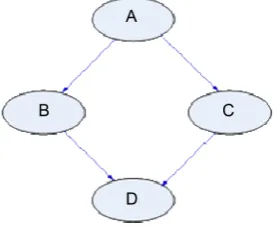
=P X Pa (1) Let us construct a simple Bayesian network as shown in Figure 1, where A isDOI: 10.4236/jep.2018.94024 372 Journal of Environmental Protection the parent node of B and C, and D is the child node of B and C.
3) The determination of Bayesian network parameters
Considering the sources of risk in a hypothetical scenario of a rotor-blade ac-cident, we set the two states of network node as occurrence/non-occurrence (logically true/false) with two states; “0” and “1”. To determine the parameters of a Bayesian network for accident risk assessment, we use historical, rotor-blade accident data reported in a reference (WIND TURBINE ACCIDENT AND INCIDENT COMPILATION). We evaluated the prior information of each likely risk source to determine the parameters for each node in the network.
At the same time, in order to obtain the posterior probability in the Bayesian network, a large number of Conditional Probability Tables (CPTs) in the net-work must be determined in advance. To determine the conditional probability table is the basis for the next step of Bias network inference. This research uses accident reports as the sample data, combining expert experience to generate conditional probability tables that correspond to each node of the network. In order to ensure that the conditional probability values for each node are more close to the actual situation, based on the statistical analysis of the data, using a Bayesian expectation estimation method; At the same time, combined with the results of the expert questionnaire survey, the two parties are weighted to deter-mine the condition probability. The formulation of a node conditional probabil-ity table, is based on the realprobabil-ity of the fan accident made statistical analysis, in which each sample the result of the accident will cause the fan accident broke out, which makes the research of objectivity and authenticity, so the phenome-non that the probability of risk become larger will occur when probabilistic in-ference.
3.1.2. Dynamic Bayesian Network
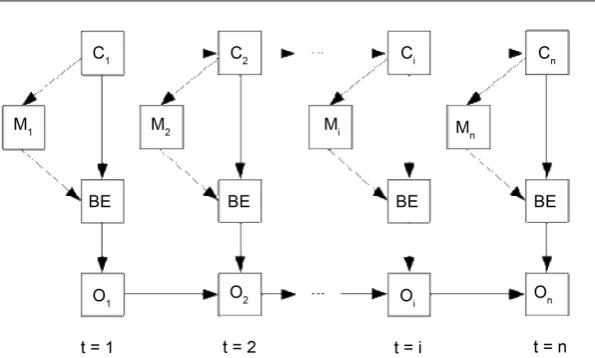
The dynamic Bayesian network is an extension of the Bayesian network. It not only can express the causality between variables as well as Bayesian network, but also can describe the evolution of a variable state in time sequence (Zheng, Gao, 2008). A dynamic Bayesian network can model and analyze a sequence of events, as shown in Figure 2.
The variable Xt=
{
C M Ot, t, t}
in Figure 2 has a probability dependency that varies with time t=1, 2,,n, ∀t C, t ⇒M Ct, t ∧Mt⇒Ot, the joint probability distribution of variable Xi is:( )
t(
t, t, t)
( ) (
t t t) (
t t, t)
P X =P C M O =P C P M C P O C M (2)
Consider the conditional probability between Ot and Ct:
(
)
(
( )
)
(
( )
)
( ) (
) (
)
( )
(
) (
)
, , , | | , | | ,t t t
t t m
t t
t t
t t t t t t
m
t
t t t t t
P O C M m P O C
P O C
P C P C
P C P M m C P O C M m
P C
P M m C P O C M m
DOI: 10.4236/jep.2018.94024 373 Journal of Environmental Protection Figure 2. Dynamic bayesian network composition.
Between moments t − 1 and t, the state of the variable set Ct shifts, so the
transition probability of the variable set Xt is:
(
t| t1)
(
t| t 1)
P X X− =P C C− (4) A dynamic Bayesian network can not only model the dependence of features corresponding to variables, but also the temporal relationship between the fea-tures, and the probability dependency among the variables through the network topology and changes over time. Thus, it is suitable for the modeling of complex characteristics of offshore wind power generation that are both fea-ture-dependent and time-dependent.
3.2. GeNIe Tools
GeNIe was designed by the University of Pittsburgh Decision Systems Labora-tory. It is software used to build theoretical models for graphical deci-sion-making. The GeNIe interface is an easy and powerful way to build Bayesian network models, widely used in project research and commercial applications. This software eliminates the computational complexity for researchers and sim-plifies the work steps, supporting the work of academics using Bayesian net-works to study uncertainty across many domains.
4. Life Cycle Phases of Offshore Wind Farms for Risk
Assessment
DOI: 10.4236/jep.2018.94024 374 Journal of Environmental Protection phase.
4.1. Construction of Dynamic Bayesian Networks for Risk
Assessment of Offshore Wind Farms
The establishment of a general dynamic Bayesian network model is rather com-plicated. Before establishing a model, it is necessary to make assumptions and simplifications. In this paper, we make the following assumptions about dynam-ic Bayesian networks:
Hypothesis 1: Within a finite time, change in the conditional probability for all t is stable and consistent;
Hypothesis 2: The process of dynamic probability can be described as a Mar-kov chain. The probability of occurrence of future events is stochastic, having nothing to do with past events, but only with the current moment;
Hypothesis 3: Conditional probability processes remain stable at adjacent times, that is, probability and time have no relation.
4.2. Construction of Planning Phase in Bayesian Network
In this paper, the methods of historical data analysis, brainstorming, and expert judgment combined with the Delphi method are used to identify potential risks.
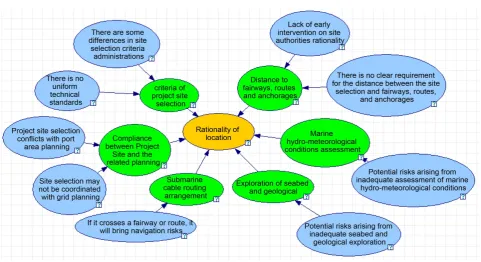
According to the expert questionnaire survey, it is determined that the risk factors of offshore wind power construction and production in the planning phase are as follows: 1) the site selection criteria; 2) the distance between factors waterway, navigation route and anchorage; 3) site selection and planning com-pliance; 4) submarine cable routing arrangement; 5) seabed and geological ex-ploration; 6) ocean hydrological meteorological conditions assessment. Each category also contains a number of risk factors. The Bayesian network model of risk assessment in this phase is shown in Figure 3.
4.3. Establishing the Construction Phase in a Bayesian Network
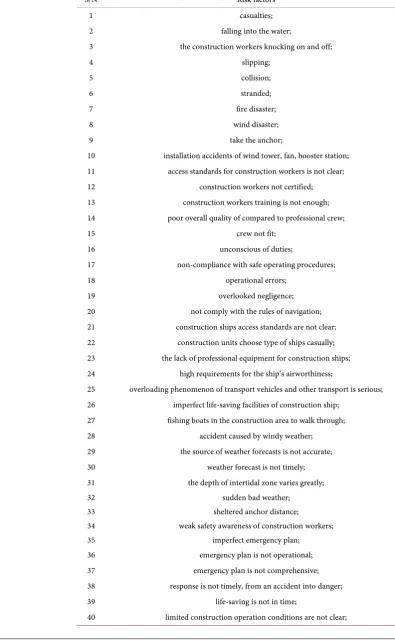
According to historical accident data and expert questionnaire survey, the risk factors of offshore wind power in construction and production construction phase are determined as Table 1.
4.4. Construction of Operation and Maintenance Phase in
Bayesian Network
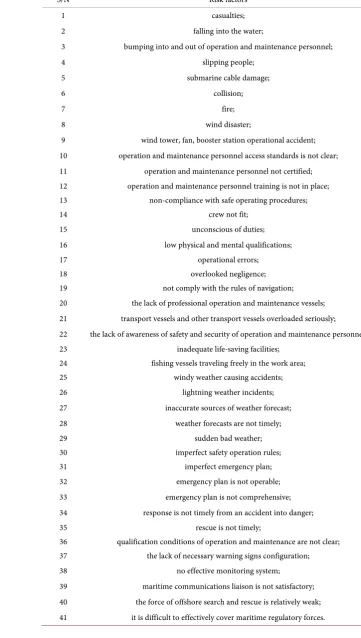
According to historical accident data and expert questionnaire survey, the risk factors of offshore wind power construction and production operation and maintenance phases are determined as Table 2.
4.5. Construction of Disposal Phase in Bayesian Network
DOI: 10.4236/jep.2018.94024 375 Journal of Environmental Protection Figure 3. Bayesian network model for risk assessment during planning phase.
5. Risk Assessment at Different Life-Cycle Phases
5.1. Determination of Node Parameters
The node parameters are the states of the nodes or the states of different states when the states of the nodes are uncertain. Since most of the risk factors studied in this paper are in an indefinite state, this paper focuses on the method of de-termining the node parameters when the node state is uncertain. It is notewor-thy that in a complete Bayesian network assessment model, the node parameters only need to get the parameters of the basic node.
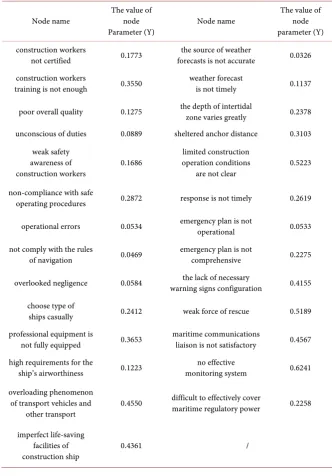
In the entire Bayesian network, there are nine nodes in the planning phase, there are 27 Bayesian nodes in the construction phase, there are 26 Bayesian nodes in the operation and maintenance phase. Network node parameters in disposal phase include 27; construction phase of the basic node as shown in Ta-ble 4.
Conditional probability table can obtain all node parameters except the base node.
The parameters of the basic nodes in the four phases are generally obtained from the data. When there is no relevant data for reference, it is necessary to utilize 2057 wind farm accidents collected at home and abroad for nearly 30 years (582 of which are in construction phase and 1328 in operation and main-tenance phase, 147 in disposal phase) and the form of expert judgment to deter-mine the node parameters. The frequency of occurrence of the risk factor in an accident is the probability of occurrence of the node.
DOI: 10.4236/jep.2018.94024 376 Journal of Environmental Protection Table 1. Risk factors in construction phase.
S/N Risk factors
1 casualties;
2 falling into the water;
3 the construction workers knocking on and off;
4 slipping;
5 collision;
6 stranded;
7 fire disaster;
8 wind disaster;
9 take the anchor;
10 installation accidents of wind tower, fan, booster station; 11 access standards for construction workers is not clear; 12 construction workers not certified; 13 construction workers training is not enough; 14 poor overall quality of compared to professional crew;
15 crew not fit;
16 unconscious of duties;
17 non-compliance with safe operating procedures; 18 operational errors;
19 overlooked negligence; 20 not comply with the rules of navigation; 21 construction ships access standards are not clear; 22 construction units choose type of ships casually; 23 the lack of professional equipment for construction ships; 24 high requirements for the ship’s airworthiness;
25 overloading phenomenon of transport vehicles and other transport is serious; 26 imperfect life-saving facilities of construction ship;
27 fishing boats in the construction area to walk through; 28 accident caused by windy weather; 29 the source of weather forecasts is not accurate; 30 weather forecast is not timely; 31 the depth of intertidal zone varies greatly; 32 sudden bad weather;
33 sheltered anchor distance;
34 weak safety awareness of construction workers; 35 imperfect emergency plan; 36 emergency plan is not operational; 37 emergency plan is not comprehensive; 38 response is not timely, from an accident into danger; 39 life-saving is not in time;
DOI: 10.4236/jep.2018.94024 377 Journal of Environmental Protection Continued
41 the lack of necessary warning signs configuration; 42 no effective monitoring system;
43 maritime communications liaison is not satisfactory; 44 offshore search and rescue forces are relatively weak; 45 many shipping companies and management difficulties;
46 lack of effective communication and cooperation between construction unit and construction unit;
47 difficult to effectively cover maritime regulatory power.
the base node can be determined. Since no traffic accident occurs in the plan-ning phase, the node parameters of the base node are determined by expert judgment. Node parameters as shown in Table 4.
5.2. Determination of Bayesian Conditional Probability
In Bayesian networks, the Bayesian conditional probability table is the link be-tween the reaction nodes and the nodes. When the state of a node cannot be known, the probability of the basic node can be determined by hydrological, meteorological data and the prior probability, while the intermediate node and the top node need to be determined by the conditional probability table.
Conditional probability table to obtain generally two ways, one is to use a large number of accident data to learn from Bayesian network ,then get the con-ditional probability table; the other is to use the expert questionnaire to obtain the conditional probability table. After verifying the reliability of the conditional probability table obtained from the expert questionnaire, the paper will use his-torical accident data to optimize it and verify the effectiveness of the optimiza-tion.
This article collected a total of 2057 records of accidents (WIND TURBINE ACCIDENT AND INCIDENT COMPILATION), after a detailed analysis of the accident process, the nodes in the Bayesian network, which are at risk of sunk failure as reflected in the accident process, are counted. Considering that there are some not-so-reasonable parts of the conditional probability table based solely on historical accident data, which is due to failure to obtain the complete cause of the accident from the accidental data, resulting in missing base nodes in the Bayesian network and the middle node affects the accuracy of the conditional probability table. Based on the experience of a large number of experts in the field, it is very important to optimize and perfect the conditional probability ta-ble to make up for the possita-ble error caused by the data learning of simple acci-dent.
DOI: 10.4236/jep.2018.94024 378 Journal of Environmental Protection Table 2. Risk factors in operation and maintenance phase.
S/N Risk factors
1 casualties;
2 falling into the water;
3 bumping into and out of operation and maintenance personnel; 4 slipping people;
5 submarine cable damage;
6 collision;
7 fire;
8 wind disaster;
9 wind tower, fan, booster station operational accident; 10 operation and maintenance personnel access standards is not clear; 11 operation and maintenance personnel not certified; 12 operation and maintenance personnel training is not in place; 13 non-compliance with safe operating procedures;
14 crew not fit;
15 unconscious of duties; 16 low physical and mental qualifications; 17 operational errors; 18 overlooked negligence; 19 not comply with the rules of navigation; 20 the lack of professional operation and maintenance vessels; 21 transport vessels and other transport vessels overloaded seriously; 22 the lack of awareness of safety and security of operation and maintenance personnel; 23 inadequate life-saving facilities;
24 fishing vessels traveling freely in the work area; 25 windy weather causing accidents; 26 lightning weather incidents; 27 inaccurate sources of weather forecast; 28 weather forecasts are not timely; 29 sudden bad weather; 30 imperfect safety operation rules; 31 imperfect emergency plan; 32 emergency plan is not operable; 33 emergency plan is not comprehensive; 34 response is not timely from an accident into danger; 35 rescue is not timely;
36 qualification conditions of operation and maintenance are not clear; 37 the lack of necessary warning signs configuration; 38 no effective monitoring system;
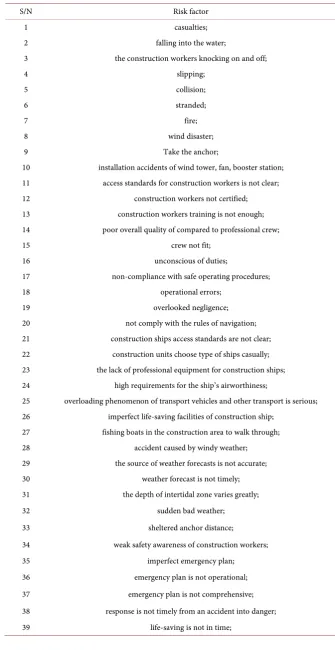
DOI: 10.4236/jep.2018.94024 379 Journal of Environmental Protection Table 3. Risk factors in disposal phase.
S/N Risk factor
1 casualties;
2 falling into the water;
3 the construction workers knocking on and off;
4 slipping;
5 collision;
6 stranded;
7 fire;
8 wind disaster;
9 Take the anchor;
10 installation accidents of wind tower, fan, booster station; 11 access standards for construction workers is not clear; 12 construction workers not certified; 13 construction workers training is not enough; 14 poor overall quality of compared to professional crew;
15 crew not fit;
16 unconscious of duties;
17 non-compliance with safe operating procedures; 18 operational errors;
19 overlooked negligence; 20 not comply with the rules of navigation; 21 construction ships access standards are not clear; 22 construction units choose type of ships casually; 23 the lack of professional equipment for construction ships; 24 high requirements for the ship’s airworthiness;
25 overloading phenomenon of transport vehicles and other transport is serious; 26 imperfect life-saving facilities of construction ship;
27 fishing boats in the construction area to walk through; 28 accident caused by windy weather; 29 the source of weather forecasts is not accurate; 30 weather forecast is not timely; 31 the depth of intertidal zone varies greatly; 32 sudden bad weather;
33 sheltered anchor distance;
DOI: 10.4236/jep.2018.94024 380 Journal of Environmental Protection Continued
40 limited construction operation conditions are not clear; 41 the lack of necessary warning signs configuration; 42 no effective monitoring system;
[image:13.595.205.538.255.732.2]43 maritime communications liaison is not satisfactory; 44 offshore search and rescue forces are relatively weak; 45 many shipping companies and management difficulties; 46 lack of effective communication and cooperation between construction unit and construction unit; 47 difficult to effectively cover maritime regulatory power.
Table 4. The basic node parameter settings during construction phase.
Node name The value of node
Parameter (Y) Node name
The value of node parameter (Y) construction workers
not certified 0.1773 forecasts is not accurate the source of weather 0.0326 construction workers
training is not enough 0.3550 weather forecast is not timely 0.1137
poor overall quality 0.1275 the depth of intertidal zone varies greatly 0.2378
unconscious of duties 0.0889 sheltered anchor distance 0.3103 weak safety
awareness of
construction workers 0.1686
limited construction operation conditions
are not clear 0.5223 non-compliance with safe
operating procedures 0.2872 response is not timely 0.2619
operational errors 0.0534 emergency plan is not operational 0.0533
not comply with the rules
of navigation 0.0469 emergency plan is not comprehensive 0.2275
overlooked negligence 0.0584 warning signs configuration the lack of necessary 0.4155
choose type of
ships casually 0.2412 weak force of rescue 0.5189 professional equipment is
not fully equipped 0.3653 maritime communications liaison is not satisfactory 0.4567 high requirements for the
ship’s airworthiness 0.1223 monitoring system no effective 0.6241 overloading phenomenon
of transport vehicles and
other transport 0.4550
difficult to effectively cover
maritime regulatory power 0.2258
imperfect life-saving facilities of
DOI: 10.4236/jep.2018.94024 381 Journal of Environmental Protection subjects, the captain and chief officer who has many years of sailing experience, and the front-line staff engaged in the construction and operation of the wind farm. With the combination of professionalism and practicality, the results of the questionnaire can be used as a consensus in the field.
From July 5th to July 8th, 2017, the project team went to Huaneng Power In-ternation-al Co., Ltd. Jiangsu Branch, Jiangsu Offshore Longyuan Wind Power Co., Ltd., Jiangsu Longyuan Zhenhua Marine Engineering Co., Ltd., Xiangshui The Yangtze River Wind Power Co., Ltd., China Communications Third Navi-gation Engineering Bureau Co., Ltd. Jiangsu Branch, National Power Investment Group Binhai Offshore Wind Power Co., Ltd., and Huadian Heavy Industry Co., Ltd. to conducted a questionnaire survey.
[image:14.595.205.535.554.744.2]150 questionnaires were distributed, 145 were collected, and 128 valid ques-tionnaires were confirmed after screening. When calculating the actual probabil-ity, each expert will take the average of the corresponding interval. After statis-tics and calculation, one of the conditional probability tables (for example, “man-over-water” in the node of operation and maintenance phase) is shown in
Table 5.
5.3. Risk Assessment
Since the risk assessment methods adopted in the four life-cycle phases are simi-lar, this paper takes the planning phase as an example to assess the risk.
The base node probability of planning phase and the conditional probability of other nodes combined with historical accident learning and expert judgment are written into the Bayesian network model of risk assessment of planning phase in offshore wind farms. With the realization form of GeNIe software visu-alization, then get the Bayesian network of risk assessment during planning phase. As shown in Figure 4.
5.4. Risk Assessment Results
Design a questionnaire survey of experts, research the causes of the accident.
Table 5. Probability table for “man-over-water” conditions based on expert experience.
builders go up and down
aboard N Y
staff slipping N Y N Y
emergency plan is not
comprehensive N Y N Y N Y N Y no effective
monitoring
DOI: 10.4236/jep.2018.94024 382 Journal of Environmental Protection Figure 4. Risk assessment results of planning phase.
Through the research of domestic and international wind power accident inves-tigation report, literature reading and wind power enterprises, expert judgment method, brainstorming method and historical data analysis method are used to identify the various stages of offshore wind farm risk source. According to the expert's view and combined with the experience of offshore wind power acci-dents to exclude the sources of risk that with small effect or no impact. The dy-namic Bayesian network is used to analyze the accident factors and optimize the risk sources. The results are fed back to the experts, and the final verification is carried out.
The assumptions made in this paper for a dynamic Bayesian network are es-tablished. Expert experience can make up for missing nodes to a certain degree, but only through expert surveys to determine the conditional probability will lead to the subjectivity of the entire Bayesian network. On this basis, the histori-cal accident data is used to verify and optimize it, making the conditional proba-bility more accurate.
6. Conclusions
visu-DOI: 10.4236/jep.2018.94024 383 Journal of Environmental Protection alization software, the modeling and assessment of each phase of offshore wind farm construction and production are carried out.
On the basis of risk identification and assessment, from the rationality and importance of site selection of offshore wind farm construction, operation quali-fication of construction (operation and maintenance), access conditions of ships (construction vessels, operation and maintenance vessels), personnel (construc-tors, operation and maintenance personnel), guidance and warning signs and the provision of safety supervision and other aspects of the requirements and recommendations for safety and security measures. We put forward require-ments for emergency handling of wind turbine accidents, collisions, stranding, fire and explosion that may occur during the construction and production of offshore wind power.
After completion of this study, we can submit a complete offshore wind power development and production of maritime regulatory standards as well as off-shore wind power production safety guidelines for the construction and assess-ment results. We can provide theoretical support for the construction of mari-time wind power and production of marimari-time regulation and standardization of security.
Acknowledgements
This thesis is based on the offshore wind power project from School of Naviga-tion Wuhan University of Technology as a theoretical support, and I would like to thank the project for providing theoretical support and experimental data for me, I can successfully write this thesis. Thanks to the scholars who brought me references, I am grateful to them for bringing me many references so that I can have reference in the process of writing essays.
References
[1] Huang, Y.Q. (2008) Research on Risk Assessment of Software Projects Based on BP Neural Network. China University of Petroleum (East China), Qingdao.
[2] Zhu, J.L. and Zhang, Z.D. (2012) Fault Prognosis for Data Incomplete Systems: A Dynamic Bayesian Network Approach. Key Laboratory of Advanced Process Con-trol for Light Industry, Ministry of Education, Jiangnan University, Wuxi, 6. [3] Thompson, C.P. (2009) Novel Recursive Inference Algorithm for Discrete Dynamic
Bayesian Networks. Progress in Natural Science, 19, 1147-1151.
https://doi.org/10.1016/j.pnsc.2008.10.015
[4] Yu, Y.T. and Ying, D. (2014) Improved Dynamic Bayesian Networks in Sea-Battlefield Situation Assessment. Shanghai Jiao Tong University, East China University of Science and Technology, Shanghai University of Engineering Science, Engineering and Industry Technology Institute, Shanghai, 6.
[5] Chen, F., Wang, X.F. and Rao, Y.M. (2007) Learning Bayesian Networks Using Ge-netic Algorithm. This Project Was Supported by the National Natural Science Foundation of China (70572045). Journal of Systems Engineering and Electronics, 18, 142-147.
DOI: 10.4236/jep.2018.94024 384 Journal of Environmental Protection Farm Modeling For Reliability Assessment from the Viewpoint of Interconnected Systems. Electric Power Components and Systems, 40, 257-272.
https://doi.org/10.1080/15325008.2011.631086