A Modeling Language for
Multi-tenant Data Architecture
Evolution in Cloud Applications
Assylbek Sagitzhanuly Jumagaliyev
M.Sc., International Information Technologies University, 2014
B.Sc., Suleyman Demirel University, 2011
Thesis submitted for the degree of
Doctor of Philosophy
Multi-tenancy enables efficient resource utilization by sharing application resources across multiple customers (i.e., tenants). Hence, applications built using this pat-tern can be o↵ered at a lower price and reduce maintenance e↵ort as less application instances and supporting cloud resources must be maintained. These properties en-courage cloud application providers to adopt multi-tenancy to their existing appli-cations, yet introducing this pattern requires significant changes in the application structure to address multi-tenancy requirements such as isolation of tenants, exten-sibility of the application, and scalability of the solution. In cloud applications, the data layer is often the prime candidate for multi-tenancy, and it usually comprises a combination of di↵erent cloud storage solutions such as blob storage, relational and non-relational databases. These storage types are conceptually and tangibly di-vergent, each requiring its own partitioning schemes to meet multi-tenancy require-ments. Currently, multi-tenant data architectures are implemented using manual coding methods, at times following guidance and patterns o↵ered by cloud prov-iders. However, such manual implementation approach tends to be time consum-ing and error prone. Several modelconsum-ing methods based on Model-Driven Engineer-ing (MDE) and Software Product Line EngineerEngineer-ing (SPLE) have been proposed to capture multi-tenancy in cloud applications. These methods mainly generate cloud deployment configurations from an application model, though they do not automate implementation or evolution of applications.
I declare that the work in this thesis is my own work and has not been submitted either in whole or in part for the award of a higher degree elsewhere. Any sections of the thesis which have been published are clearly identified.
Thesis originally submitted on 29 April 2019
Recommended corrections submitted on 19 June 2019
... Assylbek Sagitzhanuly Jumagaliyev
I would like to express my sincerely gratitude to Yehia Elkhatib for his great patience, profound expertise, inspirational encouragement, generous professional support, and perceptive advice throughout my PhD. He has successfully guided me through the long and sometimes hard roads of PhD life. I have learnt so much from him and I feel lucky to have him as my advisor, mentor and friend.
Besides my supervisor, I would like to thank my examiners, Francois Taiani and Sumi Helal for their objective feedback, interesting suggestions, and constructive discussions we had during my viva.
My sincere thank also goes to my former supervisor, Jon Whittle, for his sup-port and help at the beginning of my PhD, and for his contribution to my initial development as a researcher.
I thank my wonderful colleagues and fellow office mates who have been helpful and supportive. Specifically, a big thank to Abdessalam Elhabbash for reading my thesis and providing constructive feedback on some chapters. In addition, I am grateful to Zheng Wang, Rotsos Charalampos, Amit Chopra, Pete Sawyer, Gerald Kotonya, Jaejoon Lee, Ethem Bagci, Faiza Samreen, William Simm, Debbie Stubbs, Claire Oulton, Alex Powers, and Umar Armaya’U.
Special thanks go to my friends in Lancaster who have made my life enjoyable and unforgettable. I would like to thank Shahin, Afaf, Huyem, Aiman, Pang, Pear, Boyeun, Victoria, Peng, Hamed and Hunter.
Abstract i
Declaration iii
Acknowledgments iv
Table of Contents vi
List of Acronyms x
List of Figures xiii
List of Tables xv
1 Introduction 1
1.1 Cloud Computing . . . 2
1.1.1 Cloud Service Models . . . 2
1.1.2 Multi-tenancy in SaaS . . . 4
1.1.3 Domain-Specific Languages (DSLs) . . . 5
1.2 Motivation . . . 6
1.3 Challenges . . . 7
1.4 Problem Statement . . . 8
1.5 Research Aim & Objectives . . . 10
1.6 Research Methodology . . . 11
1.7 Contributions . . . 12
1.8 Thesis Organization . . . 14
1.9 Publications . . . 15
2 Related Work 16 2.1 Overview . . . 16
2.2 Manual Approaches . . . 17
2.2.1 Schema-extension Techniques . . . 18
2.2.3 Multi-tenancy Enablement Layer . . . 20
2.3 MDE Based Approaches . . . 22
2.3.1 Unified Modeling Language Extensions . . . 22
2.3.2 Domain-Specific Languages . . . 23
2.4 SPLE Based Approaches . . . 24
2.4.1 Feature Modeling Based Techniques . . . 24
2.4.2 Orthogonal Variability Modeling Language (OVM) Based Tech-niques . . . 26
2.5 Hybrid & Other Modeling Approaches . . . 27
2.6 Summary . . . 29
3 Proposed Solution 31 3.1 Requirements . . . 32
3.1.1 Concepts and Terminology Requirements . . . 32
3.1.2 Meta-modeling Language Requirements . . . 33
3.2 Methodology . . . 34
3.3 Domain Analysis . . . 35
3.3.1 Cloud Data Storage Types . . . 35
3.3.2 Data Architecture Partitioning Schemes . . . 38
3.3.3 Current Cloud Application Modeling Languages . . . 38
3.3.4 Domain Analysis Output . . . 39
3.4 Design . . . 40
3.4.1 Language Exploitation versus Language Invention . . . 40
3.4.2 Design Specification . . . 41
3.4.3 CadaML Meta-model . . . 41
3.5 Implementation . . . 43
3.5.1 Graphical Domain-Specific Language (DSL) Implementation Frameworks and Tools . . . 44
3.5.2 Comparing Graphical DSL Frameworks . . . 46
3.5.3 Graphical Editor for CadaML . . . 48
3.5.4 Validation Rules and Constraints . . . 51
3.5.5 Code Generation . . . 52
3.6 Reflection on Requirements . . . 56
3.7 Summary . . . 58
4 Application & Qualitative Evaluation of CadaML 59 4.1 Evolving from Single- to Multi-tenancy . . . 60
4.1.1 Manual Evolution . . . 60
4.1.2 Modeling using CadaML . . . 61
4.2.1 Overview . . . 65
4.2.2 Evolution Motivation & Challenges . . . 66
4.3 Industrial Case Study: Implementation . . . 67
4.3.1 Comparing the Data Partitioning Schemes . . . 68
4.3.2 Evolving the Data Architecture . . . 69
4.3.3 Evolving the Application Architecture . . . 70
4.4 Qualitative Evaluation . . . 72
4.4.1 Evaluation Methodology . . . 72
4.4.2 Evaluation of the Feasibility . . . 75
4.4.3 Evaluation of the Adequacy of Multi-tenancy Implementation 76 4.5 Discussion . . . 77
4.5.1 Reflection on Challenges . . . 77
4.5.2 Limitations . . . 79
4.6 Summary . . . 80
5 Experimental Evaluation 81 5.1 Evolving the Application . . . 81
5.2 Experimental Design . . . 82
5.2.1 Experiment Procedure . . . 83
5.2.2 Participant Recruitment . . . 84
5.2.3 Experimental Task . . . 84
5.2.4 Exit Interview Questions . . . 85
5.3 Participant Expertise . . . 86
5.4 Participation Allocation . . . 88
5.5 Modeling in CadaML . . . 89
5.6 Evaluation of Productivity . . . 91
5.7 Error Analysis . . . 94
5.8 Exit Interview Results . . . 95
5.8.1 Productivity . . . 96
5.8.2 Quality of the Generated Code . . . 97
5.8.3 Usability of CadaML . . . 98
5.9 Discussion . . . 99
5.9.1 Ease of Exploitation . . . 99
5.9.2 Productivity of Developers . . . 99
5.9.3 Code Generator . . . 100
5.10 Threats to Validity . . . 101
5.10.1 Construct Validity . . . 101
5.10.2 Internal Validity . . . 101
5.10.4 Conclusion Validity . . . 102
5.11 Summary . . . 102
6 Discussions & Conclusions 104 6.1 Thesis Summary . . . 104
6.2 Contributions . . . 105
6.3 Reflection on Research Objectives . . . 107
6.4 Limitations . . . 108
6.5 Discussion . . . 109
6.6 Future Work . . . 113
Bibliography 113 A Comparing Data Storage Services of Cloud Providers 129 B Comparing Data Storage APIs of Cloud Providers 136 B.1 Relational Databases . . . 136
B.1.1 Alibaba ApsaraDB . . . 136
B.1.2 Amazon Relational Database Service (RDS) . . . 137
B.1.3 Azure Structured Query Language (SQL) Databases . . . 137
B.1.4 Creating connection and interacting with a database using Java Database Connectivity (JDBC) Application Program-ming Interface (API) . . . 137
B.2 Non-relational Databases . . . 138
B.2.1 Alibaba Table Store Service . . . 138
B.2.2 Amazon Web Services (AWS) DynamoDB . . . 139
B.2.3 Azure Table Storage . . . 140
B.3 Blob Storage . . . 140
B.3.1 Alibaba Object Storage Service (OSS) . . . 140
B.3.2 Amazon Simple Storage Service (S3) . . . 141
B.3.3 Azure Blob Storage . . . 141
C Comparing Meta-modeling Environments 142
D Data Model for Alibaba Table Store 144
ACM Association for Computing Machinery
API Application Programming Interface
APP Application
AWS Amazon Web Services
BPEL Business Process Execution Language
CAML Cloud Application Modeling Language
CadaML Cloud Application Data Architecture Modeling Language
CDN Content Delivery Network
CEUR Central Europe
CRUD Create, Read, Update, and Delete
CloudML Cloud Modeling Language
DB Database
DSL Domain-Specific Language
DSPL Dynamic Software Product Line
EC2 Elastic Compute Cloud
EF Entity Framework
EGL Epsilon Generation Language
EMF Eclipse Modeling Framework
EOL Eclipse Object Language
EVL Epsilon Validation Language
FSTREC Faculty of Science and Technology Research Ethics Committee
FaaS Functions as a Service
GAE Google App Engine
GCE Google Compute Engine
GCP Google Cloud Platform
GMF Graphical Modeling Framework
GOPPRR Graph, Object, Property, Port, Relationship and Role
GWT Google Web Toolkit
IaaS Infrastructure as a Service
IBM International Business Machines
IDE Integrated Development Environment
IRB Institutional Review Board
JDBC Java Database Connectivity
JPA Java Persistence Application Programming Interface
JPQL Java Persistence Query Language
JSON JavaScript Object Notation
LoC Lines of Code
MDE Model-Driven Engineering
MOCCA Move to Clouds for Composite Applications
MODA-Clouds Model-Driven Approach for Clouds
MSDK Modeling SDK for Visual Studio
NoSQL Not only Structured Query Language
OCL Object Constraint Language
OSS Object Storage Service
OVM Orthogonal Variability Modeling Language
PaaS Platform as a Service
RDS Relational Database Service
S3 Simple Storage Service
SaaS Software as a Service
SDK Software Development Kit
SINTEF Stiftelsen for Industriell og Teknisk Forskning
SLE Service Line Engineering
SOA Service-Oriented Architecture
SoaML Service-Oriented Architecture Modeling Language
SPLE Software Product Line Engineering
StratusML Stratus Modeling Language
SQL Structured Query Language
TOSCA Topology and Orchestration Specification for Cloud Applications
UFPE Universidade Federal de Pernambuco
UML Unified Modeling Language
URL Uniform Resource Locator
XMI XML Metadata Interchange
XML eXtensible Markup Language
1.1 Separation of responsibilities in di↵erent cloud service models [61]. . . 2 1.2 Multi-tenancy patterns to deploy tenants and their resources. . . 4 1.3 Overview of the thesis design where chapters are mapped to research
phases. . . 12 2.1 Overlap of approaches between SQL databases, Not only Structured
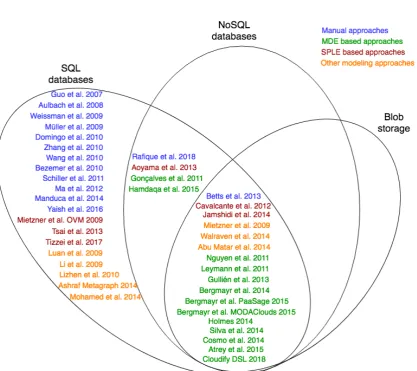
Query Language (NoSQL) databases, and blob storage. . . 29 3.1 The development phases of CadaML following the methodology
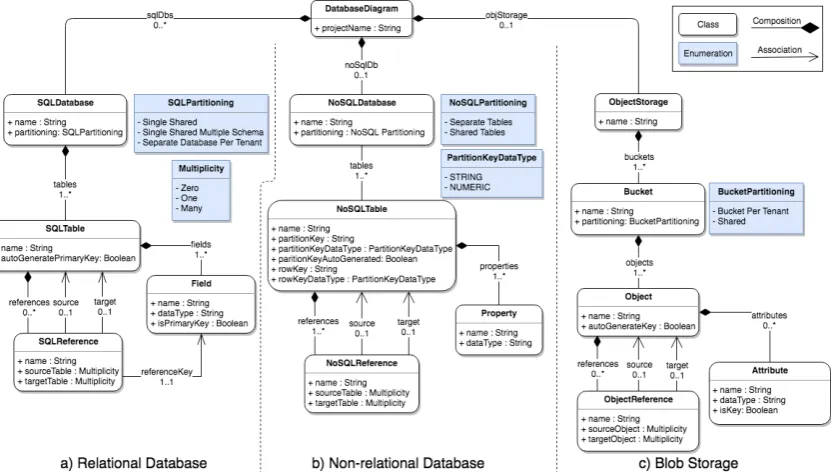
pre-sented in [91]. . . 34 3.2 Selected concepts and terminology for CadaML. . . 39 3.3 CadaML meta-model in UML class diagram. . . 42 3.4 The concrete syntax of CadaML implemented as the graphical editor
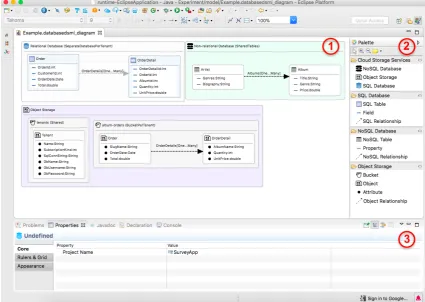
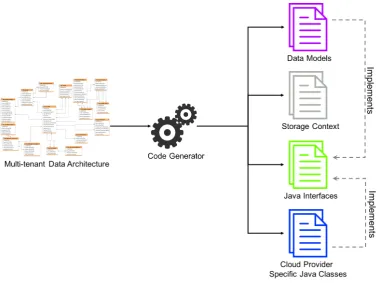
with three parts: ¨ canvas≠ palette, and Æ properties tab. . . 50 3.5 CadaML code generation process. . . 53 4.1 Comparing the implementation processes of the manual approach and
that of CadaML. . . 60 4.2 The business process application architecture. . . 64 4.3 The Entity Relationship (ER) diagram of the business process
appli-cation. . . 65 4.4 The evolution of the use case application from single- to multi-tenancy. 66 4.5 The evolved multi-tenant data architecture modeled in CadaML. . . . 69 4.6 The first deployment scenario: the evolved architecture of the
busi-ness process application that is deployed to services of AWS. . . 70 4.7 The second deployment scenario: the evolved architecture of the
5.3 The participants’ self-reported programming experience in years. . . . 86
5.4 The number of participants based on self-reported experience in cloud application development and modeling. . . 86
5.5 The number of participants based on self-reported experience in ex-ploiting cloud service providers, and their allocation. . . 87
5.6 The number of participants based on self-reported expertise level in years in cloud application development and modeling tools, and their allocation. . . 88
5.7 Object storage data architecture modeled in CadaML. . . 89
5.8 Non-relational data architecture modeled in CadaML. . . 90
5.9 Relational data architecture modeled in CadaML. . . 91
5.10 The distribution (median and interquartile range) of time taken by participants to finish the data layer implementation tasks using the 3 di↵erent datastore types. Using CadaML significantly reduces the development time. Note that only one participant attempted to ac-complish any progress on SQL using manual implementation, hence the very narrow box on the far right. . . 93
5.11 Participant feedback regarding productivity: all agreed that CadaML helps reduce implementation time and difficulty, but not all agreed that it was sufficient on its own. . . 96
5.12 Participant feedback on reliability: generated code is of high readabil-ity and low frequency of errors; but with mixed perceptions about the ability of finding errors in the generated code. . . 97
2.1 Total number of approaches and their application to di↵erent cloud
storage types . . . 17
3.1 Mapping cloud storage types to storage services of public cloud pro-viders . . . 36
3.2 Comparing concepts of non-relational databases to relational database 37 3.3 Comparing concepts of blob storage to filesystem . . . 37
3.4 Comparing the DSL implementation frameworks . . . 47
4.1 The distribution of test cases based on concerns under investigation per entity . . . 77
4.2 The expanded test cases for ProcessDefinition and Process entities . . 78
5.1 The participants’ self-reported expertise level in cloud APIs and stor-age services. . . 87
5.2 The participants’ self-reported expertise level in programming with Java. . . 88
5.3 Time spent (in h:min:s) and completion rate (CR) by participants for each storage type through manual implementation . . . 91
5.4 Time spent (in h:min:s) and completion rate (CR) by participants for each storage type using CadaML . . . 92
5.5 The distribution of test cases planned for each storage type per par-ticipant. . . 94
5.6 The distribution of test cases that were planned and execute with their success and failure status. . . 94
A.1 Characteristics of Alibaba Object Storage Service (OSS) . . . 129
A.2 Characteristics of Amazon S3 . . . 130
A.3 Characteristics of Azure Blob Storage . . . 130
A.4 Characteristics of Google Cloud Storage . . . 131
A.5 Characteristics of Alibaba Table Store . . . 132
Introduction
Cloud computing has become a major service provisioning paradigm as it provides powerful, reliable, and efficient platform to build and deploy cloud applications. It delivers on-demand, flexible and configurable computing resources over the Inter-net. Hence, instead of purchasing their own hardware and software infrastructure, cloud customers exploit computing resources over the network, and pay only for the resources they actually need and use. With the rapid growth of more efficient and a↵ordable services o↵ered by major cloud service providers such as Amazon, Google, and Microsoft, application providers are shifting to cloud environments.
Cloud computing resources can be provisioned as a virtual infrastructure, a plat-form, or predefined services. Most commonly application providers use computing resources delivered as a platform to develop and host their predefined services. These services range from email services to business oriented applications. Moreover, ap-plication providers tend to deploy multiple customers to a shared service with each customer enabled to configure or even customize the service based on its needs. Nevertheless, customers must be able to access and use a shared service as it it is a dedicated one. Therefore, this thesis considers the challenges associated with sharing a single application across multiple customers. In particular, the thesis in-vestigates the concerns related to sharing data, and propose a solution to address these concerns.
1.1
Cloud Computing
In recent years, cloud computing has been widely exploited to deliver services over the Internet as it o↵ers many advantages in comparison with existing traditional service providers. By definition, cloud computing is a paradigm that provides on-demand access to configurable computing resources to develop and deploy cloud applications [90]. The main factors that trigger application providers moving their applications to the cloud are the flexibility in resource provisioning and payment on the usage basis which lead to significant reduction in initial costs and transition from capital investments to operational expenses [90].
1.1.1
Cloud Service Models
[image:19.595.136.478.408.744.2]As illustrated in Figure 1.1, there are three di↵erent service models [90] that allow outsourcing varying degrees of computing resources and hardware maintenance to a cloud provider. These models have their own benefits as well as di↵erences in the amount of control over hardware and software resources they provide, and in the level of responsibility in managing them. The following describes each service model and its characteristics.
• Infrastructure as a Service (IaaS) model provides a pool of infrastructural resources such as servers, storage, and networking that are provisioned using virtualization technologies. In this model, cloud customers typically install a software stack which consists of an operating system, middleware and runtime environment to deploy their applications. Managing and maintaining the soft-ware stack is the responsibility of the customer, while managing the underlying infrastructure is handled by the cloud provider. The examples of IaaS provi-sioning services include AWS, Cisco Metacloud, DigitalOcean, Google Compute Engine (GCE), Linode, Microsoft Azure, and Rackspace.
• Platform as a Service (PaaS) model delivers operating systems and associ-ated application services that facilitate development, testing, deployment and maintenance of applications without the need for investment in infrastructure and software environment. PaaS provides an environment to run cloud applica-tions, services for data storage, and a number of additional services to fully sup-port deployment of cloud applications. In order to benefit from the capabilities of the cloud platform, it is necessary to significantly evolve existing applications, or even implement a new one. As the evolution we refer to the modification of the application to adapt for the cloud environment. Most commonly exploited PaaS services comprise Apache Stratos, AWS Elastic Beanstalk, Force.com, Google App Engine (GAE), Heroku, OpenShift and Windows Azure.
• Software as a Service (SaaS)model enables customers to access applications running on a cloud infrastructure (e.g., Cisco WebEx, Concur, GoToMeeting, Dropbox, and Salesforce). In this model, the application and associated data are hosted in the cloud and customers subscribe to the application over the Internet. This, in turn, eliminates the need to install and maintain the appli-cation, and it also removes the necessity to manage and control the underlying cloud infrastructure. Nevertheless, customers have no control over individual application capabilities, they are only enabled with limited user-specific appli-cation configuration settings.
application providers [115], and makes PaaS the most commonly used service model to develop and run SaaS applications [131]. Moreover, the demand for PaaS ser-vices is rapidly growing [33], and cloud service providers encourage building SaaS applications using PaaS services by o↵ering a complete set of tools and design guide-lines [17, 58, 105, 125]. Based on this, we investigate how SaaS applications can be implemented using services of the PaaS provisioning model and deployed on top of them.
1.1.2
Multi-tenancy in SaaS
In traditional application provisioning models each customer is deoployed to its own independent application, database and software stack that are customized based on customer’s requirements. However, this model has many drawbacks, such as inefficient resource utilization, limited scalability, and high maintenance e↵ort and deployment costs [18,19,126]. In order to address these drawbacks, application pro-viders have been adopting multi-tenancy pattern, where multiple tenants share an application with its supporting infrastructure while being able to configure the appli-cation for their needs [68]. In this context, atenant is a group of users that belongs to an organization who has access with specific privileges to an application [74].
Figure 1.2: Multi-tenancy patterns to deploy tenants and their resources.
As illustrated in Figure 1.2, there are generally two resource sharing approaches in multi-tenancy [26]: multiple instances multi-tenancy and single instance multi-tenancy. In multiple instances multi-tenancy, each tenant has a dedicated applica-tion instance on a shared hardware, operating system, or middleware. Whereas in
tenants must be able to configure and extend the application to their needs as it runs in a dedicated environment.
Multi-tenancy approaches o↵er di↵erent benefits and drawbacks, and choosing one approach over another depends on application requirements and architectural considerations. The multiple instances pattern (i.e., Shared Hardware and Shared Operating System (OS)) provides more security compared to the single instance
pattern as each tenant’s application and data are completely separate from each other. The chance of accidental access other tenant’s data is essentially eliminated. This type of isolation also prevents performance degradation which leads to higher reliability and provides tenants with full control over the environment. Nevertheless, cloud providers have limits on the number of application and database instances that can be created. Moreover, the multiple instances approach is usually costly and labor-intensive as it requires maintenance of multiple application and database instances, and it is inefficient in terms of resource utilization.
In contrast, thesingle instance approach addresses the limitations of themultiple instances technique. Primarily, tenants share the same application and database in-stances that dynamically scale on demand, hence, this approach can support a much larger number of tenants [17, 26, 29, 105], and maximizes resource usage. Further-more, application and database maintenance becomes easier since a single instance of each has to be maintained. All these factors significantly reduce overall operational and energy costs of resource provisioning and software maintenance [1,21,37,52,123], and encourage application providers to adopt this pattern for their existing applica-tions. Throughout this thesis, we focus on thesingle instance multi-tenancy pattern, explore the key requirements, and consider the challenges introduced by this pattern.
1.1.3
Domain-Specific Languages (DSLs)
Multi-tenancy in cloud applications introduces a set of concerns that could be en-capsulated into DSLs, specifically, to generate and/or maintain cloud application implementations [1]. A DSL is a concise, simple and expressive language that is fo-cused on addressing problems of a particular domain [43]. DSLs can raise the level of abstraction by enabling specification of a model of an application directly using domain concepts, and improve productivity of developers during the application development by generating an application from the high-level model [85].
the Entity Framework (EF) designer from Microsoft1 is used for visual modeling of persistent classes, generating a database schema from a model, and producing code in C# to interact with SQL Server databases.
In this thesis, we aim to implement a DSL to address multi-tenancy concerns in cloud applications. A DSL for multi-tenancy would possibly comprise concepts to represent tenants, their configurations, cloud providers, tenant database, tenant schema, and deployment specifications.
1.2
Motivation
Software evolution is an inevitable process in any software system that requires modification of software to adapt to changes [120]. The reasons that call for evolution to multi-tenancy include changes in business requirements, changes in hardware and software platforms, improving resource provisioning and application maintenance, or changes in the application delivery model. In this section, we describe some of the evolution motivations that typically lead to introducing multi-tenancy in existing applications.
Most importantly, provisioning and deploying dedicated application and database instances for each tenant is time consuming and labor-intensive [18]. Providing an application and a database for new tenants usually requires preparation of the de-ployment infrastructure, configuration of networks, installation of all necessary soft-ware, and ensuring proper functioning of the infrastructure. Nevertheless, tenant demands need to be met more quickly and efficiently than the traditional deployment procedures allow.
Another issue with traditional application provisioning is that much of the in-frastructure is used inefficiently. As it is difficult to predict an application workload, application and database instances are deployed on servers that are configured to provide enough resources during high workload. Thus, the majority of servers are underutilized during normal workload [18, 19, 21, 37, 52, 73, 123]. This inefficiency could be optimized using better application deployment solutions.
A final issue is that maintenance and support of several web application and database instances require additional e↵ort. For application providers, it is impor-tant to fix tenants’ problems before they become expensive to resolve. Moreover, providing on-time and sufficient support is crucial to keep tenants satisfied with the application. The nature of cloud environments along with multi-tenancy patterns could address these issues by providing lower costs through economies of scale and resource sharing, automated management of the application resources, centralized
control over the application with its supporting infrastructure, and dynamic scala-bility.
1.3
Challenges
Despite its benefits, introducing multi-tenancy a↵ects the overall application stru-cture which requires application providers to address multiple challenges and find a balance between several architectural trade-o↵s [74]. The following multi-tenancy concerns along with design factors influence the application design, and they are listed in the order of importance.
• Transparent tenant isolation: When multiple tenants share the same application instance with its supporting infrastructure, isolation among di↵erent tenants is the highest priority. In a shared environment, each tenant must be able to access and use the application as if it is a dedicated one. Nevertheless, tenants must be able to view and edit only their own data. Hence, tenant isolation must be carefully considered in all layers of the application architecture from both functional and non-functional perspectives.
• Configurability and extensibility: In the traditional application provisioning model, each tenant is able to be served by customized application and database instances based on its requirements. In multi-tenancy, such customization is not applicable since customization of one tenant will impact the whole appli-cation. As a result, multi-tenant applications must provide a mean for tenants to configure and extend the application and database at run-time to cater for their needs without a↵ecting other tenants sharing the application.
• Scalability: In multi-tenancy the application and database workload varies as several customers of multiple tenants interact with a single application and database. To avoid disruption and enable smooth running of the services, appli-cation providers must ensure scalability of the solution by dynamically creating and releasing application resources to match the performance requirements [59].
These challenges influence all layers of an application architecture. This is espe-cially true in the case of the data layer which is often the prime candidate for multi-tenancy [52], as other layers are typically stateless in cloud applications [11, 38]. Stateless layers do not store any tenant data since they are provided with each re-quest [40]. Therefore, throughout this thesis, we focus on the data layer, analyze how these challenges influence the data layer of multi-tenant cloud applications that usually consists of di↵erent cloud data storage types, and investigate how these challenges can be addressed using modeling techniques.
1.4
Problem Statement
When building a multi-tenant application, one of the highest priorities for developers is to design a configurable and scalable data architecture that maximizes resource sharing across tenants, and one that is also efficient and cost-e↵ective to implement and maintain [28]. However, cloud applications usually have a variety of data storage requirements and are often best served by a combination of multiple data storage options [110, 116, 125]. These storage options di↵er in storing and organizing data. Moreover, each storage option has its own partitioning and extensibility approaches to support multi-tenancy.
Cloud providers o↵errelational databases,non-relational databases and blob/ob-ject storage at the PaaS provisioning level for storing application data. Relational databases are appropriate for structured data with a well-defined schema where data is organized in tables, rows and columns, and aprimary key identifies each row in a table. Relationships among tables, columns and other database elements are strongly defined in the data model. On the contrary,non-relational databases (also called NoSQL) are suitable for flexible data schemas and they support key-value store models. Data is also stored in tables, where a partition key determines the partition in which data will be stored, and a row key identifies data within each partition. In turn, Blob/Object storage is ideal for completely unstructured data such as documents, media files, or binary data. Data is stored in buckets as a blob, where akey uniquely identifies each blob (i.e., object or item) within a bucket.
table. Similarly, non-relational databases can be partitioned by either deploying
separate tables per tenant, or sharing tables across all tenants. Whereas for blob storage all blobs belonging to a specific tenant can be stored in a dedicated bucket, or all tenant data can be stored in shared buckets.
Furthermore, cloud providers o↵er similar data storage services, though they provide di↵erent libraries and APIs to implement the data layer. For example, Al-ibaba Cloud requires manually creating an instance of a non-relational database, meanwhile for other cloud providers a database instance can be created using their APIs. In addition, cloud providers use their own annotations for mapping classes and properties to tables and attributes in actual non-relational databases. As an-other example, a deployment region for blob storage can be assigned at run-time for Alibaba and AWS, but for Azure and Google this must be specified when creating a storage credentials and creating a project in GAE, respectively. More detailed char-acteristics of di↵erent cloud data storage types and comparison of APIs provided by major cloud providers are presented in Appendices A and B.
Given these varying cloud data storage solutions, partitioning schemes and APIs, manually implementing a multi-tenant data architecture can be highly time-consuming and error-prone [23, 45], especially for architectures utilizing more than one storage type. Recent research has aimed to generate multi-tenant cloud applications from high-level models in order to hide cloud-specific implementation details, e.g., [20, 41, 88, 94, 97, 103]. Several modeling languages have been proposed in this direc-tion. As an example, an eXtensible Markup Language (XML)-based modeling language is provided by Topology and Orchestration Specification for Cloud Ap-plications (TOSCA) to define application components and their relationships [8]. Another example, Cloud Application Modeling Language (CAML) is proposed to express cloud-based deployments directly in an application model [15]. However, these modeling languages tend to focus less on managing multi-tenancy in the data layer, and instead focus on other aspects such as enabling configurable application functionality, capturing di↵erent functional and quality-of-service tenant require-ments, and modeling variation of business logic implementation and deployment alternatives. Although there is a few approaches that tackle multi-tenancy at the data layer, none of them allow to capture multi-tenancy patterns in the data layer, produce the data access code from the model, or consider di↵erent cloud storage types with their partitioning peculiarities.
In conclusion, we come up with the following research areas that need improve-ments:
• Current modeling approaches should capture varying data architecture parti-tioning and extensibility alternatives of di↵erent cloud data storage types.
• Current modeling approaches should provide a way to build a multi-tenant data architecture that abstracts from the implementation di↵erences of di↵erent cloud data storage types.
• Current modeling approaches should expedite data layer implementation by reducing the development overhead and minimizing errors in the application code.
1.5
Research Aim & Objectives
This thesis aims to facilitate implementation of multi-tenancy at the data layer of cloud applications. Specifically, we investigate how applying MDE techniques could benefit to raise the level of abstraction when building multi-tenant data architec-tures, expedite the development process, and increase the productivity of developers. In MDE, models are the key artifacts throughout the engineering lifecycle and they represent abstract description of an application from a certain viewpoint. As the main contribution of the thesis, we propose a cloud data architecture modeling language (CadaML) to design a multi-tenant data architecture and generate source code from the model that is suitable for di↵erent cloud storage types. We set the following objectives to achieve our aim.
RO1: Analyze existing approaches that consider multi-tenancy challenges at the data layer of cloud applications. This will help to assess the previous and current research in multi-tenancy, gain insights into the practical challenges of implementing multi-tenancy at the data layer, and explore methods for data collection and evaluation of modeling languages.
RO2: Provide a way to describe a multi-tenant cloud data architecture at an abstract level. This is based on the realization that cloud providers o↵er their own libraries and APIs to implement the data layer. Hence, a data architecture designed using the modeling language should hide the implementation details by only representing data layer related components while also capturing data partitioning and extensibility to address the multi-tenancy challenges. From the data architecture, the modeling language should be able to produce the data access layer code that can be deployed to services of di↵erent cloud providers.
time-consuming and error-prone, the modeling language should mitigate and reduce the development e↵ort by (semi-)automating the data layer imple-mentation process.
RO4: Improve reliability of the application code (specifically at the data layer). For the same reason as in RO3, the modeling language should reduce the number of errors in the application code by means of model validation and automated code generation.
RO5: Provide developers with a reasonable level of usability. By proposing a mod-eling language, we aim to increase the productivity of developers, reduce the development e↵ort and improve the quality of the data access layer code. However, the modeling language needs to be intuitive to exploit, suitable to implement multi-tenancy, and it should not require much e↵ort or time to learn it.
1.6
Research Methodology
We divide the work in this thesis into three main research phases in order to sys-tematically achieve the above research objectives, and aim.
• Phase 1: Literature surveyof existing manual approaches along with model-based and model-driven modeling languages, tools and frameworks in order to define the overlap and identify the gap in the current research (Supportive of RO1).
• Phase 2: Developmentof a modeling language which simplifies and expedites the implementation of multi-tenant data architectures of cloud applications (Supportive of RO2and RO5).
• Phase 3: Evaluation of the modeling language in terms of its applicability to evolve an industrial single-tenant web application into a multi-tenant SaaS, productivity of real developers with varying abilities, reliability of the generated code, and usability of the language (Supportive of RO3,RO4, and RO5).
followed by the implementation of the modeling language (Phase 2: Development), and subsequent evaluation (Phase 3: Evaluation).
Figure 1.3: Overview of the thesis design where chapters are mapped to research phases.
Phase 1 reviews relevant approaches that tackle multi-tenancy in cloud applica-tions to (i) outline the importance of the research scope being considered; (ii) iden-tify weaknesses and limitations of the current research; and (iii) analyze di↵erent methodological approaches that have been applied for investigation of multi-tenancy concerns, data collection and evaluation of modeling languages.
Phase 2 involves identifying requirements for concepts and terminology that must be included in the modeling language, and meta-modeling language for the implementation of the language. It also involves defining the methodology for the development of the language which includes domain analysis, design and implemen-tation. The requirements and methodology are based on the findings of Phase 1
and analysis of the literature to develop DSLs.
Phase 3 evaluates the modeling language in terms of its application in a real-world application, e↵ectiveness at facilitating productivity of developers and relia-bility of the data layer code, andusability of the language. The evaluation is carried out in two stages. The first stage inspects the applicability of the modeling language to design and implement multi-tenancy at the data layer using qualitative evalua-tion. This includes conducting a case study to evolve a data layer of an industrial web application to adopt multi-tenancy, and demonstration of the correctness of multi-tenancy implementation through a combination of manual review and JUnit testing. The second stage evaluates the benefits and drawbacks of the language through a controlled experiment with task analysis. This approach involves ob-serving interaction of real developers with the modeling language, analyzing their performance and productivity, and collecting their experience through a structured questionnaire, an exit interview and open-ended questions.
1.7
Contributions
Literature review
C1. A literature search that covers current manual and modeling approaches, and patterns for developing multi-tenant cloud data architectures (RO1).
C2. Comparison of existing approaches to outline the overlap and gap in the state of the art (RO1).
Development
C3. A set of requirements for concepts and terminology for the modeling language formulated based on design methodology on DSL development (RO2).
C4. A set of requirements for a meta-modeling language to implement the mod-eling language (RO2).
C5. A domain model that includes common vocabulary of available cloud data storage solutions at the PaaS service level o↵ered by four major public cloud providers and their partitioning alternatives (RO2).
C6. A meta-model of the language, its design and implementation that support the requirements specified in C3 and C4 and integrates them into a graphical modeling language to build multi-tenant data architectures (RO2).
C7. A set of deterministic validation rules to ensure consistency of a model created using the modeling language, and reliability of the model-to-code transfor-mation (RO3 and RO4).
C8. A code generation tool that uses a validated model to synthesize a data layer implementation with multi-tenancy management logic that corresponds to the specific data storage types and policies selected by the developer (RO3 and RO4).
Evaluation
C9. A qualitative evaluation of the modeling language through a case study of an industrial web application. The aim of the evaluation is to assess the feasibility of the modeling language to design and implement the data layer of multi-tenant cloud applications (RO3and RO5).
1.8
Thesis Organization
The thesis consists of six chapters. The following gives an overview of chapters and associates each chapter with resulted contributions.
• Chapter 1 - Introduction outlines the work of the thesis.
• Chapter 2 - Related Work
Chapter 2 presents and discusses current academic and industrial research works that are geared towards addressing multi-tenancy challenges at the data layer. The related researches are covered by dividing them under four categories: man-ual methods,MDE based techniques,SPLE based techniques, andother modeling approaches. This chapter also analyzes the overlap and identifies the gap in the state of the art (C1 and C2).
• Chapter 3 - Proposed Solution
Chapter 3 proposes CadaML to fill the gap in the current research. The chap-ter starts with specifying the requirements for the concepts and meta-modeling language, and it introduces the methodology for the development of CadaML. This is followed by domain analysis, design and implementation of the mod-eling language. Finally, the chapter validates the language implementation by reflecting on the specified requirements (C3-C8).
• Chapter 4 - Application & Qualitative Evaluation of CadaML
Chapter 4 describes the application of CadaML and presents a qualitative eval-uation of the language through a case study. The application demonstrates the transformation of a data layer from single- to a multi-tenancy using the modeling environment of the language, and highlights the capability of the lan-guage to design di↵erent multi-tenancy options at the abstract level, and to produce the corresponding data access layer code from the model. The qualita-tive evaluation shows the evolution of an industrial business process analyzing web application from single-tenant on-premises to a multi-tenant service de-ployed to a public cloud. This chapter also discusses reflection on evolution challenges, and comments on the limitations of the performed case study (C9).
• Chapter 5 - Experimental Evaluation
conduct the experiment. The chapter continues by describing the expertise level of participants in programming, cloud application development, cloud data layer development, modeling tools and their allocation. Further, the modeling process of the data layer using CadaML is explained. The chapter, then, illustrates the evaluation results, discusses the limitations of the experiment, and analyzes threats to validity (C10).
• Chapter 6 - Discussions & Conclusions
Chapter 6 summarizes the chapters with overall discussions and conclusions of the thesis.
1.9
Publications
The following presents my major contributions that are published in peer reviewed workshops and conferences. The publications are listed in chronological order and mapped to chapters of this thesis they most relate to.
1. Assylbek Jumagaliyev and Jon Whittle. Model-Driven Engineering for Multi-tenant SaaS Application Development. In Proceedings of the 3rd Workshop on CrossCloud Infrastructure & Platforms co-organized with Eurosys Conference 2016, pages 1–2, 18-21 April 2016 [65] (Chapter 2)
2. Assylbek Jumagaliyev, Jon Whittle, and Yehia Elkhatib. Evolving Multi-tenant SaaS Cloud Applications Using Model-driven Engineering, In Proceed-ings of 10th International Workshop on Models and Evolution co-organized with MODELS Conference 2016, pages 60-64, 2-7 October 2016 [66] (Chapter 3) 3. Assylbek Jumagaliyev, Jon Whittle, and Yehia Elkhatib. Using DSML for
Han-dling Multi-tenant Evolution in Cloud Applications, In Proceedings of IEEE International Conference on Cloud Computing Technology and Science (Cloud-Com), pages 272-279, 11-14 December 2017 [67] (Chapters 3 and 4)
4. Assylbek Jumagaliyev and Yehia Elkhatib. CadaML: A Modeling Language for Multi-Tenant Cloud Application Data Architectures, accepted to IEEE Cloud Conference 2019 [64] (Chapters 3)
Related Work
This chapter provides detailed discussion of the previous and current approaches that consider multi-tenancy at the data layer. First, section 2.1 gives a high level overview of the approaches and their application to di↵erent cloud storage solu-tions. Then, manual approaches are described in section 2.2, followed by modeling techniques based on Model-Driven Engineering (MDE) and Software Product Line Engineering (SPLE) in sections 2.3 and 2.4, respectively. Section 2.5 presents mod-eling techniques that combine MDE and SPLE, and those that use other modmod-eling approaches. Finally, section 2.6 concludes the chapter by analyzing the overlap and identifying the gap in current approaches.
2.1
Overview
Several approaches have been proposed so far to address multi-tenancy challenges in cloud applications. These approaches have very similar goals but tackle multi-tenancy concerns in di↵erent ways. They can be classified as manual implemen-tations and modeling techniques based on MDE, SPLE, and other modeling approaches.
Manual implementations are aimed at partitioning and isolating tenant data through manual development. In turn, modeling techniques are geared towards expressing customization and configuration alternatives in an application structure, and describing deployment of application components on cloud services. Generally, MDE based techniques have been implemented as extensions for general purpose modeling languages or standalone DSLs. Meanwhile, SPLE based techniques have exploited well known modeling techniques such as feature modeling and Orthogonal Variability Modeling (OVM).
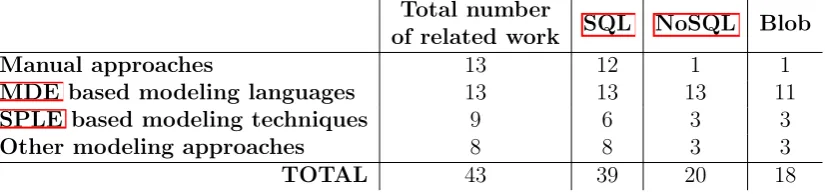
Com-Table 2.1: Total number of approaches and their application to di↵erent cloud stor-age types
Total number
of related work SQL NoSQL Blob
Manual approaches 13 12 1 1
MDE based modeling languages 13 13 13 11
SPLE based modeling techniques 9 6 3 3
Other modeling approaches 8 8 3 3
TOTAL 43 39 20 18
puting Machinery (ACM) Digital Library, SpringerLink 1, IEEE Xplore 2, Central Europe (CEUR) Workshop Proceedings 3, Google Scholar 4, ScienceDirect 5, Sco-pus6, and ResearchGate7) have been used as primary searching sources. The search for publications was filtered from 2006 onward as cloud providers such as AWS, Google Cloud Platform (GCP) and Alibaba Cloud started officially launching their services from this year. The following terms were included in the search queries:
‘multi-tenancy’, ‘data architecture’, ‘data layer’, ‘modeling’, ‘domain-specific lan-guage’, ‘model-driven engineering’. The search was also limited to studies that are indexed by the keyword ‘cloud computing’. The publications from the search results were further filtered for relevance by reading their abstract and conclusion sections. As presented in Table 2.1, in total 43 academic and industrial studies have been identified as relevant during the literature survey. Among these studies, manual approaches and MDE based modeling languages have 13 papers related to each, 9 papers refer to SPLE based modeling techniques, and the remaining 8 papers are based on other modeling approaches. Table 2.1 also emphasizes the application of approaches to di↵erent cloud storage types. Specifically, a total of 39 papers discuss multi-tenancy in relational databases, 20 cover non-relational databases, and 18 capture blob storage.
2.2
Manual Approaches
Enabling multi-tenancy in relational databases has been commonly achieved thro-ugh manual implementation. In some approaches, multi-tenancy is implemented by means of schema-extension techniques and the use of metadata. Other approaches propose an additional layer to ensure data isolation of tenants and customizability
1http://www.springerlink.com 2http://ieeexplore.ieee.org 3http://ceur-ws.org/
[image:34.595.88.501.112.210.2]of the data layer.
2.2.1
Schema-extension Techniques
Schema-extension techniques have been introduced to extend the base schema in a database in order to support customization of the data layer. The base schema contains a set of core tables that is shared across all tenants, and extension schemas define extensions and specify the purpose of extension elements.
Three generic structures have been described in [9] to achieve customization of a single shared relational database: (i)Universal table, (ii)Pivot table, and (iii)Chunk table. Auniversal table stores a large number of genericdata columns, a tenant col-umn, and a table column. The data columns have a flexible type (i.e.,VARCHAR) that can be converted into other types during the runtime. The tenant column identifies a tenant that owns columns, while thetable column defines a logical table. Thus, tenants can extend the same table in di↵erent ways. The same approach is also adopted by Salesforece.com [132]. However, one significant drawback of this approach is that the generic table has to store many null values that may lead to misinterpretation of these values, and inefficient usage of the database storage space [136].
A pivot table eliminates the need to handle many null values. In a pivot table, each field of the logical tables is mapped into a physical row. In addition totenant
and table columns, a pivot table includes row and col columns to specify a source field that a row represents and a value stored in that field. Nevertheless, apivot table
has more columns to store meta-data than actual data that also requires additional storage space.
A chunk table is an alternative to pivot tables but the col column is replaced by a chunk column. In a chunk table, a data is partitioned into chunks, and a
chunk identifier is assigned to each chunk. In all three cases, query transformation is required to produce appropriate queries that operate over the generic structures. Similarly, a database design technique proposes using common tenant tables, ex-tension tables, andvirtual extension tables in a single shared relational database [135].
Common tenant tables are physical tables that are shared across all tenants. In con-trast, extension tables store meta-data to extend an existing physical multi-tenant database schema. Further, virtual extension tables are created at run-time from
can be combined to extend the physical database schema, or (iii) virtual extension tables can be used to create a tenant-specific virtual database schema.
In another approach [112], a tenant-aware schema inheritance concept has been presented. The schema inheritance definesshared schema,virtual schemaandtenant schema types. A shared schema is static and all tenants share this schema. In turn, a virtual schema defines a core application schema that can be extended by each tenant through inheritance. As a result of extension, atenant schema is driven from the virtual schema. Furthermore, a tenant context is introduced to associate each
tenant schema with a corresponding tenant.
2.2.2
Metadata-Driven Techniques
In metadata-driven techniques, metadata is used to store configurations and exten-sions that are specific to each tenant. At run-time, an application retrieves these metadata and applies required configurations on a per-tenant basis.
In [87], an additional database is created to persist metadata that describes tenant-specific information such as tenant name, tenant domain, billing and tenant identifier. In this approach, a single shared database with shared schema has been adopted to support multi-tenancy at the data layer. Furthermore, a tenant resolver
and a data partitioner are implemented. The tenant resolver is implemented as a filter that intercepts web requests, analyzes the requests and extracts the tenant identity from the requests. Next, the tenant resolver determines the tenant from the extracted tenant identity by querying the database, and stores the tenant on the user session. In turn, the data partitioner is implemented using object mapper frameworks, and it defines parameterized default scopes for database operations (i.e., Create, Read, Update, and Delete (CRUD) operations). As a parameter the tenant identifier is set from the user session.
On the contrary, an existing application’s data layer has been evolved into a sin-gle shared database with separate schemas per tenant [134]. This partitioning model is chosen as it requires less manual modifications and lowers operational costs com-pared to other data partitioning models for relational databases. As in [87], an addi-tional database instance is deployed that is shared among all tenants. This database stores tenant information and configurations such as a tenant-specific schema ad-dress. When a tenant sends a request, the application connects to the additional database to retrieve the corresponding value of the schema address for that tenant and pushes it to a tenant’s session.
(i.e., Multi-tenant Database Index) that stores the data of which database corre-sponds to each tenant. Furthermore, a tenant identifier column is added to every existing table in the actual database to associate records in tables with an appropri-ate tenant. The data access layer also requires modifications to read configuration data from the Multi-tenant Database Index in order to route tenant requests to an associated database or records within. Finally, re-implementation of queries is needed to inject the tenant identifier.
Partitioning and tenant isolation in all three di↵erent cloud storage types have been discussed in [17]. Specifically, relational databases can be partitioned either by deploying: (i) a dedicated database per tenant with metadata associating each database with a corresponding tenant; (ii) a shared database with per tenant ta-bles where table name contains tenant identifier, or each tenant is assigned with a di↵erent schema; or (iii) single shared database with shared schema where tenant identifier is added to rows in all tables. In non-relational databases, each tenant may have its own set of tables with tenant identifier included in table name, or tenants share all tables with tenant identifier included in the partition key. Meanwhile, blob storage can be partitioned either by creating a bucket per tenant where a bucket name comprises the tenant identifier, or all tenants sharing the same buckets with the tenant identifier included in the blob name.
2.2.3
Multi-tenancy Enablement Layer
A multi-tenancy enablement layer [24] includes atenant context and an interceptor. Atenant context is an object that stores tenant information (e.g.,tenant identifier), whilst aninterceptor is a web filter that captures tenant information from thetenant context. Thetenant context is also used to propagate tenant information to perform data operations on a single shared database.
Another multi-tenancy enablement layer [26] has been proposed to provide on-demand customization and ensure isolation in security, performance, availability, and administration aspects in shared application and database by all tenants. Isolation of data is achieved by inserting the tenant-oriented filter into requests that require access to database. Hence, SQL queries are modified with a sub-statement (i.e.,
‘WHERE tenant id IS xxx’) to retrieve tenant-specific data.
interceptor and parser intercepts queries, and formulates new queries with tenant information to interact with the abstract data model. Then, a SQL request router
sends SQL request to di↵erent data cloud nodes to retrieve appropriate data from the database pool.
An additional data access layer [32] has been inserted between the business logic and the application’s database pool to enable multi-tenancy at the data layer. Ide-ally, the additional layer is responsible for creation of new tenants in the database, query adaptation to isolate tenants’ requests and load balancing to meet the chang-ing application workload. A property is added to the data model to identify whether a table is multi-tenant, and a tenant identifier is included to multi-tenant tables. To achieve tenant isolation, the query generator module needs to be extended to filter tenants’ requests by a tenant identifier. However, this approach only supports query adaptation.
An abstraction layer [98] has been implemented for back-end customization thr-ough injection of custom business logic. The abstraction layer separates business objects from the actual database, where abusiness object encapsulates business data and associated business logic. When a tenant requests abusiness object from an ap-plication, the abstraction layer intercepts a tenant identifier from the request, and retrieves a corresponding model from tenant-specific models. Note that each busi-ness object is mapped to exactly one tenant-specific model that consists of attributes, methods and relationships to other business objects. Then, arun-time object is cre-ated for the requested business object. During and after processing the request,
business objects are stored in a relational database by a data mapper. However, it is not clear how tenant data are isolated and which multi-tenant data architecture is applied.
Unlike other approaches, a middleware architecture PERSIST [104] has been implemented to enable dynamic configuration of NoSQL storage requirements for multiple cloud storage providers. The middleware consists of four di↵erent layers where the core layer is thedata management middleware layer. This layer uses Java Persistence Application Programming Interface (JPA) and Java Persistence Query Language (JPQL) to provide a data access in a cloud storage provider agnostic way. It also plays a role of a communication interface between SaaS applications and the middleware. Moreover, the middleware is capable of selecting the most suitable data storage solution based on tenant-specific meta-information regarding data storage policies. Nevertheless, the middelware incurs the same limitations as previous approaches, hence, it neither considers other cloud storage solutions nor di↵erent data partitioning alternatives to isolate tenants in non-relational storage.
cloud storage solutions [125], almost all manual approaches we surveyed implement tenancy in relational databases. Particularly, these approaches address multi-tenancy in a single shared database without considering other multi-tenant data architectures for relational databases. Surprisingly, only one approach [17] considers partitioning and tenant isolation in all three cloud storage options.
2.3
MDE Based Approaches
Modeling multi-tenancy at the data layer of cloud applications has been proposed in MDE based modeling languages. Most of these languages aim to automate the provisioning and deployment of cloud services. A few languages are geared towards portability and interoperability of cloud applications across di↵erent cloud prov-iders, and migration of existing applications to the cloud by generating deployment specification models. In general, modeling languages have been implemented as extensions for general propose modeling languages, or as independent DSLs.
2.3.1
Unified Modeling Language Extensions
CAML [15] has been proposed as an extension for Unified Modeling Language (UML) to express cloud-based deployments directly in UML models. Using this extension, a deployment topology is described in terms of CAML Library. Then, the deploy-ment topology is refined by applying a dedicatedCAML Profile to map deployments with cloud provider specific o↵erings. CAML Library uses common cloud modeling concepts that capture computing services (e.g., operating system, web server, ap-plication container), cloud storage options, and cloud services (e.g., load balancer, queue). CAML Profile comprises services from GAE and AWS. In CAML, di↵erent cloud storage options (i.e., block storage, blob storage, relational databases, and key-value storage) with consistency kinds (i.e., strict or eventual) are captured in
CAML Library.
type.
2.3.2
Domain-Specific Languages
An XML-based modeling language [8] has been provided by TOSCA to define application components and their relationships. Similarly, Cloud Modeling Lan-guage (CloudML)-Stiftelsen for Industriell og Teknisk Forskning (SINTEF) [14] has been proposed as a standalone DSL in the PaaSage8 project to express deploy-ment specification of application components. In both approaches, the data layer of an application can be described as a separate component with database properties. Specifically, TOSCA XML enables to specify a database engine, a virtual machine to deploy the database, and an operating system that runs on the virtual machine. In contrast, CloudML-SINTEF captures other database properties such as a database engine, a data structure type associated with the database engine, and consistency of the storage type.
Furthermore, CloudML-SINTEF has been evolved in Model-Driven Approach for Clouds (MODA-Clouds) 9 project to allow describing a data architecture associated with the applications data layer. The data architecture is expressed in terms of an Entity Relationship (ER) diagram and refined by a meta-model that specifies functional and non-functional data properties. Then, the data architecture is refined by cloud storage types (i.e., distributed file system, NoSQL databases, and blob storage) o↵ered by cloud providers in a cloud provider independent way. Later, the data architecture can be further refined by cloud provider-specific data structures to generate data definition scripts.
Cloudify DSL 10 is also based on TOSCA to describe an application with its resources (e.g., infrastructure, middleware, application code, scripts, tool configu-ration, metrics, and logs). The application descriptions are stored as blueprints in Yet Another Markup Language (YAML) documents. In addition to database re-lated properties, CloudifyDSL allows to specify life cycle operations (e.g.,configure, create, start and stop) in a generic manner. Similarly, using Zephyrus [34] the data layer can be specified as an application component with quality constraints (e.g.,
maximum number of components, minimum number of replicas).
Another XML-based modeling language, CloudML-Universidade Federal de Per-nambuco (UFPE) [47], allows to describe the data layer in terms of cloud resources and services with their requirements. Stratus Modeling Language (StratusML) [51] also captures an application structure as a composition of cloud services. In StratusML, a developer can specify a storage group that will be used to persist application’s data
8http://www.paasage.eu 9http://www.modaclouds.eu
and describe di↵erent data partitioning strategies. The similar approaches are also supported by Holmes [57] and Blueprint [99]. Though the latter approach enables expressing service-based applications from a combination of di↵erent services from di↵erent cloud service models (i.e., IaaS, PaaS, and SaaS). Thus, an application can be hosted by a combination of di↵erent cloud storage types from di↵erent cloud providers.
Move to Clouds for Composite Applications (MOCCA) [79] and CloudDSL [119] have been proposed to create deployment models to support migration of existing application to the cloud. MOCCA [79] provides a way to re-architect application components into groups of components where each group can be provisioned sepa-rately by di↵erent cloud providers. Whilst, CloudDSL [119] uses a common cloud vocabulary, for describing cloud IaaS services, to model an application architecture as an interconnection of cloud services. In both approaches, cloud storages are cap-tured as services with storage related configurations such as region to deploy the storage, storage type and security rules to access the storage.
Almost all of the proposed modeling languages allow to capture di↵erent cloud storage services to generate deployment configurations. This certainly helps to au-tomate deployment of application components to the cloud. However, none of the approaches explicitly enable to model a multi-tenant data architecture, or to pro-duce source code from it. In addition, partitioning and implementation peculiarities of di↵erent cloud storage types have not been considered.
2.4
SPLE Based Approaches
SPLE is another commonly adopted software engineering paradigm to model multi-tenancy in cloud applications that focuses on the development of software products from reusable core assets [78]. In SPLE based approaches, feature modeling [69] and OVM [102] techniques have been widely exploited to express di↵erent functional and quality requirements of tenants in an application structure. The main focus of these approaches is to support multi-tenancy by enabling customizability and configurability of application components.
2.4.1
Feature Modeling Based Techniques
Feature modeling is a domain analysis technique to identify common and variable aspects of an applications [69]. It provides concepts to visually represent an appli-cation as a hierarchy tree of features. A feature is a functionality or characteristic of an application, and it can be identified as a common, optional, alternative or
rest features represent variable functionality or quality that can be included in an application.
Feature modeling has been applied in [96], to capture configurable and customiz-able parts of an application. From a feature model, an application can be imple-mented as (i) application-based binary, or (ii) feature-based binary. In the former approach, multiple application instances are developed where each instance groups tenants with a di↵erent set of configurations and customizations. Whereas in the lat-ter approach, an application is built using Service-Oriented Architecture (SOA) and application components are configurable to support multi-tenancy. In addition, a hybrid approach has been proposed that leverages benefits of bothapplication-based
and feature-based approaches.
A similar approach has also integrated feature modeling with SOA to re-architect an existing application to support multi-tenancy [124]. Feature modeling is applied to represent common core artifacts and customizable features of an application dur-ing domain analysis. While SOA is exploited to implement and deploy application components as microservices to support scalability. The data layer multi-tenancy is achieved by deploying a separate database instance per tenant, where a tenant parameter is added to requests to specify a tenant-specific database. The signifi-cant drawback of these approaches is that feature modeling is only used to analyze and classify configuration and customization options, while the application itself is manually implemented after the analysis and classification. Moreover, data layer related configurability and customizability alternatives have not been captured in an application structure.
Feature modeling has been extended in [25] to complement features with at-tributes. An attribute is a measurable characteristic such as price, cloud provider, and availability. The main goal of the extension is to allow selection of cost-e↵ective cloud services for deployment. In this approach, relational and non-relational cloud storage services are grouped into a persistence feature, and blob storage services are captured as a file storage feature. Though, di↵erent partitioning and extensibility options of di↵erent cloud storage types have not been considered.
Service Line Engineering (SLE) method has been described in [130] to model customizable multi-tenant applications. SLE is based on SPLE techniques, but, it proposes a single shared customizable application instance to meet di↵erent tenant-specific requirements. In SLE, functional and non-functional application require-ments are initially modeled using feature modeling. From the feature model, a service line architecture is designed to describe all possible variations in the multi-tenant application. These variations are presented to multi-tenants during the provisioning process. Thus, tenants select and parametrize features which are transformed into tenant-specific software configurations. In this method, a data layer could poten-tially be represented in a feature model with all di↵erent cloud storage types and their partitioning alternatives.
2.4.2
OVM Based Techniques
OVM is similar to feature modeling, except that it only captures variable func-tional and quality requirements of an application in terms of variation points with
variants [102]. A variation point is a configurable functionality or quality, and a
variant is an available variation option. As in feature modeling, variation points
and variants can be either mandatory,optional or alternative.
In [94], OVM technique has been suggested to explicitly model di↵erent func-tional and quality features of an application in a separate view. The features are classified asexternal andinternal features. Theexternal features represent di↵erent requirements introduced by tenants, whereas the internal features are alternatives to implement di↵erent requirements imposed by the external features. In this ap-proach, data segmentation patterns (i.e.,shared database and separate database per tenant) are captured as quality features and presented as configuration options for tenants during tenant on-boarding process. Based on selected configuration options, the application performs necessary deployments actions for each tenant.
OVM technique has also been exploited in [118] to define customizability al-ternatives in a separate model. The main di↵erence of this approach from [94] is that the OVM is combined with Service-Oriented Architecture Modeling Lan-guage (SoaML). The role of the OVM model is to represent di↵erent application configuration options for tenants at run-time, where SoaML is used to define imple-mentation alternatives during the application development. Such approach allows modeling di↵erent business process workflows, services that perform business pro-cesses and components that implement services. However, multi-tenancy at data layer was neglected because the author does not consider it as a customization point at run-time.
![Figure 1.1: Separation of responsibilities in di↵erent cloud service models [61].](https://thumb-us.123doks.com/thumbv2/123dok_us/9303593.431076/19.595.136.478.408.744/figure-separation-responsibilities-di-erent-cloud-service-models.webp)

![Figure 3.1: The development phases of CadaML following the methodology presentedin [91].](https://thumb-us.123doks.com/thumbv2/123dok_us/9303593.431076/51.595.100.513.525.649/figure-development-phases-cadaml-following-methodology-presentedin.webp)