© 2019, IRJET | Impact Factor value: 7.34 | ISO 9001:2008 Certified Journal | Page 1308
Trust value calculation for Cloud Resources
K Prasanth Kumar
1, Prof. A. Ananda Rao
2, Dr. P. Radhika Raju
31
M-Tech Scholar, Department of Computer Science and Engineering, JNTUA College of Engineering,
Ananthapuramu, Andhra Pradesh, India
2
Professor, Department of Computer Science and Engineering, JNTUA College of Engineering, Ananthapuramu,
Andhra Pradesh, India
3
Ad-hoc Assistant Professor, Department of Computer Science and Engineering, JNTUA College of Engineering,
Ananthapuramu, Andhra Pradesh, India
---***---Abstract
- The trust is the important factor in the cloud computing environment for delivering the services for the users. In a cloud infrastructure the best cloud resources can be chosen by the users based on the Trust value. Therefore, this paper provides a methodology, for calculating the trust value of cloud resources, which uses the naive Bayesian mining technique for finding the trust values. By using the naive Bayesian algorithm to predict the test set results by visualizing the training dataset by using classifier classification. The reputation values for resources performance graph can be analyzed. Trust values are calculated by using parameters including accessibility, reliability, ability-based trust value of the resources Turnaround Efficiency and Reputation value of the resource. it generates reputation performance graph.Key Words: Accessibility, reliability, Ability, Turnaround Efficiency, Reputation.
1. INTRODUCTION
This paper is used for calculating Trust value for the Cloud resources. Previously some works are done on trust calculation, now here an extension to the previous works is done by adding the attributes and calculating those trust values based on the dataset which uses the naive Bayesian mining technique, which makes trust evaluation is more effective in cloud computing environment.
In Cloud computing platform, providing highly trustworthy services is most important and primary task. Because the users wish to send sensitive information as well as the computing tasks to the cloud data centers to secure and to maintain safe their information. Cloud providers used to controls maintains and manages the data that is stored in the physical servers for example like Apple in regards to the icloud and so on. For making cloud technology for commercialization purpose, The resource providers should build or maintain the trust with the cloud users by completing their submitted jobs based upon mutual SLA established b/w the users and the
Service provider, not only that but also it is required to see that the processed data is secured and safe at any cost[1].
The most important part of commercial aspects of cloud technology is the trust management [7, 12]. Now-a-days In distributed technology the cloud services are becoming popular because they allow the cloud users to rent best cloud resources from Cloud Service providers and provides the best services to customers, and also the storage infrastructure. Users pay as a rental basis for their use of services without spending huge amounts for maintenance, integration, and management of the IT infrastructure. Before the interaction happened between the cloud providers and the users it is very much important to build trust in the cloud relationship in order to reduce the malicious attacks and also security risk in the cloud.
In this paper, the main objective is to propose a methodology for calculating trust value for the cloud resources based on the formulas of Accessibility, reliability, ability-based trust value of the resources, Turnaround Efficiency and Reputation Value of a resource. Byusing the naive Bayesian algorithm to predict the test set results the obtained results are mentioned in Fig.3, Fig.4.
2. RELATED WORK
© 2019, IRJET | Impact Factor value: 7.34 | ISO 9001:2008 Certified Journal | Page 1309 attributes i.e., Accessibility Security, reliability etc. to
generate a heterogeneous multi dimensional Trust model in cloud [3].
Hwang and Li[4][10] They have suggested for implementation of reputation system in order to establish the trust b/w the Data owners and the service providers with using Trust overlay networks in many data centers, in the Cloud technology. Here they did not mention about problem that exists in Server side trust, they only mentioned on trust issues from user side.
Fan and Perros[4][9] The trust management framework have proposed by them in multi cloud environments that they intended for addressing necessary problems for the trust management in the multi-cloud environment of distributed environment of Trust Service Providers by using a Trust management architecture.
3. PROPOSED WORK
A method is proposed for calculating the trust values for the cloud resources by considering the formulas of attributes such as accessibility, reliability, ability of cloud resource, and turnaround efficiency these obtained values are computed using formula of Reputation value of the resource to generate the trust values, finally trust evaluation is calculated which uses the naive Bayesian mining technique for finding the trust values.By usingthe naive Bayesian algorithm to predict the test set results by visualizing the training dataset by using classifier classificationand the obtained values are mentioned in the Fig.3 and Fig.4.
For enhancing the description, there are some of the notations used for the time period T is defined:
Su indicates the no. Of jobs that are submitted to resource, similarly Acc indicates the no. of jobs that are accepted by the resource and Com indicates the no. Of jobs that are successfully completed, For the purpose of R resource, PS indicates the processor Speed, MS indicates the memory Speed, Band indicates total data transferred, Lat indicates the delay for reaching R resource, PSMax indicates the max speed of processes, MSMax indicates the max speed of memory, LatMin indicates the min delay existing in any link of the system.
Accessibility (ACC):
Accessibility is when a particular component or a system is readily available when they require need for usage purpose - IEEE90 [9]. Basically in case of software engineering, the accessibility is calculated with the mean time that is taken b/w the failures and the mean time for
repairing them [9]. The resource is said to be unavailable in one of the following situations mentioned below:
1. The resource may be busy to handle the job request. 2. Due to network problem.
3. The resource is not working properly or in a shut down state.
And, also there will be various reasons for the resource to be in unavailable state.
Accessibility of the Resource defines the total no. of jobs that are submitted i.e., Su ,Among them how many no. of jobs are accepted i.e., Acc.
Accessibility of the Resource (1)
Reliability (RE):
In case of trust, the key component is reliability. It is also called as Success rate. Reliability defines ability of particular system or a component for performing required functions based upon mentioned conditions for specific time period - IEEE90[ 9 ]. When a particular job is accepted b a resource, Then how reliably, it completes the job is to be identified. So, finally it can be defined as a finding jobs that are successful completed from the accepted jobs i.e., Acc by a cloud resource.
Reliability of the Resource defines the total no. Of jobs that are accepted by a resource i.e., Acc, among them how many no. Of jobs are completed i.e., Com.
Reliability of Resource (2)
Ability-based trust value of the resources R (Abr) [5]:
(3)
Turnaround Efficiency (TE):
© 2019, IRJET | Impact Factor value: 7.34 | ISO 9001:2008 Certified Journal | Page 1310 Turnaround Efficiency TE
(4)
Reputation value of the resource (Rep): = W1*ACC+W2*RE+W3*Abr+W4*TE (5)
The trust build on the QoS requirements [3].where the weights W1, W2, W3, and W4 these are taken as a +ve weights such that these weights are equalized to 1 i.e., W1+W2+W3+W4 = 1. Here the priority is considered for the weights and these are predestined. For Example, We will Considered the weights as W1= 0.2, W2= 0.2,W3= 0.2 and W = 0.4.
3.1 TECHNOLOGY USED
The technology used is Python; it is an interactive, object-oriented, interpreted, and high level programming language. It provides a syntax and the code readability of the python language and also provides a way of calculating the posterior probability with given predictor and allows the programmers to write their code in a fewer lines and conveying their concepts.
3.2 MODULES DESCRIPTION
Load the dataset: This module functionality is to load the dataset of 1000 records, which is used for prediction process. it helps to view the already loaded dataset. The dataset for different operations performed for prediction of reputation values. Preprocessing the data; it is basically used to analyze the given dataset. After analysis the data will apply the clustering processing, which is used to calculate the particular values. Prediction of performance: The Prediction of reputation values of dataset of 1000 records of different resources groups which consists of set of resources are analyzed and predicted. it has an ability to perform operations such as preprocessing techniques, feature extraction, prediction on the dataset and provides predicted output after performing the algorithm on the dataset are shown in Fig.2. Naïve bayes: This theorem is used to predicting the test set results by visualizing the Training set by using classifier classification: In this classification process different set of reputation values based on resources will be classified.
In Naïve Bayes theorem is a machine learning algorithm which is used for classification problems and quick prediction purposes it is primarily used for calculating the conditional probability. First step is importing the dataset. The second step is splitting of the dataset in the form of Training set and the Test set. Third step is feature scalingprocess with X_test and X_train.In the fourth step fitting the Naive bayes for the Training set by using the classifiers and GaussianNB. Fifth step is prediction of the
test set results of X_test, Sixth step is Making the Confusion Matrix Using y_test and y_pred. Seventh step is visualising the Training set results by equalizing X_set,y_set with the X_train, y_train, eight step is Visualizing the Test set results by X_set,y_set with the X_train, y_train with the matplotlib the obtained results are mentioned in Fig.4. The Prediction of resource group count consists the dataset of 1000 records as input the performance of the proposed approach is evaluated. In the classification process different set of resources are grouped together based on the resource groups for analysis purpose.
ALGORITHM:
Naive Bayesian# Step1: Importing the Dataset
dataset = pd.read_csv('Datset.csv') X = dataset. Values()
y = dataset. Values()
# Step2: Splitting the dataset into the Training set and Test set
fromsklearn.model_selection import train_test_split
X_train, X_test, y_train, y_test = train_test_split(X, y, test_size = 0.25)
# Step3: Feature Scaling
Fromsklearn.preprocessing Import StandardScaler sc = StandardScaler()
X_train = sc.fit_transform (X_train) X_test = sc.transform (X_test) # Step4: Fitting Naive Bayes to the Training set
from sklearn.naive_bayes import GaussianNB Classifier = GaussianNB ()
classifier.fit (X_train, y_train) # Step5: Predicting the Test set results
y_pred = classifier. Predict(X_test) # Step6: Making the Confusion Matrix
from sklearn.metrics import confusion_matrix cm = confusion_matrix (y_test, y_pred) # Step7: Visualising the Training set results
From matplotlib.colors import ListedColormap X_set, y_set = X_train, y_train
X1, X2 = np.meshgrid
plt.contourf (classifier. predict) plt.legend()
plt.show ()
# Step8: Visualizing the Test set results
From matplotlib.colors import ListedColormap X_set, y_set = X_test, y_test
plt.title ('Naive Bayes (Test set)') plt.legend ()
© 2019, IRJET | Impact Factor value: 7.34 | ISO 9001:2008 Certified Journal | Page 1311 For Example: Resouces_Group consists of Resources i.e.,
[image:4.595.312.561.59.204.2]Res_A, Res_B, Res_C, Res_D, Res_E in Fig.3. Here classification technique is used for calculating the sum of resources and the mean of the resources for the resource group, which it consists of set of resources with attributes such as accessibility, reliability, ability-based trust value of the resources, Turnaround Efficiency(TAT), resource group. Final total obtained results are mentioned in Fig.1, Fig.2, Fig.3 and Fig.4.
4. EXPERIMENTAL RESULTS
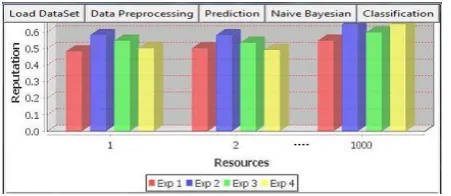
The experiment is done by using PyCharm with Python code using the naive Bayesian mining technique. Here the approach is tested and the generated outputs are mentioned in Fig.1, Fig.2, Fig.3, and Fig.4. The experimental detail is based on the dataset 1000 records as input the performance of the proposed approach is evaluated. For calculating the reputation value of cloud resources, Here four sets of weights which are of different values are considered, for example As for the 1st experiment the weights that considered is as W1 is 0.2,W2 is 0.2, W3 is 0.2, and W4 is 0.4. For the 2nd experiment different scenarios are considered, The weights are changed to W1 is 0.2,W2 is 0.2,W3 is 0.4, and W4 is 0.2. As for the 3rd experiment the weights as W1 is 0.2, W2 is 0.4,W3 is 0.2, and W4 is 0.2. for the 4th experiment, Weights are consider as W1 is0.4, W2 is0.2, W3 is 0.2, and W4 is 0.2.
[image:4.595.315.552.250.330.2]To implement a methodology, For calculating the Trust value for the cloud resources, which uses the naive Bayesian mining technique for finding the values. Here the experiment is done using PyCharm by taking the dataset of 1000 records as input which it consists of the attributes such as accessibility, reliability, ability-based trust value of the resources, Turnaround Efficiency(TAT), resource_id, resource group and reputation values. Each attribute values are calculated by using the formulas (1) (2) (3) (4) (5). it generates reputation performance modules of Bar graph from PyCharm in the Fig.1.
Fig.1. Modules of Bar graph from PyCharm
Fig. 2. The Prediction of resource group count using Navie Bayes thereom in PyCharm.
Fig.3. Results of Classification process using Naive Bayes theorem in PyCham
Fig.4. Results of Trust values for Resources through Naïve Bayes in PyCharm
5. CONCLUSION AND FUTURE WORK
[image:4.595.51.277.579.677.2]© 2019, IRJET | Impact Factor value: 7.34 | ISO 9001:2008 Certified Journal | Page 1312
REFERENCES
[1] Imad M.Abbadi, Muntaha Alawneh,“A framework for
establishing trust in the Cloud, Computers & Electrical Engineering”,Volume 38,Issue 5,September 2012,Pages 1073-1087
[2] L. J.Hoffman, K.Lawson-Jenkins, and J.Blum,“Trust
beyond security: An expanded trust model,” Commun. ACM,Volume l. 49,no.7,pp. 95–101,2006.
[3] X.Li, F.Zhou, and X.Yang,“A multi-dimensional trust
evaluation model for large-scale P2P computing,”J. Parallel Distrib. Comput.,Volume l.71, no.6, Pages.837– 847, 2011.
[4] Xiaoyong Li,JieYuan, Huadong Ma, and Wenbin
Yao,”Fast and Parallel Trust Computing Scheme Based on Big Data Analysis For Collaboration Cloud Service”, IEEE Transactions on information forenscics ans security, Volume l.13,NO.8, AUG 2018, Pages.1917-1931.
[5] Matin Chiregi,Nima Jafari Navimipour ,”Trusted
services identification in the cloud environment using the topological metrics”, Karbala International Journal of Modern Science 2 (2016) 203e210, Pages -203-210.
[6] GrandisonT, SlomanM (2000) A Survey of Trust in
Internet Applications.IEEE Communications Survey and Tutorials, Fourth quarter.
[7] Talal H.Noor, and Quan Z.Sheng, Trust as a Service:A
Framework for Trust Management in Cloud Environments, Web Information System Engineering– WISE 2011, Lecture Notes in Computer Science Volume 6997,2011, Pages314-321.
[8] IEEE 90 –Institute of Electrical and Electronics
Engineers, IEEE Standard Computer Dictionary: A Compilation of IEEE Standard Computer Glossaries.New York,NY:1990.
[9] W.Fan and H.Perros,“A novel trust management
framework for multicloud environments based on trust service providers,” Knowl-Based Syst,Volume l.70, Pages.392–406,Nov. 2014.
[10] K.Hwang and D.Li,“Trusted cloud computing with