© 2019, IRJET | Impact Factor value: 7.34 | ISO 9001:2008 Certified Journal
| Page 1199
Effect of Vibrations on Various Systems of Helicopter and its
Maintenance Implications
Sataynarain
1, Anil Punia
2, Anurag yadav
11
Post graduate student, Department of Mechanical Engineering, Rao Pahlad Singh College of Engineering and
Technology, Balana, Mohindergarh-123023
2
Assistant professor, Department of Mechanical Engineering, Rao Pahlad Singh College of Engineering and
Technology, Balana, Mohindergarh-123023
---***---Abstract - This study assesses the effect of helicopter
vibration environment on helicopter subsystem reliability, maintainability and life-cycle costs and the adequacy of design and acceptance test specifications applicable to helicopter vibration. In this study, differences in reliability and maintainability data were examined on two groups of Indian Navy Advanced Light Helicopter (ALH/Dhruv) helicopters with distinctly different vibration characteristics. One ALH helicopter group was equipped with the rotor-mounted bifilar vibration absorber, a device which reduces helicopter vibration induced by the rotor and a second aircraft group did not have the absorber. The aircraft were alike in all other respects. The analyses performed on these data show a significant reduction in the failure rate and direct maintenance for the ALH helicopters with absorbers and with reduced vibration levels. The overall ALH helicopter failure rate and corrective maintenance are reduced by 48% and 38.5% respectively. The average reduction in vibration level was 54.3%. Correspondingly, life-cycle costs show a significant reduction of approximately 10% for the overall aircraft. At the subsystem and component levels, the same reductions are shown in almost every case with the exception of certain navigation and avionics components. There are at least 15 military vibration specifications and standards which specify vibration criteria for design on test of airborne equipment. No obvious conflicts were found in these specifications, but they are lacking in requirements which clearly describe realistic vibration exposure times for the entire helicopter air vehicle system and its components. As shown by this study, reduction in vibration levels can significantly improve reliability and reduce maintenance and life-cycle costs. The results also suggest that the useful life of an aircraft can be extended beyond current limits simply by reducing vibration exposure.
1.
INTRODUCTION
The dynamic behavior of a rotary wing aircraft is characterized in contrast to a fixed wing aircraft by the existence of discreet vibration perks at fixed well known frequencies. The typical vibratory spectrum is caused by the dynamical system of the helicopter, consisting of main and tail rotor, several gear boxes, drive shafts in
© 2019, IRJET | Impact Factor value: 7.34 | ISO 9001:2008 Certified Journal
| Page 1200
of the theory is demonstrated by two illustrative examples of bending–torsion coupled beams with different end conditions, for which the influence of axial force, shear deformation and rotator inertia on the natural frequencies is studied. One of the reasons an asymmetrical rotor blade is not as stable is that the center of pressure changes with changes in angle of attack. When the center of pressure lifting force is behind the pivot point on a rotor blade, it tends to cause the rotor disc to pitch up. As the angle of attack increases, the center of pressure moves forward2. Peretz
P. et al. (1995) Vibration Reduction in Rotorcraft Using Active Control: A Comparison of Various Approaches . Based on the review of several approaches to active control of vibration reduction in helicopter rotors, one can make a few observations that summarize the current state of this fascinating area of research3. William R. et
al. (1999) Vibration problems in induction motors can be extremely frustrating and may lead to greatly reduced reliability. It is imperative, in all operations and manufacturing processes that down time is avoided or minimized. If a problem does occur the source of the problem is quickly identified and corrected. With proper knowledge and diagnostic procedures, it is normally possible to quickly pinpoint the cause of the vibration. All too often erroneous conclusions are reached as a consequence of not understanding the root cause of the vibration. This may result in trying to fix an incorrectly diagnosed problem, spending a significant amount of time and money in the process. By utilizing the proper data collection and analysis techniques, the true source of the vibration can be discovered4. Sang Joon S. et al.
(2003) Helicopter Performance and Vibration Enhancement by Twist-Actuated Blades the twist deformation is obtained using anisotropic piezo-composite actuators embedded in the piezo-composite blade construction. A four-bladed fully articulated Active Twist Rotor (ATR) system was built and tested at Langley Transonic Dynamics Tunnel. From these tests, the integral twist control authority exerted upon the fixed system was determined. Significant control authority in hub vertical shear load component is observed from different blade actuation modes. Similar control authority is found in the other components of the fixed-system loads. Exploiting those authorities, vehicle performance enhancement can be achieved using low-frequency actuation, for example, 0P, 1P and 2P. Payload increase in hover can be obtained with a steady collective actuation of blade twist. Power consumption can be reduced by employing a certain mode of blade actuation at 2P in forward flight. Vehicle pitch and roll moments are generated by longitudinal and lateral blade actuation mode at 1P frequency. On the other hand, actuation at higher frequencies can be used to reduce hub vibratory loads. The closed-loop control algorithm used for this reduction is an improved version of the traditional Higher Harmonic Control. Multiharmonic and
multi-mode controller is designed and tested as part of the present study5. Bryan G. et al. (2006) Surrogate Based Optimization of Helicopter Rotor Blades for Vibration Reduction in Forward Flight. The effectiveness of surrogate modeling of helicopter vibrations, and the use of the surrogates for optimization of helicopter vibration are studied. The accuracies of kriging, radial basis function interpolation, and polynomial regression surrogates are compared. In addition, the surrogates for the vibratory hub shears and moments are used to generate an objective function which is employed in an optimization study. The design variables consist of the cross-sectional dimensions of the structural member of the blade and the non-structural masses6. Peretz P. et
al. (2008) Department of Aerospace Engineering, The University of Michigan, Ann Arbor, MI, 48109, USA Active/passive optimization of helicopter rotor blades for vibration reduction and performance enhancement at high advance ratios is studied. Dynamic stall is the dominant source of high vibration levels for this flight regime. In the active/passive approach, active control of vibration and required rotor power is implemented with partial span trailing edge flaps operating according to a closed-loop control algorithm. Therefore, a surrogate based multi-objective function optimization approach is employed to find the active/passive configurations corresponding to the best trade-offs between vibration and performance characteristics7. KASIN et al. (2011) Whole body vibration in helicopters: risk assessment in relation to low back pain of aviation, Space and Environmental Medicine. The z-axes had the overall highest vibration levels in all the helicopters. Results show variation in vibration levels between the helicopter types and the different profiles. Max speed and turn left 45⁰ were the two profiles with the average highest vibration levels. There were no clear trends regarding ranking of vibration levels for the other flight profiles The A(8) value was calculated according to the formula in ISO 2631-1:1997 (with 2010 amendment).The measurement results for all helicopters and profiles are presented in Table III, showing the vibration levels in weighted RMS values of the different profiles. Only 5 out of 105 profiles had dominant vibration in the x- or y-axis, and z-axis was therefore the overall highest axes to be compared with the EU vibration levels8. Slobodan S. et
© 2019, IRJET | Impact Factor value: 7.34 | ISO 9001:2008 Certified Journal
| Page 1201
the unsteady aerodynamics on the forced vibration and deformation of a helicopter tail-boom was considered. CFD modeling was used to compute the unsteady flow around the main rotor-fuselage, and then the aerodynamic loads were used in conjunction with the analytical structural model, based on the Euler-Bernoulli equation with one spatial coordinate. A solution of the Euler-Bernoulli was presented as a series of spatial and time coordinates, including four harmonics10.
2. THEORETICAL DEVELOPMENT
2.1 Causes of vibration: Vibration in helicopters can be classified under two separate headings: general vibration problems which are commonly met in all aircrafts and problems peculiar to helicopters. It is evident that vibration peculiar to the helicopter must emanate from the rotor and must be felt as structural vibration or control vibration. The fundamental cause of nearly all balanced rotor vibration is forward flight. In addition to velocity ‘Vr’ due to rotation, each element feels an additional velocity ‘v’, due to the forward speed of the helicopter. The net velocity vector experienced by a blade section is the vector sum of ‘V’ and ‘Vr’. Thus, at 900 azimuth position (advancing blade), the two velocities and arithmetically to produce the highest airspeed felt by the section, and, at the 2700 azimuth position, the two velocities subtract arithmetically to produce the lowest airspeed. At other azimuth positions, the vectors ‘V’ and ‘Vr’ are not collinear; hence this vector sum results in a relative wind that is not perpendicular to the leading edge. It can also be seen that, on the retreating blade near the root, an area of reversed flow exist, i.e. the relative wind moves from trailing edge to leading edge. Obviously this part of the blade is not an efficient lift producer. Because of the higher average airspeed on the advancing than on the retreating side, a large lift dissymmetry will exist for a fixed blade pitch setting. An increase in lift on the advancing side results in the flapping up of the blade, and similarly the decrease in lift on the retreating side results in flapping down. However, the flapping up of the blade reduces the angle of attack and thus reduces the lift generated on the advancing side. A similar increase in angle of attack on the retreading side is accomplished by allowing the blade to flap down. Compared to zero flapping, up flapping reduces the angle of attack, and down flapping increases the angle of attack. The entire flapping behavior of the single blade is complex. The lifting forces are changing continuously around the disc.
Figure-1. ARIS as installed on ALH and its components
Moreover, as the blade moves up, the increased moment due to the centrifugal forces tends to oppose the motion, trying to restore the blade to its original unflapped position i.e. the centrifugal force act like a spring which exerts a restoring force on a mass, proportional to its distance from its static or trim position. It is well known that a mass on a spring oscillates at its natural frequency and that the period of this oscillation depends on the stiffness of the spring and the size of the mass. Likewise a blade subjected to sinusoidal flapping moments, as it moves around the disc, tends to oscillate up and down at its natural frequency. It can be shown that the natural period of flapping oscillation for a freely hinged blade, is exactly equal to once per blade revolution, i.e. there is one complete flapping cycle for each traverse of the rotor disc. Also, Due to the periodic variation of lift during forward flight, there is a proportional variation of drag on each element. As in the above case, the centrifugal force tries to restore the blades in the neutral position, which sets in a frequency those results in the lateral vibrations. This vibration is of smaller amplitude as compared to the vertical vibration, caused due to the dissymmetry of lift. As seen in the previous case, there is a loss of lift on the retreating blades, during the forward flight of the helicopter. However, the lift is equalized on the advancing side and the retreading side by the flapping motions of the blade. This ability of flapping to equalize lift has a fundamental limitation associated with the stalling of blade sections. With the increases in forward flight, the angle of attack on the retreading side
© 2019, IRJET | Impact Factor value: 7.34 | ISO 9001:2008 Certified Journal
| Page 1202
operations as felt in thecabin. Most vibrations are always present in the helicopter at low magnitudes. It is when the magnitude of any vibration increases that it becomes of concern. Extreme Low Frequency Vibration: Extreme low frequency vibration is virtually limited to pylon rock. This is encountered with suspended transmission systems which is typical in Bell helicopters such as the ALH series. Low Frequency Vibration: Low frequency vibrations, 1/rev and 2/rev are caused by the rotor itself. 1/rev vibrations are of two basic types, vertical or lateral. A 1/rev is caused simply by one blade developing more lift at a given point than the other blade develops at the same point. A lateral vibration is caused by a span wise unbalance of the rotor due to a difference of weight between the blades, difference in Span Moment Arms, the alignment of the CG of the blades with respect to the span wise axis which affects chord wise balance, or unbalance of the hub or stabilizer bar. Rigidly controlled manufacturing processes and techniques, eliminate all but minor differences between blades, resulting in blades which are virtually identical. The minor differences which remain will affect flight but are compensated for by adjustments of trim tabs, pitch settings and Dynamic balance weights. Smoothing of 1/rev verticals is essentially a trial and error process although most rotor heads behave reasonably predictably. This is done by applying a known adjustment (eg lib of mass on the Dynamic weight station at the hub end of the blade) and observes the magnitude of vibration created or reduced and in what direction the movement took place. After much data collection, any change to any Dynamic adjustment can be reasonably accurately and reliably forecasted. This is then amalgamated into a software package and becomes the heart of any RTB equipment on the market today. It enables multi- adjustments to be made reliably and predictably. If the charts do not produce the expected results, the only conclusion that can be drawn (assuming the operator is competent and skilled in operating the respective RTB equipment) is that there is either a problem with the hardware i.e. the blades, the head, or parts thereof- assuming the accelerometers and cabling have been installed in the correct direction/position and are functioning correctly.
2.3 Causes of n per reevaluation: Many theories have been espoused. It is probably the most avoided question when it comes to asking about helicopter vibration. The common explanation used is that it "is an inherent vibration within the rotor system". During the movement of a helicopter rotating blade, the speed of airflow over the advancing blade is higher than the retreating blade, resulting inproduction of an unequal amount of lift. This is called a dissymmetry oflift. To correct this aerodynamic imbalance, the blades are allowed toperform a series of controlled movements to
produce equal amounts oflift. This process of equalization is called flapping to equality.
© 2019, IRJET | Impact Factor value: 7.34 | ISO 9001:2008 Certified Journal
| Page 1203
Figure-2. Location of Various Components of Frahm System
2.4 Vibration reduction methods - alh (dhru): In the military and civil helicopter community, one of the standard procedures before an aircraft can be airborne and perform its mission is Rotor Track and Balance (RT&B). The main reason for doing RT&B is to smooth the helicopter hover and in flight vibrations. A low level of vibration is desired mainly because of the following reasons:- Increase components life: less vibrations induced from the rotor through the mainframe to the main components of the helicopter, will reduce the chances of incipient damage to occur and hence will extend the life of components. Increase maneuverability: a low level of vibration due to a good RT&B will make the helicopter more maneuverable and will give pilots quicker time to react to the environment in which they are flying. Increase comfort of the pilots: a less "shaking" environment for the pilots wil make them more accurate in making decision and will have a reduced impact on their health. All the above advantages of a smooth aircraft, will also translate in long-time cost savings for helicopters operators, increase readiness of the helicopters, and decreased probability of catastrophic event. The Anti-Resonance Isolation System (ARIS) (Figure 3.3 and 3.4) is a six-degree of freedom vibration isolation system. ARIS isolates the fuselage from the rotor-induced vibrations. Four units of ARIS are installed between the main gearbox (MGB) and fuselage. It is placed at ± 45°position to the fuselage centerline. This results in each unit being subjected to reaction forces generated by main rotor forces.
3. EXPERIMENTAL / COMPUTATIONAL
This study assesses the effect of helicopter vibration environment on helicopter subsystem reliability, maintainability and life-cycle costs and the adequacy of design and acceptance test specifications applicable to helicopter vibration. In this study, differences in reliability and maintainability data were examined on
two groups of ALH helicopters with distinctly different vibration characteristics. One ALH MK I and ALH MK III helicopter group was equipped with the rotor-mounted bifilar vibration absorber, a device which reduces helicopter vibration induced by the rotor and a second aircraft group did not have the absorber. The aircraft were alike in all other respects. The analyses performed on these data show a significant reduction in the failure rate and direct maintenance for the ALH helicopters with absorbers and with reduced vibration levels. The overall ALH helicopter failure rate and corrective maintenance are reduced by 48% and 38.5% respectively. The average reduction in vibration level was 54.3%. Correspondingly, life-cycle costs show a significant reduction of approximately 10% for the overall aircraft. At the subsystem and component levels, the same reductions are shown in almost every case with the exception of certain navigation and avionics components. There are at least 29 military vibration specifications and standards which specify vibration criteria for design on test of airborne equipment. No obvious conflicts were found in these specifications, but they are lacking in requirements which clearly describe realistic vibration exposure times for the entire helicopter air vehicle system and its components. As shown by this study, reduction in vibration levels can significantly improve reliability and reduce maintenance and life-cycle costs. The results also suggest that the useful life of an aircraft can be extended beyond current limits simply by reducing vibration exposure. Vibration has a recognized influence on the reliability and maintainability of helicopter airborne equipment.
© 2019, IRJET | Impact Factor value: 7.34 | ISO 9001:2008 Certified Journal
| Page 1204
that lower vibration levels inherent in fixed-wing aircraft lead to better component reliability, but other major differences in the applications also exist. At the same time, however, significant reductions in maintenance have been reported on commercial helicopters when they were equipped with vibration-reducing equipment.
The deleterious effect of vibration on reliability is not readily separated from other environmental effects. Relating helicopter vibration data to field reliability data became possible with the installation of rotor-mounted vibration absorbers on ALH helicopters. Recorded reliability data and measured vibration data on these type aircraft before and after the installation of the absorber were available. The measured vibration data were acquired from a test program conducted on three ALH helicopters at IAF Aircraft. Reliability data were acquired on operational aircraft currently in the field from the ALH maintenance data reporting system.
Evaluation and modalities of study: The study reported herein evaluated vibration levels and reliability and maintainability records for ALH helicopters with and without the vibration absorbers installed. The following was undertaken:- Two ALH helicopter populations consisting of 15 aircraft each were selected for this study. One aircraft group was initially placed into service with the absorber and the other group was placed into service without the absorber. Each aircraft group had approximately the same number of flight hours for the time period covered by the study. The vibration data and reliability data were generated and recorded prior to commencement of this study. Changes in ALH R/M levels due to changes in vibration levels are summarized in this report.
Aircraft population and data separation: At the time the study commenced there were 15 ALH helicopters which entered service equipped with the vibration absorber. Thus, a corresponding group of 15 ALH helicopters were selected as a control group without the absorber. The Flight-hour totals for each aircraft were determined from the aircraft logs or from flight times provided by field service reports. In conjunction with the determination of total flight time, the time spent in performing various missions was also considered since reported reliability and maintainability data may be sensitive to the particular mission. Detailed mission profiles were obtained for the two fleets, and no significant differences were found in the way, purpose, and length of time the aircraft was being used. Therefore, reliability and maintainability sensitivity to missions flown was assumed to be equivalent for both groups of aircraft.
© 2019, IRJET | Impact Factor value: 7.34 | ISO 9001:2008 Certified Journal
| Page 1205
study. It has long been an established procedure in the aircraft industry to acquire various data on a sample of aircraft and to apply the results of these data throughout the entire fleet of aircraft. Vibrations are induced in the helicopter and its components by the main rotor at a frequency = Hz or Fn /27π.
Since the aircraft systems and components are exposed to both the vertical and lateral motions simultaneously and experience the resultant effect, the lateral and vertical vibration components were combined to provide a single resultant vibration value. Longitudinal vibration is not included because past flight surveys have shown it to be negligible. The procedure used to determine the vibration response magnitude is provided by the equations below.
Given Ÿ = A Sin (Fn t +ø ) (2)
Ż = B Sin Fn t (3)
where Ÿ = lateral acceleration
A = lateral acceleration amplitude
Ż = vertical acceleration
B = vertical acceleration amplitude
ø = relative phase angle
then the total response is
Ŕ = [ Y2+ Ż2]1/2 (4)
Ŕ = [ A2/s (1 - cos 2Fnt sin 2ø + sin2Fn tsin2 ø) + B2/2 (1 -cos 2Fnt ) ]1/2 (5)
The vector addition of the vertical and lateral components of vibration results in equation (5) above and is valid for any phase angle ø.The phase angles used
in calculating the values shown in Table III were taken directly from the flight test data to the nearest 900. Setting the time derivative of equation (5) equal to zero and substituting 0, 900, 1800,or 2700results in equations (6), (7) and (8):
IŔl max = (A2+ B2)1/2@ ø= 0° or 180° (6)
IŔl max = A for A>B @ ø= 90° or 270° (7)
IŔl max = B for B>A @ ø= 90° or 270° (8)
The absolute value of IŔl max(the maximum one-half peak to peak value of the vibration level) is dependent upon the relative phase angle ø.
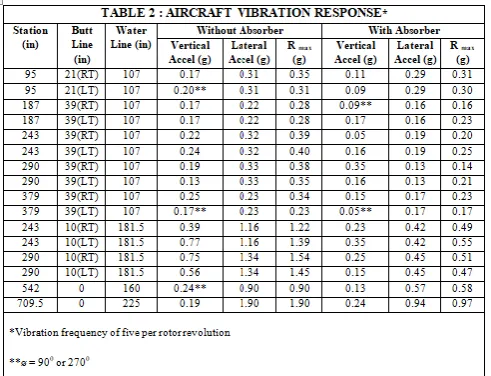
The equations (6), (7) and (8) were used to determine the resultant vibration levels shown in Table III.The phase angles for most locations are 00and 1800where equation (6) applies, and the locations where phase angles are 90° or 2700are noted by an asterisk. In these cases, the larger of the two magnitudes (lateral or vertical) represent the vector sum where equations (7) and (8) apply.
[image:7.595.37.283.179.367.2]The resultant vibration responses for the 16 pairs of vertical and lateral vibration components are given in Table 4.2 and are mapped schematically in Figure 24 and in Figure 25 for the ALH helicopter without and with the vibration absorber respectively.
Sample Calculation: Case I:
From equation (5),
ø = 0° or 180°
Ŕ = (A2+ B2)1/2cos 2Fnt (9)
To find
IŔImax∂Ŕ/∂t = 0 = Fn (A2+ B2)1/2 cos Fnt (10)
Therefore, Fnt = π/2, 3π/2
Giving, IŔl max = (A2+ B2)1/2 (6)
Given: Vibration level at Station 95, Butt Line 21 (RT), Water Line 107
Ÿ = 0.31gL00, Ż =0.17.gL00 (Table III, without absorber)
IŔl max = 0.35g
Case II:
From equation (5), ø = 90° or 270°
© 2019, IRJET | Impact Factor value: 7.34 | ISO 9001:2008 Certified Journal
| Page 1206
To find IŔI max , ∂Ŕ/∂t = 0 = {A2(cos2Fnt )+ B2(sin2Fnt)} -1/2, {B2- A2} cos Fnt sinFnt (12)
Therefore, Fnt =0, π/2, π, 3π/2
Giving, IŔl max = A if A>B (7)
= B if B>A (8)
4. DATA COLLECTION
The reliability and maintainability data used to perform this study were obtained from the United State Air Force Maintenance Management System and contained the failure and maintenance data for the two groups of aircraft. These data were prepared and recorded by the ALH within the normal routine of aircraft operation. Information pertaining to the aircraft discussed in the study has been extracted from the bulk data covering a 14 month period of operation and representing 6225 flight hours and 6171 flight hours for the non absorber and absorber equipped aircraft respectively. The reliability and maintainability information contained in the, aircraft tail number, quantity of failures, action taken, when discovered, parts removed, how malfunctioned, man-hours, work performed on or off the aircraft, and work unit code number work unit codes identify preventive maintenance tasks as well as component which required corrective maintenance. The data were sorted by work unit code, quantity of failures, and maintenance man-hours for each aircraft subsystem and component. Because of the large number of discrete work unit codes assigned to the ALH (approximately 2000), covering 37 general subsystem codes, the effect of
vibration on reliability and maintainability on those items reflecting more than 10 to 15 failures within each general subsystem code for the ten subsystem codes reflecting the highest number of failures or maintenance man-hours is discussed.
© 2019, IRJET | Impact Factor value: 7.34 | ISO 9001:2008 Certified Journal
| Page 1207
the total accumulated flight hours for each sample group of aircraft. The result of this procedure is shown in Table at the subsystem level and provides an overall view as to the dramatic impact of vibration reduction at the subsystem level on reliability and maintainability.
5 .RESULTS AND DISCUSSION
5.1. VIBRATIONS AND MAINTENANCE
Various Army Aviation units operating in various different types of environmental conditions i.e. High Altitude, Deserts Areas of High Humidity and plains were approached and data on various types of failures occurring in the helicopters was analyzed. It was seen that 50-60% of failures and snag reporting’s were accounted to vibrations11. Two categories of helicopters were analyzed i.e Helicopters with severe vibration problems which required the system to be stripped apart with almost all the subsystems being checked before the helicopter was made serviceable and helicopters which had vibration problems resolved in a short span of time. Following helicopters have been analyzed with the reasons and corrective action taken.
5.2 SNAG ANALYSIS (VERTICAL VIBRATIONS IN ALL REGIMES OF FLIGHT)
Aircraft No IN 705 ALH (Indian Name Dhruv) went for prolonged snag “Vertical Vibrations” in Nov-Dec 2017. Snag rectifications as per laid down procedures carried out, later the snag was rectified by replacing 02 x Main Rotor Blades. Here are snags and their rectification actions.
5.2.1 Brief History of The Aircraft: The aircraft was manufactured in 29 Jun 1975 and last overhauled on 29 Jan 2010. After overhaul the aircraft had never sustained such type of defect. The aircraft had competed approximates 17% of its TBO at the time of this defect. Last 1st line servicing (25 Hrs) of the aircraft was carried out at 524:40 AF hrs on 28 Nov 2018 and the last 2nd line servicing (400 Hrs) was carried out at 396:15 AF Hrs on 27 Jun 201812. The aircraft is fitted with 85 series Main Rotor Blades which are less prone to vibrations and some important info is given below:-
Anticipation of 00:20 hrs was granted against 25 hrs insp at 525:40 AF hrs to meet Op requirement. 25 Hrs inspections were carried out on the aircraft at 524:40 AF hrs and aircraft was offered for ground run on 28 Nov 2018. Aircraft reported satisfactory after ground run13. On 29 Nov 2018, after trg sortie of the aircraft, pilot reported the snag “Vertical vibrations in all regimes of flt”. Snag Analysis & Rectification Action: Snag reporting and their rectification action wef 26 Dec 2019 to 30 Mar 19 is given below:- Main Rotor Vibration Analysis of IN70Z (ALH) Occasion: After Tail Rotor Actuator Replacement
6. CONCLUSION
© 2019, IRJET | Impact Factor value: 7.34 | ISO 9001:2008 Certified Journal
| Page 1208
aircraft.This results in less downtime on the aircraft, thereby improving availability and contributing to the reduction in the operating cost of the aircraft. The life-cycle cost analysis, based upon the data presented, shows that LCC may be reduced by as much as 10% for the 13 aircraft subsystems considered in the study, because of the improved reliability and maintainability brought about by diminishing vibratory stress. The reductions are manifested by lessening the costs of direct maintenance manpower and spares, and by improving helicopter utilization.
REFERENCES
1. Jane's, 1998: All the World's Aircraft, 1997-98. Jane's Publishing Co., London, United Kingdom, 1029 pp.
2. Boeing, 1996: Current Market Outlook-Commercial Airplane Group Marketing. Boeing Corporation, Seattle, WA, USA, 36 pp.
3. Theory of Wing Sections: Including a Summary of Airfoil Data (Paperback) by Ira H. Abbott
4. Greene, D.L., 1995: Commercial Air Transport Energy Use and Emissions: Is Technology Enough? Paper presented at the 1995 Conference on Sustainable Transportation Energy Sources, 31 July - 3 August 1995. Pacific Grove, CA, USA, 26 pp.
5. Thinking Fluid Dynamics with Dolphins (Hardcover) by Minoru Nagai
6. Lynch, F.T. and G.A. Intemann, 1994: The Modern Role of CFD in Addressing Airframe/Engine Integration Issues for Subsonic Transports, ICAS 94-6.4.3, International Council on Aeronautical Sciences.
7. PBS Illustrated Guide to Aerodynamics 2/E (Paperback) by Hubert C. Smith
8. Condit, P.: 1996: Performance, Process, and Value: Commercial Aircraft Design in the 21st Century. Paper presented at the World Aviation Congress and Exposition, Los Angeles, CA, USA, The Boeing Company, Los Angeles, CA, USA, 18 pp.
9. Liebeck, R.H., M.A. Page, and B.K. Rawdon, 1998: Blended Wing Body Subsonic Commercial Transport. AIAA-98-0438, American Institute of Aeronautics and Astronautics, 36th Aerospace Sciences Meeting, 12-15 January 1998, Reno, Nevada, USA.
10. HAL Vibration Maintenance Manual - ALH
11. HAL Maintenance Manual Manual Volume II
12. Fundamentals of Aerodynamics (Hardcover) by John D. Anderson
13. Missile Aerodynamics (Hardcover) by Jack N. Nielsen
14. Aerodynamics for Engineering Students (Paperback) by E.L. Houghton