Application of the p-Median Problem in School Allocation
Fagueye Ndiaye, Babacar Mbaye Ndiaye, Idrissa Ly Laboratory of Mathematics of Decision and Numerical Analysis,
Cheikh Anta Diop University, Dakar, Senegal
Email: [email protected], [email protected]
Received April 18, 2012; revised May 20, 2012; accepted May 31, 2012
ABSTRACT
This paper focus on solving the problem of optimizing students’ orientation. After four years spent in secondary school, pupils take exams and are assigned to the high school. The main difficulty of Education Department Inspection (EDI) of Dakar lies in the allocation of pupils in the suburbs. In this paper we propose an allocation model using the p-median problem. The model takes into account the distance of the standards imposed by international organizations between pupil’s home and school. The p-median problem is a location-allocation problem that takes into account the average (total) distance between demand points (pupil’s home) and facility (pupil’s school). The p-median problem is used to determine the best location to place a limited number of schools. The model has been enhanced and applied to a wide range of school location problems in suburbs. After collecting necessary numerical data to each EDI, a formulation is presented and computational results are carried out.
Keywords: Non-Convex Optimization; Location Models; School Allocation
1. Introduction
Every year, the Education Department Inspection (EDI) of Dakar has difficulties for assigning pupils to high schools of the suburbs. After four years spent in secon- dary school, pupils take exams and are assigned to high schools. The EDI of Dakar must take several important decisions such as network design, pupil assignments, construction of new high schools, etc. Nowadays, due to the fact that the number of pupils increases each year, problems related to pupil assignments have become so complex that rudimentary techniques seam unsuitable. Thus, the need to use analytical tools to deal location- allocation problems has come out to the attention of EDI decision makers. With some processing techniques, we solve instances for the EDI of Guediewaye, Thiaroye and Keur Massar to find the optimal configuration, to install new high schools in order to attend the demand of a po- pulation. It is possible to build a high school inside some colleges that have space or in sites (vacant land) of the area. Location-allocation problems deal with decisions of finding the best (or optimal) configuration for the insta- llation of one or more facilities in order to attend the de- mand of a population [1].
Nooradelena and Noraida [2] used the p-median prob- lem to determine the best location to place a limited number of emergency medical services taking into account the uncertainty in the demand for the emergency services. The p-median problem is a location-allocation problem
that has been extensively studied. The reason for the in- terest in the p-median problem is that it has practical applications in a wide variety of planning problems: lo- cating telephone switching centers [3], school districting [4], and bank location [5]. Chardaire and Lutton [6] ex- tended the p-median problem to account for different types of located facilities that interact such as telecom- munication terminals that are connected to concentrators, which are connected to each other. Densham and Rush- ton [7] worked on a p-median problem where every faci- lity needs a minimum workload.
In this paper, the school location for pupils from se- condary school to high school is presented. An allocation model using the p-median problem is proposed. More details concerning the p-median problem formulation can be found in Church and ReVelle [8]. We solve the mixed- integer 0 - 1 linear program using the IBM-CPLEX’s MILP solver [9]; and show how the simulation tech- niques can be applied successfully to practical decision support of Dakar’s EDIs. For each EDI in Dakar: Guediewaye, Thiaroye and Keur Massar, all schools (or demand points) are listed, with i the number of pupils
who pass exam in each school with . Selected colleges will be expanded into high schools and free sur- faces are built for high schools. Facilities or facility lo- cations are places that are suitable to establish schools (service facilities). Service facilities cannot be erected outside facility locations. A configuration is a set of us-
a
ually p candidates that are proposed to get a service fa- cility. However, during the optimization process the con- figuration might consist of a different number. Every configuration that has exactly p facilities is a solution for the p-median problem. The integer number p must be chosen to specify how many facilities are to be located. The optimal solution is a configuration that has the mini- mal distance. The objective function is the total distance from every point of demand to the closest facility of the configuration. The distance is weighted or multiplied by the population of the site.
The paper is organized as follows: In Section 2, we present the allocation model using the p-median problem formulation. Section 3 is devoted to the numerical si- mulation results for EDI of Guediewaye, Thiaroye and Keur Massar. Finally, summary and conclusions are pre- sented in Section 4.
2. Problem Formulation
The p-median model formulation is based on the fol- lowing notations:
1, ,
I m
1, ,
demand points.
J n
= K a i = d i j = p
gned to site
i j is selected se j =1 =1 m n
i ij ij i j
a d X
1 1, ,
facility locations for facilities.
the maximum distance to be traveled by pupil.
i population (number of pupils) at the demand
point .
ij shortest distance between location and loca-
tion .
number of school to be established.
1 if children of school is assi 0 otherwise
ij X
1 if school =
0 otherwi
j Y
The objective function minimizing the total weighted distance of assignment.
Min (1)
subject to
=1 n
ij j
X i m
=1 n
j j
Y p
1, ,
(2)(3)
1, ,
ij j X Y i
1,
d X K i
m j n
,m j 1, ,n
0,1Y
1, ,
j n
inimizes the total weighted di
(4)
ij ij
0,1 andij j X (5) (6) 1, , i m
The objective function (1) m
stance of assignment
Xii 1
. When demand node iis assigned to a facility located at j, then
Xii 1
and the associated weighted distance a dj ij is i in theweighted distance sum. Constraint (2) ensures that each pupil must be assigned to at least one school. Constraint (3) restricts the placement or allocation of facilities to exactly p, where p is the number of high schools to be established. Constraint (4) maintains that any such assign- ment must be made to only those locations that have been selected for a facility. Constraint (5) imposes a ma- ximum distance to be covered by each pupil. Constraint (6) represents the domain of variables.
The model is solved using three EDIs in Dakar city ncluded
: ED
mber of demand points with demand values
ility locations. These are the
oca-
n at demand point i. The population
3. Simulation Results
the coast of Dakar in the
of the demand (here inela-
mands points separated by I of Guediawaye, EDI of Thiaroye and EDI of Keur Massar. We present in more detail only the results of Guediawaye’s EDI. The input data to solve this p-median problem are:
a finite nu
to specify the location and amount of demand that needs to be satisfied.
a finite number of fac
only positions where facilities can be established. Se- veral values of p are tested for the three EDI.
distances between demand points and facility l tions. Distances are calculated from the network of Dakar city.
the populatio
represents the number of pupil at school i.
3.1. EDI of Guediawaye
Guediawaye is located on
southeast of Pikine. It covers 550 square kilometers. In 2002, Guediawaye became the fourth department of the Dakar region, such as Dakar, Pikine and Rufisque. It is divided into five district municipalities: Golf Sud, Me- dina Gounass, Ndiarme Limamoulaye, Sahm Notaire and Wakhinane Nimzatt. There is in the EDI of Guediawaye ten secondary schools and two high schools. The large number of pupils requires significant renovation deci- sions or reconstruction of new locations. After exam, pu- pils are assigned to the nearest high schools. The ques- tion is which site to choose, which site is to expand, how many locations will be rebuilt and where to place such sites so as to minimize the distance traveled by pupils. The option is to compare the current situation (in number of pupils and schools) in simulations where the same number of pupils is assigned to different schools in re- duced number and location.
It begins with an analysis
stic). Regularly registered pupils are listed on a map based on their domicile;
ites using the following cri-
e land, in process, of being public or sub-
[image:3.595.130.468.243.473.2]ool and for school. In total,
Table 1. Demand points and zone weights.
No Schools Zone Weights
less than 2 kilometers.
Next we build a map of: a) location of potential s
teria: i) availabl
ject to expropriation. ii) no nuisances by the sch
this gives 8 points provides (including existing). b) defined points of demand and supply; we can run
a model and compare its results with those of the current situation.
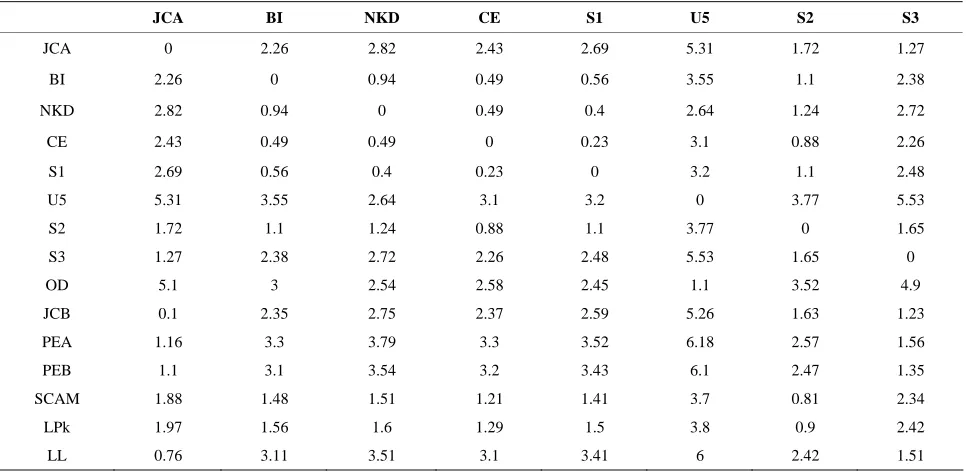
[image:3.595.57.540.500.736.2]Table 1 shows weights for the each demand; and
Table 2 indicates distances between schools and sites.
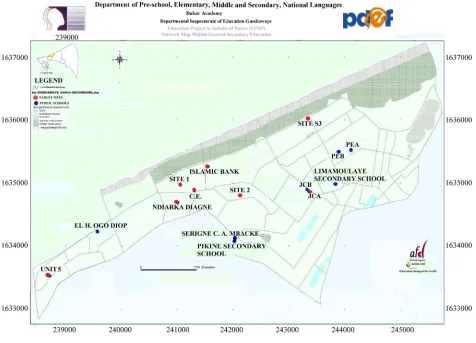
Figure 1 is the map (Seye [10], Fagueye [11]) show- ing the 15 demands points in Guediawaye locality, where facilities are represented in red. The sites are: Joseph Correa A (JCA), Islamic Bank (BI), Ndiarka Diagne (NKD), Teachers’s City (CE), Site 1 (S1), Unit 5 (U5), Site 2 (S2), Site 3 (S3), Ogo Diop (OD), Joseph Correa B (JCB), Pikine East A (PEA), Pikine East B (PEB), Serigne Cheikh Anta Mbacke (SCAM), Pikine Second- ary School (LPk), Limamoulaye Secondary School (LSS).
1 Joseph Correa A (JCA) 302
2 Islamic Bank (BI) 254
3 Ndiarka Diagne (NKD)
(JCB)
Mbacke (SCAM)
(LL)
301
4 Teachers’ City (CE) 294
5 Site 1 (S1) 01
6 Unit 5 (U5) 01
7 Site 2 (S2) 01
8 Site 3 (S3) 01
9 Ogo Diop (OD) 321
10 Joseph Correa B 343
11 Pikine East A (PEA) 441
12 Pikine East B (PEB) 290
13 Serigne Cheikh Anta 491
14 Pikine Secondary School (LPk) 01
15 Limamoulaye Secondary School 01
Table 2. Distances between schools and sites (in km).
JCA BI NKD CE S1 U5 S2 S3
JCA 0 2.26 2.82 2.43 2.69 5.31 1.72 1.27
BI 2.
NKD 2.82 0.94
0
0.
3
1.
2.
S
26 0 0.94 0.49 0.56 3.55 1.1 2.38
0 0.49 0.4 2.64 1.24 2.72
CE 2.43 0.49 .49 0 0.23 3.1 0.88 2.26
S1 2.69 0.56 0.4 23 0 3.2 1.1 2.48
U5 5.31 3.55 2.64 3.1 3.2 0 3.77 5.53
S2 1.72 1.1 1.24 0.88 1.1 .77 0 1.65
S3 1.27 2.38 2.72 2.26 2.48 5.53 65 0
OD 5.1 3 2.54 2.58 2.45 1.1 3.52 4.9
JCB 0.1 35 2.75 2.37 2.59 5.26 1.63 1.23
PEA 1.16 3.3 3.79 3.3 3.52 6.18 2.57 1.56
PEB 1.1 3.1 3.54 3.2 3.43 6.1 2.47 1.35
CAM 1.88 1.48 1.51 1.21 1.41 3.7 0.81 2.34
LPk 1.97 1.56 1.6 1.29 1.5 3.8 0.9 2.42
Figure 1. Sites for Guediawaye’s EDI.
ite 1, Site 2 and Site 3 are available land ults for the EDI of Guediawaye.
S or in process Table 3. Res
or subject to expropriation, thus the population is put to 1. Pupils in Unit 5, LPk and LL do not live in these loca- tions; they leave their home to come to these schools.
The 8 facility locations are: Joseph Correa A (JCA) (location 1), Islamic Bank (BI) (location 2), Ndiarka Dia- gne (NKD) (location 3), Teachers’s City (CE) (location 4), Site 1 (S1) (location 5), Unit 5 (U5) (location 6), Site 2 (S2) (location 7) and Site 3 (S3) (location 8).
[image:4.595.309.538.464.557.2]The numerical tests were performed by using the com- mercial MILP solver, namely IBM-CPLEX V12.3 [9]. The numerical experiments were executed on a computer: 2×Intel(R) Core(TM) 2 Duo CPU 2.00 GHz, 4.0 GB of RAM, under UNIX system. We apply the p-median mo- del for the targeted sites by setting 4 values for p. We have done tests for p = 5, 6, 7 and 8. We give here more details for the case p = 5. The procedure is the same for others (p = 6, 7 and 8).
Table 3 shows the facility locations for this scenario. Site 1, Site 2 and Site 3 are available land or in process or subject to expropriation, thus the population is put to 1. Pupils in Unit 5, LPk and LL do not live in these loca- tions, they leave their home to come to these schools.
With the given 5 sites and from 8 facility locations, the
Locations Demands points
1 1, 8, 10, 11, 12, 15
2 2
3 3, 4, 5
6 6, 9
7 7, 13, 14
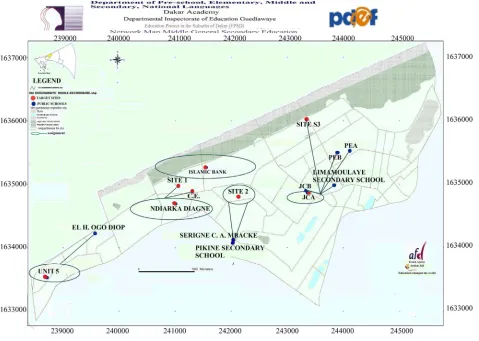
optimal locations are Joseph Correa A tion 1), the Islamic Bank cation 2), Ndiarka D
nit 5 (location 6) and the Site S2 (location 7). The de-
nd it is po
3) Pupils from Ndiarka Diagne, Teachers’ City and (loca
(lo iagne (location 3), U
termination in choosing which pupils allocated at these facility locations depends on the distance between de- mand points and facility locations (see Table 3).
1) Pupils from Joseph Correa A, Joseph Correa B, Pikine East A, Pikine East B and nearby Site 3 will be assigned to the “High School Joseph Correa A”. A
ssible to assigned pupils from Limamoulaye if nece- ssary.
nearby Site S1 will be assigned to the “High School Ndi- ar
go Diop are assigned to th
km of the Site 2 will be assigned to the “S
necessary. ka Diagne”.
4) Pupils from Unit 5 and O e new “High School Unit 5”.
5) Pupils from Serigne Cheikh Anta Mbacke and those living around 2
2 High School”. And it is possible to assigned pupils from Pikine Secondary School if
It is determined by the value
Xii 1
when we solved the p-Median problem. Figure 2 (Seye [10], Fagueye [11]) shows results; and the objective function value is 1619.490.3.2. EDI of Thiaroye
Thiaroye is a district in Dakar, Senegal. It is located in the southern department of Pikine. There are twelve
DI of Thiaroye, where six can a site where a new high school
f Keur Massar
teen boroughs in the city of ondary schools in the EDI
secondary schools in the E become high schools and
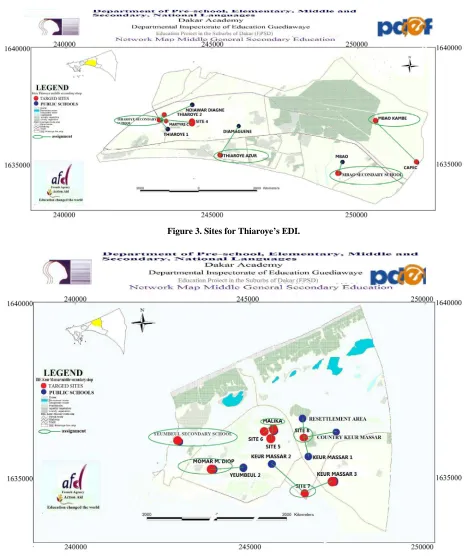
[image:5.595.60.539.378.719.2]can be built. With the given 4 sites and from 7 facility locations the optimal locations are Thiaroye Azur, Mbao Kambe, Thiaroye secondary school and Mbao secondary school. The numerical results for p4 are shown in
Figure 3.
3.3. EDI o
Keur Massar is one of the six Pikine. There are thirteen sec
of Keur Massar when four can be enlarged in order to build high schools; and four sites where new high school can be built. With the given 5 locations and from 8 facility locations, the optimal locations are Malika, Keur Momar Marme Diop, Yembeul secondary school, Site 7 and Site 8. In this case, the maximum distance that allows us to obtain results using the IBM-CPLEX’s MILP solver is K2.6 km; because with K 2 km, the model does not offer a solution. The numerical results for p4 are sh
sion
have presented school locations for ary school to high school. An alloca-
own in Figure 4.
4. Conclu
In this paper, we pupils from second
tion model using the p-median problem is proposed. We have solved the related mixed-integer 0 - 1 linear pro- gram; and have shown how the simulation techniques can be applied successfully to practical decision support of the EDI of Dakar. All facility locations are connected
Figure 3. Sites for Thiaroye’s EDI.
Figure 4. Sites for Keur Massar’s EDI.
to the demand points according to the sho etween them.
5. Acknowledgements
We thank EDI of Dakar specialists for the fruitful dis- cussions. Also we would like to thank M. Amadou G.
ding the data, and discussions related to the meaning of the data.
REFERENCES
[1] Z. Drezner, “Facility Location: A Survey of Applications and Methods,” Springer-Verlag, New York, 1995.
[2] M. R. Nooradelena and A. G. Noraida, “An Application of the p-Median Problem with Uncertainty in demand in Emergency Medical Services,” Proceedings of the 2nd IMT-GT Regional Conference on Mathematics, Statistics and Applications, Universiti Sains Malaysia, Penang, 13-15 June 2006.
[3] S. L. Hakimi, “Optimization Locations of Switching Cen-ters and the Absolute CenCen-ters and Medians of a Graph,” Operations Research, Vol. 12, No. 3, 1964, pp. 450-459. doi:10.1287/opre.12.3.450
[4] R. Honey, G. Rushton, P. Lononis, B. Dalziel, M. Arm-strong, S. De and P. Densham, “Stages in the Adoption of a Spatial Decision Support System for Reorganizing Ser-vice Delivery Regions,” Environment and Planning C, Vol. 9, No. 1, 1991, pp. 51-63. doi:10.1068/c090051 [5] D. Willer, “A Spatial Decision Support System for Bank
Location: A Case Study,” NCGIA Technical Report, Vol. 90, No. 9, 1990.
[6] P. Chardaire and J. L. Lutton, “Using Simulated Anneal-ing to Solve Concentrator Location Problems in
Tele-communication Networks,” In: R. V. Vidal, Ed., Applied Simulated Annealing, Springer, Berlin, 1993, pp. 175-199. doi:10.1007/978-3-642-46787-5_9
[7] P. Densham and G. Rushton, “A More Efficient Heuristic for Solving Large p-Median Problems,” Papers in Re-gional Science, Vol. 71, 1996, pp. 307-329.
[8] R. L. Church and C. S. ReVelle, “The Maximal Covering Location Problem,” Papers in Regional Science, Vol. 32, No. 1, 1974, pp. 101-118. doi:10.1007/BF01942293 [9] IBM ILOG CPLEX Optimization Studio V12.3, Inc.,
“Using the CPLEXR Callable Library and CPLEX Bar-rier and Mixed Integer Solver Options,” 2011.
http://www-01.ibm.com/software/integration/optimizatio n/cplex-optimization-studio
[10] A. G. Seye, “School Map Office,” Department of Na-tional Education in Senegal, 2009.