RESEARCH ARTICLE
EXAMINING HOW TOP MANAGEMENT COMMITMENT AND SUPPORT AFFECTS
IMPLEMENTATION OF FINANCIAL MANAGEMENT SYSTEMS: A CASE OF
MASINDE MULIRO UNIVERSITY OF SCIENCE AND TECHNOLOGY
*Arnety Nangila Makokha, Gerishom
Wafula Manase, Abraham A. Malenya, Douglas Musiega,
Shem Juma Michael Okumu Ojungu and Philemon Bureti
P.O. Box 1699-50200, Kenya
ARTICLE INFO ABSTRACT
Developing countries (DCs) have been encouraged to reform their public expenditure management systems and have increasingly embarked on major projects to computerize their government operations. Universities are under pressure to deliver ever-higher quality services in their financial management for accountability purposes. They are implementing Financial Management Systems (FMS). The purpose of this study was to examine how top management commitment and support affects implementation of Financial Management Systems in MMUST. The objective was to find out how top management commitment and participation affected the implementation of FMS. The research design used was descriptive survey. The target population was 115 staff drawn from five functional areas. The study sample consisted of 60 members. Each stratum had 12 members selected randomly. Research instruments were questionnaires and interview schedules. Both qualitative and quantitative data were collected and analysed using correlation and descriptive statistics. The study revealed that top management’s effective communication, commitment and participatory decision making account for 95%. Male participated in systems implementation more than female.
Copyright © 2013 Arnety Nangila Makokha, et al., This is an open access article distributed under the Creative Commons Attribution License, which permits unrestricted use, distribution, and reproduction in any medium, provided the original work is properly cited.
INTRODUCTION
Background
Management of Financial information in the current business environment has become a powerful driver in performance of business processes as it determines organizational growth and sustainability (Siriginidi, 2007). The introduction of an FMS can be regarded as an organizational reform which deeply affects work processes and institutional arrangements governing the management of public finance (Hove & Wynne 2010). The implementation of an FMS is a complex, risky, resource-intensive process that requires major procedural changes and often involves high-level officials who lack incentives for reform (Hendriks, 2012). It demands top management commitment and support to change in technology, processes and procedures as well as changes in skills, responsibilities and behaviours (Rodin- Brown 2008). Considering the nature and complexity of the project it is essential for all participants to be fully aware of the magnitude of the undertaking. The decision-makers must be convinced that the benefits of an FMS exceed the risks, and participating departments must recognise the need for a new system (Chêne 2009). According to Nah and Lau (2001), the commitment of top management is one of the most frequently cited factors deciding the success or failure of an information system. Diamond and Khemani (2006) argue that project commitment at the highest levels of the political system, as well as bureaucracy, and continuous participation from the direct users of the system and other stakeholders in all phases of the project, is necessary for success.
*Corresponding author: Arnety Nangila Makokha,
P.O. Box 1699-50200, Kenya.
Case studies of more successful countries, such as Kosovo, the Slovak Republic, Tanzania, Ethiopia and South Africa have indicate that the clear commitment of the relevant authorities is one of the main factors supporting successful implementation of an FMS (Chêne 2009). A few studies have been done in Kenyan Public Universities. The University strategic goals are achieved if the FMS solution supports a wide range of business processes that transcend functional, business, organisational and geographic boundaries. FMS design should, therefore, be preceded by detailed functional analysis that underpins current functional processes, procedures, user profiles and requirements that the new system will support (Rozner 2008). In Ghana the design and development of FMS was not satisfying, because of problems with the reporting functionality similar to Malawi. This was because of a lack of clear specifications on the reporting requirements and approval from government on the design of various reports (Diamond & Khemani 2006; Hendriks 2012). Business process re-engineering is a critical factor affecting successful implementation of any FMS reform and requires a review of all systems, functional processes, methods, rules and regulations, legislation, banking arrangements and related processes (Rodin-Brown 2008). It will be necessary to establish new, standardised procedures throughout the government to formalise job descriptions and to improve arrangements and systems for internal and external.
Statement of the problem
With increased globalization, firms are facing unprecedented competition since they operate in a dynamic environment (Watanabe, Hobo 2003). Firms are in competition to adopt best business processes by investing heavily in the implementation of Financial Management
ISSN: 0975-833X
International Journal of Current Research
Vol. 5, Issue, 10, pp.2942-2948, October,2013
OF CURRENT RESEARCH
Article History:
Received 14th July, 2013
Received in revised form
03rd August, 2013
Accepted 30th September 2013
Published online 10th October 2013
Key words:
Financial Management Systems (FMS), Integrated Financial Management Systems (IFMS),
Masinde Muliro University of Science and Technology (MMUST),
systems in their financial activities for efficiency and effectiveness. The implementation of an FMS is a complex, risky, resource-intensive process that requires major procedural changes and often involves high-level officials who lack incentives for reform (Hendriks, 2012). It demands top management commitment and support to change in technology, processes and procedures as well as changes in skills, responsibilities and behaviours and provision of all required resources for the purpose of successful implementation of FMS (Rodin- Brown 2008). Hence, the researcher found it worthy to examine how top management commitment and support affects implementation of Financial Management Systems in MMUST
Objective
To examine how top management commitment and support affects implementation of Financial Management Systems in MMUST.
Research Questions
How does top management commitment and support affect implementation of financial management systems?
Justifications
The findings of how top management commitment and support affects implementation of FMS may add new knew knowledge and provide researchers and institutional management with better understanding of implementation of IFMS in institutions of Higher learning in developing countries such as Kenya.
Scope
The study was confined examining how top management commitment and support affects implementation of Financial Management Systems in MMUST using General ledger, payables, purchasing, cash Management and Revenue and Receipting.
Limitations of the study
The findings may not necessarily be generalized to other Universities or institutions of higher learning in Kenya. However, in ensuring that the limitation did not cause much of an effect, the research concentrated on general areas that could depict similarities. Respondents were not willing and ready to offer concrete information due to fear of change and technology.
CHAPTER TWO: LITERATURE REVIEW
Top management
The process of implementing an FMS should be regarded as a major investment project requiring a structured project management approach. It’s considered under the following headings;
Commitment and Participation
The implementation of a Financial Management system (FMS) in institutions of higher learning is a substantial undertaking for any administration, and it is essential that the participants’ are fully aware of the magnitude of the undertaking. Ensuring project commitment at the highest levels of the Council and bureaucracy, and continuous participation from the direct users of the system and other stakeholders is necessary in all phases of the project (Diamond & Khemani, 2006). It is necessary that the project planning methodologies are used to plan, implement, and monitor the project with project management responsibilities clearly identified. Since the accounting is the backbone of the information system, the direction of the Finance Officer takes the lead role in the design, development, procurement, training and implementation processes relating to the FMS (Diamond & Khemani, 2006). It is critical to mobilize internal management
resources. The Finance Officer and the accountant general should be assisted by a well- staffed project management team headed by a full-time technical team consisting of a number of assistant project managers, with specializations in IT, budgetary and accounting processes. To ensure continuous commitment and participation of top management and key stakeholders, a steering committee is set up under the chairmanship of the Finance Officer to manage and
co-ordinate the entire process of design, development, and
implementation of the FMS (Diamond & Khemani, 2006). It therefore, demands top management commitment to change in technology, processes and procedures as well as changes in skills, responsibilities and behaviors to provide resources, effective communication at all levels and make a cost effective decision before investment (Rodin- Brown 2008). Considering the nature and complexity of the project, it is essential for all participants to be fully aware of the magnitude of the undertaking. The decision-makers must be convinced that the benefits of an FMS exceed the risks, and participating departments must recognize the need for a new system (Chêne 2009). According to Gargeya &Brady, 2005; Beheshti, 2006, senior management must demonstrate their commitment by showing strong leadership, limiting the initial scope of the project, and working towards achieving an early success. Top management commitment to the project is necessary to ensure the success of the system, otherwise the project is most likely to fail or fail to deliver the full range of benefits forecasted. According to Nah and Lau (2001), the commitment of top management is one of the most frequently cited factors deciding the success or failure of an information system. Diamond and Khemani (2006) argue that project commitment at the highest levels of the political system, as well as bureaucracy, and continuous participation from the direct users of the system and other stakeholders in all phases of the project, is necessary for success. Case studies of more successful countries, such as Kosovo, the Slovak Republic, Tanzania, Ethiopia and South Africa have indicate that the clear commitment of the relevant authorities is one of the main factors supporting successful implementation of an FMS (Chêne 2009)
Strategy for use of external consultants
Careful choice of external technical assistance is required when the top management are hiring consultants on addition to the in- house resources. The external consultant should have extensive experience in public financial management including the design, implementation, management and operation of government accounting, budget, and financial management systems in a developing University environment, experience in the management and operation of modern computerized financial systems in an institutional budgeting and accounting environment, Complementary experience in training, management development, human resource management, and organizational change in University set up. The external consultants need to be managed closely because they may tend to pursue their own interests. They should be required to make extensive use of training organizations and in-house resources. The in-house should be fully involved in the project design and planning, technical implementation skills for both hardware and software, user support skills.
Effective communication and coordination
level so as to avoid duplication of effort and to ensure consistency of outputs. This should cover all areas under review; the budgetary framework, general ledger accounting implementation of payroll and personnel administration system, development of an auditing system and the accounts payables and receivables.
System integration
The implementation of an FMS is carried out in a modular way, to avoid too much strain on the capacity of organizations, it is important to keep a strategic and comprehensive view in the overall process of its planning and development. International experience in implementing FMS indicated that these projects often lead to temporary disruptions of the normal functions in the budget and accounts departments. This disruption may last for a period of 10-12 months, depending on the absorptive capacities of the organizations’ involved. From the studies it has been viewed that the integration of several modules may bring
incompatibility problems hence affecting the successful
implementation of the FMS. Incompatibility majorly arise when different modules of; general ledger, budgetary accounting, accounts payable, accounts receivables and payroll system are procured from different manufactures without checking the matching specifications.
Implemented FMS
Financial Management Systems (FMS) that supports adequate management reporting, policy decisions, fiduciary responsibilities and the preparation of auditable financial statements (Rozner, 2008). It is the computerisation of public financial management processes, from budget preparation and execution to accounting and reporting, with the help of an integrated system for the purpose of financial management (Lianzuala & Khawlhring 2008). To successfully implement of FMS the three major factors should be critically focused to establish their effects.
The Conceptual Framework
[image:3.595.341.534.394.466.2]The study applied the conceptual framework as presented in figure 2.1 determining factors were taken to be independent variables, which are top management, business re-engineering, and capacity building. The dependent variables were taken to be successfully implemented Financial Management Systems (FMS) that supports adequate management reporting, policy decisions, fiduciary responsibilities and the preparation of auditable financial statements.
Figure 1. Conceptual Framework
Relationship between the Dependent and independent variables
The Top management has the responsibility of making complex decision of investments and sourcing for funds to invest in the implementation of FMS. It also ensures that there is enough skilled personnel to work on the system. Therefore, commitment and support of top management to provide all resources necessary for the implementation will ensure successfully implemented system that works as intended. The democratic style may be appropriate for implementing the FMS unlike the autocratic and laizen fair styles. The successful implementation of FMS requires participation at all the
management levels. The study focused on how top management affected the successful implementation of FMS.
CHAPTER THREE: RESEARCH METHODOLOGY
Research Design
The study used descriptive survey design. This design enabled the researcher to obtain pertinent and precise information about the current state of phenomenon and assist to draw valid conclusions from the facts discovered (Lokesh, 1994). The phenomenon in this study was to examine how top management commitment and support affects implementation of Financial Management Systems in MMUST.. For the purpose of this study, descriptive survey enabled the researcher gain a deep and rich understanding of the phenomenon in context holistically.
Target Population
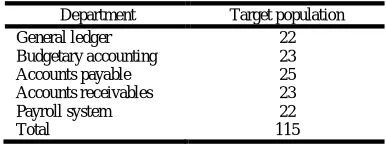
The target population for the study was 20 staff drawn from five functional areas within finance department; general ledger, budgetary accounting, accounts payable, accounts receivable and payroll systems.
Sampling frame
[image:3.595.61.283.519.655.2]The study used stratified sampling where it selected a sampling frame from different functional areas within finance department of MMUST and was classified under five groups, which formed the sampling frame of the study. These are general ledger, budget accounting, accounts payable, accounts receivable and payroll systems. Details of the targeted population grouped in table 3.1 below
Table 1: Sampling frame of different departments
Department Target population
General ledger 22
Budgetary accounting 23
Accounts payable 25
Accounts receivables 23
Payroll system 22
Total 115
Source: Masinde Muliro University personnel records
Sample size and sampling techniques
The study utilized stratified random sampling technique. This involved sub-dividing the population into homogenous sub-groups, called strata (subsets of the population that shares at least one common characteristic). In this study, the strata consisted of the categories identified above (general ledger module, budgetary accounting, accounts payable and accounts receivable and payroll systems). Within each stratum, a random sample was used to ensure that the sub-groups in the population are represented in the sample. The sample size represented of the study population according to Kathuri and Pals (1993).
Table 2: Number of staff selected
Department Target
population Sample size Percentage (%)
General ledger 22 12 54.55
Budgetary accounting 23 12 52.18
Accounts payable 25 12 48.00
Accounts receivable 23 12 52.18
Payroll system 22 12 54.55
Total 115 60 52.18
[image:3.595.316.562.633.715.2]was also emboldened by Konar (2009) opinions who postulated that a study sample should neither be too big nor too small, rather, it should be easy to manage and representative of the targeted demographic.
Instruments for Data collection
The researcher collected data using the following instruments
Research Techniques and instruments
To collect data for the study, the researcher used observation, interviews, questionnaires and document analysis.
Interviews
In gathering of data, semi structured interview method was adopted since this method gives the respondent freedom to respond and illustrate concepts. This also provides a chance to the interviewer to probe for more explanation to issues that are not understood properly by the respondents. The interview process took a form of personal interview where by the researcher conducted the interview on a face to face with the respondent at a location that was more convenient to the respondents for those respondents. Data from existing records was collected using document analysis guide.
Questionnaires
This method was used to respondents who may not be available during the face-to-face interview exercise and who may not be accessible on the telephone call.
Data collection procedure
The researcher obtained an introductory letter from Jomo Kenyatta University of Agriculture, Technology, and send to Masinde Muliro University of Science and Technology to conduct the research. The researcher wrote an introductory letter that accompanied the questionnaires for introduction purposes to the respondents; to book an appointment with various respondents’ departments to administer the questionnaires for the respondents to fill at their own pleasure. The researcher booked an appointment with the top management before the due dates for the interview.
Pre-Testing the Research Instruments
The researcher conducted a pilot study using a few members of staff in each of the departments involved in ERP implementation within the university. The staffs involved in pilot study were not included in the final study and their results were not incorporated in the final analysis to enhance the reliability of the instruments used. The validity of the research instruments were ensured through the advice of the specialist in the Department of Business Management in the School of Human Resource Development whose views were incorporated in redrafting the final instruments.
Data Analysis and presentation
Qualitative data was analysed using descriptive statistics, correlation and regression. The results of the data analysis were presented in tables. All the statistical analyses activities were implemented in Statistical Program for Social Scientists (SPSS) after coding of the data on the cases. SPSS is the statistical software that is capable of computing many different procedures with different kinds of data (Guffey & Almonte, 2009).
CHAPTER FOUR
RESEARCH FINDINGS AND DISCUSSION
Demographic Information
The demographic information of respondents presented and discussed based on functional area they belonged, gender, and possibility of being aware of modules of FMS: General ledger module, budgetary
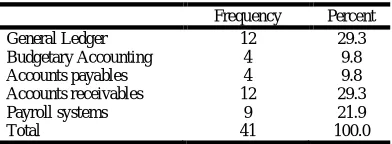
[image:4.595.342.538.129.201.2]accounting, accounts payables, accounts receivables, payroll system, and duration of use for each respondent interviewed. This information presented tables and figures. Close observation showed that the respondents were from the above mentioned core functional areas of the FMS as shown in Table 3
Table 3: Respondents functional areas
Frequency Percent
General Ledger 12 29.3
Budgetary Accounting 4 9.8
Accounts payables 4 9.8
Accounts receivables 12 29.3
Payroll systems 9 21.9
Total 41 100.0
Findings in Table 3 reveals that, 29.3% of the respondents were from both General ledger and Accounts receivables, 9.8% of the respondents were from Budgetary Accounting and Accounts payables, 21.9% of the respondents was Payroll systems. This may imply that the targeted functional areas were well represented.
Table 4: Respondents’ gender
Frequency Percent
Male 25 61.0
Female 16 39.0
Total 41 100.0
Findings in Table 4 reveal that, male respondents were 61% and female respondents were 39%. This means that male were majority. These findings agree with Ujunju, (2012) that there is a gender gap between women users of ICT and men, and that women are not well accessible to ICTs as compared to men. According to Nangila, Musiega & Juma (2013) they postulated that male had an upper hand in the use of ERP system than female and that an institution may have higher chances of successful implementation of the system if it involved male gender.
Table 5: Use of FMS
Frequency Percent
yes 23 56.1
no 18 43.9
Total 41 100
[image:4.595.344.530.607.669.2]Findings of Table 5, 56.1% indicates that they had used FMS before compared to 43.9% who indicated that they have not. This finding suggests that majority of the staff of Masinde Muliro University of Science and Technology were aware of the FMS. These findings agree with Ujunju (2012) who alluded that MMUST staff had used ICT tools like computers and not FMS.
Table 6: Duration of use
Frequency Percent
less than 1 year 5 12.2
1-2 years 31 75.6
3-4 years 3 7.3
Over 5 years 2 4.9
Total 41 100.0
Effect of Top management on successful implementation of FMS
[image:5.595.73.257.140.213.2]Respondents’ were asked to rate the degree of their agreement as whether they strongly agree, agree, neutral, disagree or strongly disagree to the various statements. The findings are as shown in the Tables
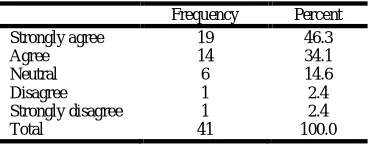
Table 7: Commitment and support by top management
Frequency Percent
Strongly agree 19 46.3
Agree 14 34.1
Neutral 6 14.6
Disagree 1 2.4
Strongly disagree 1 2.4
Total 41 100.0
[image:5.595.354.523.212.275.2]The findings of Table 7 reveals that 46.3% of the respondents strongly agreed that commitment and support from top management is very important in implementing the FMS, 34.1% of the respondents were in agreement while 14.6% of the respondents were neutral, 2.4% of the respondents disagreed and 2.4% of the respondents strongly disagreed to this fact. This may imply that 80.4% of the respondents agreed that commitment and support from top management was critical to the successful implementation of Financial Management Systems. These findings were supported by Glaser (1999) who alluded that senior management must demonstrate their commitment by showing strong leadership, limiting the initial scope of the project, and working towards achieving an early success. Top management commitment to the ERP systems is necessary to ensure the success of the system, otherwise the project is most likely to fail or fail to deliver the full range of benefits forecasted (Gargeya and Brady, 2005; Beheshti, 2006). According to Diamond & Khemani, 2006 he postulated that commitment and support to the project at the highest levels of the Council and bureaucracy, and continuous participation from the direct users of the system and other stakeholders is necessary in all phases of the project since it ensures successful implementation of FMS.
Table 7: Effective communication by top management
Frequency Percent
Strongly agree 17 41.5
Agree 19 46.3
Neutral 5 12.2
Total 41 100.0
The findings in Table 7 shows that; 41.5% of the respondents strongly agreed that effective communication by top management at all levels affected the successful implementation of the FMS, 46.3% of the respondents agree to this fact while 12.2% of the respondents were neutral. These implied that 87.8% of respondents agreed that effective
communication by top management affects the successful
implementation of FMS. According to Wee, 2000 he eluded that expectations at every level need to be communicated and that management of communication, education and expectations are critical throughout the organization. According to Rosario, 2000 he postulated that user input should be managed in acquiring their
requirements, comments, reactions and approval to the
[image:5.595.356.520.413.476.2]communications throughout the organization (Rosario, 2000).
Table 8: User participation in decision making with top management
Frequency Percent
strongly agree 39 95.1
neutral 2 4.9
Total 41 100.0
The findings in Table 8; 95.1% of the respondents strongly agreed that top management should involve users in the FMS implementation, 4.9% of the respondents were neutral to this fact. The findings implied that 95.1% of the respondents were in agreement that user participation
in decision making was critical in successful implementation of the FMS. According to Bajwa et al., 2004 he alluded that user involvement in the systems implementation enabled reduce resistance and increased participation of the users and ensured they understood how the system works and how it helped them to perform their daily tasks. According to Ahmad, 2009 he argued that failure to provide significant resources for these purposes has seen short-term gains, but end-user ignorance and discontinuance have led to long- term failure.
Provision of funds and other resources by top management
The respondents further rated these findings as under costs on acquisition, installation, maintenance and staff training.
Table 9: Costs on Acquisition
Frequency Percent
Very costly 20 48.8
Costly 19 46.3
Less costly 1 2.4
Not sure 1 2.4
Total 41 100.0
Findings in Table 9 indicate that; 48.8% of the respondents agreed that the purchase and installation of the Financial Management Systems in an organization is very expensive, 46.3% of the respondents agreed that the FMS implementation is costly, 2.4% of the respondents did not agree while the 2.4% were not sure. From the above findings, it implied that 95.1% of the respondents were in agreement that successful implementation of the FMS is costly in terms of purchasing and installation costs. Further, the respondents determined whether maintenance and staffing costs were critical when implementing the FMS.
Table 10: Maintenance costs
Frequency Percent
very costly 4 9.8
costly 30 73.1
less costly 6 14.6
not sure 1 2.4
Total 41 100.0
The findings in Table 10 indicated that; 9.8% of the respondents indicate that the maintenance is very costly, 73.1% of the respondents indicated that the maintenance is costly, 14.6% of the respondents indicated that the maintenance cost is less. The findings imply that 82.9% of the respondents agreed that maintenance cost is significant to the successful implementation of the FMS
14.6%
56.1%
29.3% less costly
costly
[image:5.595.67.262.455.509.2]very costly
Figure 2. staff training costs
[image:5.595.324.562.564.712.2] [image:5.595.56.273.683.726.2]training of staff is costly. The findings imply that 85.4% of the respondents agreed that staff training, involves a lot of funding. According to Gargeya & Brady, 2005 he postulated that end-users and training facilities have received the least amount of attention because the resources for training and support are expensive
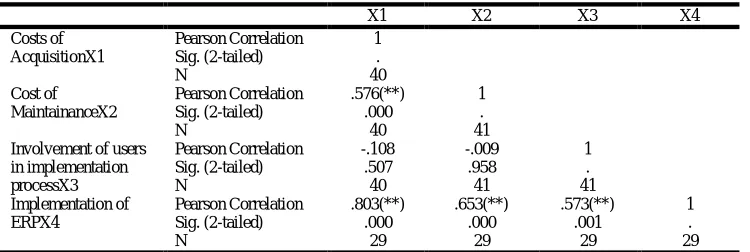
A Pearson correlation was calculated examining the relationship between, Implementation of ERP system and cost implications. A strong positive correlation that was significant was found (r (2) =.803, p<0.01) where cost of Acquisition was positively related to Implementation of ERP systems. The acquisition includes the purchase and installation costs. Table 11, 48.8% of the respondents agreed that the purchase and installation of the ERP system in an organization is very expensive. Another strong positive correlation that was significant was found (r (2) =.653, p<0.01) where costs of Maintenance was positively related to Implementation of ERP. It is depicted in Table 4.20, 80.5% of the respondents indicated that maintenance cost is significant in the implementation process. A further moderate positive correlation that was significant was also found (r (2) =.573, p<0.01) where Involvement of users in implementation process was positively related to Implementation of FMS. According to Figure 4.2, 85.4% of the respondents indicated that staff training was very significant. According to Meta Group in 2002, the average total cost of ownership; professional services, hardware, software acquisition, maintenance, internal staff and training costs) was $15 million. Pandey (2005) in his book for Financial Management supported the fact that investments in capital projects example implementation of FMS involves huge costs on acquisition, installation, maintenance and user training and involvement hence the investments must be well scrutinized as to whether they are viable before commitment of funds.
CHAPTER FIVE: SUMMARY, CONCLUSIONS AND
RECOMMENDATIONS
Summary
The study evaluated the critical success factors on ERP systems implementation in institution of higher learning. The conceptual framework developed guided the study. The research designs used was descriptive survey designs. The target population was115 staff the study sample consisted of 60 staff using simple random sampling technique. The study used questionnaires and interview schedules as research instruments. Reliability of the instruments were ensured by piloting the questionnaire .Validity of the research instruments were ensured through the advice of the specialist in the School of Human Resource Development whose views were incorporated in redrafting the final instruments. Both qualitative and quantitative data were collected and analysed. Analysis and discussion of data collected was done using regression, correlation and descriptive statistics leading to drawings of summaries and conclusions.
Effect of Top management
The findings revealed that 80.4% of the respondents confirmed that commitment, support were critical to implementations, 87.8%
indicated that effective communication was critical and 95.1% indicated that participation of users in decision making was critical in implementation of the system. Besides 28.8% of the implementations was accounted for by gender.
Conclusions
From the study summary, it is evident that top management’s commitment and support, effective communication, provision of resources and engaging users in decision-making are very critical in successful FMS implementation. In the second objective, it is evident that change management, structure, and culture are important towards successful systems implementation. This allows the legacy and manual system to be converted into an automated system. The third objective determined if capacity building affected the implementation of FMS. The findings reveal that training the users on the new technology increases their awareness in the new system and reduce resistance. It was also evident that the user involvement should be frequently, financially that the users should be empowered with the tools, and techniques on how to solve provide solutions to problems independently. Finally, compatibility of the modules in the FMS was critical for the successful implementation. The modules accounted for 85% of implementation of Finance Management Systems in the finance department. That the complexity of the University system also affected that FMS implementation since not all the campuses were integrated to the main Finance Management System
Recommendations
The researcher recommends that Institutions of Higher Learning (IHL) who have not or are in the process of implementing FMS; to track their financial transactions, produce the auditable statements on a timely basis within the Universities, to access, and use this factors; top management commitment and support, business re-engineering, capacity building, in the implementation process. The institutions should also be vigilant on the complexity of the organization and the compatibility of the modules.
Suggestions for further research
Considering the above findings, the researcher proposed that it would be worthwhile to conduct further research within Private Universities in Kenya to establish any similarity because results in public University may not generalize to private universities due to different operational dynamics. Research can also be done to find out whether business process re-engineering affects successful implementation of Financial Management Systems and investigate whether capacity building affects successful implementation of Financial Management Systems in MMUST
REFERENCES
[image:6.595.117.492.129.255.2]Babbie, E. (2004). The practice of social research. Belmont: Thomson, Wadsworth.
Table 11: Effect of cost on implementation of FMS
X1 X2 X3 X4
Costs of AcquisitionX1
Pearson Correlation 1
Sig. (2-tailed) .
N 40
Cost of MaintainanceX2
Pearson Correlation .576(**) 1
Sig. (2-tailed) .000 .
N 40 41
Involvement of users in implementation processX3
Pearson Correlation -.108 -.009 1
Sig. (2-tailed) .507 .958 .
N 40 41 41
Implementation of ERPX4
Pearson Correlation .803(**) .653(**) .573(**) 1
Sig. (2-tailed) .000 .000 .001 .
N 29 29 29 29
Baxendale, S. J & Jama, F. (2003). What ERP can offer ABC.
Strategic Finance. 2, 54-57.
Buckhout, S., Frey, E., & Nemec Jr. J. (1999). Making ERP Succeed: Turning Fear into Promise. Technology, 2nd. Quarter, 60-72. Burns, J & Scapens, R.W. (2000). Conceptualizing management
accounting change: An institutional framework, Management
Accounting Research, 3-25.
Caldwell, B. (2005). New IT Agenda. Information Week, 711, p. 30. Cameron, P.D., & Meyer, S.L. (2007). Rapid ERP Implementation.
Management Accounting, 80(6), 58-60.
Chen, I.J. (2011). Planning for ERP Systems: Analysis and Future Trend. Business Process Management Journal, 7(5), 374-386. Chene, M. & Hodess R. (2009) the implementation of Integrated
Financial Information Management Systems (IFMS), transparent
international
Chêne, M., 2009, The Implementation of Integrated Financial
Information Management Systems (IFMS), viewed 06 April 2011,
from http://www.u4.no/ helpdesk/helpdesk/query.cfm?id=196 Clemmons, S., & Simon, S.J. (2001). Control and Coordination in
Global ERP Configurations, Business Process Management
Journal, 7(3), 205-215.
Creswell J. W. (2003), Research Design: A Qualitative, Quantitative
and Mixed Method Approaches. 2nd edn. Thousand Oaks’
California: Sega Publication Inc.
Diamond J. Khemani P. (2006) Introducing Financial Management Information Systems in Developing Countries, OECD Journal on Budgeting, vol. 5 No. 3 pp 98-132
Farelo, M. & Morris, C., 2006, The Status of e-government in South
Africa, viewed 11 April 2011, from http://hdl.handle.net/
10204/966
Gichoya D (2005) Factors Affecting the Successful Implementation of ICT Projects in Government, the Electronic Journal of e-government Vol. 3 pp 175-184
Harold, J. E. (2007). Evaluating and Implementing EDI at a Small Electronics Manufacturer. Production and Inventory Management
Journal, 38(3), 1-5.
Harrold, D. (2001). How Manufacturing Benefits by Understanding ERP and IT. Control Engineering, January, 26-36.
Hawking, P., & Stein, A. (2004). Revisiting ERP Systems: Benefit Realization. Proceedings of the 37th. Hawaii International
Conference on System Sciences, p. 8.
Hayman, L. (2000). ERP in the Internet Economy. Information
Systems Frontiers, 2(2), 137-139.
Hendrickson, D. (2001). Getting more out of ERP. EAI Journal,
December, 24-27.
Hendrickson, D. (2010). Getting more out of ERP. EAI Journal,
December, 24-27.
Hendriks, C.J (2012) ‘integrated Financial Management Information Systems: guidelines for effective implementation by the public sector of south Africa’ SA journal of information Management 14(1), Art,#529,9pages
Jacobs, F.R., & Bendoly, E. (2003). Enterprise Resource Planning: Developments and directions for operations management research.
European Journal of Operational Research,146(2), 233-240.
Kaar, M. (2009), A Critical Investigation of the Merits and Drawbacks
of In-depth Interviews. Germany: GRIN Verlag.
Klaus, H., Rosemann, M., & Gable, G.G. (2000). What is ERP?
Information Systems Frontiers, 2(2), 141-162.
Khaled Al-Fawaz, Zahran Al-Salti, and Eldabi, T. 2008. 'Critical Success Factors in ERP implementation: A Review'. European And Mediterranean Conference on Information Systems 2008, Dubai.
Koch, C. (2001). Enterprise Resource Planning: Information Technology as a Steamroller for Management Politics. Journal of
Organizational Change Management, 14(1), 64-78.
Kochan, A. (2009). Shortcuts to peak ERP Performance. Works
Management, 52(3), 22-25.
Kombo et al. (2006). Proposal and Thesis Writing: An Introduction. Nairobi: Paulines Publications Africa.
Konar, N. (2009), Communication Skills for Professionals.New Delhi: PHI Learning Pvt. Ltd.
Kothari, C.R. (2004), Research Methodology, Methods and
Techniques. 2nd edn. New Delhi: New Age International (p) Ltd,
Publishers.
Kraemmergaard, P., & Rose, J. (2002). Managerial Competencies for ERP Journeys. Information Systems Frontiers, 4(2), 199-211. Kumar, V., Maheshwari, B., & Kumar, U. (2008). An Investigation of
Critical Management Issues in ERP Implementation: Empirical Evidence from Canadian Organizations. Technovation, 23(10), 793-807.
Maake, B., 2007, Presentation to National Treasury/Scopa Quarterly
Meeting: Integrated Financial Management Systems (IFMS),
viewed 09 April 2012 from http://www.pmg.org.za/docs/2007/ 070523ifms.ppt
Murphy, C. (2004). ‘Once and Future King of Campus Computing’. Campus Technology. Syllabus Media Group. Retrieved August 13, 2008. From: http://www.campustechnology.com/article.asp?id=8868
Nour, M. A. and Mouakket, S. (2011) A Classification Framework of Critical Success Factors for ERP Systems Implementation: A Multi-Stakeholder Perspective. International Journal of
Enterprise Information Systems, 7(1) pp. 56-71.
Pinto J., Slevin D. 1987. “Critical Factors in Successful Project Implementation”, IEEETransactions on Engineering Management, 34(1), pp. 22-27.
Rico, D.F. (2010). ERP in Higher Education. Retrieved on 5th October, 2012, from: http://davidfrico.com/rico04f.pdf
Romeo, J. (2001). Less Pain, More Gain in ERP Rollouts. Network
Computing, 12(19), 49-56.
Rabaa'i, Ahmad A. (2009) Identifying Critical Success Factors of ERP
Systems at the Higher Education Sector. In: ISIICT 2009 : Third
International Symposium on Innovation in Information & Communication Technology, 15 - 17 December, 2009, Philadelphia University, Amman, Jordan.
Shamboo A, & Resnik D. (2009). Responsible conduct of Research, 2nd ed. (New York: Oxford University Press)
Shanks, G. and Parr, A. (2000), “A model of ERP project implementation”, Journal of Information Technology, (15), pp. 289-303.
Siriginidi, S.R. (2007). Enterprise Resource Planning in Reengineering Business. Business Process Management Journal, 6(5), 376-391. Stinchcombe, A.L. (2005). The Logic of Social Research. Chicago:
University of Chicago Press. Systems Implementation in China: An Empirical Study. International Journal of Production
Economics, 98(1), 56-80.
Vickland, S & Nieuwenhuijs, I., 2005, ‘Critical success factors for modernising public financial management information systems in Bosnia and Herzegovina’, Public Administration and Development
25, 95–103. http://dx.doi.org/10.1002/pad.354
Watanabe, C., & Hobo, M. (2003). Creating a firm self-propagating function for advanced innovation-oriented projects: lessons from ERP. Technovation, 23, 1-15.
Zhang, Z., Lee, K.O.M., Huang, P., Zhang, L., & Huang, X. (2005). A Framework for ERP.