4400
Embedding time expressions for deep temporal ordering models
Tanya Goyal and Greg Durrett Department of Computer Science The University of Texas at Austin
[email protected], [email protected]
Abstract
Data-driven models have demonstrated state-of-the-art performance in inferring the tem-poral ordering of events in text. However, these models often overlook explicit tempo-ral signals, such as dates and time windows. Rule-based methods can be used to identify the temporal links between these time expressions (timexes), but they fail to capture timexes’ in-teractions with events and are hard to integrate with the distributed representations of neural net models. In this paper, we introduce a framework to infuse temporal awareness into such models by learning a pre-trained model to embed timexes. We generate synthetic data consisting of pairs of timexes, then train a character LSTM to learn embeddings and clas-sify the timexes’ temporal relation. We evalu-ate the utility of these embeddings in the con-text of a strong neural model for event tempo-ral ordering, and show a small increase in per-formance on the MATRES dataset and more substantial gains on an automatically collected dataset with more frequent event-timex inter-actions.1
1 Introduction
Understanding the temporal ordering of events in a document is an important component of document understanding and plays an integral role in tasks such as timeline creation (Do et al.,2012), tempo-ral question answering (Llorens et al.,2015) and causality inference (Mostafazadeh et al., 2016; Ning et al.,2018a). Inferring temporal event or-der is challenging as it often disagrees with the narrative order in text. Past work on temporal re-lation extraction has exploited cues such as global constraints on the temporal graph structure (Bram-sen et al., 2006; Chambers and Jurafsky, 2008; Ning et al.,2017), world knowledge (Ning et al.,
1Data and code are available at https://github.
com/tagoyal/Temporal-event-ordering
2018b), grouping of events (Tourille et al.,2017), or fusing these cues more effectively with deep models (Meng et al., 2017; Cheng and Miyao, 2017). One key component of temporal under-standing is time expressions (timexes) that help anchor events to the time axis, but few recent sys-tems effectively use the knowledge derivable from time expressions in their models. They either give timexes no special treatment (Ning et al., 2017) or rely on rule-based post-processing modules to remove inconsistencies with explicit timexes (Chambers et al.,2014;Meng et al.,2017).
In this work, we address this shortcoming by introducing a framework for including rich rep-resentations of timexes in neural models. These models implicitly capture some information via word embeddings (Mikolov et al.,2013; Penning-ton et al., 2014) or contextualized embeddings such as ELMo (Peters et al., 2018). However, these embeddings do not encode the full richness of temporal information needed for this task. For example, these systems fail to infer the correct event relation in the following sentence:He visited France in 1992 and went to Germany in 1963. par-tially because the dates1992and1963do not have temporally-informed embeddings.
We devise a method for embedding timexes that more explicitly reflects their temporal status. Specifically, we sample pairs of time expressions from synthetic data, train character LSTM mod-els to encode these time expressions and classify their temporal ordering. Due to the amount and type of data they are trained on, these time embed-dings will naturally capture the temporal ordering of events in standard text and generalize to things like unseen timex values.
im-provement in performance on the benchmark MA-TRES dataset (Ning et al., 2018c). Addition-ally, to evaluate the full potential of the pro-posed approach, we construct another dataset with more frequent event-timex interactions using dis-tant supervision. On this dataset, our proposed approach substantially outperforms the ELMo-equipped baseline model.
2 Methodology
We improve upon the model architecture proposed byCheng and Miyao(2017) for temporal relation extraction, which involves classifying the tem-poral relation between a given pair of events e1
ande2. Our proposed architecture is outlined in
Figure 1. The input to the system consists of two sentences, s1 = {x11, x12, ...x1n} and s2 =
{x21, x22, ...xm2 }containinge1 ande2 respectively.
Note that s1 ands2 may correspond to the same
sentence.
Input Encoding For each tokenxkin each
sen-tence, we obtain a distributed representationx˜k =
[vw;vp;vt]. Here,vw is the word embedding
ob-tained from GloVe or contextualized word embed-dings from ELMo,vpis a randomly initialized and
trainable embedding of the part-of-speech tag, and
vtcorresponds to the timex embedding derived for
time expressions (explained in Section2.1).
Contextual Encoding A biLSTM is used to ob-tain contextualized embeddingshkfor each token xkin the two sentences, as shown in Figure1. The
parameters are shared between these lower biL-STMs for the two sentences. Prior work (Cheng and Miyao, 2017) does not include these lower biLSTMs and only leverages the dependency en-coding, explained next.
Dependency Encoding We use the Stanford Dependency Parser (Manning et al.,2014) to ex-tract the dependency paths for both events to their lowest common ancestor. For inter-sentence event pairs, paths are extracted to the root of each sen-tence. Each vector along the dependency path is fed into an upper biLSTM to produce output
hupper. Formally, for sentences1,
h1upper=biLSTM([hkfork∈dep-path(e1)])
Parameters are shared between the upper biL-STMs for the two sentences.
The dollar broke through the 106-yen level for the first time since it peaked in March 1994. It remained below the 105-yen level for all 1995.
The dollar peaked in March 1994 Itremained for all 1995
concat Labels = {before, after,
vague, simultaneous}
… ...
…. ….
broke
two-layer FFNN
(e1) (e2)
hupper1 h
upper
2
Figure 1: Temporal relation extraction model. Here,
peakedandremainedare the two events under
consid-eration. The sentences are passed through the lower LSTM, then the outputs corresponding to the events’ dependency paths are fed to the upper LSTMs, which produce input to feedforward and classification layers. Time expressions are embedded with a character-level model and broadcasted to events that they modify.
Output We concatenate the outputs of the upper biLSTMs’ embeddings for the two events to obtain
z = [h1upper;h2upper]. We apply multiple feedfor-ward layers with ReLU non-linearity, followed by a softmax layer to obtain output probabilities for the four labelsbefore, after, vagueand simultane-ous,2 denoting the temporal relation between the event pair(e1, e2). The network is trained using
the cross entropy loss.
2.1 Time Embeddings
Next, we outline our approach for constructing the timex embeddings vt, which are concatenated to
word and POS embeddings to generate the input encoding (as discussed in the previous section).
Training Data To obtain time embeddings, we first constructed a grammar of time expressions in the dataset. We identified two main classes of timexes: explicit datetimes expressed in recogniz-able timex format (e.g. Sept. 12, 1993, August 2013, 1998, 10-12-2014, 9th January, etc.) and natural language time indicators (e.g.two months ago, 5 weeks ago, next year, etc.). We designed generic templates that covered both these cate-gories of timexes, e.g. [mm dd, yy].3 By ran-domly sampling values for the slots, we can gen-erate valid time expressions based on this
tem-2
These are the labels used in the MATRES dataset (Ning et al.,2018b), but our classifier could in principle generalize to other label schemes as well.
J a n 9 3 [Jan 93]
1 9 9 5
[1995]
avg pooling avg pooling
concat softmax layer Labels = {before, after, simultaneous}
h1 h2
Figure 2: Timex model. The output of character biL-STMs is used to as input to classification. These vec-tors serve as time embeddings in the downstream tasks.
plate. We used pairs of such randomly generated timexes to construct training data for our timex model. Since we generate time expression pairs from a pre-defined grammar and set of templates, it is straightforward to obtain the temporal order between the pairs of timexes.
Model Architecture The model architecture for the timex model is outlined in Figure 2. The in-put to the system are two time expressions, t1
andt2. We use character biLSTMs to obtain
dis-tributed representations of both time expressions. We obtain time embeddingsh1andh2for timext1
andt2 by averaging the outputs of biLSTM layer.
The two time embeddings are concatenated and fed through multiple feed forward layers with non-linearity. This is followed by a softmax layer that produces the output probabilities for the three la-bel classes (before, after and simultaneous), de-noting the temporal relation between the two time expressions. We train this network with the cross entropy loss.
Inclusion in Temporal Models For a given time expression, the average of the outputs of the bi-LSTM model (h1) is used as the time embedding
as shown in Figure1. For other non-timex tokens, a zero vector is concatenated instead. Further, we also project the time embedding for a timex to the corresponding event it modifies according to a set of grammatical rules on the dependency parse, shown with red arrows in Figure1.
3 Experiments
3.1 Timex Pair Ordering
First, we intrinsically evaluate the performance of the character-level timex model, outlined in Sec-tion2.1. We generated50000random pairs of time expressions for training and5000randomly gener-ated pairs for test. We seek to answer two
ques-Model w/ linear w/ biLSTM
GloVe embedding 81.3 88.7
ELMo embedding 88.3 97.6
Char embedding (Ours) − 97.3
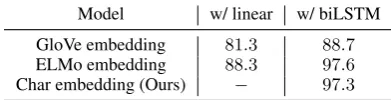
Table 1: Performance on the synthetic timex dataset, classifying a pair of timexes asbefore,after, or
simul-taneous. Including a biLSTM layer (as depicted in
Figure2) leads to higher performance than just pool-ing and a linear layer. Character-level modelpool-ing (from ELMo or our learned embeddings) is important for high performance.
tions: first, can our proposed timex model suc-cessfully capture temporal information necessary to order these timex pairs, and second, how effec-tive are pre-trained embeddings for this task?
Table 1 shows a comparison between several models in our synthetic timex setting. Our pro-posed timex model achieves an accuracy of97.3%. This high accuracy indicates that the model has ef-fectively learned from the training data; its timex embeddings contain temporal ordering informa-tion which can be used for downstream tasks.
We also evaluate whether pre-trained embed-dings such as ELMo or GloVe contain the nec-essary temporal information necnec-essary for clas-sifying the temporal order between timex pairs. We first test these with a minimal model. We construct a distributed representation of each time expression (obtained by average pooling the to-ken level GloVe or ELMo embeddings), perform element-wise subtraction between the two embed-dings, and feed the result through a linear classifi-cation layer that produces the output probabilities for the temporal label classes. The left column of Table1 shows that while both GloVe and ELMo contain some temporal information, our proposed model’s additional parameters and richer embed-ding scheme lead to higher performance.
sub-stantial improvement over previous results, with an accuracy of 97.6% for the temporal relation classification objective on the same test set. How-ever, the performance using GloVe embeddings drops to 88.7%. This drop in performance can partially be attributed to the word-level nature of GloVe vectors, which do not necessarily cover ev-ery year that might be seen in the dataset. We used the GloVe vectors with840billion tokens (largest available) to circumvent this issue and minimize the number of out of vocabulary instances, but still see low performance.
3.2 Event Temporal Ordering
Next, we investigate the effectiveness of our timex embeddings in the context of our full event tem-poral ordering model. We evaluate on two event temporal ordering datasets, one real and one artifi-cially constructed.
3.2.1 Evaluation on MATRES
We evaluate on the MATRES dataset proposed in Ning et al.(2018c). This dataset is designed to be less ambiguous than TimeBank-Dense (Cassidy et al., 2014). MATRES contains temporal anno-tations for documents from the TimeBank (Puste-jovsky et al.,2003), AQUAINT (Graff,2002) and Platinum datasets (UzZaman et al., 2013). We follow standard practice and use TimeBank and AQUAINT (256articles) for training and Platinum (20articles) for testing.
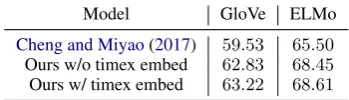
Table 2 outlines the performance of the pro-posed approach on MATRES. We implemented the model proposed by Cheng and Miyao(2017) and compare against it. We evaluate the models using both GloVe and ELMo embeddings. Our re-sults show substantial improvement over this base-line model. Moreover, including time embeddings as additional input to the improved models leads to a small improvement in the overall accuracy. However, we did not find the results to be statis-tically significant according to a bootstrap resam-pling test (GloVep-value= 0.349, ELMop-value
= 0.267).4
Note that only a fraction of examples in the MATRES dataset contain distinct time expressions
4
Augmenting word embeddings with time embeddings in-creases the number of network parameters; however, addi-tional experiments revealed that increasing the size of the GloVe embeddings in the basic temporal model did not lead to an improvement in performance. Therefore, it does not seem that extra parameters in the model contribute to the ob-served improvements.
Model GloVe ELMo
Cheng and Miyao(2017) 59.53 65.50
Ours w/o timex embed 62.83 68.45
[image:4.595.328.503.64.114.2]Ours w/ timex embed 63.22 68.61
Table 2: Performance of our event temporal ordering model on the MATRES dataset. We report the mean accuracy over 3 runs of each model. Our model im-proves substantially overCheng and Miyao(2017). In-cluding timexes leads to small accuracy gains, partially due to the fact that timexes often do not occur with the dataset’s hard examples.
that can be compared to resolve temporal ordering. To further evaluate our approach, we investigated whether an equivalent performance improvement could be achieved through post-processing rules involving time expressions. We identified event pairs in the data for which both events had an ac-companying time expression modifying the event according to the dependency parse. We can then infer the temporal relation between the event pair using rules on top of these timexes. However, we observed that such a post-processing scheme had very low coverage in the dataset and could not re-pairanyerrors in the development set. We there-fore turn our attention to a setting with a richer set of timexes for further evaluation.5
3.2.2 Evaluation on Distant Data
In MATRES, only a fraction of the examples con-tain time expressions and are consequently af-fected by inclusion of time embeddings. There-fore, to test the full potential of the proposed ap-proach, we additionally collect a test dataset of examples with explicit timexes that expose their temporal relation; we view the timexes as distant supervision for the event pairs. To identify such examples, we use two high precision classifiers proposed inChambers et al.(2014): (a) an event-timex classifier that identifies the temporal rela-tion between adjacent verb and time expressions (precision =0.92), (b) a timex-timex classifier that identifies the temporal relation between two time expressions (precision = 0.88). These classifiers can allow us to directly infer the time relation
be-5
2000 3000 4000
GloVe
Ours w/o Timex Embed 74.0 76.8 78.2
Ours w/ Masked Timex 73.9 75.5 77.1
Ours w/ Timex Embed 81.6 83.2 83.1
ELMo
Ours w/o Timex Embed 80.1 83.8 84.3
Ours w/ Masked Timex 79.8 80.1 80.7
[image:5.595.87.275.62.180.2]Ours w/ Timex Embed 82.3 84.5 84.8
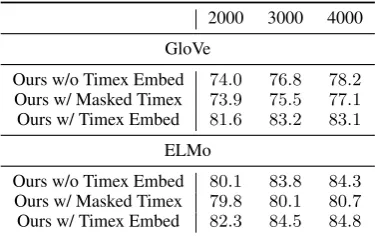
Table 3: Performance of our models on the distantly-labeled event ordering data. We report overall accu-racy values. In both the GloVe and ELMo settings, our timex embeddings lead to higher performance. The ELMo model gets substantially worse when timexes are masked, indicating that it is organically exploiting these better than GloVe is.
tween an event pair where each event is linked to a timex. An example event pair from the distant data thus collected is: “Riyadh suspendedaid to the Palestinians in 1990 when it accused Arafat of siding with Iraq after the 1990 invasion of Kuwait, but it restored aid in 1994.”6 Note that the clas-sifiers used have very low recall in general, but by running the system on Gigaword (Graff et al., 2007), we can extract a large dataset in spite of this.
Since this distant data is created using rule-based classifiers, given a large amount of train-ing data, the baseline model can achieve high per-formance as it learns to infer these rules. How-ever, our aim is to improve the performance of the event ordering model on moderately sized datasets, where the knowledge induction from timex embeddings play a larger role. Therefore, we report results on training sets of size 2000,
3000, and4000samples. The test set is kept con-stant with1000samples.
Table3outlines the performance of the tempo-ral models on this dataset. We evaluate our mod-els across three settings: (a) our event ordering model without including timex embeddings, (b) our event ordering model with masking of time tokens (replacing it with UNK tokens) and (c) our full model including timex embeddings. We evaluate the models using both GloVe and ELMo embeddings as input. In both settings, incorpo-rating our timexes leads to higher performance. For GloVe, the performance of the basic temporal model is similar to that when the time expression
6See the appendix for more samples from the distant data.
is masked out. This demonstrates that the temporal model does not use the knowledge from time ex-pressions when making temporal relation predic-tions. However, in the ELMo setting, we observed a larger drop in performance by masking out the time expressions compared to GloVe embeddings. This demonstrates that the ELMo embeddings are not agnostic to time-expressions in the sentence, although they still show improvement by inclusion of timex embeddings trained specifically with the temporal classification objective on small datasets.
4 Conclusion
In this paper, we propose a framework to learn temporally-aware timex embeddings from syn-thetic data. Through experiments on two datasets, we show that incorporating these embeddings in deep temporal models leads to an improvement in the overall temporal classification performance.
5 Acknowledgments
This work was partially supported by NSF Grant IIS-1814522, NSF Grant SHF-1762299, a Bloomberg Data Science Grant, and an equipment grant from NVIDIA. The authors acknowledge the Texas Advanced Computing Center (TACC) at The University of Texas at Austin for provid-ing HPC resources used to conduct this research. Also, thanks to the anonymous reviewers for their helpful comments.
References
Philip Bramsen, Pawan Deshpande, Yoong Keok Lee, and Regina Barzilay. 2006. Inducing Temporal Graphs. InProceedings of the 2006 Conference on Empirical Methods in Natural Language Process-ing, EMNLP ’06, pages 189–198, Stroudsburg, PA, USA. Association for Computational Linguistics.
Taylor Cassidy, Bill McDowell, Nathanael Chambers, and Steven Bethard. 2014. An Annotation Frame-work for Dense Event Ordering. In Proceedings of the 52nd Annual Meeting of the Association for Computational Linguistics (Volume 2: Short
Pa-pers), volume 2, pages 501–506.
Nathanael Chambers, Taylor Cassidy, Bill McDowell, and Steven Bethard. 2014. Dense event ordering with a multi-pass architecture. Transactions of the
Association for Computational Linguistics, 2:273–
284.
Empirical Methods in Natural Language Process-ing, EMNLP ’08, pages 698–706, Stroudsburg, PA, USA. Association for Computational Linguistics.
Fei Cheng and Yusuke Miyao. 2017. Classifying Tem-poral Relations by Bidirectional LSTM over Depen-dency Paths. In Proceedings of the 55th Annual Meeting of the Association for Computational
Lin-guistics (Volume 2: Short Papers), volume 2, pages
1–6.
Quang Xuan Do, Wei Lu, and Dan Roth. 2012. Joint inference for event timeline construction. In Pro-ceedings of the 2012 Joint Conference on Empirical Methods in Natural Language Processing and
Com-putational Natural Language Learning, pages 677–
687. Association for Computational Linguistics.
David Graff. 2002. The AQUAINT corpus of English news text. Linguistic Data Consortium,
Philadel-phia.
David Graff, Junbo Kong, Ke Chen, and Kazuaki Maeda. 2007. English Gigaword Third Edi-tion. Linguistic Data Consortium, Catalog Number LDC2007T07.
Hector Llorens, Nathanael Chambers, Naushad UzZa-man, Nasrin Mostafazadeh, James Allen, and James Pustejovsky. 2015. SemEval-2015 Task 5: QA TEMPEVAL-Evaluating Temporal Information Un-derstanding with Question Answering. In Proceed-ings of the 9th International Workshop on Semantic
Evaluation (SemEval 2015), pages 792–800.
Christopher Manning, Mihai Surdeanu, John Bauer, Jenny Finkel, Steven Bethard, and David McClosky. 2014. The Stanford CoreNLP natural language pro-cessing toolkit. In Proceedings of 52nd annual meeting of the association for computational
lin-guistics: system demonstrations, pages 55–60.
Yuanliang Meng and Anna Rumshisky. 2018. Context-Aware Neural Model for Temporal Information Ex-traction. InProceedings of the 56th Annual Meet-ing of the Association for Computational LMeet-inguistics
(Volume 1: Long Papers), volume 1, pages 527–536.
Yuanliang Meng, Anna Rumshisky, and Alexey Ro-manov. 2017. Temporal Information Extraction for Question Answering Using Syntactic Dependencies in an LSTM-based Architecture. InProceedings of the 2017 Conference on Empirical Methods in
Nat-ural Language Processing, pages 887–896.
Tomas Mikolov, Ilya Sutskever, Kai Chen, Greg S Cor-rado, and Jeff Dean. 2013. Distributed representa-tions of words and phrases and their compositional-ity. InAdvances in neural information processing
systems, pages 3111–3119.
Nasrin Mostafazadeh, Alyson Grealish, Nathanael Chambers, James Allen, and Lucy Vanderwende. 2016. CaTeRS: Causal and temporal relation scheme for semantic annotation of event structures.
In Proceedings of the Fourth Workshop on Events,
pages 51–61.
Qiang Ning, Zhili Feng, and Dan Roth. 2017. A struc-tured learning approach to temporal relation extrac-tion. InProceedings of the 2017 Conference on
Em-pirical Methods in Natural Language Processing,
pages 1027–1037.
Qiang Ning, Zhili Feng, Hao Wu, and Dan Roth. 2018a. Joint reasoning for temporal and causal rela-tions. InProceedings of the 56th Annual Meeting of the Association for Computational Linguistics
(Vol-ume 1: Long Papers), volume 1, pages 2278–2288.
Qiang Ning, Hao Wu, Haoruo Peng, and Dan Roth. 2018b. Improving Temporal Relation Extraction with a Globally Acquired Statistical Resource. In
Proceedings of the 2018 Conference of the North American Chapter of the Association for Computa-tional Linguistics: Human Language Technologies,
Volume 1 (Long Papers), pages 841–851.
Qiang Ning, Hao Wu, and Dan Roth. 2018c. A Multi-Axis Annotation Scheme for Event Temporal Rela-tions. InProceedings of the 56th Annual Meeting of the Association for Computational Linguistics
(Vol-ume 1: Long Papers), pages 1318–1328.
Jeffrey Pennington, Richard Socher, and Christopher Manning. 2014. Glove: Global vectors for word representation. InProceedings of the 2014 confer-ence on empirical methods in natural language
pro-cessing (EMNLP), pages 1532–1543.
Matthew Peters, Mark Neumann, Mohit Iyyer, Matt Gardner, Christopher Clark, Kenton Lee, and Luke Zettlemoyer. 2018. Deep Contextualized Word Rep-resentations. InProceedings of the 2018 Conference of the North American Chapter of the Association for Computational Linguistics: Human Language
Technologies, Volume 1 (Long Papers), pages 2227–
2237.
James Pustejovsky, Patrick Hanks, Roser Sauri, An-drew See, Robert Gaizauskas, Andrea Setzer, Dragomir Radev, Beth Sundheim, David Day, Lisa Ferro, et al. 2003. The timebank corpus. InCorpus
linguistics, volume 2003, page 40. Lancaster, UK.
Julien Tourille, Olivier Ferret, Aurelie Neveol, and Xavier Tannier. 2017. Neural Architecture for Tem-poral Relation Extraction: A Bi-LSTM Approach for Detecting Narrative Containers. In Proceed-ings of the 55th Annual Meeting of the Association for Computational Linguistics (Volume 2: Short
Pa-pers), volume 2, pages 224–230.
Naushad UzZaman, Hector Llorens, Leon Derczyn-ski, James Allen, Marc Verhagen, and James Puste-jovsky. 2013. Semeval-2013 task 1: Tempeval-3: Evaluating time expressions, events, and temporal relations. In Second Joint Conference on Lexical and Computational Semantics (* SEM), Volume 2: Proceedings of the Seventh International Workshop
on Semantic Evaluation (SemEval 2013), volume 2,
Event Pair Label Former Singapore premier Lee Kuan Yew, whocame to power in 1959,steppeddown in
1990 in favour of the incumbent, prime minister Goh Chok Tong, but remains influential as a senior minister in Goh’s cabinet.
Before
Relations between Sudan and Saudi Arabiagrewtense in 1990 when Riyadh accused Khar-toum of supporting Iraq after its invasion of Kuwait and worsened in 1992 when Sudan granted asylum to Saudi militant Osama Bin Laden.
Before
The Israeli-Syrian peace talkslaunchedin 1991 are mainly focusing on Damascus’ insis-tence that Israel withdraw its troops from the Golan Heights in exchange for peace. That territory has beenoccupiedby Israeli troops since 1967.
After
Resolutions werepassedby the UN Security Council after the first Indo-Pakistan war over Kashmir in 1948. The disputeledto a second war between the neighbours in 1965.
Before
Turkish mainland forcesinvadedNorthern Cyprus in 1974 after a coup in Nicosia backed by the military junta then ruling Greece. A Turkish-Cypriot state wasdeclaredin 1983, and Ankara now has about 35,000 troops and 400 tanks stationed there.
Before
More peoplewatchedFormula One on television in 1995 thanwatchedthe world cup in 1994.
After
He was freed six months early in September 1993 but re-arrested in April 1994 after meeting with John Shattuck, the US assistant secretary of state for human rights.
Before
Table 4: Examples from the distantly-labeled event ordering data. Events are shown in bold and may be co-located in a single sentence or span two sentences. Event-timex relations are recognized with high-precision classifiers fromChambers et al.(2014).
A Appendix
A.1 Timex Templates
We use generic templates for time expressions to generate training data for the timex model. Two kinds of templates were generated: (1) explicit datetimes, and (2) natural language time indica-tors. Examples of each of these kinds are outlined below:
1. Explicit datetime templates: [yyyy], [’yy], [mm dd yy], [mm yy], [mmm yyyy], [mmm dd yyyy], etc.
2. Natural language indicators:[xx units later], [xx units before], [now], [past xx units], etc., where xxis filled by a numerical value and units refers to a time unit such as months, days, or years.
Timex pairs generated through these templates can be converted to a standardized time scale and hence easily compared. It is therefore straight for-ward to infer the gold label for each pair of gen-erated timexes. For MATRES, 75% of the pairs in the training set for the timex model are sam-pled from explicit datetime templates, and the rest are sampled from natural language templates. This
relative ratio was heuristically determined. 100%
of the pairs were drawn from explicit datetime templates for the distant data.
A.2 Examples from Distant Data