Proceedings of the 56th Annual Meeting of the Association for Computational Linguistics (Long Papers), pages 1426–1436 1426
LSTMs Can Learn Syntax-Sensitive Dependencies Well,
But Modeling Structure Makes Them Better
Adhiguna Kuncoro♠♣ Chris Dyer♠ John Hale♠♥
Dani Yogatama♠ Stephen Clark♠ Phil Blunsom♠♣
♠DeepMind, London, UK
♣Department of Computer Science, University of Oxford, UK
♥Department of Linguistics, Cornell University, NY, USA
{akuncoro,cdyer,jthale,dyogatama,clarkstephen,pblunsom}@google.com
Abstract
Language exhibits hierarchical structure, but recent work using a subject-verb agreement diagnostic argued that state-of-the-art language models, LSTMs, fail to learn long-range syntax-sensitive depen-dencies. Using the same diagnostic, we show that, in fact, LSTMs do succeed in learning such dependencies—provided they have enough capacity. We then ex-plore whether models that have access to explicit syntactic information learn agree-ment more effectively, and how the way in which this structural information is in-corporated into the model impacts perfor-mance. We find that the mere presence of syntactic information does not improve ac-curacy, but when model architecture is de-termined by syntax, number agreement is improved. Further, we find that the choice
ofhow syntactic structure is built affects
how well number agreement is learned: top-down construction outperforms left-corner and bottom-up variants in capturing long-distance structural dependencies.
1 Introduction
Recurrent neural networks (RNNs) are remarkably effective models of sequential data. Recent years have witnessed the widespread adoption of recur-rent architectures such as LSTMs (Hochreiter and
Schmidhuber, 1997) in various NLP tasks, with
state of the art results in language modeling (Melis
et al.,2018) and conditional generation tasks like
machine translation (Bahdanau et al., 2015) and
text summarization (See et al.,2017).
Here we revisit the question asked by Linzen
et al. (2016): as RNNs model word sequences
[image:1.595.342.490.225.269.2]without explicit notions of hierarchical structure,
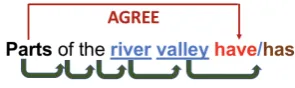
Figure 1: An example of the number agreement task with two attractors and a subject-verb dis-tance of five.
to what extent are these models able to learn non-local syntactic dependencies in natural lan-guage? Identifying number agreement between subjects and verbs—especially in the presence of attractors—can be understood as a cognitively-motivated probe that seeks to distinguish hierar-chical theories from sequential ones, as models that rely on sequential cues like the most recent noun would favor the incorrect verb form. We
provide an example of this task in Fig. 1, where
the plural form of the verbhave agrees with the
distant subject parts, rather than the adjacent
at-tractors (underlined) of the singular form.
Contrary to the findings ofLinzen et al.(2016),
our experiments suggest that sequential LSTMs are able to capture structural dependencies to a large extent, even for cases with multiple attrac-tors (§2). Our finding suggests that network capac-ity plays a crucial role in capturing structural de-pendencies with multiple attractors. Nevertheless, we find that a strong character LSTM language model—which lacks explicit word representation and has to capture much longer sequential depen-dencies in order to learn non-local structural de-pendencies effectively—performs much worse in the number agreement task.
certain class of LSTM language models that ex-plicitly models syntactic structures, the recurrent
neural network grammars (Dyer et al.,2016,
RN-NGs), considerably outperforms sequential LSTM language models for cases with multiple attrac-tors (§3). We present experiments affirming that
this gain is due to an explicit composition
op-erator rather than the presence of predicted syn-tactic annotations. Rather surprisingly, synsyn-tactic LSTM language models without explicit compo-sition have no advantage over sequential LSTMs that operate on word sequences, although these models can nevertheless be excellent predictors of
phrase structures (Choe and Charniak,2016).
Having established the importance of
model-ing structures, we explore the hypothesis thathow
we build the structure affects the model’s abil-ity to identify structural dependencies in English. As RNNGs build phrase-structure trees through top-down operations, we propose extensions to the structure-building sequences and model
archi-tecture that enable left-corner (Henderson, 2003,
2004) and bottom-up (Chelba and Jelinek, 2000;
Emami and Jelinek,2005) generation orders (§4).
Extensive prior work has characterized
top-down, left-corner, and bottom-up parsing
strate-gies in terms of cognitive plausibility (Pulman,
1986; Abney and Johnson, 1991; Resnik, 1992)
and neurophysiological evidence in human
sen-tence processing (Nelson et al., 2017). Here we
move away from the realm of parsing and
eval-uate the three strategies as models of generation
instead, and address the following empirical ques-tion: which generation order is most appropri-ately biased to model structural dependencies in English, as indicated by number agreement accu-racy? Our key finding is that the top-down gener-ation outperforms left-corner and bottom-up vari-ants for difficult cases with multiple attractors.
In theory, the three traversal strategies approxi-mate the same chain rule that decompose the joint probability of words and phrase-structure trees,
denoted as p(x,y), differently and as such will
impose different biases on the learner. In§4.3, we
show that the three variants achieve similar per-plexities on a held-out validation set. As we ob-serve different patterns in number agreement, this demonstrates that while perplexity can be a use-ful diagnostic tool, it may not be sensitive enough for comparing models in terms of how well they capture grammatical intuitions.
2 Number Agreement with LSTM
Language Models
We revisit the number agreement task with LSTMs trained on language modeling objectives, as
pro-posed byLinzen et al.(2016).
Experimental Settings. We use the same
parsed Wikipedia corpus, verb inflectors,
prepro-cessing steps, and dataset split as Linzen et al.
(2016).1 Word types beyond the most frequent
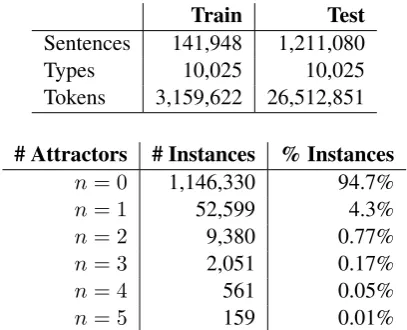
10,000 are converted to their respective POS tags. We summarize the corpus statistics of the dataset, along with the test set distribution of the
num-ber of attractors, in Table 1. Similar to Linzen
et al. (2016), we only include test cases where
all intervening nouns are of the opposite number
forms than the subject noun. All models are im-plemented using the DyNet library (Neubig et al., 2017).
Train Test
Sentences 141,948 1,211,080
Types 10,025 10,025
Tokens 3,159,622 26,512,851
# Attractors # Instances % Instances
n= 0 1,146,330 94.7%
n= 1 52,599 4.3%
n= 2 9,380 0.77%
n= 3 2,051 0.17%
n= 4 561 0.05%
[image:2.595.314.518.323.488.2]n= 5 159 0.01%
Table 1: Corpus statistics of the Linzen et al.
(2016) number agreement dataset.
Training was done using a language modeling objective that predicts the next word given the pre-fix; at test time we compute agreement error rates by comparing the probability of the correct verb form with the incorrect one. We report perfor-mance of a few different LSTM hidden layer con-figurations, while other hyper-parameters are
se-lected based on a grid search.2 FollowingLinzen
1
The dataset and scripts are obtained from https://
github.com/TalLinzen/rnn_agreement. 2
Based on the grid search results, we used the following hyper-parameters that work well across different hidden layer sizes: 1-layer LSTM, SGD optimizers with an initial learn-ing rate of 0.2, a learnlearn-ing rate decay of 0.10 after 10 epochs, LSTM dropout rates of 0.2, an input embedding dimension of 50, and a batch size of 10 sentences. Our use of single-layer LSTMs and 50-dimensional word embedding (learned from scratch) as one of the baselines is consistent with the
n=0 n=1 n=2 n=3 n=4
Random 50.0 50.0 50.0 50.0 50.0
Majority 32.0 32.0 32.0 32.0 32.0
LSTM, H=50† 6.8 32.6 ≈50 ≈65 ≈70
Our LSTM, H=50 2.4 8.0 15.7 26.1 34.65
Our LSTM, H=150 1.5 4.5 9.0 14.3 17.6
Our LSTM, H=250 1.4 3.3 5.9 9.7 13.9
Our LSTM, H=350 1.3 3.0 5.7 9.7 13.8
1B Word LSTM (repl) 2.8 8.0 14.0 21.8 20.0
[image:3.595.74.288.63.176.2]Char LSTM 1.2 5.5 11.8 20.4 27.8
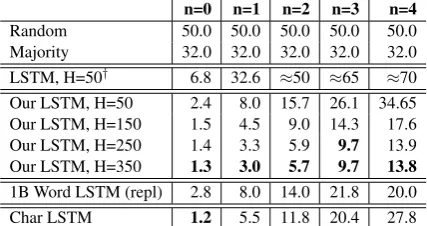
Table 2: Number agreement error rates for vari-ous LSTM language models, broken down by the number of attractors. The top two rows represent the random and majority class baselines, while the
next row (†) is the reported result from Linzen
et al. (2016) for an LSTM language model with
50 hidden units (some entries, denoted by≈, are
approximately derived from a chart, sinceLinzen
et al.(2016) did not provide a full table of results).
We report results of our LSTM implementations of various hidden layer sizes, along with our re-run of
theJozefowicz et al.(2016) language model, in the
next five rows. We lastly report the performance of a state of the art character LSTM baseline with a
large model capacity (Melis et al.,2018).
et al. (2016), we include the results of our
repli-cation3of the large-scale language model of
Joze-fowicz et al. (2016) that was trained on the One
Billion Word Benchmark.4 Hyper-parameter
tun-ing is based on validation set perplexity.
Discussion. Table 2 indicates that, given
enough capacity, LSTM language models without explicit syntactic supervision are able to perform well in number agreement. For cases with mul-tiple attractors, we observe that the LSTM lan-guage model with 50 hidden units trails behind its larger counterparts by a substantial margin de-spite comparable performance for zero attractor cases, suggesting that network capacity plays an especially important role in propagating relevant structural information across a large number of
steps.5 Our experiment independently derives the
3
When evaluating the large-scale language model, the pri-mary difference is that we do not map infrequent word types to their POS tags and that we subsample to obtain 500 test in-stances of each number of attractor due to computation cost;
both preprocessing were also done byLinzen et al.(2016).
4The pretrained large-scale language model is obtained
fromhttps://github.com/tensorflow/models/
tree/master/research/lm_1b.
5This trend is also observed by comparing results with
H=150 and H=250. While both models achieve near-identical performance for zero attractor, the model with H=250
per-same finding as the recent work ofGulordava et al.
(2018), who also find that LSTMs trained with lan-guage modeling objectives are able to learn num-ber agreement well; here we additionally identify model capacity as one of the reasons for the
dis-crepancy with theLinzen et al.(2016) results.
While the pretrained large-scale language
model ofJozefowicz et al.(2016) has certain
ad-vantages in terms of model capacity, more train-ing data, and richer vocabulary, we suspect that the poorer performance is due to differences between their training domain and the number agreement testing domain, although the model still performs reasonably well in the number agreement test set.
Prior work has confirmed the notion that, in many cases, statistical models are able to achieve good performance under some aggregate metric by
overfitting to patterns that are predictive in most
cases, often at the expense of more difficult, infre-quent instances that require deeper language
un-derstanding abilities (Rimell et al.,2009;Jia and
Liang,2017). In the vast majority of cases,
struc-tural dependencies between subjects and verbs highly overlap with sequential dependencies
(Ta-ble1). Nevertheless, the fact that number
agree-ment accuracy gets worse as the number of
attrac-tors increases is consistent with a sequential
re-cencybias in LSTMs: under this conjecture,
iden-tifying the correct structural dependency becomes harder when there are more adjacent nouns of dif-ferent number forms than the true subject.
If the sequential recency conjecture is correct, then LSTMs would perform worse when the struc-tural dependency is more distant in the sequences, compared to cases where the structural depen-dency is more adjacent. We empirically test this conjecture by running a strong character-based
LSTM language model ofMelis et al.(2018) that
achieved state of the art results on EnWiki8 from
the Hutter Prize dataset (Hutter,2012), with 1,800
hidden units and 10 million parameters. The
char-acter LSTM is trained, validated, and tested6 on
the same split of theLinzen et al. (2016) number
agreement dataset.
A priori, we expect that number agreement is harder for character LSTMs for two reasons. First, character LSTMs lack explicit word
representa-forms much better for cases with multiple attractors.
6For testing, we similarly evaluate number agreement
tions, thus succeeding in this task requires
iden-tifying structural dependencies between two
se-quences of character tokens, while word-based
LSTMs only need to resolve dependencies
be-tweenword tokens. Second, by nature of
model-ing characters, non-local structural dependencies are sequentially further apart than in the word-based language model. On the other hand, char-acter LSTMs have the ability to exploit and share informative morphological cues, such as the fact that plural nouns in English tend to end with ‘s’.
As demonstrated on the last row of Table 2,
we find that the character LSTM language model performs much worse at number agreement with multiple attractors compared to its word-based counterparts. This finding is consistent with that
ofSennrich (2017), who find that character-level
decoders in neural machine translation perform worse than subword models in capturing
mor-phosyntactic agreement. To some extent, our
finding demonstrates the limitations that character LSTMs face in learning structure from language modeling objectives, despite earlier evidence that character LSTM language models are able to
im-plicitly acquire a lexicon (Le Godais et al.,2017).
3 Number Agreement with RNNGs
Given the strong performance of sequential LSTMs in number agreement, is there any further benefit to explicitly modeling hierarchical
struc-tures? We focus on recurrent neural network
grammars (Dyer et al., 2016, RNNGs), which
jointly model the probability of phrase-structure
trees and strings, p(x,y), through
structure-building actions and explicit compositions for rep-resenting completed constituents.
Our choice of RNNGs is motivated by the
find-ings ofKuncoro et al. (2017), who find evidence
for syntactic headedness in RNNG phrasal repre-sentations. Intuitively, the ability to learn heads is beneficial for this task, as the representation for
the noun phrase “Theflowersin the vase” would
be similar to the syntactic headflowersrather than
vase. In some sense, the composition operator
can be understood as injecting astructural recency
bias into the model design, as subjects and verbs that are sequentially apart are encouraged to be close together in the RNNGs’ representation.
3.1 Recurrent Neural Network Grammars
RNNGs (Dyer et al., 2016) are language models
that estimate thejointprobability of string
termi-nals and phrase-structure tree nontermitermi-nals. Here we use stack-only RNNGs that achieve better per-plexity and parsing performance (Kuncoro et al., 2017). Given the current stack configuration, the objective function of RNNGs is to predict the correct structure-building operation according to a top-down, left-to-right traversal of the phrase-structure tree; a partial traversal for the input sen-tence “The flowers in the vase are blooming” is
illustrated in Fig.3(a).7
The structural inductive bias of RNNGs derives
from an explicit composition operator that
rep-resents completed constituents; for instance, the
constituent (NP The flowers) is represented by a
single composite element on the stack, rather than
as four separate symbols. During each REDUCE
action, the topmost stack elements that belong to the new constituent are popped from the stack and then composed by the composition function; the composed symbol is then pushed back into the stack. The model is trained in an end-to-end man-ner by minimizing the cross-entropy loss relative to a sample of gold trees.
3.2 Experiments
Here we summarize the experimental settings of running RNNGs on the number agreement dataset and discuss the empirical findings.
Experimental settings. We obtain
phrase-structure trees for theLinzen et al.(2016) dataset
using a publicly available discriminative model8
trained on the Penn Treebank (Marcus et al., 1993). At training time, we use these predicted trees to derive action sequences on the training set,
and train the RNNG model on these sequences.9
At test time, we compare the probabilities of the correct and incorrect verb forms given the prefix, which now includes both nonterminal and terminal symbols. An example of the stack contents (i.e. the prefix) when predicting the verb is provided
in Fig.3(a). We similarly run a grid search over
the same hyper-parameter range as the sequential
7
For a complete example of action sequences, we refer the
reader to the example provided byDyer et al.(2016).
8https://github.com/clab/rnng
9
Earlier work on RNNGs (Dyer et al., 2016;Kuncoro
et al.,2017) train the model on gold phrase-structure trees
LSTM and compare the results with the strongest
[image:5.595.76.286.101.225.2]sequential LSTM baseline from§2.
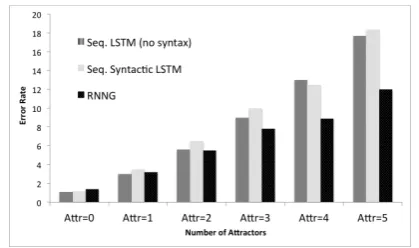
Figure 2: Number agreement error rates for se-quential LSTM language models (left), sese-quential syntactic LSTM language models (Choe and
Char-niak,2016, center), and RNNGs (right).
Discussion. Fig. 2 shows that RNNGs
(right-most) achieve much better number agreement ac-curacy compared to LSTM language models (left-most) for difficult cases with four and five at-tractors, with around 30% error rate reductions, along with a 13% error rate reduction (from 9%
to 7.8%) for three attractors. We attribute the
slightly worse performance of RNNGs on cases with zero and one attractor to the presence of inter-vening structure-building actions that separate the
subject and the verb, such as aREDUCE(step 6 in
Fig.3(a)) action to complete the noun phrase and
at least one action to predict a verb phrase (step
15 in Fig.3(a)) before the verb itself is introduced,
while LSTM language models benefit from shorter dependencies for zero and one attractor cases.
The performance gain of RNNGs might arise from two potential causes. First, RNNGs have access to predicted syntactic annotations, while LSTM language models operate solely on word sequences. Second, RNNGs incorporate explicit compositions, which encourage hierarhical repre-sentations and potentially the discovery of syntac-tic (rather than sequential) dependencies.
Would LSTMs that have access to syntactic annotations, but without the explicit composition function, benefit from the same performance gain as RNNGs? To answer this question, we run se-quential LSTMs over the same phrase-structure
trees (Choe and Charniak, 2016), similarly
es-timating the joint probability of phrase-structure nonterminals and string terminals but without an explicit composition operator. Taking the example
in Fig.3(a), the sequential syntactic LSTM would
have fifteen10 symbols on the LSTM when
pre-dicting the verb, as opposed to three symbols in the case of RNNGs’ stack LSTM. In theory, the sequential LSTM over the phrase-structure trees
(Choe and Charniak,2016) may be able to
incor-porate a similar, albeit implicit, composition pro-cess as RNNGs and consequently derive similarly syntactic heads, although there is no inductive bias that explicitly encourages such process.
Fig. 2 suggests that the sequential syntactic
LSTMs (center) perform comparably with sequen-tial LSTMs without syntax for multiple attractor cases, and worse than RNNGs for nearly all at-tractors; the gap is highest for multiple attractors. This result showcases the importance of an ex-plicit composition operator and hierarchical repre-sentations in identifying structural dependencies, as indicated by number agreement accuracy. Our
finding is consistent with the recent work of
Yo-gatama et al.(2018), who find that introducing
el-ements of hierarchical modeling through a stack-structured memory is beneficial for number agree-ment, outperforming LSTM language models and attention-augmented variants by increasing mar-gins as the number of attractor grows.
3.3 Further Analysis
In order to better interpret the results, we con-duct further analysis into the perplexities of each model, followed by a discussion on the effect of incrementality constraints on the RNNG when predicting number agreement.
Perplexity. To what extent does the success of
RNNGs in the number agreement task with mul-tiple attractors correlate with better performance under the perplexity metric? We answer this ques-tion by using an importance sampling
marginal-ization procedure (Dyer et al.,2016) to obtain an
estimate of p(x) under both RNNGs and the
se-quential syntactic LSTM model. FollowingDyer
et al. (2016), for each sentence on the validation
set we sample 100 candidate trees from a
dis-criminative model11 as our proposal distribution.
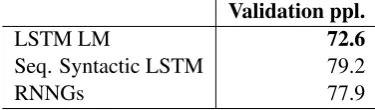
As demonstrated in Table3, the LSTM language
model has the lowest validation set perplexity de-spite substantially worse performance than RN-NGs in number agreement with multiple attrac-tors, suggesting that lower perplexity is not
neces-10
In the model ofChoe and Charniak(2016), each
nonter-minal, ternonter-minal, and closed parenthesis symbol is represented as an element on the LSTM sequence.
sarily correlated with number agreement success.
Validation ppl.
LSTM LM 72.6
Seq. Syntactic LSTM 79.2
[image:6.595.86.274.88.143.2]RNNGs 77.9
Table 3: Validation set perplexity of LSTM lan-guage model, sequential syntactic LSTM, and RN-NGs.
Incrementality constraints. As the syntactic
prefix was derived from a discriminative model that has access to unprocessed words, one poten-tial concern is that this prefix might violate the incrementality constraints and benefit the RNNG over the LSTM language model. To address this concern, we remark that the empirical evidence
from Fig.2 and Table3indicates that the LSTM
language modelwithoutsyntactic annotation
out-performs the sequential LSTMwithsyntactic
an-notation in terms of both perplexity and number agreement throughout nearly all attractor settings, suggesting that the predicted syntactic prefix does not give any unfair advantage to the syntactic mod-els.
Furthermore, we run an experiment where the syntactic prefix is instead derived from an
in-cremental beam search procedure of Fried et al.
(2017).12 To this end, we take the highest scoring
beam entry at the time that the verb is generated to be the syntactic prefix; this procedure is applied
to both the correct and incorrect verb forms.13 We
then similarly compare the probabilities of the cor-rect and incorcor-rect verb form given each respective syntactic prefix to obtain number agreement accu-racy. Our finding suggests that using the fully
in-cremental tree prefix leads to even better RNNG
number agreement performance for four and five attractors, achieving 7.1% and 8.2% error rates, respectively, compared to 9.4% and 12% for the
RNNG error rates in Fig.2.
4 Top-Down, Left-Corner, and
Bottom-Up Traversals
In this section, we propose two new variants of RNNGs that construct trees using a different
con-12As the beam search procedure is time-consuming, we
randomly sample 500 cases for each attractor and compute the number agreement accuracy on these samples.
13Consequently, the correct and incorrect forms of the
sen-tence might have different partial trees, as the highest scoring beam entries may be different for each alternative.
struction order than the top-down, left-to-right or-der used above. These are a bottom-up construc-tion order (§4.1) and a left-corner construcconstruc-tion
order (§4.2), analogous to the well-known
pars-ing strategies (e.g. Hale,2014, chapter 3). They
differ from these classic strategies insofar as they do not announce the phrase-structural content of an entire branch at the same time, adopting in-stead a node-by-node enumeration reminescent of
Markov Grammars (Charniak, 1997). This
step-by-step arrangement extends to the derived string as well; since all variants generate words from left to right, the models can be compared using
number agreement as a diagnostic.14
Here we state our hypothesis on why the build order matters. The three generation strategies rep-resent different chain rule decompositions of the joint probability of strings and phrase-structure trees, thereby imposing different biases on the
learner. Earlier work in parsing has
character-ized the plausibility of top-down, left-corner, and bottom-up strategies as viable candidates of hu-man sentence processing, especially in terms of memory constraints and human difficulties with center embedding constructions (Johnson-Laird,
1983;Pulman, 1986; Abney and Johnson, 1991;
Resnik, 1992, inter alia), along with
neurophys-iological evidence in human sentence processing
(Nelson et al.,2017). Here we cast the three
strate-gies as models of language generation (Manning
and Carpenter,1997), and focus on the empirical
question: which generation order has the most ap-propriate bias in modeling non-local structural de-pendencies in English?
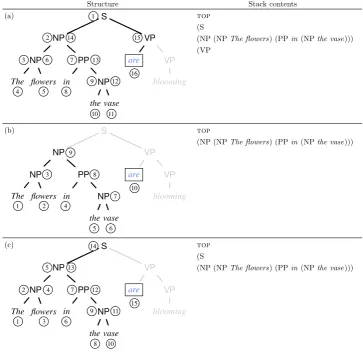
These alternative orders organize the learn-ing problem so as to yield intermediate states in generation that condition on different aspects of the grammatical structure. In number agreement, this amounts to making an agreement controller,
such as the word flowers in Fig. 3, more or less
salient. If it is more salient, the model should be better-able to inflect the main verb in agreement with this controller, without getting distracted by the attractors. The three proposed build orders are
compared in Fig.3, showing the respective
config-urations (i.e. the prefix) when generating the main
verb in a sentence with a single attractor.15 In
ad-14Only the order in which these models build the
nontermi-nal symbols is different, while the terminontermi-nal symbols are still generated in a left-to-right manner in all variants.
15Although the stack configuration at the time of verb
dition, we show concrete action sequences for a simpler sentence in each section.
4.1 Bottom-Up Traversal
In bottom-up traversals, phrases are recursively constructed and labeled with the nonterminal type once all their daughters have been built, as
illus-trated in Fig.4. Bottom-up traversals benefit from
shorter stack depths compared to top-down due to the lack of incomplete nonterminals. As the com-mitment to label the nonterminal type of a phrase is delayed until its constituents are complete, this means that the generation of a child node cannot condition on the label of its parent node.
Inn-ary branching trees, bottom-up completion
of constituents requires a procedure for determin-ing how many of the most recent elements on the stack should be daughters of the node that is
be-ing constructed.16 Conceptually, rather than
hav-ing a shav-ingleREDUCEoperation as we have before,
we have a complex REDUCE(X, n)operation that
must determine the type of the constituent (i.e., X)
as well as the number of daughters (i.e.,n).
In step 5 of Fig. 4, the newly formed NP
con-stituent only covers the terminalworms, and
nei-ther the unattached terminal eats nor the
con-stituent (NP The fox) is part of the new noun
phrase. We implement this extent decision
us-ing a stick-breakus-ing construction—usus-ing the stack LSTM encoding, a single-layer feedforward net-work, and a logistic output layer—which decides whether the top element on the stack should be the leftmost child of the new constituent (i.e. whether or not the new constituent is complete after pop-ping the current topmost stack element), as
illus-trated in Fig.5. If not, the process is then repeated
after the topmost stack element is popped. Once the extent of the new nonterminal has been de-cided, we parameterize the decision of the
nonter-minal label type; in Fig.5this is an NP. A second
difference to top-down generation is that when a single constituent remains on the stack, the sen-tence is not necessarily complete (see step 3 of
Fig.4for examples where this happens). We thus
introduce an explicitSTOPaction (step 8, Fig.4),
indicating the tree is complete, which is only as-signed non-zero probability when the stack has a
during the history of the full generation process vary consid-erably in the invariances and the kinds of actions they predict.
16This mechanism is not necessary with strictly binary
branching trees, since each new nonterminal always consists of the two children at the top of the stack.
Avg. stack depth Ppl.
TD 12.29 94.90
LC 11.45 95.86
[image:7.595.338.494.62.118.2]BU 7.41 96.53
Table 4: Average stack depth and validation set perplexity for top-down (TD), left-corner (LC), and bottom-up (BU) RNNGs.
single complete constituent.
4.2 Left-Corner Traversal
Left-corner traversals combine some aspects of
top-down and bottom-up processing. As
illus-trated in Fig.6, this works by first generating the
leftmost terminal of the tree, The (step 0),
be-fore proceeding bottom-up to predict its parent NP (step 1) and then top-down to predict the rest of its
children (step 2). AREDUCEaction similarly calls
the composition operator once the phrase is com-plete (e.g. step 3). The comcom-plete constituent (NP The fox) is the leftmost child of its parent node,
thus anNT SW(S) action is done next (step 4).
The NT SW(X) action is similar to the NT(X)
from the top-down generator, in that it introduces an open nonterminal node and must be matched
later by a corresponding REDUCE operation, but,
in addition, swaps the two topmost elements at the top of the stack. This is necessary because the parent nonterminal node is not built until af-ter its left-most child has been constructed. In step
1 of Fig.6, with a single elementTheon the stack,
the actionNT SW(NP) adds the open nonterminal
symbol NP to become the topmost stack element, but after applying the swap operator the stack now
contains (NP | The(step 2).
4.3 Experiments
We optimize the hyper-parameters of each RNNG variant using grid searches based on validation
set perplexity. Table4summarizes average stack
depths and perplexities17 on the Linzen et al.
(2016) validation set. We evaluate each of the vari-ants in terms of number agreement accuracy as an evidence of its suitability to model structural
de-pendencies in English, presented in Table 5. To
account for randomness in training, we report the error rate summary statistics of ten different runs.
17Here we measure perplexity over p(x,y), where yis
the presumptive gold tree on theLinzen et al.(2016) dataset.
Dyer et al.(2016) instead used an importance sampling
S
NP VP
VP
The
are
blooming
NP PP
the NP in
S
NP VP
VP
are
blooming
NP PP
NP in
S
NP VP
VP
are
blooming
NP PP
NP in
1
2
3
4 5
6 7
8 9
10 11 12 13
15
16
3
4
5 6
7 8 9 14
10
14
5
2 4 7
6 9
8 10 11 12
15 13
top
(NP (NPThe flowers) (PPin(NPthe vase)))
<latexit sha1_base64="pEVHBaNobe2opYNoW5WgOk9U8Tg=">AAACR3icbVDPSxtBFJ6NWjW1NerRy2BoSaCEjQi2t4AXTyUFV4VsCLOTt8ngzM4y8zZtWPbP8+Kxt/4NXnqwpUdnkxU09sGDj+9979cXpVJY9P1fXm1tfePN5tZ2/e3Ou/e7jb39S6szwyHgWmpzHTELUiQQoEAJ16kBpiIJV9HNWVm/moGxQicXOE9hqNgkEbHgDB01aow+hgg/0PIcdVrQMKwvCaPy1tc+LTMElU7ziynQWOrvblbRpq3+Ey+S4pkKnWrmzina7fZi2qjR9Dv+Iuhr0K1Ak1TRHzV+hmPNMwUJcsmsHXT9FIc5Myi4hKIeZhZSxm/YBAYOJkyBHeYLIwr6wTFjGmvjMkG6YJ935ExZO1eRUyqGU7taK8n/1QYZxp+H7tc0Q0j4clGcSYqalq7SsTDAUc4dYNwIdyvlU2YYR+dXaUJ39eXXIDjufOn4306avU+VG1vkkByRFumSU9Ij56RPAsLJLbknD+SPd+f99v56/5bSmlf1HJAXUfMeAcDnsAs=</latexit>
<latexit sha1_base64="pEVHBaNobe2opYNoW5WgOk9U8Tg=">AAACR3icbVDPSxtBFJ6NWjW1NerRy2BoSaCEjQi2t4AXTyUFV4VsCLOTt8ngzM4y8zZtWPbP8+Kxt/4NXnqwpUdnkxU09sGDj+9979cXpVJY9P1fXm1tfePN5tZ2/e3Ou/e7jb39S6szwyHgWmpzHTELUiQQoEAJ16kBpiIJV9HNWVm/moGxQicXOE9hqNgkEbHgDB01aow+hgg/0PIcdVrQMKwvCaPy1tc+LTMElU7ziynQWOrvblbRpq3+Ey+S4pkKnWrmzina7fZi2qjR9Dv+Iuhr0K1Ak1TRHzV+hmPNMwUJcsmsHXT9FIc5Myi4hKIeZhZSxm/YBAYOJkyBHeYLIwr6wTFjGmvjMkG6YJ935ExZO1eRUyqGU7taK8n/1QYZxp+H7tc0Q0j4clGcSYqalq7SsTDAUc4dYNwIdyvlU2YYR+dXaUJ39eXXIDjufOn4306avU+VG1vkkByRFumSU9Ij56RPAsLJLbknD+SPd+f99v56/5bSmlf1HJAXUfMeAcDnsAs=</latexit>
<latexit sha1_base64="pEVHBaNobe2opYNoW5WgOk9U8Tg=">AAACR3icbVDPSxtBFJ6NWjW1NerRy2BoSaCEjQi2t4AXTyUFV4VsCLOTt8ngzM4y8zZtWPbP8+Kxt/4NXnqwpUdnkxU09sGDj+9979cXpVJY9P1fXm1tfePN5tZ2/e3Ou/e7jb39S6szwyHgWmpzHTELUiQQoEAJ16kBpiIJV9HNWVm/moGxQicXOE9hqNgkEbHgDB01aow+hgg/0PIcdVrQMKwvCaPy1tc+LTMElU7ziynQWOrvblbRpq3+Ey+S4pkKnWrmzina7fZi2qjR9Dv+Iuhr0K1Ak1TRHzV+hmPNMwUJcsmsHXT9FIc5Myi4hKIeZhZSxm/YBAYOJkyBHeYLIwr6wTFjGmvjMkG6YJ935ExZO1eRUyqGU7taK8n/1QYZxp+H7tc0Q0j4clGcSYqalq7SsTDAUc4dYNwIdyvlU2YYR+dXaUJ39eXXIDjufOn4306avU+VG1vkkByRFumSU9Ij56RPAsLJLbknD+SPd+f99v56/5bSmlf1HJAXUfMeAcDnsAs=</latexit>
top (S
(NP (NPThe flowers) (PPin(NPthe vase))) (VP
<latexit sha1_base64="UOyF7nqTZQejWkT+z8q4hH00J/4=">AAACZHicbVDfSxtBEN47taaptlHxqSCLoSWBEi5FsL4JvvgkV0xUyIWwt5lLFndvj905bTjvn/TN177033DzoxATBwa+/eab2ZkvzqSwGAQvnr+xufVhu/Kx+mln9/OX2t7+jdW54dDlWmpzFzMLUqTQRYES7jIDTMUSbuP7i2n99gGMFTrt4CSDvmKjVCSCM3TUoPb0PUL4g5YXqLOSRlF1ThhVNK5X3lchnWYEKhsXnTHQROpHN7ts0kb4nxdpuaRCp3pw65XNZnNl2k1YDmr1oBXMgq6D9gLUySLCQe05GmqeK0iRS2Ztrx1k2C+YQcEllNUot5Axfs9G0HMwZQpsv5i5VNJvjhnSRBuXKdIZu9xRMGXtRMVOqRiO7WptSr5X6+WY/Oq7w7McIeXzj5JcUtR0ajkdCgMc5cQBxo1wu1I+ZoZxdOZVnQnt1ZPXQfdn66wV/D6pn/9YuFEhX8kxaZA2OSXn5JKEpEs4+etVvD1v3/vn7/oH/uFc6nuLngPyJvyjVyk1tZo=</latexit>
<latexit sha1_base64="UOyF7nqTZQejWkT+z8q4hH00J/4=">AAACZHicbVDfSxtBEN47taaptlHxqSCLoSWBEi5FsL4JvvgkV0xUyIWwt5lLFndvj905bTjvn/TN177033DzoxATBwa+/eab2ZkvzqSwGAQvnr+xufVhu/Kx+mln9/OX2t7+jdW54dDlWmpzFzMLUqTQRYES7jIDTMUSbuP7i2n99gGMFTrt4CSDvmKjVCSCM3TUoPb0PUL4g5YXqLOSRlF1ThhVNK5X3lchnWYEKhsXnTHQROpHN7ts0kb4nxdpuaRCp3pw65XNZnNl2k1YDmr1oBXMgq6D9gLUySLCQe05GmqeK0iRS2Ztrx1k2C+YQcEllNUot5Axfs9G0HMwZQpsv5i5VNJvjhnSRBuXKdIZu9xRMGXtRMVOqRiO7WptSr5X6+WY/Oq7w7McIeXzj5JcUtR0ajkdCgMc5cQBxo1wu1I+ZoZxdOZVnQnt1ZPXQfdn66wV/D6pn/9YuFEhX8kxaZA2OSXn5JKEpEs4+etVvD1v3/vn7/oH/uFc6nuLngPyJvyjVyk1tZo=</latexit>
<latexit sha1_base64="UOyF7nqTZQejWkT+z8q4hH00J/4=">AAACZHicbVDfSxtBEN47taaptlHxqSCLoSWBEi5FsL4JvvgkV0xUyIWwt5lLFndvj905bTjvn/TN177033DzoxATBwa+/eab2ZkvzqSwGAQvnr+xufVhu/Kx+mln9/OX2t7+jdW54dDlWmpzFzMLUqTQRYES7jIDTMUSbuP7i2n99gGMFTrt4CSDvmKjVCSCM3TUoPb0PUL4g5YXqLOSRlF1ThhVNK5X3lchnWYEKhsXnTHQROpHN7ts0kb4nxdpuaRCp3pw65XNZnNl2k1YDmr1oBXMgq6D9gLUySLCQe05GmqeK0iRS2Ztrx1k2C+YQcEllNUot5Axfs9G0HMwZQpsv5i5VNJvjhnSRBuXKdIZu9xRMGXtRMVOqRiO7WptSr5X6+WY/Oq7w7McIeXzj5JcUtR0ajkdCgMc5cQBxo1wu1I+ZoZxdOZVnQnt1ZPXQfdn66wV/D6pn/9YuFEhX8kxaZA2OSXn5JKEpEs4+etVvD1v3/vn7/oH/uFc6nuLngPyJvyjVyk1tZo=</latexit>
top (S
(NP (NPThe flowers) (PPin(NPthe vase)))
<latexit sha1_base64="696n4vimN65k0w31NO6f4kaJvvM=">AAACU3icbVBNixNBEO0Z4242a9asHvfSGFYSkDARwd1bwIsnGTFjApkQejo1SZPu6aG7ZjUM8yP1IPhLvHiw8yHExIKC169eVVe9JJfCYhD89PxHtcdn5/WLxuWT5tXT1vWzz1YXhkPEtdRmnDALUmQQoUAJ49wAU4mEUbJ6t6mPHsBYobMhrnOYKrbIRCo4Q0fNWquXMcJXtLxEnVc0jhs7wqiy8+no/SGkm4xB5ctyuASaSv3Fza66tBP+5UVWHajQqR7celW3261mrXbQC7ZBT0F/D9pkH+Gs9T2ea14oyJBLZu2kH+Q4LZlBwSVUjbiwkDO+YguYOJgxBXZabk2p6K1j5jTVxmWGdMsedpRMWbtWiVMqhkt7XNuQ/6tNCkzvpu7OvEDI+O6jtJAUNd04TOfCAEe5doBxI9yulC+ZYRydVw1nQv/45FMQve7d94KPb9qDV3s36uSGvCAd0idvyYC8JyGJCCffyC+PeJ73w/vt+35tJ/W9fc9z8k/4zT+HsrEg</latexit>
<latexit sha1_base64="696n4vimN65k0w31NO6f4kaJvvM=">AAACU3icbVBNixNBEO0Z4242a9asHvfSGFYSkDARwd1bwIsnGTFjApkQejo1SZPu6aG7ZjUM8yP1IPhLvHiw8yHExIKC169eVVe9JJfCYhD89PxHtcdn5/WLxuWT5tXT1vWzz1YXhkPEtdRmnDALUmQQoUAJ49wAU4mEUbJ6t6mPHsBYobMhrnOYKrbIRCo4Q0fNWquXMcJXtLxEnVc0jhs7wqiy8+no/SGkm4xB5ctyuASaSv3Fza66tBP+5UVWHajQqR7celW3261mrXbQC7ZBT0F/D9pkH+Gs9T2ea14oyJBLZu2kH+Q4LZlBwSVUjbiwkDO+YguYOJgxBXZabk2p6K1j5jTVxmWGdMsedpRMWbtWiVMqhkt7XNuQ/6tNCkzvpu7OvEDI+O6jtJAUNd04TOfCAEe5doBxI9yulC+ZYRydVw1nQv/45FMQve7d94KPb9qDV3s36uSGvCAd0idvyYC8JyGJCCffyC+PeJ73w/vt+35tJ/W9fc9z8k/4zT+HsrEg</latexit>
<latexit sha1_base64="696n4vimN65k0w31NO6f4kaJvvM=">AAACU3icbVBNixNBEO0Z4242a9asHvfSGFYSkDARwd1bwIsnGTFjApkQejo1SZPu6aG7ZjUM8yP1IPhLvHiw8yHExIKC169eVVe9JJfCYhD89PxHtcdn5/WLxuWT5tXT1vWzz1YXhkPEtdRmnDALUmQQoUAJ49wAU4mEUbJ6t6mPHsBYobMhrnOYKrbIRCo4Q0fNWquXMcJXtLxEnVc0jhs7wqiy8+no/SGkm4xB5ctyuASaSv3Fza66tBP+5UVWHajQqR7celW3261mrXbQC7ZBT0F/D9pkH+Gs9T2ea14oyJBLZu2kH+Q4LZlBwSVUjbiwkDO+YguYOJgxBXZabk2p6K1j5jTVxmWGdMsedpRMWbtWiVMqhkt7XNuQ/6tNCkzvpu7OvEDI+O6jtJAUNd04TOfCAEe5doBxI9yulC+ZYRydVw1nQv/45FMQve7d94KPb9qDV3s36uSGvCAd0idvyYC8JyGJCCffyC+PeJ73w/vt+35tJ/W9fc9z8k/4zT+HsrEg</latexit>
(a)<latexit sha1_base64="UHgaAuqwBFHO+w3+PMZ4hgEg2pg=">AAAB8nicbVBNS8NAEN3Ur1q/qh69LBahgpREBPVW8OKxgrGFJpTNdtMu3d2E3YlYQv+GFw8qXv013vw3btsctPXBwOO9GWbmRangBlz32ymtrK6tb5Q3K1vbO7t71f2DB5NkmjKfJiLRnYgYJrhiPnAQrJNqRmQkWDsa3Uz99iPThifqHsYpCyUZKB5zSsBKQQDsCbTM6+R00qvW3IY7A14mXkFqqECrV/0K+gnNJFNABTGm67kphDnRwKlgk0qQGZYSOiID1rVUEclMmM9unuATq/RxnGhbCvBM/T2RE2nMWEa2UxIYmkVvKv7ndTOIr8KcqzQDpuh8UZwJDAmeBoD7XDMKYmwJoZrbWzEdEk0o2JgqNgRv8eVl4p83rhvu3UWteVakUUZH6BjVkYcuURPdohbyEUUpekav6M3JnBfn3fmYt5acYuYQ/YHz+QNW/ZFZ</latexit><latexit sha1_base64="UHgaAuqwBFHO+w3+PMZ4hgEg2pg=">AAAB8nicbVBNS8NAEN3Ur1q/qh69LBahgpREBPVW8OKxgrGFJpTNdtMu3d2E3YlYQv+GFw8qXv013vw3btsctPXBwOO9GWbmRangBlz32ymtrK6tb5Q3K1vbO7t71f2DB5NkmjKfJiLRnYgYJrhiPnAQrJNqRmQkWDsa3Uz99iPThifqHsYpCyUZKB5zSsBKQQDsCbTM6+R00qvW3IY7A14mXkFqqECrV/0K+gnNJFNABTGm67kphDnRwKlgk0qQGZYSOiID1rVUEclMmM9unuATq/RxnGhbCvBM/T2RE2nMWEa2UxIYmkVvKv7ndTOIr8KcqzQDpuh8UZwJDAmeBoD7XDMKYmwJoZrbWzEdEk0o2JgqNgRv8eVl4p83rhvu3UWteVakUUZH6BjVkYcuURPdohbyEUUpekav6M3JnBfn3fmYt5acYuYQ/YHz+QNW/ZFZ</latexit><latexit sha1_base64="UHgaAuqwBFHO+w3+PMZ4hgEg2pg=">AAAB8nicbVBNS8NAEN3Ur1q/qh69LBahgpREBPVW8OKxgrGFJpTNdtMu3d2E3YlYQv+GFw8qXv013vw3btsctPXBwOO9GWbmRangBlz32ymtrK6tb5Q3K1vbO7t71f2DB5NkmjKfJiLRnYgYJrhiPnAQrJNqRmQkWDsa3Uz99iPThifqHsYpCyUZKB5zSsBKQQDsCbTM6+R00qvW3IY7A14mXkFqqECrV/0K+gnNJFNABTGm67kphDnRwKlgk0qQGZYSOiID1rVUEclMmM9unuATq/RxnGhbCvBM/T2RE2nMWEa2UxIYmkVvKv7ndTOIr8KcqzQDpuh8UZwJDAmeBoD7XDMKYmwJoZrbWzEdEk0o2JgqNgRv8eVl4p83rhvu3UWteVakUUZH6BjVkYcuURPdohbyEUUpekav6M3JnBfn3fmYt5acYuYQ/YHz+QNW/ZFZ</latexit>
(b)
<latexit sha1_base64="q0c13WRT90Z0PhqBh91Pvh1Rkms=">AAAB8nicbVBNS8NAEN3Ur1q/qh69LBahgpREBPVW8OKxgrGFJpTNdtMu3d2E3YlYQv+GFw8qXv013vw3btsctPXBwOO9GWbmRangBlz32ymtrK6tb5Q3K1vbO7t71f2DB5NkmjKfJiLRnYgYJrhiPnAQrJNqRmQkWDsa3Uz99iPThifqHsYpCyUZKB5zSsBKQQDsCbTM69HppFetuQ13BrxMvILUUIFWr/oV9BOaSaaACmJM13NTCHOigVPBJpUgMywldEQGrGupIpKZMJ/dPMEnVunjONG2FOCZ+nsiJ9KYsYxspyQwNIveVPzP62YQX4U5V2kGTNH5ojgTGBI8DQD3uWYUxNgSQjW3t2I6JJpQsDFVbAje4svLxD9vXDfcu4ta86xIo4yO0DGqIw9doia6RS3kI4pS9Ixe0ZuTOS/Ou/Mxby05xcwh+gPn8wdYgpFa</latexit>
<latexit sha1_base64="q0c13WRT90Z0PhqBh91Pvh1Rkms=">AAAB8nicbVBNS8NAEN3Ur1q/qh69LBahgpREBPVW8OKxgrGFJpTNdtMu3d2E3YlYQv+GFw8qXv013vw3btsctPXBwOO9GWbmRangBlz32ymtrK6tb5Q3K1vbO7t71f2DB5NkmjKfJiLRnYgYJrhiPnAQrJNqRmQkWDsa3Uz99iPThifqHsYpCyUZKB5zSsBKQQDsCbTM69HppFetuQ13BrxMvILUUIFWr/oV9BOaSaaACmJM13NTCHOigVPBJpUgMywldEQGrGupIpKZMJ/dPMEnVunjONG2FOCZ+nsiJ9KYsYxspyQwNIveVPzP62YQX4U5V2kGTNH5ojgTGBI8DQD3uWYUxNgSQjW3t2I6JJpQsDFVbAje4svLxD9vXDfcu4ta86xIo4yO0DGqIw9doia6RS3kI4pS9Ixe0ZuTOS/Ou/Mxby05xcwh+gPn8wdYgpFa</latexit>
<latexit sha1_base64="q0c13WRT90Z0PhqBh91Pvh1Rkms=">AAAB8nicbVBNS8NAEN3Ur1q/qh69LBahgpREBPVW8OKxgrGFJpTNdtMu3d2E3YlYQv+GFw8qXv013vw3btsctPXBwOO9GWbmRangBlz32ymtrK6tb5Q3K1vbO7t71f2DB5NkmjKfJiLRnYgYJrhiPnAQrJNqRmQkWDsa3Uz99iPThifqHsYpCyUZKB5zSsBKQQDsCbTM69HppFetuQ13BrxMvILUUIFWr/oV9BOaSaaACmJM13NTCHOigVPBJpUgMywldEQGrGupIpKZMJ/dPMEnVunjONG2FOCZ+nsiJ9KYsYxspyQwNIveVPzP62YQX4U5V2kGTNH5ojgTGBI8DQD3uWYUxNgSQjW3t2I6JJpQsDFVbAje4svLxD9vXDfcu4ta86xIo4yO0DGqIw9doia6RS3kI4pS9Ixe0ZuTOS/Ou/Mxby05xcwh+gPn8wdYgpFa</latexit>
(c)
<latexit sha1_base64="nBjLEin08ijRvaoqcwftuVRQPlE=">AAAB8nicbVBNS8NAEN3Ur1q/qh69LBahgpREBPVW8OKxgrGFJpTNdtMu3d2E3YlYQv+GFw8qXv013vw3btsctPXBwOO9GWbmRangBlz32ymtrK6tb5Q3K1vbO7t71f2DB5NkmjKfJiLRnYgYJrhiPnAQrJNqRmQkWDsa3Uz99iPThifqHsYpCyUZKB5zSsBKQQDsCbTM6/R00qvW3IY7A14mXkFqqECrV/0K+gnNJFNABTGm67kphDnRwKlgk0qQGZYSOiID1rVUEclMmM9unuATq/RxnGhbCvBM/T2RE2nMWEa2UxIYmkVvKv7ndTOIr8KcqzQDpuh8UZwJDAmeBoD7XDMKYmwJoZrbWzEdEk0o2JgqNgRv8eVl4p83rhvu3UWteVakUUZH6BjVkYcuURPdohbyEUUpekav6M3JnBfn3fmYt5acYuYQ/YHz+QNaB5Fb</latexit>
<latexit sha1_base64="nBjLEin08ijRvaoqcwftuVRQPlE=">AAAB8nicbVBNS8NAEN3Ur1q/qh69LBahgpREBPVW8OKxgrGFJpTNdtMu3d2E3YlYQv+GFw8qXv013vw3btsctPXBwOO9GWbmRangBlz32ymtrK6tb5Q3K1vbO7t71f2DB5NkmjKfJiLRnYgYJrhiPnAQrJNqRmQkWDsa3Uz99iPThifqHsYpCyUZKB5zSsBKQQDsCbTM6/R00qvW3IY7A14mXkFqqECrV/0K+gnNJFNABTGm67kphDnRwKlgk0qQGZYSOiID1rVUEclMmM9unuATq/RxnGhbCvBM/T2RE2nMWEa2UxIYmkVvKv7ndTOIr8KcqzQDpuh8UZwJDAmeBoD7XDMKYmwJoZrbWzEdEk0o2JgqNgRv8eVl4p83rhvu3UWteVakUUZH6BjVkYcuURPdohbyEUUpekav6M3JnBfn3fmYt5acYuYQ/YHz+QNaB5Fb</latexit>
<latexit sha1_base64="nBjLEin08ijRvaoqcwftuVRQPlE=">AAAB8nicbVBNS8NAEN3Ur1q/qh69LBahgpREBPVW8OKxgrGFJpTNdtMu3d2E3YlYQv+GFw8qXv013vw3btsctPXBwOO9GWbmRangBlz32ymtrK6tb5Q3K1vbO7t71f2DB5NkmjKfJiLRnYgYJrhiPnAQrJNqRmQkWDsa3Uz99iPThifqHsYpCyUZKB5zSsBKQQDsCbTM6/R00qvW3IY7A14mXkFqqECrV/0K+gnNJFNABTGm67kphDnRwKlgk0qQGZYSOiID1rVUEclMmM9unuATq/RxnGhbCvBM/T2RE2nMWEa2UxIYmkVvKv7ndTOIr8KcqzQDpuh8UZwJDAmeBoD7XDMKYmwJoZrbWzEdEk0o2JgqNgRv8eVl4p83rhvu3UWteVakUUZH6BjVkYcuURPdohbyEUUpekav6M3JnBfn3fmYt5acYuYQ/YHz+QNaB5Fb</latexit>
Structure Stack contents
<latexit sha1_base64="Bpgv0W9yrxMbIL8afjLiNO9akmk=">AAACRniclVA7SwNBEJ6LrxhfUUubxSBYSLiIoHYBG8uIxgRyMeztbZLFvUd2Z8Vw5N/Z2Nr5F2wsVGzdPBBNbBzY4eOb+WZ2Pj+RQqPrPjuZufmFxaXscm5ldW19I7+5da1joxivsljGqu5TzaWIeBUFSl5PFKehL3nNvz0b1mt3XGkRR1fYT3gzpJ1ItAWjaKlW/sZDfo8qTC9RGYZG8YHX6xka/CcP0/cYym4JiyPkEepBK19wi+4oyCwoTUABJlFp5Z+8IGYmtGomqdaNkptgM6UKBZN8kPOM5oldQTu8YWFEQ66b6ciHAdmzTEDasbIvQjJifypSGmrdD33bGVLs6unakPyr1jDYPmmmIkqMPYuNF7WNJBiToakkEIozlH0LKFPC/pWwLlWUobU+Z00oTZ88C6qHxdOie3FUKB9M3MjCDuzCPpTgGMpwDhWoAoMHeIE3eHcenVfnw/kct2aciWYbfkUGvgDQs7Yh</latexit>
<latexit sha1_base64="Bpgv0W9yrxMbIL8afjLiNO9akmk=">AAACRniclVA7SwNBEJ6LrxhfUUubxSBYSLiIoHYBG8uIxgRyMeztbZLFvUd2Z8Vw5N/Z2Nr5F2wsVGzdPBBNbBzY4eOb+WZ2Pj+RQqPrPjuZufmFxaXscm5ldW19I7+5da1joxivsljGqu5TzaWIeBUFSl5PFKehL3nNvz0b1mt3XGkRR1fYT3gzpJ1ItAWjaKlW/sZDfo8qTC9RGYZG8YHX6xka/CcP0/cYym4JiyPkEepBK19wi+4oyCwoTUABJlFp5Z+8IGYmtGomqdaNkptgM6UKBZN8kPOM5oldQTu8YWFEQ66b6ciHAdmzTEDasbIvQjJifypSGmrdD33bGVLs6unakPyr1jDYPmmmIkqMPYuNF7WNJBiToakkEIozlH0LKFPC/pWwLlWUobU+Z00oTZ88C6qHxdOie3FUKB9M3MjCDuzCPpTgGMpwDhWoAoMHeIE3eHcenVfnw/kct2aciWYbfkUGvgDQs7Yh</latexit><latexit sha1_base64="Bpgv0W9yrxMbIL8afjLiNO9akmk=">AAACRniclVA7SwNBEJ6LrxhfUUubxSBYSLiIoHYBG8uIxgRyMeztbZLFvUd2Z8Vw5N/Z2Nr5F2wsVGzdPBBNbBzY4eOb+WZ2Pj+RQqPrPjuZufmFxaXscm5ldW19I7+5da1joxivsljGqu5TzaWIeBUFSl5PFKehL3nNvz0b1mt3XGkRR1fYT3gzpJ1ItAWjaKlW/sZDfo8qTC9RGYZG8YHX6xka/CcP0/cYym4JiyPkEepBK19wi+4oyCwoTUABJlFp5Z+8IGYmtGomqdaNkptgM6UKBZN8kPOM5oldQTu8YWFEQ66b6ciHAdmzTEDasbIvQjJifypSGmrdD33bGVLs6unakPyr1jDYPmmmIkqMPYuNF7WNJBiToakkEIozlH0LKFPC/pWwLlWUobU+Z00oTZ88C6qHxdOie3FUKB9M3MjCDuzCPpTgGMpwDhWoAoMHeIE3eHcenVfnw/kct2aciWYbfkUGvgDQs7Yh</latexit>
flowers
The
1 2
flowers
The
1 3
flowers
vase
the vase
[image:8.595.116.480.62.414.2]the vase
Figure 3: The (a) top-down, (b) bottom-up, and (c) left-corner build order variants showing in black
the structure that exists as well as the generator’s stack contents when the wordareis generated during
the derivation of the sentenceThe flowers in the vase are blooming. Structure in grey indicates material
that will be generated subsequent to this. Circled numbers indicate the time when the corresponding
structure/word is constructed. In (a) and (c), nonterminals are generated by a matched pair of NT and
REDUCEoperations, while in (b) they are introduced by a single complexREDUCEoperation.
Input:The fox eats worms
Stack Action
0 GEN(The)
1 The GEN(fox)
2 The|fox REDUCE(NP,2)
3 (NPThe fox) GEN(eats)
4 (NPThe fox)|eats GEN(worms)
5 (NPThe fox)|eats|worms REDUCE(NP,1)
6 (NPThe fox)|eats|(NPworms) REDUCE(VP,2)
7 (NPThe fox)|(VPeats(NPworms)) REDUCE(S,2)
8 (S (NPThe fox) (VPeats(NPworms)) STOP
Figure 4: Example Derivation for Bottom-Up
Traversal. ‘|’ indicates separate elements on the
stack. The REDUCE(X, n) action takes the top
n elements on the stack and creates a new
con-stituent of type X with the composition function.
Avg.(±sdev)/min/max
n=2 n=3 n=4
[image:8.595.73.287.547.663.2]LM 5.8(±0.2)/5.5/6.0 9.6(±0.7)/8.8/10.1 14.1(±1.2)/13.0/15.3 TD 5.5(±0.4)/4.9/5.8 7.8(±0.6)/7.4/8.0 8.9(±1.1)/7.9/9.8 LC 5.4(±0.3)/5.2/5.5 8.2(±0.4)/7.9/8.7 9.9(±1.3)/8.8/11.5 BU 5.7(±0.3) 5.5/5.8 8.5(±0.7)/8.0/9.3 9.7(±1.1)/9.0/11.3
[image:8.595.310.520.562.620.2]Figure 5: Architecture to determine type and span of new constituents during bottom-up generation.
Input:The fox eats worms
Stack Action
0 GEN(The)
1 The NT SW(NP)
2 (NP|The GEN(fox)
3 (NP|The|fox REDUCE
4 (NPThe fox) NT SW(S) 5 (S|(NPThe fox) GEN(eats) 6 (S|(NPThe fox)|eats NT SW(VP) 7 (S|(NPThe fox)|(VP|eats GEN(worms) 8 (S|(NPThe fox)|(VP|eats|worms NT SW(NP) 9 (S|(NPThe fox)|(VP|eats|(NP|worms REDUCE
10 (S|(NPThe fox)|(VP|eats|(NPworms) REDUCE
11 (S|(NPThe fox)|(VPeats(NPworms)) REDUCE
12 (S (NPThe fox) (VPeats(NPworms))) N/A
Figure 6: Example Derivation for left-corner
traversal. Each NT SW(X) action adds the open
nonterminal symbol (X to the stack, followed by
a deterministic swap operator that swaps the top
two elements on the stack.
Discussion. In Table 5, we focus on
empiri-cal results for cases where the structural depen-dencies matter the most, corresponding to cases
with two, three, and four attractors. All three
RNNG variants outperform the sequential LSTM language model baseline for these cases. Nev-ertheless, the top-down variant outperforms both left-corner and bottom-up strategies for difficult cases with three or more attractors, suggesting that the top-down strategy is most appropriately biased to model difficult number agreement dependencies in English. We run an approximate randomization test by stratifying the output and permuting within
each stratum (Yeh, 2000) and find that, for four
attractors, the performance difference between the top-down RNNG and the other variants is
statisti-cally significant atp <0.05.
The success of the top-down traversal in the do-main of number-agreement prediction is consis-tent with a classical view in parsing that argues top-down parsing is the most human-like
pars-ing strategy since it is the mostanticipatory. Only
anticipatory representations, it is said, could ex-plain the rapid, incremental processing that
hu-mans seem to exhibit (Marslen-Wilson, 1973;
Tanenhaus et al.,1995); this line of thinking
sim-ilarly motivates Charniak (2010), among others.
While most work in this domain has been con-cerned with the parsing problem, our findings sug-gest that anticipatory mechanisms are also bene-ficial in capturing structural dependencies in
lan-guage modeling. We note that our results are
achieved using models that, in theory, are able to condition on the entire derivation history, while earlier work in sentence processing has focused on cognitive memory considerations, such as the
memory-bounded model ofSchuler et al.(2010).
5 Conclusion
Given enough capacity, LSTMs trained on lan-guage modeling objectives are able to learn syntax-sensitive dependencies, as evidenced by accurate number agreement accuracy with multi-ple attractors. Despite this strong performance, we discover explicit modeling of structure does improve the model’s ability to discover non-local structural dependencies when determining the dis-tribution over subsequent word generation. Recur-rent neural network grammars (RNNGs), which jointly model phrase-structure trees and strings and employ an explicit composition operator, sub-stantially outperform LSTM language models and syntactic language models without explicit com-positions; this highlights the importance of a hier-archical inductive bias in capturing structural de-pendencies. We explore the possibility that how the structure is built affects number agreement per-formance. Through novel extensions to RNNGs that enable the use of left-corner and bottom-up generation strategies, we discover that this is in-deed the case: the three RNNG variants have dif-ferent generalization properties for number agree-ment, with the top-down traversal strategy per-forming best for cases with multiple attractors.
Acknowledgments
[image:9.595.76.288.228.369.2]References
Steven Abney and Mark Johnson. 1991. Memory re-quirements and local ambiguities for parsing strate-gies. Journal of Psycholinguistic Research.
Dzmitry Bahdanau, Kyunghyun Cho, and Yoshua Ben-gio. 2015. Neural machine translation by jointly learning to align and translate. InProc. of ICLR.
Eugene Charniak. 1997. Statistical techniques for nat-ural language parsing. AI Magazine.
Eugene Charniak. 2010. Top-down nearly-context-sensitive parsing. In Proceedings of the 2010 Conference on Empirical Methods in Natural
Language Processing. Association for
Computa-tional Linguistics, Cambridge, MA, pages 674–683. http://www.aclweb.org/anthology/D10-1066.
Ciprian Chelba and Frederick Jelinek. 2000. Struc-tured language modeling. Computer Speech and
Language14(4).
Do Kook Choe and Eugene Charniak. 2016. Parsing as language modeling. InProc. of EMNLP.
Chris Dyer, Adhiguna Kuncoro, Miguel Ballesteros, and Noah A. Smith. 2016. Recurrent neural network grammars. InProc. of NAACL.
Ahmad Emami and Frederick Jelinek. 2005. A neu-ral syntactic language model. Machine Learning
60:195–227.
Daniel Fried, Mitchell Stern, and Dan Klein. 2017. Im-proving neural parsing by disentangling model com-bination and reranking effects. InProceedings of the 55th Annual Meeting of the Association for Compu-tational Linguistics (Volume 2: Short Papers). Van-couver, Canada, pages 161–166.
Kristina Gulordava, Piotr Bojanowski, Edouard Grave, Tal Linzen, and Marco Baroni. 2018. Colorless green recurrent networks dream hierarchically. In
Proc. of NAACL.
John T Hale. 2014. Automaton theories of human
sen-tence comprehension. CSLI Publications.
James Henderson. 2003. Inducing history representa-tions for broad coverage statistical parsing. InProc.
of NAACL.
James Henderson. 2004. Discriminative training of a neural network statistical parser. InProc. of ACL.
Sepp Hochreiter and J¨urgen Schmidhuber. 1997. Long short-term memory.Neural Computation.
Marcus Hutter. 2012. The human knowledge compres-sion contest .
Robin Jia and Percy Liang. 2017. Adversarial exam-ples for evaluating reading comprehension systems.
InProc. of EMNLP.
Philip N. Johnson-Laird. 1983. Mental Models. Har-vard University Press.
Rafal Jozefowicz, Oriol Vinyals, Mike Schuster, Noam Shazeer, and Yonghui Wu. 2016. Exploring the lim-its of language modeling.
Adhiguna Kuncoro, Miguel Ballesteros, Lingpeng Kong, Chris Dyer, Graham Neubig, and Noah A. Smith. 2017. What do recurrent neural network grammars learn about syntax? InProc. of EACL.
Ga¨el Le Godais, Tal Linzen, and Emmanuel Dupoux. 2017. Comparing character-level neural language models using a lexical decision task. In Proc. of
EACL.
Tal Linzen, Emmanuel Dupoux, and Yoav Goldberg. 2016. Assessing the ability of LSTMs to learn syntax-sensitive dependencies. Transactions of the Association for Computational Linguistics.
Christopher D. Manning and Bob Carpenter. 1997. Probabilistic parsing using left corner language models. InProc. of IWPT.
Mitchell P. Marcus, Mary Ann Marcinkiewicz, and Beatrice Santorini. 1993. Building a large annotated corpus of english: The penn treebank. Computa-tional Linguistics.
William Marslen-Wilson. 1973. Linguistic structure and speech shadowing at very short latencies. Na-ture244:522–523.
Gabor Melis, Chris Dyer, and Phil Blunsom. 2018. On the state of the art of evaluation in neural language models. InProc. of ICLR.
Matthew J. Nelson, Imen El Karoui, Kristof Giber, Xiaofang Yang, Laurent Cohen, Hilda Koopman, Sydney S. Cash, Lionel Naccache, John T. Hale, Christophe Pallier, and Stanislas Dehaene. 2017. Neurophysiological dynamics of phrase-structure building during sentence processing. Proceedings of the National Academy of Sciences of the United States of America.
Graham Neubig, Chris Dyer, Yoav Goldberg, Austin Matthews, Waleed Ammar, Antonios Anastasopou-los, Miguel Ballesteros, David Chiang, Daniel Clothiaux, Trevor Cohn, Kevin Duh, Manaal Faruqui, Cynthia Gan, Dan Garrette, Yangfeng Ji, Lingpeng Kong, Adhiguna Kuncoro, Gaurav Ku-mar, Chaitanya Malaviya, Paul Michel, Yusuke Oda, Matthew Richardson, Naomi Saphra, Swabha Swayamdipta, and Pengcheng Yin. 2017. Dynet: The dynamic neural network toolkit. arXiv preprint
arXiv:1701.03980.
Stephen Pulman. 1986. Grammars, parsers, and mem-ory limitations. Language and Cognitive Processes
.
Laura Rimell, Stephen Clark, and Mark Steedman. 2009. Unbounded dependency recovery for parser evaluation. InProc. of EMNLP.
William Schuler, Samir AbdelRahman, Tim Miller, and Lane Schwartz. 2010. Broad-coverage parsing using human-like memory constraints 36(1):1–30.
Abigail See, Peter Liu, and Christopher D. Manning. 2017. Get to the point: Summarization with pointer-generator networks. InProc. of ACL.
Rico Sennrich. 2017. How grammatical is character-level neural machine translation? assessing mt qual-ity with contrastive translation pairs. In Proc. of
EACL.
Michael Tanenhaus, Michael Spivey-Knowlton, Kath-leen Eberhard, and Julie Sedivy. 1995. Integration of visual and linguistic information in spoken lan-guage comprehension. Science268:1632–1634.
Alexander Yeh. 2000. More accurate tests for the sta-tistical significance of result differences. InProc. of
COLING.