2182
Deep Dyna-Q: Integrating Planning for
Task-Completion Dialogue Policy Learning
Baolin Peng? Xiujun Li† Jianfeng Gao† Jingjing Liu† Kam-Fai Wong?‡ †Microsoft Research, Redmond, WA, USA
?The Chinese University of Hong Kong, Hong Kong
‡MoE Key Lab of High Confidence Software Technologies, China
{blpeng, kfwong}@se.cuhk.edu.hk {xiul,jfgao,jingjl}@microsoft.com
Abstract
Training a task-completion dialogue agent via reinforcement learning (RL) is costly because it requires many interactions with real users. One common alternative is to use a user simulator. However, a user simulator usually lacks the language com-plexity of human interlocutors and the bi-ases in its design may tend to degrade the agent. To address these issues, we present Deep Dyna-Q, which to our knowledge is the first deep RL framework that inte-grates planning for task-completion dia-logue policy learning. We incorporate into the dialogue agent a model of the envi-ronment, referred to as theworld model, to mimic real user response and gener-ate simulgener-ated experience. During dialogue policy learning, the world model is con-stantly updated with real user experience to approach real user behavior, and in turn, the dialogue agent is optimized using both real experience and simulated expe-rience. The effectiveness of our approach is demonstrated on a movie-ticket booking task in both simulated and human-in-the-loop settings1.
1 Introduction
Learning policies for task-completion dialogue is often formulated as a reinforcement learning (RL) problem (Young et al.,2013;Levin et al.,1997). However, applying RL to real-world dialogue sys-tems can be challenging, due to the constraint that an RL learner needs an environment to operate in. In the dialogue setting, this requires a dia-logue agent to interact with real users and adjust
1The source code of this work is available athttps://
github.com/MiuLab/DDQ
its policy in an online fashion, as illustrated in Fig-ure1(a). Unlike simulation-based games such as Atari games (Mnih et al.,2015) and AlphaGo (Sil-ver et al., 2016a, 2017) where RL has made its greatest strides, task-completion dialogue systems may incur significant real-world cost in case of failure. Thus, except for very simple tasks (Singh et al., 2002; Gaˇsi´c et al., 2010, 2011; Pietquin et al.,2011;Li et al.,2016a;Su et al.,2016b), RL is too expensive to be applied to real users to train dialogue agents from scratch.
One strategy is to convert human-interacting di-alogue to a simulation problem (similar to Atari games), by building a user simulator using human conversational data (Schatzmann et al., 2007; Li et al.,2016b). In this way, the dialogue agent can learn its policy by interacting with the simulator instead of real users (Figure1(b)). The simulator, in theory, does not incur any real-world cost and can provide unlimited simulated experience for re-inforcement learning. The dialogue agent trained with such a user simulator can then be deployed to real users and further enhanced by only a small number of human interactions. Most of recent studies in this area have adopted this strategy (Su et al.,2016a;Lipton et al.,2016;Zhao and Eske-nazi, 2016;Williams et al., 2017; Dhingra et al., 2017;Li et al., 2017;Liu and Lane, 2017; Peng et al., 2017b; Budzianowski et al., 2017; Peng et al.,2017a).
User
Human Conversational Data
Policy
Model Direct
Reinforcement Learning
Acting Imitation
Learning
(a) Learning with real users
Simulator
Human Conversational Data
Policy
Model Direct
Reinforcement Learning
Acting Imitation
Learning
Supervised Learning
(b) Learning with user simulators
Policy Model
User
World Model
Real Experience
Direct Reinforcement
Learning
World model learning
Planning
Acting Human
Conversational Data Imitation Learning Supervised
Learning
[image:2.595.83.519.70.196.2](c) Learning with real users via DDQ
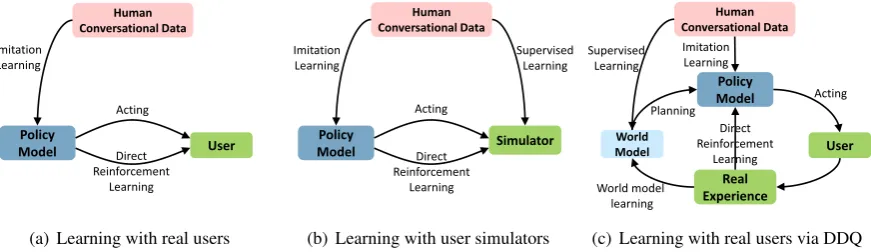
Figure 1: Three strategies of learning task-completion dialogue policies via RL.
controversial whether training task-completion di-alogue agent via simulated users is a valid ap-proach.
We propose a new strategy of learning dialogue policy by interacting with real users. Compared to previous works (Singh et al., 2002; Li et al., 2016a;Su et al.,2016b;Papangelis,2012), our di-alogue agent learns in a much more efficient way, using only a small number of real user interac-tions, which amounts to an affordable cost in many nontrivial dialogue tasks.
Our approach is based on the Dyna-Q frame-work (Sutton,1990) where planning is integrated into policy learning for task-completion dialogue. Specifically, we incorporate a model of the envi-ronment, referred to as the world model, into the dialogue agent, which simulates the environment and generates simulated user experience. During the dialogue policy learning, real user experience plays two pivotal roles: first, it can be used to im-prove the world model and make it behave more like real users, via supervised learning; second, it can also be used to directly improve the dialogue policy via RL. The former is referred to asworld model learning, and the latterdirect reinforcement learning. Dialogue policy can be improved ei-ther using real experience directly (i.e., direct re-inforcement learning) or via the world model in-directly (referred to as planning or indirect re-inforcement learning). The interaction between world model learning, direct reinforcement learn-ing and plannlearn-ing is illustrated in Figure1(c), fol-lowing the Dyna-Q framework (Sutton,1990).
The original papers on Dyna-Q and most its early extensions used tabular methods for both planning and learning (Singh, 1992; Peng and Williams, 1993; Moore and Atkeson, 1993; Ku-vayev and Sutton,1996). This table-lookup repre-sentation limits its application to small problems
only. Sutton et al. (2012) extends the Dyna ar-chitecture to linear function approximation, mak-ing it applicable to larger problems. In the dia-logue setting, we are dealing with a much larger action-state space. Inspired byMnih et al.(2015), we propose Deep Dyna-Q (DDQ) by combining Dyna-Q with deep learning approaches to repre-senting the state-action space by neural networks (NN).
By employing the world model for planning, the DDQ method can be viewed as a model-based RL approach, which has drawn growing interest in the research community. However, most model-based RL methods (Tamar et al., 2016; Silver et al., 2016b;Gu et al.,2016;Racani`ere et al.,2017) are developed for simulation-based, synthetic prob-lems (e.g., games), but not for human-in-the-loop, real-world problems. To these ends, our main con-tributions in this work are two-fold:
• We present Deep Dyna-Q, which to the best of our knowledge is the first deep RL frame-work that incorporates planning for task-completion dialogue policy learning.
• We demonstrate that a task-completion dia-logue agent can efficiently adapt its policy on the fly, by interacting with real users via RL. This results in a significant improvement in success rate on a nontrivial task.
2 Dialogue Policy Learning via Deep Dyna-Q (DDQ)
NLG
NLU 𝑜
1 𝑜2
Dialogue State Tracker
𝑜𝑡
Dialogue Policy
Dialogue Manager
System Action (Policy)
𝑠𝑡
𝑠1 𝑠2 𝑠𝑛
𝑎1 𝑎2 𝑎𝑘
……
…
Semantic Frame
State Representation
𝑎∗= max 𝑎 𝜋 𝑎|𝑠
World Model User
[image:3.595.74.290.64.241.2]Goal
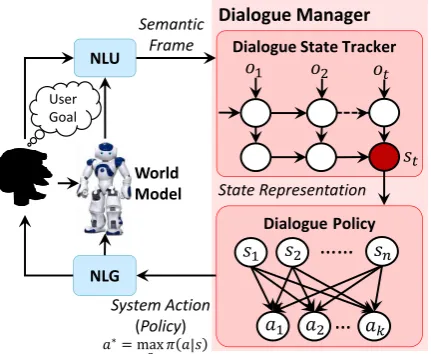
Figure 2: Illustration of the task-completion DDQ dialogue agent.
the next action2 based on the current state; (4) a model-based natural language generation (NLG) module for converting dialogue actions to natural language response (Wen et al.); and (5) a world model for generating simulated user actions and simulated rewards.
As illustrated in Figure 1(c), starting with an initial dialogue policy and an initial world model (both trained with pre-collected human conversa-tional data), the training of the DDQ agent con-sists of three processes: (1) direct reinforcement learning, where the agent interacts with a real user, collects real experience and improves the dialogue policy; (2)world model learning, where the world model is learned and refined using real experience; and (3)planning, where the agent improves the di-alogue policy using simulated experience.
Although these three processes conceptually can occur simultaneously in the DDQ agent, we implement an iterative training procedure, as shown in Algorithm 1, where we specify the or-der in which they occur within each iteration. In what follows, we will describe these processes in details.
2.1 Direct Reinforcement Learning
In this process (lines 5-18 in Algorithm1) we use the DQN method (Mnih et al., 2015) to improve the dialogue policy based on real experience. We consider task-completion dialogue as a Markov Decision Process (MDP), where the agent
inter-2In the dialogue scenario, actions are dialogue-acts, con-sisting of a single act and a (possibly empty) collection of
(slot=value)pairs (Schatzmann et al.,2007).
acts with a user in a sequence of actions to ac-complish a user goal. In each step, the agent ob-serves the dialogue states, and chooses the action ato execute, using an-greedy policy that selects a random action with probabilityor otherwise fol-lows the greedy policya=argmaxa0Q(s, a0;θQ). Q(s, a;θQ)which is the approximated value
func-tion, implemented as a Multi-Layer Perceptron (MLP) parameterized by θQ. The agent then
re-ceives reward3r, observes next user responseau,
and updates the state tos0. Finally, we store the experience(s, a, r, au, s0)in the replay bufferDu.
The cycle continues until the dialogue terminates. We improve the value function Q(s, a;θQ) by
adjusting θQ to minimize the mean-squared loss
function, defined as follows:
L(θQ) = E(s,a,r,s0)∼Du[(yi−Q(s, a;θQ))2] yi = r+γmax
a0 Q
0(s0, a0;θ
Q0) (1)
whereγ ∈ [0,1]is a discount factor, andQ0(.)is the target value function that is only periodically updated (line 42 in Algorithm1). By differentiat-ing the loss function with respect toθQ, we arrive
at the following gradient:
∇θQL(θQ) =E(s,a,r,s0)∼Du[(r+
γmax a0 Q
0(s0, a0;θ
Q0)−Q(s, a;θQ))
∇θQQ(s, a;θQ)]
(2)
As shown in lines 16-17 in Algorithm1, in each iteration, we improveQ(.)using minibatch Deep Q-learning.
2.2 Planning
In the planning process (lines 23-41 in Algo-rithm1), the world model is employed to generate simulated experience that can be used to improve dialogue policy. K in line 24 is the number of planning steps that the agent performs per step of direct reinforcement learning. If the world model is able to accurately simulate the environment, a big K can be used to speed up the policy learn-ing. In DDQ, we use two replay buffers, Du for
storing real experience and Ds for simulated
ex-perience. Learning and planning are accomplished
3
2185 Algorithm 1 Deep Dyna-Q for Dialogue Policy Learning
Require: N,,K,L,C,Z Ensure: Q(s, a;θQ),M(s, a;θM)
1: initializeQ(s, a;θQ)and M(s, a;θM) via pre-training on human conversational data
2: initializeQ0(s, a;θ
Q0)withθQ0=θQ 3: initialize real experience replay bufferDu
using Reply Buffer Spiking (RBS), and simulated experience replay bufferDs
as empty 4: forn=1:Ndo
5: #Direct Reinforcement Learningstarts 6: userstarts a dialogue with user actionau 7: generate an initial dialogue states
8: whilesis not a terminal statedo
9: with probabilityselect a random actiona
10: otherwise selecta=argmaxa0Q(s, a0;θQ) 11: executea, and observe userresponseauand
re-wardr
12: update dialogue state tos0
13: store(s, a, r, au, s0)
toDu 14: s=s0
15: end while
16: sample random minibatches of(s, a, r, s0)
fromDu 17: updateθQviaZ-step minibatch Q-learning according
to Equation (2)
18: #Direct Reinforcement Learningends 19: #World Model Learningstarts
20: sample random minibatches of training samples
(s, a, r, au, s0
)fromDu
21: updateθM viaZ-step minibatch SGD of multi-task learning
22: #World Model Learningends 23: #Planningstarts
24: fork=1:Kdo
25: t= FALSE,l= 0
26: sample a user goalG
27: sample user actionau fromG
28: generate an initial dialogue states
29: whiletis FALSE∧l≤Ldo
30: with probabilityselect a random actiona
31: otherwise selecta=argmaxa0Q(s, a0;θQ) 32: executea
33: world modelresponds withau ,randt
34: update dialogue state tos0
35: store(s, a, r, s0)
toDs 36: l=l+ 1,s=s0
37: end while
38: sample random minibatches of (s, a, r, s0) from
Ds
39: update θQ via Z-step minibatch Q-learning ac-cording to Equation (2)
40: end for
41: #Planningends
42: everyCsteps resetθQ0 =θQ
43: end for
by the same DQN algorithm, operating on real ex-perience inDu for learning and on simulated
ex-perience in Dsfor planning. Thus, here we only
describe the way the simulated experience is gen-erated.
Similar to Schatzmann et al.(2007), at the be-ginning of each dialogue, we uniformly draw a user goal G = (C, R), whereC is a set of
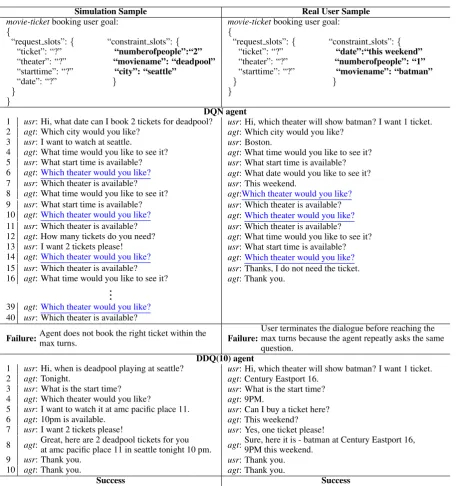
con-straints and R is a set of requests (line 26 in Al-gorithm1). For movie-ticket booking dialogues, constraints are typically the name and the date of the movie, the number of tickets to buy, etc. Requests can contain these slots as well as the location of the theater, its start time, etc. Ta-ble 3 presents some sampled user goals and di-alogues generated by simulated and real users, respectively. The first user action au (line 27)
can be either a request or an inform dialogue-act. A request, such as request(theater;
moviename=batman), consists of a request
slot and multiple (> 1) constraint slots, uni-formly sampled from R and C, respectively. An inform contains constraint slots only. The user action can also be converted to natural lan-guage via NLG, e.g.,"which theater will show batman?"
In each dialogue turn, the world model takes as input the current dialogue states and the last agent actiona(represented as an one-hot vector), and generates user response au, reward r, and a
binary variablet, which indicates whether the di-alogue terminates (line 33). The generation is ac-complished using the world modelM(s, a;θM), a
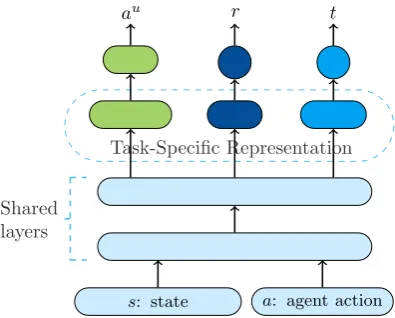
MLP shown in Figure3, as follows:
h = tanh(Wh(s, a) +bh)
r = Wrh+br
au = softmax(W
ah+ba)
t = sigmoid(Wth+bt)
where(s, a) is the concatenation ofsanda, and W andb are parameter matrices and vectors, re-spectively.
Task-Specific Representation
s: state a: agent action
au r t
[image:4.595.307.505.571.730.2]Shared layers
2.3 World Model Learning
In this process (lines 19-22 in Algorithm 1), M(s, a;θM) is refined via minibatch SGD using
real experience in the replay bufferDu. As shown
in Figure3,M(s, a;θM)is a multi-task neural
net-work (Liu et al., 2015) that combines two classi-fication tasks of simulatingauandt, respectively,
and one regression task of simulatingr. The lower layers are shared across all tasks, while the top lay-ers are task-specific.
3 Experiments and Results
We evaluate the DDQ method on a movie-ticket booking task in both simulation and human-in-the-loop settings.
3.1 Dataset
Raw conversational data in the movie-ticket book-ing scenario was collected via Amazon Mechani-cal Turk. The dataset has been manually labeled based on a schema defined by domain experts, as shown in Table 4, which consists of 11 dialogue acts and 16 slots. In total, the dataset contains 280 annotated dialogues, the average length of which is approximately 11 turns.
3.2 Dialogue Agents for Comparison
To benchmark the performance of DDQ, we have developed different versions of task-completion dialogue agents, using variations of Algorithm1.
• ADQN agent is learned by standard DQN, implemented with direct reinforcement learn-ing only (lines 5-18 in Algorithm1) in each epoch.
• TheDDQ(K)agents are learned by DDQ of Algorithm1, with an initial world model pre-trained on human conversational data, as de-scribed in Section3.1. K is the number of planning steps. We trained different versions of DDQ(K) with differentK’s.
• The DDQ(K, rand-init θM) agents are
learned by the DDQ method with a randomly initialized world model.
• The DDQ(K, fixed θM) agents are learned
by DDQ with an initial world model pre-trained on human conversational data. But the world model is not updated afterwards. That is, theworld model learningpart in Al-gorithm 1 (lines 19-22) is removed. The DDQ(K, fixed θM) agents are evaluated in
the simulation setting only.
• The DQN(K) agents are learned by DQN, but withK times more real experiences than the DQN agent. DQN(K) is evaluated in the simulation setting only. Its performance can be viewed as the upper bound of its DDQ(K) counterpart, assuming that the world model in DDQ(K) perfectly matches real users.
Implementation Details All the models in these agents (Q(s, a;θQ),M(s, a;θM)) are MLPs with
tanhactivations. Each policy network Q(.) has one hidden layer with 80 hidden nodes. As shown in Figure 3, the world model M(.) contains two shared hidden layers and three task-specific hid-den layers, with 80 nodes in each. All the agents are trained by Algorithm 1 with the same set of hyper-parameters. -greedy is always applied for exploration. We set the discount factorγ = 0.95. The buffer sizes of both Du and Ds are set to
5000. The target value function is updated at the end of each epoch. In each epoch, Q(.) and M(.)are refined using one-step (Z = 1)16 -tuple-minibatch update. 4 In planning, the maximum length of a simulated dialogue is 40 (L = 40). In addition, to make the dialogue training effi-cient, we also applied a variant of imitation learn-ing, called Reply Buffer Spiking (RBS) (Lipton et al.,2016). We built a naive but occasionally suc-cessful rule-based agent based on human conver-sational dataset (line 1 in Algorithm1), and pre-filled the real experience replay buffer Du with
100 dialogues of experience (line 2) before train-ing for all the variants of agents.
3.3 Simulated User Evaluation
In this setting the dialogue agents are optimized by interacting with user simulators, instead of real users. Thus, the world model is learned to mimic user simulators. Although the simulator-trained agents are sub-optimal when applied to real users due to the discrepancy between simulators and real users, the simulation setting allows us to perform a detailed analysis of DDQ without much cost and to reproduce the experimental results easily.
4
Agent Epoch = 100 Epoch = 200 Epoch = 300 Success Reward Turns Success Reward Turns Success Reward Turns DQN .4260 -3.84 31.93 .5308 10.78 22.72 .6480 27.66 22.21 DDQ(5) .6056 20.35 26.65 .7128 36.76 19.55 .7372 39.97 18.99 DDQ(5, rand-initθM) .5904 18.75 26.21 .6888 33.47 20.36 .7032 36.06 18.64 DDQ(5, fixedθM) .5540 14.54 25.89 .6660 29.72 22.39 .6860 33.58 19.49 DQN(5) .6560 29.38 21.76 .7344 41.09 16.07 .7576 43.97 15.88 DDQ(10) .6624 28.18 24.62 .7664 42.46 21.01 .7840 45.11 19.94 DDQ(10, rand-initθM) .6132 21.50 26.16 .6864 32.43 21.86 .7628 42.37 20.32 DDQ(10, fixedθM) .5884 18.41 26.41 .6196 24.17 22.36 .6412 26.70 22.49 DQN(10) .7944 48.61 15.43 .8296 54.00 13.09 .8356 54.89 12.77
Table 1: Results of different agents at training epoch = {100, 200, 300}. Each number is averaged over 5 runs, each run tested on 2000 dialogues. Excluding DQN(5) and DQN(10) which serve as the upper bounds, any two groups of success rate (except three groups: at epoch 100, DDQ(5, rand-initθM)
and DDQ(10, fixed θM), at epoch 200, DDQ(5, rand-initθM) and DDQ(10, rand-init θM), at epoch
300, DQN and DDQ(10, fixedθM)) evaluated at the same epoch is statistically significant in mean with
p <0.01. (Success: success rate)
(SRFK
6XFFHVVUDWH '41
''4 ''4 ''4 ''4
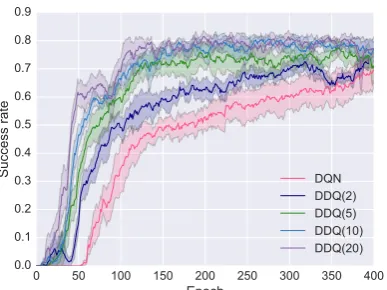
Figure 4: Learning curves of the DDQ(K) agents withK= 2,5,10,20. The DQN agent is identical to a DDQ(K) agent withK = 0.
User Simulator We adapted a publicly avail-able user simulator (Li et al.,2016b) to the task-completion dialogue setting. During training, the simulator provides the agent with a simulated user response in each dialogue turn and a reward sig-nal at the end of the dialogue. A dialogue is considered successful only when a movie ticket is booked successfully and when the information provided by the agent satisfies all the user’s con-straints. At the end of each dialogue, the agent receives a positive reward of2∗Lfor success, or a negative reward of −L for failure, where L is the maximum number of turns in each dialogue, and is set to40in our experiments. Furthermore, in each turn, the agent receives a reward of −1, so that shorter dialogues are encouraged. Read-ers can refer to AppendixBfor details on the user simulator.
(SRFK
6XFFHVVUDWH '41
[image:6.595.307.526.280.436.2]''4 ''4UDQGLQLW ''4IL[HG '41
Figure 5: Learning curves of DQN, DDQ(10), DDQ(10, rand-initθM), DDQ(10, fixedθM), and
DQN(10).
[image:6.595.81.275.290.435.2]Agent Epoch = 100 Epoch = 150 Epoch = 200 Success Reward Turns Success Reward Turns Success Reward Turns DQN .0000 -58.69 39.38 .4080 -5.730 30.38 .4545 0.350 30.38 DDQ(5) .4620 00.78 31.33 .5637 15.05 26.17 .6000 19.84 26.32 DDQ(5, rand-initθM) .3600 -11.67 31.74 .5500 13.71 26.58 .5752 16.84 26.37 DDQ(10) .5555 14.69 25.92 .6416 25.85 24.28 .7332 38.88 20.21 DDQ(10, rand-initθM) .5010 6.27 29.70 .6055 22.11 23.11 .7023 36.90 21.20
Table 2: The performance of different agents at training epoch ={100, 150, 200}in the human-in-the-loop experiments. The difference between the results of all agent pairs evaluated at the same epoch is statistically significant (p <0.01). (Success: success rate)
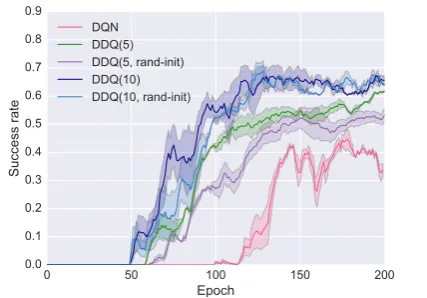
and DDQ(10) took only 50 epochs.
Intuitively, the optimal value of K needs to be determined by seeking the best trade-off between the quality of the world model and the amount of simulated experience that is useful for improv-ing the dialogue agent. This is a non-trivial opti-mization problem because both the dialogue agent and the world model are updated constantly during training and the optimal K needs to be adjusted accordingly. For example, we find in our experi-ments that at the early stages of training, it is fine to perform planning aggressively by using large amounts of simulated experience even though they are of low quality, but in the late stages of train-ing where the dialogue agent has been signif-icantly improved, low-quality simulated experi-ence is likely to hurt the performance. Thus, in our implementation of Algorithm1, we use a heuris-tic5 to reduce the value ofK in the late stages of training (e.g., after 150 epochs in Figure4) to mit-igate the negative impact of low-qualify simulated experience. We leave it to future work how to op-timize the planning step size during DDQ training in a principled way.
Figure 5 shows that the quality of the world model has a significant impact on the agent’s performance. The learning curve of DQN(10) indicates the best performance we can expect with a perfect world model. With a pre-trained world model, the performance of the DDQ agent improves more rapidly, although eventually, the DDQ and DDQ(rand-init θM) agents reach the
same success rate after many epochs. The world model learning process is crucial to both the ef-ficiency of dialogue policy learning and the final performance of the agent. For example, in the early stages (before 60 epochs), the performances of DDQ and DDQ(fixedθM) remain very close to
each other, but DDQ reaches a success rate almost
5The heuristic is not presented in Algorithm1. Readers can refer to the released source code for details.
(SRFK
6XFFHVVUDWH
'41 ''4 ''4UDQGLQLW ''4 ''4UDQGLQLW
Figure 6: Human-in-the-loop dialogue policy learning curves in four different agents.
10% better than DDQ(fixedθM) after 400 epochs.
3.4 Human-in-the-Loop Evaluation
In this setting, five dialogue agents (i.e., DQN, DDQ(10), DDQ(10, rand-init θM), DDQ(5), and
DDQ(5, rand-init θM)) are trained via RL by
[image:7.595.311.525.213.362.2]Simulation Sample Real User Sample movie-ticketbooking user goal:
{
“request slots”:{ “constraint slots”:{
“ticket”: “?” “numberofpeople”:“2”
“theater”: “?” “moviename”: “deadpool”
“starttime”: “?” “city”: “seattle”
“date”: “?” } }
}
movie-ticketbooking user goal:
{
“request slots”:{ “constraint slots”:{
“ticket”: “?” “date”:“this weekend”
“theater”: “?” “numberofpeople”: “1”
“starttime”: “?” “moviename”: “batman”
} }
}
DQN agent
1 usr: Hi, what date can I book 2 tickets for deadpool? usr: Hi, which theater will show batman? I want 1 ticket. 2 agt: Which city would you like? agt: Which city would you like?
3 usr: I want to watch at seattle. usr: Boston.
4 agt: What time would you like to see it? agt: What time would you like to see it? 5 usr: What start time is available? usr: What start time is available? 6 agt:Which theater would you like? agt: What date would you like to see it? 7 usr: Which theater is available? usr: This weekend.
8 agt: What time would you like to see it? agt:Which theater would you like? 9 usr: What start time is available? usr: Which theater is available? 10 agt:Which theater would you like? agt:Which theater would you like? 11 usr: Which theater is available? usr: Which theater is available? 12 agt: How many tickets do you need? agt: What time would you like to see it? 13 usr: I want 2 tickets please! usr: What start time is available? 14 agt:Which theater would you like? agt:Which theater would you like? 15 usr: Which theater is available? usr: Thanks, I do not need the ticket. 16 agt: What time would you like to see it? agt: Thank you.
.. .
39 agt:Which theater would you like? 40 usr: Which theater is available?
Failure:Agent does not book the right ticket within the
max turns. Failure:
User terminates the dialogue before reaching the max turns because the agent repeatly asks the same question.
DDQ(10) agent
1 usr: Hi, when is deadpool playing at seattle? usr: Hi, which theater will show batman? I want 1 ticket. 2 agt: Tonight. agt: Century Eastport 16.
3 usr: What is the start time? usr: What is the start time? 4 agt: Which theater would you like? agt: 9PM.
5 usr: I want to watch it at amc pacific place 11. usr: Can I buy a ticket here? 6 agt: 10pm is available. agt: This weekend? 7 usr: I want 2 tickets please! usr: Yes, one ticket please!
8 agt:Great, here are 2 deadpool tickets for you
at amc pacific place 11 in seattle tonight 10 pm. agt:
Sure, here it is - batman at Century Eastport 16, 9PM this weekend.
9 usr: Thank you. usr: Thank you.
10 agt: Thank you. agt: Thank you.
[image:8.595.72.532.56.543.2]Success Success
Table 3: Two sample dialogue sessions by DQN and DDQ(10) agents trained at epoch 100: Left: simu-lated user experiments; Right: human-in-the-loop experiments. (agt: agent,usr: user)
Figure 6, with each agent averaged over two in-dependent runs. The results confirm what we ob-served in the simulation experiments. The conclu-sions are summarized as below:
• The DDQ agent significantly outperforms DQN, as demonstrated by the comparison be-tween DDQ(10) and DQN. Table3 presents four example dialogues produced by two di-alogue agents interacting with simulated and human users, respectively. The DQN agent, after being trained with 100 dialogues, still behaved like a naive rule-based agent that
re-quested information bit by bit in a fixed or-der. When the user did not answer the request explicitly (e.g., usr: which theater
is available?), the agent failed to
re-spond properly. On the other hand, with plan-ning, the DDQ agent trained with 100 real dialogues is much more robust and can com-plete 50% of user tasks successfully.
• A largerKleads to more aggressive planning and better results, as shown by DDQ(10) vs. DDQ(5).
con-versational data improves the learning effi-ciency and the agent’s performance, as shown by DDQ(5) vs. DDQ(5, rand-init θM), and
DDQ(10) vs. DDQ(10, rand-initθM).
4 Conclusion
We propose a new strategy for a task-completion dialogue agent to learn its policy by interacting with real users. Compared to previous work, our agent learns in a much more efficient way, us-ing only a small number of real user interactions, which amounts to an affordable cost in many non-trivial domains. Our strategy is based on the Deep Dyna-Q (DDQ) framework where planning is in-tegrated into dialogue policy learning. The ef-fectiveness of DDQ is validated by human-in-the-loop experiments, demonstrating that a dialogue agent can efficiently adapt its policy on the fly by interacting with real users via deep RL.
One interesting topic for future research is ex-ploration in planning. We need to deal with the challenge of adapting the world model in a chang-ing environment, as exemplified by the domain ex-tension problem (Lipton et al.,2016). As pointed out bySutton and Barto(1998), the general prob-lem here is a particular manifestation of the con-flict between exploration and exploitation. In a planning context, exploration means trying actions that may improve the world model, whereas ex-ploitation means trying to behave in the optimal way given the current model. To this end, we want the agent to explore in the environment, but not so much that the performance would be greatly de-graded.
Additional Authors
Shang-Yu Su (National Taiwan University, Room
524, CSIE Bldg., No. 1, Sec. 4,
Roo-sevelt Rd., Taipei 10617, Taiwan. email: [email protected])
Acknowledgments
We would like to thank Chris Brockett, Yun-Nung Chen, Michel Galley and Lihong Li for their in-sightful comments on the paper. We would like to acknowledge the volunteers from Microsoft Re-search for helping us with the human-in-the-loop experiments. This work was done when Baolin Peng and Shang-Yu Su were visiting Microsoft. Baolin Peng is in part supported by Innovation
and Technology Fund (6904333), and General Re-search Fund of Hong Kong (12183516).
References
Pawel Budzianowski, Stefan Ultes, Pei-Hao Su, Nikola Mrksic, Tsung-Hsien Wen, Inigo Casanueva, Lina
Rojas-Barahona, and Milica Gasic. 2017.
Sub-domain modelling for dialogue management with hierarchical reinforcement learning. arXiv preprint arXiv:1706.06210.
Bhuwan Dhingra, Lihong Li, Xiujun Li, Jianfeng Gao, Yun-Nung Chen, Faisal Ahmed, and Li Deng. 2017. Towards end-to-end reinforcement learning of
dia-logue agents for information access. In
Proceed-ings of the 55th Annual Meeting of the Association for Computational Linguistics (Volume 1: Long Pa-pers). volume 1, pages 484–495.
Milica Gaˇsi´c, Filip Jurˇc´ıˇcek, Simon Keizer, Franc¸ois Mairesse, Blaise Thomson, Kai Yu, and Steve Young. 2010. Gaussian processes for fast policy op-timisation of pomdp-based dialogue managers. In
Proceedings of the 11th Annual Meeting of the Spe-cial Interest Group on Discourse and Dialogue. As-sociation for Computational Linguistics, pages 201– 204.
Milica Gaˇsi´c, Filip Jurˇc´ıˇcek, Blaise Thomson, Kai Yu, and Steve Young. 2011. On-line policy optimisation of spoken dialogue systems via live interaction with
human subjects. In Automatic Speech Recognition
and Understanding (ASRU), 2011 IEEE Workshop
on. IEEE, pages 312–317.
Shixiang Gu, Timothy Lillicrap, Ilya Sutskever, and Sergey Levine. 2016. Continuous deep q-learning
with model-based acceleration. In International
Conference on Machine Learning. pages 2829– 2838.
Dilek Hakkani-T¨ur, Gokhan Tur, Asli Celikyilmaz, Yun-Nung Chen, Jianfeng Gao, Li Deng, and Ye-Yi Wang. 2016. Multi-domain joint semantic frame
parsing using bi-directional RNN-LSTM. In
Pro-ceedings of The 17th Annual Meeting of the Interna-tional Speech Communication Association.
Leonid Kuvayev and Richard S Sutton. 1996. Model-based reinforcement learning with an approximate,
learned model. Inin Proceedings of the Ninth Yale
Workshop on Adaptive and Learning Systems. Cite-seer.
Esther Levin, Roberto Pieraccini, and Wieland Eck-ert. 1997. Learning dialogue strategies within the
markov decision process framework. InAutomatic
Speech Recognition and Understanding, 1997. Pro-ceedings., 1997 IEEE Workshop on. IEEE, pages 72–79.
Jiwei Li, Alexander H Miller, Sumit Chopra,
Dialogue learning with human-in-the-loop. arXiv preprint arXiv:1611.09823.
Xiujun Li, Zachary C Lipton, Bhuwan Dhingra, Lihong Li, Jianfeng Gao, and Yun-Nung Chen. 2016b. A user simulator for task-completion dialogues. arXiv preprint arXiv:1612.05688.
Xuijun Li, Yun-Nung Chen, Lihong Li, Jianfeng Gao,
and Asli Celikyilmaz. 2017. End-to-end
task-completion neural dialogue systems. In
Proceed-ings of the The 8th International Joint Conference on Natural Language Processing. pages 733–743.
Zachary C Lipton, Jianfeng Gao, Lihong Li, Xiujun
Li, Faisal Ahmed, and Li Deng. 2016. Efficient
exploration for dialogue policy learning with bbq networks & replay buffer spiking. arXiv preprint arXiv:1608.05081.
Bing Liu and Ian Lane. 2017. Iterative policy learning in end-to-end trainable task-oriented neural dialog
models. InProceedings of 2017 IEEE Workshop on
Automatic Speech Recognition and Understanding.
Xiaodong Liu, Jianfeng Gao, Xiaodong He, Li Deng, Kevin Duh, and Ye-Yi Wang. 2015. Representation learning using multi-task deep neural networks for semantic classification and information retrieval .
Volodymyr Mnih, Koray Kavukcuoglu, David Silver, Andrei A Rusu, Joel Veness, Marc G Bellemare, Alex Graves, Martin Riedmiller, Andreas K
Fidje-land, Georg Ostrovski, et al. 2015. Human-level
control through deep reinforcement learning.
Na-ture518(7540):529–533.
Andrew W Moore and Christopher G Atkeson. 1993. Prioritized sweeping: Reinforcement learning with
less data and less time. Machine learning
13(1):103–130.
Nikola Mrkˇsi´c, Diarmuid O S´eaghdha, Tsung-Hsien Wen, Blaise Thomson, and Steve Young. 2016. Neural belief tracker: Data-driven dialogue state tracking.arXiv preprint arXiv:1606.03777.
Alexandros Papangelis. 2012. A comparative study of reinforcement learning techniques on dialogue
man-agement. In Proceedings of the Student Research
Workshop at the 13th Conference of the European Chapter of the Association for Computational Lin-guistics. Association for Computational Linguistics, pages 22–31.
Baolin Peng, Xiujun Li, Jianfeng Gao, Jingjing Liu, Yun-Nung Chen, and Kam-Fai Wong. 2017a. Ad-versarial advantage actor-critic model for task-completion dialogue policy learning. arXiv preprint arXiv:1710.11277.
Baolin Peng, Xiujun Li, Lihong Li, Jianfeng Gao, Asli Celikyilmaz, Sungjin Lee, and Kam-Fai Wong. 2017b. Composite task-completion dialogue policy
learning via hierarchical deep reinforcement
learn-ing. InProceedings of the 2017 Conference on
Em-pirical Methods in Natural Language Processing. pages 2221–2230.
Jing Peng and Ronald J Williams. 1993. Efficient
learning and planning within the dyna framework.
Adaptive Behavior1(4):437–454.
Olivier Pietquin, Matthieu Geist, Senthilkumar
Chan-dramohan, et al. 2011. Sample efficient
on-line learning of optimal dialogue policies with
kalman temporal differences. InIJCAI
Proceedings-International Joint Conference on Artificial Intelli-gence. volume 22, page 1878.
Olivier Pietquin and Helen Hastie. 2013. A survey on metrics for the evaluation of user simulations. The knowledge engineering review.
S´ebastien Racani`ere, Th´eophane Weber, David Re-ichert, Lars Buesing, Arthur Guez, Danilo Jimenez
Rezende, Adri`a Puigdom`enech Badia, Oriol
Vinyals, Nicolas Heess, Yujia Li, et al. 2017. Imagination-augmented agents for deep
reinforce-ment learning. In Advances in Neural Information
Processing Systems. pages 5694–5705.
Jost Schatzmann, Blaise Thomson, Karl Weilhammer, Hui Ye, and Steve Young. 2007. Agenda-based user simulation for bootstrapping a pomdp dialogue
sys-tem. In NAACL 2007; Companion Volume, Short
Papers. Association for Computational Linguistics, pages 149–152.
David Silver, Aja Huang, Chris J Maddison, Arthur Guez, Laurent Sifre, George Van Den Driessche, Ju-lian Schrittwieser, Ioannis Antonoglou, Veda Pan-neershelvam, Marc Lanctot, et al. 2016a. Mastering the game of go with deep neural networks and tree
search. Nature529(7587):484–489.
David Silver, Julian Schrittwieser, Karen Simonyan, Ioannis Antonoglou, Aja Huang, Arthur Guez, Thomas Hubert, Lucas Baker, Matthew Lai, Adrian Bolton, et al. 2017. Mastering the game of go
with-out human knowledge. Nature550(7676):354.
David Silver, Hado van Hasselt, Matteo Hessel, Tom Schaul, Arthur Guez, Tim Harley, Gabriel Dulac-Arnold, David Reichert, Neil Rabinowitz, Andre
Barreto, et al. 2016b. The predictron:
End-to-end learning and planning. arXiv preprint
arXiv:1612.08810.
Satinder Singh, Diane Litman, Michael Kearns, and Marilyn Walker. 2002. Optimizing dialogue man-agement with reinforcement learning: Experiments with the njfun system. Journal of Artificial Intelli-gence Research16:105–133.
Satinder P Singh. 1992. Reinforcement learning with
a hierarchy of abstract models. In Proceedings of
Pei-Hao Su, Milica Gasic, Nikola Mrksic, Lina Rojas-Barahona, Stefan Ultes, David Vandyke,
Tsung-Hsien Wen, and Steve Young. 2016a.
Continu-ously learning neural dialogue management. arXiv
preprint arXiv:1606.02689.
Pei-Hao Su, Milica Gasic, Nikola Mrksic, Lina Rojas-Barahona, Stefan Ultes, David Vandyke, Tsung-Hsien Wen, and Steve Young. 2016b. On-line active reward learning for policy optimisation in spoken
di-alogue systems.arXiv preprint arXiv:1605.07669.
Richard S Sutton. 1990. Integrated architectures for learning, planning, and reacting based on
approx-imating dynamic programming. In Proceedings
of the seventh international conference on machine learning. pages 216–224.
Richard S Sutton and Andrew G Barto. 1998.
Introduc-tion to reinforcement learning, volume 135. MIT press Cambridge.
Richard S Sutton, Csaba Szepesv´ari, Alborz
Geram-ifard, and Michael P Bowling. 2012. Dyna-style
planning with linear function approximation and
pri-oritized sweeping. arXiv preprint arXiv:1206.3285
.
Aviv Tamar, Yi Wu, Garrett Thomas, Sergey Levine, and Pieter Abbeel. 2016. Value iteration networks. InAdvances in Neural Information Processing
Sys-tems. pages 2154–2162.
Tsung-Hsien Wen, Milica Gasic, Nikola Mrksic, Pei-hao Su, David Vandyke, and Steve J. Young. ???? Semantically conditioned LSTM-based natural lan-guage generation for spoken dialogue systems. In
EMNLP 2015, Lisbon, Portugal, September 17-21,
2015. pages 1711–1721.
Jason D Williams, Kavosh Asadi, and Geoffrey Zweig. 2017. Hybrid code networks: Practical and efficient end-to-end dialog control with supervised and
rein-forcement learning. InProceedings of the 55th
An-nual Meeting of the Association for Computational Linguistics.
Steve Young, Milica Gaˇsi´c, Blaise Thomson, and Ja-son D Williams. 2013. Pomdp-based statistical
spo-ken dialog systems: A review. Proceedings of the
IEEE101(5):1160–1179.
Tiancheng Zhao and Maxine Eskenazi. 2016.
To-wards end-to-end learning for dialog state tracking and management using deep reinforcement learning.
arXiv preprint arXiv:1606.02560.
A Dataset Annotation Schema
Table4lists all annotated dialogue acts and slots in details.
Annotations
request,inform,deny,confirm question, Intent confirm answer,greeting,closing,not sure,
multiple choice,thanks,welcome
Slot
city,closing,date,distanceconstraints, greeting,moviename,numberofpeople, price,starttime,state,taskcomplete,theater, theater chain,ticket,video format,zip
Table 4: The data annotation schema
B User Simulator
In the task-completion dialogue setting, the entire conversation is around a user goal implicitly, but the agent knows nothing about the user goal ex-plicitly and its objective is to help the user to ac-complish this goal. Generally, the definition of user goal contains two parts:
• inform slots contain a number of slot-value pairs which serve as constraints from the user.
• request slots contain a set of slots that user has no information about the values, but wants to get the values from the agent dur-ing the conversation. ticketis a default slot which always appears in the request slots part of user goal.
To make the user goal more realistic, we add some constraints in the user goal: slots are split into two groups. Some of slots must appear in the user goal, we called these elements as Required slots. In the movie-booking scenario, it includes moviename, theater, starttime, date, num-berofpeople; the rest slots areOptional slots, for example,theater chain, video formatetc.