2409
Distantly Supervised Named Entity Recognition using Positive-Unlabeled
Learning
Minlong Peng∗, Xiaoyu Xing∗, Qi Zhang, Jinlan Fu, Xuanjing Huang School of Computer Science, Fudan University, Shanghai, China
{mlpeng16,xyxing18,qz,fujl16,xjhuang}@fudan.edu.cn
Abstract
In this work, we explore the way to perform named entity recognition (NER) using only unlabeled data and named entity dictionar-ies. To this end, we formulate the task as a positive-unlabeled (PU) learning problem and accordingly propose a novel PU learning algorithm to perform the task. We prove that the proposed algorithm can unbiasedly and consistently estimate the task loss as if there is fully labeled data. A key feature of the proposed method is that it does not require the dictionaries to label every entity within a sentence, and it even does not require the dictionaries to label all of the words constituting an entity. This greatly reduces the requirement on the quality of the dictionaries and makes our method generalize well with quite simple dictionaries. Empirical studies on four public NER datasets demonstrate the effectiveness of our proposed method. We have published the source code athttps:// github.com/v-mipeng/LexiconNER.
1 Introduction
Named Entity Recognition (NER) is concerned with identifying named entities, such as person, location, product and organization names in un-structured text. It is a fundamental component in many natural language processing tasks such as machine translation (Babych and Hartley, 2003), knowledge base construction (Riedel et al.,2013; Shen et al., 2012), automatic question answering (Bordes et al.,2015), search (Zhu et al.,2005), etc. In this field, supervised methods, ranging from the typical graph models (Zhou and Su, 2002; McCallum et al.,2000;McCallum and Li, 2003; Settles,2004) to current popular neural-network-based models (Chiu and Nichols, 2016; Lample et al.,2016;Gridach,2017;Liu et al.,2018;Zhang
∗
Equal contribution.
Dictionary
Simons David Anna Joe
[image:1.595.313.518.222.311.2]Bobick was managed by weight legend Joe Frazier
Figure 1: Data labeling example for person names using our constructed dictionary.
and Yang, 2018), have achieved great success. However, these supervised methods often require large scale fine-grained annotations (label every word of a sentence) to generalize well. This makes it hard to apply them to label-few domains, e.g., bio/medical domains (Del˙eger et al.,2016).
In this work, we explore the way to perform NER using only unlabeled data and named entity dictionaries, which are relatively easier to obtain compared with labeled data. A natural practice to perform the task is to scan through the query text using the dictionary and treat terms matched with a list of entries of the dictionary as the entities (Nadeau et al., 2006; Gerner et al., 2010; Liu et al., 2015; Yang et al., 2018). However, this practice requires very high quality named entity dictionaries that cover most of entities, otherwise
it will fail with poor performance. As shown
in Figure 1, the constructed dictionary of person names only labels one entity within the query text, which contains two entities “Bobick” and “Joe Frazier”, and it only labels one word “Joe” out of the two-word entity “Joe Frazier”.
not labeled by the dictionary as the non-entity word. Take the data labeling results depicted in Figure1as an example. Simply treating “Bobick” and “Frazier” as non-entity words and then per-forming supervised learning will introduce label noise to the supervised classifier. Therefore, when using the dictionary to perform data labeling, we can actually only obtain some entity words and a bunch of unlabeled data comprising of both entity and non-entity words. In this case, the conventional supervised or semi-supervised learning algorithms are not suitable, since they usually require labeled data of all classes.
With this consideration, we propose to for-mulate the task as a positive-unlabeled (PU) learning problem and accordingly introduce a novel PU learning algorithm to perform the task. In our proposed method, the labeled entity words form the positive (P) data and the rest form the unlabeled (U) data for PU learning. We proved that the proposed algorithm can unbiasedly and consistently estimate the task loss as if there is fully labeled data, under the assumption that the labeled P data can reveal the data distribution of class P. Of course, since words labeled by the dictionary only cover part of entities, it cannot fully reveal data distribution of entity words. To deal with this problem, we propose an adapted method, motivated by the AdaSampling algorithm (Yang et al., 2017), to enrich the dictionary. We evaluate the effectiveness of our proposed method on four NER datasets. Experimental results show that it can even achieve comparable performance with several supervised methods, using quite simple dictionaries.
Contributions of this work can be summarized
as follows: 1)We proposed a novel PU learning
algorithm to perform the NER task using only unlabeled data and named entity dictionaries. 2)
We proved that the proposed algorithm can unbi-asedly and consistently estimate the task loss as if there is fully labeled data, under the assumption that the entities found out by the dictionary can reveal the distribution of entities. 3) To make the above assumption hold as far as possible, we propose an adapted method, motivated by the
AdaSampling algorithm, to enrich the dictionary.
4) We empirically prove the effectiveness of
our proposed method with extensive experimental studies on four NER datasets.
2 Preliminaries
2.1 Risk Minimization
LetX ∈ X andY ∈ Y be the input and output
random variables, whereX ⊂RdandY ={0,1}
denote the space of X and Y, respectively. Let
f :X →Rdenote a classifier. A loss function is a map` :R× Y →R+. Given any loss function `and a classifierf, we define the`-risk off by:
R`(f) =EX,Y`(f(x), yx) (1)
whereEdenotes the expectation and its subscript
indicates the random variables with respect to
which the expectation is taken. In ordinary
supervised learning, we estimate R` with the
empirical lossRˆ`:
ˆ R` =
1 n
n X
i=1
`(f(xi), yi), (2)
and update model parameters to learn a classifier
f∗that minimizesRˆ`: f∗ = arg min
f
ˆ
R`(f). (3)
2.2 Unbiased Positive-Unlabeled learning
Unbiased positive-unlabeled learning (uPU)
(du Plessis et al.,2014) aims to estimateR`when
there are only a set of positive (P) examples and a set of unlabeled (U) examples, which contains both positive and negative examples. R`can also
be formulated by:
R` =πnEX,Y=0`(f(x),0)+πpEX,Y=1`(f(x),1), (4)
where πp = P(Y = 1) and πn = P(Y =
0). Note thatEX,Y=1`(f(x),1)can be effectively
estimated using positive data. Therefore, the
main problem of PU learning is how to estimate
EX,Y=0`(f(x),0)without using negative labeled data. To this end, it further formulates:
πnEX,Y=0`(f(x),0) =EX`(f(x),0)
−πpEX,Y=1`(f(x),0).
This equation holds because:
P(Y = 0)P(X|Y = 0) = P(X)−P(Y = 1)P(X|Y = 1).
According to this equation, we can now estimate
estimated using only unlabeled data and positive
data. In summary, we have that R` can be
unbiasedly estimated by:
ˆ
R`=
1
nu nu X
i=1
`(f(xui),0)+
πp np
np X
i=1
(`(f(xpi),1)−`(f(xpi),0)),
(5)
where xui and xpi denotes an unlabeled and
positive example, respectively, and nu and np
denotes the number of unlabeled and positive examples, respectively.
2.3 Consistent Positive-Unlabeled Learning
As we know, a good estimation should be not only unbiased but also consistent. The above induction has proved that Rˆ` is an unbiased estimation of R`. In this section, we show thatRˆ` can be also a
consistent estimation ofR`when the loss function `is upper bounded. We argue that this is the first work to give such a proof, which is summarized in the following theorem:
Theorem 1. If` is bounded by [0, M], then for any >0,
P{S∈ D| sup f∈HR
|R`−Rˆ`| ≤}
≥1−2N( 4(1 + 2πp)LM
)e−
min(np,nu)2 8(1+2πp)2B2 ,
(6)
whereB = LMM +C0. Here, LM denotes the
Lipschitz constant thatLM > ∂`(∂ww,y),∀w ∈ R, C0= maxy`(0, y), andHdenotes a Reproducing
Kernel Hilbert Space (RKHS) (Aronszajn,1950).
HRis the hypothesis space for each givenR >0
in the ball of radius R in H. N() denotes the
covering number ofHR following Theorem C in
(Cucker and Smale,2002).
Proof. Proof appears in AppendixA.
Remark 1. Let us intuitively think about what if`
is not upper bounded (e.g., the cross entropy loss function). Suppose that there is a positive example
xpi not occurring in the unlabeled data set. Then, its corresponding risk defined in Rˆ` isV(xpi) =
πp np(`(f(x
p
i),1)−`(f(x p
i),0)). If` is not upper
bounded, to achieve a small value ofV(xpi),fcan heavily overfit xpi making `(f(xpi),0) → +∞, and in turn V(xpi) → −∞. From this analysis, we can expect that, when using a unbounded loss function and a flexible classifier, Rˆ` will
dramatically decrease to a far below zero value.
Therefore, in this work, we force ` to be
bounded by replacing the common unbounded cross entropy loss function with the mean absolute error, resulting in a bounded unbiased positive-unlabeled learning (buPU) algorithm. This slightly differs from the setting of uPU, which only requires`to be symmetric.
We further combine buPU with the
non-negative constraint proposed by Kiryo et al.
(2017), which has proved to be effectiveness
in alleviating overfitting, obtaining a bounded non-negative positive-unlabeled learning (bnPU) algorithm:
ˆ
R`= πp np
np X
i=1
`(f(xpi),1)+
max 0, 1 nu
nu X
i=1
`(f(xui),0)− πp np
np X
i=1
`(f(xpi),0) !
.
(7)
3 Dictionary-based NER with PU Learning
In the following, we first define some notations used throughout this work, and illustrate the label assignment mechanism used in our method. Then, we precisely illustrate the data labeling process using the dictionary. After that, we show the detail for building the PU classifier, including word representation, loss definition, and label inference. Finally, we show the adapted method for enriching the dictionary.
3.1 Notations
We denote W ∈ V and S = {W} ∈ S be
the word-level and sentence-level input random
variables, where V is the word vocabulary and
S is the sentence space. De denotes the entity
dictionary for a given entity type and D =
{s1,· · · , sN} ⊆ Sdenotes the unlabelled dataset.
We denoteD+ the set of entity words labeled by De, and denoteDuthe rest unlabeled words.
3.2 Label Assignment Mechanism
In this work, we apply the binary label assignment mechanism for the NER task instead of the
prevalent BIO or BIOES mechanism. Entity
Algorithm 1Data Labeing using the Dictionary
1: Input:named entity dictionaryDe, a sentence
s={w1,· · ·, wn}, and the context sizek
2: Result:partial labeled sentence 3: Initialize:i←1
4: whilei≤ndo
5: forj∈[k,· · · ,0]do
6: if{wi,· · · , wmax(i+j,n)} ∈Dethen 7: label {wi,· · · , wmax(i+j,n)} as
positive class.
8: i←i+j+ 1
9: break
10: ifj== 0then
11: i←i+ 1
of an entity. Therefore, we cannot distinguish
which type, B, I, or E, the labeled entity word belongs to. Take the data labeling results depicted in Figure1as an example. With the dictionary, we know that “Joe” is an entity word. However we cannot know that it is the beginning of the person name “Joe Frazier”.
3.3 Data Labeling using the Dictionary
To obtain D+, we use the maximum matching
algorithm (Liu et al.,1994;Xue,2003) to perform
data labeling with De. It is a greedy search
routine that walks through a sentence trying to find the longest string, starting from a given point in the sentence, that matches with an entry in the dictionary. The general process of this algorithm is summarized in Alg. 1. In our experiments, we intuitively set the context sizek= 4.
3.4 Build PU Learning Classifier
In this work, we use a neural-network-based architecture to implement the classifierf, and this architecture is shared by different entity types.
Word Representation. Context-independent
word representation consists of three part
of features, i.e., the character sequence
representation ec(w), the word embedding
ew(w), and some human designed features on the word-faceeh(w).
For the character-level representationec(w) of
w, we use the one-layer convolution network
model (Kim, 2014) on its character sequence
{c1, c2,· · · , cm} ∈ Vc, where Vcis the character
vocabulary. Each charactercis represented using
v(c) =Wc(c),
whereWcdenotes a character embedding lookup
table. Theone-layer convolution networkis then applied to {v(c1),v(c2),· · ·,v(cm)} to obtain ec(w).
For the word-level representation ew(w) of
w, we introduce an unique dense vector for w, which is initialized with Stanford’s GloVe word embeddings1 (Pennington et al., 2014) and fine-tuned during model training.
For the human designed features eh(w) of w,
we introduce a set of binary feature indicators. These indicators are designed on options proposed by Collobert et al.(2011): allCaps, upperInitial,
lowercase, mixedCaps, noinfo. If any feature is activated, its corresponding indicator is set
to 1, otherwise 0. This way, it can keep the
capitalization information erased during lookup of the word embedding.
The final word presentation independent to its
context e(w) ∈ Rkw of w, is obtained by
concatenating these three part of features:
e(w) = [ec(w)⊕ew(w)⊕eh(w)], (8)
where ⊕ denotes the concatenation operation.
Based on this representation, we apply a
bidirec-tional LSTM (BiLSTM) network (Huang et al.,
2015), taking e(wt), wt ∈ s as step input,
to model context information of wt given the
sentence s. Hidden states of the forward and
backward LSTMs at the t step are concatenated:
e(wt|s) = [ − →
ht⊕ ←−
ht], (9)
to form the representation ofwtgivens.
Loss Definition. Given the word representation,
e(w|s), ofwconditional ons, its probability to be predicted as positive class is modeled by:
f(w|s) =σ(wpTe(w|s) +b), (10)
where σ denotes the sigmoid function, wp is a
trainable parameter vector andbis the bias term. The prediction risk on this word given labely is defined by:
`(f(w|s), y) =|y−f(w|s)|. (11)
Note that`(f(w|s), y) ∈[0,1)is upper bounded. The empirical training loss is defined by:
ˆ
R`(f) =πpRˆp+(f) + max
n
0,Rˆu−(f)−πpRˆ−p(f)
o , (12)
where
ˆ
Rp+(f) =
1 |D+|
X
w|s∈D+
`(f(w|s),1),
ˆ
R−p(f) = 1−Rˆ + p(f),
ˆ
R−u(f) =
1 |Du|
X
w|s∈Du
`(f(w|s),0),
andπpis the ratio of entity words withinDu.
In addition, during our experiments, we find out that due to the class imbalance problem (πp
is very small), f inclines to predict all instances as the negative class, achieving a high value of accuracy while a small value of F1 on the positive class. This is unacceptable for NER. Therefore, we introduce a class weightγfor the positive class and accordingly redefine the training loss as:
ˆ
R`(f) =γ·πpRˆ+
p(f) + max
n
0,Rˆ−u(f)−πpRˆ−p(f)
o
. (13)
Label Inference. Once the PU classifier has been trained, we use it to perform label prediction. However, since we build a distinct classifier for each entity type, a word may be predicted
as positive class by multiple classifiers. To
address the conflict, we choose the type with the highest prediction probability (evaluated by
f(w|s)). Predictions of classifiers of the other types are reset to 0.
At inference time, we first solve the type
conflict using the above method. After that,
consecutive words being predicted as positive class by the classifier of the same type are treated
as an entity. Specifically, for sequence s =
{w1, w2, w3, w4, w5}, if its predicted labels by the classifier of a given type are L = {1,1,0,0,1}, then we treat{w1, w2}and {w5} as two entities of the type.
3.5 Adapted PU Learning for NER
In PU learning, we use the empirical risk on labeled positive data, np1 Pnp
i=1`(f(x
p
i),1), to
estimate the expectation risk of positive data. This requires that the positive examplesxpi draw identi-cally independent from the distributionP(X|Y = 1). The requirement is usually hard to satisfy, using a simple dictionary to perform data labeling. To alleviate this problem, we propose an adapted method, motivated by the AdaSampling (Yang et al., 2017) algorithm. The key idea of the proposed method is to adaptively enrich the named entity dictionary. Specifically, we first
train a PU learning classifierf and use it to label
the unlabeled dataset. Based on the predicted
label, it extracts all of the predicted entities. For a predicted entity, if it occurs over k times and all of its occurrences within the unlabeled dataset are predicted as entities, we will add it into the entity
dictionary in the next iteration. This process
iterates several times until the dictionary does not change.
4 Experiments
In this section, we empirically study:
• the general performance of our proposed method using simple dictionaries;
• the influence of the unlabeled data size;
• the influence of dictionary quality, such as size, data labeling precision and recall;
• and the influence of the estimation ofπp.
4.1 Compared Methods
There are five indispensable baselines with which our proposed Adapted PU learning (AdaPU) algo-rithm should compare. The first one is the
dictio-nary matching method, which we callMatching.
It directly uses the constructed named entity dictionary to label the testing set as illustrated
in Alg. 1. The second one is the supervised
method that uses the same architecture as f but trains on fine-grained annotations (fully labeled
Du and D+). In addition, it applies the BIOES label assignment mechanism for model training. We call this baseline BiLSTM. The third one is theuPUalgorithm, which uses cross entropy loss
to implement `. The fourth one is the bounded
uPU (buPU) algorithm, which implementellwith mean absolute error. Compared with AdaPU, it does not apply the non-negative constraint and
does not perform dictionary adaptation. The
last one is the bounded non-negative PU learning (bnPU) algorithm, which does not perform dictio-nary adaptation compared with AdaPU.
Additionally, we compared our method with several representative supervised methods that have achieved state-of-the-art performance on
NER. These methods include: Stanford NER
(MEMM) (McCallum et al.,2000) a
maximum-entropy-markov-model-based method; Stanford
NER (CRF) (Finkel et al., 2005) a
Dataset Type # of l.w. Precision Recall
CoNLL (en)
PER 2,507 89.26 17.38
LOC 4,384 85.07 50.03
ORG 3,198 86.17 29.45
MISC 1,464 92.13 30.59
CoNLL (sp)
PER 574 90.24 37.84
LOC 272 84.93 16.39
ORG 702 96.87 27.19
MISC 157 68.15 11.94
MUC
PER 788 74.56 28.50
LOC 511 89.43 43.33
ORG 1,257 97.74 30.38
PER 1,842 79.26 26.03
LOC 1,109 90.96 34.15
ORG 398 83.77 20.58
Table 1: Data labeling results using the dictionary: the number of labeled words (# of l.w.), the word-level precision (# of total labeled words# of true labeled words) and recall.
(Huang et al., 2015) a neural-network-based method as the BiLSTM baseline, but additionally introducing a CRF layer.
4.2 Datasets
CoNLL (en). CoNLL2003 NER Shared Task
Dataset in English (Tjong Kim Sang and De
Meul-der, 2003) collected from Reuters News. It
is annotated by four types: PER, LOC, ORG, and MISC. We used the official split training set for model training, and testb for testing in our experiments, which contains 203K and 46K tokens, respectively. In addition, there are about 456k additional unlabeled tokens.
CoNLL (sp). CoNLL2002 Spanish NER Shared Task Dataset (Sang and Erik,2002) collected from Spanish EFE News Agency. It is also annotated by PER, LOC, ORG, and MISC types. The training and test data sets contain 273k and 53k lines, respectively.
MUC. Message Understanding Conference 7
released byChinchor(1998) for NER. It has about 190K tokens in the training set and 64K tokens in the testing set. For the sake of homogeneity, we perform entity detection on PER, LOC, and ORG in this study.
Twitter. Twitter is a dataset collected from
Twit-ter and released by Zhang et al. (2018). It
contains 4,000 tweets for training and 3,257 tweets
for testing. Every tweet contains both textual
information and visual information. In this work, we only used the textual information to perform NER and we also only performed entity detection
Dataset PER LOC ORG MISC
CoNLL (en) .055/.053 .041/.038 .049/.045 .023/.020 CoNLL (sp) .019/.018 .019/.017 .030/.027 − − −−
MUC-7 .022/.019 .025/.023 .037/.034 − − −−
Twitter .058/.055 .046/.044 .021/.018 − − −−
Table 2: True/Estimated value ofπp.
on PER, LOC, and ORG.
For the proposed method and the PU-learning-based baselines, we used the training set of each
dataset as D. Note that we did not use label
information of each training set for training these models.
4.3 Build Named Entity Dictionary
For CoNLL (en), MUC, and Twitter datasets, we collected the first 2,000 popular English names
in England and Wales in 2015 from ONS2 to
construct the PER dictionary. For LOC, we
collected names of countries and their top two popular cities3to construct the dictionary. While for MISC, we turned country names into the adjective forms, for example, England→English,
and China → Chinese, and used the resultant
forms to construct the dictionary. For ORG, we collected names of popular organizations and their corresponding abbreviations from Wikipedia4 to construct the dictionary. We also added names of some international companies5, such as Microsoft,
Google, and Facebook, into the dictionary. In
addition, we added some common words occur-ring in organization names such as “Conference”, “Cooperation”, “Commission”, and so on, into the dictionary.
For CoNLL (sp), we used DBpedia query
editor6 to select the most common 2000 names
of the people who was born in Spain to construct
the PER dictionary. We further used Google
translator to translate the English LOC, ORG, MISC dictionary into Spanish.
The resultant named entity dictionaries contain 2,000 person names, 748 location names, 353 organization names, and 104 MISC entities. Table
1 lists some statistic information of the data
labeling results with these dictionaries using Alg.
2http://www.ons.gov.uk/ons/index.html
3
https://en.wikipedia.org/wiki/List of countries by national capital largest and second-largest cities
4
https://en.wikipedia.org/wiki/List of intergovernmental organizations
5
https://en.wikipedia.org/wiki/List of multinational corp-orations
Dataset Type MEMM CRF BiLSTM BiLSTM+CRF Matching uPU buPU bnPU AdaPU
CoNLL (en)
PER 91.61 93.12 94.21 95.71 6.70 74.22 85.01 87.21 90.17 LOC 89.72 91.15 91.76 93.02 67.16 69.88 81.27 83.37 85.62 ORG 80.60 81.91 83.21 88.45 46.65 73.64 74.72 75.29 76.03 MISC 77.45 79.35 76.00 79.86 53.98 68.90 68.90 66.88 69.30 Overall 86.13 87.94 88.30 90.01 44.90 72.32 79.20 80.74 82.94
CoNLL (sp)
PER 86.18 86.77 88.93 90.41 32.40 82.28 83.76 84.30 85.10 LOC 78.48 80.30 75.43 80.55 28.53 70.44 72.55 73.68 75.23 ORG 79.23 80.83 79.27 83.26 55.76 69.82 71.22 69.82 72.28 Overall 81.14 82.63 80.28 84.74 42.23 73.84 74.50 74.43 75.85
MUC
PER 86.32 87.50 85.71 84.55 27.84 77.98 84.94 84.21 85.26 LOC 81.70 83.83 79.48 83.43 62.82 64.56 72.62 75.61 77.35 ORG 68.48 72.33 66.17 67.66 51.60 45.30 58.39 58.75 60.15 Overall 74.66 76.47 73.12 75.08 50.12 63.87 69.89 70.06 71.60
PER 73.85 80.86 80.61 80.77 41.33 67.30 72.72 72.68 74.66 LOC 69.35 75.39 73.52 72.56 49.74 59.28 61.41 63.44 65.18 ORG 41.81 47.77 41.39 41.33 32.38 31.51 36.78 35.77 36.62 Overall 61.48 67.15 65.60 65.32 37.90 53.63 57.16 57.54 59.36
Table 3: Model performance by F1 on the testing set of each dataset. The first group of models are all fully-supervised, which use manual fine-grained annotations. while the second group of models use only named entity dictionaries to perform the NER task.
0 20% 40% 60% 80% 100% 300%
Propotion
80 82 84 86 88 90 92 94 96
F1
83.51
+232 86.87
+88 85.18 +68
89.86
+62 90.17
+33 90.65 BiLSTM
(a) PER
0 20% 40% 60% 80% 100% 300%
Propotion
70 75 80 85 90 95
F1 79.6 +201
81.24
+31 83.74
+42 83.97 +19
85.62
+23 89.86 BiLSTM
(b) LOC
0 20% 40% 60% 80% 100% 300%
Propotion
60 65 70 75 80 85
F1
64.9
+137 71.94
+81 75.27
+6
77.57
+10 76.03 +3
76.51 BiLSTM
(c) ORG
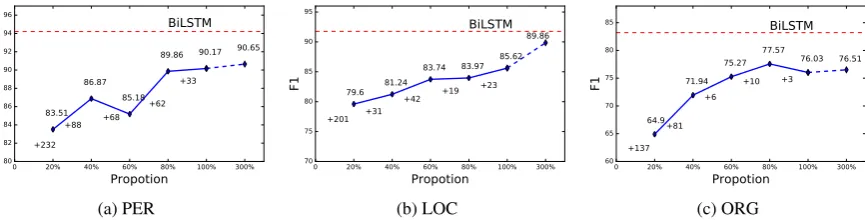
Figure 2: F1 of AdaPU on the testing set of CoNLL (en) using different portion of the training data set for model training. The red dot line denotes performance of BiLSTM. ’+k’ means that it labelskmore unique words on the additional 20% (e.g., 40%-20%) of training data.
1. From the table, we can see that the precision of the data labeling is acceptable but the recall is quite poor. This is expectable and is a typical problem of the method using only dictionaries to perform NER.
4.4 Estimateπp
Before disscussing the estimation of πp
defined in Eq. (12), let us first look at
some statistic information of the four studied datasets. Table 2 lists the true value of πp =
(# of entity words)/(# of words of the training set)
for different entity types over dataset. From the table, we can see that the variation of πp cross
different datasets is quite small. This motivates
us to use the value of πp obtained from an
existing labeled dataset as an initialization. The labeled dataset may be from other domains or
be out-of-date. In this work, we initially set
πp = 0.04,0.04,0.05,0.03for PER, LOC, ORG,
and MISC, respectively. Starting from this value, we trained the proposed model and used it to perform prediction on the unlabeled dataset. Based on the predicted results, we re-estimate the value of πp. The resulted values are listed in
table2and were used throughout our experiments without further illustration.
4.5 Results
Following the protocol of most previous works, we apply the entity-level (exact entity match) F1 to evaluate model performance.
General Performance. Table 3 shows model performance by entity type and the overall per-formance on the four tested datasets. From the table, we can observe: 1)The performance of the Matching model is quite poor compared to other
models. We found out that it mainly resulted
discussion in §1 and shows its inapplicability
using such simple dictionaries. 2) Those
PU-learning-based methods achieve significant im-provement over Matching on all datasets. This demonstrates the effectiveness of the PU learning
framework for NER in the studied setting. 3)
buPU greatly outperforms uPU. This verifies our analysis in§2.3about the necessity to make`
up-per bounded. 4)bnPU slightly outperforms buPU
on most of datasets and entity types. This verifies the effectiveness of the non-negative constraint proposed byKiryo et al.(2017). 5)The proposed AdaPU model achieves further improvement over bnPU, and it even achieves comparable results with some supervised methods, especially for the PER type. This verifies the effectiveness of our proposed method for enriching the named entity dictionaries.
Type Size Precision Recall
PER 10,159 (2,000) 89.65 (89.26) 19.08 (17.38) LOC 10,106 (748) 71.77 (85.07) 56.42 (50.03) ORG 10,039 (353) 83.42 (86.17) 28.59 (29.45)
Table 4: Statistic information of the extended dictionary v.s. (that of the original dictionary).
Model PER LOC ORG Overall
Matching 9.10 (6.70) 69.85 (67.16) 45.52 (46.65) 41.40 (39.39) AdaPU 91.14 (90.17) 77.60 (85.62) 76.67 (76.03) 81.87 (82.94)
Table 5: F1 of the proposed method using the extend dictionary v.s. (that using the original dictionary) on CoNLL (en) testing set.
Influence of Unlabeled Data Size. We further study the influence of the unlabeled data size to our proposed method. To perform the study, we used 20%, 40%, 60%, 80%, 100%, and 300% (using additional unlabeled data) of the training data set of CoNLL (en) to train AdaPU, respectively. Figure 2 depicts the results of this study on PER, LOC, and ORG. From the figure, we can see that increasing the size of training data will, in general, improve the performance of AdaPU, but the improvements are diminishing. Our explanation of this phenomenon is that when the data size exceeds a threshold, the number of unique patterns becomes an sublinear function
of the data size. This was verified by the
observation from the figure, for example, on PER, it labeled 232 unique words on 20% of training data, while it only labeled 88 more unique words
πp PER LOC ORG MISC Overall
True 90.21 85.06 77.17 69.85 83.13 Estimated 90.17 85.62 76.03 69.30 82.94
Table 6: F1 of the proposed method on CoNLL (en) when using True/Estimated value ofπp.
after introducing additional 20% of training data.
Influence of Dictionary. We then study the influence of the dictionary on our proposed model. To this end, we extended the dictionary with DBpedia using the same protocol proposed by Chiu and Nichols (2016). Statistic information of the resultant dictionary is listed in table 4, and model performance using this dictionary is listed in table5. A noteworthy observation of the results is that, on LOC, the performance should decrease a lot when using the extended dictionary.
We turn to table 4 for the explanation. We
can see from the table that, on LOC, the data labeling precision dropped about 13 points (85.07
→71.77) using the extend dictionary. This means that it introduced more false-positive examples into the PU learning and made the empirical risk estimation bias more to the expectation when using the extended dictionary.
Influence ofπp Value. Table 6lists the
perfor-mance of AdaPU when using the true or estimated
value of πp as listed in table 2. From the
table, we can see that the proposed model using the estimatedπp only slightly underperforms that
using the true value of πp. This shows the
robustness of the proposed model to a small variation ofπpand verifies the effectiveness of the πpestimation method.
5 Related Work
Positive-unlabeled (PU) learning (Li and Liu, 2005) aims to train a classifier using only labeled positive examples and a set of unlabeled data, which contains both positive and negative
exam-ples. Recently, PU learning has been used in
AdaSampling (Yang et al., 2017) is a self-training-based approach designed for PU learning, which utilizes predictions of the model to itera-tively update training data. Generally speaking, it initially treats all unlabeled instances as negative examples. Then, based on the model trained in the last iteration, it generates the probability p(y = 0|xu
i)of an unlabeled examplexui to be a negative
one. This value, in turn, determines the probability of xui to be selected as the negative examples for model training in next iteration. This process iterates for an acceptable result.
6 Conclusion
In this work, we introduce a novel PU learning algorithm to perform the NER task using only unlabeled data and named entity dictionaries. We prove that this algorithm can unbiasedly and consistently estimate the task loss as if there is
fully labeled data. And we argue that it can
greatly reduce the requirement on sizes of the dictionaries. Extensive experimental studies on four NER datasets validate its effectiveness.
Acknowledgements
The authors wish to thank the anonymous
reviewers for their helpful comments. This
work was partially funded by China National
Key R&D Program (No. 2018YFB1005104,
2018YFC0831105, 2017YFB1002104, ),
National Natural Science Foundation of
China (No. 61751201, 61532011), Shanghai
Municipal Science and Technology Major
Project (No.2018SHZDZX01), STCSM
(No.16JC1420401,17JC1420200), ZJLab.
References
Nachman Aronszajn. 1950. Theory of reproducing kernels. Transactions of the American mathematical society, 68(3):337–404.
Bogdan Babych and Anthony Hartley. 2003. Im-proving machine translation quality with automatic named entity recognition. In Proceedings of the 7th International EAMT workshop on MT and other Language Technology Tools, pages 1–8. Association for Computational Linguistics.
Antoine Bordes, Nicolas Usunier, Sumit Chopra, and Jason Weston. 2015. Large-scale simple question answering with memory networks. arXiv preprint arXiv:1506.02075.
Nancy Chinchor. 1998. Overview of muc-7. In Seventh Message Understanding Conference (MUC-7): Proceedings of a Conference Held in Fairfax, Virginia, April 29-May 1, 1998.
Jason Chiu and Eric Nichols. 2016. Named entity recognition with bidirectional lstm-cnns. Transactions of the Association of Computational Linguistics, 4(1):357–370.
Ronan Collobert, Jason Weston, L´eon Bottou, Michael Karlen, Koray Kavukcuoglu, and Pavel Kuksa. 2011. Natural language processing (almost) from scratch. Journal of Machine Learning Research, 12(Aug):2493–2537.
Felipe Cucker and Steve Smale. 2002. On the mathematical foundations of learning. Bulletin of the American mathematical society, 39(1):1–49.
Louise Del˙eger, Robert Bossy, Estelle Chaix, Mouhamadou Ba, Arnaud Ferr˙e, Philippe Bessieres, and Claire N˙edellec. 2016. Overview of the bacteria biotope task at bionlp shared task 2016. In Proceedings of the 4th BioNLP Shared Task Workshop, pages 12–22.
Jenny Rose Finkel, Trond Grenager, and Christopher Manning. 2005. Incorporating non-local informa-tion into informainforma-tion extracinforma-tion systems by gibbs sampling. In Proceedings of the 43rd annual meeting on association for computational linguis-tics, pages 363–370. Association for Computational Linguistics.
Martin Gerner, Goran Nenadic, and Casey M Bergman. 2010. Linnaeus: a species name identification sys-tem for biomedical literature. BMC bioinformatics, 11(1):85.
Mourad Gridach. 2017. Character-level neural network for biomedical named entity recognition. Journal of biomedical informatics, 70:85–91.
Cho-Jui Hsieh, Nagarajan Natarajan, and Inderjit S Dhillon. 2015. Pu learning for matrix completion. InICML, pages 2445–2453.
Zhiheng Huang, Wei Xu, and Kai Yu. 2015. Bidirec-tional lstm-crf models for sequence tagging. arXiv preprint arXiv:1508.01991.
Yoon Kim. 2014. Convolutional neural networks for sentence classification. Empirical Methods in Natural Language Processing.
Ryuichi Kiryo, Gang Niu, Marthinus C du Plessis, and Masashi Sugiyama. 2017. Positive-unlabeled learn-ing with non-negative risk estimator. In Advances in Neural Information Processing Systems, pages 1675–1685.
Xiao-Li Li and Bing Liu. 2005. Learning from positive and unlabeled examples with different data distributions. InEuropean Conference on Machine Learning, pages 218–229. Springer.
Xiaoli Li and Bing Liu. 2003. Learning to classify texts using positive and unlabeled data. In IJCAI, volume 3, pages 587–592.
Liyuan Liu, Jingbo Shang, Xiang Ren, Frank Xu, Huan Gui, Jian Peng, and Jiawei Han. 2018. Empower sequence labeling with task-aware neural language model. AAAI Conference on Artificial Intelligence.
Shengyu Liu, Buzhou Tang, Qingcai Chen, and Xiaolong Wang. 2015. Effects of semantic features on machine learning-based drug name recognition systems: word embeddings vs. manually constructed dictionaries. Information, 6(4):848– 865.
Yuan Liu, Qiang Tan, and Kun Xu Shen. 1994. The word segmentation rules and automatic word segmentation methods for chinese information pro-cessing. Qing Hua University Press and Guang Xi, page 36.
Andrew McCallum, Dayne Freitag, and Fernando CN Pereira. 2000. Maximum entropy markov models for information extraction and segmentation. In Icml, volume 17, pages 591–598.
Andrew McCallum and Wei Li. 2003. Early results for named entity recognition with conditional random fields, feature induction and web-enhanced lexicons. InProceedings of the seventh conference on Natural language learning at HLT-NAACL 2003-Volume 4, pages 188–191. Association for Computational Linguistics.
David Nadeau, Peter D Turney, and Stan Matwin. 2006. Unsupervised named-entity recognition: Generating gazetteers and resolving ambiguity. InConference of the Canadian Society for Computational Studies of Intelligence, pages 266–277. Springer.
Minh Nhut Nguyen, Xiao-Li Li, and See-Kiong Ng. 2011. Positive unlabeled learning for time series classification. InTwenty-Second International Joint Conference on Artificial Intelligence.
Jeffrey Pennington, Richard Socher, and Christopher Manning. 2014. Glove: Global vectors for word representation. In Proceedings of the 2014 con-ference on empirical methods in natural language processing (EMNLP), pages 1532–1543.
Marthinus C du Plessis, Gang Niu, and Masashi Sugiyama. 2014. Analysis of learning from positive and unlabeled data. InAdvances in neural information processing systems, pages 703–711.
Sebastian Riedel, Limin Yao, Andrew McCallum, and Benjamin M Marlin. 2013. Relation extraction with matrix factorization and universal schemas. In Proceedings of the 2013 Conference of the North
American Chapter of the Association for Computa-tional Linguistics: Human Language Technologies, pages 74–84.
Lorenzo Rosasco, Ernesto De Vito, Andrea Capon-netto, Michele Piana, and Alessandro Verri. 2004. Are loss functions all the same? Neural Computation, 16(5):1063–1076.
Tjong Kim Sang and F Erik. 2002. Introduction to the conll-2002 shared task: language-independent named entity recognition. Computer Science, pages 142–147.
Burr Settles. 2004. Biomedical named entity recognition using conditional random fields and rich feature sets. In Proceedings of the international joint workshop on natural language processing in biomedicine and its applications, pages 104–107. Association for Computational Linguistics.
Wei Shen, Jianyong Wang, Ping Luo, and Min Wang. 2012. Linden: linking named entities with knowledge base via semantic knowledge. In Proceedings of the 21st international conference on World Wide Web, pages 449–458. ACM.
Erik F Tjong Kim Sang and Fien De Meulder. 2003. Introduction to the conll-2003 shared task: Language-independent named entity recognition. In Proceedings of the seventh conference on Natural language learning at HLT-NAACL 2003-Volume 4, pages 142–147. Association for Computational Linguistics.
Nianwen Xue. 2003. Chinese word segmentation as character tagging. International Journal of Computational Linguistics & Chinese Language Processing, Volume 8, Number 1, February 2003: Special Issue on Word Formation and Chinese Language Processing, 8(1):29–48.
Pengyi Yang, Wei Liu, and Jean Yang. 2017. Positive unlabeled learning via wrapper-based adaptive sam-pling. InIJCAI.
Yaosheng Yang, Wenliang Chen, Zhenghua Li, Zhengqiu He, and Min Zhang. 2018. Distantly supervised ner with partial annotation learning and reinforcement learning. In Proceedings of the 27th International Conference on Computational Linguistics, pages 2159–2169.
Qi Zhang, Jinlan Fu, Xiaoyu Liu, and Xuanjing Huang. 2018. Adaptive co-attention network for named entity recognition in tweets. InAAAI.
Yue Zhang and Jie Yang. 2018. Chinese ner using lattice lstm. Proceedings of the 56th Annual Meeting of the Association for Computational Linguistics (ACL), 1554-1564.
Jianhan Zhu, Victoria Uren, and Enrico Motta. 2005. Espotter: Adaptive named entity recognition for web browsing. In Biennial Conference on Professional
Knowledge Management/Wissensmanagement,
pages 518–529. Springer.
A Proof of Theorem 1
Proof. Let denoteRˆs`(f)the empirical estimation
of R`(f) with k randomly labeled examples.
Since ` is bounded, C0, M, and B are finite. According to the Lemma in (Rosasco et al.,2004) we have:
P{S∈ D| sup f∈HR
|R`(f)−Rˆs`(f)| ≤}
≥1−2N( 4LM
)e−k 2 8B2.
(14)
Then, the empirical estimation error of R`(f) −
ˆ
R`(f)in PU learning can be written as:
R`(f)−Rˆ`(f)
= EX`(f(x),0)− 1 nu
nu X
i=1
`((f(xui),0) !
+πp EX|Y=1`(f(x),1)− 1 np
np X
i=1
`(f(xpi),1) !
−πp EX|Y=1`(f(x),0)− 1 np
np X
i=1
`(f(xpi),0) !
(15)
Thus,
|R`(f)−Rˆ`(f)|
≤
EX`(f(x),0)− 1 nu
nu X
i=1
`((f(xui),0)
+πp
EX|Y=1`(f(x),1)− 1 np
np X
i=1
`(f(xpi),1)
+πp
EX|Y=1`(f(x),0)− 1 np
np X
i=1
`(f(xpi),0) (16)
LetI`(X,0)denote
EX`(f(x),0)− 1 nu
nu X
i=1
`((f(xui),0).
According to Eq.14, we have:
P{S∈ D| sup f∈HR
|I`(X,0)| ≤}
≥1−2N( 4LM
)e−nu 2 8B2
(17)
Similarly, letI`(X|Y = 1,1)denote
EX|Y=1`(f(x),1)− 1 np
np X
i=1
`(f(xpi),1),
andI`(X|Y = 1,0)denote
EX|Y=1`(f(x),0)− 1 np
np X
i=1
`(f(xpi),0),
we have:
P{S∈ D| sup f∈HR
|I`(X|Y = 1,1)| ≤}
≥1−2N( 4LM
)e− np2
8B2 ,
(18)
and
P{S∈ D| sup f∈HR
|I`(X|Y = 1,0)| ≤}
≥1−2N( 4LM
)e−np 2 8B2 ,
(19)
Therefore,
P{S∈ D| sup f∈HR
|R`(f)−Rˆ`(f)| ≤(1 + 2πp)}
≥min(1−2N( 4LM
)e−np 2 8B2,
1−2N( 4LM
)e−nu 2 8B2 )
= 1−2N( 4LM
)e−
min(np,nu)2 8B2
(20)