1828
Self-Supervised Neural Machine Translation
Dana Ruiter Cristina Espa ˜na-Bonet Josef van Genabith
Saarland University Saarland University Saarland University
DFKI GmbH DFKI GmbH
{cristinae,Josef.Van Genabith}@dfki.de
Abstract
We present a simple new method where an emergent NMT system is used for simultane-ously selecting training data and learning in-ternal NMT representations. This is done in a self-supervised way without parallel data, in such a way that both tasks enhance each other during training. The method is lan-guage independent, introduces no additional hyper-parameters, and achieves BLEU scores of 29.21 (en2f r) and 27.36 (f r2en) on new-stest2014using English and French Wikipedia data for training.
1 Introduction
Neural machine translation (NMT) has brought major improvements in translation quality (Cho et al.,2014;Bahdanau et al.,2014;Vaswani et al., 2017). Until recently, these relied on the avail-ability of high-quality parallel corpora. As such corpora exist only for a few high-resource lan-guage combinations, overcoming this constraint by either extracting parallel data from non-parallel sources or developing unsupervised techniques in NMT is crucial to cover all languages.
Obtaining comparable corpora is becoming eas-ier (Paramita et al., 2019) and extracting par-allel sentences from them a wide research field. Most of the methods estimate similarities between fragments to select pairs. Here we focus on similarities estimated from NMT representations. The strength of NMT embeddings as semantic representations was first shown qualitatively in Sutskever et al.(2014);Ha et al.(2016) and John-son et al.(2017), and used for estimating semantic similarities at sentence level inEspa˜na-Bonet and Barr´on-Cede˜no(2017) for example. In a system-atic study, Espa˜na-Bonet et al. (2017) show that cosine similarities between context vectors dis-criminate between parallel and non-parallel sen-tences already in the first stages of training. Other
approaches perform max-pooling over encoder outputs (Schwenk, 2018; Artetxe and Schwenk, 2018) or calculate the mean of word embeddings (Bouamor and Sajjad,2018) to extract pairs.
On the other hand,unsupervised NMTis now achieving impressive results using large amounts of monolingual data and small parallel lexicons (Lample et al.,2018a;Artetxe et al.,2018b;Yang et al., 2018). These systems rely on very strong language models and back-translation, and build complex architectures that combine denoising au-toencoders, back-translation steps and shared en-coders among languages. The most successful architectures also use SMT phrase tables, stand-alone or in combination with NMT (Lample et al., 2018b;Artetxe et al.,2018a).
Inour approach, we propose a new and sim-pler method withouta prioriparallel corpora. Our premise is that NMT systems —either sequence to sequence models with RNNs, transformers, or any architecture based on encoder–decoder models— already learn strong enough representations of words and sentences to judge on-line if an input sentence pair is useful or not. Our approach re-sembles self-supervised learning (Raina et al., 2007; Bengio et al., 2013), i.e. learning a pri-mary task where labelled data is not directly avail-able but where the data itself provides a supervi-sion signal for another auxiliary task which lets the network learn the primary one. In our case this comes with a twist: we find cross-lingually close sentences as an auxiliary task for learning MT and learning MT as an auxiliary task for find-ing cross-lfind-ingually close sentences in a mutually self-supervised loop: in effect a doubly virtuous circle.
therefore the use of comparable corpora is recom-mended to speed up the training.
In the following, we describe the approach (Sec-tion2) and the experiments in which it is going to be tested (Section3). Section4reviews the results and, finally, we summarise and sketch future work in Section5.
2 Joint Model Architecture
Without loss of generality, we consider a bidirec-tional NMT system {L1, L2}→{L1, L2} where the encoder and decoder have the information of both languages L1 and L2. The bidirectionality is simply achieved by tagging the source sentence with the target language as done byJohnson et al. (2017) in their multilingual systems and inputting sentence pairs in both directions. Two dimensions determine our architectures: (i) the specific repre-sentation of an input sentence, and (ii) the similar-ity or score function for an input sentence pair.
We focus on two different embedding spaces in the encoder to buildsemantic sentence represen-tations: the sum of word embeddings (Ce) and the hidden states of an RNN or the encoder outputs of a transformer (Ch). We define:
Ce= T X
t=1
et, Ch= T X
t=1
ht, (1)
whereetis the word embedding at time steptand
htits hidden state (RNN) or encoder output (trans-former). In casehtis an RNN hidden state, it is further defined by the concatenation of its forward and backward componenthRNNt = [−→ht;
←− ht]. These representations are used to score input sentence pairs. We study two functions for sen-tence selection with the aim of exploring whether a threshold-free selection method is viable.
Let SL1 andSL2 be the vector representations
for each sentence of a pair (eitherCeorCh). The cosine similarity of a sentence pair is calculated as the dot product of their representations:
sim(SL1, SL2) =
SL1·SL2
kSL1k kSL2k
, (2)
which is bounded in the [-1, 1] range. However, the threshold to decide when to accept a pair is not straightforward and might depend on the lan-guage pair and the corpus (Espa˜na-Bonet et al., 2017;Artetxe and Schwenk,2018). Besides, even if the measure does not depend on the length of the
sentences, it might be scaled differently for differ-ent sdiffer-entences. To solve this,Artetxe and Schwenk (2018) proposed amargin-basedfunction:
margin(SL1, SL2) =
sim(SL1, SL2)
avrkNN(SL1, Pk)/2 + avrkNN(SL2, Qk)/2
, (3)
whereavrkNN(X, Yk)corresponds to the average similarity between a sentenceXandkNN(X), its
knearest neighborsYkin the other language:
avrkNN(X, Yk) = X
Y∈kNN(X)
sim(X, Y)
k . (4)
This scoring method penalises sentences which have a generally high cosine similarity with sev-eral candidates. FollowingArtetxe and Schwenk (2018), we usek= 4in our experiments.
In the selection process that follows, we con-sider four strategies. In all of them,sim(SL1, SL2)
andmargin(SL1, SL2)can be used for scoring.
(i) Threshold dependent. We find the highest scoring target sentence for each source sentence (pair i) as well as the highest scoring source for each target sentence (pair j) for either represen-tationS=Ch orS=Ce (systemsH andE respec-tively in the experiments). Since often i 6= j, the process is not symmetric and only pairs that have been matched during selection in both lan-guage directions are accepted to the candidate list. A threshold is empirically determined to filter out false positives.
(ii) High precision, medium recall. (systemP) We apply the same methodology as before, but we use both representations S=Ch and S=Ce. Only pairs that have been matched during selection in both language directionsand both representation types are accepted to the candidate list. Ch and
Ceturn out to be complementary and this further restriction allows us to get rid of the threshold, and the sentence selection becomes parameter-free.
number of candidates considered only forS=Ch, which is the most restrictive factor at the begin-ning of traibegin-ning.
(iv) Low precision, high recall. Generalisa-tion of the previous strategy where we make the method symmetric in source–target andCh–Ce.
3 Experimental Setting
Data. We use Wikipedia (WP) dumps1 in En-glish (en) and French (f r), and pre-process the articles and split the text into sentences using the Wikitailor toolkit2 (Barr´on-Cede˜no et al., 2015). We further tokenise and truecase them using stan-dard Moses scripts (Koehn et al., 2007) and ap-ply a byte-pair encoding (Sennrich et al., 2016) of 100 k merge operations trained on the concate-nation of English and French data. We also re-move duplicates and discard sentences with more than 50 tokens for training the MT systems. We fix these settings as a comparison point for all the experiments even though smaller vocabularies and longer sentences might imply the extraction of more parallel sentences (see Section4). We use newstest2012for validation andnewstest2014for testing.
WP dumps are used for two different purposes in our systems: (i) to calculate initial word embed-dings and (ii) as training corpus. In the first case, we use the complete editions (92 M sentences / 2.247 M tokens in en and 27 M / 652 M in f r). In the second case, we select only the subset of articles that can be linked among languages us-ing Wikipedia’slanglinkswith Wikitailor, i.e., we only take an article if there is the equivalent article in the other language. For this, the total amount of sentences (tokens) is 12 M (318 M) forenand 8 M (207 M) forf r.
Model Specifications. We implemented3the ar-chitecture described in Section2within the Open-NMT toolkit (Klein et al.,2017) both for RNN and Transformer encoders, and trained:
LSTMsimP: 1-layer bidirectional encoder with
LSTM units, additive attention, 512-dim word em-beddings and hidden states, and an initial learning rate (λ) of 0.5 with SGD.CeandChare both used
1
We use WP editions downloaded in Jan. 2015 from
https://dumps.wikimedia.org/ 2
https://github.com/cristinae/ WikiTailor
3https://github.com/ruitedk6/
comparableNMT
as representations in the high precision mode and
sim(SL1, SL2)as scoring function.
LSTMmargP: The same as LSTMsimP but
margin(SL1, SL2)as scoring function.
LSTMmargR: The same asLSTMmargPbutCe
andChare used in the high recall mode.
LSTMmargH: AsLSTMmargPwithChas only
representation. A hard threshold of 1.0 is used.
LSTMmargE: AsLSTMmargPwithCe as only
representation. A hard threshold of 1.2 is used. Transformer: Transformer base as defined in Vaswani et al. (2017) with 6-layer encoder– decoder with 8-head self-attention, 512-dim word embeddings and a 2048-dim hidden feed-forward. Adam optimisation with λ=2 and beta2=0.998; noamλdecay with 8000 warm-up steps. Labels are smoothed (=0.1) and a dropout mask (p=0.1) is applied.
The five models described in the LSTM cate-gory have transformer counterparts which follow the same transformer base architecture.
All systems are trained on a single GPU GTX TITAN using a batch size of 64 (LSTM) or 50 (transformer) sentences.
4 Results and Discussion
In order to train the 10 NMT systems, we initialise the word embeddings following Artetxe et al. (2017) using a seed dictionary of 2.591 numerals automatically extracted from our Wikipedia edi-tions, and feed the system directly with compa-rable articles. This avoids the n×m explosion of possible combinations of sentences, wherenis the number of sentences in L1 and m in L2. In our approach, we inputP
articleni×mj sentence pairs, that is, only all possible source–target sen-tence combinations within two articles linked by Wikipedia’s langlinks. Hence we miss the paral-lel sentences in non-linked articles but we win in speed.
Articles are input in lots4. For them, the
ap-propriate representation and scoring function are applied. Sentence pairs accepted by the selec-tion method within a lot are extracted. Whenever enough parallel sentences are available to create a training batch, a training step is performed. Em-beddings are modified by back-propagation and
4Since margin(S
0 1 2 3 4 5 6 7 Epochs
0.5 1.0 1.5 2.0
Num
be
r o
f P
ai s
(M
illi
ons
)
Δ 0Δ10Δ 0Δ27 Δ 0Δ07
Δ 0Δ34 Δ 0Δ16
Δ 0Δ34 Δ 0Δ29
Δ 0Δ33 Δ 0Δ32
Δ 0Δ34 Δ 0Δ32
Δ 0Δ34
[image:4.595.75.275.64.219.2]T ansfo me LSTM
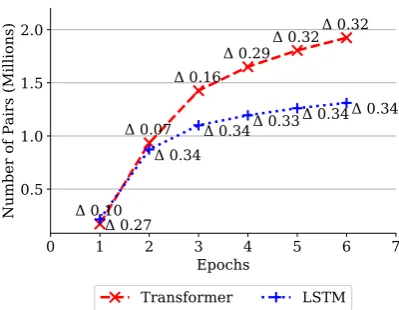
Figure 1: Number of unique accepted sentence pairs over the first 6 epochs for bothmargPsystems. Points are labeled with the difference between the average margin scores of accepted and rejected pairs.
the next lot of articles is processed with the im-proved representations. Notice that the extracted pairs may therefore differ through iterations, since it is the sentence representation at the specific training step that is responsible for the selection.
Figure1shows the number of unique pairs se-lected during the first six epochs of training for both LSTMmargP and TransformermargP. The
number of accepted sentences increases through-out the epochs, and so does the number of unique sentences used in training. Especially the first it-eration over the data set is vital for improving and adapting the representations to the data itself. This quadruples the number of unique sentences ac-cepted in the second pass over the data. While sentences are still able to pass from rejected to accepted as training advances, the two distribu-tions are pushed apart and the gap in average mar-gin scores between the two distributions (∆) in-creases as the representations get better at discrim-inating. We observe curriculum learning in the process: at the beginning (epoch 1) simple sen-tences withanchors (mostly homographs such as numbers, named entities, acronyms...) are selected but as training progresses, complex semantically equivalent sentences are extracted too. Curriculum learning is important since once the capacity of a neural architecture is exhausted, more data does not improve the performance. This self-supervised architecture not only selects the data but it does it in the most useful way for the learning. It re-mains to be checked whether smaller vocabular-ies and therefore a larger number of common BPE sub-units modifies the distribution of selected
sen-2 4 6 8 10
Epochs 0
5 10 15 20 25 30
B
L
EU
[image:4.595.308.510.64.222.2]en2fr fr2en
Figure 2: BLEU scores of TransformermargP on
new-stest2014as training progresses.
tences especially at the beginning of training. These trends are common to all our models with small nuances due to the concrete architec-tures. Transformers generally accumulate more unique pairs before convergence than their LSTM counterparts for example, but other than this the behaviour is the same. To validate our method, we carry out a control experiment on parallel data (Europarl) where we scramble the target sen-tences, creating pseudo-comparable data with a ratio of 1:5 between parallel and unrelated sen-tences. On this data, we can measure precision and recall and we observe how our approach pro-gresses towards high values for these scores in both margPandmargR systems. These experi-ments also validate the nomenclature used in Sec-tion2: TransformermargRreaches higher levels of
recall than TransformermargP (98.4% vs. 95.3%)
at the cost of a lower precision (73.9% vs. 94.7%). The major increment in data through training leads to a higher translation quality as measured by BLEU, so extraction and training in a loop en-hance each other’s performance. Figure2 shows the progressive improvement in translation perfor-mance throughout the training process of system TransformermargPand, again, the trend is general.
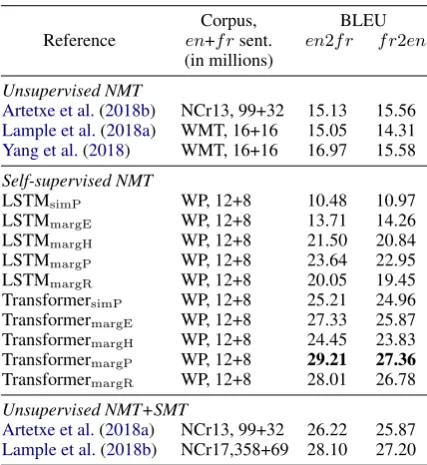
Table 1 summarises the final performance of our 10 systems according to BLEU. The first thing to point out is that the difference between
sim(SL1, SL2)andmargin(SL1, SL2)is clear and
Corpus, BLEU Reference en+f rsent. en2f r f r2en
(in millions)
Unsupervised NMT
Artetxe et al.(2018b) NCr13, 99+32 15.13 15.56 Lample et al.(2018a) WMT, 16+16 15.05 14.31 Yang et al.(2018) WMT, 16+16 16.97 15.58
Self-supervised NMT
LSTMsimP WP, 12+8 10.48 10.97
LSTMmargE WP, 12+8 13.71 14.26
LSTMmargH WP, 12+8 21.50 20.84
LSTMmargP WP, 12+8 23.64 22.95
LSTMmargR WP, 12+8 20.05 19.45
TransformersimP WP, 12+8 25.21 24.96 TransformermargE WP, 12+8 27.33 25.87 TransformermargH WP, 12+8 24.45 23.83 TransformermargP WP, 12+8 29.21 27.36 TransformermargR WP, 12+8 28.01 26.78
Unsupervised NMT+SMT
[image:5.595.77.291.62.295.2]Artetxe et al.(2018a) NCr13, 99+32 26.22 25.87 Lample et al.(2018b) NCr17,358+69 28.10 27.20
Table 1: BLEU scores achieved onnewstest2014with
multi-bleu.perl. Training corpora differ by vari-ous authors: News Crawl 2007–2013 (NCr13), 2007– 2017 (NCr17), the full WMT data and Wikipedia (WP).
models margE and margH (only word embed-dings or encoder outputs) are 2–10 BLEU points below systems that combine both representations. It should be noted that such single representa-tion systemscanperform comparatively well (see TransformermargH) if the threshold is optimally
set. However, this is not guaranteed even with a preceding exploration of the threshold parame-ter. In margP andmargR, the combinations of representations do not need such hyper-parameters and achieve the best translation quality. The best system, TransformermargP, focuses on extracting
parallel sentences with high precision and ob-tains BLEU scores of 29.21 (en2f r) and 27.36 (f r2en) with a total of 2.4 M selected unique sen-tence pairs. When increasing recall, too few new parallel sentences are gained as compared to the new false positives to improve the final translation, and TransformermargRand LSTMmargRare∼1–3
BLEU points below their medium recall counter-parts. Notice that we do not include theLow pre-cision, high recallstrategy since the effect is even more pronounced.
Table1also presents a comparison with related work on unsupervised NMT. The comparison is delicate because training corpora and methodol-ogy differ. If we compare the final performance, we observe that we achieve similar results with
less data (us vs.Lample et al.(2018b)); and when the same order of magnitude of sentences is used we obtain significantly better results (us vs. Lam-ple et al.(2018a) andYang et al.(2018)). The cru-cial difference here is that in one case one needs monolingual data, whereas we are using compara-ble corpora.
5 Conclusions and Future Work
We present a joint architecture to select data and train NMT systems simultaneously using the emerging NMT system itself to select the data. This is a form of self-supervision alternating be-tween two tasks that support each other in an in-cremental fashion. We focus on data representa-tion, an adequate function for the selection pro-cess, and studying how to avoid additional hyper-parameters that depend on the input corpus. The key point of our approach is the combination of a margin-based score with the intersection of sen-tence representations for filtering the input corpus. As future work, we will apply our methodology to domain adaptation. In this setting, word embed-dings and hidden layers are already initialised via standard NMT training on parallel data and train-ing is continued with an in-domain monoltrain-ingual or comparable corpus. Our architecture is also useful for data selection in data rich language pairs and we will perform experiments on cleaning noisy parallel corpora.
In the same vain as unsupervised MT, we want to continue our research by using back transla-tion for rejected pairs and dealing with phrases instead of full sentences. That will allow us to extract more parallel text from a corpus and fa-cilitate using these approaches for low-resourced languages. Existing approaches make use of huge amounts of monolingual (∼100 M, references in Table 1) or comparable (∼10 M, this work) sen-tences and these numbers are still far from what one can gather in a truly low-resource scenario.
Acknowledgments
References
Mikel Artetxe, Gorka Labaka, and Eneko Agirre. 2017. Learning bilingual word embeddings with (almost) no bilingual data. InProceedings of the 55th Annual Meeting of the Association for Computational Lin-guistics (Volume 1: Long Papers), pages 451–462. Mikel Artetxe, Gorka Labaka, and Eneko Agirre.
2018a. Unsupervised statistical machine transla-tion. In Proceedings of the 2018 Conference on Empirical Methods in Natural Language Process-ing, pages 3632–3642, Brussels, Belgium. Associ-ation for ComputAssoci-ational Linguistics.
Mikel Artetxe, Gorka Labaka, Eneko Agirre, and Kyunghyun Cho. 2018b. Unsupervised neural ma-chine translation. InProceedings of the Sixth Inter-national Conference on Learning Representations, ICLR.
Mikel Artetxe and Holger Schwenk. 2018. Margin-based parallel corpus mining with multilin-gual sentence embeddings. arXiv preprint arXiv:1811.01136.
Dzmitry Bahdanau, Kyunghyun Cho, and Yoshua Ben-gio. 2014. Neural Machine Translation by Jointly Learning to Align and Translate. InProceedings of the 3rd International Conference on Learning Rep-resentations (ICLR 2015), San Diego, CA.
Alberto Barr´on-Cede˜no, Cristina Espa˜na-Bonet, Josu Boldoba, and Llu´ıs M`arquez. 2015. A factory of comparable corpora from Wikipedia. In Proceed-ings of the Eighth Workshop on Building and Using Comparable Corpora, pages 3–13.
Yoshua Bengio, Aaron Courville, and Pascal Vincent. 2013. Representation learning: A review and new perspectives. IEEE Trans. Pattern Anal. Mach. In-tell., 35(8):1798–1828.
Houda Bouamor and Hassan Sajjad. 2018. H2@BUCC18: Parallel Sentence Extraction from Comparable Corpora Using Multilingual Sen-tence Embeddings. In11th Workshop on Building and Using Comparable Corpora, page 43.
Kyunghyun Cho, Bart van Merri¨enboer, Caglar Gul-cehre, Dzmitry Bahdanau, Fethi Bougares, Hol-ger Schwenk, and Yoshua Bengio. 2014. Learn-ing Phrase Representations UsLearn-ing RNN Encoder– Decoder for Statistical Machine Translation. In Pro-ceedings of the Conference on Empirical Methods in Natural Language Processing (EMNLP 2014), pages 1724–1734, Doha, Qatar. Association for Computational Linguistics.
Cristina Espa˜na-Bonet and Alberto Barr´on-Cede˜no. 2017. Lump at SemEval-2017 Task 1: Towards an Interlingua Semantic Similarity. InProceedings of the 11th International Workshop on Semantic Eval-uation (SemEval-2017), pages 144–149, Vancouver, Canada. Association for Computational Linguistics.
Cristina Espa˜na-Bonet, Ad´am Csaba Varga, Alberto Barr´on-Cede˜no, and Josef van Genabith. 2017. An empirical analysis of NMT-derived interlingual em-beddings and their use in parallel sentence identifi-cation. IEEE Journal of Selected Topics in Signal Processing, 11(8):1340–1350.
Thanh-Le Ha, Jan Niehues, and Alexander H. Waibel. 2016. Toward Multilingual Neural Machine Trans-lation with Universal Encoder and Decoder. In Pro-ceedings of the International Workshop on Spoken Language Translation, Seattle, WA.
Melvin Johnson, Mike Schuster, Quoc V. Le, Maxim Krikun, Yonghui Wu, Zhifeng Chen, Nikhil Tho-rat, Fernanda B. Vi´egas, Martin Wattenberg, Greg Corrado, Macduff Hughes, and Jeffrey Dean. 2017. Google’s Multilingual Neural Machine Translation System: Enabling Zero-Shot Translation. Transac-tions of the Association for Computational Linguist, 5:339–351.
Guillaume Klein, Yoon Kim, Yuntian Deng, Jean Senellart, and Alexander Rush. 2017. Opennmt: Open-source toolkit for neural machine translation. In Proceedings of ACL 2017, System Demonstra-tions, pages 67–72. Association for Computational Linguistics.
Philipp Koehn, Hieu Hoang, Alexandra Birch, Chris Callison-Burch, Marcello Federico, Nicola Bertoldi, Brooke Cowan, Wade Shen, Christine Moran, Richard Zens, Chris Dyer, Ondrej Bojar, Alexan-dra Constantin, and Evan Herbst. 2007. Moses: Open source toolkit for statistical machine transla-tion. InProceedings of the 45th Annual Meeting of the Association for Computational Linguistics Com-panion Volume Proceedings of the Demo and Poster Sessions, pages 177–180. Association for Computa-tional Linguistics.
Guillaume Lample, Alexis Conneau, Ludovic De-noyer, and Marc’Aurelio Ranzato. 2018a. Unsu-pervised machine translation using monolingual cor-pora only. InProceedings of the Sixth International Conference on Learning Representations, ICLR. Guillaume Lample, Myle Ott, Alexis Conneau,
Lu-dovic Denoyer, and Marc’Aurelio Ranzato. 2018b.
Phrase-based & neural unsupervised machine trans-lation. In Proceedings of the 2018 Conference on Empirical Methods in Natural Language Process-ing, pages 5039–5049. Association for Computa-tional Linguistics.
Monica Lestari Paramita, Ahmet Aker, Paul Clough, Robert Gaizauskas, Nikos Glaros, Nikos Mastropav-los, Olga Yannoutsou, Radu Ion, Dan S¸tef˘anescu, Alexandru Ceaus¸u, Dan Tufis¸, and Judita Preiss. 2019. Using Comparable Corpora for Under-Resourced Areas of Machine Translation, chapter Collecting Comparable Corpora. Springer, Cham.
learn-ing: Transfer learning from unlabeled data. In Pro-ceedings of the 24th International Conference on Machine Learning, ICML’07, pages 759–766, New York, NY, USA. ACM.
Holger Schwenk. 2018. Filtering and mining paral-lel data in a joint multilingual space. In Proceed-ings of the 56th Annual Meeting of the Associa-tion for ComputaAssocia-tional Linguistics (Volume 2: Short Papers), pages 228–234. Association for Computa-tional Linguistics.
Rico Sennrich, Barry Haddow, and Alexandra Birch. 2016. Neural Machine Translation of Rare Words with Subword Units. InProceedings of the 54th An-nual Meeting of the Association for Computational Linguistics, (ACL 2016), Volume 1: Long Papers, pages 1715–1725, Berlin, Germany.
Ilya Sutskever, Oriol Vinyals, and Quoc V Le. 2014. Sequence to Sequence Learning with Neural Net-works. In Z. Ghahramani, M. Welling, C. Cortes, N. D. Lawrence, and K. Q. Weinberger, editors, Ad-vances in Neural Information Processing Systems 27, pages 3104–3112. Curran Associates, Inc. Ashish Vaswani, Noam Shazeer, Niki Parmar, Jakob
Uszkoreit, Llion Jones, Aidan N Gomez, Ł ukasz Kaiser, and Illia Polosukhin. 2017. Attention is all you need. In I. Guyon, U. V. Luxburg, S. Bengio, H. Wallach, R. Fergus, S. Vishwanathan, and R. Gar-nett, editors, Advances in Neural Information Pro-cessing Systems 30, pages 5998–6008. Curran As-sociates, Inc.