Proceedings of the 57th Annual Meeting of the Association for Computational Linguistics, pages 2102–2113
2102
Learning to Select, Track, and Generate for Data-to-Text
Hayate Iso∗†Yui Uehara‡Tatsuya Ishigaki\‡Hiroshi Noji‡
Eiji Aramaki†‡ Ichiro Kobayashi[‡Yusuke Miyao]‡Naoaki Okazaki\‡Hiroya Takamura\‡
†Nara Institute of Science and Technology‡Artificial Intelligence Research Center, AIST
\Tokyo Institute of Technology[Ochanomizu University]The University of Tokyo
{iso.hayate.id3,aramaki}@is.naist.jp [email protected]
{yui.uehara,ishigaki.t,hiroshi.noji,takamura.hiroya}@aist.go.jp
[email protected] [email protected]
Abstract
We propose a data-to-text generation model with two modules, one for tracking and the other for text generation. Our tracking mod-ule selects and keeps track of salient infor-mation and memorizes which record has been mentioned. Our generation module generates a summary conditioned on the state of track-ing module. Our model is considered to simu-late the human-like writing process that gradu-ally selects the information by determining the intermediate variables while writing the sum-mary. In addition, we also explore the ef-fectiveness of the writer information for gen-eration. Experimental results show that our model outperforms existing models in all eval-uation metrics even without writer informa-tion. Incorporating writer information fur-ther improves the performance, contributing to content planning and surface realization.
1 Introduction
Advances in sensor and data storage technolo-gies have rapidly increased the amount of data produced in various fields such as weather, fi-nance, and sports. In order to address the infor-mation overload caused by the massive data, data-to-text generation technology, which expresses the contents of data in natural language, becomes more important (Barzilay and Lapata,2005). Re-cently, neural methods can generate high-quality short summaries especially from small pieces of data (Liu et al.,2018).
Despite this success, it remains challenging to generate a high-quality long summary from data (Wiseman et al., 2017). One reason for the difficulty is because the input data is too large for a naive model to find its salient part, i.e., to deter-mine which part of the data should be mentioned.
∗
Work was done during the internship at Artificial Intel-ligence Research Center, AIST
In addition, the salient part moves as the sum-mary explains the data. For example, when gen-erating a summary of a basketball game (Table1
(b)) from the box score (Table 1 (a)), the input contains numerous data records about the game: e.g.,Jordan Clarkson scored 18 points. Existing models often refer to the same data record mul-tiple times (Puduppully et al., 2019). The mod-els may mention an incorrect data record, e.g.,
Kawhi Leonard added 19 points: the summary
should mention LaMarcus Aldridge, who scored 19 points. Thus, we need a model that finds salient parts, tracks transitions of salient parts, and ex-presses information faithful to the input.
In this paper, we propose a novel data-to-text generation model with two modules, one for saliency tracking and another for text generation. The tracking module keeps track of saliency in the input data: when the module detects a saliency transition, the tracking module selects a new data record1and updates the state of the tracking mod-ule. The text generation module generates a doc-ument conditioned on the current tracking state. Our model is considered to imitate the human-like writing process that gradually selects and tracks the data while generating the summary. In ad-dition, we note some writer-specific patterns and characteristics: how data records are selected to be mentioned; and how data records are expressed as text, e.g., the order of data records and the word usages. We also incorporate writer information into our model.
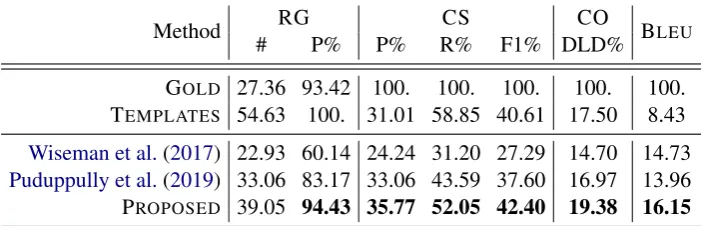
The experimental results demonstrate that, even without writer information, our model achieves the best performance among the previous models in all evaluation metrics: 94.38% precision of re-lation generation, 42.40% F1 score of content se-lection, 19.38% normalized Damerau-Levenshtein
Distance (DLD) of content ordering, and 16.15% of BLEU score. We also confirm that adding writer information further improves the perfor-mance.
2 Related Work
2.1 Data-to-Text Generation
Data-to-text generation is a task for generating de-scriptions from structured or non-structured data including sports commentary (Tanaka-Ishii et al.,
1998;Chen and Mooney,2008;Taniguchi et al.,
2019), weather forecast (Liang et al., 2009; Mei et al., 2016), biographical text from infobox in Wikipedia (Lebret et al., 2016;Sha et al., 2018;
Liu et al.,2018) and market comments from stock prices (Murakami et al.,2017;Aoki et al.,2018).
Neural generation methods have become the mainstream approach for data-to-text generation. The encoder-decoder framework (Cho et al.,2014;
Sutskever et al., 2014) with the attention ( Bah-danau et al., 2015;Luong et al., 2015) and copy mechanism (Gu et al.,2016;Gulcehre et al.,2016) has successfully applied to data-to-text tasks. However, neural generation methods sometimes yield fluent but inadequate descriptions (Tu et al.,
2017). In data-to-text generation, descriptions in-consistent to the input data are problematic.
Recently, Wiseman et al. (2017) introduced the ROTOWIRE dataset, which contains multi-sentence summaries of basketball games with box-score (Table1). This dataset requires the selection of a salient subset of data records for generating descriptions. They also proposed automatic evalu-ation metrics for measuring the informativeness of generated summaries.
Puduppully et al. (2019) proposed a two-stage method that first predicts the sequence of data records to be mentioned and then generates a summary conditioned on the predicted sequences. Their idea is similar to ours in that the both con-sider a sequence of data records as content plan-ning. However, our proposal differs from theirs in that ours uses a recurrent neural network for saliency tracking, and that our decoder dynami-cally chooses a data record to be mentioned with-out fixing a sequence of data records.
2.2 Memory modules
The memory network can be used to maintain and update representations of the salient informa-tion (Weston et al.,2015;Sukhbaatar et al.,2015;
Graves et al., 2016). This module is often used in natural language understanding to keep track of the entity state (Kobayashi et al.,2016;Hoang et al.,2018;Bosselut et al.,2018).
Recently, entity tracking has been popular for generating coherent text (Kiddon et al., 2016;Ji et al.,2017;Yang et al.,2017;Clark et al.,2018).
Kiddon et al. (2016) proposed a neural checklist model that updates predefined item states.Ji et al.
(2017) proposed an entity representation for the language model. Updating entity tracking states when the entity is introduced, their method selects the salient entity state.
Our model extends this entity tracking module for data-to-text generation tasks. The entity track-ing module selects the salient entity and appropri-ate attribute in each timestep, updappropri-ates their stappropri-ates, and generates coherent summaries from the se-lected data record.
3 Data
Through careful examination, we found that in the original dataset ROTOWIRE, some NBA games have two documents, one of which is sometimes in the training data and the other is in the test or val-idation data. Such documents are similar to each other, though not identical. To make this dataset more reliable as an experimental dataset, we cre-ated a new version.
We ran the script provided by Wiseman et al.
(2017), which is for crawling the ROTOWIRE
website for NBA game summaries. The script col-lected approximately 78% of the documents in the original dataset; the remaining documents disap-peared. We also collected the box-scores associ-ated with the collected documents. We observed that some of the box-scores were modified com-pared with the original ROTOWIREdataset.
TEAM H/V WIN LOSS PTS REB AST FGPCT FG3 PCT . . . KNICKS H 16 19 104 46 26 45 46 . . . BUCKS V 18 16 105 42 20 47 32 . . .
PLAYER H/V PTSREB AST BLKSTLMIN CITY . . . CARMELOANTHONY H 30 11 7 0 2 37 NEWYORK . . . DERRICKROSE H 15 3 4 0 1 33 NEWYORK . . . COURTNEYLEE H 11 2 3 1 1 38 NEWYORK . . . GIANNISANTETOKOUNMPO V 27 13 4 3 1 39 MILWAUKEE. . . GREGMONROE V 18 9 4 1 3 31 MILWAUKEE. . . JABARIPARKER V 15 4 3 0 1 37 MILWAUKEE. . . MALCOLMBROGDON V 12 6 8 0 0 38 MILWAUKEE. . . MIRZATELETOVIC V 13 1 0 0 0 21 MILWAUKEE. . . JOHNHENSON V 2 2 0 0 0 14 MILWAUKEE. . . . . . .
(a) Box score: Top contingency table shows number of wins and losses and summary of each game. Bottom table shows statistics of each player such as points scored (PLAYER’s PTS), and total rebounds (PLAYER’s REB).
TheMilwaukee Bucksdefeated theNew York Knicks, 105-104, at Madison Square Garden on Wednesday. The
Knicks(16-19) checked in to Wednesday’s contest looking to snap a five-game losing streak and heading into the fourth quarter, they looked like they were well on their way to that goal.. . . Antetokounmpoled the Bucks with27points,13 rebounds,fourassists, a steal andthreeblocks, his second consecutive double-double. Greg Monroeactually checked in as the second-leading scorer and did so in his customary bench role, posting18points, along withnineboards,four assists,threesteals and a block.Jabari Parkercontributed 15points,fourrebounds,threeassists and a steal.Malcolm Brogdonwent for12points,eightassists andsixrebounds.
Mirza Teletovicwas productive in a reserve role as well, generating13points and a rebound.. . .Courtney Lee
checked in with11points,threeassists,tworebounds, a steal and a block. . . .The Bucks and Knicks face off once again in the second game of the home-and-home series, with the meeting taking place Friday night in Milwaukee.
[image:3.595.75.326.68.212.2](b) NBA basketball game summary: Each summary consists of game victory or defeat of the game and highlights of valuable players.
Table 1: Example of input and output data: task defines box score (1a) used for input and summary document of game (1b) used as output. Extracted entities are shown inbold face. Extracted values are shown ingreen.
t 199 200 201 202 203 204 205 206 207 208 209 Yt Jabari Parker contributed 15 points , four rebounds , three assists
Zt 1 1 0 1 0 0 1 0 0 1 0
Et PARKERJABARI PARKERJABARI - PARKERJABARI - - PARKERJABARI - - PARKERJABARI
-At FIRSTNAME LASTNAME - PLAYERPTS - - PLAYERREB - - PLAYERAST
-Nt - - - 0 - - 1 - - 1
-Table 2: Running example of our model’s generation process. At every time stept, model predicts each random variable. Model firstly determines whether to refer to data records (Zt = 1) or not (Zt= 0). If random variable
Zt= 1, model selects entityEt, its attributeAtand binary variablesNtif needed. For example, att= 202, model predicts random variableZ202 = 1and then selects the entityJABARI PARKERand its attributePLAYERPTS.
Given these values, model outputs token15from selected data record.
our training, development, test dataset are respec-tively 2,714, 534, and 500. On average, each sum-mary has 384 tokens and 644 data records. Each match has only one summary in our dataset, as far as we checked. We also collected the writer of each document. Our dataset contains 32 differ-ent writers. The most prolific writer in our dataset wrote 607 documents. There are also writers who wrote less than ten documents. On average, each writer wrote 117 documents. We call our new dataset ROTOWIRE-MODIFIED.2
4 Saliency-Aware Text Generation
At the core of our model is a neural language model with a memory state hLM to generate a summaryy1:T = (y1, . . . , yT) given a set of data
records x. Our model has another memory state hENT, which is used to remember the data records
2For information about the dataset, please follow
this link: https://github.com/aistairc/
rotowire-modified
that have been referred to.hENTis also used to
up-datehLM, meaning that the referred data records affect the text generation.
Our model decides whether to refer tox, which data recordr ∈xto be mentioned, and how to ex-press a number. The selected data record is used to updatehENT. Formally, we use the four variables:
1. Zt: binary variable that determines whether the model refers to inputxat time stept(Zt= 1). 2. Et: At each time step t, this variable
indi-cates the salient entity (e.g., HAWKS, LEBRON
JAMES).
3. At: At each time stept, this variable indicates
the salient attribute to be mentioned (e.g., PTS). 4. Nt: If attribute At of the salient entity Et is a numeric attribute, this variable determines if a value in the data records should be output in Arabic numerals (e.g., 50) or in English words (e.g., five).
[image:3.595.77.520.311.385.2]t through its summary generation process. Run-ning example of our model is shown in Table 2
and full algorithm is described in AppendixA. In the following subsections, we explain how to ini-tialize the model, predict these random variables, and generate a summary. Due to space limitations, bias vectors are omitted.
Before explaining our method, we describe our notation. Let E and A denote the sets of en-tities and attributes, respectively. Each record
r ∈ xconsists of entitye ∈ E, attributea ∈ A, and its valuex[e, a], and is therefore represented as r = (e, a,x[e, a]). For example, the box-score in Table 1 has a record r such that e =
ANTHONYDAVIS, a=PTS,andx[e, a] = 20.
4.1 Initialization
Letrdenote the embedding of data recordr ∈x. Lete¯denote the embedding of entitye. Note that
¯
e depends on the set of data records, i.e., it de-pends on the game. We also use efor static em-bedding of entitye, which, on the other hand, does not depend on the game.
Given the embedding of entity e, attribute a, and its value v, we use the concatenation layer to combine the information from these vectors to produce the embedding of each data record
(e, a, v), denoted asre,a,vas follows:
re,a,v = tanh WR(e⊕a⊕v)
, (1)
where ⊕ indicates the concatenation of vectors, andWRdenotes a weight matrix.3
We obtaine¯in the set of data recordsx, by sum-ming all the data-record embeddings transformed by a matrix:
¯
e= tanh X a∈A
WAare,a,x[e,a]
!
, (2)
where WAa is a weight matrix for attribute a. Since ¯edepends on the game as above,¯eis sup-posed to represent how entityeplayed in the game. To initialize the hidden state of each module, we use embeddings of<SOD>forhLMand averaged embeddings of¯eforhENT.
4.2 Saliency transition
Generally, the saliency of text changes during text generation. In our work, we suppose that the
3We also concatenate the embedding vectors that
repre-sents whether the entity is in home or away team.
saliency is represented as the entity and its at-tribute being talked about. We therefore propose a model that refers to a data record at each time-point, and transitions to another as text goes.
To determine whether to transition to another data record or not at timet, the model calculates the following probability:
p(Zt= 1|hLMt−1,htE−NT1) =σ(Wz(htLM−1⊕hEt−NT1)),
(3)
whereσ(·)is the sigmoid function. Ifp(Zt = 1 |
hLMt−1,hENT
t−1) is high, the model transitions to
an-other data record.
When the model decides to transition to another, the model then determines which entity and at-tribute to refer to, and generates the next word (Section4.3). On the other hand, if the model de-cides not transition to another, the model generates the next word without updating the tracking states hENT
t =hEt−NT1 (Section4.4). 4.3 Selection and tracking
When the model refers to a new data record (Zt = 1), it selects an entity and its attribute. It
also tracks the saliency by putting the informa-tion about the selected entity and attribute into the memory vectorhENT. The model begins to select
the subject entity and update the memory states if the subject entity will change.
Specifically, the model first calculates the prob-ability of selecting an entity:
p(Et=e|htLM−1,hEt−NT1)
∝
(
exp hENT
s WOLDhtLM−1
ife∈ Et−1
exp ¯eWNEWhLM
t−1
otherwise , (4)
whereEt−1 is the set of entities that have already
been referred to by time stept, andsis defined as
s = max{s:s≤t−1, e=es}, which indicates
the time step when this entity was last mentioned. The model selects the most probable entity as the next salient entity and updates the set of enti-ties that appeared (Et=Et−1∪ {et}).
If the salient entity changes (et 6= et−1), the
model updates the hidden state of the tracking modelhENT with a recurrent neural network with
a gated recurrent unit (GRU;Chung et al.,2014):
hENT0
t =
hENT
t−1 ifet=et−1
GRUE(¯e,hENT
t−1) else ifet6∈ Et−1
GRUE(WsShsENT,hEt−NT1) otherwise.
Note that if the selected entity at time stept,et, is
identical to the previously selected entityet−1, the
hidden state of the tracking model is not updated. If the selected entityetis new (et 6∈ Et−1), the
hidden state of the tracking model is updated with the embeddinge¯of entityetas input. In contrast, if entityethas already appeared in the past (et ∈
Et−1) but is not identical to the previous one(et6=
et−1), we usehEsNT (i.e., the memory state when
this entity last appeared) to fully exploit the local history of this entity.
Given the updated hidden state of the tracking model hENT
t , we next select the attribute of the
salient entity by the following probability:
p(At=a|et,htLM−1,hENT
0
t ) (6)
∝exp
ret,a,x[et,a]W
ATTR(hLM
t−1⊕hENT
0 t )
.
After selectingat, i.e., the most probable attribute of the salient entity, the tracking model updates the memory statehENT
t with the embedding of the data
recordret,at,x[et,at]introduced in Section4.1:
hENT
t =GRUA(ret,at,x[et,at],h
ENT0
t ). (7)
4.4 Summary generation
Given two hidden states, one for language model hLMt−1 and the other for tracking model hENT
t , the
model generates the next wordyt. We also incor-porate a copy mechanism that copies the value of the salient data recordx[et, at].
If the model refers to a new data record (Zt = 1), it directly copies the value of the data record x[et, at]. However, the values of numerical
at-tributes can be expressed in at least two different manners: Arabic numerals (e.g.,14) and English words (e.g.,fourteen). We decide which one to use by the following probability:
p(Nt= 1|hLMt−1,htENT) =σ(WN(htLM−1⊕hEtNT)),
(8)
where WN is a weight matrix. The model then updates the hidden states of the language model:
h0t= tanh WH(htLM−1⊕htENT)
, (9)
whereWHis a weight matrix.
If the salient data record is the same as the pre-vious one (Zt= 0), it predicts the next wordytvia
a probability over words conditioned on the con-text vectorh0t:
p(Yt|h0t) =softmax(WYh0t). (10)
Subsequently, the hidden state of language model hLMis updated:
htLM=LSTM(yt⊕h0t,htLM−1), (11)
whereytis the embedding of the word generated at time stept.4
4.5 Incorporating writer information
We also incorporate the information about the writer of the summaries into our model. Specif-ically, instead of using Equation (9), we concate-nate the embeddingwof a writer tohLMt−1⊕hEtNT
to construct context vectorh0t:
h0t= tanh W0H(hLMt−1⊕hENT t ⊕w)
, (12)
whereW0His a new weight matrix. Since this new context vectorh0tis used for calculating the proba-bility over words in Equation (10), the writer infor-mation will directly affect word generation, which is regarded as surface realization in terms of tra-ditional text generation. Simultaneously, context vectorh0tenhanced with the writer information is used to obtainhLMt , which is the hidden state of the language model and is further used to select the salient entity and attribute, as mentioned in Sec-tions 4.2 and 4.3. Therefore, in our model, the writer information affects both surface realization and content planning.
4.6 Learning objective
We apply fully supervised training that maximizes the following log-likelihood:
logp(Y1:T, Z1:T, E1:T, A1:T, N1:T |x)
= T X
t=1
logp(Zt=zt|hLMt−1,hEt−NT1)
+ X
t:Zt=1
logp(Et=et|htLM−1,hEt−NT1)
+ X
t:Zt=1
logp(At=at|et,hLMt−1,hENT
0 t )
+ X
t:Zt=1,atis num attr
logp(Nt=nt|htLM−1,htENT)
+ X
t:Zt=0
logp(Yt=yt|h0t)
4
In our initial experiment, we observed a word repetition problem when the tracking model is not updated during gen-erating each sentence. To avoid this problem, we also update the tracking model with special trainable vectorsvREFRESH
to refresh these states after our model generates a period:
hENT
t =GRUA(vREFRESH,hE NT
Method RG CS CO BLEU
# P% P% R% F1% DLD%
GOLD 27.36 93.42 100. 100. 100. 100. 100.
TEMPLATES 54.63 100. 31.01 58.85 40.61 17.50 8.43
Wiseman et al.(2017) 22.93 60.14 24.24 31.20 27.29 14.70 14.73
Puduppully et al.(2019) 33.06 83.17 33.06 43.59 37.60 16.97 13.96
[image:6.595.123.475.64.177.2]PROPOSED 39.05 94.43 35.77 52.05 42.40 19.38 16.15
Table 3: Experimental result. Each metric evaluates whether important information (CS) is described accurately (RG) and in correct order (CO).
5 Experiments
5.1 Experimental settings
We used ROTOWIRE-MODIFIEDas the dataset for our experiments, which we explained in Section3. The training, development, and test data respec-tively contained 2,714, 534, and 500 games.
Since we take a supervised training approach, we need the annotations of the random variables (i.e., Zt, Et, At, andNt) in the training data, as shown in Table2. Instead of simple lexical match-ing with r ∈ x, which is prone to errors in the annotation, we use the information extraction sys-tem provided byWiseman et al.(2017). Although this system is trained on noisy rule-based annota-tions, we conjecture that it is more robust to errors because it is trained to minimize the marginalized loss function for ambiguous relations. All training details are described in AppendixB.
5.2 Models to be compared
We compare our model5 against two baseline models. One is the model used by Wiseman et al.(2017), which generates a summary with an attention-based encoder-decoder model. The other baseline model is the one proposed byPuduppully et al.(2019), which first predicts the sequence of data records and then generates a summary condi-tioned on the predicted sequences.Wiseman et al.
(2017)’s model refers to all data records every timestep, whilePuduppully et al. (2019)’s model refers to a subset of all data records, which is pre-dicted in the first stage. Unlike these models, our model uses one memory vector hENT
t that tracks
the history of the data records, during generation. We retrained the baselines on our new dataset. We also present the performance of the GOLD and
5Our code is available fromhttps://github.com/
aistairc/sports-reporter
TEMPLATES summaries. The GOLDsummary is exactly identical with the reference summary and each TEMPLATES summary is generated in the
same manner asWiseman et al.(2017).
In the latter half of our experiments, we exam-ine the effect of adding information about writers. In addition to our model enhanced with writer in-formation, we also add writer information to the model byPuduppully et al.(2019). Their method consists of two stages corresponding to content planning and surface realization. Therefore, by incorporating writer information to each of the two stages, we can clearly see which part of the model to which the writer information contributes to. ForPuduppully et al.(2019) model, we attach the writer information in the following three ways:
1. concatenating writer embeddingwwith the in-put vector for LSTM in the content planning decoder (stage 1);
2. concatenating writer embeddingwwith the in-put vector for LSTM in the text generator (stage 2);
3. using both 1 and 2 above.
For more details about each decoding stage, read-ers can refer toPuduppully et al.(2019).
5.3 Evaluation metrics
As evaluation metrics, we use BLEU score ( Pap-ineni et al.,2002) and the extractive metrics pro-posed byWiseman et al.(2017), i.e., relation gen-eration (RG), content selection (CS), and content ordering (CO) as evaluation metrics. The extrac-tive metrics measure how well the relations ex-tracted from the generated summary match the correct relations6:
6The model for extracting relation tuples was trained on
ex-- RG: the ratio of the correct relations out of all the extracted relations, where correct relations are relations found in the input data recordsx. The average number of extracted relations is also reported.
- CS: precision and recall of the relations ex-tracted from the generated summary against those from the reference summary.
- CO: edit distance measured with normalized Damerau-Levenshtein Distance (DLD) between the sequences of relations extracted from the generated and reference summary.
6 Results and Discussions
We first focus on the quality of tracking model and entity representation in Sections6.1to6.4, where we use the model without writer information. We examine the effect of writer information in Sec-tion6.5.
6.1 Saliency tracking-based model
As shown in Table3, our model outperforms all baselines across all evaluation metrics.7 One of the noticeable results is that our model achieves slightly higher RG precision than the gold sum-mary. Owing to the extractive evaluation nature, the generated summary of the precision of the rela-tion generarela-tion could beat the gold summary per-formance. In fact, the template model achieves 100% precision of the relation generations.
The other is that only our model exceeds the template model regarding F1 score of the con-tent selection and obtains the highest performance of content ordering. This imply that the tracking model encourages to select salient input records in the correct order.
6.2 Qualitative analysis of entity embedding
Our model has the entity embedding¯e, which de-pends on the box score for each game in addition to static entity embeddinge. Now we analyze the difference of these two types of embeddings.
We present a two-dimensional visualizations of both embeddings produced using PCA (Pearson,
tracted from the summaries, and the corresponding attributes (e.g., “TEAMNAME”, “PTS”) found in the box- or line-score. The precision and the recall of this extraction model are re-spectively 93.4% and 75.0% in the test data.
7
The scores ofPuduppully et al.(2019)’s model signifi-cantly dropped from what they reported, especially on BLEU metric. We speculate this is mainly due to the reduced amount of our training data (Section3). That is, their model might be more data-hungry than other models.
Solomon Hill Joe Ingles
PJ Tucker
Kevin Garnett
Jimmy Butler Shabazz Muhammad
Carlos Boozer
Jonathan Gibson Bobby Portis Jabari Brown James Jones
Giannis Antetokounmpo Deron Williams Patrick Beverley Shavlik Randolph Alan Williams Jared Sullinger Joel Freeland Amir Johnson Dahntay Jones Amar'e Stoudemire Mario Hezonja NeneTerrence Ross
Larry Drew II Tony Snell Tyler Ulis Cheick Diallo Jamal Crawford Devin Harris Gordon Hayward Alex Stepheson Hedo TurkogluC.J. Watson
Joffrey Lauvergne Karl-Anthony Towns Dennis Schroder Jarell Eddie Isaiah Whitehead Jordan McRae Joel Embiid
Otto Porter Jr. Arron Afflalo Jae Crowder Jannero Pargo Al Horford Boris Diaw Serge Ibaka Tyreke Evans Shaun Livingston Andre Roberson Dwight Howard Alexis Ajinca Roy Hibbert Hollis Thompson Gerald Green Isaiah Canaan Pascal Siakam Michael Kidd-Gilchrist Darrun Hilliard Mario Chalmers
Kelly Oubre Jr. John Henson Shelvin Mack Quincy Pondexter Thomas Robinson Brian Roberts Kris Humphries Jerome Jordan Mike Miller Alec Burks
Zach Randolph Ricky Rubio
Nikola Mirotic Randy Foye Danny Granger Nikola Pekovic Ed Davis Francisco Garcia Donald Sloan Nick Collison Evan Fournier Nerlens Noel Jordan Hill Semaj Christon Ersan Ilyasova
Jarell MartinBen Gordon Damien Inglis Marreese Speights Georgios Papagiannis Jon Leuer Denzel Valentine Clint Capela Willie Green Sean Kilpatrick Chris Douglas-Roberts DeMarcus Cousins Shawn Marion Trey Burke Brook Lopez James Harden
Kevon LooneyNorris ColeMalcolm Brogdon Lance Thomas Jeremy Lin
Klay Thompson Reggie Jackson
Channing Frye Joe Harris Jerian Grant Dion Waiters Tiago Splitter Anthony Morrow Aaron Brooks Andrew Wiggins Jusuf Nurkic Greg Monroe Justise Winslow Ty Lawson Bryce Cotton Dorell Wright
Tim Hardaway Jr.
Carmelo Anthony Alex Len DeMarre Carroll DeMar DeRozan Jason Smith Kevin Love Marco Belinelli Bruno Caboclo KJ McDaniels Mike Muscala Spencer Hawes Marcin Gortat Alex Kirk Donatas Motiejunas Jordan Adams Andrew Harrison Nick Calathes Tomas Satoransky Tyrus Thomas Lance Stephenson Raul Neto Stanley Johnson T.J. McConnell Rasual Butler Ricky LedoLuis Scola
Dario Saric Brandon Rush Alex Abrines
Darius Miller Evan Turner Doug McDermott Chris Johnson Steve Novak Tarik Black Blake Griffin Goran Dragic Derrick Rose Matt Bonner Omer Asik Courtney Lee Okaro White
Gerald Henderson Shawn Long Jordan Clarkson Mike Scott Derrick Favors Eric Gordon David West Kyle O'Quinn Dirk Nowitzki Kyrie Irving Kendrick Perkins
Victor Oladipo JaMychal Green Chris Bosh Buddy Hield Bismack Biyombo Cody Zeller Russ Smith Jimmer Fredette Garrett Temple Dante Cunningham Ish Smith Robert Sacre Sam Dekker Malcolm Delaney Raymond Felton Austin Daye Wayne Ellington Vince Carter Kris Dunn Andre Iguodala Shawne Williams
Eric Bledsoe Corey Brewer
Paul George Alonzo Gee Nemanja Nedovic Andre Drummond Reggie Evans Dante Exum Reggie Bullock Bradley Beal Kirk Hinrich Steve Blake Mike Dunleavy CJ McCollum Marcus Smart Jared Cunningham Kevin Durant Jorge Gutierrez Taj Gibson
T.J. WarrenIan Mahinmi Drew Gooden Nick Young Anthony Brown O.J. Mayo Trevor Ariza LeBron James Ray McCallum
Rondae Hollis-Jefferson Skal Labissiere Ryan Hollins Andrea Bargnani Allen Crabbe Chris Kaman Sheldon Mac Robin Lopez Kobe Bryant Shane Larkin Marcus Thornton Matt Barnes Chase Budinger Troy Williams Marvin Williams Kemba Walker
Luc Mbah a Moute Kenyon Martin
Cameron Payne Austin Rivers
Jabari Parker Justin Hamilton Elliot Williams
Justin Holiday Ryan Anderson Emmanuel Mudiay Omri Casspi Jahlil Okafor Aaron Gordon Ron Baker Avery Bradley Derrick Williams Kyle Korver Ronny Turiaf Juancho Hernangomez Cory Jefferson DeAndre Liggins Greivis Vasquez Tobias Harris Kyle Anderson D.J. Augustin Rodney McGruder Bernard James Andrew Goudelock Tyler Hansbrough Ian Clark
Festus Ezeli
Tyler Johnson Tyler Zeller Troy DanielsFred VanVleet John Lucas III
JJ Redick Brandon Bass
Damian Jones
Jeff Teague
Paul Millsap Lavoy Allen
Jared Dudley Zaza Pachulia Danny Green Henry Walker Chris Copeland Miles Plumlee Matthew Dellavedova Cristiano Felicio Isaiah Thomas Jerami Grant Jarrod Uthoff Sasha Vujacic JR Smith Malachi Richardson Adreian Payne CJ Miles Meyers Leonard Stephen Curry Jose Calderon John Wall Elijah Millsap Tony Allen Brandon Davies Harrison Barnes JaKarr Sampson Rajon Rondo Dorian Finney-Smith Brandon Jennings Lou Williams DeAndre Jordan Danilo Gallinari Kelly Olynyk Kosta Koufos Jeff Withey
Hassan WhitesideRodney StuckeyDomantas SabonisQuincy Acy Jarrett Jack Glen Davis Quincy Miller AJ Price Khris Middleton Gary Neal James Young JaVale McGee Michael Beasley Deyonta Davis Russell Westbrook
Anthony Davis E'Twaun Moore
Jonas Valanciunas
Tony Wroten
Perry Jones III Henry Sims Spencer Dinwiddie Carl Landry Markel Brown Wesley Matthews Dwyane Wade Dewayne Dedmon Mason Plumlee Tim Frazier Gorgui Dieng Brandon Knight Ramon Sessions Darrell Arthur Nicolas Batum Iman Shumpert Gary Harris Yogi Ferrell Tyler Ennis Beno Udrih Draymond Green
Danuel House Jr. Al Jefferson Cole Aldrich Thaddeus Young Frank Kaminsky J.J. Barea Nate Wolters Marcelo Huertas Kevin Seraphin Manny Harris Devyn Marble Chris Andersen Mitch McGary Davis Bertans Cory Joseph Aron Baynes Alexey Shved Charlie Villanueva Kyle Singler Kristaps Porzingis Damian Lillard DeJuan Blair Tyson Chandler Joey Dorsey Tony Parker
Johnny O'Bryant III Willy Hernangomez
Kawhi Leonard
Jeff Ayres
Marcus Morris
Bojan Bogdanovic
Zoran DragicJonathon Simmons Salah Mejri
Nemanja Bjelica Alan Anderson
Larry Nance Jr.
Chris McCullough Shabazz Napier Michael Carter-Williams Norman Powell Timothe Luwawu-Cabarrot LaMarcus Aldridge Sebastian Telfair Justin Anderson Wesley Johnson Furkan Aldemir Montrezl Harrell Brice Johnson Tristan Thompson Tim Duncan Nikola Jokic Zach LaVine Mo Williams Robert Covington
Terrence JonesJaylen Brown Robbie Hummel Joakim Noah Steven Adams Anthony Bennett Phil Pressey Joe Johnson Arinze Onuaku Coty Clarke Chris Paul Seth Curry
Monta Ellis Dwight Buycks Chasson Randle Brandan Wright
Kentavious Caldwell-PopeMaurice Harkless
Jeremy Evans
Nikola Vucevic
Ronnie Price Andre Miller JJ Hickson
Andrew Bogut Andrew Nicholson Julius Randle Markieff Morris Chandler Parsons Timofey Mozgov Jason Richardson Anderson Varejao
James Ennis III
Manu Ginobili Jodie Meeks Ivica Zubac Jrue Holiday Richaun Holmes Luis Montero Jordan Crawford Caris LeVert Pierre Jackson Nik Stauskas Darren Collison Wilson Chandler Josh Huestis Patrick Patterson Damjan Rudez Jakob Poeltl Jeff Green Pau Gasol
Rodney Hood Willie Cauley-Stein Greg Stiemsma Rudy Gobert Jerryd Bayless Kenneth Faried Jason Thompson Paul Zipser
Glenn Robinson III Trevor Booker Jonas Jerebko Marc Gasol Toney Douglas Tyus Jones Richard Jefferson Archie Goodwin Mirza Teletovic Jordan Hamilton Thabo Sefolosha John Jenkins Landry Fields Brandon Ingram Joe Young Samuel Dalembert Pero Antic
Lou Amundson
Jeremy Lamb Dwight Powell
Luol Deng Patty Mills Anthony Tolliver Thanasis Antetokounmpo Rashad Vaughn Mike Conley Enes Kanter Devin Booker Elfrid Payton Langston Galloway D'Angelo Russell Will Barton Kostas Papanikolaou Kevin Martin Ryan Kelly
James Michael McAdoo
Kent Bazemore Al-Farouq Aminu Paul Pierce Josh Smith Josh McRoberts James Johnson
Ben McLemore Mindaugas Kuzminskas
David Lee Rudy Gay George Hill Jordan Mickey Jameer Nelson Cleanthony Early Myles Turner Jason Terry John Salmons James Anderson Kyle Lowry Tayshaun Prince Gigi Datome Leandro Barbosa Nate Robinson
Figure 1: Illustrations of static entity embeddingse. Players with colored letters are listed in the ranking top 100 players for the 2016-17 NBA season at https: //www.washingtonpost.com/graphics/ sports/nba-top-100-players-2016/.
OnlyLeBron Jamesis inredand the other players in
top 100 are inblue. Top-ranked players have similar representations ofe.
1901). As shown in Figure 1, which is the vi-sualization of static entity embeddinge, the top-ranked players are closely located.
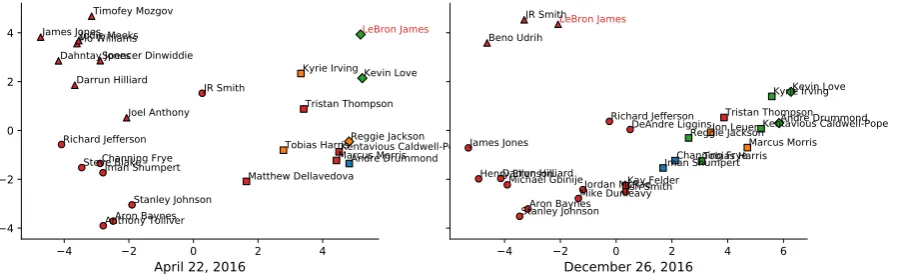
We also present the visualizations of dynamic entity embeddings ¯e in Figure 2. Although we did not carry out feature engineering specific to the NBA (e.g., whether a player scored double digits or not)8 for representing the dynamic en-tity embedding ¯e, the embeddings of the players who performed well for each game have similar representations. In addition, the change in embed-dings of the same player was observed depending on the box-scores for each game. For instance, Le-Bron James recorded a double-double in a game on April 22, 2016. For this game, his embedding is located close to the embedding of Kevin Love, who also scored a double-double. However, he did not participate in the game on December 26, 2016. His embedding for this game became closer to those of other players who also did not partici-pate.
6.3 Duplicate ratios of extracted relations
As Puduppully et al. (2019) pointed out, a gen-erated summary may mention the same relation multiple times. Such duplicated relations are not favorable in terms of the brevity of text.
Figure3shows the ratios of the generated sum-maries with duplicate mentions of relations in the development data. While the models byWiseman et al.(2017) andPuduppully et al.(2019)
respec-8
4 2 0 2 4 April 22, 2016
4 2 0 2
4 LeBron James
Kevin Love Tristan Thompson JR Smith
Kyrie Irving
Iman Shumpert Richard Jefferson
Channing Frye
Matthew Dellavedova Dahntay Jones
James Jones
Timofey Mozgov Mo Williams
Tobias HarrisMarcus Morris Andre Drummond Kentavious Caldwell-PopeReggie Jackson
Anthony Tolliver Steve Blake
Aron BaynesStanley Johnson Joel Anthony Spencer Dinwiddie Darrun Hilliard
Jodie Meeks
4 2 0 2 4 6
December 26, 2016
Richard Jefferson
Kevin Love Tristan Thompson DeAndre Liggins
Kyrie Irving
Iman Shumpert Kay Felder Mike Dunleavy
Channing Frye James Jones
Jordan McRae
LeBron James
JR Smith
Jon Leuer Marcus Morris
Andre Drummond Kentavious Caldwell-Pope Reggie Jackson
Tobias Harris Ish Smith
Stanley JohnsonAron Baynes Darrun Hilliard Henry EllensonMichael Gbinije
[image:8.595.77.526.67.207.2]Beno Udrih
Figure 2: Illustrations of dynamic entity embedding¯e. Both left and right figures are forCleveland Cavaliersvs.
Detroit Pistons, on different dates. LeBron James is inred letters.Entities with orange symbolsappeared only
in the reference summary. Entities with blue symbolsappeared only in the generated summary. Entities with green symbolsappeared in both the reference and the generated summary. The others are withred symbols. 2 represents player who scored in the double digits, and3represents player who recorded double-double. Players with4did not participate in the game.◦represents other players.
Wiseman+'17 Pudupully+'19 Proposed 0.00
0.25 0.50 0.75 1.00
64.0% 20.2% 15.8%
84.2% 12.7%
95.8%
1 2 > 2
Figure 3: Ratios of generated summaries with dupli-cate mention of relations. Each label represents number of duplicated relations within each document. While
Wiseman et al.(2017)’s model exhibited 36.0% dupli-cation andPuduppully et al.(2019)’s model exhibited 15.8%, our model exhibited only 4.2%.
tively showed 36.0% and 15.8% as duplicate ra-tios, our model exhibited 4.2%. This suggests that our model dramatically suppressed generation of redundant relations. We speculate that the track-ing model successfully memorized which input records have been selected inhENT
s .
6.4 Qualitative analysis of output examples
Figure5shows the generated examples from val-idation inputs with Puduppully et al. (2019)’s model and our model. Whereas both generations seem to be fluent, the summary of Puduppully et al.(2019)’s model includes erroneous relations colored inorange.
Specifically, the description about DERRICK
ROSE’s relations, “15 points, four assists, three rounds and one steal in 33 minutes.”, is also used for other entities (e.g., JOHNHENSONand WILLY
HERNAGOMEZ). This is becausePuduppully et al.
(2019)’s model has no tracking module unlike our
model, which mitigates redundant references and therefore rarely contains erroneous relations.
However, when complicated expressions such as parallel structures are used our model also gen-erates erroneous relations as illustrated by the un-derlined sentences describing the two players who scored the same points. For example, “11-point efforts” is correct for COURTNEYLEEbut not for DERRICKROSE. As a future study, it is necessary to develop a method that can handle such compli-cated relations.
6.5 Use of writer information
We first look at the results of an extension of
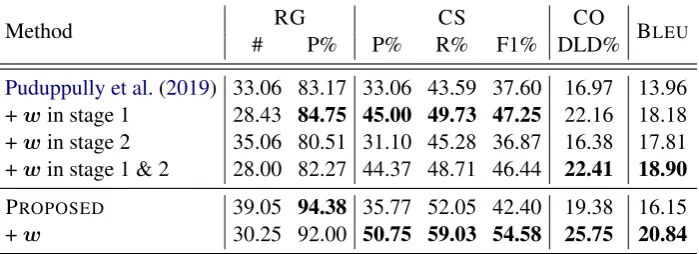
Puduppully et al. (2019)’s model with writer in-formation w in Table 4. By adding w to con-tent planning (stage 1), the method obtained im-provements in CS (37.60 to 47.25), CO (16.97 to 22.16), and BLEU score (13.96 to 18.18). By addingwto the component for surface realization (stage 2), the method obtained an improvement in BLEU score (13.96 to 17.81), while the effects on the other metrics were not very significant. By adding w to both stages, the method scored the highest BLEU, while the other metrics were not very different from those obtained by adding w to stage 1. This result suggests that writer infor-mation contributes to both content planning and surface realization when it is properly used, and improvements of content planning lead to much better performance in surface realization.
[image:8.595.75.288.315.388.2]incor-Method RG CS CO BLEU
# P% P% R% F1% DLD%
Puduppully et al.(2019) 33.06 83.17 33.06 43.59 37.60 16.97 13.96
+win stage 1 28.43 84.75 45.00 49.73 47.25 22.16 18.18
+win stage 2 35.06 80.51 31.10 45.28 36.87 16.38 17.81
+win stage 1 & 2 28.00 82.27 44.37 48.71 46.44 22.41 18.90
PROPOSED 39.05 94.38 35.77 52.05 42.40 19.38 16.15
[image:9.595.125.475.64.191.2]+w 30.25 92.00 50.75 59.03 54.58 25.75 20.84
Table 4: Effects of writer information. windicates that WRITERembeddings are used. Numbers inboldare the largest among the variants of each method.
TheMilwaukee Bucksdefeated theNew York Knicks,105 -104, at Madison Square Garden on Wednesday evening. The
Bucks(18-16) have been one of the hottest teams in the league, having won five of their last six games, and they have now won six of their last eight games. TheKnicks(16-19) have now won six of their last six games, as they continue to battle for the eighth and final playoff spot in the Eastern Conference.Giannis Antetokounmpoled the way for Milwaukee, as he tallied27 points,13rebounds,fourassists,threeblocked shots andone
steal, in39minutes . Jabari Parkeradded15points,four re-bounds,threeassists,onesteal andoneblock, and6-of-8from long range.John Hensonaddedtwopoints,tworebounds,one
assist,threesteals andoneblock. John Hensonwas the only other player to score in double digits for the Knicks, with15
points,fourassists,threerebounds andonesteal, in33 min-utes. The Bucks were led byDerrick Rose, who tallied15 points,fourassists,threerebounds andonesteal in33minutes.
Willy Hernangomezstarted in place of Porzingis and finished with15points,fourassists,threerebounds andonesteal in33
minutes.Willy Hernangomezstarted in place of Jose Calderon ( knee ) and responded withonerebound andoneblock. The Knicks were led by their starting backcourt ofCarmelo An-thonyandCarmelo Anthony, but combined for just13points on 5-of-16 shooting. The Bucks next head to Philadelphia to take on the Sixers on Friday night, while the Knicks remain home to face the Los Angeles Clippers on Wednesday.
(a)Puduppully et al.(2019)
TheMilwaukee Bucksdefeated theNew York Knicks,105-104, at Madison Square Garden on Saturday. TheBucks(18-16) checked in to Saturday’s contest with a well, outscoring theKnicks(16-19) by a margin of 39-19 in the first quarter. However, New York by just a 25-foot lead at the end of the first quarter, the Bucks were able to pull away, as they outscored the Knicks by a 59-46 margin into the second. 45 points in the third quarter to seal the win for New York with the rest of the starters to seal the win. The Knicks were led byGiannis Antetokounmpo, who tallied a game-high27points, to go along with 13rebounds,fourassists,threeblocks and a steal. The game was a crucial night for the Bucks’ starting five, as the duo was the most effective shooters, as they posted Milwaukee to go on a pair of low low-wise (Carmelo Anthony) and Malcolm Brogdon.Anthonyadded 11rebounds,sevenassists andtwosteals to his team-high scoring total.
Jabari Parkerwas right behind him with15points,fourrebounds, threeassists and a block.Greg Monroewas next with a bench-leading 18points, along withninerebounds,fourassists andthreesteals.
Brogdonposted12points,eightassists,sixrebounds and a steal.
Derrick RoseandCourtney Leewere next with a pair of{11/11}
-point efforts.Rosealso suppliedfourassists andthreerebounds, while
Leecomplemented his scoring withthreeassists, a rebound and a steal.
John HensonandMirza Teletovicwere next with a pair of{two/two}
-point efforts.Teletovicalso registered13points, and he added a re-bound and an assist.Jason Terrysuppliedeightpoints,threerebounds and a pair of steals. The Cavs remain in last place in the Eastern Conference’s Atlantic Division. They now head home to face the Toronto Raptors on Saturday night.
(b) Our model
Table 5: Example summaries generated withPuduppully et al.(2019)’s model (left) and our model (right). Names inbold faceare salient entities. Blue numbersare correct relations derived from input data records but are not observed in reference summary. Orange numbersare incorrect relations. Green numbersare correct relations mentioned in reference summary.
porating writer information w. As discussed in Section4.5,wis supposed to affect both content planning and surface realization. Our experimen-tal result is consistent with the discussion.
7 Conclusion
In this research, we proposed a new data-to-text model that produces a summary text while track-ing the salient information that imitates a human-writing process. As a result, our model outper-formed the existing models in all evaluation mea-sures. We also explored the effects of incorpo-rating writer information to data-to-text models. With writer information, our model successfully
generated highest quality summaries that scored 20.84 points of BLEU score.
Acknowledgments
References
Tatsuya Aoki, Akira Miyazawa, Tatsuya Ishigaki, Kei-ichi Goshima, Kasumi Aoki, Ichiro Kobayashi, Hi-roya Takamura, and Yusuke Miyao. 2018. Gener-ating Market Comments Referring to External Re-sources. In Proceedings of the 11th International
Conference on Natural Language Generation, pages
135–139.
Dzmitry Bahdanau, Kyunghyun Cho, and Yoshua Ben-gio. 2015. Neural machine translation by jointly learning to align and translate. InProceedings of the Third International Conference on Learning
Repre-sentations.
Regina Barzilay and Mirella Lapata. 2005. Collective content selection for concept-to-text generation. In
Proceedings of the conference on Human Language Technology and Empirical Methods in Natural
Lan-guage Processing, pages 331–338.
Antoine Bosselut, Omer Levy, Ari Holtzman, Corin Ennis, Dieter Fox, and Yejin Choi. 2018. Simulating Action Dynamics with Neural Process Networks. In
Proceedings of the Sixth International Conference
on Learning Representations.
David L Chen and Raymond J Mooney. 2008. Learn-ing to sportscast: a test of grounded language ac-quisition. InProceedings of the 25th international
conference on Machine learning, pages 128–135.
Kyunghyun Cho, Bart van Merrienboer, Caglar Gul-cehre, Dzmitry Bahdanau, Fethi Bougares, Hol-ger Schwenk, and Yoshua Bengio. 2014. Learn-ing Phrase Representations usLearn-ing RNN Encoder– Decoder for Statistical Machine Translation. In Pro-ceedings of the 2014 Conference on Empirical
Meth-ods in Natural Language Processing, pages 1724–
1734.
Junyoung Chung, Caglar Gulcehre, KyungHyun Cho, and Yoshua Bengio. 2014. Empirical evaluation of gated recurrent neural networks on sequence
model-ing. arXiv preprint arXiv:1412.3555.
Elizabeth Clark, Yangfeng Ji, and Noah A Smith. 2018.
Neural Text Generation in Stories Using Entity Rep-resentations as Context. InProceedings of the 16th Conference of the North American Chapter of the Association for Computational Linguistics: Human
Language Technologies, pages 2250–2260.
Xavier Glorot and Yoshua Bengio. 2010. Understand-ing the difficulty of trainUnderstand-ing deep feedforward neu-ral networks. In Proceedings of the thirteenth in-ternational conference on artificial intelligence and
statistics, pages 249–256.
Alex Graves, Greg Wayne, Malcolm Reynolds, Tim Harley, Ivo Danihelka, Agnieszka Grabska-Barwi´nska, Sergio G´omez Colmenarejo, Edward Grefenstette, Tiago Ramalho, John Agapiou, et al. 2016. Hybrid computing using a neural net-work with dynamic external memory. Nature, 538(7626):471.
Jiatao Gu, Zhengdong Lu, Hang Li, and Victor OK Li. 2016. Incorporating Copying Mechanism in Sequence-to-Sequence Learning. InProceedings of the 54th Annual Meeting of the Association for
Com-putational Linguistics, volume 1, pages 1631–1640.
Caglar Gulcehre, Sungjin Ahn, Ramesh Nallapati, Bowen Zhou, and Yoshua Bengio. 2016. Pointing the Unknown Words. InProceedings of the 54th An-nual Meeting of the Association for Computational
Linguistics, pages 140–149.
Luong Hoang, Sam Wiseman, and Alexander Rush. 2018. Entity Tracking Improves Cloze-style Read-ing Comprehension. In Proceedings of the 2018 Conference on Empirical Methods in Natural
Lan-guage Processing, pages 1049–1055.
Yangfeng Ji, Chenhao Tan, Sebastian Martschat, Yejin Choi, and Noah A Smith. 2017. Dynamic Entity Representations in Neural Language Models. In
Proceedings of the 2017 Conference on Empirical
Methods in Natural Language Processing, pages
1830–1839.
Chlo´e Kiddon, Luke Zettlemoyer, and Yejin Choi. 2016.Globally coherent text generation with neural checklist models. InProceedings of the 2016 Con-ference on Empirical Methods in Natural Language
Processing, pages 329–339.
Sosuke Kobayashi, Ran Tian, Naoaki Okazaki, and Kentaro Inui. 2016. Dynamic entity representation with max-pooling improves machine reading. In
Proceedings of the 15th Conference of the North American Chapter of the Association for
Computa-tional Linguistics: Human Language Technologies,
pages 850–855.
R´emi Lebret, David Grangier, and Michael Auli. 2016.
Neural Text Generation from Structured Data with Application to the Biography Domain. In Proceed-ings of the 2016 Conference on Empirical Methods
in Natural Language Processing, pages 1203–1213.
Percy Liang, Michael I Jordan, and Dan Klein. 2009.
Learning semantic correspondences with less super-vision. InProceedings of the Joint Conference of the 47th Annual Meeting of the ACL and the 4th In-ternational Joint Conference on Natural Language
Processing of the AFNLP, pages 91–99.
Tianyu Liu, Kexiang Wang, Lei Sha, Baobao Chang, and Zhifang Sui. 2018. Table-to-text Generation by Structure-aware Seq2seq Learning. InProceedings of the Thirty-Second AAAI Conference on Artificial
Intelligence.
Thang Luong, Hieu Pham, and Christopher D Man-ning. 2015. Effective Approaches to Attention-based Neural Machine Translation. InProceedings of the 2015 Conference on Empirical Methods in
Hongyuan Mei, Mohit Bansal, and Matthew R Walter. 2016.What to talk about and how? Selective Gener-ation using LSTMs with Coarse-to-Fine Alignment.
InProceedings of the 15th Conference of the North
American Chapter of the Association for
Computa-tional Linguistics: Human Language Technologies,
pages 720–730.
Soichiro Murakami, Akihiko Watanabe, Akira Miyazawa, Keiichi Goshima, Toshihiko Yanase, Hi-roya Takamura, and Yusuke Miyao. 2017. Learning to generate market comments from stock prices.
In Proceedings of the 55th Annual Meeting of the
Association for Computational Linguistics, pages
1374–1384.
Graham Neubig, Chris Dyer, Yoav Goldberg, Austin Matthews, Waleed Ammar, Antonios Anastasopou-los, Miguel Ballesteros, David Chiang, Daniel Clothiaux, Trevor Cohn, et al. 2017. Dynet: The dynamic neural network toolkit. arXiv preprint
arXiv:1701.03980.
Kishore Papineni, Salim Roukos, Todd Ward, and Wei-Jing Zhu. 2002. BLEU: a method for automatic evaluation of machine translation. InProceedings of the 40th annual meeting on association for
com-putational linguistics, pages 311–318.
Karl Pearson. 1901. On lines and planes of closest fit to systems of points in space.The London, Edinburgh, and Dublin Philosophical Magazine and Journal of
Science, 2(11):559–572.
Ratish Puduppully, Li Dong, and Mirella Lapata. 2019.
Data-to-Text Generation with Content Selection and Planning. InProceedings of the Thirty-Third AAAI
Conference on Artificial Intelligence.
Sashank J Reddi, Satyen Kale, and Sanjiv Kumar. 2018. On the convergence of adam and beyond. In
Proceedings of the Sixth International Conference
on Learning Representations.
Lei Sha, Lili Mou, Tianyu Liu, Pascal Poupart, Sujian Li, Baobao Chang, and Zhifang Sui. 2018. Order-planning neural text generation from structured data.
In Proceedings of the Thirty-Second AAAI
Confer-ence on Artificial IntelligConfer-ence.
Sainbayar Sukhbaatar, Jason Weston, Rob Fergus, et al. 2015. End-to-end memory networks. InAdvances
in neural information processing systems, pages
2440–2448.
Ilya Sutskever, Oriol Vinyals, and Quoc V Le. 2014.
Sequence to sequence learning with neural net-works. InAdvances in neural information
process-ing systems, pages 3104–3112.
Kumiko Tanaka-Ishii, Kˆoiti Hasida, and Itsuki Noda. 1998. Reactive content selection in the generation of real-time soccer commentary. InProceedings of the 36th Annual Meeting of the Association for Com-putational Linguistics and 17th International
Con-ference on Computational Linguistics, pages 1282–
1288.
Yasufumi Taniguchi, Yukun Feng, Hiroya Takamura, and Manabu Okumura. 2019. Generating Live Soccer-Match Commentary from Play Data. In Pro-ceedings of the Thirty-Third AAAI Conference on
Artificial Intelligence.
Zhaopeng Tu, Yang Liu, Zhengdong Lu, Xiaohua Liu, and Hang Li. 2017. Context gates for neural ma-chine translation. Transactions of the Association
for Computational Linguistics, 5:87–99.
Jason Weston, Sumit Chopra, and Antoine Bordes. 2015. Memory Networks. In Proceedings of the Third International Conference on Learning
Repre-sentations.
Sam Wiseman, Stuart Shieber, and Alexander Rush. 2017. Challenges in Data-to-Document Generation.
In Proceedings of the 2017 Conference on
Empiri-cal Methods in Natural Language Processing, pages
2253–2263.
Zichao Yang, Phil Blunsom, Chris Dyer, and Wang Ling. 2017. Reference-Aware Language Models.
In Proceedings of the 2017 Conference on
Empiri-cal Methods in Natural Language Processing, pages
1850–1859.
A Algorithm
The generation process of our model is shown in Algorithm 1. For a concise description, we omit the condition for each probability notation.
<SOD>and<EOD>represent “start of the doc-ument” and “end of the docdoc-ument”, respectively.
B Experimental settings
We set the dimensions of the embeddings to 128, and those of the hidden state of RNN to 512 and all of parameters are initialized with the Xavier ini-tialization (Glorot and Bengio,2010). We set the maximum number of epochs to 30, and choose the model with the highest BLEUscore on the
Algorithm 1:Generation process
Input:Data recordss,
AnnotationsZ1:T, E1:T, A1:T, N1:T
1 Initialize{re,a,v}r∈x,{e}¯ e∈E,h0LM,h0ENT
2 t←0
3 et, yt← NONE, <SOD>
4 whileyt6=<EOD>do
5 t←t+ 1
6 ifp(Zt= 1)≥0.5then
/* Select the entity */
7 et←arg maxp(Et=e0t)
8 ifet6∈ Et−1then
/* If et is a new entity */
9 hENT
0
t ←GRUE(¯et,htE−NT1)
10 Et← Et−1∪ {et}
11 else ifet6=et−1then
/* If et has been observed before, but is different from
the previous one. */
12 hEtNT’← GRUE(WShENT
s ,hEt−NT1),
13 wheres= max{s:s≤t−1, e=es}
14 else
15 hEtNT’←htE−NT1
/* Select an attribute for the entity, et. */
16 at←arg maxp(At=a0t)
17 hEtNT ←GRUA(ret,at,x[et,at],h
ENT0 t )
18 ifatis a number attributethen
19 ifp(Nt= 1)≥0.5then
20 yt←numeral ofx[et, at]
21 else
22 yt←x[et, at]
23 end
24 else
25 yt←x[et, at]
26 h0t←tanh WH(htLM−1⊕hEtNT)
27 hLMt ←LSTM(yt⊕h0t,htLM−1)
28 else
29 et, at,hEtNT ←et−1, at−1,hEt−NT1
30 h0t←tanh WH(htLM−1⊕hEtNT)
31 yt←arg maxp(Yt)
32 hLMt ←LSTM(yt⊕h0t,htLM−1)
33 end
34 if ytis “.”then
35 hEtNT ←GRUA(vREFRESH,hE NT t )
36 end