111
Praaline: An Open-Source System for Managing, Annotating,
Visualising and Analysing Speech Corpora
George Christodoulides
Metrology and Language Sciences Unit, University of Mons Place du Parc 18, B-7000 Mons, Belgium
Abstract
In this system demonstration we present the latest developments of Praaline, an open-source software system for constitut-ing and managconstitut-ing, manually and automati-cally annotating, visualising and analysing spoken language and multimodal corpora. We review the system’s functionality and design architecture, present current use cases and directions for future develop-ment.
1 Introduction
In this system demonstration, we presentPraaline. Praalineis an open-source application for creating and managing speech and multi-modal corpora, annotating them manually or automatically, visu-alising the speech signal and annotations, query-ing the data and creatquery-ing concordances, and per-forming statistical analyses. The system was first presented in (Christodoulides,2014). Praalineis a cross-platform standalone application that runs on Windows, Mac OSX and Linux. It is writ-ten in C++ using the Qt framework. The ap-plication is available for download at https: //www.praaline.organd the source code is available on GitHub (https://github.com/ praaline), under the GPL version 3 license.
Several tools are being used currently in spo-ken language research. In the phonetics and prosody domain, the most widely used tool is Praat(Boersma and Weenink,2018); in the prag-matics and discourse studies community Exmar-alda (Schmidt and W¨orner, 2009) is appreciated for its concordancing functionality; for multi-modal and signed language corpora,ELAN( Brug-man and Russel, 2004) is often preferred; and large corpora have been transcribed using Tran-scriberAG(Barras et al.,1998).
We have focused on creating a tool that will cover the needs of researchers working simultane-ously on speech (phonetics, phonology, prosody) and discourse (syntax, semantics, pragmatics). Praalineshould help an individual researcher or-ganise their data using the best practices in corpus design and data management, and allow them to work independently. At the same time, our system aims to facilitate depositing the corpus data to a central repository at the end of a research project, using a structure that will facilitate long-term stor-age and reuse. For these reasons, we have decided to use an SQL relational database for data stor-age: an SQLite database for local projects, or a MySQL or PostgreSQL database for using Praa-line in a network environment. Furthermore the system provides extensive support for importing and exporting data between Praaline and other annotation tools (Praat,Exmaralda,ELAN, Tran-sriberAG, other formats), as well as support for importing and exporting annotation data in the XML and JSON formats.
In the following, we will present the main func-tionality ofPraaline, describe its design architec-ture and conclude with our plans for fuarchitec-ture devel-opment.
2 Features
2.1 Corpus Management
ba-sic objects can all be described using a set of meta-data. Praaline does not impose any schema for metadata: the user can define their own metadata schema per Repository. The Corpus Explorer (see Figure 1) is used to constitute the corpus and to edit its metadata: corpus objects can be browsed in a tree (possibly grouped based on metadata in-formation); the user can also edit metadata using a spreadsheet-like display.
Figure 1: Corpus Explorer
2.2 Metadata and Annotation Structure
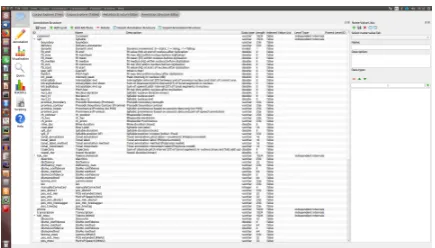
Each Corpus Repository will have a defined data structure for its metadata and annotations. Tem-plates are provided to help individual researchers; it is also possible to standardise these struc-tures when multiple users are accessing the same database.Praalineincludes an editor for metadata and annotation structures: the editors perform data definition language (DDL) queries to change the SQL database structure. The metadata structure editor allows the user to define the fields that will be stored for each of the six main objects described in the previous section. Annotations are organised in Levels and Attributes: a Level describes a unit of linguistic analysis (e.g. a syllable, a token, an utterance etc) and contains a label and an arbitrary number of Attributes. Each Annotation Level cor-responds to a table in the SQL database and At-tributes correspond to columns. The data structure editor for annotations is shown in Figure2).
The metadata and annotation structure editors allow the user to define fields having any of the standard SQL data types (integers, real numbers, strings, boolean values etc.). Furthermore, a sys-tem for defining and importing/exporting name-value lists is available. A name-name-value list (NVL) can be associated with any number of metadata fields or annotation attributes. The NVL subsys-tem can improve data quality by enforcing
ref-Figure 2: Annotation Structure and Vocabularies
erential integrity rules and help users in annotat-ing data based on a closed vocabulary (e.g. a de-fined set of part-of-speech tags, dependency re-lations, discourse rere-lations, phoneme labels etc.). The metadata and annotation structure of a corpus repository can be exported as an XML or JSON file; when these files are imported on another repository, Praaline recreates the corresponding database structures and NVL data.
2.3 Annotation
[image:2.595.74.291.197.320.2]Annotations can be added to the corpus using one of the Manual Annotation editors: a spreadsheet-like editor that can combine multiple levels of an-notation; a transcriber interface; an editor for se-quences or for relations. The tabular editor is show in Figure3.
Figure 3: Manual Annotation Editor
[image:2.595.307.527.478.603.2]multi-ple speakers. The Long Sound Aligner module al-lows the user to reuse existing, possibly imperfect, transcriptions of the corpus materials. The Long Sound Aligner uses the output of a speech recog-nition engine and the transcription text to pro-duce iteratively refined alignments of transcrip-tion utterances to the speech signal (similar to other long sound alignment tools, e.g. Katsama-nis et al. (2011)). The Forced Alignment mod-ule allows the user to produce alignments at the phone, syllable and token level, based on a pro-nunciation dictionary or other system for phoneti-sation, and an ASR engine. The currently sup-ported ASR engines in Praalineare HTK(Young et al., 2006), PocketSphinx (Walker et al., 2004) and Kaldi (Povey et al.,2011).
The annotation framework in Praaline is lan-guage independent: annotations are stored in Unicode format and no assumptions are made about language. However, several tasks require language-specific resources: tokenisation rules, pronunciation dictionaries, acoustic models and language models for the ASR engine. A collection of open resources is available, and the develop-ment of language resources for the back-end tools in the context of other open source projects can be harnessed.
[image:3.595.307.527.478.603.2]Much of the functionality in Praaline comes from its automatic annotation plug-ins. The user can run a cascade of automatic annotation plugins, after setting the relevant parameters (each plugin defines its own set) on the entire corpus or on a subset of corpus items. The user interface for these operations is shown in Figure4.
Figure 4: Automatic Annotation Plugins
Currently, plugins are available for the follow-ing tasks:
• Part-of-speech tagging and syntactical analy-sis of spoken language, in several languages,
using the DisMo plug-in (Christodoulides et al., 2014). Statistical models for many languages are provided, based on the work by the Universal Dependencies project (Nivre et al.,2016).
• Prosodic feature extraction and pitch styli-sation, using either the Prosogram (Mertens,
2004) system, or the INTSINT/MoMel sys-tem (Hirst,2007) for intonation annotation.
• Automatic detection and annotation of prosodic events, with language-specific statistical models extracted from manually annotated corpora.
2.4 Visualisation
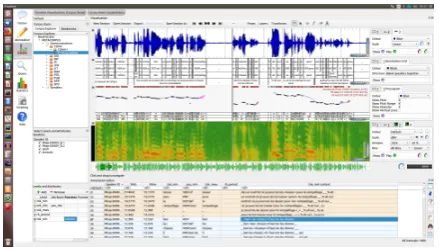
The Visualisation module ofPraalinereuses and extends the code of Sonic Visualiser (Cannam et al.,2010), which is also an open-source (GPL) project written in C++/Qt and used in the field of musicology. The user can create the visualisa-tion that best suits their needs by combining panes and layers, containing: annotation tiers, points, curves, histograms, colour-coded regions, spec-trograms etc. Extensions have been added for visualising intonation information, for studies in prosody. Visualisation templates can be saved in XMl and JSON formats; a collection of available visualisation templates is presented to the user. An example of a visualisation is show in Figure5.
Figure 5: Visualisation
[image:3.595.74.291.535.663.2]with a time-code constitute a Bookmark that can be stored in collections of bookmarks for easy ac-cess. The results of a concordance search (see next section) can also be exported as bookmarks.
2.5 Queries and Concordances
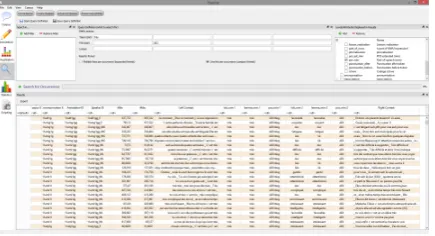
[image:4.595.308.527.185.307.2]The user can perform queries on any of the an-notation levels or a combination of these levels. The results are displayed in keyword-in-context (KWIC) concordances and can be exported for further analysis. It is possible to search for se-quences and patterns. The Concordancer results can be exported as Bookmarks for immediate ac-cess in the Annotation editors and in the Visu-aliser. The Concordancer is show in Figure6.
Figure 6: Concordancer
Furthermore, an interface is provided for cre-ating datasets. Using a dataset, information from multiple annotation levels can be combined, a set of basic statistic operations can be applied and the results can be saved for further analysis. As an example, in a corpus annotated on four lev-els (phones, syllables, tokens, discourse units), the user may export a dataset containing: all the syl-lables in the corpus, their acoustic features (ex-tracted from upstream plug-ins), the correspond-ing tokens and associated attributes (e.g. POS tags), the corresponding discourse units and asso-ciated attributes, and some metadata attributes. A dataset has a minimum unit (in the previous ex-ample, the syllable) and lower-level (grouped) or higher-level (associated) data.
2.6 Statistics
Praaline includes a set of statistical analysis plu-gins, covering a range of common analyses in speech research: basic counts; temporal anal-ysis (pauses, speech rate, dialogue dynamics); prosodic and disfluency analysis; clustering cor-pus items using principal component analysis. The
[image:4.595.74.292.279.397.2]results of the analysis can be exported, and the basic graphics can be immediately accessed from within Praaline. For more advanced statistical analysis of corpus data, users can use R scripts (R Core Team,2018) that take advantage of the fact that the corpus data and annotations are stored in SQL format. An example of a PCA analysis is shown in Figure7.
Figure 7: Statistics (PCA plot)
3 System Architecture and Extensibility
The system is following a modular design. A core library (Praaline Core) contains all the basic func-tionality needed to access and manage Praaline corpus metadata and annotations. The library can be reused in other software (see also next section). At the next level, a set of modules (Praaline Li-braries) contain the functionality needed for auto-matic speech recognition, the application of ma-chine learning algorithms, feature extraction etc. These libraries are often wrappers of existing and well-established open-source NLP tools, such as Sphinx, OpenSmile, HTK, CRF++ etc. An addi-tional module contains the user interface elements (e.g. widgets for visualisation). All these modules are brought together in the main application.
An API for the Core library and for interfacing with the main application allows for the creation of plugins. Plugins add functionality toPraaline and include implementations of automatic annota-tion algorithms, statistical analysis plugins or new visualisation elements.
an-notation information without usingPraaline’s user interface.
4 Future Development
Praaline is under active development. The main priorities for adding features are as follows:
• A signal annotation editor strongly resem-bling Praat. We have found that researchers in some communities are strongly attached to this user interface, and this addition will facilitate the acceptance of a new system on their part.
• Stabilise the API of the Praaline Core library and provide Python and R bindings.
• Finalise the development ofPraalineWeb, a system that allows the publication of corpora on the web, using Django.
• Add functionality for editing dependency re-lations.
The development of Praalinehas been mainly driven by the expectations and needs of its users. It is hoped that this system demonstration will pro-vide additional feedback.
References
Claude Barras, Edouard Geoffrois, Zhibiao Wu, and Mark Liberman. 1998. Transcriber: a free tool for segmenting, labeling and transcribing speech. In LREC 1998 – 1st International Conference on Language Resources and Evaluation, 28–30 May, Granada, Spain Proceedings, pages 1373–1376.
Paul Boersma and David Weenink. 2018.Praat: doing phonetics by computer, ver. 6.0.37.
Hennie Brugman and Albert Russel. 2004. Annotating multimedia and multi-modal resources with elan. In LREC 2004 – 4thInternational Conference on
Lan-guage Resources and Evaluation, May 26–28, Paris, France, Proceedings, pages 2065–2068.
Chris Cannam, Christian Landone, and Sandler Mark. 2010. Sonic visualiser: An open source application for viewing, analysing, and annotating music audio files. InProceedings of the ACM Multimedia 2010 International Conference, pages 1467–1468.
George Christodoulides. 2014. Praaline: Integrating tools for speech corpus research. In LREC 2014 – 9th International Conference on Language Re-sources and Evaluation, May 26–31, Reykjavik, Ice-land, Proceedings, pages 31–34.
George Christodoulides, Mathieu Avanzi, and Jean Philippe Goldman. 2014. DisMo: A mor-phosyntactic, disfluency and multi-word unit annotator. InLREC 2014 – 9th International
Con-ference on Language Resources and Evaluation, May 26–31, Reykjavik, Iceland, Proceedings, pages 3902–3907.
Daniel Hirst. 2007. A praat plugin for momel and intsint with improved algorithms for modelling and coding intonation.
Athanasios Katsamanis, Matthew P. Black, Panayio-tis G. Georgiou, Louis Goldstein, and Shrikanth S. Narayanan. 2011. SailAlign: Robust long speech-text alignment. InProceedings of the Workshop on New Tools and Methods for Very-Large Scale Pho-netics Research.
Piet Mertens. 2004. The Prosogram: Semi-automatic transcription of prosody based on a tonal perception model. InProc. of Speech Prosody 2004, March 23– 26, Nara, Japan, pages 549–552.
Joakim Nivre, Marie-Catherine de Marneffe, Filip Gin-ter, Yoav Goldberg, Jan Hajic, Christopher D. Man-ning, Ryan McDonald, Slav Petrov, Sampo Pyysalo, Natalia Silveira, and et al. 2016. Universal depen-dencies v1: A multilingual treebank collection. In Proceedings of the 10th International Conference on Language Resources and Evaluation (LREC 2016).
Daniel Povey, Arnab Ghoshal, Gilles Boulianne, Lukas Burget, Ondrej Glembek, Nagendra Goel, Mirko Hannemann, Petr Motlicek, Yanmin Qian, Petr Schwarz, Jan Silovsky, Georg Stemmer, and Karel Vesely. 2011. The kaldi speech recognition toolkit. In IEEE 2011 Workshop on Automatic Speech Recognition and Understanding. IEEE Signal Pro-cessing Society. IEEE Catalog No.: CFP11SRW-USB.
R Core Team. 2018. R: A language and environment for statistical computing. R Foundation for Statisti-cal Computing, Vienna, Austria.
Thomas Schmidt and Kai W¨orner. 2009. EXMAR-aLDA – creating, analysing and sharing spoken lan-guage corpora for pragmatic research. Pragmatics, 19(4):565–582.
Willie Walker, Paul Lamere, Philip Kwok, Bhiksha Raj, Rita Singh, Evandro Gouvea, Peter Wolf, and Joe Woelfel. 2004. Sphinx-4: A flexible open source framework for speech recognition. Technical report, Mountain View, CA, USA.