516
Dynamic and Static Topic Model
for Analyzing Time-Series Document Collections
Rem Hida† Naoya Takeishi‡† Takehisa Yairi† Koichi Hori† †Department of Aeronautics and Astronautics, The University of Tokyo
{hida,yairi,hori}@ailab.t.u-tokyo.ac.jp
‡RIKEN Center for Advanced Intelligence Project, Tokyo, Japan
Abstract
For extracting meaningful topics from texts, their structures should be considered properly. In this paper, we aim to analyze structured time-series documents such as a collection of news articles and a series of scientific papers, wherein topics evolve along time depending on multiple topics in the past, and are also related to each other at each time. To this end, we propose a
dynamic and static topic model, which si-multaneously considers the dynamic struc-tures of the temporal topic evolution and the static structures of the topic hierarchy at each time. We show the results of ex-periments on collections of scientific pa-pers, in which the proposed method out-performed conventional models. More-over, we show an example of extracted topic structures, which we found helpful for analyzing research activities.
1 Introduction
Probabilistic topic models such as latent Dirichlet allocation (LDA) (Blei et al.,2003) have been uti-lized for analyzing a wide variety of datasets such as document collections, images, and genes. Al-though vanilla LDA has been favored partly due to its simplicity, one of its limitations is that the out-put is not necessarily very understandable because the priors on the topics are independent. Conse-quently, there has been a lot of research aimed at improving probabilistic topic models by utilizing the inherentstructuresof datasets in their model-ing (see, e.g.,Blei and Lafferty(2006);Li and Mc-Callum(2006); see Section2for other models).
In this work, we aimed to leverage the dynamic and static structures of topics for improving the modeling capability and the understandability of
topic models. These two types of structures, which we instantiate below, are essential in many types of datasets, and in fact, each of them has been con-sidered separately in several previous studies. In this paper, we propose a topic model that is aware of both of these structures, namelydynamic and static topic model(DSTM).
The underlying motivation of DSTM is twofold. First, a collection of documents often hasdynamic structures; i.e., topics evolve along time influenc-ing each other. For example, topics in papers are related to topics in past papers. We may want to extract such dynamic structures of topics from collections of scientific papers for summarizing research activities. Second, there are also static structuresof topics such as correlation and hierar-chy. For instance, in a collection of news articles, the “sports” topic must have the “baseball” topic and the “football” topic as its subtopic. This kind of static structure of topics helps us understand the relationship among them.
The remainder of this paper is organized as fol-lows. In Section2, we briefly review related work. In Section 3, the generative model and the infer-ence/learning procedures of DSTM are presented. In Section 4, the results of the experiments are shown. This paper is concluded in Section5.
2 Related Work
Dt number of documents at epocht
ntd number of words in thed-th doc. at epocht wt
d,i thei-th word in thed-th doc. at epocht K total number of subtopics
S number of supertopics yt
d,i supertopic ofwtd,i zt
d,i subtopic ofwd,it
1✓t
d multinomial distribution over supertopics for thed-th doc. at epocht
2✓t
d,s multinomial distribution over subtopics for the d-th doc. ins-th supertopic at epocht t
k multinomial distribution over words for the k-th subtopic at epocht
2↵t
s static structure weight (prior of2✓d,s)t t dynamic structure weight between topics at
[image:2.595.324.508.57.218.2]timet 1and those at epocht
Table 1: Notations in the proposed model.
These methods have been successfully applied to a temporal collection of documents, but none of them take temporal dependencies between multi-ple topics into account; i.e., in these models, only a single topic contributes to a topic in the future.
For the static structure, several models includ-ing correlated topic model (CTM) (Lafferty and Blei,2006), pachinko allocation model (PAM) (Li and McCallum,2006), and segmented topic model (STM) (Du et al.,2010) have been proposed. CTM models the correlation between topics using the normal distribution as the prior, PAM introduces the hierarchical structure to topics, and STM uses paragraphs or sentences as the hierarchical ture. These models can consider the static struc-ture such as correlation and hierarchy between topics. However, most of them lack the dynamic structure in their model; i.e., they do not premise temporal collections of documents.
One of the existing methods that is most re-lated to the proposed model is the hierarchical topic evolution model (HTEM) (Song et al.,2016). HTEM captures the relation between evolving topics using a nested distance-dependent Chinese restaurant process. It has been successfully ap-plied to a temporal collection of documents for ex-tracting structure but does not take multiple topics dependencies into account either.
In this work, we built a new model to overcome the limitation of the existing models, i.e., to ex-amine both the dynamic and static structures si-multaneously. We expect that the proposed model can be applied to various applications such as topic trend analysis and text summarization.
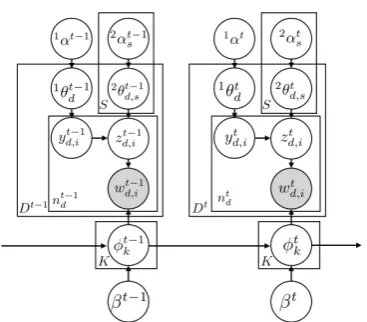
Figure 1: Graphical model of the proposed model for epochst 1andt.
3 Dynamic and Static Topic Model
In this section, we state the generative model of the proposed method, DSTM. Afterward, the pro-cedure for inference and learning is presented. Our notations are summarized in Table1.
3.1 Generative Model
In the proposed model, DSTM, the dynamic and static structures are modeled as follows.
Dynamic Structure We model the temporal
evolution of topic-word distribution by making it proportional to a weighted sum of topic-word dis-tributions at the previous time (epoch), i.e.,
t
k ⇠Dirichlet K X
k0=1
t k,k0 tk01
!
, (1)
where t
kdenotes the word distribution of thek-th topic at thet-th time-epoch, and t
k,k0 is a weight
that determines the dependency between thek-th
topic at epochtand thek0-th topic at epocht 1.
Static Structure We model the static structure
as a hierarchy of topics at each epoch. We uti-lize the supertopic-subtopic structure as in PAM (Li and McCallum,2006), where the priors of top-ics (subtoptop-ics) are determined by their supertopic.
Generative Process In summary, the generative
process at epochtis as follows.
1. For each subtopick= 1, .., K,
(a) Draw a topic-word distribution t
k⇠Dirichlet( P
k0 k,kt 0 tk01).
2. For each documentd= 1, ..., Dt,
(a) Draw a supertopic distribution
1✓t
[image:2.595.78.286.63.226.2](b) For each supertopics= 1, ..., S, i. Draw a subtopic distribution
2✓t
d,s⇠Dirichlet(2↵ts). (c) For each wordi= 1, ..., nt
d,
i. Draw a supertopic-word assignment
yd,it ⇠Multinomial(1✓dt).
ii. Draw a subtopic-word assignment
zt
d,i ⇠Multinomial(2✓td,yt d,i).
iii. Draw a word-observation
wtd,i ⇠Multinomial( tzt d,i).
Note that the above process should be repeated for every epocht. The corresponding graphical model is presented in Figure1.
3.2 Inference and Learning
Since analytical inference for DSTM is in-tractable, we resort to a stochastic EM algorithm (Andrieu et al., 2003) with the collapsed Gibbs sampling (Griffiths and Steyvers, 2004). How-ever, such a strategy is still much costly due to the temporal dependencies of . Therefore, we intro-duce a further approximation; we surrogate t 1
k0
in Eq. (1) by its expectation ˆt 1
k0 =E[ tk01]. This
compromise enables us to run the EM algorithm
for eachepoch in sequence fromt = 1tot = T
without any backward inference. In fact, such ap-proximation technique is also utilized in the infer-ence of MDTM (Iwata et al.,2010).
Note that the proposed model has a moderate number of hyperparameters to be set manually, and that they can be tuned according to the ex-isting know-how of topic modeling. This feature makes the proposed model appealing in terms of inference and learning.
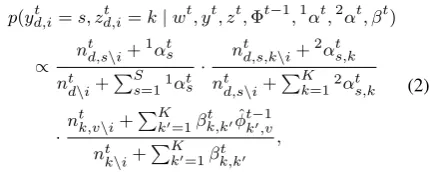
E-step In E-step, the supertopic/subtopic
as-signments are sampled. Given the current state of all variables except yt
d,i and zd,it , new values for them should be sampled according to
p(ytd,i=s, ztd,i=k|wt, yt, zt, t 1,1↵t,2↵t, t)
/ n
t
d,s\i+1↵ts
nt d\i+
PS s=11↵ts
· n
t
d,s,k\i+2↵ts,k
nt d,s\i+
PK k=12↵ts,k
·n
t k,v\i+
PK
k0=1 k,kt 0ˆtk0,v1
nt k\i+
PK k0=1 k,kt 0
,
(2)
wherentk,vdenotes the number of tokens assigned
to topic k for word v at epoch t, ntk=Pvntk,v,
andntd,sandntd,s,kdenote the number of tokens in
documentdassigned to supertopicsand subtopic
NIPS Drone
Date 1987–1999 2009–2016
# Documents 1,740 1,035
# Vocabulary 11,443 3,442
[image:3.595.75.291.614.700.2]# Tokens 2,271,087 68,305
Table 2: Summary of the datasets.
k(via s), at epoch trespectively. Moreover, nt·\i
denotes the count yielded excluding thei-th token.
M-step In M-step,2↵tand tare updated using
the fixed-point iteration (Minka,2000).
(2↵ts,k)⇤=2↵ts,k
PDt
d=1 (ntd,s,k+2↵ts,k) (2↵ts,k)
PDt
d=1 (ntd,s+2↵ts) (2↵ts)
, (3)
( k,kt 0)⇤= k,kt 0
P
vˆ t 1
k0,vBtk0,v
(nt k+
P
k0 k,kt 0) (
P
k0 tk,k0)
. (4)
Here, is the digamma function,2↵t
s=
P k2↵ts,k, and
Bkt0,v=
⇣
ntk,v+
X
k0 t k,k0ˆtk0,v1
⌘ ⇣X
k0 t k,k0ˆtk0,v1
⌘
.
Overall Procedure The EM algorithm is run for
each epoch in sequence; at epocht, after running
the EM until convergence, ˆt
k,vis computed by
ˆt
k,v =
ntk,v+Pk0 k,kt 0ˆtk0,v1
nt
k+
P k0 k,kt 0
,
and then this value is used for the EM at the next epocht+ 1. Moreover, see SupplementaryAfor the computation of the statistics of the other vari-ables.
4 Experiments
4.1 Datasets
NIPS Drone
[image:4.595.80.515.179.312.2]static dynamic K30 (S15) K40 (S20) K50 (S25) K15 (S3) K20 (S3) K25 (S3) LDA - - 1455.6 (16.7) 1407.3 (15.9) 1374.6 (16.8) 1624.3 (191.1) 1634.8 (189.1) 1644.7 (193.0) PAM X - 1455.1 (18.2) 1407.0 (17.5) 1376.9 (16.7) 1587.4 (185.1) 1589.9 (191.4) 1590.8 (186.8) DRTM - X 1380.7 (18.5) 1308.6 (17.5) 1253.9 (17.9) 1212.5 (153.2) 1206.1 (148.0) 1201.2 (143.5) DSTM X X 1378.7 (16.5) 1301.0 (17.9) 1247.3 (17.2) 1194.2 (148.2) 1180.0 (147.0) 1171.6 (141.4)
Table 3: Means (and standard deviations) of PPLs averaged over all epochs for each dataset with different values ofKandS. The proposed method, DSTM, achieved the smallest PPL.
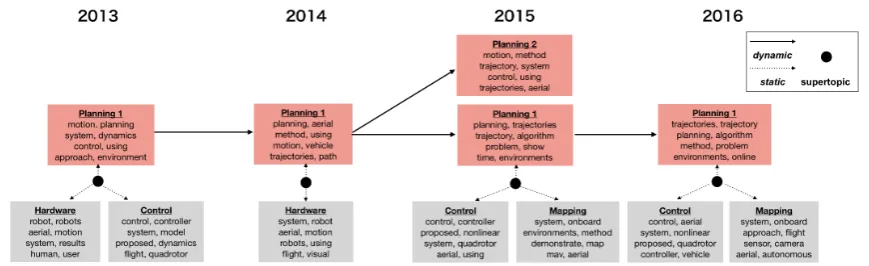
Figure 2: Part of the topic structure extracted fromDronedataset using the proposed method. The solid arrows denote the temporal evolution of “planning” topics. The dotted arrows mean that “planning” topics are related to “hardware”, “control”, and “mapping” topics via some supertopics (filled circles).
4.2 Evaluation by Perplexity
First, we evaluate the performance of the proposed method quantitatively using perplexity (PPL):
PPL = exp
0 @
PD d=1
P
wtestd logp(wd,i|M)
PD d=1ntestd
1 A.
For each epoch, we used 90% of tokens in each document for training and calculated the PPL us-ing the remainus-ing 10% of tokens. We randomly created 10 train-test pairs and evaluated the means of the PPLs over those random trials. We com-pared the performance of DSTM to three base-lines: LDA (Blei et al.,2003), PAM (Li and Mc-Callum, 2006), and the proposed model without the static structure, which we term DRTM. See SupplementaryCon their hyperparameter setting. The means of the PPLs averaged over all epochs for each dataset with different valuesKare shown
in Table 3. In both datasets with every setting of K, the proposed model, DSTM, achieved the
smallest PPL, which implies its effectiveness for modeling a collection of technical papers. For clarity, we conducted paired t-tests between the perplexities of the proposed method and those of the baselines. On the differences between DSTM
and DRTM, the p-values were 4.2⇥10 2 (K =
30), 7.9 ⇥ 10 5 (K = 40), and 6.4 ⇥ 10 7
(K = 50) for theNIPS dataset, and1.3⇥10 4
(K = 15),8.8⇥10 5 (K = 20), and4.9⇥10 6
(K = 25) for theDrone dataset, respectively. It
is also noteworthy that DRTM shows more sig-nificant improvement relative to LDA than PAM does. This suggests that the dynamic structure with multiple-topic dependencies is essential for datasets of this kind.
4.3 Analysis of Extracted Structure
We examined the topic structures extracted from
the Drone dataset using DSTM. In Figure2, we
show a part of the extracted structure regarding planning of the UAV’s path and/or movement. We identified “planning” topics by looking for key-words such as “trajectory” and “motion.” In Fig-ure2, each node is labeled with eight most prob-able keywords. Moreover, solid arrows (dynamic relations) are drawn if the corresponding t
k,k0 is
larger than 200, and dotted arrows (static relations) are drawn between a supertopic and subtopics with the two or three largest values of2↵t
s,k.
Looking at the dynamic structure, we may see how research interest regarding planning has
changed. For example, word “online” first
example, the “planning” topic is related to the “hardware” and “control” topics in 2013 and 2014, whereas it is also related to the “mapping” topic in 2015 and 2016. Looking at these static structures, we may anticipate how research areas are related to each other in each year. In this case, we can anticipate that planning problems are combined with mapping problems well in recent years. Note that we cannot obtain these results unless the dy-namic and static structures are considered simul-taneously.
5 Conclusion
In this work, we developed a topic model with dynamic and static structures. We confirmed the superiority of the proposed model to the conven-tional topic models in terms of perplexity and ana-lyzed the topic structures of a collection of papers. Possible future directions of research include auto-matic inference of the number of topics and appli-cation to topic trend analysis in various domains.
Acknowledgments
We thank Chun Fui Liew for sharing his dataset with us and advice.
References
Amr Ahmed and Eric P. Xing. 2010. Timeline: A dy-namic hierarchical Dirichlet process model for re-covering birth/death and evolution of topics in text stream. In Proceedings of the 26th Conference on Uncertainty in Artificial Intelligence, pages 20–29.
Christophe Andrieu, Nando de Freitas, Arnaud Doucet, and Michael I. Jordan. 2003. An introduction to MCMC for machine learning. Machine Learning, 50(1):5–43.
David M. Blei and John D. Lafferty. 2006. Dynamic topic models. InProceedings of the 23rd Interna-tional Conference on Machine Learning, pages 113– 120.
David M. Blei, Andrew Y. Ng, and Michael I. Jordan. 2003. Latent Dirichlet allocation. Journal of Ma-chine Learning Research, 3(Jan):993–1022.
Lan Du, Wray Buntine, and Huidong Jin. 2010. A segmented topic model based on the two-parameter Poisson-Dirichlet process. Machine Learning, 81(1):5–19.
Thomas L. Griffiths and Mark Steyvers. 2004. Find-ing scientific topics. InProceedings of the National Academy of Sciences of the United States of Amer-ica, volume 101, pages 5228–5235.
Tomoharu Iwata, Takeshi Yamada, Yasushi Sakurai, and Naonori Ueda. 2010. Online multiscale dy-namic topic models. In Proceedings of the 16th ACM SIGKDD International Conference on Knowl-edge Discovery and Data Mining, pages 663–672. John D. Lafferty and David M. Blei. 2006. Correlated
topic models. In Advances in Neural Information Processing Systems, volume 18, pages 147–154.
Wei Li and Andrew McCallum. 2006. Pachinko allo-cation: DAG-structured mixture models of topic cor-relations. InProceedings of the 23rd International Conference on Machine Learning, pages 577–584. Chun Fui Liew, Danielle DeLatte, Naoya Takeishi,
and Takehisa Yairi. 2017. Recent developments in aerial robotics: A survey and prototypes overview. arXiv:1711.10085.
Dahua Lin, Eric Grimson, and John W. Fisher. 2010. Construction of dependent Dirichlet processes based on Poisson processes. InAdvances in Neural Infor-mation Processing Systems, volume 23, pages 1396– 1404.
Thomas Minka. 2000. Estimating a Dirichlet distribu-tion. Technical report, MIT.
Valerio Perrone, Paul A. Jenkins, Dario Spano, and Yee Whye Teh. 2016. Poisson random fields for dy-namic feature models. arXiv:1611.07460.
Jun Song, Yu Huang, Xiang Qi, Yuheng Li, Feng Li, Kun Fu, and Tinglei Huang. 2016. Discovering hier-archical topic evolution in time-stamped documents. Journal of the Association for Information Science and Technology, 67(4):915–927.