Event Extraction via Dynamic Multi-Pooling Convolutional Neural
Networks
Yubo Chen, Liheng Xu, Kang Liu, Daojian Zeng and Jun Zhao National Laboratory of Pattern Recognition
Institute of Automation, Chinese Academy of Sciences, Beijing, 100190, China
{yubo.chen,lhxu,kliu,djzeng,jzhao}@nlpr.ia.ac.cn
Abstract
Traditional approaches to the task of ACE event extraction primarily rely on elabo-rately designed features and complicated natural language processing (NLP) tools. These traditional approaches lack gener-alization, take a large amount of human effort and are prone to error propaga-tion and data sparsity problems. This paper proposes a novel event-extraction method, which aims to automatically ex-tract lexical-level and sentence-level fea-tures without using complicated NLP tools. We introduce a word-representation model to capture meaningful semantic reg-ularities for words and adopt a framework based on a convolutional neural network (CNN) to capture sentence-level clues. However, CNN can only capture the most important information in a sentence and may miss valuable facts when considering multiple-event sentences. We propose a dynamic multi-pooling convolutional neu-ral network (DMCNN), which uses a dy-namic multi-pooling layer according to event triggers and arguments, to reserve more crucial information. The experimen-tal results show that our approach signif-icantly outperforms other state-of-the-art methods.
1 Introduction
Event extraction is an important and challenging task in Information Extraction (IE), which aims to discover event triggers with specific types and their arguments. Current state-of-the-art methods (Li et al., 2014; Li et al., 2013; Hong et al., 2011; Liao and Grishman, 2010; Ji and Grishman, 2008) often use a set of elaborately designed features that are extracted by textual analysis and linguistic
knowledge. In general, we can divide the features into two categories: lexical features and contex-tual features.
Lexical features contain part-of-speech tags (POS), entity information, and morphology fea-tures (e.g., token, lemma, etc.), which aim to cap-ture semantics or the background knowledge of words. For example, consider the following sen-tence with an ambiguous wordbeats:
S1:ObamabeatsMcCain. S2:Tysonbeatshis opponent .
In S1,beatsis a trigger of typeElect. However, in S2, beatsis a trigger of type Attack, which is more common than typeElect. Because of the am-biguity, a traditional approach may mislabelbeats
in S1 as a trigger ofAttack. However, if we have the priori knowledge thatObamaandMcCainare presidential contenders, we have ample evidence to predict thatbeatsis a trigger of typeElect. We call these knowledgelexical-level clues. To repre-sent such features, the existing methods (Hong et al., 2011) often rely on human ingenuity, which is a time-consuming process and lacks general-ization. Furthermore, traditional lexical features in previous methods are a one-hot representation, which may suffer from the data sparsity problem and may not be able to adequately capture the se-mantics of the words (Turian et al., 2010).
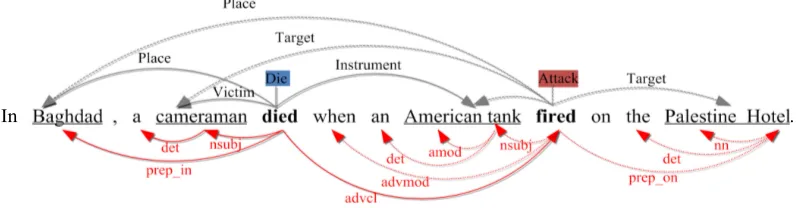
To identify events and arguments more pre-cisely, previous methods often captured contex-tual features, such as syntactic features, which aim to understand how facts are tied together from a larger field of view. For example, in S3, there are two events that share three arguments as shown in Figure 1. From the dependency relation of
nsubjbetween the argumentcameramanand trig-ger died, we can induce a Victim role to cam-eraman in the Die event. We call such infor-mation sentence-level clues. However, the argu-ment wordcameraman and its trigger wordfired
are in different clauses, and there is no direct
In Baghdad , a cameraman died when an American tank fired on the Palestine Hotel.
prep_in
det nsubj nsubj
advcl advmod
det amod
prep_on det
[image:2.595.100.498.66.170.2]nn
Figure 1: Event mentions and syntactic parser results of S3. The upper side shows two event mentions that share three arguments: theDieevent mention, triggered by “died”, and theAttack event mention, triggered by “fired”. The lower side shows the collapsed dependency results.
pendency path between them. Thus it is difficult to find the Target role between them using tradi-tional dependency features. In addition, extracting such features depends heavily on the performance of pre-existing NLP systems, which could suffer from error propagation.
S3: In Baghdad, a cameraman died when an American tankfiredon the Palestine Hotel.
To correctly attachcameramantofiredas a Tar-getargument, we must exploit internal semantics over the entire sentence such that theAttackevent results in Die event. Recent improvements of convolutional neural networks (CNNs) have been proven to be efficient for capturing syntactic and semantics between words within a sentence (Col-lobert et al., 2011; Kalchbrenner and Blunsom, 2013; Zeng et al., 2014) for NLP tasks. CNNs typically use a max-pooling layer, which applies a max operation over the representation of an en-tire sentence to capture the most useful informa-tion. However, in event extraction, one sentence may contain two or more events, and these events may share the argument with different roles. For example, there are two events in S3, namely, the
Dieevent andAttackevent. If we use a traditional max-pooling layer and only keep the most impor-tant information to represent the sentence, we may obtain the information that depicts “a cameraman died” but miss the information about “American tank fired on the Palestine Hotel”, which is impor-tant for predicting the Attack event and valuable for attachingcameramantofired as anTarget ar-gument. In our experiments, we found that such multiple-event sentences comprise 27.3% of our dataset, which is a phenomenon we cannot ignore. In this paper, we propose a dynamic multi-pooling convolutional neural network (DMCNN) to address the problems stated above. To capture
lexical-level clues and reduce human effort, we introduce a word-representation model (Mikolov et al., 2013b), which has been shown to be able to capture the meaningful semantic regularities of words (Bengio et al., 2003; Erhan et al., 2010; Mikolov et al., 2013a). To capture sentence-level clues without using complicated NLP tools, and to reserve information more comprehensively, we devise a dynamic multi-pooling layer for CNN, which returns the maximum value in each part of the sentence according to event triggers and argu-ments. In summary, the contributions of this paper are as follows:
• We present a novel framework for event extraction, which can automatically induce lexical-level and sentence-level features from plain texts without complicated NLP prepro-cessing.
• We devise a dynamic multi-pooling convolu-tional neural network (DMCNN), which aims to capture more valuable information within a sentence for event extraction.
• We conduct experiments on a widely used ACE2005 event extraction dataset, and the experimental results show that our approach outperforms other state-of-the-art methods.
2 Event Extraction Task
In this paper, we focus on the event extraction task defined in Automatic Content Extraction1 (ACE)
evaluation, where an event is defined as a specific occurrence involving participants. First, we in-troduce some ACE terminology to understand this task more easily:
• Event mention: a phrase or sentence within which an event is described, including a trig-ger and arguments.
• Event trigger: the main word that most clearly expresses the occurrence of an event (An ACE event trigger is typically a verb or a noun).
• Event argument: an entity mention, tempo-ral expression or value (e.g. Job-Title) that is involved in an event (viz., participants).
• Argument role: the relationship between an argument to the event in which it participates. Given an English text document, an event ex-traction system should predict event triggers with specific subtypes and their arguments for each sen-tence. The upper side of figure 1 depicts the event triggers and their arguments for S3 in Section 1. ACE defines 8 event types and 33 subtypes, such asAttackorElect.
Although event extraction depends on name identification and entity mention co-reference, it is another difficult task in ACE evaluation and not the focus in the event extraction task. Thus, in this paper, we directly leverage the entity label pro-vided by the ACE, following most previous works (Hong et al., 2011; Liao and Grishman, 2010; Ji and Grishman, 2008).
3 Methodology
In this paper, event extraction is formulated as a two-stage, multi-class classification via dynamic multi-pooling convolutional neural networks with the automatically learned features. The first stage is calledtrigger classification, in which we use a DMCNN to classify each word in a sentence to identify trigger words. If one sentence has trig-gers, the second stage is conducted, which applies a similar DMCNN to assign arguments to trig-gers and align the roles of the arguments. We call thisargument classification. Because the second stage is more complicated, we first describe the methodology of argument classification in Section 3.1∼3.4 and then illustrate the difference between the DMCNNs that are used for trigger classifica-tion and those used for argument classificaclassifica-tion in Section 3.5.
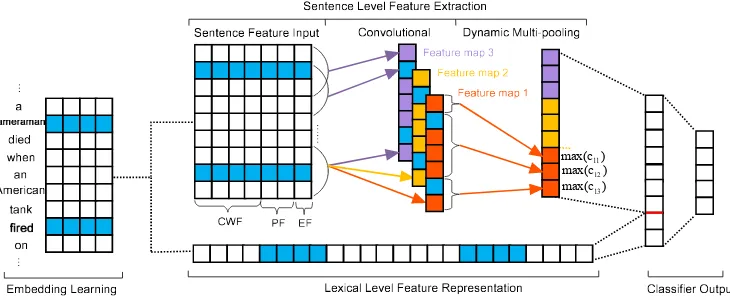
Figure 2 describes the architecture of argu-ment classification, which primarily involves the following four components: (i) word-embedding
learning, which reveals the embedding vectors of words in an unsupervised manner; (ii) lexical-level feature representation, which directly uses embed-ding vectors of words to capture lexical clues; (iii) sentence-level feature extraction, which proposes a DMCNN to learn the compositional semantic features of sentences; and (iv) argument classi-fier output, which calculates a confidence score for each argument role candidate.
3.1 Word Embedding Learning and Lexical-Level Feature Representation
Lexical-level features serve as important clues for event extraction (Hong et al., 2011; Li et al., 2013). Traditional lexical-level features primar-ily includelemma, synonyms andPOS tag of the candidate words. The quality of such features depends strongly on the results of existing NLP tools and human ingenuity. Additionally, the tra-ditional features remain unsatisfactory for captur-ing the semantics of words, which are important in event extraction, as showed in S1 and S2. As Erhan et al. (2010) reported, word embeddings learned from a significant amount of unlabeled data are more powerful for capturing the mean-ingful semantic regularities of words. This paper uses unsupervised pre-trained word embedding as the source of base features. We select the word embeddings of candidate words (candidate trigger, candidate argument) and the context tokens (left and right tokens of the candidate words). Then, all of these word embeddings are concatenated into the lexical-level features vectorLto represent the lexical-level features in argument classification.
In this work, we use the Skip-gram model to pre-train the word embedding. This model is the state-of-the-art model in many NLP tasks (Baroni et al., 2014). The Skip-gram model trains the embeddings of wordsw1, w2...wmby maximizing
the average log probability, 1
m
m X
t=1
X
−c≤j≤c,j6=0
logp(wt+j|wt) (1)
where c is the size of the training window. Basi-cally,p(wt+j|wt)is defined as,
p(wt+j|wt) = exp(e 0T t+jet) Pm
w=1exp(e0wTet) (2)
wheremis the vocabulary of the unlabeled text.e0i is another embedding forei, see Morin and Bengio
... a
died when
an American
tank
on ...
Sentence Feature Input Convolutional Dynamic Multi-pooling
Feature map 1
Feature map 2 Feature map 3
11
max(c )
12
max(c )
13
max(c )
Embedding Learning Lexical Level Feature Representation Classifier Output
CWF PF EF
.... ..
[image:4.595.117.482.64.214.2]Sentence Level Feature Extraction
Figure 2: The architecture for the stage of argument classification in the event extraction. It illustrates the processing of one instance with the predict triggerfiredand the candidate argumentcameraman.
3.2 Extracting Sentence-Level Features Using a DMCNN
The CNN, with max-pooling layers, is a good choice to capture the semantics of long-distance words within a sentence (Collobert et al., 2011). However, as noted in the section 1, traditional CNN is incapable of addressing the event extrac-tion problem. Because a sentence may contain more than one event, using only the most impor-tant information to represent a sentence, as in the traditional CNN, will miss valuable clues. To re-solve this problem, we propose a DMCNN to ex-tract the sentence-level features. The DMCNN uses a dynamic multi-pooling layer to obtain a maximum value for each part of a sentence, which is split by event triggers and event arguments. Thus, the DMCNN is expected to capture more valuable clues compared to traditional CNN meth-ods.
3.2.1 Input
This subsection illustrates the input needed for a DMCNN to extract sentence-level features. The semantic interactions between the predicted trig-ger words and argument candidates are crucial for argument classification. Therefore, we propose three types of input that the DMCNN uses to cap-ture these important clues:
• Context-word feature (CWF): Similar to Kalchbrenner et al. (2014) and Collobert et al. (2011), we take all the words of the whole sentence as the context. CWF is the vector of each word token transformed by looking up word embeddings.
• Position feature (PF): It is necessary to
spec-ify which words are the predicted trigger or candidate argument in the argument classi-fication. Thus, we proposed the PF, which is defined as the relative distance of the cur-rent word to the predicted trigger or candidate argument. For example, in S3, the relative distances oftank to the candidate argument
cameramanis5. To encode the position fea-ture, each distance value is also represented by an embedding vector. Similar to word em-bedding, Distance Values are randomly ini-tialized and optimized through back propaga-tion.
• Event-type feature (EF): The event type of a current trigger is valuable for argument clas-sification (Ahn, 2006; Hong et al., 2011; Liao and Grishman, 2010; Li et al., 2013), so we encode event type predicted in the trigger classification stage as an important clue for the DMCNN, as in the PF.
Figure 2 assumes that word embedding has size dw = 4, position embedding has size dp = 1
and event-type embedding has sizede = 1. Let
xi ∈ Rdbe thed-dimensional vector
representa-tion corresponding to thei-th word in the sentence, whered=dw+dp∗2 +de. A sentence of length
nis represented as follows:
x1:n=x1⊕x2⊕...⊕xn (3)
where ⊕ is the concatenation operator. Thus, combined word embedding, position embedding and event-type embedding transform an instance as a matrixX ∈ Rn×d. Then,X is fed into the
3.2.2 Convolution
The convolution layer aims to capture the compo-sitional semantics of a entire sentence and com-press these valuable semantics into feature maps. In general, letxi:i+j refer to the concatenation of
wordsxi, xi+1, ..., xi+j. A convolution operation
involves a filterw ∈ Rh×d, which is applied to a
window ofhwords to produce a new feature. For example, a featureci is generated from a window
of wordsxi:i+h−1by the following operator,
ci =f(w·xi:i+h−1+b) (4)
whereb ∈ Ris a bias term and f is a non-linear function such as the hyperbolic tangent. This fil-ter is applied to each possible window of words in the sentencex1:h, x2:h+1, ..., xn−h+1:nto produce
a feature mapci where the indexiranges from1
ton−h+ 1.
We have described the process of how one fea-ture map is extracted from one filter. To capfea-ture different features, it usually use multiple filters in the convolution. Assuming that we use m filters W = w1, w2, ..., wm, the convolution operation
can be expressed as:
cji=f(wj ·xi:i+h−1+bj) (5)
where j ranges from1tom. The convolution result is a matrixC ∈Rm×(n−h+1).
3.2.3 Dynamic Multi-Pooling
To extract the most important features (max value) within each feature map, traditional CNNs (Col-lobert et al., 2011; Kim, 2014; Zeng et al., 2014) take one feature map as a pool and only get one max value for each feature map. However, sin-gle max-pooling is not sufficient for event extrac-tion. Because in the task of this paper, one sen-tence may contain two or more events, and one argument candidate may play a different role with a different trigger. To make an accurate predic-tion, it is necessary to capture the most valuable information with regard to the change of the can-didate words. Thus, we split each feature map into three parts according to the candidate argu-ment and predicted trigger in the arguargu-ment clas-sification stage. Instead of using one max value for an entire feature map to represent the sen-tence, we keep the max value of each split part and call it dynamic multi-pooling. Compared to tra-ditional max-pooling, dynamic multi-pooling can
reserve more valuable information without miss-ing the max-poolmiss-ing value.
As shown in Figure 2, the feature map outputcj
is divided into three sectionscj1, cj2, cj3by “cam-eraman” and “fired”. The dynamic multi-pooling can be expressed as formula 6,where1 ≤j ≤ m and1≤i≤3.
pji= max(cji) (6)
Through the dynamic multi-pooling layer, we obtain the pji for each feature map. Then, we
concatenate all pji to form a vector P ∈ R3m,
which can be considered as higher-level features (sentence-level features).
3.3 Output
The automatically learned lexical and sentence-level features mentioned above are concatenated into a single vectorF = [L, P]. To compute the confidence of each argument role, the feature vec-tor F ∈ R3m+dl, where m is the number of the
feature map anddlis the dimension of the
lexical-level features, is fed into a classifier.
O=WsF+bs (7)
Ws ∈ Rn1×(3m+dl) is the transformation
ma-trix and O ∈ Rn1 is the final output of the
net-work, wheren1 is equal to the number of the ar-gument role including the “None role” label for the candidate argument which don’t play any role in the event. For regularization, we also employ dropout(Hinton et al., 2012) on the penultimate layer, which can prevent the co-adaptation of hid-den units by randomly dropping out a proportionp of the hidden units during forward and backprop-agation.
3.4 Training
We define all of the parameters for the stage of argument classification to be trained as θ = (E, P F1, P F2, EF, W, b, WS, bs). Specifically, E
is the word embedding,P F1andP F2are the posi-tion embedding,EFis the embedding of the event type, W andbare the parameter of the filter,Ws
andbsare all of the parameters of the output layer.
Given an input example s, the network with pa-rameter θ outputs the vector O, where the i-th componentOicontains the score for argument role
role types:
p(i|x, θ) = Pn1eoi
k=1e
ok
(8)
Given all of our (suppose T) training examples (xi;yi), we can then define the objective function
as follows:
J(θ) =XT
i=1
logp(y(i)|x(i), θ) (9)
To compute the network parameter θ, we max-imize the log likelihoodJ(θ) through stochastic gradient descent over shuffled mini-batches with the Adadelta (Zeiler, 2012) update rule.
3.5 Model for Trigger Classification
In the above sections, we presented our model and features for argument classification. The method proposed above is also suitable for trigger classi-fication, but the task only need to find triggers in the sentence, which is less complicated than argu-ment classification. Thus we can used a simplified version of DMCNN.
In the trigger classification, we only use the can-didate trigger and its left and right tokens in the lexical-level feature representation. In the feature representation of the sentence level, we use the same CWF as does in argument classification, but we only use the position of the candidate trigger to embed the position feature. Furthermore, instead of splitting the sentence into three parts, the sen-tence is split into two parts by a candidate trigger. Except for the above change in the features and model, we classify a trigger as the classification of an argument. Both stages form the framework of the event extraction.
4 Experiments
4.1 Dataset and Evaluation Metric
We utilized the ACE 2005 corpus as our dataset. For comparison, as the same as Li et al. (2013), Hong et al. (2011) and Liao and Grishman (2010), we used the same test set with 40 newswire articles and the same development set with 30 other docu-ments randomly selected from different genres and the rest 529 documents are used for training. Sim-ilar to previous work (Li et al., 2013; Hong et al., 2011; Liao and Grishman, 2010; Ji and Grishman, 2008), we use the following criteria to judge the correctness of each predicted event mention:
• A trigger is correct if its event subtype and offsets match those of a reference trigger.
• An argument is correctly identified if its event subtype and offsets match those of any of the reference argument mentions.
• An argument is correctly classified if its event subtype, offsets and argument role match those of any of the reference argument men-tions.
Finally we use Precision (P), Recall (R) and F measure (F1)as the evaluation metrics.
4.2 Our Method vs. State-of-the-art Methods
We select the following state-of-the-art methods for comparison.
1)Li’s baselineis the feature-based system pro-posed by Li et al. (2013), which only employs human-designed lexical features, basic features and syntactic features.
2)Liao’s cross-eventis the method proposed by Liao and Grishman (2010), which uses document-level information to improve the performance of ACE event extraction.
3)Hong’s cross-entityis the method proposed by Hong et al. (2011), which extracts event by using cross-entity inference. To the best of our knowl-edge, it is the best-reported feature-based system in the literature based on gold standards argument candidates.
4)Li’s structureis the method proposed by Li et al. (2013), which extracts events based on struc-ture prediction. It is the best-reported strucstruc-ture- structure-based system.
Methods Identification(%)Trigger Trigger Identification+ Classification(%) Identification(%)Argument ArgumentRole(%)
P R F P R F P R F P R F
Li’s baseline 76.2 60.5 67.4 74.5 59.1 65.9 74.1 37.4 49.7 65.4 33.1 43.9 Liao’s cross-event N/A 68.7 68.9 68.8 50.9 49.7 50.3 45.1 44.1 44.6 Hong’s cross-entity N/A 72.9 64.3 68.3 53.4 52.9 53.1 51.6 45.5 48.3 Li’s structure 76.9 65.0 70.4 73.7 62.3 67.5 69.8 47.9 56.8 64.7 44.4 52.7
[image:7.595.76.524.62.148.2]DMCNN model 80.4 67.7 73.5 75.6 63.6 69.1 68.8 51.9 59.1 62.2 46.9 53.5
Table 1: Overall performance on blind test data
rate = 0.5. We train the word embedding using the Skip-gram algorithm2on the NYT corpus3.
Table 1 shows the overall performance on the blind test dataset. From the results, we can see that the DMCNN model we proposed with the automatically learned features achieves the best performance among all of the compared meth-ods. DMCNN can improve the best F1 (Li et al., 2013) in the state-of-the-arts for trigger clas-sification by 1.6% and argument role classifica-tion by 0.8%. This demonstrates the effective-ness of the proposed method. Moreover, a com-parison ofLiao’s cross-eventwithLi’s baseline il-lustrates thatLiao’s cross-event achieves a better performance. We can also make the same obser-vation when comparingHong’s cross-entity with
Liao’s cross-event and comparing Li’s structure
with Hong’s cross-entity. It proves that richer feature sets lead to better performance when us-ing traditional human-designed features. How-ever, our method could obtain further better re-sults on the condition of only using automatically learned features from original words. Specifically, compared toHong’s cross-entity, it gains0.8% im-provement on trigger classification F1 and 5.2% improvement on argument classification F1. We believe the reason is that the features we automati-cally learned can capture more meaningful seman-tic regularities of words. Remarkably, compared toLi’s structure, our approach with sentence and lexical features achieves comparable performance even though we do not use complicated NLP tools.
4.3 Effect of The DMCNN on Extracting Sentence-Level Features
In this subsection, we prove the effectiveness of the proposed DMCNN for sentence-level feature extraction. We specifically select two methods as baselines for comparison with our DMCNN: Em-beddings+T and CNN. EmEm-beddings+T uses word
2https://code.google.com/p/word2vec/ 3https://catalog.ldc.upenn.edu/LDC2008T19
embeddings as lexical-level features and tradi-tional sentence-level features based on human de-sign (Li et al., 2013). A CNN is similar to a DMCNN, except that it uses a standard convolu-tional neural network with max-pooling to capture sentence-level features. By contrast, a DMCNN uses the dynamic multi-pooling layer in the net-work instead of the max-pooling layer in a CNN. Moreover, to prove that a DMCNN could capture more precise sentence-level features, especially for those sentences with multiple events, we divide the testing data into two parts according the event number in a sentence (single event and multiple events) and perform evaluations separately. Table 2 shows the proportion of sentences with multiple events or a single event and the proportion of argu-ments that attend one event or more events within one sentence in our dataset. Table 3 shows the re-sults.
Stage 1/1 (%) 1/N (%)
Trigger 72.7 27.3
[image:7.595.352.483.462.494.2]Argument 76.8 23.2
Table 2: The proportion of multiple events within one sentence. 1/1 means that one sentence only has one trigger or one argument plays a role in one sentence; otherwise, 1/N is used.
the argument classification results. This demon-strates that the proposed DMCNN can effectively capture more valuable clues than the CNN with max-pooling, especially when one sentence con-tains more than one event.
Stage Method 1/1F1 1/NF1 allF1
Trigger Embedding+TCNN 68.172.5 25.543.1 59.866.3 DMCNN 74.3 50.9 69.1
[image:8.595.323.510.61.125.2]Argument Embedding+TCNN 37.451.6 15.536.6 32.648.9 DMCNN 54.6 48.7 53.5
Table 3: Comparison of the event extraction scores obtained for the Traditional, CNN and DMCNN models
4.4 Effect of Word Embedding on Extracting Lexical-Level Features
This subsection studies the effectiveness of our word embedding for lexical features. For compar-ison purposes, we select the baseline described by Li et al. (2013) as the traditional method, which uses traditional lexical features, such as n-grams, POS tags and some entity information. In con-trast, we only use word embedding as our lexical feature. Moreover, to prove that word embedding could capture more valuable semantics, especially for those words in the test data that never appear to be the same event type or argument role in the training data, we divide the triggers and arguments in the testing data into two parts (1: appearing in testing data only, or 2: appearing in both testing and training data with the same event type or argu-ment role) and perform evaluations separately. For triggers, 34.9% of the trigger words in the test data never appear to be the same event type in the train-ing data. This proportion is 83.1% for arguments. The experimental results are shown in Table 4.
Table 4 illustrates that for all situations, our method makes significant improvements com-pared with the traditional lexical features in the classification of both the trigger and argument. For situation B, the lexical-level features extracted from word embedding yield a18.8%improvement for trigger classification and an8.5%improvement for argument classification. This occurs because the baseline only uses discrete features, so they suffer from data sparsity and could not adequately handle a situation in which a trigger or argument does not appear in the training data.
Stage Method F1A F1B AllF1
Trigger TraditionalOurs 68.870.7 14.333.1 61.264.9 Argument TraditionalOurs 58.559.5 22.230.7 34.640.2
Table 4: Comparison of the results for the tradi-tional lexical feature and our lexical feature. A de-notes the triggers or arguments appearing in both training and test datasets, and B indicates all other cases.
4.5 Lexical features vs. Sentence Features
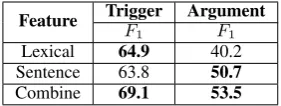
To compare the effectiveness of different levels of features, we extract events by using lexical fea-tures and sentence feafea-tures separately. The results obtained using the DMCNN are shown in table 5. Interestingly, in the trigger-classification stage, the lexical features play an effective role, whereas the sentence features play a more important role in the argument-classification stage. The best results are achieved when we combine lexical-level and sentence-level features. This observation demon-strates that both of the two-level features are im-portant for event extraction.
Feature TriggerF1 ArgumentF1
Lexical 64.9 40.2 Sentence 63.8 50.7
[image:8.595.79.283.141.224.2]Combine 69.1 53.5
Table 5: Comparison of the trigger-classification score and argument-classification score obtained by lexical-level features, sentence-level features and a combination of both
5 Related Work
Event extraction is one of important topics in NLP. Many approaches have been explored for event ex-traction. Nearly all of the ACE event extraction use supervised paradigm. We further divide super-vised approaches into feature-based methods and structure-based methods.
[image:8.595.346.487.414.467.2]Dis-course”(Yarowsky, 1995), Ji and Grishman (2008) combined global evidence from related documents with local decisions for the event extraction. To capture more clues from the texts, Gupta and Ji (2009), Liao and Grishman (2010) and Hong et al. (2011) proposed the cross-event and cross-entity inference for the ACE event task. Although these approaches achieve high performance, feature-based methods suffer from the problem of select-ing a suitable feature set when convertselect-ing the clas-sification clues into feature vectors.
In structure-based methods, researchers treat event extraction as the task of predicting the struc-ture of the event in a sentence. McClosky et al. (2011) casted the problem of biomedical event ex-traction as a dependency parsing problem. Li et al. (2013) presented a joint framework for ACE event extraction based on structured perceptron with beam search. To use more information from the sentence, Li et al. (2014) proposed to extract entity mentions, relations and events in ACE task based on the unified structure. These methods yield relatively high performance. However, the performance of these methods depend strongly on the quality of the designed features and endure the errors in the existing NLP tools.
6 Conclusion
This paper proposes a novel event extraction method, which can automatically extract lexical-level and sentence-lexical-level features from plain texts without complicated NLP preprocessing. A word-representation model is introduced to capture lex-ical semantic clues and a dynamic multi-pooling convolutional neural network (DMCNN) is de-vised to encode sentence semantic clues. The ex-perimental results prove the effectiveness of the proposed method.
Acknowledgments
This work was supported by the National Basic Research Program of China (No. 2014CB340503) and the National Natural Science Foundation of China (No. 61272332 and No. 61202329)
References
David Ahn. 2006. The stages of event extraction. In
Proceedings of ACL, pages 1–8.
Marco Baroni, Georgiana Dinu, and Germ´an Kruszewski. 2014. Dont count, predict! a
systematic comparison of context-counting vs. context-predicting semantic vectors. InProceedings of ACL, pages 238–247.
Yoshua Bengio, R´ejean Ducharme, Pascal Vincent, and Christian Jauvin. 2003. A neural probabilistic lan-guage model. The Journal of Machine Learning Re-search, 3:1137–1155.
Chen Chen and V Incent NG. 2012. Joint modeling for chinese event extraction with rich linguistic features. InProceedings of COLING, pages 529–544.
Ronan Collobert, Jason Weston, L´eon Bottou, Michael Karlen, Koray Kavukcuoglu, and Pavel Kuksa. 2011. Natural language processing (almost) from scratch. The Journal of Machine Learning Re-search, 12:2493–2537.
Dumitru Erhan, Yoshua Bengio, Aaron Courville, Pierre-Antoine Manzagol, Pascal Vincent, and Samy Bengio. 2010. Why does unsupervised pre-training help deep learning? The Journal of Machine Learn-ing Research, 11:625–660.
Prashant Gupta and Heng Ji. 2009. Predicting un-known time arguments based on cross-event propa-gation. InProceedings of ACL-IJCNLP, pages 369– 372.
Geoffrey E Hinton, Nitish Srivastava, Alex Krizhevsky, Ilya Sutskever, and Ruslan R Salakhutdinov. 2012. Improving neural networks by preventing co-adaptation of feature detectors. arXiv preprint arXiv:1207.0580.
Yu Hong, Jianfeng Zhang, Bin Ma, Jianmin Yao, Guodong Zhou, and Qiaoming Zhu. 2011. Using cross-entity inference to improve event extraction. InProceedings of ACL-HLT, pages 1127–1136. Heng Ji and Ralph Grishman. 2008. Refining event
ex-traction through cross-document inference. In Pro-ceedings of ACL, pages 254–262.
Nal Kalchbrenner and Phil Blunsom. 2013. Recurrent convolutional neural networks for discourse compo-sitionality.arXiv preprint arXiv:1306.3584.
Nal Kalchbrenner, Edward Grefenstette, and Phil Blunsom. 2014. A convolutional neural net-work for modelling sentences. arXiv preprint arXiv:1404.2188.
Yoon Kim. 2014. Convolutional neural net-works for sentence classification. arXiv preprint arXiv:1408.5882.
Siwei Lai, Liheng Xu, Kang Liu, and Jun Zhao. 2015. Recurrent convolutional neural networks for text classification. InProceedings of AAAI.
Qi Li, Heng Ji, Yu Hong, and Sujian Li. 2014. Constructing information networks using one sin-gle model. InProceedings of EMNLP, pages 1846– 1851.
Shasha Liao and Ralph Grishman. 2010. Using doc-ument level cross-event inference to improve event extraction. InProceedings of ACL, pages 789–797. David McClosky, Mihai Surdeanu, and Christopher D
Manning. 2011. Event extraction as dependency parsing. InProceedings of ACL-HLT, pages 1626– 1635.
Tomas Mikolov, Kai Chen, Greg Corrado, and Jef-frey Dean. 2013a. Efficient estimation of word representations in vector space. arXiv preprint arXiv:1301.3781.
Tomas Mikolov, Ilya Sutskever, Kai Chen, Greg S Cor-rado, and Jeff Dean. 2013b. Distributed representa-tions of words and phrases and their compositional-ity. InProceedings of NIPS, pages 3111–3119. Frederic Morin and Yoshua Bengio. 2005.
Hierarchi-cal probabilistic neural network language model. In
Proceedings of AISTATS, pages 246–252.
Joseph Turian, Lev Ratinov, and Yoshua Bengio. 2010. Word representations: a simple and general method for semi-supervised learning. In Proceedings of ACL, pages 384–394.
David Yarowsky. 1995. Unsupervised word sense dis-ambiguation rivaling supervised methods. In Pro-ceedings of ACL, pages 189–196.
Matthew D Zeiler. 2012. Adadelta: An adaptive learn-ing rate method.arXiv preprint arXiv:1212.5701. Daojian Zeng, Kang Liu, Siwei Lai, Guangyou Zhou,